“But you just ought to see the back yards of some of the houses!” said a young country girl to her sister in telling of the sights seen during her recent visit in the city.
“Why, so many of the houses that look quite nice from the street have the most untidy back yards you ever saw! It’s just horrid!”
And the young girl, used to the scrupulous cleanliness of a farmhouse, with its broad yards, where space was not so important a factor to be considered, went on describing in shocked terms those “horrid” back yards of the city, where, oftimes, a large family, with all their household goods and other accessories, were cramped upon a few square feet of earth, the house itself covering most of the tiny “lot” of ground, and where the same tidiness and order which prevail in the spacious yards of farmhouses and country towns could not be expected.
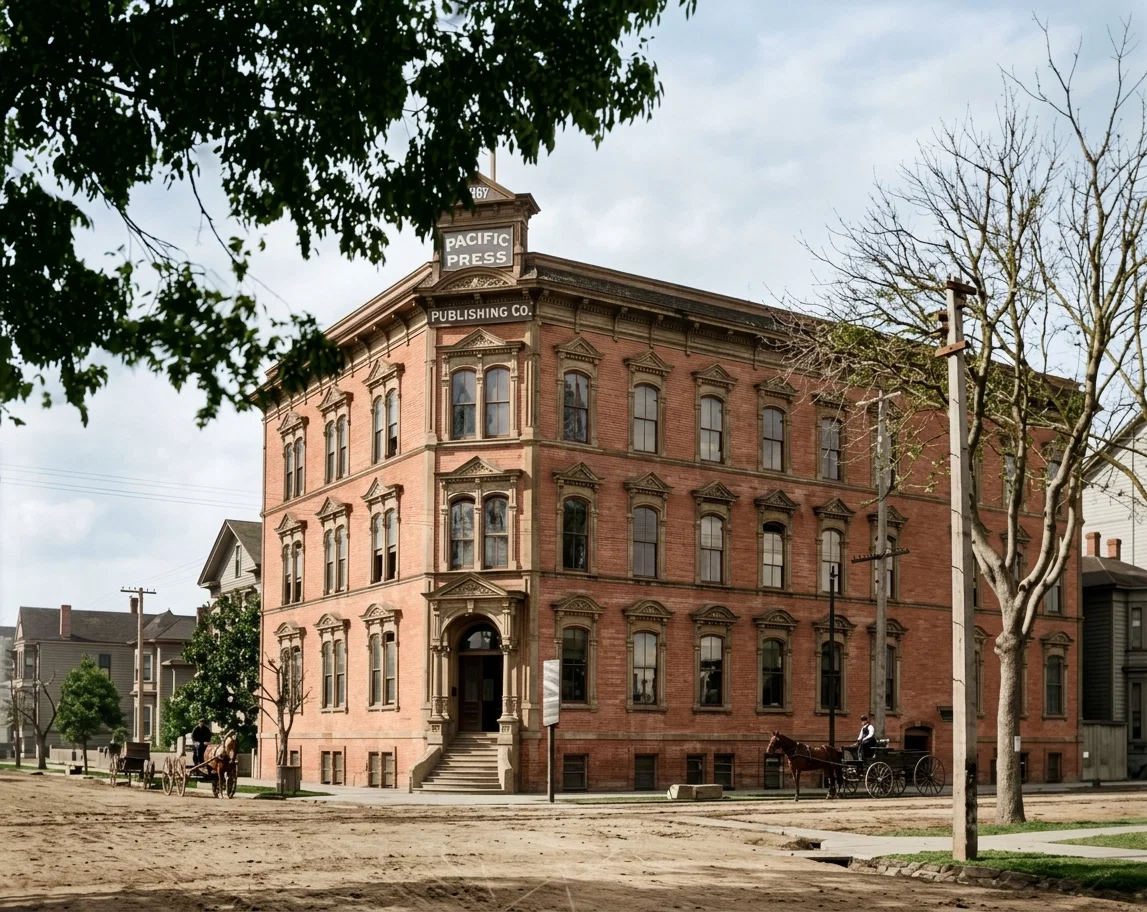
CALIFORNIA SCENERY, No. 12.—OUR HOME.—The above illustration shows the home of the SIGNS OF THE TIMES, corner Twelfth and Castro Streets, Oakland, Cal. The main building was erected in 1887, and is 60x100 feet in lateral dimension. The building to the left, of which only the gable appears in the picture, is the original house, erected in 1876. This building is now partially occupied by the offices of the International Sabbath-school Association, the California Conference, and the California Tract Society; the basement contains two large boilers that furnish steam for the entire institution, and the remainder of the building is used for storage and shipping purposes. The basement of the main building contains two steam engines, an electric light plant, ten power printing presses, two machine book and paper folders, and the counter check book department, with four Kidder web presses. The first floor is occupied by the business offices, book and stationery salesroom, job stock-room, and commercial job printing department, with five presses. The second floor contains the book and paper composition department, and the editorial and proof-reading rooms. The third floor is occupied entirely by the book-binding department. In the rear of the main building is a two-story structure, the first floor of which is occupied by the electrotyping and stereotyping department, and the second floor is devoted to chapel purposes.
“Yes,” said the elder sister at the conclusion of the description, “God made the country and man made the towns, and that shows the difference in their handiwork.”
The talk drifted on to other subjects, for the two girls had much to tell each other after their recent separation; especially had the younger one much to relate of her visit to the city.
Finally their conversation turned upon an acquaintance who, tho a professor of godliness, with a character outwardly fair, was known by the sisters to be a wolf in sheep’s clothing.
“Well, there are back yards to character too,” her mind recurring to the former conversation. “And some people are like the houses in the city. They look very well viewed from the street, but the back yards won’t stand inspection.”
Sadly we must admit this truth. How great the contrast between the phase presented to the world and the “back yards” of some hearts!
And it is sad indeed to think that young people must be introduced so early in life to these unwholesome back yards, and thus have their natural faith in humanity weakened until they too often become gloomy misanthropes who see no good in men but suspect all of dishonesty and hypocrisy.
How different, oftimes, the side presented to the public, to the domestic life of a man; how different the manner of addressing mere acquaintances to that used toward his family! On one side all is jollity and mirth, hail-fellow-well-met with every one, while on the other all is stern words and averted glances.
He is reading the morning paper while at breakfast instead of cheering the tired wife for the day by pleasant conversation.
He pushes the children away as they crowd up to him, eager to tell of victories at school, instead of encouraging and praising them. He cares more for “stock” and “politics” than for the love of his children. He thinks more of the “money question” than of the happiness of his wife, and is more interested, apparently, in the bank failures of the day than in the immortal souls of his family.
Yet he is a popular and influential man in the town. He always goes to church on Sunday with his family, and subscribes to all charitable enterprises.
But we have looked into the back yard.
How different is the side of the young man presented to society and among pure womanhood to that presented at the brothel and the gambling den!
How different is the face of the daughter presented to the tired mother at home to the smiling face presented to other girls’ mothers when she is out calling!
How great a change in the voice of the mother angrily scolding her children to the soft, cooing tones that call them her “darlings” when a visitor is announced!
Will such stand in the last great day?
Their reputation is good, but their character is bad, for “reputation is what men think of us, while character is what God and the angels know of us,” and the all-seeing Eye beholds distinctly the condition of those back yards, and it is by His estimate of them that they shall be judged in the final reckoning.
Let us clean up the back yards of our characters, for as it is from their foul condition that the city pestilence frequently proceeds, so it is often the sins which are unseen by men which destroy the soul in the sight of God; for to Him there is no “secret sin.”—Alice M. Smith, in Pacific Christian.
GOD'S CARE.
A THOUGHTLESS little fellow, having been praying in his fright, as he passed through a dark strip of woods, exclaimed, “You needn’t take care of me any longer, dear Lord; I can see grandmother’s house now!” He forgot that God watched over grandmother and boy, and that we need His care about us night and day.
Sometimes He sends strange messengers to our aid. Here is an incident that shows how He watches over His people at sea.
That the ocean abounds in wonders is daily being proved, and seldom more forcibly so than in the experience of Captain Ward, of the bark Providence, at Hartlepool, who had just returned from Dantzic, at which port he was frozen up during one late severe winter. He states that during his outward voyage to that port, in November last, the ship sprang a severe leak during a gale in the Baltic, and the crew were all but exhausted in their efforts at the pumps to reduce it. One day she suddenly stopped making more water, and in time the vessel reached Dantzic safely. After the discharge of the cargo, a search was made for the leak, and a hole was found in the center of one of the after planks from a yielding of a knot in the wood; in this hole there was wedged a fish, whose collision with the vessel had stopped the leak and saved the ship and crew.—Anonymous.
KEEP IN TUNE.
By Priscilla Leonard
THERE is a harmony that runs
Through all God's works of love.
It rises through the hum of earth
To join the choirs above;
And if your heart desires a part,
Morning and eve and noon,
In the wide chorus, sing your best,
And always keep in tune.
The voices close beside your ear
May grate discordantly,
And sometimes all the world around
Seems to be out of key.
But hold the note you know is true,
Sing clear and sweet, and soon
Others will join the melody
Because you keep in tune.
—Priscilla Leonard.
COURAGE
By Sterne
The brave only know how to forgive; it is the most refined and generous pitch of virtue human nature can arrive at. Cowards have done good and kind actions; cowards have even fought, nay, sometimes even conquered; but a coward never forgave; it is not in his nature; the power of doing it flows only from a strength and greatness of soul, conscious of its own force and security, and above the little temptations of resenting every fruitless attempt to interrupt its happiness.—Sterne.
VOLUNTEER MISSIONARY CONVENTION.
By J. W. Collie
[From our own correspondent.]
THE third International Convention of the Students’ Volunteer Movement convened in Cleveland, Ohio, February 23–27. In point of numbers it was attended more largely than any previous meeting of the kind, there being 1,717 students present, 106 college presidents and members of faculties, 89 returned missionaries, 83 secretaries of foreign mission boards, 219 visiting pastors and editors of religious papers, making a total enrollment of 2,214.
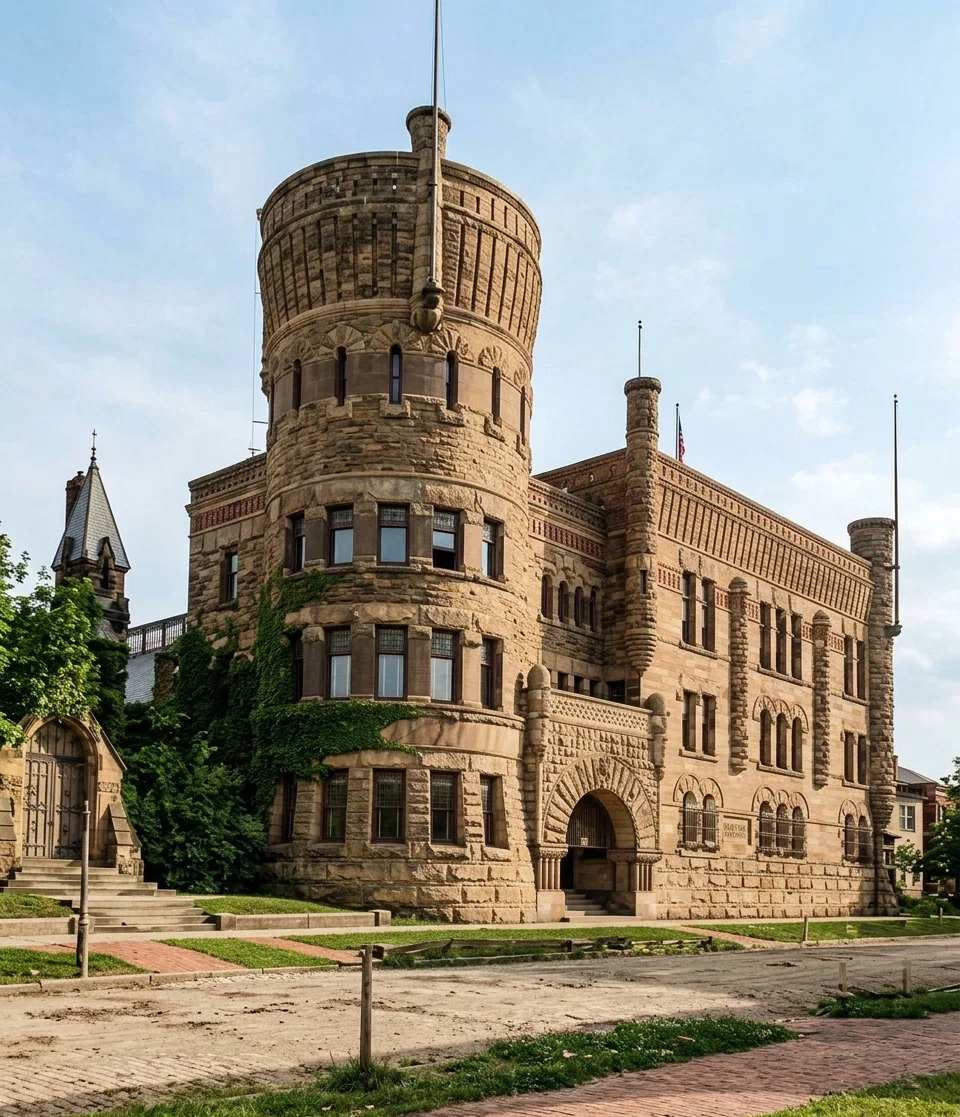
Exterior of Armory, where Convention Was Held.
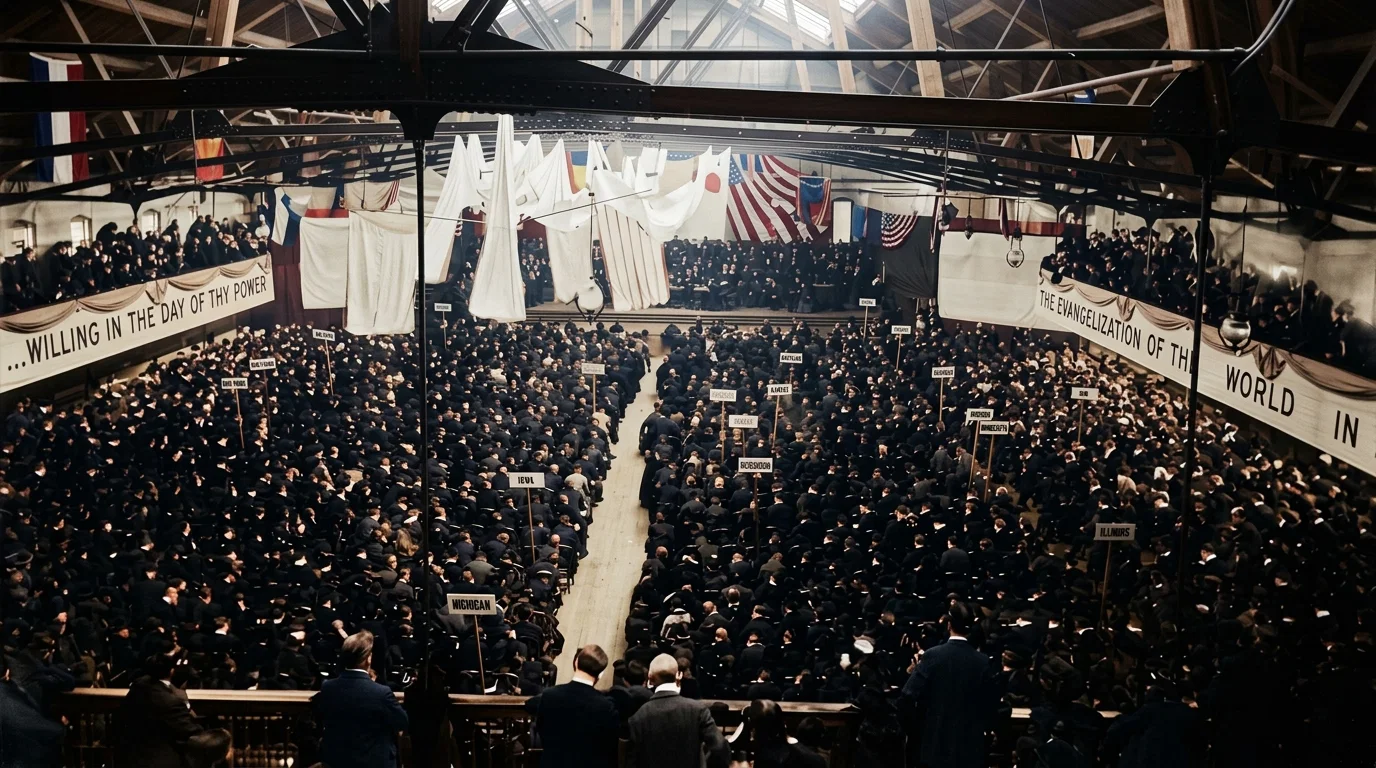
The meetings of the convention were held in Armory Hall, which had a seating capacity of about 2,500, and in order to accommodate the large crowds, overflow meetings were held in some of the largest churches, and were addressed by leading men of the convention.
The convention hall was beautifully decorated with flags of the various nations, twenty-three distinctive nations having representatives present. Over the stage was a large banner bearing the inscription, “Thy Kingdom Come;” draped on either side were immense flags, one American and one British, signifying that these two nations, foremost in learning and intelligence, would take the initiative steps in the great work to be accomplished by the movement.
Running the length of the west gallery was the inscription, “The evangelization of the world in this generation.” Along the east gallery was the inscription, “Thy people shall be willing in the day of Thy power.”
Complete arrangements were made for the seating of the delegates, and no one was admitted without ticket until ten minutes before the time of meeting, and then the hall was not allowed to become overcrowded.
Mr. J. R. Mott, chairman of the movement, was in charge, and complete arrangements were made for the accommodation of all.
Among some of the prominent members and workers present, I might cite the following: Rev. W. S. Ament, of China; Rev. Lyman Bartlett, of Turkey; Rev. W. S. Boomer, of Chile; Rev. J. G. Brown, of India; Rev. J. L. Bruce, of Brazil; Rev. A. Bunker, D.D., of Burma; Rev. H. D. Campbell, Lower Kongo, Africa; Rev. T. N. B. Demaree, of Japan; Rev. Jas. Gale, of Corea; Rev. F. B. Meyers, of London, Eng.; Rev. S. M. Zwemer, of Arabia; Rev. Francis Clark, Boston; Rev. David J. Burrell, New York; and Hon. Jas. A. Beaver, Pennsylvania. The address of Chairman Mott was of much interest, as he stated the object and work of the movement, making it understood that the volunteer movement was simply a recruiting agency and a servant of all missionary boards. At the present time they are co-operating with 839 institutions and boards and have enrolled over 4,000 volunteers.
The movement has spread not only to the colleges of all Christendom; but also of all mission fields, and the Christian young men and women, with the fire and enthusiasm of youth, are ready to carry the conquests everywhere, and prove true their watchword, “The evangelization of the world in this generation.”
The idea of the leaders does not seem to be that the world is to be converted, but is to receive a knowledge of Christ and His Gospel in this present generation.
The most wonderfully impressive service of the entire convention was the first meeting, conducted by Dr. F. B. Meyer, of London. His fine diction, earnestness, eloquence, and peculiar accent, served to hold his audience spellbound throughout. But what served to make the discourse more impressive than anything else, was the entire absence, on the part of the speaker, of any demonstration of self or ability. His text was, “Be ye clean that bear the vessels of the Lord.” He exhorted his hearers to shun uncleanliness, unclean and polluting habits, overindulgence in eating and drinking, unholy alliances, worldly ambitions, worldly pleasures, and mere emotional religion, if they would be the representatives of God.
Speaking of worldly pleasures, Dr. Meyer said:—
“We must stand clear of worldly pleasures, card tables, horse-races, balls, and the theater. We are not here to denounce them; but as teachers of Christ we must keep clean of them.” Pausing for a moment, and looking over the immense congregation, and thinking, no doubt, of the condition existing in many places, Dr. Meyer said: “If you must attend card parties,11go to them; if you must go to the theater, go; but for the Lord’s sake, and the sake of the Gospel, first lay down the sacred vessels. ‘Be ye clean.’”
There was no visible demonstration of religious enthusiasm exhibited during the meeting, but every heart was stirred, and his auditors were made to feel that they stood in the presence of the Searcher of hearts. At intervals the audience was asked to join in silent prayer, while the speaker spoke of existing sins, and implored each to confess before God. It was a deep, thoughtful service, long to be remembered by those present.
A noticeable feature of the convention was the prevalent idea that the need to-day in the needy fields of the world was intelligent men and women; not necessarily graduates of great institutions of learning, but those who could adapt themselves to the situation. The best field for learning, for those who contemplate going to foreign fields, is the home field. It is not alone that those are wanted to go who are willing; but those are wanted who are willing to stay. The pen pictures that were drawn by those who had returned from China, with its narrow streets, its pride and idolatry, from Africa’s burning plains, from India’s misery and enslavement of women, from Turkey, Arabia, and South America, with their dark superstitions, served to give a new phase to missionary work, and showed that those who went would not go for a holiday excursion, but would go because of a longing desire to help those in sin, and to co-operate with Him whose work was not to condemn but to save the lost ones of earth.
FROM A PHOTOGRAPH OF A DEVOTIONAL SERVICE IN THE GREAT CONVENTION.
Rev. S. M. Zwemer, of Arabia, presented the Moslem world in a new light from which it is generally regarded. Said the speaker: “Let not Christian people speak of the fact that Turkish control makes Mohammedanism hard of access. The people of that world numbers 201,000,000; of these, only 18,000,000 are in Turkish dominion, and the rest reside in countries presided over by Christian rulers or independent governments. We are not to be dismayed by any obstacles, but realize that their need is what our need is, and that need is Christ.”
“That Christ is the only way to save them is proved by their own religion. Their creed is half truth, half lie. The Moslem world is a challenge to your faith. It is the Goliath to your David, and can be overcome if we have great faith in a great God.”
Gen. James A. Beaver, one of the superior judges of Pennsylvania, in speaking of the possibility of carrying the Gospel to those who know it not in this generation, said: “Has the time come for it? Is the world ripe? Open your eyes. The harvest is not coming. It is here. It is upon us. It is white. It is over-ripe. If you are not ready to put in the sickle, furnish the sickle.”
One of the most telling discourses of the convention was delivered by Robt. E. Speer. He is a young man of fine address, and his earnestness and devotion to the cause of Christ were very manifest.
Among other things he said:—
If the church of Christ were what it should be, twenty would not pass away before the story of the cross would be given to the ears of every living person in the world; and when this is done, the end will come. Shall we rise to this great mission? Our watchword sounds the call of a new crusade, demanding new standards of heroism and sacrifice. Above self-gratification, ease, personal ambition, it lifts the cross of the Crucified; from it He calls. And His call is the testing for eternity.
“He hath sounded forth the trumpet, that shall never call retreat;
He is sifting out the hearts of men, before His judgment-seat;
O, be swift, my soul, to answer Him, be jubilant, my feet!”
The scene at the last meeting was one long to be remembered. There were gathered men and women who have braved dangers, and trials of severity, sicknesses in lands where their only friends were the natives whom they were laboring to enlighten. These were the veterans. In contrast with them were the army of enthusiastic young men and women who were to show in the coming years what they were made of. A score or more arose upon invitation and signified their intention of leaving for some foreign field within a year.
The majority of them seemed to realize what their vow meant. One young lady with tears said she had consecrated her life to Christ, and she felt a desire to work for the lepers of China; and, altho it meant a living death, she could do it cheerfully for His sake who had laid down His life for her. Many others spoke in the same strain, and as the words of the beautiful hymn, “Peal out the watchword,” were sung, mingled with the sobs of those who had given themselves to Christ, impressions were made upon the immense congregation that will prove an incentive for more diligent work in the Master’s vineyard.
In closing, the chairman used as the gavel the hammer of Peter Carey, the “cobbler missionary,” and the congregation broke up—many to return to their colleges and universities, to prepare for their life work; others, to foreign fields; and only the judgment will reveal the motives and work of this movement.
J. W. Collie.
CRUEL DESTRUCTION OF CATTLE.
IN view of the thousands of cattle which die from starvation and cold on the great western plains every year, oftentimes because of carelessness and thoughtlessness on the part of men, the following from the New Orleans Picayune is to the point:—
“A king, a cattle king, was what they called him, this man who came loaded with diamonds and free with money, to spend the winter in a mild Southern city. A king, and yet no royal blood in his veins! A self-made monarch—and his subjects?—Only the lowing herds in the far-off West. His kingdom is the frozen plains, where his cattle are dying. For it is cheaper to lose half his subjects than to feed and protect the whole. He has left his ice-bound home, has closed his ears to the suffering beasts; he wraps his great coat close about him and seeks pleasure. Can he shut out the cries that are piercing the winter nights beyond that mountain chain out towards the setting sun? Do not dreams of the cattle—his subjects—suffering, starving, freezing, and dead, haunt the pillow of this king? Murder!—surely this king did no murder. There is no blood on his hands. He only let his dumb beasts starve or freeze to death—that is all!”
“But there is another King—a King whose kingdom is the universe—‘and the cattle upon a thousand hills are His.’ How will the cattle king stand on the day when deeds stand witness for and against us, and balanced against his gold will be the cattle—God’s cattle—which he left on the plains without food or shelter, to die of slow starvation, that he might have more gold?”
SOME ANIMAL PARADOXES.
IN New Zealand a species of parrot is found that, finding its food entirely on the ground, has lost the power of flight. It differs from the rest of its family only in this particular, and in being almost voiceless.
Among recent breeds of pigeons is the parlor tumbler, which has not only lost the power of flight, but has very nearly lost that of walking as well. Its queer motions when it attempts to walk have given it its name, the tumbler.
“As thick as the hair on a dog’s back,” expresses nothing in Mexico, for the Mexican dog is entirely devoid of hair on his back or anywhere else. The hot climate having rendered it superfluous, Mother Nature kindly divested him of it. Nor does “the little busy bee improve each shining hour” in that country. On the contrary, it soon learns that, as there is no winter there, there is no necessity for laying in a store of honey, and degenerates into a thoroughbred loafer.
“As big as a whale” might be rather small, as there is a species of the cetacean genus hardly three feet long.
“As cunning as a fox” would have sounded idiotic to the discoverers of Kamtchatka. They found foxes in large numbers, but so stupid, because they had never before seen an enemy, that they could be killed with clubs.
“As awkward as a crab” does not apply on some of the South Sea islands, for a crab is found there that not only runs as fast as an average man, but climbs trees with the ease of a schoolboy.—Sports Afield.
OUR FUTURE MOTHERS.
By Rabbi Jacob Nieto
—Compare the life of a society young lady of to-day with that of any female Biblical character, and the difference in the result of domestic training will become at once apparent. The society belle has nothing to do but read modern novels, dress and talk well—and these are the future mothers.—Rabbi Jacob Nieto.
LIVING BY SERVING.
By Mrs. Charles
Is thy cruse of comfort failing?
Rise and share it with another,
And through all the years of famine
It shall serve thee and thy brother.
Love divine will fill thy storehouse,
Or thy handful still renew;
Scanty fare for one will often
Make a royal feast for two.
Numb and weary on the mountains,
Wouldst thou sleep amidst the snow?
Chafe that frozen form beside thee,
And together both shall glow.
Art thou stricken in life's battle?
Many wounded round thee moan;
Lavish on their wounds thy balsams,
And that balm shall heal thine own.
For the heart grows rich in giving;
All its wealth is living grain;
Seeds which mildew in the garner,
Scattered, fill with gold the plain.
Is thy burden hard and heavy?
Do thy steps drag wearily?
Help to bear thy brother's burden;
God will bear both it and thee.
Is the heart a well left empty?
None but God its void can fill;
Nothing but a ceaseless fountain
Can its ceaseless longings still.
Is the heart a living power?
Self-entwined, its strength sinks low:
It can only live in loving,
And by serving love will grow.
—Mrs. Charles.
OUR WORK AND WORKERS.
A STATE meeting of the Colorado brethren will be held at Denver, April 4–11.
A NEW house of worship has been erected by the church at Williamstown, N. Y.
BROTHER B. W. MARSH reports that “thirteen are standing on the Word” as the result of meetings held at Montrose, Colo.
THE new church building at Arroyo Grande, Cal., is about finished, and will shortly be dedicated.
AN addition of six persons to our ranks at Portland, Iowa, is the report of Brother Henry Johnson.
MEETINGS held at Williamsburg, Colo., by Brother M. Mackintosh, closed with eight additions to the Master’s army.
ON the 9th inst. five candidates—four young men and one young lady—were baptized and added to the church in this city.
A SABBATH-SCHOOL of twenty-eight members has been organized near Doud’s Station, Iowa, under the labors of Brother F. L. Moody.
BROTHER C. SANTEE, president of Iowa Conference, and the brethren in Des Moines, are looking up a location for mission work in that city.
A SABBATH-SCHOOL of thirteen members has been organized at Middletown, Lake County, Cal., with Brother A. L. Anthony as superintendent. A free reading-room has also been established in the town, of which he is a trustee, and our periodicals and health literature are desired for its tables.
NINE members were added to the church at Los Angeles, Cal., on the 12th ult. The Sunday Times, a journal of wide influence in that city, recently published an illustrated article giving a fair representation of our faith and work, which has been the means of stirring up considerable interest in further investigation.12
THE brethren in Butte, Mont., are taking the preliminary steps toward establishing a Helping Hand Mission in that city. Whoever wants to help is asked by Brother C. N. Martin to communicate with Mrs. C. G. Allen, 517 Galena Street. In the matter of the new church building just about completed there, Brother Stone says “the citizens have contributed liberally toward the building.”
BROTHER P. S. OLSEN, formerly of Minnesota Conference, is now in Winnipeg, Manitoba, engaged in religious liberty work. As the Legislature is in session there, and a strong effort is being made to secure a provincial Sunday law, he will find plenty to do. The advocates of the law are very active in the circulation of petitions, and the sentiment is said to be even stronger than in the United States, but as yet they have only municipal laws on the subject.
BROTHER J. H. DURLAND says, in Field Echoes, that “recently our brethren in London, Ontario, have organized a company for the purpose of manufacturing health foods, and for the past few months have been purchasing machinery, and fitting up a building. March 1 everything was in readiness to start the machinery, and as the enterprise was for the purpose of helping to carry forward the message, it was thought advisable to have a short dedicatory service before the machinery was put into operation.”
FROM Field Echoes we clip the following good point, contributed by Brother J. D. Cowell: “One of the families of the church [at Grand Rapids, Mich.], greatly esteemed by all, was about to move away, and the church-members thought to give them a surprise by all taking a basket well filled with food and having a feast at this brother’s house. After they had all come together, it was suggested that, as none present were in need of food which the baskets contained, it could be better used to the glory of God by searching out families who were in need, and supplying them. The plan was heartily adopted, and it is hardly necessary to state that many hearts were made glad by this effort, and that in the young people’s meeting, held the next evening, many blessed experiences were related. And the end is not yet, for the good work goes on.”
18 “And the day following Paul went in with us unto James; 19 and all the elders were present. And when he had saluted them, he rehearsed one by one the things which God had 20 wrought among the Gentiles by his ministry. And they, when they heard it, glorified God; and they said unto him, Thou seest, brother, how many thousands there are among the Jews of them which have believed; and they are all zealous for the 21 law; and they have been informed concerning thee, that thou teachest all the Jews which are among the Gentiles to forsake Moses, telling them not to circumcise their children, neither 22 to walk after the customs. What is it therefore? They will certainly hear that thou art come. Do therefore this that we say to thee: We have four men which have a vow on them; these 24 take, and purify thyself with them, and be at charges with them, that they may shave their heads; and all shall know that there is no truth in the things whereof they have been informed concerning thee; but that thou thyself also walkest orderly, 25 keeping the law. But as touching the Gentiles which have believed, we wrote, giving judgment that they should keep themselves from things sacrificed to idols, and from blood, 26 and from what is strangled, and from fornication. Then Paul took the men, and the next day purifying himself with them went into the temple, declaring the fulfilment of the days of purification, until the offering was offered for every one of them. 27 “And when the seven days were almost completed, the Jews from Asia, when they saw him in the temple, stirred up all the 28 multitude, and laid hands on him, crying out, Men of Israel, help: This is the man, that teacheth all men everywhere against the people, and the law, and this place; and moreover he brought Greeks also into the temple, and hath defiled this 29 holy place. For they had before seen with him in the city Trophimus the Ephesian, whom they supposed that Paul had 30 brought into the temple. And all the city was moved, and the people ran together; and they laid hold on Paul, and dragged him out of the temple; and straightway the doors were shut. 31 And as they were seeking to kill him, tidings came up to the chief captain of the band, that all Jerusalem was in confusion. 32 And forthwith he took soldiers and centurions, and ran down upon them; and they, when they saw the chief captain and the 33 soldiers, left off beating Paul. Then the chief captain came near, and laid hold on him, and commanded him to be bound with two chains; and inquired who he was, and what he had 34 done. And some shouted one thing, some another, among the crowd; and when he could not know the certainty for the uproar; he commanded him to be brought into the castle. And when he came upon the stairs, so it was, that he was borne of 36 the soldiers for the violence of the crowd; for the multitude of the people followed after, crying out, Away with him. 37 “And as Paul was about to be brought into the castle, he saith unto the chief captain, May I say something unto thee? 38 And he said, Dost thou know Greek? Art thou not then the Egyptian, which before these days stirred up to sedition and led out into the wilderness the four thousand men of the 39 Assassins? But Paul said, I am a Jew, of Tarsus in Cilicia, a citizen of no mean city; and I beseech thee, give me leave to 40 speak unto the people. And when he had given him leave, Paul, standing on the stairs, beckoned with the hand unto the people; and when there was made a great silence, he spake unto them in the Hebrew language, saying.
QUESTIONS.
1. How were Paul and his companions received by the brethren in Jerusalem?
2. Describe his interview with the elders. Verses 18, 19.
3. After he had finished his account of the work among the Gentiles, how did the elders address him? What did they say of the number of believing Jews in Jerusalem? For what were they all zealous? Verse 20.
4. What had these Jews been told about Paul? Verse 21.
5. What did the elders advise Paul to do in order to silence the reports concerning him? Verses 22, 24.
6. What did they say as touching the believers from the Gentiles? Verse 25.
7. What did Paul, in compliance with this advice, proceed to do? Verse 26.
8. How long a time was to be occupied in all this ceremony? What happened near the close of the period? Who were the instigators of the riot? Verse 27.
9. Upon whom did they call for assistance? With what words did they stir up the rage of the Jews against Paul? Verse 28.
10. Upon what trivial circumstance was this charge based? Verse 29.
11. What was the effect of their outcry? What did the multitude do to Paul? Verse 30.
12. What was their purpose? As they were about to kill Paul, who received news of the uproar? Verse 31.13
13. What did he at once do? What effect did the presence of the Roman soldiers have upon the mob? Verse 32.
14. What did the commanding officer do to Paul? What inquiries did he make? Verse 33.
15. What response did he receive? What command did he make in order to escape the confusion? Verse 34.
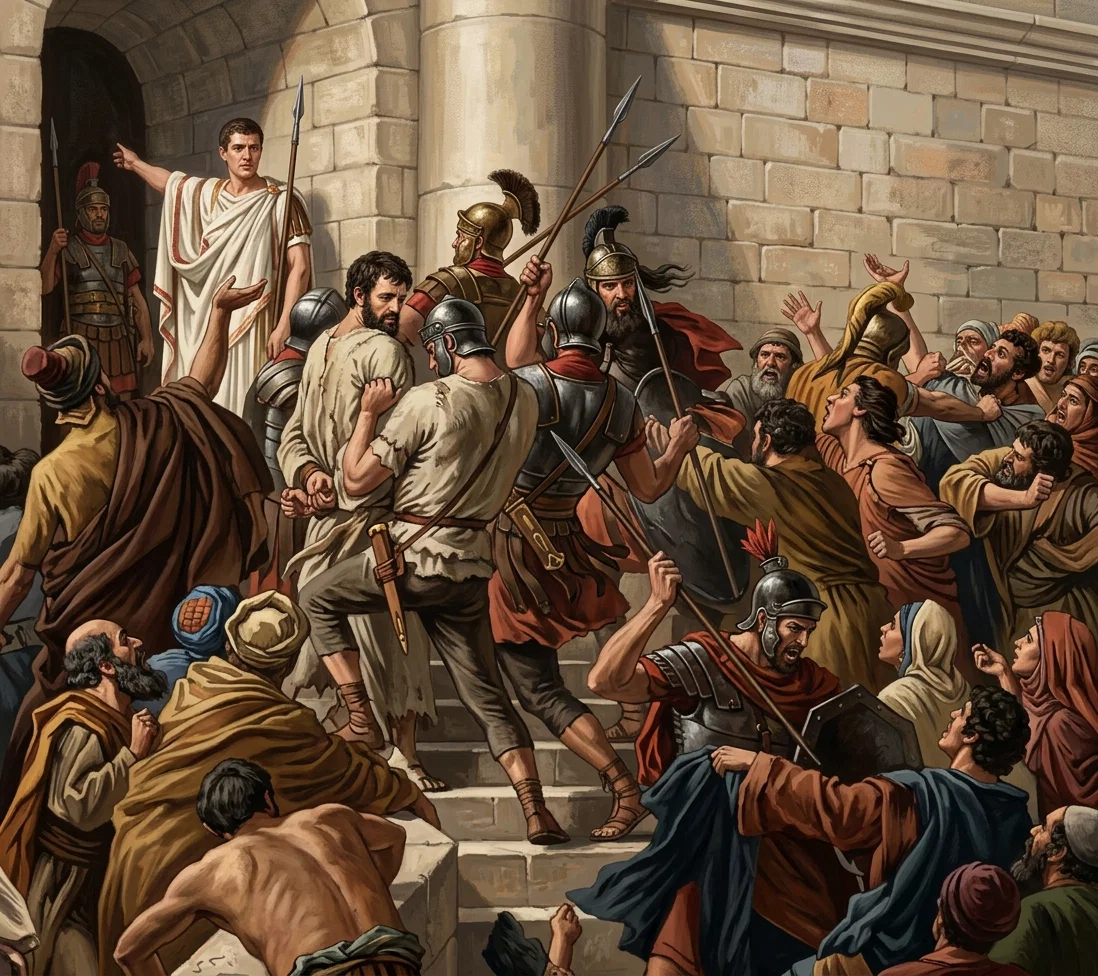
16. What was necessary in order to protect Paul from the violence of the people? Verse 35.
17. What did they cry out as they pressed around? Verse 36.
18. As Paul was about to be carried into the castle, what did he say to the captain? At what did the captain express surprise? Verse 37.
19. What did he think Paul was? Verse 38.
20. What was Paul’s reply? What request did he earnestly make? Verse 39.
21. Having received leave to speak, what did Paul do? What followed? In what language did Paul address the crowd of Jews? Verse 40.
NOTES AND QUESTIONS.
1. In verse 20, where we have “how many thousands,” the Greek has “myriads” instead of the word for thousands. A myriad is ten thousand. So what the elders really said as to the number of the believing Jews in Jerusalem, was, “Thou seest, brother, how many ten thousands of Jews there are which believe.”
2. If Paul had not heeded the advice of the elders to try to prove to the people that he was law-abiding, could he have gotten into any more difficulty than he did? What lesson may we learn as to going out of the way to do something merely to show that we are right, that is, doing a thing merely for effect?
3. What occasion is referred to in verse 25? Recall Peter’s words on that occasion which largely influenced the decision. He said, referring to the Gentiles, “God . . . put no difference between us and them.” Was the advice given to Paul by the elders (Acts 21: 24, 25) in harmony with what was said in that assembly?
4. Note that, altho Greek was the common language even among the Jews in Paul’s day, he spoke to them in Hebrew. Why was this?
PAUL ARRESTED IN JERUSALEM. ACTS 21:34, 35.
PERIODICALS WANTED.
Robert Sawyer will use in missionary work all the SIGNS, Little Friends, or health tracts that may be sent to him, post-paid, at No. 41 Avenue U, Galveston, Texas. He also asks that brethren who may come to that city will call on him.
John H. Hunt, 1338 N. Bond Street, Baltimore, Md., asks for clean old copies of our papers in foreign languages, for ship missionary work. Please send post-paid.
Mrs. V. Morgan, San Miguel, San Luis Obispo County, Cal., desires late, clean copies of any of our periodicals or tracts, post-paid, for missionary work.
WHERE IS HE?
INFORMATION is desired concerning the whereabouts of W. E. Luther, a Sabbath-keeper, perhaps by occupation a canvasser. Any one knowing, address A. A. Luther, Pawnee, Oklahoma.
400 RECITATIONS AND READINGS.
A book designed for Parlor Readings, Sabbath-schools, Temperance Organizations, Debating Societies, Young People's Associations, Reading Clubs and Home Circles. This is a handsome book, bound in paper cover, and contains 400 of the best recitations ever issued, and other choice reading. Price, 40 cents, post-paid. Send order, with remittance, to Laconic Publishing Co., 123 Liberty St., New York.
When you write, please mention the SIGNS OF THE TIMES.
YOSEMITE VALLEY And Big Trees of California
Read All About Them in the Book
IN THE HEART OF THE SIERRAS
Nearly 500 Pages, with Many Illustrations. Limp Binding.