Your ShelfYour Projects

Signs of the Times, Vol. 37, No. 16.

ROSES

Signs of the Times

Apr 26, 1910

Pacific Press Publishing Association · Mountain View, California · Apr 26, 1910

ROSES

God, He of infinite Wisdom, Maker of infinite Art, Gave us the beautiful Roses, Gave them as flowers of the Heart,
Touched them with Perfume of Heaven, Kissed them with blushes of Light, Clothed them in scarlet and crimson, Robed them in gold and in white.
Speak they of Love and of Beauty, Speak they of Pleasure and Pain, Speak they the thorns in Earth’s Duty, Speak they of Heaven’s great Gain. M. C. W.

"IF YE WILL INQUIRE, INQUIRE YE."

This Inquirers' Department is conducted for the purpose of helping those who are studying the Bible. The answers are oftentimes only suggestive. They are never to be considered infallible, only as they agree with the infallible Word. The writer who may answer them does not consider that his opinion is infallible. He will simply give the best that he has, and plead with the inquirer to search the Word. Such questions only will be answered as, to the editors, seem to minister to the good of the readers and to the mission of the paper. We can not answer repeatedly in the same volume questions upon the same scripture. The name and address must accompany question, not for publication, but as an evidence of good faith, and that answer may be made by letter if deemed advisable. No letters are answered which do not contain the name of the writer. It is well always to enclose stamp for reply.

3104.—Why Not Restore the Sabbath?

Why do not the true Christians of various Protestant churches take some action to replace Saturday as a universal day of rest and worship, if there is absolute proof that it is the real Sabbath day? I do not think God could continue to bless and prosper these churches if they have willingly set aside His law. A READER.
All reforms go slowly, very slowly, and that is especially true of those which involve a cross. And the keeping of the Sabbath of the Lord involves a cross to the natural heart. It is not a mere keeping of Saturday. That is simply a day in the civil calendar, beginning at midnight Friday night, and ending at midnight Saturday night; but the Sabbath day of the Lord begins at sunset Friday evening, and closes the next sunset.
There is no question, if God's Word is to be taken as He has given it, as it has come down to us, regarding the Sabbath day and its identity. One of the great difficulties is that science falsely so called, the teachings of Higher Criticism, have taken away faith in that Word from the great mass of the people, and they are looking upon it as something that is of very minor importance. God prospers according to light received and how we regard that light. Prosperity, however, is not to be measured by numbers. It is not to be measured by wealth. The only true prosperity in God's work is that which deepens spirituality, brings men closer to Him, and saves souls from sin and sinning. Any prosperity which does not do this in the church of God, is a false prosperity.
Entirely apart from what any church may do or any churches are doing, God holds the individual responsible. Every man shall give account of himself to God. And in view of that great fact, God asks as the whole duty of man the keeping of His commandments. Eccl. 12:13, 14. Jesus Christ died that He might win men to obedience. Titus 2:14.

3107.—The Day

Does God recognize the dark part of time as well as the light part, for a day? and in the fourth commandment does it include the dark part of time as well as the light part for the Sabbath day? also in Gen. 1:5, 14, etc.?
Day is used in different senses in the Bible; sometimes for an indefinite period of time; sometimes as a symbol of a year—a prophetic day. Sometimes it refers simply to the light part of the day. "Are there not twelve hours in the day?" But when a day as a division of time is referred to, it includes both night and day. That is shown in the 1st chapter of Genesis, "The evening and the morning were the first day," "The evening and the morning were the second day." The dark part is included with the light part. This is also shown in Matt. 8:16; Mark 1:32; and Luke 4:40. If you will read the context of these scriptures, you will see that the Sabbath closed at sunset, and then began the first day of the week. The Sabbath also began at sunset. "From even unto even shall ye celebrate your Sabbaths." Lev. 23:32. That was a law for all holy days.

3103.—Who Changed the Sabbath?

Can we really say that any one ever changed the Sabbath?
From the view-point of literal fact, it never can be said that the Sabbath is changed. Our correspondent truly suggests that God only could change the Sabbath. What made it a Sabbath, was the Lord's resting upon it. What sanctified it, was His setting it apart to be kept to His glory. What makes it a blessed day, was the fact that He placed His blessing within it. Inasmuch as Infinite Wisdom felt that it took three acts to make that a Sabbath,—resting, blessing, and sanctification,—and as all those acts were wrought by the Creator, and inasmuch as He has not told us anywhere in His Word from Genesis to Revelation that any change has ever taken place, we must conclude that the day remains the same. Really it could not be said that the fact of God's resting could be changed. He rested upon one day; namely, the seventh day of the septenary cycle. He rested upon no other; so just as long as eternity exists, that will remain a fact, the blessing of that day will remain a fact, the sanctification of that day will remain a fact. And justice to those who are commanded to obey, would demand that any repeal or setting aside of those acts should be just as public as the record of the acts; but God has not given us any such record. The command remains in force.
When the change of the Sabbath is spoken of, reference is made to the practise of the Christian church. In the early days of the Christian dispensation a change did take place, beginning even in the apostle's day. That change was not in God's law or God's requirements, but in the church itself, which rapidly went into apostasy. Down as late as the fifth century, men were keeping two days, the traditional Sunday and the commanded Sabbath. It was not until a thousand years after Christ, that the first day was called the Sabbath. These are facts which can be abundantly attested in history. See "The Lord's Day the Test of the Ages," Bible Students' Library, No. 134. Price 10 cents.

3105.—Existence of the Soul after Death

Do not the following Scripture references indicate a spiritual existence of the soul during the interval between death and the final resurrection? Luke 23: 43, 46; Acts 7:59; Rev. 6:9, 10.
For an exposition of Luke 23:43 see the SIGNS of March 22, question No. 3080. Acts 7:59 and Luke 23:46 are just simply another form of saying that "Father, into Thy hands I commend My life." The word rendered "spirit" is not the same as the word rendered "soul." It is simply the God-given life which His children have; is quite clearly explained by Col. 3:3. "For ye are dead, and your life is hid with Christ in God. When Christ, who is our life, shall appear, then shall ye also appear with Him in glory." It is simply placing that life in God's hands, that He may give it to His children when they are raised from the dead.
Rev. 6:9, 10 is a figurative description, not telling us of the actual things. There are no souls under the altar on the earth still crying for vengeance. That has not been characteristic of God's children in any age. It does show us, however, that the very fact of their dying as they did, calls for justice from God, just the same as Abel's blood cried to God from the ground. See Gen. 4:10. One believing in the immortality of the soul, as did Dr. Albert Barnes, would not for a moment think that the expression in Revelation represented the martyrs as crying; but just as clearly "as if" they were crying, the voice of justice goes up to God against those who put them to death. None of these passages in any way teach the conscious existence of the soul apart from the body.

3106.—Dying to Live

Please explain 2 Cor. 15:36, "That which thou sowest is not quickened, except it die." O. R. G.
Our querist evidently means 1 Cor. 15:36. There are but thirteen chapters in 2 Corinthians. The expression is used of the apostle referring to that which was supposed to be known by almost every one, the sowing of grain. If the wheat that is cast into the ground did not die, it would simply remain there as in the granary, bringing forth no fruit whatsoever; but it dies, and the germ within the seed is released. That is true in the Christian life. Our Lord Himself teaches it in John 12:24, 25: "Except a corn of wheat fall into the ground and die, it abideth alone; but if it die, it bringeth forth much fruit;" and this is the lesson. "He that loveth his life shall lose it." A man that endeavors to gather everything to himself, loses all that he tries to hold; but the man who gives his life for God, shall receive from Him eternal life. The term "quicken" means "live." That which thou sowest is not quickened, does not come to life, except it die. Man's whole life must be given up to God; he must die to sin in order that he may have the life hereafter.

3108.—Progress of Catholicism

Is it not true that many of the Catholics are being converted to the Protestant belief, and that the evils of the Catholic Church are being exposed? Or are the Catholics increasing in power and numbers in the United States and in the world?
A READER.
In a recent issue of the SIGNS is a brief article on the increase of Roman Catholics in the United States. See "Catholicism in America," page 11 of the issue of April 12. There are those who are contending that the Roman Catholic Church is losing more than it is gaining. Its loss, however, is not through the conversion of large numbers to Protestantism, but through utter indifference. Men drift away from the Catholic Church, losing regard for all religion. It seems to be evident that the Roman Catholic Church is gaining in influence constantly in official circles, in its general broad influence, and in the attitude of Protestants. The very fact that Protestantism is weakening and drifting from its old moorings and principles, and the added fact that Roman Catholicism is standing decidedly for its convictions, gives a strength to Roman Catholicism which modern Protestantism does not have.

3109.—Unfulfilled Prophecies

Will you please give in both the Old and the New Testament all prophecies not yet fulfilled? A READER.
This is utterly impossible. Nearly all the prophecies of the great future include eternity, and the eternal inheritance which God will bestow upon His people; and to name all the prophecies which point forward to this glorious outcome would take altogether too much space. The events named in Daniel are practically, so far as this age is concerned, fulfilled or fulfilling. We are living in the very last days, according to all the prophecies of Daniel; and the next great event is the second coming of Christ. So it is with most of the prophecies of the Revelation. They either are fulfilled or are fulfilling. We do not have the 13th chapter of Revelation yet filled up, nor the 14th, nor any of the 15th or the 16th chapter, not all of the 17th, and so on with all the chapters that follow.

3110.— The Sacrifice of Christ

If after Christ had taken upon Himself humanity, and “became sin for us,” He had refused to submit to His death on the cross, would He have lost eternal life as well as we? Having “entered in” by the sacrifice of Himself makes it look as tho He would. John 10: 2. B. T. M.
This subject will be more fully developed in our Sabbath-school lessons as we proceed. Answering briefly: If He had refused to submit to the will of God, He certainly would have been out of harmony with God's will, and would have allied Himself with sin. That will be seen by His prayer in the garden. It was a matter of His yielding to God's will. He prayed that the cup of suffering might be removed, but above that prayer was the prayer that God's will might be done. That was the awful risk which God in Christ was willing to take because of His love for fallen man.

"Look and Live"

By Mrs. E. G. White
"AND they journeyed from Mount Hor by the way of the Red Sea, to compass the land of Edom; and the soul of the people was much discouraged because of the way." The Lord does not remove all the difficulties and trials and hardships from the pathway of His people. He would have them learn to put their trust in Him, believing that the invisible God is their mighty helper. The children of Israel became accustomed to the presence of the pillar of cloud; that covered them as a canopy by day, and was as a pillar of fire by night. They came to look upon the cloud as a common thing. They did not appreciate the fact that they were favored with the presence of the only-begotten Son of God, who was equal with God; and, in spite of all their perversity, their murmuring and rebellion, He had done wonderful things for them in all their journeyings.
The Lord had said: "Behold, I send an Angel before thee, to keep thee in the way, and to bring thee into the place which I have prepared. Beware of Him, and obey His voice, provoke Him not; for He will not pardon your transgressions: for My name is in Him. But if thou shalt indeed obey His voice, and do all that I speak; then I will be an enemy unto thine enemies, and an adversary unto thine adversaries. For Mine Angel shall go before thee." The one great object of the care and guardianship of Christ was the church in the wilderness. He said of Israel: "I am the Lord thy God, the Holy One of Israel, thy Saviour: I gave Egypt for thy ransom, Ethiopia and Seba for thee. Since thou wast precious in My sight, thou hast been honorable, and I have loved thee: therefore will I give men for thee, and people for thy life." Egypt was desolated with plagues, and became a wasted land, in order that Israel might be freed from bondage; but the people did not appreciate the goodness and mercy and love of God. The Lord, their Redeemer, undertook to lead and guide them; but when He brought them into strait places, they were discouraged because of the way, and spoke against God and Moses, saying: "Wherefore have ye brought us up out of Egypt to die in the wilderness? for there is no bread, neither is there any water; and our soul loatheth this light bread. And the Lord sent fiery serpents among the people, and they bit the people; and much people of Israel died."
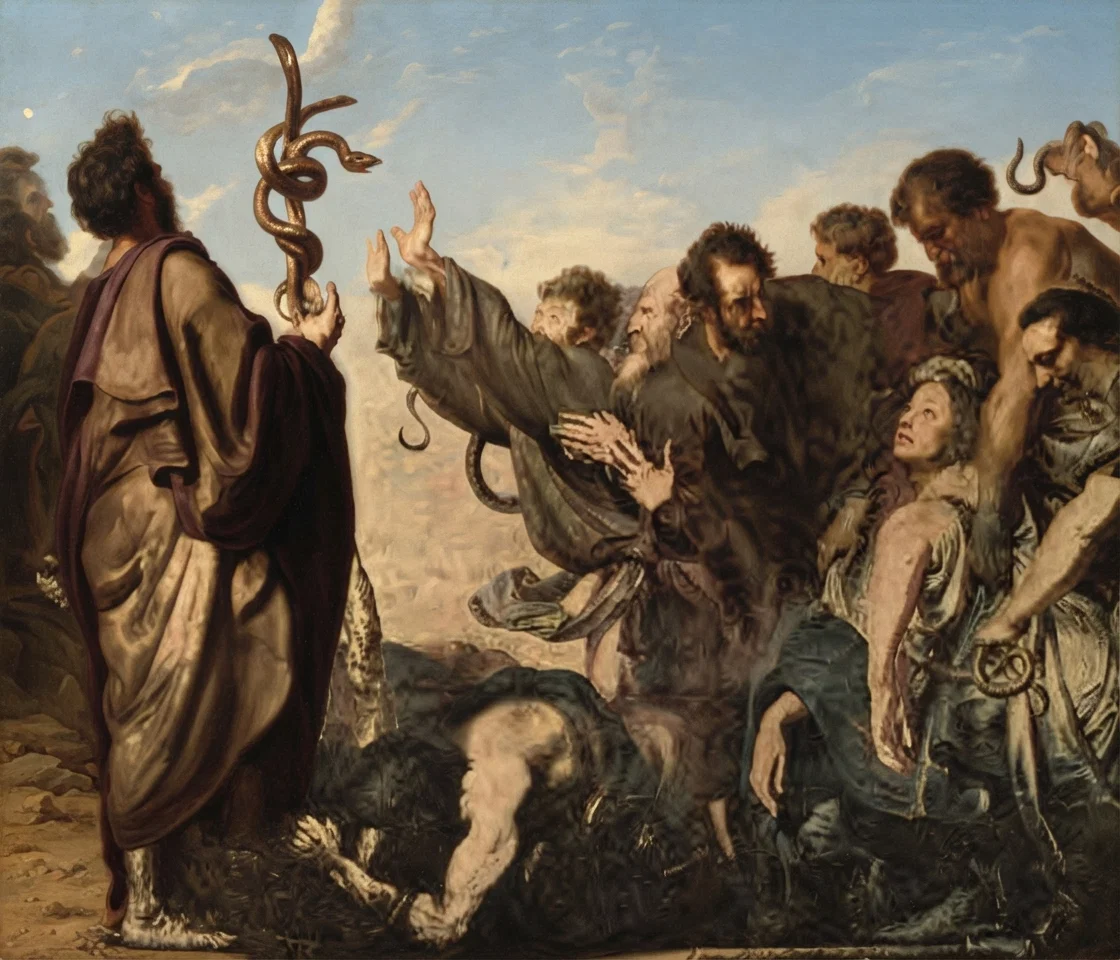
"As Moses lifted up the serpent in the wilderness"
The Lord had fed them with the bread of heaven, even with angels' food; and yet they murmured against Him. By His power He had held in check the wild beasts of the forests, and the reptiles of the wilderness, so that they had not hurt His people; but now He removed His restraining hand, and let the poisonous serpents do as they would have done all along the way had the Lord not restrained them. The real trouble that now came upon them served to bring them to their senses, and to awaken their paralyzed thoughts as to what course to pursue. "Therefore the people came to Moses, and said, We have sinned, for we have spoken against the Lord, and against thee; pray unto the Lord, that He take away the serpents from us. . . . And the Lord said unto Moses, Make thee a fiery serpent, and set it upon a pole: and it shall come to pass, that every one that is bitten, when he looketh upon it, shall live. And Moses made a serpent of brass, and put it upon a pole, and it came to pass, that if a serpent had bitten any man, when he beheld the serpent of brass, he lived."
Throughout the camp of Israel there were the suffering and the dying who had been wounded by the deadly sting of the serpent. But Jesus Christ spoke from the pillar of cloud, and gave directions whereby the people might be healed. The promise was made that whosoever looked upon the brazen serpent should live; and to those who looked the promise was verified. But if any one said: "What good will it do to look? I shall certainly die under the serpent's deadly sting;" if he continued to talk of his deadly wound, and declared that his case was hopeless, and would not perform the simple act of obedience, he would die. But every one who looked, lived.
Jesus said: "As Moses lifted up the serpent in the wilderness, even so must the Son of Man be lifted up: that whosoever believeth in Him should not perish, but have everlasting life. For God so loved the world, that He gave His only-begotten Son, that whosoever believeth in Him should not perish, but have everlasting life. For God sent not His Son into the world to condemn the world; but that the world through Him might be saved." Christ is speaking to us now as certainly as He spoke to the children of Israel in the wilderness. He is the Healer of both body and soul. Our attention is now called to the Great Physician. "Behold the Lamb of God, which taketh away the sin of the world." Just as long as we look at our sins, and talk of and deplore our wretched condition, our wounds and putrefying sores will remain. It is when we take our eyes from ourselves, and fasten them upon the uplifted Saviour, that our souls find hope and peace. The Lord speaks to us through His Word, bidding us "look and live." "He that hath received His testimony hath set to his seal that God is true. For He whom God hath sent speaketh the words of God: for God giveth not the Spirit by measure unto Him.
The Father loveth the Son, and hath given all things into His hand. He that believeth on the Son hath everlasting life."
There is every reason why we should be encouraged to hope for the salvation of our souls. In Jesus Christ every provision for our salvation has been made. No matter what may have been our sins and shortcomings, there is a fountain open in the house of David for all sin and uncleanness. "Come now, and let us reason together, saith the Lord; tho your sins be as scarlet, they shall be as white as snow; tho they be red like crimson, they shall be as wool." This is the word of the Lord. Shall we accept it? Shall we believe on Him?
David had been bitten by the fiery serpent,—he had been poisoned with the venom of sin,—yet hear the words that describe his experience after looking upon the uplifted Saviour: "Blessed is he whose transgression is forgiven, whose sin is covered. Blessed is the man unto whom the Lord imputeth not iniquity, and in whose spirit there is no-guile. . . . I acknowledged my sin unto Thee, and mine iniquity have I not hid. I said, I will confess my transgressions unto the Lord; and Thou forgavest the iniquity of my sin. For this shall every one that is godly pray unto Thee in a time when Thou mayest be found; surely in the floods of great waters they shall not come nigh unto him. Thou art my hiding-place; Thou shalt preserve me from trouble; Thou shalt compass me about with songs of deliverance." "The Lord is nigh unto them that are of a broken heart; and saveth such as be of a contrite spirit. . . . The Lord redeemeth the soul of His servants, and none of them that trust in Him shall be desolate."

The Spirit in Regeneration

By John Orr Corliss

Two Generations

WHAT is regeneration?—It is a new generation of a single object or name. To generate a thing is to produce it; to bring it into life; to originate it. Then to regenerate anything would be to produce it anew, or give it a new life.
Two regenerations are recognized in the Bible. The first is designated the “washing of regeneration” bestowed on individuals for their salvation, through the mercy of God (Titus 3:5); while the second relates to the renewal of all things earthly, when Christ shall assume His throne of glory among men (Matt. 19:28).
In this final and complete regeneration, the Lord says, “Behold, I make all things new.” Rev. 21:5. By reference to that which precedes this statement, we learn what these “all things” include. First of all, the earth, originally projected by the breath or Spirit of God, but tainted and marred by man’s sinful conduct, will again respond to the creative fiat of Jehovah, and reappear in its original robes of infinite beauty. Even the atmosphere and sky above will become sublimely heightened in grandeur, to fit the changed condition below.
A new city of gold and precious stones, enclosed in walls of jasper, pierced with gates of pearl, and arrayed in resplendent glory,—the holy “possession of peace” in its “beautiful garments,”—will descend from the presence of Jehovah, to become the capital of all the saved nations, and the attraction of every eye. But its magnetic charms do not consist alone in its twelve foundations of costly stones, in which are engraved the names of the twelve apostles of Christ; nor in the height of its unparalleled walls; nor its matchless gates, bearing the names of the twelve tribes of Israel; nor in its streets of transparent gold. No, indeed; no one of the things mentioned, nor all of them together, can draw the attention away from Him who will there be the central setting of all those beautiful environments. As the proclamation, set to heavenly music, shall be heralded forth, “The tabernacle of God is with men,” and, behold, “Thy God reigneth;” and as these words echo and reecho throughout every part of God’s fair domain, every face must surely be turned toward the point whence the charming sound proceeds. There will then be seen by all the redeemed the unspeakable glory of the throne of God and the Lamb; and they also will be permitted to look into the face of the King Himself, whom they have so long desired to behold.
Then will appear the name of God in the foreheads of men, because they will have been restored to His glorious image. The joyous announcement from the throne itself, that “all things” are to be made new, will dry every tear fountain, which had in the former earth-life flowed so often and so freely. Death, sorrow, crying, and the last twinge of pain, are also buried in oblivion, as former things which have “passed away.”
But such regeneration exceeds the limit of the unaided human comprehension, and properly so; for he whose mind has been confined to the narrow sphere of earthly conditions, has necessarily a dwarfed intellect regarding things of heavenly production. This fact is clearly expressed by the prophet when he said, “Since the beginning of the world men have not heard, nor perceived by the ear, neither hath the eye seen, O God, beside Thee, what He hath prepared for him that waiteth for Him.” Isa. 64:4.
But while the spirit of man discerns only the things of men, the assurance is given that the Spirit of God not only traces out all the “deep things of God,” but it also reveals them to men. 1 Cor. 2:10. It is therefore very clear that one can not possibly understand these things without direct enlightenment concerning them; much less enter upon their possession. The reason is quite obvious; God having perfected through His own Spirit the wondrous device for man’s eternal happiness, it remains within the power of His Spirit alone, to reveal the system to those for whom it is prepared. It also follows that he who would understand the impressions of God’s Spirit in this, or in any other matter, must have his own faulty spirit regenerated, to be in direct relation to, and in perfect sympathy with, the faultless Spirit of Jehovah. In other words, he must “put on the new man, which is renewed in knowledge after the image of Him that created him.” Col. 3:10.

Changes in Man

When we consider the earth-born traits of men, and the change necessary to constitute them associates with everlasting innocence, the wonder is how the transition can possibly be effected. This is but one rule of the proceeding at which the natural mind balks, since the entire measure is an act of the infinite mind of Jehovah. The method of its accomplishment must therefore ever be outside the purview of human reason, and be accepted by faith alone, as an unsearchable mystery of the riches of God’s glory. So real, however, is this precious connection with the Holy One, that the world at large is able to recognize in those having a title to it, a “fellowship” of this hidden mystery, which forms a mark of distinction between them and the unregenerate. Eph. 3:9.
But how is it possible for the fellowship of this sacredly obscure faculty in one, to be plainly discernable to the unrepentant world, and yet the foundation of it remain undiscovered? The answer must be, Because the mystery itself is Christ in man, acting through him physically and mentally. Dwelling thus in humanity, the result is a “new creature.” The words and actions of Christ are then manifest where once only sensual words and degraded actions filled life’s program.
No one supposes for a moment that this human indwelling of Christ is His physical presence. When here in the flesh many centuries ago, He said emphatically that it would be advantageous to man for Him to go away; for, said He, “if I do not go away, the Comforter will not come unto you.” John 16:7. This Comforter,—the paracletos, “one called alongside of, for help,”—is none other than the “Spirit of truth, which proceedeth from the Father,” to bear witness to Christ in His personal absence. John 15:26. Because men do not permit the indwelling of the Spirit of Christ, by which their lives may be made conformable to His, they can not estimate the value of this greatest gift to the world. Those, however, who do receive the help offered, accept a legacy, which they appreciate because of its permanent indwelling, and controlling sway over them. John 14:16, 17. This phase of the subject will be further studied, however, in a succeeding article.

My Evening Prayer

If I have wounded any soul to-day; If I have caused one foot to go astray; If I have walked in my own wilful way— Good Lord, forgive!
If I have uttered idle words or vain; If I have turned aside from want or pain, Lest I myself should suffer through the strain— Good Lord, forgive!
If I have craved for joys that are not mine; If I have let my wayward heart repine, Dwelling on things of earth, not things divine— Good Lord, forgive!
If I have been perverse, or hard, or cold; If I have longed for shelter in Thy fold, When Thou hast given me some part to hold— Good Lord, forgive!
Forgive the sins I have confessed to Thee; Forgive the secret sins I do not see. That which I knew not, Father, teach Thou me— Help me to live. —C. Maud Battersby.

“They Shall Bear Thee Up”

ONE day a little boy asked his mother to let him lead his little sister out on the green grass. She had just begun to walk alone, and could not step over anything that lay in the way. His mother told him that he might do so, but charged him not to let her fall. A gentleman met them and said: “You seem very happy, George. Is this your sister?” “Yes, sir.” “Can she walk alone?” “Yes, sir, on smooth ground.” “And how did she get over all those stones?” “O, mother told me to be careful not to let her fall, so I put my hands under her arms and lifted her up when she came to a stone, so she wouldn’t hit her little foot against it!”
Then the gentleman said: “George, you can understand better now that beautiful text, ‘He shall give His angels charge concerning thee: and in their hands they shall bear thee up, lest at any time thou dash thy foot against a stone.’ God charges His angels to lead and lift His people over difficulties, just as you have lifted little Annie over those stones. Do you understand it now?” “O, yes, sir; and I shall never forget it.”—Anon.

God Is, and All Is Well

BEFORE us, even as behind, God is, and all is well.—Whittier.

III. Cyrus Learns of Jehovah

CYRUS the Great, who had been the leading general in the conquest of Babylon, succeeded to the throne of the Medo-Persian empire in 536. There was much to put Cyrus in sympathy with the Jewish people. Years before the fall of Babylon and the rule of Darius the Median and Cyrus the Persian, God had foretold through His prophets just what would be the fate of the proud city and kingdom of Babylon. Through the prophets Jeremiah and Isaiah an outline of what was to happen had been very clearly given and every essential fact foretold. The nations that were to come against Babylon, the way in which they would capture the city, and even the name of the great general, had been stated in these wonderful prophecies. About the year 712 B.C., Isaiah was inspired to say:
"Thus saith Jehovah to His anointed, to Cyrus, whose right hand I have holden, to subdue nations before him, and I will loose the loins of kings; to open the doors before him, and the gates shall not be shut: I will go before thee, and make the crooked places smooth; I will break in pieces the doors of brass, and cut in sunder the bars of iron; and I will give thee the treasures of darkness, and hidden riches of secret places."
Cyrus took Babylon in 538 B.C., when he was about sixty-one years old. Thus the Lord called him by name in this prophecy 113 years before he was born; and foretold what he would do, 174 years before he did it. When, therefore, Cyrus and Darius became associated with the prophet Daniel, he had not been slow to teach them what God had said respecting them and their work, and they had been wonderfully drawn to the man whom God by His providence had placed among them.
In these scriptures Cyrus found the Lord God of heaven speaking to him personally. He calls him by his name, assures him He will go before him, and that He will give him the treasures of darkness and hidden riches of secret places. For what reason? —"That thou mayest know that it is I, Jehovah, who call thee by thy name, even the God of Israel. For Jacob My servant's sake, and Israel My chosen, I have called thee by thy name: I have surnamed thee, tho thou hast not known Me. I am Jehovah, and there is none else; besides Me there is no God. I will gird thee, tho thou hast not known Me." This revelation of God to Cyrus was so personal and so clear and plain that Cyrus accepted it and acknowledged Him. This is all very clearly shown in the proclamation which he made in the first year of his reign, as recorded in the first chapter of Ezra, verses one to three:
"Now in the first year of Cyrus, king of Persia, that the word of Jehovah by the mouth of Jeremiah might be accomplished, Jehovah stirred up the spirit of Cyrus king of Persia, so that he made a proclamation throughout all his kingdom, and put it also in writing, saying, Thus saith Cyrus, king of Persia, All the kingdoms of the earth hath Jehovah, the God of heaven, given me; and He hath charged me to build Him a house in Jerusalem, which is in Judah. Whosoever there is among you of all His people, his God be with him, and let him go up to Jerusalem, which is in Judah, and build the house of Jehovah, the God of Israel (He is God)."
In it he says, "All the kingdoms of the earth hath Jehovah, the God of heaven, given me; and He hath charged me to build Him a house in Jerusalem, which is in Judah." The fact that he uses the word "Jehovah" shows that he acknowledges the God of Israel, for "Jehovah" was the term for "God" which only the Israelites up to that time had used. God was not known to any other of the nations nor to the patriarchs by this name. It was preeminently the Israelites' name for God. It shows how closely Cyrus had identified himself with the Jehovah God of the Jews. Further in this proclamation he says: "Whosoever there is among you of all His people, his God be with him, and let him go up to Jerusalem, which is in Judah, and build the house of Jehovah, the God of Israel. (He is God.)"
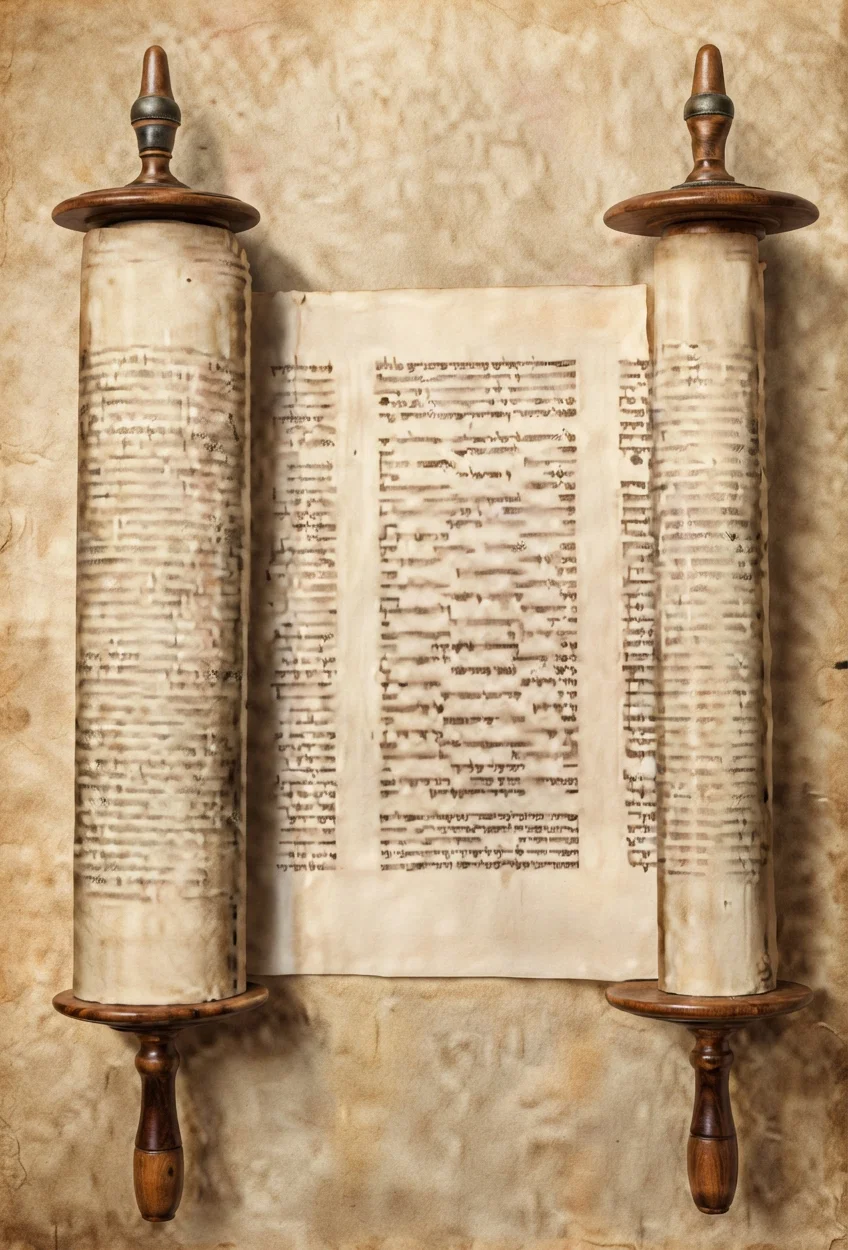
Ancient Scroll of Scripture
When Cyrus read the wonderful prophecy recorded in Isa. 44:28, where God calls him His shepherd, and tells him to perform His pleasure, "even saying to Jerusalem, Thou shalt be built; and to the temple, Thy foundations shall be laid;" he was stirred in spirit by the great Jehovah, and acknowledged that God had charged him to build Him a house in Jerusalem; and he commissioned any one of those who worshiped Jehovah, that might be in his realms, to go up to Jerusalem and build the house, and required that whosoever was left in any place where he sojourned, the men of the place should help with silver and with gold and with goods and with beasts, besides the free-will offering for the house of God which is in Jerusalem.
This was a remarkable thing for a heathen king to do, and shows what a remarkable influence the Spirit of God had upon his heart. Some historians in modern times have not been able to understand this remarkable thing of a king of another nation so wonderfully befriending and helping those who were representatives of a nation religiously at least opposed to the Persians. Some have thought that his conduct could be explained by the idea that his designs were political, that he wished to reestablish the Jewish nation as a barrier between his dominion and those of the Egyptians. Those familiar with Cyrus, his prowess, and the wonderful experience which he had undergone through the influence of the prophet of God, know that this could not be the explanation of his conduct. Everything of a selfish character would influence Cyrus not to allow the Jews to restore their city and temple. The fact that he did do so much for them, and the fact that the Persian nation continued for so many years to encourage this work of restoration of the Jewish city and temple, show that the cause was really supernatural.

Absurdity of Higher Criticism

It is well sometimes to let our teachers know how skeptics in these days treat parts of the Bible. The German rationalist says there was no miracle in what happened to Paul on the road to Damascus. The fact is that Paul was an excitable man: that he was journeying to Damascus over the plain, which is notoriously hot, and it was noonday and he got a sunstroke; and then in his fever he thought he saw visions and heard voices. The whole thing was a subjective delusion, and not an objective reality. That is the rationalistic explanation of this miracle.
Now I never knew that sunstroke turns a persecutor into a preacher, or that it makes an evangelical man out of a skeptic. One of my classmates, who was with me in city missions, got half a sunstroke in the city of New York, and he never did another stroke of work for a year and six months. Paul gets a full sunstroke, and begins instantly to preach marvelously. If this German theory be correct, then you had better close your theological seminaries, and stand all your young men out against a brick wall and sunstroke the whole of them, and then ordain them.—Rev. A. E. Schauffler.

Thoughts Heard in Heaven

Our thoughts are heard in heaven.

Life Evermore

OUR past life is not past; it lives in at least two ways: in the character we have formed and the influence we have exerted. All life is a springtime of sowing; “in due season we shall reap.” Heaven lies hidden in our daily deed, even as the oak with all its centuries of growth and all its summer glory sleeps in the acorn cup.—Great Thoughts.
Continue reading: Mr. Bryan's Objection to Darwinism