A WRITER in the Hibbert Journal of recent date comments on the fact that simultaneously with the growth of materialistic views which is characteristic of the times there is also a “remarkable revival of the occult.” And this revival of occultism is more general than might at first thought be supposed. “It is idle, it is simply not true,” says this writer, “to say that this dabbling in the black arts is confined to those few queer people whom we shall always have with us, and that it is without significance. One has only to walk up and down a street in the busier part of any of our cities to see what a trade must be going on in the unseen and the diabolical.”
It is a remarkable fact that with all the increase of scientific knowledge for which the age is noted, and the general diffusion of this knowledge among the people, there is at the same time a marked revival of superstition and confidence in the pretended revelations from occult sources. This is evidence that scientific knowledge, as the world supplies it, is no safeguard to the mind against superstition. The doctrines of Rome, which are largely superstition or of superstitious basis, flourish in an age of great intellectual light the same as they did in medieval darkness.
But while scientific knowledge is on the increase, true faith—belief of God’s Word, adherence to the solid, old-time doctrines of Christianity—is markedly on the decline; and between this fact and the revival of superstition there is a direct relation. Atheists attempt to show that faith and superstition are essentially the same. The religious phenomena of the present day refute this idea. So far from being the same or similar, they are opposites, and each is destructive of the other. The individual noted for a sane, sound mind, fortified against all forms of religious quackery, is pre-eminently the one who takes God’s Word for his guide and source of knowledge in the things of the spiritual life.
L. A. S
Resignation
“We sometimes wonder why our Lord has placed us
Within a place so narrow, so obscure,
That nothing we call work can find an entrance;
There is only room to suffer—to endure.
“Well, God loves patience! souls that dwell in stillness,
Doing the little things, or resting quite,
May just as perfectly fulfil their mission,
Be just as useful in the Father's sight.”
The Collection for the Colored Work
By Ellen G. White
(To be Read in all the Churches on Sabbath. October 7)
DEAR BRETHREN AND SISTERS: I am thankful that the General Conference has set apart the first Sabbath in October as a day upon which a general contribution will be taken up in all our churches for the advancement of the work among the colored people of the Southern States. I have great hope that this important work will receive substantial help as the result of this collection. I am working, praying, and hoping for this; and I shall leave the result with God.
Some may say that the work in the Southern States is already receiving from the General Conference more than its share of attention, more than its proportion of men and means. But if the South were not a neglected, needy field, if there were not a pressing necessity for more work to be done there in many different lines, why should the Lord keep the question constantly before his people as he has done for so many years?
Over and over again the Lord has presented before me the pioneer work that must be done in new territory. When a difficult field is presented before me as one that must receive special attention, I understand that it is my duty to make this field my special burden, until, before the earnest, continuous efforts put forth, the difficulties disappear, and the work is established.
The work among the colored people in the Southern field, with its encouraging and discouraging features, has been kept before me for many years. While in Australia, I earnestly called upon my brethren and sisters in America to awake to the responsibility resting upon them to carry the third angel’s message to this neglected race. And since my return to this country, I have borne a similar message in every place, where I have been. I have an intense interest in all that concerns the welfare of the work among the colored people.
Few realize the magnitude of the work that must be done among the colored people. In the South there are millions who have never heard the third angel’s message. These must be given the light of present truth. And it is because of the neglect of our people to take hold of this work heartily, that the Lord has instructed me to continue making appeals in their behalf.
At one time I felt as if I could no longer bear the burden of this work. I thought that if men would continue to do as they have done, I would let matters drift, and let those who have so much confidence in their own plans go on as they chose to go. I intended merely to pray that the Lord would have mercy upon the ignorant and those who are out of the way. But I dared not lay down the burden; for in the visions of the night the Lord asked me the question: “Will you do that which many would be only too pleased to see you doing? Will you keep silent? Will your voice no longer be heard presenting clearly and distinctly the needs of this long-neglected field? If so, you yourself will share the reproach that rests on the ministers and people who have not done for the Southern field the work the Lord has given them to do, who have passed by on the other side those who are their neighbors, treating them with indifference and cruel neglect.”
I know not how to describe the way in which the Southern field has been presented to me. In this field thousands and thousands of people are living in ignorance of the third angel’s message, and they are right within the shadow of our doors. This field bears testimony to the neglect of a people who should have been wide-awake to work for the Master among all classes, but who have done very little for the colored people of the South. A little work has been done there, it is true; we have touched the field with the tips of our fingers; but not one hundredth part of the work has been done that should be done. God calls upon his people to stand in a right position before him, to heed the light given fifteen years ago—that the colored people be labored for and helped.
My brethren and sisters, I entreat you to arouse, and show a living interest in the unworked portions of the Lord’s vineyard. Catch the spirit of the great Master Worker. His heart was ever touched with human woe. Why are we so cold and indifferent? Why are our hearts so unimpressionable? Christ placed himself on the altar of service, a living sacrifice. Why are we so unwilling to give ourselves to the work to which he consecrated his life? Something must be done to cure the terrible indifference that has taken hold upon us. Let us bow our heads in humiliation as we see how much less we have done than we might have done to sow the seeds of truth.
To the members of our churches I am instructed to say once more, Take hold of this work now, at once, and resolutely put away all compliance with selfish desires. Come right to the merits of the case. The work among the colored people must be helped with an earnestness that is proportionate to its discouraging features. Many excuses present themselves for our not taking up this work, but these excuses are not prompted by the Holy Spirit.
The sentiment prevails in some minds that when colored people are given an education, they are spoiled for practical work. Of the education given in some schools this may be true to a certain extent; but it will not be so in the schools where the Bible is made the foundation of all education, and where the students are taught to work in the fear and love of God, as their Master worked. It will not be so where students follow the example of the One who gave his life for the life of the world.
There are among the negro race those who have superior natural intelligence, and who, if converted to Christ, could do a good work for their own people. Many should be given the opportunity of learning trades. And others are to be trained to labor as evangelists, Bible workers, teachers, nurses, hygienic cooks, and colporteurs. Many can be taught to be home missionaries.
We ask our people to enlarge their gifts, that the training of workers may be hastened, and that the various lines of work so greatly needed may be established without further delay. Every church-member should awake to the responsibility resting upon him. The colored people are to be shown that God has not left them, but that he is working that they may receive an education that will enable them to read, believe, and do the words of Christ, catching his spirit, that in turn they may work for their own people.
Churches of believers are to be developed. Meeting-houses are to be built. Facilities for caring for the sick are to be provided. Small books specially prepared to meet the needs of the people, are to be given a wide circulation. In all the large cities of the South the light of present truth is to shine forth to the colored people. And in all parts of the field, the believers, by a wise use of the talent of speech and by practical Christian Help work, are to live out the truth before those who know it not.
The Lord has instructed me that those who are now carrying on work among the colored people can not remain in the field in a bare-handed condition, and do the work that is required. It will be necessary for them to receive help. The Lord has been calling upon his people in the stronger conferences of the North, the East, and the West to sustain the Huntsville school by liberal gifts. We pray that he will put it into their hearts to respond nobly. And the smaller mission schools must also be sustained. In past years this line of work has been8
approved and blessed of heaven, and it must now be developed and strengthened. Means must be raised for establishing the medical missionary work also, and for training and supporting ministers and house-to-house workers.
Will our brethren awake to a realization of their responsibility? Will they give liberally, that the work in the South may be so established that it may be self-supporting? This world was established and is supported by the charity of a benevolent Creator. We are sustained by God’s compassionate love. God is the donor of all we have. He calls upon us to return to him a portion of the abundance he has bestowed upon us. Think of the care he gives the earth, sending the rain and the sunshine in their season, to cause vegetation to flourish. It is the great Husbandman who gives life to the seeds planted in the earth. He bestows his favors on the just and on the unjust. Shall not the recipients of his blessings show their gratitude to him by giving of their bounties to help suffering humanity?
Greater liberality must be shown toward the work among the colored people, than has yet been shown. The families among us who have every comfort and convenience of life are to work out plans by which, through self-denial and self-sacrifice, they may help to accomplish what God has said should be accomplished.
There is before us a long-neglected duty,—the practise of self-denial and economy. In every transaction of life, we are to follow the example and reveal the spirit of the greatest Teacher the world has ever seen. He is our example in all things. When we follow his example, we shall let our light shine forth in good works.
I call upon our people in America to come up to the help of the Lord. Let those who can not do more, bring their mites; and let those who have been entrusted with more, bring larger offerings. We ask fathers and mothers to make gifts for the advancement of the work in the South, and we ask them to tell their children of the blessing they will receive if they will give of their pennies and nickels and dimes.
I present this matter to you, my brethren and sisters, and I ask you to do your best on the day that the General Conference has set apart as the time when gifts are to be made for work among the colored people. By willing liberality let us prepare the way for the laborers in the South to do a work of mercy for this people. I urge you in the name of the Lord to do something, and do it now. I pray that God will open your hearts, and help you to do justice to the needs of the work for the colored people.
ELLEN G. WHITE.
Palestine
By M. E. KERN
M. E. KERN
THE POOL OF SILOAM, SHOWING OUTLET OF THE CONDUIT IN WHICH THE SILOAM INSCRIPTION WAS FOUND
The land of Palestine has not yet revealed much archeological material. Doubtless it will reveal more as the Palestine exploration society and others proceed with their work. In 1880 two boys bathing in a conduit that empties into the Pool of Siloam found an inscription on the side of the conduit cut in the rock. The picture shows the old pool and the outlet of the conduit. The inscription refers to the digging of the conduit and its completion; how the workmen, working from both ends, heard each others' voices when three cubits distant from each other, and how they suddenly met. The conduit was probably built in the time of Hezekiah, and the inscription shows considerable skill in engineering.
The Moabite Stone
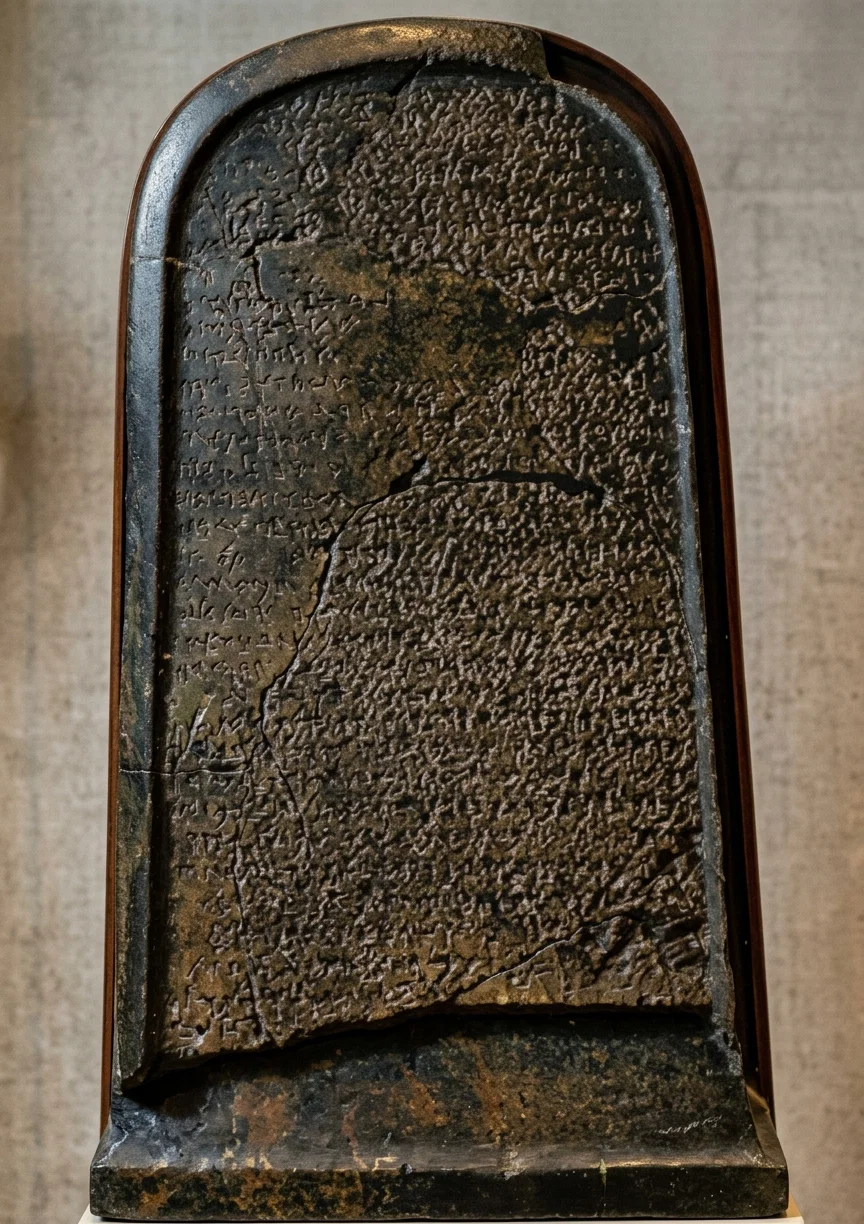
THE MOABITE STONE
In 1868 there was found at Dibon, in Moab, by a German missionary, a black stone two feet by four feet and fourteen inches thick, which contains the most ancient Hebrew writing known, and is a supplement to 2 Kings 3. After much negotiating, the missionary purchased the stone, but through interference of the French it was not delivered, but was broken into pieces by the Arabs and distributed among them, they thinking there was some charm about so valuable a stone. The pieces were afterward nearly all collected and put together, and the stone can be seen in the Louvre at Paris. It is an inscription of Mesha king of Moab to commemorate his deliverance from the yoke of Israel, 850 B. C. It is indeed a remarkable inscription.
Conclusion
So we might go on. Enough has been said to show that Oriental archeology does indeed throw light upon the Old Testament. Day by day as the work proceeds, new light is thrown on the Sacred Word. The narrative of the Old Testament, whenever tested by contemporaneous documents, has been shown to agree in the minutest details. While inscriptions are found which supplement and illuminate the Bible, none are found which in any way seriously contradict it. On the other hand, apocryphal books like Tobit and Judith, or the histories of the East preserved in the old classical writers, will not bear the test of appeal to the native inscriptions. But the Bible stands. In the words of Professor Sayce, 'The long-forgotten empires of the ancient East have arisen out of the grave of centuries to testify to the truth of the oracles of God.'
I hope that what I have written may increase the interest of the reader in these things, and lead him to a closer study of this subject, a subject not without difficulties, as I have pointed out, but one yielding rich returns. Every point of truth must be defended, and we need every ray of light that can be thrown upon the Sacred Word in this faithless generation.
College View, Neb.
Unload Your Cares
A VERY beautiful thought is brought out by the French translation of a verse in the first epistle of Peter. The words are: “Casting all your care upon Him; for he careth for you.” Where our version reads “casting,” the French translation is “unloading” (dechargeant). The difference of meaning is made plain by an illustration we have somewhere seen. The writer said: “The word ‘cast’ might seem to bring to our mind the action of taking up something and throwing it over on Jesus; but many times, dear friends, have you not found the cares too heavy to lift? Have you ever seen a coal cart unloaded? The man took out of the front of the heavy cart a little iron pin, and the cart was so balanced on the axle that then, with a slight pressure on the back of the9cart, it would tip up, and the whole load slide off to the ground, and the pony would trot away with a light step. You do not have to take it up; just take out the little pin of your endeavors to help matters, and, with your hands of faith and committal, tip up the big load, and then run on, for ‘he takes care of you.’”—Selected.
Love Gives Without Limit
THE heart that loves, sets no time limit to its service, nor stays to measure its gifts; for love must serve, and love must give.—Foreign Field.
The Cleansing of the Heavenly Sanctuary
By J. O. CORLISS
The Final Adjustment of Human Awards—No. 7
The Cleansing of the Heavenly Sanctuary
J. O. CORLISS
AFTER briefly referring to the two apartments of the earthly sanctuary and the work done in each, the apostle, in Heb. 9:8-11, says that the Holy Spirit signified that while that tabernacle existed, the way into the “holiest of all” was not yet revealed, but that the typical work then done was, for the time, a “figure” of a “greater and more perfect tabernacle, not made with hands.” Speaking of the intent of that figure, the apostle went on to say that it was necessary for those “patterns” of things in the heavens to be purified with the blood of animals, but that the heavenly things themselves must be cleansed with a better sacrifice. As the reason for this conclusion, he says that Christ is not entered into the earthly holy places, but into heaven itself, to appear in the presence of God for us. Verses 23, 24.
One point in the foregoing should be emphasized here. It will be noticed that Christ’s work as high priest is said to be the cleansing of “heavenly things.” This means more than the cleansing of sinful hearts in earthly forms. So in the apostle’s comparison of the two systems, he has the year-end cleansing of the earthly sanctuary, after the individual forgiveness of sins through confession, stand as a figure of a final cleansing of heavenly things, after men have received personal forgiveness for sins which they have laid on the heavenly High Priest through confession. It therefore follows that a time must come in the work of Christ as high priest when he shall carry in before God all the confessed sins of those whose names are in the book of life, and there confess them before God, in the presence of the angels. Rev. 3:5. This is the occasion when men’s eternal at-one-ment with God is decided.
It further follows that in confessing only for the names of “overcomers,” preparatory to laying their sins on the head of the originator of evil, to be borne by him, all whose names are not so confessed must bear their own sins, and so have part in the lake of fire with Satan and his angels. Matt. 25:41; Rev. 20:15. With such a doom awaiting them, it is evidence that these have not received the at-one-ment with God, but were judged to be separated from the holy people, and receive punishment for the sins which they still retained after the atonement work for the world is completed. This work, it will be quickly recognized, is the exact antitype of the whole work carried on in the earthly sanctuary on the annual day of atonement.
As in the earthly typical work a specific day was set apart for the work of deciding who were to be counted in at-one-ment with God, so for the heavenly and final service God has “appointed a day, in the which he will judge the world” by Jesus Christ. Not only was this emphatically proclaimed by Paul at Athens, but an angel of God was sent to an ancient prophet to reveal the same truth. While contemplating the future through prophetic eyes, Daniel was spoken to by one clothed in white, who said concerning the work God was yet to do for his people, “Unto two thousand and three hundred days; then shall the sanctuary be cleansed.” Dan. 8:14.
When we consider that the earthly sanctuary of Daniel’s days was cleansed regularly each recurring year, we feel sure that this text has reference to another sanctuary, and another cleansing; for whereas the interim between the cleansing ceremonies of the earthly tabernacle was, at most, but three hundred and sixty-five days, the sanctuary here spoken of must wait for its cleansing 2,300 days,—a period of more than six times as long, even though the days be pronounced literal time. But that the days under consideration are not literal days, the words of the angel confirm, when in response to the command to reveal the intent of the matter, he explained to the trembling and prostrate Daniel that the vision referred to “the time of the end.” Verses 16, 17.
These, then, are symbolic days, and according to God’s established rule of their interpretation (Eze. 4:1-6) the 2,300 days signify a corresponding number of years. At the time the vision was given, Daniel became so dazed at the revelation that he fell ill, and so the full explanation of the thing to him was deferred. But when able to look into the matter, the angel was again at hand to guide his understanding. So while at prayer over the meaning, the angel said: “O Daniel, I am now come forth to give thee skill and understanding.” Chap. 9:22. Then, after commending the prophet for his zeal in trying to settle so perplexing a question, he added: “Therefore understand the matter, and consider the vision.”
The angel next proceeded to make the subject clear to the prophet’s mind by saying: “Seventy weeks are determined upon thy people and upon thy holy city.” The Hebrew word here rendered “determined,” is defined by Gesenius to mean, “literally, to cut off; tropically, to divide, and so to determine, or decree.” From this it is plain that the seventy weeks, or 490 days, were “cut off” from the 2,300 days of the vision under consideration. But as only this part of the whole number of days was determined, or decreed, upon Daniel’s people, it follows that with the end of the 490 symbolical days, the exclusive privileges of the Jewish people were to cease.
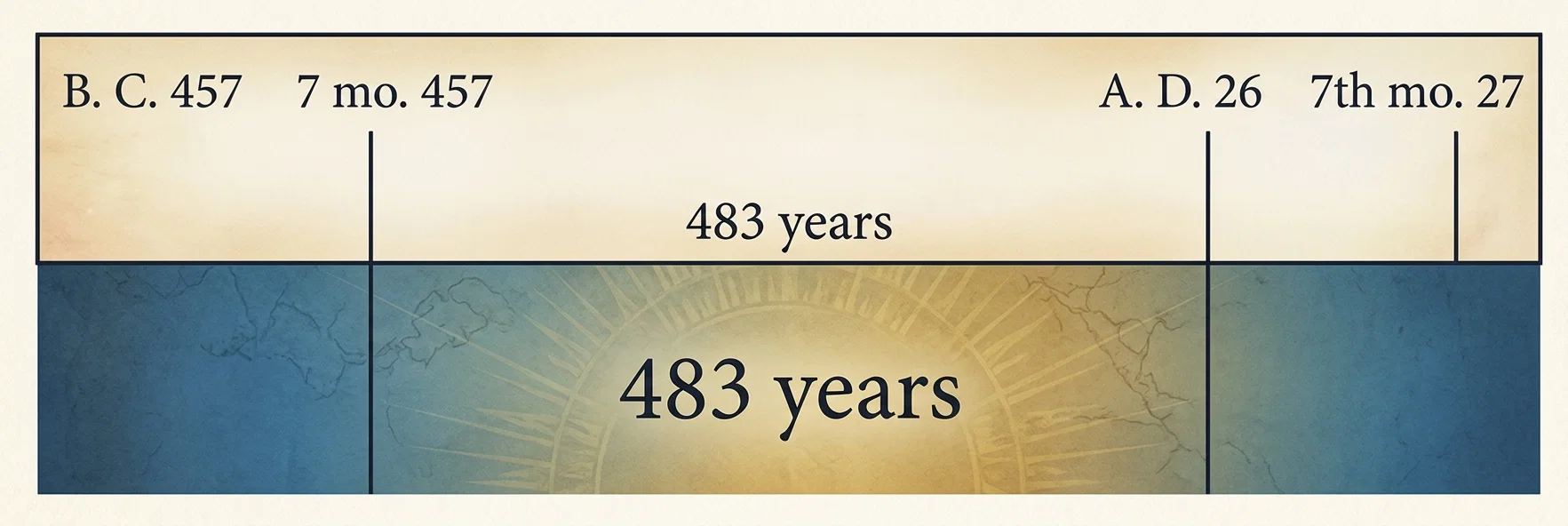
As to the beginning of these days, the angel proceeds to say that sixty-nine of those seventy symbolical weeks, or 483 years, would reach from the command to restore and rebuild Jerusalem to the appearance of the Messiah. This term as applied to Christ means “anointed.” See the margin of John 1:41. By comparing Acts 10:37, 38, with Mark 1:10 we learn that Christ was anointed at the time of his baptism.
This, then, is the point of time at which the 483 years must properly terminate. So in looking for the beginning of this prophetic period, we are directed to the seventh chapter of Ezra, where we learn that the command to restore and rebuild Jerusalem went into effect in the year 457 B. C. See margin of verse 8. Reckoning forward from this date 483 years, we, of course, must ascertain the precise time when the anointing of Christ should take place. But as the 457 years before Christ do not cover the entire period of 483 years, we subtract these 457 years B. C. from the 483 years, and have twenty-six years remaining. These, as one readily sees, belong this side of the Christian era. But to insure accuracy, one other consideration is here necessary. It requires the full amount of these twenty-six years of the Christian era and the full number of 457 years before Christ to complete the 483 years, the end of which must mark the anointing of Christ, so that if the 483 years were to begin with the first day of 457 B. C., they would not terminate until the very last day of 26 A. D. As the work of rebuilding Jerusalem did not begin until the autumn of 457 B. C., it is manifest that the months lost from the count in the beginning of that year must be added to the close of 26 A. D., thus locating the time of Christ’s anointing in the autumn of 27 A. D. This is made plain by the following simple diagram:—
The chronological date in the margin of most English Bibles opposite Mark 1:10, wherein is recorded the baptism of Christ, is 27 A. D. Thus with unerring accuracy the words of the angel to Daniel are verified. In harmony also with the prophecy, our Saviour immediately after his baptism began preaching the gospel, saying: “The time is fulfilled.” He could have reference to nothing else than the prophecy relating to his own work and mission, and that is covered by the words of the angel to Daniel, just under consideration.
Having found sixty-nine of the seventy weeks to reach to the autumn of 27 A. D., the seventieth week must extend the time specifically allotted to the Jews or to the autumn of 34 A. D. It was at this time that the Jewish Sanhedrin cut their nation off from participation in gospel10privileges by the public execution of Stephen for adherence to Christianity. See Acts 8. Referring to this fact afterward, the apostle Paul said to the Jews of Antioch: “It was necessary that the word of God should first have been spoken to you: but seeing ye put it from you, and judge yourselves unworthy of everlasting life, lo, we turn to the Gentiles.” Acts 13:46. See also Rom. 1:16.
Having found the ending of the 490 years to be in 34 A. D., the remaining 1,810 of the 2,300 years have but to be added to the year 34 A. D. to reach the year 1844, when, according to the infallible words of the angel to Daniel, the great sanctuary cleansing must begin. And as in the type the annual cleansing of the earthly sanctuary was a time of deciding men’s cases either for or against them, so in the antitype; the cleansing of the heavenly sanctuary, which began in 1844, is a work of deciding the cases of men, once for all, for weal or woe.
It is indeed a solemn time to the people of the present generation, who must see the end of this heavenly work. That done, the Lord comes to receive his own,—those whose characters before the grand assize were pronounced in at-one-ment with the Lord of glory. To such he will surely say, “Well done, thou good and faithful servant,” and they will be forever happy in the presence of their Saviour. But if it should appear that any who are called to the marriage feast shall not be “chosen,” what agony will rend their hearts at the revelation of Jesus Christ. How much better to put away all sin, and be ready to say when he appears: “Lo, this is our God; we have waited for him, and he will save us. . . . We will be glad and rejoice in his salvation.” Isa. 25:9.
Mountain View, Cal.
The Law of Cause and Effect in Christianity
By M. E. ELLIS
M. E. ELLIS
The Christian religion is nothing if it is not practical. There is nothing more logical and more closely following out the law of cause and effect than rightdoing. It is by an exercise of faith that we believe in Christ, that he lives and is cognizant of our lives and actions; but all our senses unite to give us proof of the real practicability of his teaching, when once we have accepted him and his precepts, and have endeavored, by his grace, to live them out.
There is still enough of the divine image left in every man who has not completely sinned away his day of grace, so that more satisfaction and peace of mind are afforded him when doing right than when committing wrong. He recognizes this in his sober moments, if at no other time; and the more he does that which is right and in accordance with the commandments of God, the less will he feel of melancholy, remorse, or bitterness of spirit. But this in itself is nothing miraculous; it is simply the working of the law of cause and effect.
The earth was made to fit harmoniously into its place in God's creation; the people on it were to fill their places harmoniously also; and though both planet and people have miserably failed of fulfilling the object of their creation, it is still true that the nearer they come to it, the more will they feel the natural effect of this course of action—peace in the heart, but not necessarily cessation of trouble. That is why Christ says, 'These things I have spoken unto you, that in me ye might have peace. In the world ye shall have tribulation.'
A failure to make a proper distinction between being spiritually in Christ and physically in the world, is the rock on which many new converts and more old ones are broken, and it is necessary to remember that at the same time we may have 'peace that passeth understanding'—from the consciousness of duties faithfully performed—and no end of tribulation in our daily life, from both the covert and the open attacks of the enemy of souls, a state of being which shows in both its phases only a still further working out of the law of cause and effect; for the nearer we live to the Creator, whose plan is universal harmony, the more peace shall we feel in our hearts; but at the same time the more tribulation we shall have, as the logical result of living in opposition to the ruler of this world, the foundation of whose kingdom is laid in discord, unrest, and sin.
So, then, there are set before us always two ways, two masters, two great causes, and two final effects. We must choose one course, but can never be wholly free from the influence of the other, because both are still contending for the supremacy of the world.
The ways are the way of righteousness, calling for the denial of the inherent tendencies of man, bounded by trouble, but whose end is peace; and the broad road, pleasant and easy at first, but which leads swiftly and surely to ruin, and ends in death.
The two masters are Christ, the Lamb of God, who gave his life for the millions that had no claim on him, and whose every thought is one of love and sympathy and tenderness for all; and Satan, the prince of this world, who delights in sin and the temptation and fall of the good, the instigator of every wrong action that has ever been committed in the universe of God, the hater of all good and the destroyer of the souls of men.
The two great causes for these conditions are the spirit of hate and rebellion that caused Satan to use every means in his power to destroy the great plan of God, and love, 'for God so loved the world, that he gave his only begotten Son.'
The two final effects are life eternal in the kingdom of God, with nothing but happiness and praise for the Redeemer; and a terrible second death in the lake of fire, with no future, no life, and no God.
Take a logical view of the situation. Is there not even in this life sufficient reason for choosing the way that leads to God? Then let us take it, and expect and enjoy the natural results of a life lived in harmony with God's laws, and receive in addition a little later the matchless gift of eternal life.
“I’m Too Busy”
A MERCHANT sat at his office desk. Various letters were spread before him. His whole being was absorbed in the intricacies of his business. A zealous friend of religion entered the office.
“I want to interest you a little in a new effort for the cause of Jesus Christ,” said the good man.
“Sir, you must excuse me,” replied the merchant. “I am too busy to attend to that subject now.”
“But, sir, inquiry is on the increase among us,” said his friend.
“Is it? I’m sorry, but I’m too busy at present to do anything.”
“When shall I call again, sir?”
“I can not tell; I’m busy every day. Excuse me, sir; I wish you a good morning.”
Then bowing the intruder out of his office, he resumed the study of his papers.
The merchant had frequently repulsed the friends of humanity in this manner. No matter what the object, he was always too busy to listen to their claims. He had even told his minister that he was too busy to do anything but to make money.
But one morning a disagreeable stranger stepped very softly to his side, laying a cold, moist hand upon his brow, and saying, “Go home with me!”
The merchant laid down his pen, his head grew dizzy; his stomach felt faint and sick; he left the counting-room, went home, and retired to his bedchamber.
His unwelcome visitor followed him, and now took his place by his bedside, whispering ever and anon, “You must go with me.”
A cold chill settled on the merchant’s heart; specters of ships, notes, houses, and lands flittered before his excited mind. Still his pulse beat slower, his heart heaved heavily, thick films gathered over his eyes, his tongue refused to speak. Then the merchant knew that the name of his visitor was Death.
Humanity, mercy, and religion had alike begged his influence, means, and attention in vain; but when death came, he was powerless—he was compelled to have leisure to die.
Let us beware how we make ourselves too busy to secure life’s great end. When the excuse rises to our lips, and we are about to say we are too busy to do good, let us remember we can not be too busy to die. “Prepare to meet your God.”—Selected.
Duty and God’s Provision
By Geo. McDonald
A MAN’S business is just to do his duty; God takes upon himself the feeding and the clothing.—Geo. McDonald.
The Debtor
By Annie R. Stillman
THE dearest of my friends to-day
Spoke wistfully: “I have a friend
Who, in more ways than I may tell,
Hath served me well;
But he doth owe a debt he can not pay,
And there is none to lend.”
Eager, I cried: “Thy friends are mine!
Speak but his name, ere time is lost.
What is his score? Whom doth he owe?
My gold shall flow
To ease his care, whose care, O Lord, is
thine;
Nor will I grudge the cost.”
“And is thy love so great?” He sighed,
And turned from me, and, stooping, wrote—
As once of old—with kingly hand
Upon the sand,
The while I waited, wond’ring, full of
pride,
Impatient to devote.
At last he rose, and looked at me;
His eyes were flames that burned through tears.
“Who cancels this, serves me,” he said.
I knelt and read—
For the last time—thy name, mine enemy,
And that old wrong of years.