Your ShelfYour Projects

Review and Herald, Vol. 82, No. 39.

THE DEAD SEA

Review and Herald

Sep 28, 1905

Review and Herald Publishing Association · Washington, D.C. · Sep 28, 1905
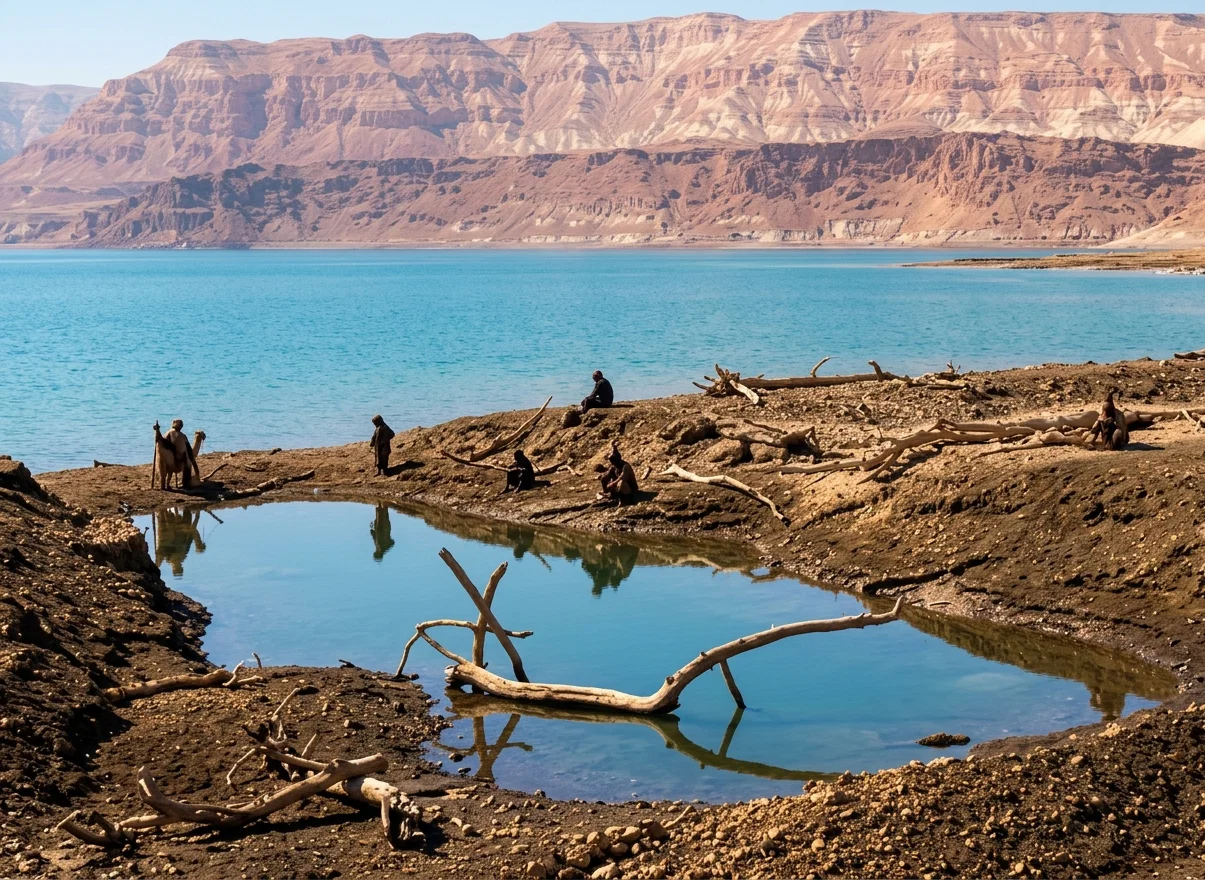
THE DEAD SEA

This sea, variously known as the Salt Sea, sea of the plain, the asphaltic lake, and sea of Sodom, is one of the most remarkable bodies of water in the world. It is forty-six miles in length, and from five to nine miles in width. It is remarkable in its character, its history, and its situation. It is the most saline of any large body of water in the world, its waters containing also large quantities of chlorid of calcium and chlorid of magnesium. No life can exist in it, and the land bordering it will not support vegetation.
Its history takes us back to the destruction of Sodom and Gomorrah by “brimstone and fire from the Lord out of heaven,” as described in Genesis 19. A large tract now covered by the lake was, previous to this destruction, the “vale of Siddim” (Gen. 14:3), which seems to have been a well-watered and fertile plain.
The Dead Sea is situated in the deepest large depression in the earth’s surface, the extreme depth of this depression being 2,608 feet below the level of the sea. The surface of the lake is 1,300 feet below sea-level, and the lake is 1,308 feet in depth.
The water of the Dead Sea, though so impregnated with salt and other minerals, is perfectly clear, and a bath in it is not only harmless, but refreshing. During the summer the sun shines upon the lake from an unclouded sky, and the intense heat produces evaporation from its surface to such an extent that in spite of the large volume of water received from the Jordan and smaller streams, the level of the lake does not rise, except for a short period during the spring freshets. Driftwood is constantly brought down by the Jordan, consisting of canes, branches and trunks of trees, which, strewn along the shores, add to the desolation of the scene. Bordering the lake are marshes which in summer give off, poisonous vapors that are fatal to strangers, and make the inhabitants of the surrounding territory weak and sickly. The saltness of the sea is ascribed to the absence of any outlet, excessive evaporation, washings from the “salt range of Sodom,” and the inflow from numerous brackish springs along the shore.

THE PRECIOUS SEED AND THE SOWERS

“He that goeth forth and weepeth, bearing precious seed, shall doubtless come again with rejoicing, bringing his sheaves with him.”
BEGINNING with October 11, four Special Message Numbers of The Signs of the Times will be issued as follows: (1) The Sure Word of Prophecy and Christ’s Coming; (2) The Sanctuary, the Gospel in Type and Antitype; (3) The Law, the Gospel, and the Sabbath—“The Whole Duty of Man;” (4) The Church Triumphant.
The titles of the leading articles to be printed in these special issues are given herewith:—

I—PROPHECY AND CHRIST’S COMING

  1. Object of Prophecy.
  2. Prophecy May Be Understood.
  3. Importance of Prophecy.
  4. Alphabet of Symbolic Prophecy, Daniel 2.
  5. God’s View of the Nations, Daniel 7.
  6. Christ Will Come Again. How? When?
  7. What His Coming Means.
  8. Christ Our Life.
  9. The Only Power That Can Save. Acts 4:12.

II—THE SANCTUARY—THE GOSPEL IN TYPE AND ANTITYPE

  1. The Gospel in Type.
  2. The Sanctuary and Its Lessons.
  3. The Priesthood in Type and Antitype.
  4. The Day of Atonement and the Judgment.
  5. The Wonderful Book—The Seven Seals.
  6. The Closing Work of Our High Priest.
  7. The Great Apostate Powers. Revelation 12 and 13.
  8. Signs in the Heavens.
  9. A Message of Preparation.

III—THE LAW, THE GOSPEL, AND THE SABBATH—“THE WHOLE DUTY OF MAN”

  1. The Eternal Law, the Everlasting Gospel.
  2. The Bible Sabbath.
  3. The First Day of the Week.
  4. The Broken Hedge, Sabbath Changed in the Church.
  5. Babylon—Its Character.
  6. Principles of Babylon in Succeeding Ages.
  7. The Reformation and America.
  8. Encroachments on Freedom—Beast, Image, Mark.
  9. Great Field of Prophecy.
  10. Signs in the Earth.

IV—THE CHURCH TRIUMPHANT

  1. A Spirit-Filled Church.
  2. Requisite Conditions To.
  3. Spiritual Gifts.
  4. The Apostasy.
  5. The Great Center of Sanctuary Service.
  6. The Seal of God—Sabbath Restored.
  7. God’s Last Great Protest.
  8. A Church Restored, and Triumphant.
It will be seen from this general outline that most important phases of gospel truth will be considered in these special issues, and it is certain that these papers ought to have a very large circulation. It was a part of the plan for the fall missionary campaign that special numbers of our missionary periodicals should be prepared, and that our people should circulate them by the hundreds of thousands. We hope that this work will be entered upon in a hearty way, and that these messengers of truth will bring light and blessing to many thousands of homes. Let the officers of our churches be wide-awake in this matter, and let early arrangements be made to send in large orders at once. Let every one help to spread the message.
The prices for sets of these special Signs are as follows:— 1 to 4 sets to one or more addresses ........$.20 a set 5 or more sets to single addresses ..........$.15 a set 25 to 500 sets to one address ................$.10 a set 500 and upward ...............................$.09 a set They will be sold only in sets.
The Signs should be ordered of your conference tract society, or of Signs of the Times, Mountain View, Cal.
THIS special effort during the fall campaign is to enlist thousands of new recruits in some definite line of missionary effort. Do not be confused by the variety of work outlined, nor by the large variety of publications suggested for circulation. Simply select what appeals to you as the work which you can do most heartily, seek divine guidance and blessing, and go to work. It is not the intent that those already at work shall do less, or of necessity change their work, but to find some work for all—“to every man his work.”
BOOKS of travel interest a great many people, and when we can get hold of one written by a person who “sees things” as he goes, and who is able to tell of the sights in an entertaining, instructive way, we like to read his descriptions. Such a book is “By Land and Sea,” by G. C. Tenney. The author visited five continents, and describes what he saw in New Zealand, Australia, Ceylon, India, Egypt, Palestine, Italy, and the islands of the sea. Numerous illustrations accompanying the text give a good idea of the various phases of life in the countries visited. The study of this book will enable us to “look on the fields” in an intelligent way, and will arouse our interest and quicken our efforts in the spread of the message which is to go to “every nation, kindred, tongue, and people.” “Land and Sea” contains 392 large pages, and is neatly bound in cloth. The price has been reduced to $1.25 a copy. Supplied through the usual denominational channels.
THE October Sabbath School Worker is a special Convention Number, and contains four additional pages. Nothing like it has ever been attempted before. Sabbath-school conventions have been held in the past, and some of them have been most encouraging and helpful. Others have not been so encouraging, because they were not wisely planned. Lack of experience and lack of help have prevented many from even making the attempt. Such excuses for not holding conventions can not be made any more, for in this number is just the help needed to hold a successful convention. A full program is given, and suggestions for the whole undertaking are presented by workers of experience. Sabbath-school teachers or officers who do not have the Worker are missing much. Extra copies of the October number can be secured at the rate of two for 5 cents. The subscription price is 35 cents a year to single addresses, or 25 cents a copy in clubs of two or more to one address. Order from the Sabbath School Worker, Washington, D. C.

Editorial

Making a Right Choice

In the daily experience of life we are constantly called upon to choose the course which we shall pursue. In many instances the matters seem to be trifling, while in other cases we recognize that we are in a crisis, and we are conscious that much depends upon the decision which we make. Doubtless in almost every time of choosing we are making it either easier or harder to make a right choice next time, as much depends upon the habit of the mind. The basis of our whole Christian experience is found in keeping the choice and the will on the side of God and his promises. Mark these words: “You have confessed your sins, and in heart put them away. You have resolved to give yourself to God. Now go to him, and ask that he will wash away your sins, and give you a new heart. Then believe that he does this because he has promised.” Here is the lesson taught in the healing of the paralytic at Bethesda. “He believed Christ's word, believed that he was made whole, and he made the effort at once; he willed to walk, and he did walk. . . .” In like manner you are a sinner. You can not atone for your past sins, you can not change your heart, and make yourself holy. But God promises to do all this for you through Christ. You believe that promise. You confess your sins, and give yourself to God. You will to serve him. Just as surely as you do this, God will fulfil his word to you.” This is God's plan in the provision for our salvation, that we shall choose his way as revealed in his Word, believe the promises which he makes to those who choose his way, and he has pledged himself to supply the fact in our experience. God has given us a free will and the gift of faith, and we are therefore able to do all that he requires of us—to choose and to believe. As we maintain our choice and continue to exercise faith in his promises, God's power is revealed to keep us in the way which we choose, and to fulfil in us all the good pleasure of his will. “Choose ye this day whom ye will serve,” and make the choice every day.

A Refreshing Testimony

It is the fashion in these days of skeptical criticism to extol the infallibility of modern scholarship rather than the infallibility of the Bible. It is undoubtedly true that during the last quarter of a century the leading teachers of Christianity have changed their attitude toward the Bible, and there are few now who would be ready to declare their belief in the inspiration of the Scriptures in the same sense in which the preachers of the last generation believed it. It is therefore refreshing to read the testimony of such a scholar as Dr. Adolph Saphir, who wrote as one who had been blessed by exercising the old-fashioned faith in the inspiration of the Bible. We believe that the following paragraphs from his pen will be read with interest and profit:—
The apostles and the Lord himself teach us that not merely was Israel’s history, if we may so say, inspired, under the special influence of God; but they teach us also that the record of this history is inspired, that the Scripture which narrates God’s dealings with Israel is also under the special and infallible guidance of the Holy Ghost. It must be evident, from the preaching of the apostles to Jews and Gentiles, from the manner in which they decide difficult questions of doctrine and practise, from the epistles they addressed to the churches, that they believed Scripture inspired in the fullest sense, and regarded the men by whom the word was written as the instruments, but the Lord, and more especially the Holy Ghost, as the true author of the whole organism of the Jewish record.
It appears from this very chapter [Hebrews 7] (and from the whole epistle) that its author regarded the Scripture as inspired in the most absolute sense of the word; for his whole argument here is based upon the manner in which the Holy Ghost narrated the incident of Melchisedec’s appearing and blessing. Because there is no statement given of his descent, of his beginning and end, the apostle sees in this omission the indication of a very important and fundamental truth. Genesis is the book of genealogies. Most carefully and minutely the descent of men is traced; their age is stated, and the fact of their death chronicled. In a human work no further inference could be drawn from an omission of this kind. It is otherwise, however, in Scripture. As in music, not only the notes, but also the pauses are according to the plan and mind of the composer, and instinct with the life and spirit which breathe through the whole; so the very omissions of Scripture are not the result of chance, or of the accidental ignorance of the writer, but according to and in harmony with the wisdom of the eternal Spirit, who is the true author of the record. The apostle evidently thinks that the Holy Ghost teaches by not stating these points. In like manner he attaches importance to the names of Melchisedec and Salem.
When he writes to the Galatians, he bases a very important argument on the word “seed”—not many, but one—showing that Christ is the promised seed and heir. He represents Sarah and Hagar as typical of the two covenants—of Jerusalem and of Sinai—gospel and law, liberty and bondage; and, in a manner quite analogous to our chapter, he points out that the promise given to Abraham four hundred years before the giving of the law could not be disannulled by it. He affirms that the Scripture, foreseeing that God would justify the heathen by faith, preached before the gospel unto Abraham, saying, “In thee shall all nations be blessed.” And again, “The Scripture hath concluded all under sin, that the promise by faith of Jesus Christ might be given to them that believe.” He personifies the Scripture as omniscient, foreseeing all things, and speaking in harmony with the whole counsel of God.
The apostolic “as it is written” is rooted in a very deep conviction of the divine perfection of the written Word. The whole Scripture is one organic structure; and in its minute and subsidiary portions, as well as in the more prominent and fundamental parts, the Scripture is inspired of God. The infinite and eternal Spirit reveals through the Scripture the truths and realities of God’s salvation.
Hence the names of persons and places, the omissions of circumstances, the use of the singular or plural number, the application of a title,—all things are under the control of the all-wise and gracious Spirit of God.
I may also add a word on the manner of quotation. Scripture passages are quoted by the Lord in the Gospels and by the apostles not always with verbal accuracy, giving an exact repetition ofthe expressions used by Moses or the prophets. This appears at first sight a difficulty, and not in harmony with the true doctrine of inspiration. But on investigation it will be found to confirm this truth; for here also the Spirit is revealed as the Spirit of truth and liberty. The original meaning of the Spirit is developed with increasing clearness and fulness; the Lord and his apostles quote the Scripture according to the deepest and truest meaning of the inspired Word, and according to the new requirements of the dispensation and the condition of their hearers. The prophets themselves knew that their prophecy was above them; they therefore searched with diligent zeal what Messiah’s Spirit which was in them did signify. In the fulness of the Spirit the Messiah himself quotes Scripture; in the fulness of the Spirit, received on the day of Pentecost, the apostles quote and apply the Scripture to confirm and illustrate the truth as it is in Jesus, to guide and to exhort the church in her present course. This refers also to interpretation. The allegorical interpretation, if applied by man, is dangerous; because he may either be without the mind of Christ, and then he will certainly introduce thought contrary to and apart from Scripture, and his interpretation will not be the unfolding of the divine truth; or he may possess the Spirit, yet by reason of imperfection and sin fail to see the true and real meaning of the Word. But when the Lord Jesus and the inspired apostles interpret Scripture, it is as if the author of a book himself explains his true, real, and full meaning to those who have read it. It is authentic exposition of the original Word; an exposition which, on account of the further development of God’s counsel, is more profound and luminous than could have been given at the time of its first utterance.
It seems as if in the outward form of Scripture, in the quotations and comments, there is such apparent imperfection in order that faith may be tested. Outwardly, there seems no difference between Paul’s allegorizing and that of the rabbis or of Philo. It was said of Jesus. “Is not this Jesus, the son of Joseph, the carpenter?” So it may be thought that Scripture is merely human. The Word (that is Christ, and also the Scripture) came, as Luther says, “in unser armes Fleisch und Blut”—in our poor flesh and blood.
Above all, remember that the Lord Jesus, our one and only Master, the Son of God, who is the Truth, honored, confirmed, and fulfilled the Scripture, and led his apostles into a deeper, because more loving, reverence for the inspired Word, and into the true and full understanding of its mysteries. Remember how Jesus referred to Scripture when he was teaching the people, or refuting gainsayers, or resisting and conquering Satan, or instructing and comforting his disciples. Remember how he appeals to Scripture as the ultimate judge, declaring as an axiom that the Scripture can not be broken, and that not one jot or tittle of the law can pass away. Remember his questions: How does David in the Spirit call him Lord? How readest thou? Have ye not read? Remember his references to the whole scope of prophetic teaching (it is written in the prophets, They shall be all taught of God); to Moses, who wrote of him; to the prophets and psalms; to the whole Scripture (the things written concerning me); and to single words and expressions, incidents and institutions, contained in the Scripture. Remember Christ’s references to Scripture on the cross, how the whole prophetic word passed before his mind; and in the conviction of his having fulfilled all that by the Holy Ghost was written concerning him, after he had said, “I thirst,” he uttered that great and blessed word, “It is finished.” And after his resurrection, appearing unto his chosen disciples and witnesses, he opened unto them the Scriptures, beginning with Moses, unfolding unto them his suffering, and giving and commanding them to preach, because they understood now the Word. “Thus it is written, and thus it behooved Christ to suffer, and to rise from the dead the third day,” and thus preach repentance and remission of sins in his name.
It is impossible to separate the Lord Jesus either from Israel or from the Scripture. Faith in Jesus, the true and real Jesus, who died and rose again according to Scripture, must lead to childlike and reverential faith in the Scripture as the word of God, inspired and perfect.
On the testimony of the Lord Jesus and the apostles I receive the Scripture as God’s word. Like David, I pray that God may open mine eyes to see wonders hidden in God’s law, in the history and ordinances recorded in the Scripture; like the psalmist, I view the history of Israel as a parable, a symbol of spiritual and eternal truth. Ps. 119: 18; 78: 2, etc. Not as a critic dare I approach this book as if it were an ordinary book, which I may hope to master and fathom. It is above me, and I can not exhaust its fulness: it knows me, even the hidden things of the heart, and judges me, bringing me into contact with the all-seeing God. I enter with reverence into the temple of Scripture which, from the height of God’s eternal counsel and out of the depth of God’s infinite love, beholds and comprehends all ages, and is sufficient for the guidance and perfecting of souls in all generations—praying with trustful hope that out of Christ’s fulness the Spirit will minister unto me also grace upon grace.
But while I thus stand in awe, beholding the grandeur and infinite depth of the Scripture as one organic Spirit-built temple, and the beauty, perfection, and exquisite skill which characterize the most minute portion of this structure, I feel at home and as in a peaceful and fragrant garden. For our admonition was the Scripture written: for us upon whom the ends of the world are come. Moses and the prophets minister unto us, to whom the fulness of salvation is revealed. Through comfort of the Scriptures we have hope. I am not paralyzed by the divine perfection and the infinite depth of the Word; for such is the love, such is the perfection, of God, that even from a child I may know the Scriptures, and be made wise by them unto salvation. And while it may be given to me in some favored moment to take a comprehensive view, and to behold somewhat of the length, and breadth, and height, and depth, I know that every word of God is pure, every name which he has revealed, every promise which he has given, every word he has uttered, is perfect; and in it he is a shield unto them that put their trust in him. Thus I possess the whole in every little fragment; though weak, ignorant, and limited, I have perfect peace and the light of life. And often I find the truth of that saying, so characteristic of that great lover of the Word [Luther], “In Scripture every little daisy is a meadow.”

The Indefinite Sabbath and the Definite Sunday

THE progress of the final gospel message in missionary lands is causing a stir among those who have planted in those lands the standard of popular Christianity. The seventh-day Sabbath is obtaining a foothold there, and this disturbs the work of those who have established the first day as the day of weekly rest. In a recent issue of the New York Observer, Seventh-day Adventists are mentioned by name, and charged with proselyting among the Christian converts in Spanish-speaking countries. “The Methodists and Presbyterians,” says the Observer, “have already lost to the Seventh-day Adventists work that has cost them years of effort and thousands of dollars of missionary money.” These “Saturday-Sunday proselyters,” it says, “have no moral right, much less moral duty, to go upon mission ground, and there divide with their peculiar preachment the little flocks gathered by other workers.”
This view is based upon the idea, which the Observer asserts in the same connection, that whether the seventh or the first day of the week is observed as the Sabbath is not a matter of any importance. It says:—
Of late the advocates of a seventh-day Sunday have been making trouble for the missionaries in Spanish-speaking countries by trying to reconvert the converts already made to the idea that it makes a difference whether Sunday or Saturday be observed as a rest day, thus exactly imitating the tactics of the Judaizers of Paul’s time, who, secure in their own dogmatic interpretations of the precise meaning of Scripture, sought to bind men to the letter of the law instead of informing them with the spirit of the gospel. Broadly, it may be said at the outset that a controversy between Saturday and Sunday is altogether alien from the spirit of the gospel of Jesus. If a man conscientiously observes either day to the Lord, doubtless the Lord accepts the worship. We have no sympathy with strenuous attempts controversially to fasten either day, as a mere day, upon the church.
But the Observer believes in Sunday, so it immediately adds:—
But we believe it to be of vast importance that a weekly Sabbath should be observed by all Christians, and observed properly, and commend the work of the Sabbath Alliance and of the World’s Sunday Rest Congress, which labor to that end. As a matter of convenience,if for no other reason, it is better for the Christian world to unite upon the observance of some one day, and except for a few irreconcilable dissentists, it has decided upon Sunday, and now seeks to secure the enactment of laws which will properly safeguard that day.
This is a peculiar view, warranted only by logic that is pressed into service in an emergency. We are told that so far as what God has said about the Sabbath is concerned, it makes no difference whether an individual observes the seventh day of the week or the first; but further, that it is “of vast importance that a weekly Sabbath should be observed by all Christians;” that the work of the Sabbath Alliance and World’s Sunday Rest Congress to that end is “commendable,” and that “as a matter of convenience, if for no other reason, it is better for the Christian world to unite upon the observance of some one day,” etc.
Did the Creator know, when he instituted the Sabbath, that for convenience, if for no other reason, it would be better to have a particular day designated as the Sabbath, and not leave each person to select his own day of rest? or has it been left for man to discover a point which the Creator overlooked? And if the Creator did know that it would be best to designate a particular day, did he have enough regard for the convenience of the human race to establish the Sabbath on that basis? We unhesitatingly take the ground that the Omniscient knew all about the matter at the start,—that he knew every need of man and just how to adapt the Sabbath to man’s requirements, and did so adapt it when he instituted it at creation. “The Sabbath was made for man,” and when it was so made by the Creator, so vital a point as the need of a definite Sabbath day was not overlooked.
God worked six days and rested the seventh day, then blessed the seventh day and sanctified it. This instituted the weekly division of time, and designated a particular day—the last one of the week—as the Sabbath.
But to evade the claims of the seventh-day Sabbath, men virtually charge God with having less wisdom than themselves. God, they say, is not particular about the day; but they themselves are very particular and very strenuous about the day. It must be Sunday and no other; and to secure this definite day they have enacted Sunday laws, and insist that these laws be enforced upon the people. When the propriety of these laws is called in question, they are ready with any amount of argument to show that a definite day, which they call the Christian sabbath, must be observed, and enforced by law if necessary; that the Christian religion depends upon it; and that if this particular, definite day is not so observed, “Christianity will be lost, and the nation will go down in ruin.” And almost in the same breath they will argue that God instituted a hit-or-miss sort of Sabbath, and is not particular whether an individual observes one day or the other, so that he observes some one day in seven.
Such logic, we repeat, is called up to do service in an emergency, but there is no valid way of evading the claims of the creation Sabbath, the seventh day of the week. Sabbath observance, just as God has commanded and specified it, is a matter of vital importance to all persons; and this is the justification of Seventh-day Adventists in persuading people everywhere to remove their feet from the seventh-day Sabbath, and to honor the day instituted by the Creator.
L. A. S.

Days of Trouble

WHAT with plague and famine, earthquake, war, and flood, truly the world is getting a warning as to the times and seasons. The special correspondent of a Toronto paper gives the following account of the harrowing situation in Spain:—
The famine in Spain is believed to be the worst in the history of the kingdom.
Starving men and women are roaming over the country, sacking the farms, and carrying off sheep and cattle.
The wealthier families are flocking into Seville and Cordova for protection. At Ecija, Utrera, and Carmona the prisons are crowded. In spite of the efforts of the police new bands of hungry peasants have forced their way into Malaga.
In Bujalance, near Cordova, the principal square is filled all day with starving people, who lie in the sun, and look like living skeletons. The town council is at the end of its resources, and is in three months' debt to its employees. In many places both cows and goats are failing to give milk for want of food.
Throughout the former fertile valley of Andalusia, children are living on fir cones and the fruit of the wild cactus. The jails are crowded with persons who have committed no offenses, but who have given themselves up to the police on the pretense of having committed a crime, in order to get shelter and food. Hunger riots are of daily occurrence.
Joel’s prophecy of the last days reads like a comment on the situation—“the corn is withered,” “the herds of cattle are perplexed, because they have no pasture; yea, the flocks of sheep are made desolate.” We read also that India is threatened with another great famine. It is for such a time that the Lord, through the prophet Joel, utters the command: “Blow ye the trumpet in Zion, and sound an alarm in my holy mountain: let all the inhabitants of the land tremble: for the day of the Lord cometh, for it is nigh at hand.”
These great calamities are bound to cause people to give ear to the warning message of the end. They are stirring calls to us who know the advent truth to press into these unevangelized regions. W. A. S.

The Meaning of Exemption Clauses

WHEN objection is made to proposed Sunday laws, the answer is often returned that an exemption clause has been inserted for those who observe another day. This seems to be regarded by Sunday-law advocates as all that could be asked for by those who keep the Sabbath of the Bible. The true meaning of these exemption clauses has been well stated by the Sabbath Recorder, from which we take the following editorial note:— The Recorder has frequently called attention to the fact that few things more clearly establish the religious character of Sunday legislation than the exemptions which are made in favor of persons who “religiously” observe another day of the week. Such exemptions show that the religious observance of one day of the week is the object and intent of the legislation. From a compilation of the laws of the States of the Union relating to the observance of the Sabbath recently issued by the Massachusetts Bureau of Statistics of Labor, the American Hebrew of New York learns that “the laws exempting those persons from the provisions of the Sunday labor law who conscientiously believe the seventh day of the week to be the Sabbath, and who uniformly observe such day by refraining from labor, are quite general.” Such exemptions are made in Connecticut, Indiana, Kentucky, Maine, Massachusetts, Minnesota, Missouri, Nebraska, New Jersey, New York, Rhode Island, South Dakota, Texas, Virginia, West Virginia, and Wisconsin. The exemptions are also requirements demanding that those claiming the provisions must “conscientiously believe”that the seventh day is the Sabbath, and must “actually refrain from secular business” on that day. Such provisions do not meet the demands of Christianity for liberty of conscience and freedom in obedience, and they do establish beyond controversy the fact that Sunday legislation is religious in origin and purpose. Reduced to lowest terms, the law requires a religious observance of either the Sabbath or Sunday, although the laws are inoperative and self-contradicting.

The Chinese Week

REFERRING TO an article in the REVIEW on the ancient Syrian calendar of the week, Dr. Miller writes from Honan, China:—
In Chinese we enumerate the days as the article stated; as,—
Sabbath.
Sunday, “the first day after the Sabbath.”
Monday, “the second day after the Sabbath,” etc.
And the name for week is “nan-shisk-er,” Sabbath.
Unfortunately for the people, and for those who engineered it as well, the churches generally have followed the calendar of the early Catholic missionaries, by which they call Monday the first day. This is now getting them into trouble, as the Sabbath truth turns the attention of the people to this self-evident deception.
W. A. S.

The Church and Working Men

OF late the church and the working men have been coming together, not by the working men joining the church, but by what is known as a rapprochement between the two. The Literary Digest observes that attention was recently called to this fact by the setting apart of Sunday, September 3, for sermons on the labor question from Presbyterian pulpits throughout the country. The Presbyterian Board of Home Missions has recently created a new department of its work called the Department of Church and Labor, for the purpose of making a systematic study of the labor problem in this country, and to supply the church with information regarding the aims of organized labor, and inform working men concerning the mission of the church.
Of the work of this new department which serves as a connecting link between the working men and the Presbyterian Church, it is stated:—
Most helpful and encouraging of all the plans devised by Mr. Stelzle [head of the department], and one which has been working long enough to prove its worth, is that which already has brought so many clergymen into trades-union meetings as delegates from ministers’ associations or presbyteries, and has brought representatives of trades-unions into the ministers’ associations in a like capacity. These delegates have all of its privileges save that of voting. They co-operate in bringing about municipal reform and eradication of social evils, and they establish cordial relations between the institutions they represent. This plan is in operation now in about fifty cities.
Within a year past, we are further informed, special interest in the problems of labor has been manifested by the Protestant Episcopal and the Congregational Churches in this country, and in England by the Methodist Church.
This is a movement within which great possibilities may lie concealed. It will bear watching. The enforcement of the edict that no man may buy or sell save such as have upon them the mark of the “beast” power described in the book of Revelation, is to come through some form of rapprochement between the church and the forces of labor.

Note and Comment

The Congregational Church of the United States, before which the issue of “tainted money” has been brought by Rev. Washington Gladden in connection with the offer of funds by John D. Rockefeller to promote its missionary work, has taken its stand on the question, and “tainted money” has been sustained. “By a vote of forty-six to ten,” says a Seattle, Wash., dispatch, “the American board of commissioners for foreign missions of the Congregational Church to-day [September 15] went on record as opposed to a further discussion of ‘tainted money’ in any of its private phases. This vote was taken after the leading Congregationalists of America had voiced their sentiments on the subject. Dr. Washington Gladden was the leader of the minority.”

The Offering to Be Made Sabbath, October 7

ON returning from Europe, I am reminded that time has been passing, and that the varied interests of our fall and winter work are upon us. One of these interests is the general collection that has been arranged to be taken October 7, for the work in behalf of the colored people in the United States.
In looking over the files of American papers, I see that the needs of this part of our work have been clearly set before our people by brethren located in different parts of the country. While I can not hope to say anything new in behalf of this enterprise, I do desire to say to our brethren and sisters that I sincerely hope a good offering will be made this year. The needs as set forth by those who have written are actual and pressing. Conditions are such that what we do for these unfortunate people in the South, we must do quickly. What we fail to do now may have to be done under much greater difficulties. Possibly what is not done now may never be done for many.
As we now have the blessed privilege of giving them the greatest blessing that can be conferred upon them, namely, the light of the third angel’s message, let us hasten to do a quick, thorough work. Why delay until the way is hedged up, and the opportunity is gone forever? A large offering at this time will provide the means greatly needed, and thus enable us to do a large work.
A. G. DANIELLS.

China’s Great Awakening

A WRITER in Harper's Weekly is impressed by the unmistakable signs of a great awakening in China, as evidence of which he cites the following:—
One of these signs is the re-purchase from American citizens of the franchise for building a railway from Canton to Hankow. Another is the fact that of late scores of thousands of Chinese soldiers have been organized, trained, and officered by Chinese educated in Japan or by Japanese officers. Now an edict has gone forth from Peking that an army of forty thousand men, similarly disciplined and equipped, shall be raised in each of more than twenty provinces. Five years ago there was not a single Chinese studying in Japan. Now there are upward of a thousand Chinese young men of the higher or governing class attending military or naval schools or other educational institutions in the island empire. Almost all the British, French, and German military instructors were dismissed five years ago. There is also reason to expect that, backed by the moral influence, if not also by the material power, of Japan, the Peking government will speedily insist on the withdrawal of the foreign intruders from her soil.
The Orient is darkened by the shadows of mighty coming events.
Continue reading: L. A. S