THE following paragraphs are selected from an article of some length on this subject in The Housekeeper, by Mary Taylor-Ross:—
“In no other room in the house has there taken place the marked changes that have been made in our sleeping rooms during the last decade. Who of us can not remember the sort of old curiosity shop in which we were wont to sleep, fancy work of every description placed here and there, much of it in the condition that suggested ‘better days,’ which days were probably those spent in the glory of the damp and seldom-used guest-chamber? Women are growing wise, and now one sees bedrooms without a bit of useless fancy work, drapery, or furniture to hold dust and disease germs, and furnished in such a manner that they are easily kept clean. The bedroom should surround its occupant with such conditions as will induce sound and healthy sleep, perfect rest, and a fresh awakening, and to this end many reforms have taken place.
The Sensible Shape in Beds
“Before long we shall have beds with low headboards and footboards,—indeed, only high enough to support the pillows,—and when housewives consider the convenience as well as the greater possibilities for fresh air, this bed will be in great demand.
Mattress and Pillows
“Having purchased a good mattress and a set of well-made pillows, one has only to give them intelligent care. See that they are aired every morning, and at least once in three months see that they spend an entire day in the open air, for this livens a feather pillow or feather bed as nothing else will, provided it is not too old to be enlivened at all. Make a covering for the mattress and one for each pillow, tying the cases into place with tapes so as to exclude all dust. . . .
“As to the laundering of bedclothes and bed linen, by sleeping only under blankets, with possibly one quilt or comfortable, it is a simple matter to have the bedclothes washed once a year anyway, and then aired thoroughly by being placed out of doors on a line, in the sun’s direct rays, at least once a month.
Sun-dried Bed Linen
“The bed linen may be changed completely once a week in winter and twice a week in summer by following the directions of authorities upon hygiene, who tell us that bed linen should be sun-dried, and put onto the bed without ironing; that the sun-dried linen is far more healthful, not to mention the saving of labor. Sun-dried clothes contain not only purer air than those dried and ironed in the laundry, but more of it. We get more protection from a certain weight of sun-dried bed covers than from the same weight of ironed covers. Sun-dried clothes also absorb the moisture more rapidly, which is an important point in summer.
“Next to the mattress and bed furnishings is the importance of having a light bedstead. It is much more easy to care for than one which is massive; it can be drawn out into the room, into the sunlight, with ease, and is more easily kept clean. Of course metal beds are selected by all sensible persons.
“Any sort of counterpane that will not admit of frequent washing is a piece of foolishness of which no wise woman will be guilty. Everything on a bed should be washable, and for this reason: while lace spreads lined with silk are pretty and dainty, they are not as desirable as a plain white spread, which may be made of muslin and trimmed with lace—as dainty as one pleases, only easily washable.
The Floor Covering
“Now comes the matter of floor treatment. Of course the day of heavy carpets, rugs, or draperies in the bedrooms has gone by, and only a lightweight rug upon the oiled, stained, or painted floor is to be seen. In the home of a well-known artist every bedroom is fitted with an old-fashioned woven rug, with the colors judiciously selected and blended; they are all of different colors, to suit the color scheme used in each room, but are alike in that they are of the old-time ‘hit or miss’ pattern. They are spread upon the polished hardwood floors, and are taken to the country home in the summer.
“For removing the dust that so quickly accumulates in the bedroom nothing is so good as the carpet-sweeper. House dust always holds microbes. The ordinary broom or duster simply scatters and diffuses the dust and germs through the room. They lodge upon the walls and cling to carpets, curtains, bedding, and clothing. A good carpet-sweeper that will collect the dust into a receptacle, from which it can be removed from the room, does away with this risk, and is a preventive of disease. To use a labor-saving implement of this sort is real economy.
“It is possible to purchase jute rugs, that have a really artistic air, for little money, and so desirable is it that all carpets should be removed from bedrooms, all floor coverings of any sort that are fastened to the floor, that even a rug of denim should be used until one can afford to replace it with a more expensive one. At any rate, get rid of the old carpet, and see how easily the bedroom can be kept clean. By removing the rugs out-of-doors, where they may be beaten and swept till clean, and then by wiping up the floor with a clean mop wrung out of tepid water, to which has been added half a cup of furniture polish, and then relaying the rug, one has a perfectly clean floor without raising a particle of dust in the upper part of the house.
The Simple Home
“More and more, in the homes of those who feel that life holds something better, higher, more worth striving for than mere display, or bowing down to what one’s wealthy neighbor has declared ‘the thing,’ have been banished the heavy draperies, the ornaments and bric-a-brac, and the accumulation of trash that really kept the house from being a home.
“The doctrine of elimination is a beautiful one, and it is especially beautiful when applied to the bedchamber. Eliminate all that is useless, and have the necessaries chosen with an eye to what is easily kept immaculately clean, and what is the best of its kind for the purpose. So shall one’s bedchambers be havens of rest, renewing one’s youth every night of one’s life, and making the stranger within our gates long remember our guest-chamber as one of the earth’s delightful places.”
Special Sacrifice, Special Rewards
“SPECIAL callings of Christ ask for special sacrifice, for which he promises special rewards.”
Some Uses of the Cocoanut
By A. Currow
In civilized countries the cocoanut is not appreciated, nor made use of as freely as it should be. From it may be obtained some of the best substitutes for dairy butter, cream, and milk. These products, if properly prepared, are sweeter, more palatable, and agree better with dyspeptics than dairy products.
Process for Making Cocoanut Milk
Select good nuts, those which have plenty of water inside. Scrape off all loose fiber, and have the shell smooth and free from particles. Crack the nut in two, around, as neatly and evenly as possible. Pour the water into a bowl, and use for diluting milk or adding to a soup or other dish. A stout piece of iron one and a half to two inches wide, one eighth of an inch thick, slightly turned up at one end, rounded off and filed into fine teeth with upward groove, makes a most durable grater. The other end of the grater may be fastened or screwed to a piece of board or the seat of an old stool.
Grate out finely all the flesh, avoiding the hard skin inside. The finer the grating, the easier the next process, of wringing, and the richer the milk.
Wringing
Have hot water ready, and add one pint for each nut grated; mix together well, and allow to stand until cool. Make ready beforehand one or more cloths, ten to twelve inches square, cut from good, firm material; prepare a wide bowl or dish, into which spread open the cloth. Put into it some of the gratings, take up the ends, and wring gently, then vigorously, until nothing more can be squeezed out. The last wringings contain the milk elements, being rich in proteids. The milk is now ready for the table, needing neither straining nor sterilizing. A little salt added gives a better flavor for use with vegetables or grains. Milk thus made can be used for baking breads or biscuits, for either boiled or baked puddings, and is far superior to cow’s milk as stock for vegetable soups. In tropical climates it keeps a whole day without scalding, only a little salt being added.
For Cream
For a good cream suitable for fruit dishes or any other way in which ordinary cream is used, the process is the same, the quantity of water being one cupful to each cocoanut. Let stand in a cool place, and skim off the cream when risen.
For Butter
The process is the same, the quantity of water being limited to one cupful for three cocoanuts, the wringing being done more thoroughly. Pour the milk into a flat enameled dish, place on stove, and heat, not too rapidly, to simmering. In a few minutes the albumin will coagulate. When it has all thickened, remove the dish and let cool rapidly. It will then set into the consistency of jelly, and is ready for use. No oil is separated if the milk is heated quickly and not allowed to simmer too long. With or without salt added, it is very palatable, and is an excellent, pure substitute for dairy butter. With salt added, it will keep for three days in a warm climate, and longer in a cold. If kept on ice, it could probably be kept for five days. One can partake of it freely on bread, with vegetables or fruit, without fear of taxing the liver or in any way deterring digestion. Children take to it readily. To some the taste is a little rich at first; but after a few trials a liking is acquired for it. A few drops of lemon juice mingled with it impart quite a new flavor, much relished by some.
The value of butter thus prepared is that it contains fat in a perfectly emulsified state and ready for digestion, which is not the case with dairy butter. The latter, when used with hot foods, melts, and saturates the particles, so preventing the gastric juice from penetrating and dissolving the albumin present.
The Residue
The cocoanut gratings left need not be thrown away as useless. Save some, and the rest give to the fowls. Fowls relish nut foods, improve in flesh, and lay more eggs of a better quality, when fed thereon.
A rich brown gravy can be made from the gratings by adding thereto a little water. Let boil, strain off the liquid, thicken with brown flour, and salt to taste. This adds a pleasant nutty taste and rich flavor to the gravy.
Keep the shells for ironing day, and use for fuel, and the irons will give little cause for distress. The shells may be made into little pots for hanging ferns, suspended by thin wire passed into holes bored through the shell, and fastened above.—A. Currow, in Australasian Good Health.
The Use of Flowers
By Mary Howitt
God might have made the earth bring forth
Enough for great and small,
The oak tree and the cedar tree,
Without a flower at all.
We might have had enough, enough
For every want of ours,
For luxury, medicine, and toil,
And yet have had no flowers.
Then wherefore, wherefore were they made,
All dyed with rainbow light,
All fashioned with supremest grace,
Upspringing day and night;
Springing in valleys green and low,
And on the mountains high,
And in the silent wilderness
Where no man passes by?
Our outward life requires them not;
Then wherefore had they birth?
To minister delight to man,
To beautify the earth;
To comfort man—to whisper hope,
Whene'er his faith is dim,
For whoso careth for the flowers
Will care much more for Him.
—Mary Howitt.
The Progress of Civilization
Some one has written 'a dialogue between the years as follows:—
1594— What have those men in their mouths?
1894— Tobacco. We have special rooms for its use in public places.
1594— A kind of medicine? Many using it look pale and nervous.
1894— O, no. Instead, it's a delightful poison. It kills many, injures more, but it doesn't seem to hurt.
1594— Probably it takes the place of the liquors we used?
1894— No; it gives an appetite for them.
1594— Do children use it?
1894— Fathers are seldom willing to let children under three years of age use it for themselves, although they often breathe the poisonous smoke from the day of their birth.
1594— Is the smell ever offensive?
1894— Any one with good manners (?) says, “I do not mind the smell,” even if it sickens him.
1594— Is it not rather dirty?
1894— By being very careful, the user can keep himself pretty clean, except his breath and clothes and hair.
1594— Is it cheap?
1894— O, dear, no!
1594— Do only rich people use it?
1894— O, no. It is one of the luxuries of the rich and the necessities of the poor. Tobacco first, bread next.
1594— Of course Christians don’t use it?
1894— Well ——.
—Ram's Horn.
To Be Popular
By Lucy Elliott Keeler
If you want people to like you — and what girl, indifferent as she may appear, does not ardently desire that? — do not weep or whine. This is a selfish world, and it is not going to stop and ask what is the matter. It only cares for results of the happy kind. If you will smile, it will gladly smile with you; and if it sees that you smile when you would rather cry, it will respect you all the more. There is nothing more debasing to a human being than incessant brooding over his wrongs; and grumbling and fretting, whether silent or spoken, use up just so much force. So be joyous if you can, girls, but good-natured at all hazards. A welcoming, gracious manner and light-heartedness will do more for you than beauty or learning or the riches of India.
“I seek no thorns,” said Goethe’s wise mother to a sentimental maiden, “and I catch the small joys. If the door is low, I stoop down. If I can remove the stone out of my way, I do so. If it is too heavy, I go around it. And thus every day I find something which gladdens me.”—Lucy Elliott Keeler.
The Beautifying Power of Joy
THERE is no beautifier of complexion, or form, or behavior like the wish to scatter joy and not pain around us.—Emerson.
A Trip to a General Meeting in Brazil
By John Lipke
JOHN LIPKE
After returning from a general meeting at Blumenau, in the northern part of the State of Santa Catharina, we made preparations for a trip over land to the southern part of the same State, to hold another general meeting. As traveling here is far different than in the States, I will describe this trip in detail.
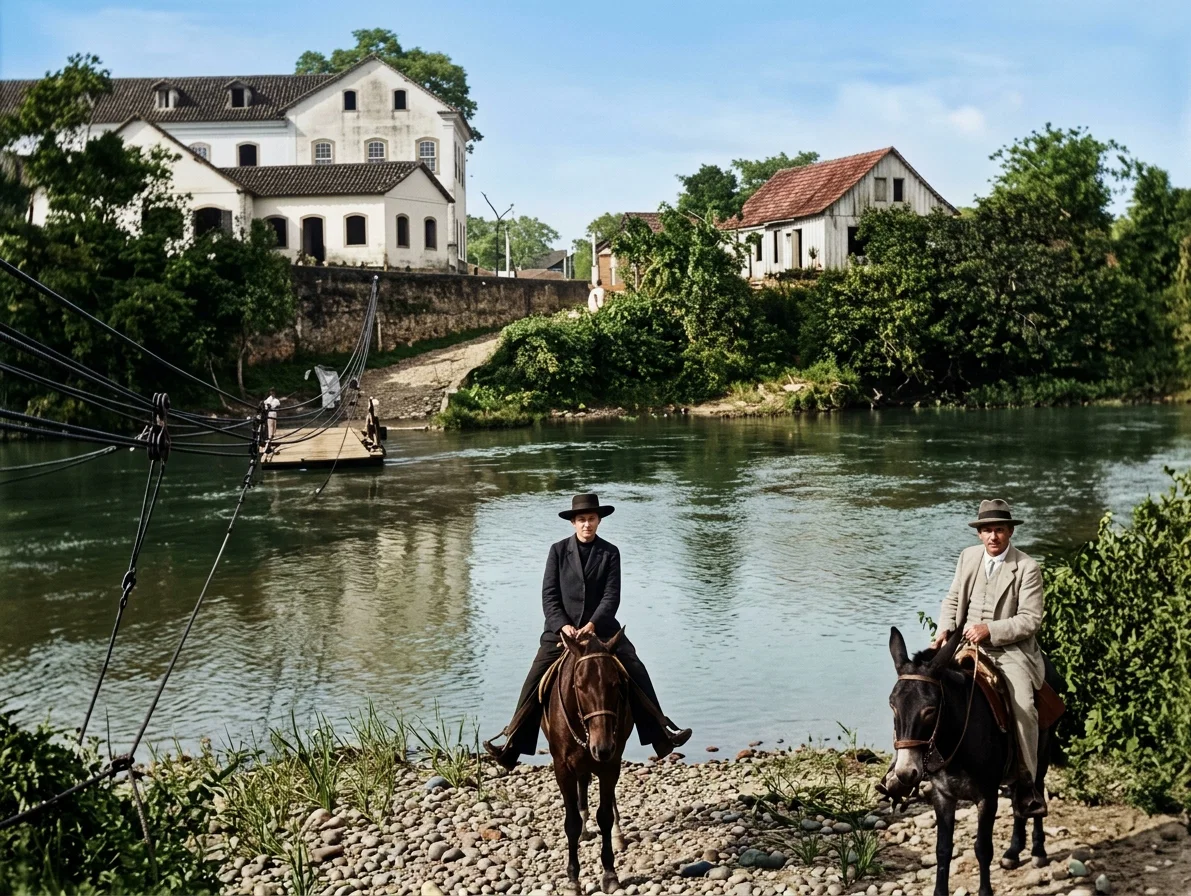
Owing to bad roads, it is impossible to make the trip by wagon, so we had to ride on mules or horses. Our company consisted of eleven persons. My wife, our daughter, ten years of age, and some of my former students accompanied me.
May 15 we left Brusque for Linha Torres, via Laguna, with twelve animals. It began to rain as we started, and continued almost all day. In the afternoon we had to climb a steep hill, by a road steeper than any I ever saw in the States. On account of the rain, the road was in a miserable condition. It was dark when we arrived at a small store kept by a Brazilian, where we stayed over night. Our beds were made on the floor. Some of us had to sleep on our saddle blankets, in a storeroom, in company with a number of rats.
Next morning before daylight we made preparations to go on. The second day was better, as we did not have much rain, and no steep hills. That night we stayed again with a Brazilian, some of us sleeping as we had the previous night, on our saddle blankets. Bread we could not buy here, and very few bananas.
The third morning we were compelled to ride a distance through a swamp. A stone path kept us from sinking. One step off this stone path could result in animal and rider losing their lives. The Lord kept us as we went through. It rained almost all day.
That evening we came to the home of a German family. There we got a good bed again, and a good warm meal, which we had not had since leaving home.
FERRY AT BRUSQUE
At every place we stopped, we held morning and evening worship. We sang, read the Bible, made remarks, and prayed. Our singing at this place brought many people together, and we hope we have prepared the way for a good work in the future.
Knowing that the worst part of our journey was to come, where little food could be bought, we purchased enough bread here to last for some time. About noon we had to climb a steep hill, and had to cross a river, after which we must ride through dangerous places. I remained at a dangerous place until the others had passed over. As my mule went on, he began to sink, and fell over on one side, throwing me into the water. One of my saddle pockets filled with water, and I got very wet. I managed to get the animal out again, and with the help of others we came ashore. I praised the Lord for his keeping, and that such an accident did not happen to one who could not swim. My wife or daughter, in the same position, might have lost their lives.
About twenty minutes later we came to a bakery, where I dried my books, clothing, etc., and bought some bread, after which we continued our journey.
On Friday before sunset we reached a small fisher village, where we concluded we would rest over Sabbath. We rented an old house, with three small rooms. There again we could have some warm food. We made our beds on the floor, on our saddle blankets. At this place we found souls hungry for the truth.
The Sabbath having begun, we sang, played the cornet, and read the Scriptures. Among the men who listened we found one who desired to come into close touch with us, so we held a Bible study with him and a few others. Though a Catholic, he expressed his faith in the Bible he had bought of a colporteur. One of our people who had passed through the village had given him a copy of the Arauto, our Portuguese paper, which he had read with interest.
Early Sabbath morning he came to us again with his Bible, hungry for the truth. Three times during the Sabbath we had Bible study with him and some others. It did our hearts good to see him drink in the truth. When we left on Sunday morning, he bought several tracts, subscribed for our Arauto, and invited us to visit him again. He said that he was our brother, and declared his willingness to do God's will. We do not know when one of our laborers will be able to visit him again. Few are the laborers, and great is the work, in Brazil. May God arouse some of our dear brethren in the States, who live in comparative ease and plenty, to consecrate their lives to God, and come over and help us to find in Brazil, under hardships and difficulties, hungry souls, and feed them with the bread of life.
On Sunday morning we must again cross a river. We took our saddles, etc., in a canoe, while our animals had to swim over. When, about noon of that day, passing through another village, we desired to buy bread, we were not able to do so. We made our dinner of oranges which we found, and some bread that we still had left. That night we stayed with a Brazilian fisher, a poor sick man who had not enough for his own family to eat. Eating the little we had remaining from our noon meal, we made our beds on the ground, in a shed, with dissatisfied stomachs, but with happy hearts, and after singing, reading, and prayer, retired. After a good night's rest, we went on the next morning, after our worship, with empty stomachs, expecting to be able to buy bread at the next village. But we hoped in vain. We had to take something else in its place. In the afternoon we arrived at Laguna, a city of about six thousand inhabitants, where we could get bread. It is sometimes difficult in this country to adhere to vegetarian principles.
On a small ferry, we had to cross a broad entrance of a lagoon, while the rain poured down. It was a dangerous passage. Happy we were at night to get a shelter in the house of a fisherman. We had bread and bananas for supper.
The next day it rained again. That night we could stay in a shed, making our beds on the bare ground, and having for supper some farina, made from a root called manioc, with some sugar and warm water.
The last was the worst day of our journey. It rained steadily. The roads were bad, and our stomachs were indeed dissatisfied, as we had to wait for food until about three o'clock in the afternoon. Cold, wet through and through, and hungry, we arrived at Linha Torres, where our people live, and a better time began.
Our journey lasted about eight and one-half days. I have given some details of this trip, that our brethren may14have an idea of the traveler's experience in Brazil, and how long it takes to go from one place to another. As we saw our brethren come from different places to attend the general meeting, we were glad, and forgot our difficult journey.
The German-Swiss Meeting
By GUY DAIL
GUY DAIL
IN Wadenswil, thirty minutes' ride up Lake Zurich from the delightful city of Zurich, the German-Swiss brethren held their fourth annual meeting, July 4-9. Along either bank of the green inland lake, stretching back up the hillsides, were the clean, well-kept villages, among the pleasant fields and orchards and fruit-trees and vines, while off in the distance were the snow-peaked Alps, painted red by the evening sun, the whole forming a picture more entrancing than the most delicate hand can portray, ever reminding us of the power, goodness, and love of our Creator, whose wonderful handiwork should cause us to admire, worship, and praise him.
WADENSWIL
Wadenswil itself contains about four thousand inhabitants, and many of them attended the services, so we had a fair attendance. Of our own people, there were about one hundred and sixty present. Twenty-three tents were on the ground, and this little white village could be seen by thousands of the dwellers just across the lake.
Elders Conradi, Erzberger (known to most of our readers as Erzenberger), Schuberth, and Frauchiger were able to unite their labors with the efforts of the workers in the field, feeding an interested audience on the bread of life.
Properly elected delegates represented every church and group in the conference. Two new companies applied for and received admission—the one at Sissach, where we held our meeting last season, and the other at Thalwil. During 1904 seventy were added to our membership, bringing it up from three hundred and sixteen to three hundred and eighty-six.
In the experiences related by the laborers, it was evident that the enemy had not been idle, and that we have not yet reached the time when one should think persecution an impossibility. In one godless and irreligious neighborhood, where there was a hatred for everything built upon the Word of God, and for the Bible itself, our worker was cast into a pool of dirty cold water, and the mob left him to get out the best way he could. Notwithstanding he was compelled to remain in his wet clothes for an hour, we are glad to say he suffered no ill effects. Another brother was laboring in a very devout neighborhood, where the people were divided into two opposing religious parties. Night after night he was laid in wait for by about twenty fanatics, who desired his hurt, but he passed through their midst unharmed, as they did not recognize him, and in one instance they watched for him until three o'clock in the morning, not knowing that he was safe at home in bed, having been protected from harm as he went by. Such instances remind one of the earlier days in the gospel work, and they will be more and more common as we near the end. In God alone can we rest safely; if our peace is made with him, we need have no fear of what man can do.
Six resolutions, some of them of general interest, were discussed and unanimously passed. They expressed thankfulness for God's care the past year, and humbly pledged to greater faithfulness in time to come, especially in encouraging proper young persons to enter our colporteur and evangelical work, and in the payment of tithes and First-day offerings (the First-day collection on Sunday amounted to one hundred and forty francs). It was also voted to establish a material fund for the aid of the "Ministry of Healing" in German, and to purchase a new tent before the next camp-meeting, as the two large tents now in use are made of unimpregnated canvas, and do not turn the rain, nor stand the dampness of the climate.
Seven persons were baptized on Sabbath, and one who was prevented from being present at the Sabbath baptism was baptized Sunday. This soul is our first-fruits in the unbelieving neighborhood to which we have already referred.
There was no party spirit, there was no lack of unity, in the business transactions of the conference. A good spirit was present, and the unconverted who began to serve God at the meeting are an evidence of his presence and power.
The finances of the German-Swiss field never were more prosperous. Their book sales amounted to $3,625 in 1903, and $2,926 the next year; their tithe to $2,418, and in 1904 it reached $3,102; gifts, 1903, $581, 1904, $569.
Brother O. Stoye, whose labors God has blessed, was ordained to the ministry of the gospel Sabbath afternoon; a very precious season was this for us all.
The officers chosen are as follows: President, J. T. Boettcher; Treasurer, A. Sebald; Secretary, O. Stoye; Secretary of Sabbath-school Department, Mrs. L. Sebald; Secretary of Missionary Department, T. Kestenholz; Committee, J. T. Boettcher, J. Erzberger, W. Kury, A. Sebald, J. Murbach.
Two ministers, one licentiate, and five Bible workers take up the work in this field, with its 2,319,000 inhabitants, for the coming year. We are glad for the progress being made, and hope God will continue to add his blessings, that the work may grow yet more rapidly.
Wadenswil, Switzerland.
Mission Notes
AN Eurasian named Macdonald, who is an elder in the Presbyterian church at Darjeeling, North India, went with the Younghusband expedition to Lhasa as interpreter. He was able there to preach Christ to several small groups of Tibetans, and to explain Christianity to the present prime minister and regent of Tibet, who was very anxious to learn about “the white man’s religion.” He gave three Gospels in Tibetan to this august inquirer, and distributed quite a number of Gospels among both lamas and laymen in Lhasa. Mr. Macdonald spoke the first words of Jesus Christ ever heard in the Lhasa-region from an evangelical Christian.
THE Moravian Mission Board was oppressed by a large deficit at the end of the year 1903. It now rejoices that the whole amount ($50,000 or more) has been paid by special contributions. The Baptist Missionary Society (England) gives thanks for the extinction of a similar deficit of nearly $50,000, by special subscriptions, two gentlemen of Cambridge—brothers—having agreed to pay whatever was still due after the subscriptions of the churches had all come in. The British and Foreign Bible Society has received 230,000 pounds toward the special Centenary Fund of 250,000 pounds ($1,217,000) which was called for as a reserve. Such facts show that the public interest in missions is not dying out.
A COLPORTEUR of the British and Foreign Bible Society working in Morocco reports the sale of seventy-nine Bibles and Testaments in a tour through twenty-seven Mohammedan villages. For these Scriptures he received $1.50 in cash, seventy-five cents’ worth of barley (horse feed), fifty-eight eggs, two chickens, two loaves of bread, ten cents’ worth of butter, and three cents’ worth of straw. Although generally well treated, the colporteur had to walk softly, because men in that land do not mince matters about their religious belief. One man undertook to kill the colporteur on general principles, saying that no one can object to the killing of a Christian. At another place the people proposed to burn him and his Bibles together, because the Bible does not contain the name of Mohammed.
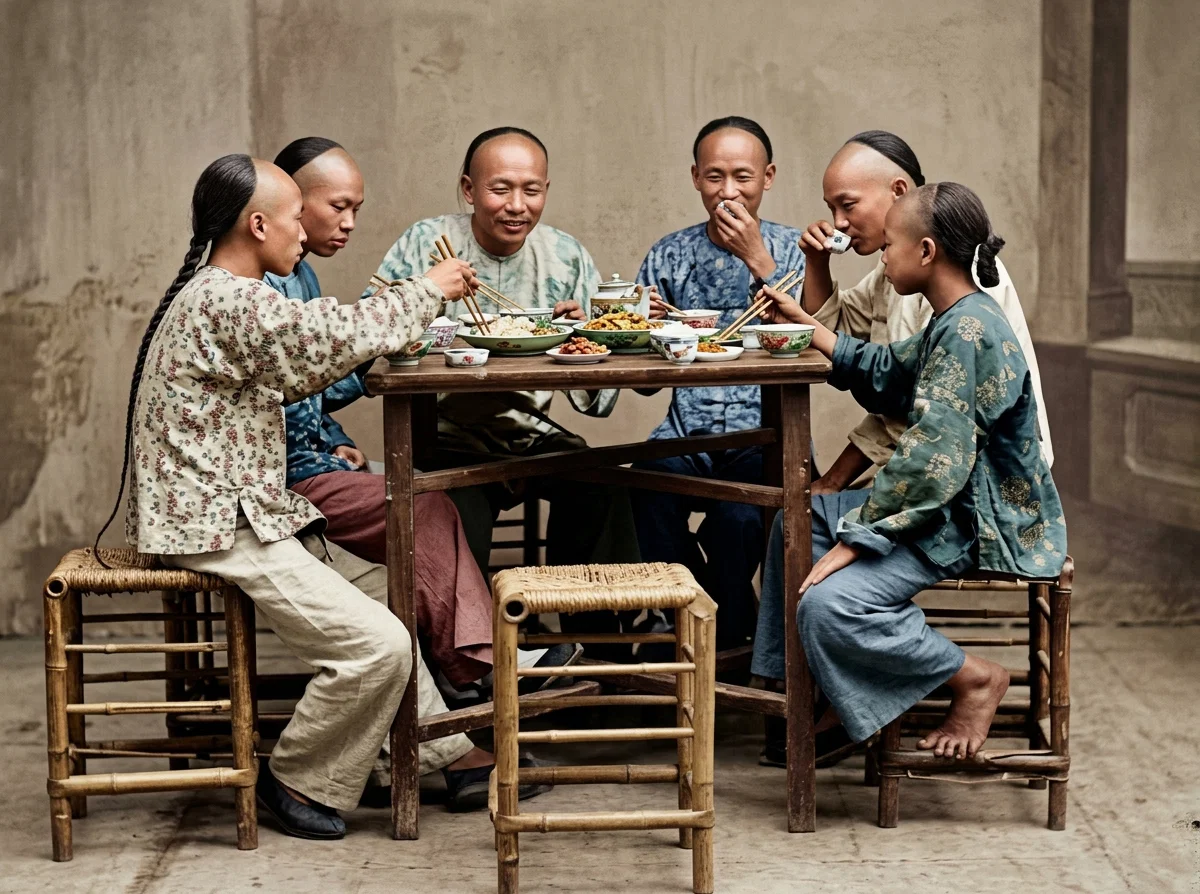
EATING WITH CHOP-STICKS
Canton and Amoy, China
By E. H. WILBUR
WITH longing hearts we have looked forward to the time when reinforcements should come to south China, and you may be sure we were glad to welcome Brother W. C. Hankins and his wife, who arrived in Hongkong, May 3, 1905. They came to Canton, and remained with us two weeks. This gave them an opportunity to rest from their long journey, and to get acquainted with the work and workers here. Our Chinese pastor in Amoy—Brother Keh Nga Pit—came to Canton to meet them. His visit was a source of encouragement to himself, as well as to all of us. He has been studying the Cantonese dialect some since last fall, and it is astonishing how much he can understand. We were glad to speak to him directly, instead of through an interpreter as formerly. I accompanied Brother and Sister Hankins to Amoy, where we arrived on the morning of May 21. Brother Keh and his wife kindly took us into their own home, and did everything possible to make us comfortable. A number of Chinese Christians called to see us, among whom were several pastors and teachers. As they inquired about our work, it gave an opportunity to present the truth to them.
May 24 Brother Keh and I went thirty miles, by steam-launch and sampan, to the village of Do Kong, our first inland mission in Fukien Province. Brother Tin Khi Tsoan, who connected with our work in February, had preceded us one day, so the people knew of our coming, and were waiting to receive us. We went at once to our Lai Pai Tong (“worship house”), a small two-story building fitted up for a chapel. We were given a drink of boiled water, and some fresh arbutus, a fruit resembling strawberries. We then walked out through the rice-fields, and visited some near-by villages, one of which is the home of several men who are interested in the gospel. At the home of one of these men we had supper, eating with chop-sticks. There are about fifty thousand people living in villages in this locality, and our mission is the first to begin gospel work there. Through one of those strange providences by which God puts inquiring souls in touch with his servants, one of these natives had heard of Brother Keh, and came to Amoy with the plea, “Come and teach us the gospel.” Four men, chief of four clans of about ten thousand souls, are favorable to our work. Two of them came to see me, and attended our meeting in the evening. The house was full of attentive listeners,—men and boys,—and I spoke to them for one hour about the true God and his ten commandments, and about Jesus our Saviour. I spoke in Cantonese, and Brother Keh acted as interpreter, addressing them in the Amoy dialect. After meeting we took a small boat, and while we slept were borne down the river with the tide, to the place where we took the steam-launch at six o’clock in the morning. We arrived in Amoy in time for breakfast at nine o’clock.
On Sabbath forenoon we had a service in our chapel in Kulongsu, the foreign settlement of Amoy. About eighteen persons were present, including children. In the forenoon we had another service in Amoy with a young printer, who has been keeping the Sabbath for several months. I asked his mother, who has been a Christian for several years, “Do you keep the Sabbath?” She replied, “I keep two days.” “Why do you do that?” “I am afraid if I do not keep Sunday, there will not be many people to accompany me to the grave when I die.” We told her that we would rather obey God and have eternal life, even if there were no one to accompany our remains to the grave, than to be the emperor of China, and have a multitude at our funerals. A good death is one of the five blessings earnestly sought for by the Chinese, and we can hardly realize how deeply this idea is implanted in their minds.
On the whole, the work in Amoy is most encouraging. Many have learned the Sabbath truth through Brother Timothy, and through Brother Keh and his tract. Now our brother has written a Chinese poem about the Sabbath, which will make this truth very plain to the women and children. One man, a native preacher,—Brother Tin Khi Tsoan,—is keeping the Sabbath with his family. He has not used tobacco for ten years. He is a humble man, and seems to be doing a good work in holding up the light of truth, as far as he knows it. Others seem convinced of the truth, and will undoubtedly step out, now that they see our work is permanent. Some, no doubt, are, as were the parents of the man who was born blind (John 9:22)—fearful lest they should be put out of the synagogue, as a resolution was passed at a recent conference in Kulongsu that if any should be found not observing the “Lord’s day,” but keeping Saturday, they should be promptly dismissed from church fellowship.
On Sabbath, June 3, I again had the privilege of meeting with our people in Canton. The work is moving forward here. We are finding new friends, who manifest an interest in our work, and we know that God has promised that “he that goeth forth and weepeth, bearing precious seed, shall doubtless come again with rejoicing, bringing his sheaves with him.” Ps. 126:6. Pray for us, brethren and sisters, and do not forget your offerings for China. This is a vast field; but if we all do our part faithfully, the Lord will soon finish the work. He has agencies ready for our hand.
E. H. WILBUR.
Hayti
By H. Williams
CAPE HAYTIEN.—I thank you very much for the news which your communications impart, particularly in regard to the appointment and preparation of Elder Tanner for Hayti. Anything less than great joy for such a blessing would not be natural, considering the years of expectation for such a favor. Elder Tanner’s arrival here is anxiously looked for, both by friends and by foes of the cause of present truth. The Protestant churches here are stirred to exercise themselves more than they have ever done before, and at the same time—as everywhere else—are making us appear to be engaged in an evil work. Brother Isaac is showing up their false and rebellious position in the papers, and they are uneasy.
H. WILLIAMS.
Mexico
By Geo. M. Brown
TACUBAYA.—We are passing through trying experiences in our family. We buried our little Martha, three years and eight months old, Friday, September 8. Mrs. Brown is almost prostrated with the strain of long watching and anxiety, and the baby boy is not well. We surely appreciate the Christian's hope as never before, and feel that the coming of Christ is more precious to us. We hope to have an interest in your prayers.
Brother Caviness still sends encouraging reports from the north. Our new colporteur sent us a list of forty subscribers the other day. Another man who is interested in our paper, but who is not employed by us, and whom we have never seen, has ordered three clubs of ten each, within a month.
We regret that the financial outlook is so unsatisfactory. We expect the Lord will provide in some way, but have not yet learned to eliminate the anxious thought, when we see the many opportunities for work and the few and meager facilities that we have to carry it on.
Geo. M. Brown.