An aged brother writes from Boulder, Colo.: “An article in a recent number of the Review awakened my heart to a new realization of the value of the true Sabbath. As a young man my mind was more or less exercised over the general observance of the first day of the week in face of the distinct Bible command to remember and keep holy the seventh day. Some forty-three years ago I attended a series of meetings conducted by an Adventist minister at Eureka, Kans., and learned of the third angel’s message, and of a people who observed the true Sabbath of the Lord. Surely the Bible is an open book when studied in the fear of God. I am rejoicing in his love today.”
Faithfulness in Health Reform
By Ellen G. White
— No. 2
MRS. E. G. WHITE
Health Reform to be Taught
Greater efforts should be put forth to educate the people in the principles of health reform. Cooking schools should be established, and house-to-house instruction should be given in the art of cooking wholesome food. Old and young should learn how to cook more simply. Wherever the truth is presented, the people are to be taught how to prepare food in a simple, yet appetizing way. They are to be shown that a nourishing diet can be provided without the use of flesh meats.
Teach the people that it is better to know how to keep well than how to cure disease. Our physicians should be wise educators, warning all against self-indulgence, and showing that abstinence from the things that God has prohibited is the only way to prevent ruin of body and mind.
Much tact and discretion should be employed in preparing nourishing food to take the place of that which has formerly constituted the diet of those who are learning to be health reformers. Faith in God, earnestness of purpose, and a willingness to help one another will be required. A diet lacking in the proper elements of nutrition, brings reproach upon the cause of health reform. We are mortal, and must supply ourselves with food that will give proper nourishment to the body.
Extreme Views
Some of our people, while conscientiously abstaining from eating improper foods, neglect to supply themselves with the elements necessary for the sustenance of the body. Those who take an extreme view of health reform are in danger of preparing tasteless dishes, making them so insipid that they are not satisfying. Food should be prepared in such a way that it will be appetizing as well as nourishing. It should not be robbed of that which the system needs. I use some salt, and always have, because salt, instead of being deleterious, is actually essential for the blood. Vegetables should be made palatable with a little milk or cream, or something equivalent.
While warnings have been given regarding the dangers of disease through butter, and the evil of the free use of eggs by small children, yet we should not consider it a violation of principle to use eggs from hens which are well cared for and suitably fed. Eggs contain properties which are remedial agencies in counteracting certain poisons.
Some in abstaining from milk, eggs, and butter, have failed to supply the system with proper nourishment, and as a consequence have become weak and unable to work. Thus health reform is brought into disrepute. The work that we have tried to build up solidly is confused with strange things that God has not required, and the energies of the church are crippled. But God will interfere to prevent the results of these too strenuous ideas. The gospel is to harmonize the sinful race. It is to bring the rich and poor together at the feet of Jesus.
The time will come when we may have to discard some of the articles of diet we now use, such as milk and cream and eggs; but it is not necessary to bring upon ourselves perplexity by premature and extreme restrictions. Wait until the circumstances demand it, and the Lord prepares the way for it.
Those who would be successful in proclaiming the principles of health reform must make the Word of God their guide and counselor. Only as the teachers of health principles do this, can they stand on vantage ground. Let us never bear a testimony against health reform by failing to use wholesome, palatable food in place of the harmful articles of diet that we have discarded. Do not in any way encourage an appetite for stimulants. Eat only plain, simple, wholesome food, and thank God constantly for the principles of health reform. In all things be true and upright, and you will gain precious victories.
Diet in Different Countries
While working against gluttony and intemperance, we must recognize the condition to which the human family is subjected. God has made provision for those who live in the different countries of the world. Those who desire to be coworkers with God must consider carefully before they specify just what foods should and should not be eaten. We are to be brought into connection with the masses. Should health reform in its most extreme form be taught to those whose circumstances forbid its adoption, more harm than good would be done. As I preach the gospel to the poor, I am instructed to tell them to eat that food which is most nourishing. I cannot say to them, “You must not eat eggs, or milk, or cream. You must use no butter in the preparation of food.” The gospel must be preached to the poor, but the time has not yet come to prescribe the strictest diet.
Loss in Neglect of Health Reform
Those ministers who feel at liberty to indulge the appetite are falling far short of the mark. God wants them to be health reformers. He wants them to live up to the light that has been given on this subject. I feel sad when I see those who ought to be zealous for our health principles not yet converted to the right way of living. I pray that the Lord may impress their minds that they are meeting with great loss. If things were as they should be in the households that make up our churches, we might do double work for the Lord.
Conditions of Answered Prayer
In order to be purified and to remain pure, Seventh-day Adventists must have the Holy Spirit in their hearts and in their homes. The Lord has given me light that when the Israel of today humble themselves before him, and cleanse the soul-temple from all defilement, he will hear their prayers in behalf of the sick, and will bless in the use of his remedies for disease. When in faith the human agent does all he can to combat disease, using the simple methods of treatment that God has provided, his efforts will be blessed of God.
If, after so much light has been given, God’s people will cherish wrong habits, indulging self and refusing to reform, they will suffer the sure consequences of transgression. If they are determined to gratify perverted appetite at any cost, God will not miraculously save them from the consequences of their indulgence. “They shall lie down in sorrow.”
Those who choose to be presumptuous, saying, “The Lord has healed me, and I need not restrict my diet; I can eat and drink as I please,” will prolong need, in body and soul, the restoring power of God. Because the Lord has graciously healed you, you must not think you can link yourselves up with the self-indulgent practices of the world. Do as Christ commanded after his work of healing, “Go, and sin no more.” Appetite must not be your god.
The Lord gave his word to ancient Israel, that if they would cleave strictly to him, and do all his requirements, he would keep them from all the diseases such as he had brought on the Egyptians; but this promise was given on the condition of obedience. Had the Israelites obeyed the instruction they received, and profited by their advantages, they would have been the world’s object lesson of health and prosperity. The Israelites failed of fulfilling God’s purpose, and thus failed of receiving the blessings that might have been theirs. But in Joseph and Daniel, in Moses and Elijah, and many others, we have noble examples of the results of the true plan of living. Like faithfulness today will produce like results. To us it is written, “Ye are a chosen generation, a royal priesthood, an holy nation, a peculiar people: that ye should show forth the praises of him who hath called you out of darkness into his marvelous light.”
Self-Surrender Brings Rest
O how many lose the richest blessings that God has in store for them in health and spiritual endowments! There are many souls who wrestle for special victories and special blessings that they may8do some great thing. To this end they are always feeling that they must make an agonizing struggle in prayer and tears. When these persons search the Scriptures with prayer to know the expressed will of God, and then do his will from the heart without one reservation or self-indulgence, they will find rest. All the agonizing, all the tears and struggles, will not bring them the blessing they long for. Self must be entirely surrendered. They must do the work that presents itself, appropriating the abundance of the grace of God which is promised to all who ask in faith.
“If any man will come after me,” said Jesus, “let him deny himself, and take up his cross daily, and follow me.” Let us follow the Saviour in his simplicity and self-denial. Let us lift up the Man of Calvary, by word and by holy living. The Saviour comes very near to those who consecrate themselves to God. If ever there was a time when we needed the working of the Spirit of God upon our hearts and lives, it is now. Let us lay hold of this divine power for strength to live a life of holiness and self-surrender.—General Conference Bulletin for June 2, 1909.
Spiritual Power Lost and Regained
By O. A. JOHNSON
O. A. JOHNSON
WHEN the Lord was here on earth, he selected twelve of his followers and trained them for missionary work. After some time he ordained the twelve and sent them out to preach, “The kingdom of heaven is at hand.” He gave them power over unclean spirits, to cast them out and “to heal all manner of sickness, and to” “raise the dead.” Matt. 10: 1-8. “And they departed, and went through the towns, preaching the gospel, and healing everywhere.” Luke 9: 1-6. The healing of the sick and other wonders were done by “the power of the Spirit of God.” Rom. 15: 19; 1 Cor. 12: 9.
“The apostles, when they were returned, told him all that they had done.” And when he was alone with his disciples, “he asked them, saying, Whom say the people that I am? They answering said, John the Baptist; but some say, Elias; and others say, that one of the old prophets is risen again. He said unto them, But whom say ye that I am? Peter answering said, The Christ of God.” Luke 9: 10, 18-20.
The apostles had gone out and preached the gospel as far as they had learned it, but Christ had now additional light for them. Hence we read that “from that time forth began Jesus to show unto his disciples, how that he must go unto Jerusalem, and suffer many things of the elders and chief priests and scribes, and be killed, and be raised again the third day.” But Peter was not prepared to receive this new light, even from Jesus himself, whom he had confessed to be Christ, the Son of the living God. Therefore Peter rebuked him, saying, “Be it far from thee, Lord; this shall not be unto thee.” Thereupon Jesus said to Peter, “Get thee behind me, Satan.” Matt. 16: 16, 21-23. This attitude of Peter to the additional instruction of Jesus was wrong, and grieved the Spirit of Christ. Other things also occurred that grieved the Holy Spirit from them.
Soon after this Jesus took Peter, James, and John up into the mountain, and was transfigured before them. The other nine disciples who were left behind, evidently felt somewhat jealous because these three should be permitted to be with Jesus while they were not thus favored.
Before Jesus came down from the mountain a person possessed with a devil was brought to the nine disciples to be cured, but they could not do it. Matt. 17: 1-21. They had lost the power attending them on their first missionary tour, and this power was not regained till after they were baptized anew with the Holy Spirit on the day of Pentecost. But instead of seeking to cultivate a spirit of humility, they cherished a spirit of selfishness; for soon afterward, on the way to Capernaum, they were disputing which of them should be greatest. Thereupon Jesus taught them that he who desires to be greatest must be the servant of all, and be like a little child. Mark 9: 33-37; Luke 9: 46-48.
But somehow it seemed so hard for them to be united; for later we find James and John, through their mother, asking that they might sit one at the right and the other at the left in his kingdom. “When the ten heard it, they were moved with indignation against the two brethren.” Again Jesus had to give them the lesson on humility. Matt. 20: 20-28. Now this we might suppose would have been sufficient on this subject; but not so, for we find that when they were seated at the last Passover supper, just before the institution of the Lord’s Supper, a strife arose among them “which of them should be accounted the greatest.”
And now again he had to teach them the lesson of humility, and illustrate it by washing their feet. John 13: 1-17. How sad it must have made Jesus feel to see his disciples, whom he had taught and ordained to preach the gospel, and to whom he had given power to heal all manner of disease, manifesting such selfishness and discord among themselves, and to see it continued even till the last day of his ministry! No wonder they had lost the power to cast out devils; no wonder they were not able to remain loyal to Christ during his hour of bitter trial and crucifixion! Under these circumstances we can better understand why Jesus prayed so earnestly that his disciples might be one as he and his Father were one. John 17: 11, 20, 21.
Before his ascension, Jesus counseled his disciples to remain at Jerusalem until they were endowed with the Holy Spirit which he had promised them. Luke 24: 49; Acts 1: 8. After his ascension they returned to Jerusalem, and devoted to prayer the remaining ten days before Pentecost. They put away all differences, and continued to seek God till they finally became of one accord, and then the Holy Spirit was given them in fulness and power. Then Peter could preach with such demonstration of the power of the Spirit that thousands were converted. The sick were healed by the touch and even by the shadow of Peter falling upon them. Acts 1 to 5. They prayed and were all filled with the Holy Spirit, so that “the multitude of them that believed were of one heart and one soul.” Acts 4: 24-33.
The power of the Spirit at first enjoyed by the apostles, which was lost by unbelief, dissension, and strife, was now restored to them in even greater measure after they had put away all selfishness, all differences, and had been united in humility and love.
Is it not a fact that there is a great dearth of God’s Holy Spirit among his professed people? And why? Is not a desire for supremacy one chief cause of selfishness in the Sabbath school, in the church, and in the conference? Is there that real humility among the workers, a heart desire to esteem others better than themselves? We must be of one accord among ourselves as workers and laymen if we ever expect to receive the promised blessing, the fulness of the Holy Spirit. We must be in harmony with God’s revealed will. Then and not till then will we receive the latter rain of God’s divine Spirit and power. The heart must be cleansed from all sin and selfishness, and there must be a full consecration to God before we can receive and enjoy the fulness of the Spirit.
But how long shall the Lord have to wait before we are so emptied of self that he can fill us with that blessed Spirit of peace and power? Oh, let us not rest till we know by personal and living experience that we are enjoying this sweet heavenly communion with God.
College Place, Wash.
That Missing Testimony
By L. T. Nicola
L. T. NICOLA
The topic study was faith. A testimony meeting followed. Many excellent experiences and Bible incidents were mentioned. All present took part, except one young man; and he was a Christian. At the close of the service the leader passed around, cordially shaking hands with those present. He remarked to the young man who had had nothing to say, “I regretted to close the exercises without hearing from you.” This was the reply: “I feared that I could not add anything to the interest of the occasion; for I could only think of a verse of Scripture to use in a testimony, and that was 1 John 5:4: ‘For whatsoever is born of God overcometh the world: and this is the victory that overcometh the world, even our faith.’” “Be assured,” was the response, “the meeting suffered a real loss by your failure to quote that very text. Its use would have given a completeness to the service that9it did not have; also you would have received a blessing that you did not receive. That missing testimony would have been a real aid to the meeting.”
Detroit, Mich.
To Whom and When Given
By MILTON C. WILCOX
The Law of God — No. 3
To Whom and When Given
MILTON C. WILCOX
“Open thou mine eyes, that I may behold wondrous things out of thy law.” God’s law, the decalogue, is found in Ex. 20: 3-17. We quote the first and second verses also:—
“God spake all these words, saying: I am Jehovah thy God, which have brought thee out of the land of Egypt, out of the house of bondage.”
I
“Thou shalt have no other gods before me.”
II
“Thou shalt not make unto thee any graven image, or any likeness of anything that is in heaven above, or that is in the earth beneath, or that is in the water under the earth: thou shalt not bow down thyself to them, nor serve them: for I Jehovah thy God am a jealous God, visiting the iniquities of the fathers upon the children unto the third and fourth generation of them that hate me; and showing mercy unto thousands of them that love me, and keep my commandments.”
III
“Thou shalt not take the name of Jehovah thy God in vain; for Jehovah will not hold him guiltless that taketh his name in vain.”
IV
“Remember the Sabbath day, to keep it holy. Six days shalt thou labor, and do all thy work: but the seventh day is the Sabbath of Jehovah thy God: in it thou shalt not do any work, thou, nor thy son, nor thy daughter, thy manservant, nor thy maidservant, nor thy cattle, nor thy stranger that is within thy gates: for in six days Jehovah made heaven and earth, the sea, and all that in them is, and rested the seventh day: therefore Jehovah blessed the Sabbath day, and hallowed it.”
V
“Honor thy father and thy mother: that thy days may be long upon the land which Jehovah thy God giveth thee.”
VI
“Thou shalt not kill.”
VII
“Thou shalt not commit adultery.”
VIII
“Thou shalt not steal.”
IX
“Thou shalt not bear false witness against thy neighbor.”
X
“Thou shalt not covet thy neighbor’s house, thou shalt not covet thy neighbor’s wife, nor his manservant, nor his maidservant, nor his ox, nor his ass, nor anything that is thy neighbor’s.”
The above is from the common English version, with one exception, namely, the covenant name of God, “Jehovah,” is substituted for “the Lord.” Now “there are lords many,” but there is only “one Jehovah.” Deut. 6:4. Whenever the word Lord, printed in capitals or small capitals, or with initial capital, occurs, it comes from the word Jehovah. The last term is distinctive, it is the name by which the God of the Bible designates himself. The word “lord” means only “master.” It is applied to human beings and heathen deities. The covenant name Jehovah will be often used in these articles.
The Lawgiver
Whose law is this? “And God spake all these words.” The law is therefore God’s law. It is not a result of human study, human devising, or human development. It came from God, adapted to fallen humanity.
God gave the law; not the God of the Jews, not the God of the Assyrians, not the God of the Philistines, not the God of the Gentiles in general or in particular, but the God of heaven and earth, to whom all are subject, to whom all are amenable, to whom the homage and obedience of all are due.
The Place of Giving
This, too, is indicated by the place where the law was given. God did not so speak it in Egypt. He did not wait till Israel came to Palestine. He led a people out into the desert wild, in no man’s land, and there amid the solitudes of the everlasting hills and the strength and steadfastness of the mountains, God spoke from Sinai’s blazing summit his holy law. It was given by the one God; it was given for all the world.
To Whom Committed
It must be committed to some on earth for their own upbuilding and for the salvation of all. It was committed to one of the smallest peoples of earth, a nation of slaves redeemed out of bondage, in order that the glory and the praise should be seen to be of God and not of man. It was God’s design that the custodians of his holy law, and all the blessed gospel truths connected therewith, should be an obedient people, “an holy nation,” “a kingdom of priests.” Ex. 19: 4-6. “The priest’s lips should keep knowledge, and they should seek the law at his mouth: for he is the messenger of Jehovah of hosts.” Mal. 2: 7. The whole nation of Israel should be God’s priest to all the nations of the world, that the nations might learn of God and find in him salvation.
That holy trust committed to them by God—not because of their wealth, or their greatness, or their power—would be the thing that commended them to the nations. “Behold, I have taught you statutes and ordinances, even as Jehovah my God commanded me, that ye should do so in the midst of the land whither ye go in to possess it. Keep therefore and do them; for this is your wisdom and your understanding in the sight of the peoples, that shall hear all these statutes, and say, Surely this great nation is a wise and understanding people. For what great nation is there, that hath a god so nigh unto them as Jehovah our God is whensoever we call upon him? And what great nation is there, that hath statutes and ordinances so righteous as all this law, which I set before you this day?” Deut. 4: 5-8, A. R. V. Their very songs breathed the missionary spirit:—
“O give thanks unto Jehovah, call upon his name;
Make known his doings among the peoples. . . .
Show forth his salvation from day to day. Declare his glory among the nations,
His marvelous works among all the peoples.”
The Law and the Land
There is much more which clearly shows that God designed that Israel should be a missionary people. For that very reason he placed them in the little land that he did, the center of the earth, through which the travel of the world passed between Egypt and Babylonia. It was a great trust and a wonderful opportunity.
The decalogue was not therefore a law for the Hebrews alone, but for all the world through them, even as the salvation in Christ Jesus came through them. Rom. 9: 4, 5; John 4: 22.
One Law
God’s law is one law, even as God is one. There is no diversity in it, there are no contradictions, no inconsistencies. The same God who spoke one commandment, spoke all. The first precept is equally holy with the fifth, or seventh, or tenth. They are ten constituent, essential parts of one law. If any are wanting, the law is incomplete, the perfect chain broken. It no more represents the perfect character of God for his children. Rebellion against one is rebellion against all; for it is rebellion against the Lawgiver who requires its obedience. To choose to regard some precepts and to reject others is to exalt ourselves above God, and to condemn him. Thus we may see how, if we “offend in one point,” we “are guilty of all;” for it is not the mere cold legal precept to which we are subject, but to the God who gave the law.
These articles do not, nor can they in the nature of the case, bring out all the great evidences of unity and beauty in God’s law. It is hoped they will be suggestive of many excellent thoughts these studies do not contain.
Mountain View, Cal.
Making Circumstances Our Helpers
By Lucy Larcom
It is a conquest when we can lift ourselves above the annoyance of circumstances over which we have no control; but it is a greater victory when we can make those circumstances our helpers, when we can appreciate the good there is in them.— Lucy Larcom.
Living for Christ Daily
By John Caird
It is a great thing to love Christ so dearly as to be “ready to be bound and to die” for him, but it is often a thing not less great to be ready to take our daily cross and to live for him.—John Caird.
Fukien Province, South China
By B. L. ANDERSON
B. L. ANDERSON
Just as the unusually hot weather of the past summer was drawing to a close, it was announced that the property secured by the mission last spring in the city of Chioh-be had been put in repair, and the building was in readiness for dedication. Accordingly a four days' meeting was appointed to be held in the new chapel, when a special effort would be made to reach the heathen population, of both the higher and the lower classes. The new chapel was dedicated on Sabbath, September 11, and meetings adapted especially for the heathen were held during the next four days.
Photo by J. C. Rogers
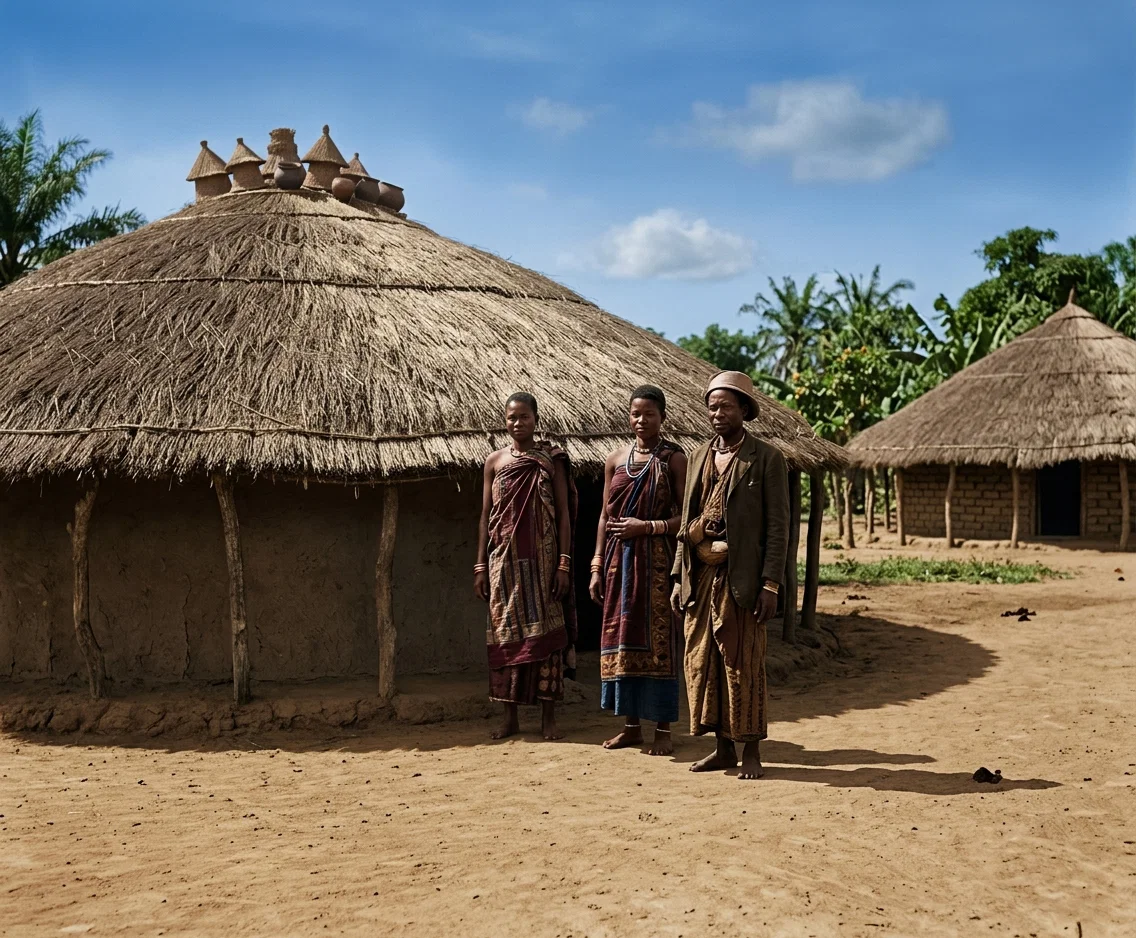
VILLAGE NEAR KONGO BORDER
These meetings were well attended, especially the evening services. The chapel, which will accommodate two hundred persons, was crowded to the limit, and the people listened with intense interest. Toward the close of the effort cards were passed out, asking for the names and addresses of those wishing to become members of the regular Bible class which would be conducted after the close of the public meetings. Forty-six names were passed in, and others have joined since, until nearly eighty names are enrolled as members of the Bible class.
Among those who have attended the Bible classes are two persons whose characters might be called in question when we consider the business in which they were engaged. The one is a man whose business was to collect the governmental revenue from the brothels, and the other is a woman who has been buying young girls and renting them out for immoral purposes. The revenue collector attended the meetings faithfully, and afterward the Bible classes. He became intensely interested in the gospel, and gives evidence of becoming a Christian. As the woman listened to the preaching of the word, and continued the study of the Bible, a new life has sprung up in her soul, and she sees the wonderful truth of God and recognizes the error of her ways. She has declared that the business in which she has been engaged must cease, and she purposes henceforth to live a different life. In speaking of this matter, the evangelist said that he was forcefully reminded of the words of Jesus: "Verily I say unto you, That the publicans and the harlots go into the kingdom of God before you."
During this series of meetings the same plan was followed in regard to the women as at other times. Mrs. Hankins and Mrs. Anderson were present, and held several meetings for both Christian and heathen women. At the close of one of the meetings, one poor woman said with tears in her eyes, "It is certainly very much better to come and worship the Lord than to remain in the heathen worship."
Brazilian Union Conference
By F. W. SPIES
F. W. SPIES
REPORTING from Brazil for the past year, were we to tell the story only from the standpoint of material conditions, it would be many shades darker and sadder than were the reports for other years. The commercial and industrial crisis, which had already been burdening the country for several years, grew more tense in consequence of conditions in the country and outside of it. And to the already sad conditions which sent many to their beds at night hungry, were added the anguish and horrors of drought and famine.
The almost unprecedented heavy rains in the northern part of Brazil during the rainy season of 1914, were followed by a drought and consequent famine last year. The daily papers of the northern states told sad and heart-rending stories of suffering and starvation. The people waited and hoped, hoped and waited, that the much-coveted blessing — rain — would descend from heaven. But all in vain. They saw their scant water supply dry up, their cattle starve before their eyes, their children grow weak and emaciated. At length it became apparent to many that unless they should leave, they, too, would perish. They started, but alas! many had waited too long. Their children had grown so weak that some of them could no longer endure the long journey necessary under a scorching tropical sun in a parched country, and some of them had to be left behind along the way. Many finally reached the help sought for, and others succumbed.
Such conditions show that the whole creation is groaning for that glad day when all the suffering caused by sin shall forever have passed away. They should also teach us to pray more fervently than ever before, “Even so, come, Lord Jesus.”
Looking at the situation from the standpoint of the work of God, the year 1915 has been one of special blessing and progress. The work has been strengthened in the older fields, and a promising beginning made in some new ones.
In spite of the difficult financial condition, our book work has increased almost 50 per cent. During the year 1914 we sold $13,312 worth of books, whereas in 1915 we reached the sum of $18,745.50. Our publishing house has been busy. Aside from printing new editions of books and tracts, we printed 16,000 “Coming King” in Portuguese, and some new tracts. Our special war journal enjoyed three editions, a total of 70,000 copies.
Last year a new training school for gospel workers was opened, located about five miles south of Santo Amaro. Eighteen students have thus far enrolled, at the same time assisting in building up the school. We certainly feel encouraged at the prospect of being better able in the future to educate our young Brazilian brethren who desire to enter the work, as these can, in many respects, work more effectually for their people than can missionaries from other countries.
We have in our union at present 2,017 members, a gain of 321 for 1915. There was paid in tithes $17,933.70, and in other offerings for missions $3,476.45, which shows some gain over 1914 in spite of the hard times.
War Conditions in the Colonies
By J. C. ROGERS
J. C. ROGERS
I THINK few of our people can understand readily how severely mission work is affected by the great war. I am hearing of the great growing interest in the message in the territory of the actual warring nations. The reason for this is plain. People want to know its meaning, and turn to God's Word for light.
Photo by J. C. Rogers
CHIEF OF VILLAGE, IN BELGIAN KONGO,
AND HIS WIVES
In the mission field, that is, the heathen field, the situation is reversed, and for various reasons. This is truly a world war, no colony or dependency being safe or at peace. I shall illustrate this fact by my own experiences in one of the most isolated dependencies anywhere to be found.11
Northeast Rhodesia, a huge slice or block of Africa, has no railroad or steamboat line anywhere touching its border. It is no less than a month's travel from the nearest railway connections to its northern, central, or southern point. Yet not a corner of it is unaffected by the war. In the extreme north, where I have spent almost eighteen months, along the borders of the Belgian Kongo and of German East Africa, nothing but unrest exists. The attention of government officials is almost wholly given up to military affairs. The native gets attention only as he is required for government service of some kind, or in case he may be powerful enough to be feared politically. All villages must send able-bodied men as carriers for the troops (white and black), but on demand of local officials. For a force of one hundred white troops, no less than seven hundred native carriers are required. Six hundred native troops require about a thousand carriers and workmen, approximately two carriers for one soldier, including all classes of troops. That is, if ten thousand troops are operating in a certain district, it still means that thirty thousand men must be fed, clothed, and doctored as required. Thirty thousand to be provisioned means sixty thousand pounds of native flour daily, besides beans, peas, fish, meat, and salt used as relish to go with the flour which is made into porridge.
Photo by J. C. Rogers
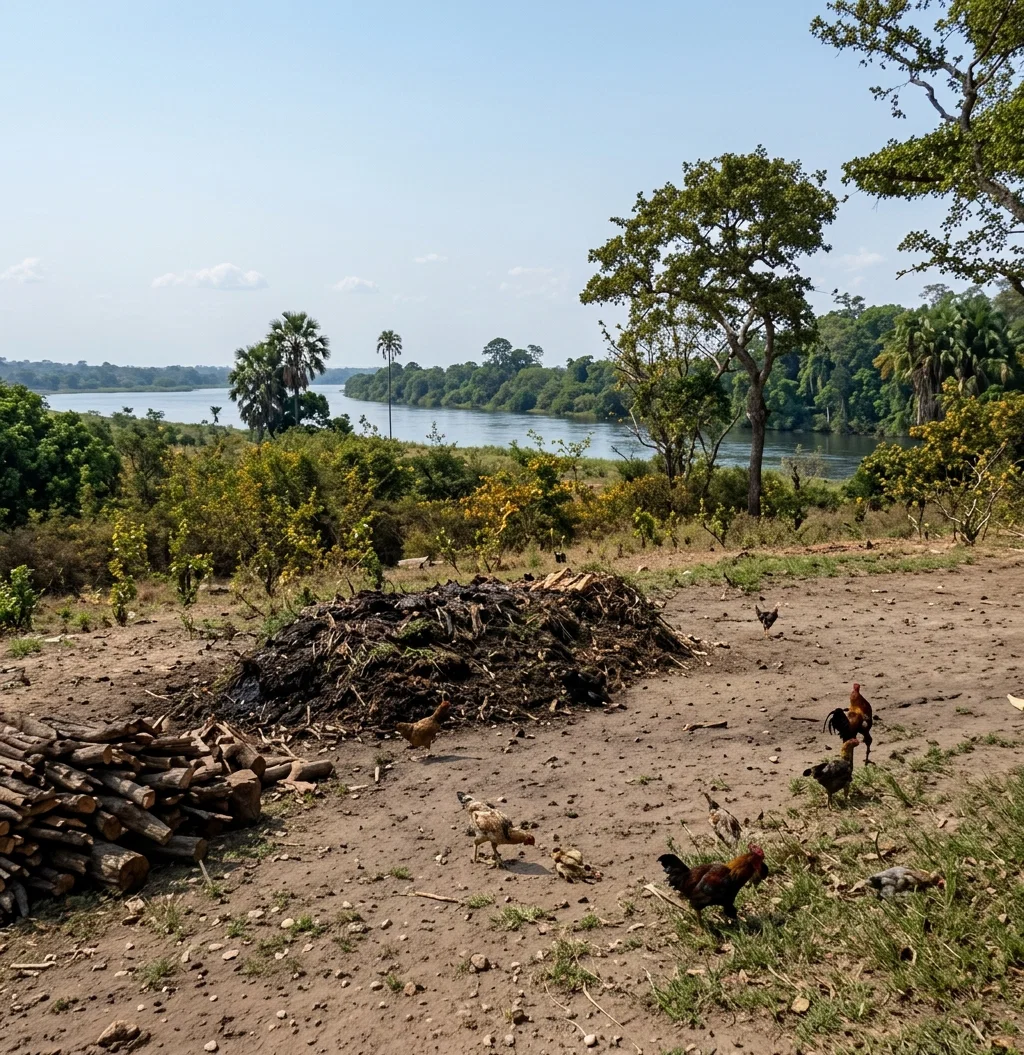
LUAPULA RIVER (TAKEN FROM HOUSE
OF BELGIAN MANAGER)
Thirty tons more or less to be ground, collected, and carried from one to three hundred miles each day, keeps all officials and nearly all the people, men, women, and children, busy with this provisioning of the troops.
Along the borders where military operations are active, all is agitation and expectation, unrest. This has been the condition along the Belgian border of the Kongo State, the British border of German East Africa, and I think along the borders and in many interior points of all colonies and dependencies in Africa.
Some of our people will be asking, Why have our missionaries not written about these conditions? The answer is, It has seemed best to say little regarding these conditions, as all outgoing matter is carefully censored. As I am now at the Cape12and writing regarding conditions of three months ago up in the interior, no doubt the censor will let my report go through.
I have left the border because of military operations, and to accompany my wife to the sanitarium at Cape Town. She has recently been raised up by God's hand after the doctors gave her up. She is still very weak, but improving slowly. She is now able to walk about the building with the help of the nurses. Never having been sick before, it goes hard with her. But she is very patient, and longing to return to Central Africa.