Your ShelfYour Projects

Signs of the Times, Vol. 22, No. 6.

The Sowers: Parable of the Wheat and Tares

Signs of the Times

Feb 6, 1896

Pacific Press Publishing Company · Oakland, California · Feb 6, 1896

The Sowers: Parable of the Wheat and Tares
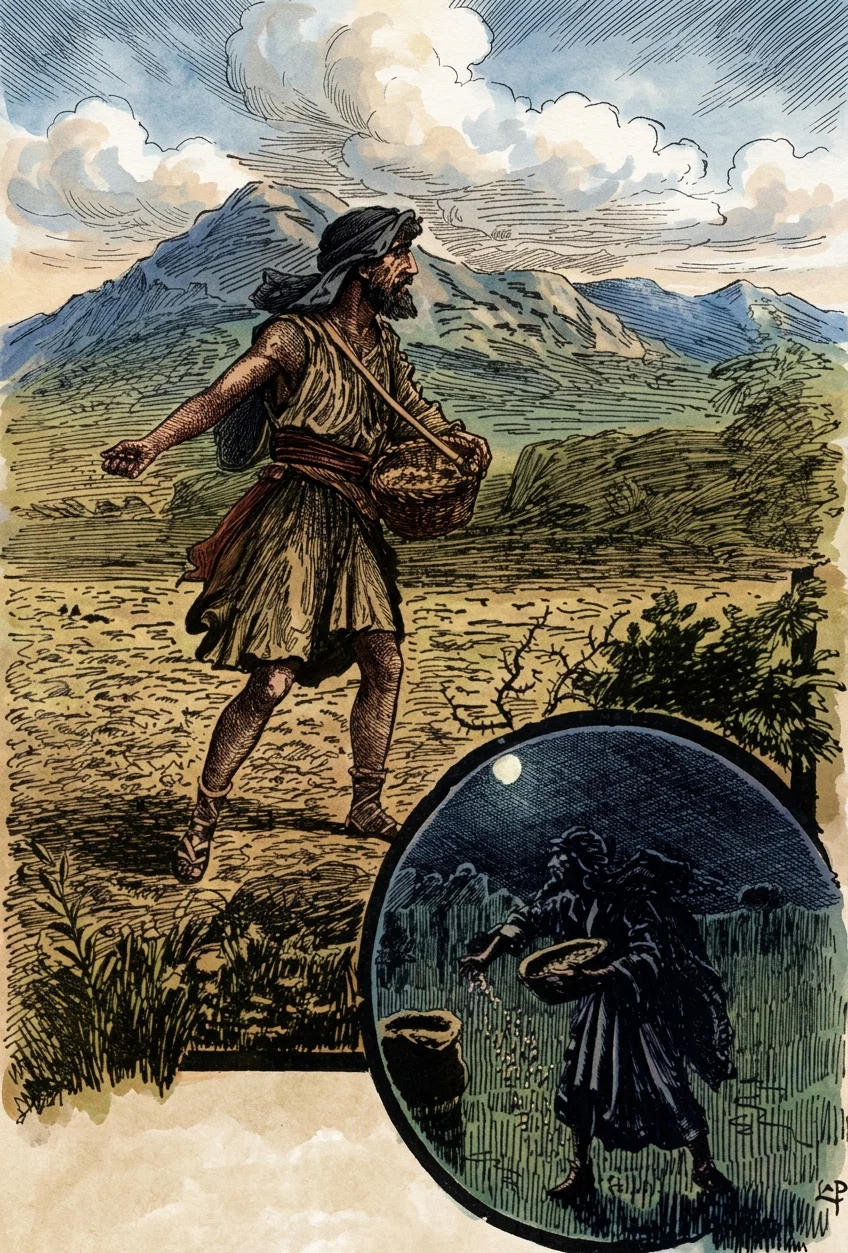
The Sowers.—One of the comprehensive parables of our Lord is that commonly called the “Parable of the Wheat and Tares,” or the “Parable of the Tares.” It is recorded only by Matthew, and reads as follows:—
“The kingdom of heaven is likened unto a man which sowed good seed in his field; but while men slept, his enemy came and sowed tares among the wheat, and went his way. But when the blade was sprung up, and brought forth fruit, then appeared the tares also. So the servants of the householder came and said unto him, Sir, didst not thou sow good seed in thy field? from whence then hath it tares? He said unto them, An enemy hath done this. The servants said unto him, Wilt thou then that we go and gather them up? But he said, Nay; lest while ye gather up the tares, ye root up also the wheat with them. Let both grow together until the harvest; and in the time of harvest I will say to the reapers, Gather ye together first the tares, and bind them in bundles to burn them; but gather the wheat into my barn.”
Light to the Upright.—There has been much speculation and many interpretations of this parable among expositors and teachers. It has been wrested and warped in every conceivable way to fit this doctrine or that, or to escape the conclusions of the parable itself. All this has been done in the face of the fact that our Lord himself has given us the interpretation of the parable. And yet those who thus construe the teachings of our Lord fulfill the very words of Jesus, spoken on the occasion when this parable was given. There is light in the parables of Christ in all his teachings if men will seek it aright, if they truly desire to walk in the light. “To the upright in heart there ariseth light in the darkness.” “Light is sown for the righteous.”
The precious jewels of truth are not given to be trodden underfoot of swine. They are living food to the hungry soul. “Blessed are they that hunger and thirst after righteousness; for they shall be filled.” The parables of Christ were given to illustrate the very truths which were already in the possession of the Jews, but they could not see them, because they did not know in their own lives the power of the truth. Wherefore, our Lord said:—
“For this people’s heart is waxed gross, and their ears are dull of hearing, and their eyes they have closed; lest at any time they should see with their eyes, and hear with their ears, and should understand with their heart, and should be converted, and I should heal them.”
The More Hopeless.—None are so blind as those who will not see; none so hard of hearing aright as those who stop their ears against instruction; none so hard-hearted, vile criminal though he may be, as those who determinedly resist the truth. The scoffing Pharisee at the foot of the cross who prided himself on his righteous life, was harder of heart than the penitent thief who was suffering justly for his crimes. Let the heart and life be opened toward God, and his truth will ever be light and beauty.
The Interpretation.—After Jesus had spoken the parable, his disciples came unto him and asked its meaning. He replied as follows:—
“He that soweth the good seed is the Son of man; the field is the world; the good seed are the children of the kingdom; but the tares are the children of the wicked one; the enemy that sowed them is the devil; the harvest is the end of the world; and the reapers are the angels.
“As therefore the tares are gathered and burned in the fire; so shall it be in the end of the world. The Son of man shall send forth his angels, and they shall gather out of his kingdom all things that offend, and them which do iniquity; and shall cast them into a furnace of fire; there shall be wailing and gnashing of teeth. Then shall the righteous shine forth as the sun in the kingdom of their Father. Who hath ears to hear, let him hear.” Matt. 13:37–43.
Christ the Sower.—Nothing can be plainer than the meaning here given. We may enlarge upon the meaning; but the words may not be perverted. Christ is the sower, not alone personally, but through his representatives. The good seed are the children of the kingdom, Christ’s kingdom of righteousness. They are made what they are by receiving the incorruptible seed of life, the word of God. See 1 Peter 1:23; Luke 8:11. The word is spirit and life (John 6:63), and all those who have received that word, and “in an honest and good heart” “keep it, and bring forth fruit with patience” (Luke 8:15) are the children of the kingdom of God.
The Evil Sower.—The sower of the evil seed is the devil, with all his agents, and his time of sowing is from the time that sin entered into this world till the end. He sows not truth, but lies, error, falsehood. “He is a liar, and the father of it,” and “abode not in the truth.” He does not love truth. Himself deceived, his object is the deception of others. While he seems at times to use truth, it is but the surface facts by which he hides the lies. The truth is eternal and infinite. It roots in the Everlasting Throne and draws its nourishmentfrom the river of life. But error is the surface of truth perverted. It is the stream of life perverted to the channel of death. Satan uses every device, every artifice of evil, with, just so far as will serve his purpose, a veneering or interweaving of truth. But it is never truth for truth’s sake, but for his own baleful, selfish purpose; and for this he ever appeals to some base, selfish motive of man. And this seed of error and evil received into the heart of men makes them children of the wicked one, represented by the tares, or darnel.
Patiently Wait.—Man is finite. He knows but little. He can not always tell the young tares from the wheat. Sometimes the two plants are so intertwined that to root up one roots up the other. Therefore to man in this life is not committed the judgment of his fellows. Even Jesus did not thus judge. John 12:47. We must wait till the harvest, the end of the age, when the righteous will be taken to their eternal home, and the wicked receive the thing they have chosen, death.
Some Other Lessons.—We learn also from this parable that there never will come a time in this present arrangement of things when all men will be converted. Both the good and the evil, the righteous and the sinner, will remain together on earth till the harvest time. We learn that there will be no everlastingly burning hell, but as “the tares are gathered and burned in the fire,” so shall it be with the wicked. They have chosen destruction; and their “end is destruction.” See Phil. 3:19; Mal. 4:1–3. The parable is a fruitful field, but we may glean no more at present. But, reader, the great question is, What seed is sown in your heart? Whose child are you? This is for you to decide. May you do it wisely, in view of eternity.

ESTABLISHING THE LAW.

We now come to the close of the third chapter of Romans, but will defer a general review until later. It will be sufficient for the present simply to mark the connection between the last lesson and this one. In that we found that righteousness is the free gift of God unto every one that believeth. It is not that God gives a man righteousness as a reward for believing certain dogmas; the Gospel is something entirely different from that. It is this, that true faith has Christ alone as its object, and it brings Christ and his life actually into the heart; and therefore it must bring righteousness. This act of mercy on the part of God is eminently just, because in the first place the sin is against God, and he has a right to pass by offenses against him; and, further, it is just, because he gives his own life as an atonement for the sin, so that the majesty of the law is not only maintained, but is magnified. “Mercy and truth are met together; righteousness and peace have kissed each other.” Ps. 85:10. God is just and the justifier of him which believeth in Jesus. All righteousness is from him alone.
“Where is boasting then? It is excluded. By what law? of works? Nay; but by the law of faith. Therefore we conclude that a man is justified by faith without the deeds of the law. Is he the God of the Jews only? is he not also of the gentiles? Yes, of the gentiles also; seeing it is one God, which shall justify the circumcision by faith, and uncircumcision through faith. Do we then make void the law through faith? God forbid; yea, we establish the law.” Rom. 3:27–31.

Questioning the Text.

What have we previously learned as to the condition of all men?
“Guilty before God.” “For all have sinned.”
What is God to them that believe?
“The justifier of him which believeth in Jesus.”
How does he justify those who have sinned?
“Freely by his grace through the redemption that is in Christ Jesus.”
What righteousness does the man so justified have?
“The righteousness of God which is by faith of Jesus Christ.”
Where is boasting then?
“It is excluded.”
By what law? of works?
“Nay; but by the law of faith.”
What then is the conclusion?
“Therefore we conclude that a man is justified by faith without the deeds of the law.”
Is God the God of the Jews only? is he not of the gentiles also?
“Yes, of the gentiles also.”
What is the proof?
“Seeing it is one God, which shall justify the circumcision by faith, and uncircumcision through faith.”
Do we then make void the law through faith?
“God forbid [Not by any means.]; yea, we establish the law.”
No Boasting.—“Where is boasting then? It is excluded.” Since righteousness is a free gift of God through Jesus Christ, it is evident that no one can justly boast of any righteousness that he has. “For by grace are ye saved through faith; and that not of yourselves; it is the gift of God; not of works, lest any man should boast.” Eph. 2:8, 9. “Who maketh thee to differ from another? and what hast thou that thou didst not receive? now if thou didst receive it, why dost thou glory, as if thou hadst not received it?” 1 Cor. 4:7.
What Boasting Proves.—“Behold, his soul which is lifted up is not upright in him; but the just shall live by his faith.” Hab. 2:4. Boasting, therefore, is an evidence of a sinful heart. But suppose a man boasts of his righteousness, as, for instance, when a man says that he has lived without sin for so many years? “If we say that we have no sin, we deceive ourselves, and the truth is not in us.” 1 John 1:8. But are not the grace and power of God manifested in Christ to cleanse and keep us from sin?—Most certainly; but only when in humility we acknowledge that we are sinners. “If we confess our sins, he is faithful and just to forgive us our sins, and to cleanse us from all unrighteousness.” 1 John 1:9. When we say that we have no sin, that very thing is evidence that we have; but when with faith in the word of the Lord we say that we are sinners, then the blood of Christ cleanses us from all sin. In the plan of salvation there is no place for human pride and boasting.
No Boasting in Heaven.—The result of boasting in heaven is seen in the case of Satan. Once he was one of the covering cherubs above the throne of God. But he began to contemplate his own glory and goodness, and his fall was the consequence. “Thou hast sinned; therefore I will cast thee as profane out of the mountain of God; and I will destroy thee, O covering cherub; from the midst of the stones of fire. Thine heart was lifted up because of thy beauty, thou hast corrupted thy wisdom by reason of thy brightness.” Eze. 28:16, 17. If the saints after their translation should begin to boast of their sinlessness, they would be as bad as they ever were. But that will never be. All who are admitted to heaven will have fully learned the lesson that God is all and in all. There will not be a voice or a heart silent in the song of praise, “Unto him that loved us, and washed us from our sins in his own blood, and hath made us kings and priests unto God and his Father; to him be glory and dominion forever and ever.”
The Law of Works.—The law of works does not exclude boasting. If a man were justified by works, he would have whereof to boast over another who had the same privilege, but did not use it. In that case the righteous could boast over the wicked; and people would continually be comparing themselves with one another to see who had done the most. The law of works is simply the Ten Commandments in form only. Compliance with the law of works enables one toappear outwardly righteous, while within he is full of corruption. Yet the one who follows the law of works is not always necessarily a hypocrite. He may have an earnest desire to keep the commandments, but may be deceived into thinking that he can work them out of himself.
The Law of Faith.—This has for its object the same thing as the law of works, namely, the commandments of God, but the result is different. The law of works deceives a man with a form; the law of faith gives him the substance. The law of faith is the law “as it is in Jesus.” The one may be a sincere attempt to keep the law; the other is the actual accomplishment of that desire, through the redemption that is in Christ Jesus. The Ten Commandments as given by the Lord are only a law of faith, since God never designed that they should be taken in any other way; and he never expected that anybody could get righteousness from them in any other way than by faith. The law of works is man’s perversion of the law of God.
Faith without Works.—“Therefore we conclude that a man is justified by faith without the deeds of the law.” Because there is no other means by which he could be justified. We have before seen that all men are sinners, and that no man has power in himself to perform the deeds of the law, no matter how strong his desires. “Not the hearers of the law are just before God, but the doers of the law shall be justified.” Rom. 2:13. But “by the deeds of the law shall no flesh be justified in his sight; for by the law is the knowledge of sin.” Rom. 3:20. Therefore whoever is justified, or made righteous at all, must be made righteous by faith alone, wholly apart from the deeds of the law. This is of universal application. It means that justification, first, last, and all the time, is by faith alone. The Christian can not be justified by works any more than the sinner can be. No man can ever get so good and strong that his own deeds can justify him.
Faith and Works.—But that is not to say that works have nothing to do with faith. Justification means making just, or making righteous. Righteousness is right doing. Faith which justifies, therefore, is faith which makes a man a doer of the law, or, rather, which puts the doing of the law into him. “For we are his workmanship, created in Christ Jesus unto good works, which God hath before ordained that we should walk in them.” Eph. 2:10. “It is God which worketh in you both to will and to do of his good pleasure.” Phil. 2:13. “This is a faithful saying, and these things I will that thou affirm constantly, that they which have believed in God might be careful to maintain good works.” Titus 3:8. A man is not justified by faith and works, but by faith alone, which works.
One God for All.—There is but “one God and Father of all.” Eph. 4:6. He “hath made of one blood all nations of men,” “for we are also his offspring.” Acts 16:26, 28. “There is no respect of persons with God.” Rom. 2:11. “In every nation he that feareth him, and worketh righteousness, is accepted with him.” Acts 10:35. The Scripture saith: “Whosoever believeth on him shall not be ashamed. For there is no difference between the Jew and the Greek; for the same Lord over all is rich unto all that call upon him.” Rom. 10:11, 12.
One Means of Justification.—The fact that justification is only by faith, and that God “commandeth all men everywhere to repent” (Acts 17:30), shows that God regards Jew and gentile alike. Nor is there any evidence that he ever did put any difference between them. A believing gentile was always accounted righteous, and an unbelieving Jew was never considered by the Lord any better than any other unbeliever. Remember that Abraham, the father of the whole Jewish nation, was a Chaldean. The Jews were related to the Chaldeans who remained in their native land, just as surely as they were to one another in the land of Canaan. Unfortunately, they forgot this; but they are not the only ones in the world who have forgotten that all men are their brethren.
In the statement, “It is one God, which shall justify the circumcision by faith, and uncircumcision through faith,” there is no need of stumbling over the prepositions. Bear in mind how often we use the words “by” and “through” interchangeably, to indicate means, and there will be no difficulty. The emphatic word is “faith.” Both circumcision and uncircumcision are justified through or by means of faith.
Making Void the Law.—Making void the law does not mean abolishing the law. There is no question as to the perpetuity of the law. It is so plainly eternal that the apostle Paul never wastes space in arguing about it. The only question is as to how its claim may be satisfied. The Saviour said that the Jews made the commandment of God of none effect through their tradition. So far as they were concerned, they made it void. No man could by any action or lack of action abolish or in any way affect the law of God. But anybody may by his unbelief obliterate it from his own heart. The question then is, Do we by faith make the law of God of none effect? Or, more plainly still, Does faith lead to the transgression of the law? The answer is, “Not by any means.”
Establishing the Law.—That which has been said in regard to making void the law of God, will apply here also. That is, no action of man can make the law anything different from what it actually is. It is the foundation of the throne of God, and such it will ever abide, in spite of demons and men. But it is left for us to say whether or not we will have it obliterated from our hearts or have it established there. If we choose to have it established in our hearts, we have only to accept Christ by faith. Faith brings Christ to dwell in the heart. Eph. 3:17. The law of God is in the heart of Christ (Ps. 40:8), so that the faith which brings Christ into the heart establishes the law there. And since the law of God is the establishment of his throne, the faith which brings the law into the heart, enthrones God there. And thus it is that God works in men both to will and to do of his good pleasure. E. J. W.

LIVING AT OUR BEST.

Do not try to do a great thing; you may waste all your life waiting for the opportunity, which may never come. But since little things are always claiming your attention, do them as they come, from a great motive, for the glory of God, to win his smile and approval, and to do good to men. It is harder to plod on in obscurity, acting thus, than to stand on the high places of the field, within the view of all, and to do deeds of valor at which rival armies stand still to gaze. But no such act goes without the swift recognition and the ultimate recompense of Christ. To fulfill faithfully the duties of your station; to use to the uttermost the gifts of your ministry; to bear chafing annoyances and trivial irritations as martyrs bore the pillory and stake; to find the one noble trait in people that try to molest you; to put the kindest construction on unkind acts and words; to love with the love of God even the unthankful and evil, to be content to be a fountain in the midst of a wild valley of stones, nourishing a few lichens and wild flowers, or now and again a thirsty sheep; and to do this always, and not for the praise of man, but for the sake of God—this makes a great life.—F. B. Meyer.

Question Corner

No. 259. A Matter of Eating. Rom. 14:2.

Please explain Rom. 14:2: “For one believeth that he may eat all things; another, who is weak, eateth herbs.”
W. C. T.
With this verse should be taken into connection verses 1, 3, and 4. The question under discussion is that of faith. One man’s faith was so broad he could eat all things; but another man, differently educated, confined his diet to herbs, vegetables; for the original word refers to plants cultivated. The lesson is that he who eats should not regard with contempt his brother, neither should the one who ate herbs judge or condemn him whose faith allowed a broader diet. Let neither pride himself in his virtue or condemn his brother. To God alone is each responsible. The mere doing or not doing of a particular thing is not salvation, but “righteousness, and peace, and joy in the Holy Ghost.” Verse 17. But the true servant of God will eat and drink to God’s glory (1 Cor. 10:31), and will not cause his brother to stumble (Rom. 14:15, 21).

No. 260. Three Days and Nights. Matt. 12:40.

Please explain Matt. 12:40, as it is generally understood that Christ was only two nights in the earth.
F. H. S.
Jesus was to be in “the heart of the earth” three days and three nights, as Jonah was in the great fish. Counting parts of days as whole days, a common mode in the Bible, and this was true of Jesus from the time he was yielded to the Roman power, till his resurrection. The heart of the earth may mean the powers of earth. At the time he was thus delivered, Jesus said, “This is your hour, and the power of darkness.” Luke 22:53; John 12:27. It is a purely arbitrary interpretation to say “the heart of the earth” means the grave. When Jesus was delivered into the hands of his enemies, he was in the power of the rulers of earth. The three days may cover all—the betrayal, the persecution, the crucifixion, the burial, to the resurrection. Compare Matt. 16:21; Luke 24:20, 21.

No. 261. 1 Cor. 5:9-13.

WILL you please explain 1 Cor. 5:9-13?
The passage in question reads as follows:—
“I wrote unto you in an epistle not to company with fornicators; yet not altogether with the fornicators of this world, or with the covetous, or extortioners, or with idolaters; for then must ye needs go out of the world. But now I have written unto you not to keep company, if any man that is called a brother be a fornicator, or covetous, or an idolater, or a railer, or a drunkard, or an extortioner; with such an one not to eat. For what have I to do to judge them also that are without? do not ye judge them that are within? But them that are without God judgeth. Therefore put away from among yourselves that wicked person.”

The scripture does not refer to individual judgment upon individuals; but the united action of a church, guided by the Spirit of the Lord, and acting in his name. All these sins must be sufficiently manifest by actual deed that a church standing in the counsel of God may act clearly and unitedly. Covetousness is often manifested in what might not be called stealing in criminal law, but which would be as wicked in the sight of God, overreaching, grasping, oppressively exacting. A church should take cognizance of such a course. 1 Thess. 4:6. An idolater might be one who actually worshiped idols, or indicated his condition of heart as manifestly some other way. No child of God should refuse to come to the Lord’s table on account of others’ sins. It is not the one person, but the church through its divinely ordained course, that is to deal in all such matters. A church that does not do this well deserves the reproof of 1 Cor. 5:1-6.
Continue reading: GOD'S GREAT THREEFOLD MESSAGE