Your ShelfYour Projects

Review and Herald, Vol. 86, No. 27.

Why Not Always Strong?

Review and Herald

Jul 8, 1909

Review and Herald Publishing Association · Takoma Park Station, Washington, D. C. · Jul 8, 1909

Why Not Always Strong?

Lord, what a change within us one short hour Spent in Thy presence will prevail to make! What heavy burdens from our bosoms take, What parched grounds revive, as with a shower We kneel, and all around us seems to lower; We rise, and all, the distant and the near, Stands forth a sunny outline, brave and clear. We kneel, how weak! We rise, how full of power! Why, therefore, should we do ourselves this wrong, Or others, that we are not always strong; That we are ever overborne with care; That we should ever weak or heartless be, Anxious or troubled, when with us is prayer, And joy, and strength, and courage are with Thee!
— Archbishop Trench.

“Liberty” Magazine for the Third Quarter Now Ready

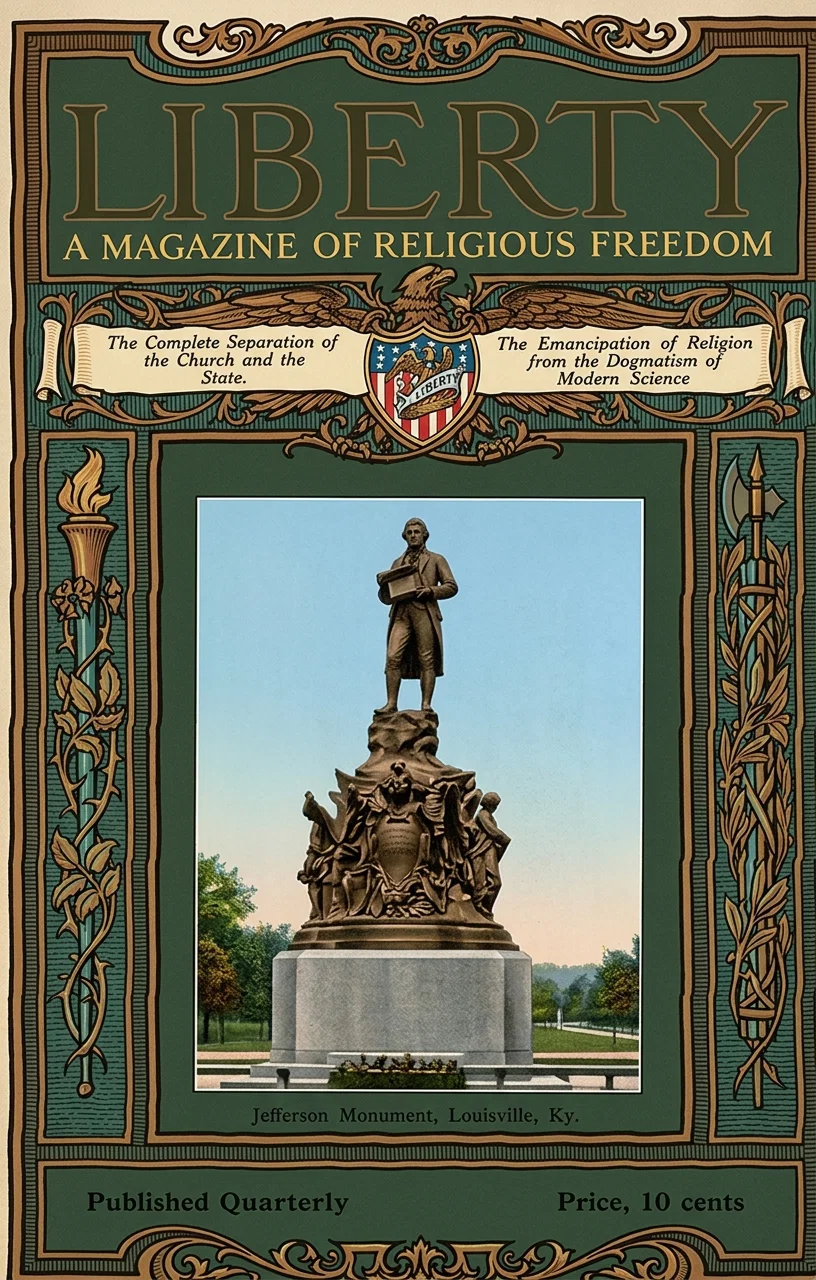
THE July-August-September issue of Liberty is now ready for delivery. Beautiful without and intensely interesting within, this special Thomas Jefferson number is the best that has appeared.
The artistic, two-color cover design, and the stirring sentiments of genuine patriotism this magazine contains, will, of themselves, make this one of the best-selling numbers of the season.
On the front of the magazine appears a photo-reproduction of the Jefferson Monument in Louisville, Ky. On the second page of cover will be found a noteworthy “Declaration of Principles” made by the Religious Liberty Association of Washington, D. C.; also a directory of the leading branches of this association throughout the world. This page will hereafter appear in every issue of Liberty. A full-page “Antisaloon Map of the United States,” in black and white and shaded effects, appears on the third cover page. It shows which States have license, local option, county prohibition legislation, and which are “dry.” Thomas Jefferson’s famous prophecy concerning “The Future of America” appears on the back of the cover.
We are printing 50,000 copies as our first edition of this noteworthy number.

Contents of “Liberty” No. 3

Within the beautiful cover of this magazine are found the following striking articles and illustrations:—
ILLUSTRATIONS.—Twenty-five photo-reproductions, a number of them full page. Well worth the price of the magazine.
EDITORIAL.—A Crusade Against the Sabbath — Loath to Reform — An Embargo on the Souls of Men — A Notable Religious Liberty Gathering — Rome and the Laws of Nations — A Question Americans Must Answer — How National Reform Principles Work in Russia — Christian Citizenship — The Present Status of Religious Legislation in Congress — Repudiating the Principles.
CONTRIBUTED ARTICLES.—Sunday Laws Advancing the Cause of Rome, by C. E. Milton — Civic Righteousness, by S. B. Horton — A Question of Authority, by T. E. Bowen — Some Evil Results of a Union of Church and State, by C. E. Holmes — Sunday Legislation Is Religious, by S. B. Horton — Independence Day and Its Meaning, by S. B. Horton — The Dawn of Religious Liberty in Bolivia, by E. W. Thomann — Is It Right? by I. H. Evans — Church and State in Early New England, by J. O. Corliss — A Great Declaration, by J. S. Wightman — The Lord’s Day Alliance and Sunday Enforcement, by C. H. Keslake — The Absurd Side of Religious Coercion, by W. A. Spicer.
TEMPERANCE.—Should the Liquor Traffic Be Abolished? by Matilda Erickson — Abraham Lincoln’s Stirring Words on Intemperance.

You Can Sell “Liberty” No. 3

Over one thousand agents are selling this beautiful magazine. Fifty thousand copies of the previous number have been sold. That means that Liberty No. 2 was read by not less than 200,000 people.
Send 25 cents for five sample copies. Sell them at 10 cents a copy. Or, better still, send $1 for twenty-five copies to sell in your neighborhood, or to mail to thinking men and women. If you are new in this work, write for leaflet, “How to Sell Our Magazines.” If interested in earning a scholarship ask for leaflet, “How to Earn a Scholarship.” Begin work at once. By this means you may be able to secure a liberal education in some of our schools, and thus be fitted for a great field of usefulness in connection with this closing work.

Address Your Tract Society

If at all possible, please order Liberty through, and arrange for territory with, your tract society. If you must order direct, send cash with order.

Old Prices Until Further Notice

Single copies, 10 cents; 5 to 20 copies, 5 cents each; 25 to 400 copies, 4 cents; 500 to 800 copies, 3½ cents; 1,000 or more, 3 cents.

Send Written Recommendation

In applying for agency, kindly send a written recommendation from your pastor, teacher, banker, tract society, or leading business firm of your town. Address your tract society, or Liberty, Washington, D. C.
HAS your conference ordered Liberty to be sent for one year to the governor, officers, judges, and legislators of your State? Consult the following alphabetical list of twenty-nine States whose legislators are now receiving the magazine: Arizona, Arkansas, California, Colorado, Connecticut, Illinois, Indiana, Iowa, Kansas, Kentucky, Louisiana, Maine, Massachusetts, Michigan, Minnesota, Missouri, New Jersey, New York, Ohio, Oklahoma, Pennsylvania, Rhode Island, South Carolina, South Dakota, Tennessee, Virginia, West Virginia, Wisconsin, and Wyoming. Remember that when ten or more copies are ordered at one time, the special yearly subscription price of Liberty is only fifteen cents. In ordering do not forget your State officers, judges, sheriffs, mayors of cities, leading attorneys, and other prominent citizens. The Maine and Southern Missouri conferences also ordered the magazine sent to their judges. Send in your list to-day.
FACSIMILE OF COVER PAGE. ORIGINAL PRINTED IN TWO COLORS

THE WORK — AND — THE WORKERS

UP to date we have printed 80,000 copies of the July Life and Health. This is 15,000 copies more than any previous record.
UP to June 28 we had received orders for 50,000 copies of the July Life and Health,—the best number issued. And still the orders continue to pour in!
MISS MYRTLE V. MAXWELL reports a sale of 124 copies of Life and Health in four hours, or 31 copies per hour; also another record of 45 copies sold in 30 minutes.
WHAT is worse than a summer cold? Why not send for a copy of “Colds; Their Cause, Prevention, and Cure,” and learn from it how to prevent taking cold? An ounce of prevention in the matter of colds, is worth even more than a pound of cure. A cold can be prevented. Send 25 cents for “Colds; Their Cause, Prevention, and Cure,” and learn how to do it.
MANY of our workers are demonstrating that the Life and Health Leaflets are very effective. These leaflets are envelope size, and treat upon timely health topics. On account of their moderate price they can be used in large quantities for general distribution. Topics covered in the series are: “Alcohol and Disease,” “Alcohol and Poverty,” “Counting the Cost of Alcohol,” “Is Alcohol a Food?” “The Cure for National Intemperance,” “Patent Medicines,” “Simple Treatment for a Cold,” “Effects of Tobacco Using,” “Pointed Facts About Tobacco,” “Pure Air in the Home.” A supply of these health tracts is carried by our State tract societies.
A MISSIONARY map of the world on the walls of our homes is a good object-lesson. A young man recently said that his first impression of personal responsibility in connection with the carrying of the message to heathen lands came to him as he daily beheld the missionary map on the dining-room walls of his mother’s home.
Our large missionary maps of the world are 50 x 87 inches in size, printed on strong cloth, and in attractive, fast oil colors, to represent the prevailing religions of the world. Available spaces are filled with appropriate texts, tables of population, statistics, and a striking diagram illustrating the numerical relations of the leading religions. The map is not only strong, large, and durable, suitable for hall and tent use, but is sold at prices within the reach of all — $2.25 without Seventh-day Adventist mission stations marked, and $2.75 with the stations marked. The regular retail price of this large map without stations marked, is $6.
We also have a small missionary map 24 x 36 inches, with our mission stations marked, for 75 cents. This map is not large enough for hall or tent work, but serves nicely for home, class, or personal study. The price of these maps includes the postage. Order from the General Conference, Takoma Park, Washington, D. C.

Editorial

The Call of the Fields

FRESH from regions where a few workers face unwarned millions, delegates to the General Conference voiced the plea of the mission fields for help. Their cry still sounds upon our ears:—
Where Rome Has Ruled: “Remember that we have one hundred ten million souls to care for, and only forty workers. We hope this Conference will give us one or more workers each for Spain, Portugal, and Italy; and five thousand dollars to start a printing plant.”—L. P. Tieche, Latin Union Conference.
The Sunrise Kingdom: “Our brethren and sisters in Japan are praying and waiting for good news from this Conference, and I hope they may not be disappointed. In the East the angels are holding the spirit of strife, and we can not tell how soon the clouds may break. The truth must be spread now, or it may soon be too late. Remember needy Japan in your prayers.”—H. Kuniya.
One Fourth the World: “We are planning for an advance move on the entire Chinese world—one fourth the population of the earth. . . . In this situation we are constrained to submit to our brethren here assembled, and to the entire body of believers, the desirability, the wisdom, the necessity, of at once planning to send out to that field forty strong, consecrated young married men, to enter upon the great task of carrying the advent message to the millions of the Chinese world.”—J. N. Anderson, China.
South America: “Imagine North America as one union conference, with two thousand five hundred Sabbath-keepers scattered from Alaska to Panama and Maine, and you will get some idea of our situation.”—J. W. Westphal, of South American Union Conference.
America’s Gateway: “The message must be given to the two million five hundred thousand foreigners in New York City. But on the other hand, we must not neglect the work for the American people. . . . We have no sanitarium, no treatment-rooms, no school building, no institution of any kind, not even a conference office. Worse than all this, we have no church building that might stand as a memorial of our work.”—Memorial of Greater New York Conference.
Wide-Open Russia: “Calls are coming from many parts of Siberia. . . . Turkestan needs five or six workers at once; but we have neither the men nor the means. . . . When I visit these few places [in Little Russia], they take hold of me bodily, and beg me to stay. . . . We appeal to this Conference not to put this matter [the Russian training-school] off much longer. There is no country in the world where ministers, teachers, nurses, Bible workers, and canvassers are more appreciated than in Russia. Our needs are certainly great; but this is the cause of God.”—J. T. Boettcher, Russian Union Conference.
The Moslem World: “Hours might be spent in making pleas, but, brethren, consider just a moment that in the world there are two hundred million Mohammedans, from whose ranks but one has been converted to the truth. . . . May our prayers go up to God in behalf of the millions who to-day turn their faces in their devotions toward Mecca. Let us supply means whereby their faces may be turned toward the New Jerusalem.”—C. D. AcMoody, Turkey.
West Africa: “A hundred million, with two hundred languages and dialects to be reached.”—D. C. Babcock, Sierra Leone.
South Africa: There was thrown upon the screen one night in the large pavilion, by stereopticon, the photograph of a chief who walked three hundred miles to one of our stations to call for a missionary. The chief returned alone—no worker being available. “And this chief is only one of many who are urging us to send them missionaries.”—H. J. Edmed, South African Union Conference.
East Africa; a Dying Plea: “She had returned from Africa on account of her husband’s health, and now she was stricken. When I met her husband, he told me that she would have but a few hours to live. She had two beautiful children, and she herself was on her death-bed. Death marked her features as I entered the room; yet there was with her such a sweet peace as she stated that she was glad to meet me, and asked me to pray with them, that she and her husband might be restored to health, to return to Africa. There is indeed the stamp of divinity in such a dying request. And while some noble workers lay their all upon the altar of God, and while dark Africa is calling for hundreds more of workers and thousands of dollars of means, ought not we to respond? Ought not our young people to consecrate themselves to this work? and ought not the men and women of means to bring their thousands to support it? The Master of the vineyard is looking down upon us. What will his people say?”—L. R. Conradi, for East Africa.
The Response: Next week we will give the response of delegates from home conferences to the call of the mission fields.

The Living God

A PROTESTANT named Woodman was before the Bishop of London's court for heresy, in the days of Catholic Queen Mary. He used the expression, “the living God.”
“There,” said Dr. Story, “there is the evidence. You will find that all heretics talk about ‘the living God.’”
Woodman said he had but used the words of the Bible. Dr. Story replied: “Bible-babble! There is no such word in all the Bible.” Woodman quoted the scripture, “My heart and my flesh crieth out for the living God.” The doctor only abused him the more violently for his acquaintance with Scripture, and cried out, “Send him to prison!”
How was it that this phrase, “the living God,” had become to the persecuting ecclesiastic a sign of heresy? Evidently the Protestant believers of those days, turning from the man-made deity of the mass, and the far-removed unseeing deity of scholastic theology, had laid hold with all their hearts upon the truth that the true God is the living God, a present help, a Saviour in time of trouble, one with whom a needy sinner may commune in prayer, with noorder of priests, or saints, or angels between.
In those times of storm and stress they needed a living God, able to do things for his children, to bring actual salvation from sin, and deliverance or sustaining comfort and grace amid peril and persecution.
I am glad the bishop’s chancellor has left the record that those early Protestants loved that blessed truth so much that the phrase, ‘the living God,’ came ever naturally to their lips.
We, too, need to know by experience that God is the living God, whose voice speaks in the living Word. He has a work, a special work, in the earth, and as truly as he led Israel of old in the exodus movement from Egypt to Canaan, so truly is he leading in the advent movement in these last days.
The God who led his people of old, who actually did things on earth for those who needed help and put their trust in him, is the living God to-day. He is able to send deliverances and to work wondrously by his intervening providences.
Believers too often, perhaps almost unconsciously, feel in their hearts that it was all divinely natural that in Bible times angelic messengers were sent to help and deliver, prison doors were swung open, food was sent by ravens, or the deadly viper was shaken off the apostle’s unscathed hand; but that now, since Bible times, these special interpositions of God’s providence are hardly to be expected.
We shall print each week, for some time, incidents gathered from the history of Reformation times and from the story of missions, bearing testimony to the fact that since the Bible record closed, the Lord has been continually, as to his glory, helping and delivering and sustaining his children and the cause of truth by special manifestations of his intervening providence.
And while these incidents are being printed, I hope our missionaries and other readers will call to mind special providences and deliverances in our own work, and send in briefly written reports of such experiences for later use in the REVIEW. We can not, of course, give space to all those continual providences and evidences of divine care and answers to prayer in the experiences of our brethren. Day by day the Lord has been to us the living God.
But many experiences, especially in mission fields and in pioneer work, showing special interpositions of God’s providence in delivering from danger, in opening ways for the truth to reach the people, or in bringing people to the truth, might be told in a few paragraphs, and would be a blessing to our readers.
The coming of the Lord is at the door. There is a great work to be done. We gain confidence and strengthen faith by recounting the delivering and guiding mercies of the Lord as he has wondrously worked in all past time. The Lord himself puts into the mouths of the advent believers the prayer for these last days: ‘Awake, awake, put on strength, O arm of the Lord; awake, as in the ancient days, in the generations of old. Art thou not it that hath cut Rahab [Egypt], and wounded the dragon? Art thou not it which hath dried the sea, the waters of the great deep; that hath made the depths of the sea a way for the ransomed to pass over?’
And the Lord responds: ‘Therefore the redeemed of the Lord shall return, and come with singing unto Zion; and everlasting joy shall be upon their head: they shall obtain gladness and joy; and sorrow and mourning shall flee away. I, even I, am he that comforteth you: who art thou, that thou shouldest be afraid of a man that shall die, and of the son of man which shall be as grass; and forgettest the Lord thy maker, that hath stretched forth the heavens, and laid the foundations of the earth?’
The threefold message of Revelation 14 is to call all men to worship and give glory to God, who made heaven, and earth, and the sea, and the fountains of water, ‘the living God,’ whose sign that he is the living God is his holy Sabbath. He is our leader and our King.
W. A. S.

Creation vs. Evolution

(Concluded)
BUT NOW, further,—not only do this people call themselves observers of the seventh-day Sabbath, but they are Seventh-day Adventists—those who observe this seventh-day Sabbath, according to the Scriptures, and those who, according to the Scripture, believe in and teach the near, personal, second advent of our Lord. Is such a protest needed in this generation? There are two standpoints from which some look at this matter. Here are two classes of teachers: the Roman Catholic teacher does not hesitate to say, frankly and openly, “The tradition of the church is of more authority than the Scriptures; the teaching of the church is above the teaching of the written Word.” I am not making any wrong statements. I am not making any attack or charge in saying this. You may read it in any authoritative Catholic work upon this subject. The church writers say there are two divine streams, the written Word, and tradition; both of these are divine, “but to us,” they say, “tradition is more clear, and more safe.” In fact, you know perhaps that they make the charge that Protestants would not have the Bible if the Catholic Church had not allowed them to have it.
But on the other side are Protestants who profess to believe the Word, claim to teach the Word, and they are brought into a very inconsistent position. Now, Roman Catholics are not inconsistent on the Sabbath question. Their position is perfectly consistent. Here are some of the things they say. Cardinal Gibbons takes this view, in order to prove that the Bible is not the single rule of faith:—
A rule of faith, or a competent guide to heaven, must be able to instruct in all the truths necessary for salvation. Now the Scriptures alone do not contain all the truths which a Christian is bound to believe, nor do they explicitly enjoin all the duties which he is obliged to practise. Not to mention other examples, is not every Christian obliged to sanctify Sunday, and to abstain on that day from unnecessary servile work? Is not the observance of this law among the most prominent of our sacred duties? But you may read the Bible from Genesis to Revelation, and you will not find a single line authorizing the sanctification of Sunday. The Scriptures enforce the religious observance of Saturday, a day which we never sanctify.—From “Faith of Our Fathers,” page 111.
Look at the logic; the great mass of professed Christian believers are observing the first day of the week. The Bible clearly teaches that the seventh day is the Sabbath, as Cardinal Gibbons says; therefore, “the Bible is not a sufficient rule of practise.” That is to say, if the majority of the people decide to act contrary to the Bible, that is proof that the Bible is not a divine guide. That is the logic of such a position. Now the consistent Protestant must say that the Bible is a sufficient rule of faith and practise; and no matter if nine tenths, or ninety-nine hundredths, of the people of the world depart from it, that does not prove the Bible wrong, but proves the people wrong. The consistent Protestant must say that the Bible is to remain forever a sufficient guide. But the Catholic says it is not sufficient; the church, he says, is above the Bible, tradition is above the Bible. We read:—
It is worth while to remember that this observance of the Sabbath—in which, after all, the only Protestant worship consists—not only has no foundation in the Bible, but it is in flagrant contradiction with its letter, which commands rest on the Sabbath, which is Saturday. It was the Catholic Church which, by the authority of Jesus Christ, has transferred this rest to the Sunday in remembrance of the resurrection of our Lord. Thus the observance of Sunday by the Protestants is an homage they pay, in spite of themselves, to the authority of the Church.—“Plain Talk,” page 213.
Now while speaking as a Seventh-day Adventist, I say the Roman Catholics are consistent, speaking as Catholics,they themselves say that the Seventh-day Adventists are consistent. This next is from a Catholic writer as it appeared in a prominent Catholic paper, the Mirror:—
Of those who follow the Bible as their guide, the Israelites and Seventh-day Adventists have the exclusive weight of evidence on their side, whilst the Biblical Protestant has not a word in self-defense for his substitution of Sunday for Saturday.—From the tract, “The Christian Sabbath,” page 14, published by the Catholic Mirror, Baltimore.
Now when you are willing to put tradition and the voice of the church above the Bible, you have no trouble with these questions; but so long as we stand upon the Protestant platform,—the Bible as the rule of faith and practise; the revelation of the living Word as the revelation we are to follow,—then we must hew to the line; then we must follow the guide. But how is it in this generation? Professed Protestants have discarded the Scriptures as a sufficient rule of faith and practise; they have substituted speculation, reason, the conclusions of a false science, in the place of the Bible; and they are following that ignis fatuus. The two, although seemingly so far apart, have one common principle; and what is that?—The exaltation of the authority of man above the authority of God. It does not make any difference whether it is a combination, as in the hierarchy of the Roman Catholic Church, or whether it is one person. It does not make any difference whether millions upon millions of Catholics agree and have one pope, or whether millions upon millions of Protestants disagree, and have just as many popes as there are Protestants. The thing is just the same. It is the exaltation of human authority, the exaltation of man above God; and Protestants are adopting the Roman Catholic principle, only in a different way.
Now what is the result of both?—They all come to one result finally. By different routes, they appeal to different classes of minds; but there is one mind behind the whole thing. Any one who can take a wide view of the present situation, as regards the religious world, must recognize that to-day the master mind which has been plotting against the gospel of Jesus Christ since the first promise was made that the seed of the woman should bruise the serpent’s head,—that that master mind is marshaling all his forces, from every point, bringing them into line for the final contest against the Son of God. That is the situation just now, in this generation, just in the time when people’s minds ought to be directed toward heaven and heavenly things, when they ought to see in the heavenly sanctuary the great High Priest doing his final work of atonement preparatory to his laying aside his priestly robes and putting on his robe as a king and coming in power and great glory. Just at that time, all theories are marshaled, all forces are brought into line, everything is brought to bear to prove that there can be no such thing as the second advent, to prove that the whole thing is a delusion and a snare. Now just read what professed Protestants say about it:—
The time has fully come for Christian leaders to admit frankly that it is impossible to construct a credible doctrine of the second coming of Christ on the basis of a literal interpretation of texts. The books of Daniel and Revelation were written to instil courage and hope into men harassed by terrible persecution; they were tracts for their times, one for the Maccabean age and the other for the days of Domitian, and their use to predict world catastrophes is a sin against all sound principles of exegesis. The words of Jesus, as recorded, would seem to show that he expected his return within the lifetime of men then living [talk about “principles of exegesis,” and make that statement! I challenge it!], and St. Paul and his contemporaries awaited the parousia daily. Time has shown that this was an error; and if Christian experience counts for anything, it is demonstrated that the whole attitude of waiting for the clouds to break is unwise and harmful. Already in New Testament days the wiser and more spiritual view obtained [when the apostasy began, you know]; for in the fourth Gospel a portion is no longer marvelous and apocalyptic, but a quiet coming of the Spirit of the Lord. This is the only parousia which can be preached with any compelling force to men of to-day.
No considerable body of people will ever again anticipate the personal return of Jesus to the earth.
I protest! I say, There is a body of people, to be in every nation, out of every kindred, tongue, and people, that will be a living protest against that statement!
A pervading of society by his Spirit, which is actually taking place, is something a great deal better.—N. Y. Independent, 1908.
“Actually taking place!” Think of the record of the last three or four years, and ask yourself whether you want that spirit to continue to increase, and pervade society more and more. Rottenness in politics! Rottenness in finance! Rottenness in morality! Rottenness in the home! Rottenness in the church! Rottenness everywhere! That is not the Spirit of Christ pervading society: that is the spirit of the devil!
But now that is from a liberal. That is from a paper that professes to be liberal. Here is something from a paper that does not profess any such thing. This is from The Christian Advocate, of New York, the leading Methodist paper of this country:—
The Seventh-day Adventists maintain that “the end of all things is at hand,” and believe that the world should be warned of that event. . . . They do not now fix a day, but they feel certain that his [Christ’s] coming is near at hand. Through the whole career of Christianity, people have been teaching that same thing. Believing, as we do, in the Gospels, and that the words and passages in the Bible which relate to the coming of Christ must be compatible with the lapse of nineteen hundred years, though they seem in their letter to imply his speedy coming, we infer that what is compatible with nineteen hundred years may be compatible with ten times that number. We trust that the Seventh-day Adventists, whom we respect for their energy and adherence to an unpopular doctrine, will not think us inclined to scoff when we show that Saint Peter meets the case in a way which convinces us of the entire uncertainty of the time of Christ’s coming [and that “entire uncertainty,” when you analyze it, means to-morrow—never “this generation”], and that he may not come for thousands of years; and further, that the reason he is delaying is that more souls may be saved.
In the third chapter of the Second Epistle of Peter it is written: “There shall come in the last days scoffers, walking after their own lusts, and saying, Where is the promise of his coming? for since the fathers fell asleep, all things continue as they were from the beginning of creation.”
I think I would not have quoted that, if I had been the editor. He then draws a parallel between the people who did not believe the flood was coming, but were mistaken,—just see how complete this is,—and proceeds:—
“But, beloved, be not ignorant of this one thing; that one day is with the Lord as a thousand years, and a thousand years as one day. The Lord is not slack concerning his promise, as some men count slackness; but is long-suffering to us ward, not willing that any should perish, but that all should come to repentance.” In stating that with the Lord one day is as a thousand years and a thousand years as one day, the apostle overturns the view that undertakes to determine whether he is coming soon or will long delay.—Christian Advocate (New York), March 25, 1909.
Now this is another view of this question of the advent; and just notice the basis upon which this is made to rest. One day is with the Lord as a thousand years, and a thousand years as one day. But he did not say it is so with men. One day is with the Lord as a thousand years, and a thousand years as one day; but not so with me. And when the Lord deals with me, he deals with me for what I am, and on my basis, and not on his basis.
Now observe: If that is a correct exegesis, let me indicate what you will be compelled to overthrow.
First, you must overthrow the literal prediction given by God to Noah, that in 120 years the world would be destroyed by a flood. The flood came, and that prediction was fulfilled.
You must overthrow the prophecy ofthe 400 years, given to Abraham—a prophecy that was afterward literally fulfilled.
You must overthrow Isaiah’s definite prophecy, that “the head of Syria is Damascus, and the head of Damascus is Rezin; and within threescore and five years shall Ephraim be broken, that it be not a people;” and this was literally fulfilled.
You must overthrow Jeremiah’s literal prophecy, that the Lord would give the children of Israel, and the city of Jerusalem, into the hands of Nebuchadnezzar, “seventy years. And it shall come to pass, when seventy years are accomplished, that I will punish the king of Babylon.” When the seventy years had ended, this prediction was literally fulfilled, and the children of Israel returned to the land of their fathers.
You must overthrow Daniel’s definite prophecy of the 1260 years, when the church was to be given into the hands of a persecuting power “until a time and times and the dividing of time,”—the time when the woman (the church) “fled into the wilderness,” as brought to view in the seventh chapter of Daniel and in the twelfth chapter of Revelation.
You must overthrow Daniel’s remarkably definite prophecy of the seventy weeks,—dated from the going forth of the commandment to restore and build Jerusalem, and made up of three definite periods of seven weeks, threescore and two weeks, and one week, or 490 years in all. And this prophecy of Dan. 9:25 was literally fulfilled.
And, I pray you, what must you not do, if you adopt that position? Every fulfilled literal prophecy in the Bible says that exegesis is wrong!
But that is simply to show that on all sides, and among all classes, the scientist, the Roman Catholic, the liberal Protestant, the man who believes himself to be a conservative Protestant, are all setting aside the idea of the second advent. Seventh-day Adventists proclaim the message to the world (and I hope live the message to the world) that He is coming, and coming soon, and that this is the generation that is to witness the closing of this mighty conflict. Let the forces be marshaled; let the enemy do his worst; let his forces attempt to set aside the Bible; let them attempt to put man in the place of God; but the day will come, and will come soon, when our God shall come, and shall not keep silence, and a fire shall devour before him, and it shall be very tempestuous round about him. Then those who have defied him, then those who have defied his Word, will call to the rocks and the mountains to hide them “from the face of him that sitteth on the throne, and from the wrath of the Lamb: for the great day of his wrath is come; and who shall be able to stand?” But those who have protested against infidel science will say, “Lo, this is our God; we have waited for him, and he will save us: this is the Lord; we will be glad and rejoice in his salvation.”
Continue reading: Who Gives Us the Sabbath?