Your ShelfYour Projects

Signs of the Times, Vol. 24, No. 16.

PREPARATION FOR HIS COMING

Signs of the Times

Apr 21, 1898

Pacific Press Publishing Company · Oakland, California · Apr 21, 1898

PREPARATION FOR HIS COMING.
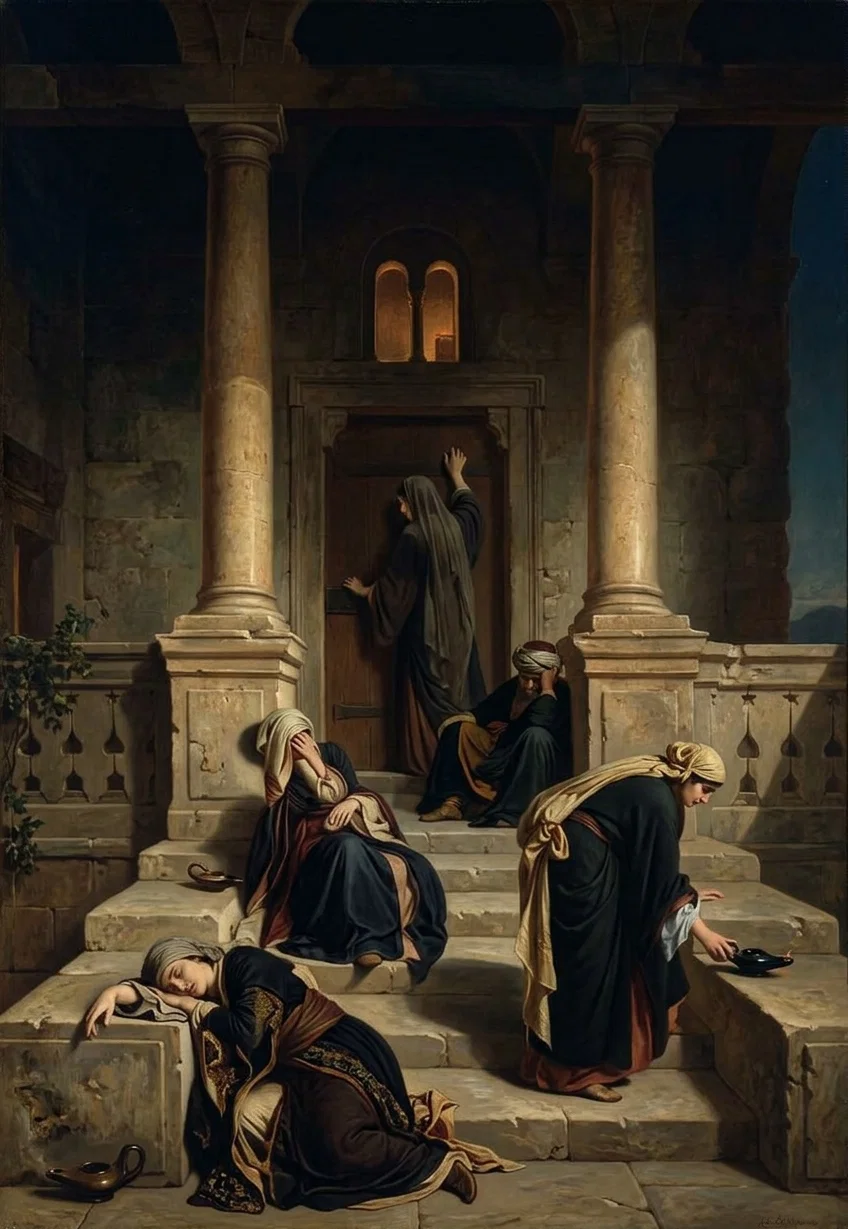
“Afterward came also the other virgins, saying, Lord, Lord, open to us. But he answered and said, Verily I say unto you, I know you not. Watch therefore, for ye know neither the day nor the hour wherein the Son of man cometh.” Matt. 25: 11-13.
IN the twenty-fourth and twenty-fifth chapters of Matthew is described the second coming of Christ to our world: “And then shall appear the sign of the Son of man in heaven; and then shall all the tribes of the earth mourn, and they shall see the Son of man coming in the clouds of heaven with power and great glory. And He shall send His angels with a great sound of a trumpet, and they shall gather together His elect from the four winds, from one end of heaven to the other.” “But of that day and hour knoweth no man, no, not the angels of heaven, but My Father only. But as the days of Noe were, so shall also the coming of the Son of man be. For as in the days that were before the flood they were eating and drinking, marrying and giving in marriage, until the day that Noe entered into the ark, and knew not until the flood came, and took them all away; so shall also the coming of the Son of man be.”
Then the warning is given: “Watch therefore; for ye know not what hour your Lord doth come. . . . . . Therefore be ye also ready; for in such an hour as ye think not the Son of man cometh. Who then is a faithful and wise servant, whom his lord hath made ruler over his household, to give them meat in due season? Blessed is that servant, whom his lord when he cometh shall find so doing. Verily I say unto you, That he shall make him ruler over all his goods. But and if that evil servant shall say in his heart, My lord delayeth his coming; and shall begin to smite his fellow-servants, and to eat and drink with the drunken; the lord of that servant shall come in a day when he looketh not for him, and in an hour that he is not aware of, and shall cut him asunder, and appoint him his portion with the hypocrites; there shall be weeping and gnashing of teeth.” What earnest zeal should these words arouse in the heart of the true believer! Here the condition of the church at Christ’s second coming is portrayed.
Again its spiritual condition is described in the parable of the ten virgins, five of whom were wise and five foolish: “Then shall the kingdom of heaven be likened unto ten virgins, which took their lamps, and went forth to meet the bridegroom. And five of them were wise, and five were foolish. They that were foolish took their lamps, and took no oil with them; but the wise took oil in their vessels with their lamps.
While the bridegroom tarried, they all slumbered and slept. And at midnight there was a cry made, Behold, the bridegroom cometh; go ye out to meet him. Then all those virgins arose, and trimmed their lamps. And the foolish said unto the wise, give us of your oil; for our lamps are gone out. But the wise answered, saying, Not so; lest there be not enough for us and you; but go ye rather to them that sell, and buy for yourselves. And while they went to buy, the bridegroom came; and they that were ready went in with him to the marriage; and the door was shut. Afterward came also the other virgins, saying, Lord, Lord, open unto us. But he answered and said, Verily I say unto you, I know you not. Watch therefore; for ye know neither the day nor the hour wherein the Son of man cometh.” And we may all ask, Can it be that I shall be among the wise virgins?
Here also is given the parable of the talents. The man who hid his lord’s money in the earth, was pronounced an unprofitable steward of his lord’s goods, and the sentence was issued, “Cast ye the unprofitable servant into outer darkness; there shall be weeping and gnashing of teeth.” And this is an illustration of the last general judgment, when each shall be dealt with according to the use he has made of his talents. The righteous alone will shine forth in the kingdom of God in that great decisive day when every character shall appear just as it is. They that have done good will have a part in the resurrection of life; they that have done evil will be awarded according to their works.
The obedient and the disobedient decide the whole matter.
The Word declares, “When the Son of man shall come in His glory, and all the holy angels with Him, then shall He sit upon the throne of His glory.” Then the triumph of Christ willhave come. What a scene will this be upon which the whole universe will gaze! How the love of God is here displayed through His Son to all who have proved true and faithful! In that day Christ does not present before men the great work He has done for them in giving His life for their redemption. He presents before them the faithful work they have done for Him. What surpassing love is this! He even mentions the work of the heathen world, who have had no intelligent knowledge of the law of the Lord, but who have done the very things the law requires, because they heeded the voice speaking to them in the things of nature around them. The grace of God working upon their darkened minds, softened their savage nature, untaught by the wisdom of men.
While among men, Christ pronounced sentence upon rabbis, rulers, Pharisees, and Sadducees, because of their hypocrisy, their rejection of light. Looking at them searchingly, He said, “He that is without sin among you, let him first cast a stone.” But He addressed the woman who was guilty of sin in words of tenderest compassion. He knew all about the character of the sin committed; but He traced upon the ground the sins of her accusers, who had laid their net for the woman, that thus they might find occasion for condemning Christ. Their curiosity led them near to Christ, to see what He had written in the sand; but they did not care to look more than once, and one by one they hastily left His presence. Those who had acted a part in bringing this poor woman before Him were far more guilty than she, and Christ knew it. The guilty persons expected that before they could take themselves away, Christ would single them out, and expose them and their deep-laid plot before the gathered throng. These professors were spiritually blind. Maxims and traditions were cherished by them, and obedience to God’s requirements was regarded as a thing of naught. Christ was grieved with them. He looked upon them with anger, being grieved at the hardness of their heart. He could detect every phase of their hypocrisy, and their great sin brought from His divine lips a scathing rebuke.
The humble, the ignorant, are Christ’s most hopeful disciples. The uneducated heathen in all their cruelty are regarded in a more favorable light than are those who have had great light, who have had evidence upon evidence, but who, when the Lord in His mercy reproves them for the sins they are cherishing as virtues, are offended, and (mark the words), like the disciples of Christ’s day, go back, and walk no more with Him. Christ recognizes every act in the savage that reflects His own mercy and compassion. When the Holy Spirit puts Christ’s Spirit into the savage, and he befriends God’s servants, the quickening of the heart’s sympathy is contrary to his nature, contrary to his education. Christ implants His grace in the heart of the savage, and he ministers to the necessity of the missionary even before he has heard or comprehended the words of truth and life. Behold that crowd collected about some of God’s servants to murder them; but the Lord is working upon the heart and mind of perhaps only one man to plead in behalf of those servants who love and fear God. When the war council has been carried on to determine the destruction of some Christian’s life, on several occasions the intercession of one savage has turned the decision and his life has been spared. O, the love that goes forth to the savage for this one act! To such in the judgment Christ is represented as saying: “I was an hungered, and ye gave Me meat; I was thirsty, and ye gave Me drink; I was a stranger, and ye took Me in; naked, and ye clothed Me; I was sick, and ye visited Me; I was in prison, and ye came unto Me.” “Come, ye blessed of My Father, inherit the kingdom prepared for you from the foundation of the world.”
MRS. E. G. WHITE.

GOD’S PURPOSE.

“In whom we have redemption through His blood, the forgiveness of sins, according to the riches of His grace; wherein He hath abounded toward us in all wisdom and prudence; having made known unto us the mystery of His will, according to His good-pleasure which He hath purposed in Himself; that in the dispensation of the fulness of times He might gather together in one all things in Christ, both which are in heaven, and which are on earth; even in Him.” Eph. 1:7-10.
Here is set forth the purpose of God in creating each individual in the universe,—that he should be one with Christ. And as the purpose is eternal (Eph. 3:11), it contemplates the creating sinful beings anew in Christ, that they may be brought back to that union which existed when they came from the hand of the Creator.
We therefore find the Saviour saying, “And I, if I be lifted up from the earth, will draw all men unto Me.” John 12:32. Notice that “men” is a supplied word. It is not only men that are going to be drawn to Christ, but by His being lifted up on the cross, He draws all the universe to Him as they were not drawn to Him before. And the result will be that all, both in heaven and in earth, will be one with Christ throughout the eternal ages. Notice how it works out the oneness of Father and Son:—
“Jesus saith unto him, I am the Way, the Truth, and the Life; no man cometh unto the Father, but by Me. If ye had known Me, ye should have known My Father also; and from henceforth ye know Him, and have seen Him. Philip saith unto Him, Lord, show us the Father and it sufficeth us. Jesus saith unto him, Have I been so long time with you, and yet hast thou not known Me, Philip? He that hath seen Me hath seen the Father; and how sayest thou then, Show us the Father? Believest thou not that I am in the Father, and the Father in Me? the words that I speak unto you I speak not of Myself; but the Father that dwelleth in Me, He doeth the works.” John 14:6-10. “To wit, that God was in Christ.” 2 Cor. 5:19. “I in them, and Thou in Me.” John 17:23.
All the words and works of Jesus were but the outward manifestation of what the Father wrought in Him. So the Saviour says, “I and My Father are one.” Not one entity, but one in Spirit. They are one in that which will forever make their purpose one; for the Spirit is called both the Spirit of God and the Spirit of Christ. Rom. 8:9.

Oneness of God and Angels.

In Ezekiel, chapter 1, is a description of living creatures, which God brought within the vision of the prophet; and in the tenth chapter we are told that these creatures are the angels. Of these angels it is said:—
“And they went every one straight forward; whither the Spirit was to go, they went; and they turned not when they went.” “The living creatures ran and returned as the appearance of a flash of lightning.” “Whithersoever the Spirit was to go, they went, thither was their spirit to go.” Eze. 1:12, 14, 20.
It would be hard to express the willingness of the angels to execute the will of God in fewer words than by the expression, “Whithersoever the Spirit was to go, they went, thither was their spirit to go;” and the despatch with which the desires of the Spirit are executed are “as the appearance of a flash of lightning.” Surely, then, they are one in Spirit with the Father and the Son.

Oneness of Christ and Followers.

“I am crucified with Christ; nevertheless I live; yet not I, but Christ liveth in me.” Gal. 2:20.
“Ye are of God, little children, and have overcome them; because greater is He that is in you, than he that is in the world.” 1 John 4:4.
The mystery of godliness is “God manifest in the flesh,” and the mystery of God is “Christ in you, the hope of glory.” So, as God is in us, He is to work in us “both to will and to do of His good-pleasure.” 1 Tim. 3:16; Col. 1:27; Phil. 2:13.
If Christ is to be in us—is to be our life—we must be one with Him; for “He that is joined unto the Lord is one spirit” with the Lord. 1 Cor. 6:17. Therefore, “both He that sanctifieth [God, Eze. 20:12] and they who are sanctified [His people, I Cor. 1:2] are all of one” (Heb. 2:11), not are similar in character, but “are all of one.”

Oneness of Believers.

“Neither pray I for these alone, but for them also which shall believe on Me through their word; that they all may be one; as Thou, Father, art in Me, and I in Thee, that they also may be one in Us; that the world may believe that Thou hast sent Me. And the glory which Thou gavest Me I have given them; that they may be one, even as We are one; I in them, and Thou in Me, that they may be made perfect in one.” John 17:20-23.
Truly the Lord desires His professed followers to allow Him to live in them and to make them one with Him and with all His children. His Spirit is the living bond which unites all His real followers. This is realized by us in a limited sense at conversion. When we first find Jesus, a new love springs up in our hearts, and we feel at peace with God and all His creatures; and if we hear any one speak evil of another, even tho that other one is a sinner, it grates harshly on our ears.
The note of this union of Christ’s followers is sounded in the words, “I in them, and Thou in Me.” Then if we find that our hearts are not in harmony with the brethren and sisters in Christ, it is a serious matter. It simply means that we are not possessors of Christ’s Spirit; and “if any man have not the Spirit of Christ, he is none of His.” We are not one in Christ, and so are not members of the universe as it now exists in God’s purpose, and will shortly exist in fact.

Lower Creatures and Purpose.

We have seen that the Father and the Son and the angels and Christians are already gathered together into one Spirit; but is there nothing else in heaven and in earth but these? for all both in heaven and in earth are to be one with Christ. Yes, there are other intelligences of a lower order, which we are wont to term dumb animals. But are there to be animals in the universe when complete? Let us consider: We are told that the “first dominion” shall return to the “Tower of the flock,” or Christ. Micah 4:8. The first dominion is that, evidently, which was given at the first to Adam. Did any animals exist then?—All kinds. Then, if this first dominion is to return to the Second Adam, will it not contain animals?
What spirit will be in these lower intelligences? Will they be one in spirit with the rest of the universe? Let these words answer:—
“And there shall come forth a rod out of the stem of Jesse, and a Branch shall grow out of his roots. . . . The wolf also shall dwell with the lamb, and the leopard shall lie down with the kid; and the calf and the young lion and the fatling together; and a little child shall lead them. And the cow and the bear shall feed; their young ones shall lie down together; and the lion shall eat straw like the ox. . . . They shall not hurt nor destroy in all My holy mountain; for the earth shall be full of the knowledge of the Lord, as the waters cover the sea.” Isa. 11:1-9.

The Universe Complete.

“And every creature which is in heaven, and on the earth, and under the earth, and such as are in the sea, and all that are in them, heard I saying, Blessing, and honor, and glory, and power, be unto Him that sitteth upon the throne, and unto the Lamb forever and ever.” Rev. 5:13.
“And when all things shall be subdued unto Him, then shall the Son also Himself be subject unto Him that put all things under Him, that God may be all in all.” 1 Cor. 15:28.
This tells us of the happiness of the universe, of the rule of God that makes this happiness, and of how God rules. The Son is subject to the Father the same as we are to be subject to Him. How is the Son subject?—He submits to the Father, and lets Him rule in his heart. We must submit, and let the Saviour rule in our hearts. Then God will be “all in all.” Then, as one has truly said: “The great controversy is ended. Sin and sinners are no more. The entire universe is clean. One pulse of harmony and gladness beats through the vast creation. From Him that sitteth on the throne flow life and light and gladness throughout the realms of illimitable space. From the minutest to the greatest world, all things, animate and inanimate, in their unshadowed beauty and perfect joy, declare that God is love.”
Such, in short, is the spirit of the home which God is preparing for His children, both the children in heaven and of earth. No wonder that the prophet exclaims, “Eye hath not seen, nor ear heard, neither have entered into the heart of man, the things which God hath prepared for them that love Him.” But we may know something of it now; for “He hath revealed them unto us by His Spirit,” the “earnest”—the part payment—“of our inheritance,” until the complete redemption of this purchased home from sin. Grand universe! Loving Father, what hast Thou prepared! C. L. Emerson.

THE COMING DAWN.

“The night is far spent; the day is at hand.” Rom. 13:12.
I’ve watched and waited, tho the night is long, And, O, so dark, I sometimes miss my way! My eyes are often dim, too dim to see The promises that herald in the day.
But I remember, when my doubts are shaped, And cling like specters of a hope long dead, There was a darker night, and One who watched With a world’s sin upon His sinless head.
And I was there. I helped to form the tears That nature forced through every bleeding pore. Yes, I remember, and I strive to cry, “When will the darkness flee and night be o’er?”
When will the light appear? O Jesus, when Will thy long-looked-for presence greet our sight? When will the day in all its glory dawn, To scatter the last shadow of the night?
A. G. C.
San Francisco, Cal.

GOD’S WORD ABOVE EVERY WORD.

“We have also a more sure Word of prophecy; whereunto ye do well that ye take heed, as unto a light that shineth in a dark place.” God has magnified His Word above His name. Ps. 138:2. His great power is in His Word, for “by the Word of the Lord were the heavens made; and all the host of them by the breath of His mouth.”
When the lion roars, the beasts of the forest keep silence. When Jehovah speaks, the inhabitants of the world ought to stand in awe. Amos 3:6–8. During the space of nearly two thousand years, God uttered His voice in the ears of the children of men. He has declared his will and sanctioned such revelation by the repeated manifestations of almighty power. He employed holy men as the authorized recorders of His laws. The last book closes with a curse against all who should add to or diminish therefrom. Rev. 22:18, 19. Notwithstanding all this, there have been men in all ages of the world who have set up their wills against that of the great Jehovah. They have made a record of the same, forbidding what God has commanded, or ordaining what God has prohibited. Thus by their traditions they make void the laws of the Most High.
What folly is this! what blasphemy! what rebellion! The words of the Lord are tried, pure, and everlasting. Luke 21:33. The words of men are short-weight, corrupt, and are passing away. By the laws of God, and not by the opinions of men, we shall be judged at the last great day. Rom. 2:12, 13.
Terribly has the curse fallen upon those who have established human opinions in opposition to the Word of God. Witness the Jews, who, since the fatal overthrow of their city, have been wanderers over all the face of the earth. Witness the poverty, ignorance, and misery of those parts of the world where human creeds prevail, and where the Bible is rejected; yea, witness in the case of every man who substitutes his will for God’s will. The end of disobedience is death. “To the law and to the testimony; if they speak not according to this Word, it is because there is no light in them.” Isa. 8:20.
Reader, are you enjoying the blessed light of God’s Word? or are you trusting in the tradition (or the opinions) of men? If you are, give them up, for “all are to perish with the using.” Col. 2:22. FRED H. SEENY.
Cheswold, Del.

SNAGS

[Republished by request.]
EVERY one knows what snags are; and almost everything that moves, from the barefooted boy who roams the woods to the largest steamer that navigates the Mississippi or Missouri Rivers, is in more or less danger of being snagged. Snags are constantly in the way, and have to be avoided; even in our towns and cities, care must be exercised if one would avoid injury from things that are closely akin to them, while all know that they are the constant dread of river pilots; and many a valuable steamboat has been lost because of snags.
But snags are not confined to material things, nor is the injury which they inflict always physical. The pathway of each one of us is beset with spiritual snags, and if these are not carefully avoided, we are liable not only to suffer minor injuries, but there is danger that we shall make shipwreck of faith and go down in the dark waters of everlasting death.
But let us examine one of these snags. Perhaps the biggest of all is the inconsistencies of false professors and the failures of true Christians. A great many are wrecked on this snag; and the strangest thing about it is that so few try to avoid it. Suppose that there is a dangerous snag in one of our largest rivers. It can not be removed, but its location is described, and everything that can be done is done to warn people against it. What would we think of a pilot who should deliberately search for that snag until he had found it, and then, with a full head of steam, run his boat right upon it? Every one would say at once that he was a madman. But that is just the way people do in spiritual things. Ask almost any worldly man you meet, why he is not a Christian, and most likely he will tell you that it is because of faults which he sees in this or that person. In short, he has been snagged!
But how did it happen? Well, he once felt that he ought to be a Christian, but was not willing to make the sacrifice required; so he sought for some excuse; he went hunting around for a snag, and presently he found it in the life of a poor, struggling fellow-mortal, who, tho fighting against sin, was sometimes overcome by temptation. He could not see the poor man’s heart; he never witnessed his heartfelt grief, nor heard his broken cry as upon his knees he sought the forgiveness of Him whose law he had transgressed; no, he only saw the mistake, the failure—the sin, if you please—and straightway he says, “There’s a snag; that man is no better than I am; I want none of his religion.” A Christian friend says: “You will not be called to account for another’s sin. The shortcomings of that man will not excuse you; the Saviour alone is to be your example,” etc.; but it makes no difference, he won’t pass that snag; the sensation of being snagged is too pleasant! Of course it wounds his soul and injures his character, but then it eases his conscience, and that is what he wants; and so he steams up full force, strikes the snag head on, and settles down into the mud of infidelity, consoling himself the while that he is about as good as his neighbor; and perhaps he may be, but he is not good enough for a place in the kingdom of God, and never will be till he pulls away from that snag.
But even professed Christians are sometimes snagged. The writer once knew of a man who was led to investigate the claims of the law of God, and was convinced of his duty to obey; but to do so would require a sacrifice, and so, to use his own expression, he began to cast about for “snags,” and where do you suppose he found them? Well, strange as it may seem, tho a professed Christian himself, he sought and found them just where the worldling did,—in the lives of other professed Christians; only, instead of looking among Sunday-keepers, he went snag-hunting among Sabbath-keepers, and, like any one who looks away from Christ and the Scriptures of truth, he soon found what he wanted, and settled down satisfied with himself, his conscience fully at ease and quiet.
But is it not surprising that any one with even a limited knowledge of the principles of the Gospel should seek such an excuse? Such a course can only be accounted for in the light of the declaration that “the heart is deceitful above all things, and desperately wicked.” The apostle Paul thus condemns those who, by looking at their fellow-men, are enabled to build themselves up on their self-righteousness: “For we dare not make ourselves of the number, or compare ourselves with some that commend themselves; but they, measuring themselves by themselves, and comparing themselves among themselves, are not wise.” 2 Cor. 10:12.
Even among the twelve apostles there was one traitor, and one weak disciple who denied his Lord even with oaths; dare we then condemn religion in general, or any special system of faith in particular, because all its adherents are not all that they should be? If we trust now in such subterfuges, what shall be our confidence when the Lord brings to pass that which He has spoken, saying: “Judgment also will I lay to the line, and righteousness to theplummet; and the hail shall sweep away the refuge of lies, and the waters shall overflow the hiding-place. And your covenant with death shall be disannulled, and your agreement with hell shall not stand”?
In following Christ we are safe; in keeping the commandments of God and the faith of Jesus (Rev. 14:12), we have the promise of eternal life. More than this no man can do, and less than this is not acceptable to God; for it is written: “Fear God, and keep His commandments; for this is the whole duty of man. For God shall bring every work into judgment, with every secret thing, whether it be good, or whether it be evil.” Eccl. 12:13, 14.
C. P. BOLLMAN.

A PRAYER.

As Thou hast made Thy world without, Make Thou more fair my world within; Shine through its lingering clouds of doubt, Rebuke its haunting shapes of sin; Fill, brief or long, my granted span Of life with love to Thee and man; Strike when Thou wilt the hour of rest; But let my last days be my best.
—J. G. Whittier.

SENSITIVENESS OR SELFISHNESS?

SENSITIVENESS is a Christian grace. Sensitiveness is an unchristian vice. The sensitive person is a blessing to society. The sensitive person is a nuisance in any community. The sensitive spirit should be assiduously cultivated by all. The sensitive spirit is by all means to be striven against and conquered.
It all depends upon what you mean by sensitiveness. There is a true sensitiveness, which implies great delicacy of feeling and perception. And there is a false sensitiveness, that should be spelled selfishness. What a pity that one name should be applied to two qualities so nearly opposite!
There is the “sensitive plant.” How it shrinks from every rude touch! Just brush its leaves carelessly with your hand, and straightway they fold themselves close together and droop downwards, a touching picture of hurt feelings.
Society abounds in sensitive plants. They grow luxuriantly in the church. Everywhere we may find them. They are always on the lookout for slights and criticisms. They think a great deal about their rights and dignities. They may be good workers, but they must be appreciated. Their feelings are very tender, and they wear them where they will be exposed to the most violent shocks. A suspicion of neglect, a word of opposition or criticism, and they are offended. They stop work at once, and will not do anything more till they have been duly flattered and cajoled. And even then they often assume the air of martyrs.
But are they as careful of the feelings of others as they expect others to be of their feelings?—Very rarely. As a rule, your sensitive soul is quite careless of the rights and feelings of others. When you hear one say, “I am exceedingly sensitive,” you are safe to conclude that he is exceedingly selfish.
True sensitiveness, on the other hand, is that delicacy of spirit and quickness of perception that makes us very tender in our treatment of others. It does not make us more ready to take offense, but it saves us from giving offense. It makes us considerate of the weaknesses and prejudices and foibles of our neighbors. It restrains us from trespassing on their rights and prerogatives.
Two men were partners in a country store, both of whom liked a joke, but one was universally popular, while the other was equally unpopular. One day the latter said to the former, “Why is it that you can joke with people as much as you like, and they never seem to mind it; but, if I joke them, they always get angry?” “That is plain enough,” replied the other. “I always joke people about something that they care nothing about; but when you joke a man, you select the sorest spot you can find, and then hit him as hard as you can right there.” The first man was sensitive in the proper sense; the second was not.
Jesus Christ was the most truly sensitive of men, yet He never took offense. His own feelings were entirely consecrated to His work. He never “stood on His dignity;” He never claimed His rights; He never fretted because He was not appreciated. But how tenderly He treated the feelings and rights of others; how patient with Samaritan prejudice; how gentle towards Galilean ignorance and stupidity; how careful at all times to treat even bigotry and superstition in such a manner that the smallest bud of faith should not be blighted!
Of such sensitiveness the world can never have enough. To quickly perceive that we are hurting another’s feelings, or that we are touching an unwelcome topic; to avoid all words or actions that might make others unhappy; to have the faculty of soothing ruffled spirits and relieving the friction and jarring of life,—this is a great gift. It is a most Christly grace. But he who possesses it will never be heard saying, “I am exceedingly sensitive.”—Rev. Geo. H. Hubbard, in S. S. Times.

THE TEMPTER AND THE TEMPTED: or The Personality of Satan.

1. He who is now called Satan, adversary, was once called Lucifer, a being of perfection and highest order in heaven. He was created perfect, but little by little perverted his wisdom and might, and became the leader of the great controversy between good and evil. Isa. 14:12-17; Eze. 28:12-19; Hosea 4:1; Jer. 25:31; Eph. 2:1-3; 6:11, 12.
2. Satan, or Lucifer, as he was then called, wanted to be above the Son of God; Christ must not have authority over him, so he started the controversy in heaven, but was cast out, taking with him about one-third of the angels of heaven, who with him had rebelled against God and His holy law. This made them sinners. Rev. 12:4, 7-9; Isa. 14:12-14. “I will be like the Most High.” These were the words of Satan. He would not bow to Christ. This is further shown by the way Satan acted toward Christ in the temptation in the mountain, when he tried to get Christ to fall down and worship him. Matt. 4:1-11; Luke 4:1-8. His desire was still to be like the Most High. See also 2 Peter 2:4; Jude 6.
3. Satan was once in the truth, but did not abide there. John 8:44. With him murder and lying began. 1 John 3:8. Had Satan no personality, he could not be called a liar and murderer, as he is in the text in John 8:44. Pride separated his soul from God, and caused his casting out of heaven. Said Christ, “I beheld Satan as lightning fall from heaven.” Luke 10:18.
4. Satan carried the Saviour bodily to a pinnacle of the temple in Jerusalem, and tried to get Him to cast Himself from that dizzy height, because of his malicious desire to destroy the Son of God. He next took Christ to an exceeding high mountain, and there he showed Him all the kingdoms of the world and their glory in a moment of time, and promised them to Him if He would worship him. How could he have done all this if he had not been a person? Matt. 4:1-11; Luke 4:1-13. He found no answering chord in Christ to his temptations. John 14:30. Christ was tempted, but not overcome. He knew no sin. He never yielded to Satan.
5. Satan is called the prince of devils or demons, and Christ recognized that Satan had a kingdom. Though a fallen angel, he is still a being of great power and glory, and all his perverted wisdom he uses to pervert the truth of God, His law, and His Gospel. With these perversions he corrupts all his subjects, and turns them against God. Matt. 12:24, 26; Rev. 12:9-12; 2 Cor. 11:3, 12-15; 4:4.
6. He goes about seeking, like a hungry lion, whom he may devour. He at times brings storms and fire and thieves to destroy our property. He often meets with the people of God when they meet, and does all he can to destroy souls by catching the Word out of their hearts. Job 1:6-12; 2:1-7; 1 Peter 5:8; Luke 22:31; Rev. 12:12; Matt. 13:19; Mark 4:15.
7. He tries to hitch his work onto the work of God whenever he can. Acts 8:9-12, 18-24; 13:6-12; 16:16-24; 19:13-20. Elymas was called a child of the devil by Paul.
8. Satan is back of every false interpretation of prophecy, as when he spoke through Peter to tell Christ that He should not be delivered into the hands of sinners and put to death at Jerusalem. It was Satan who put these words in Peter’s mouth; that is why Christ used the form of rebuke He did. Matt. 16:16, 17, 21-23.
9. Those who are under the power and control of Satan are called his children. John 8:44. Satan “is the prince of the power of the air, the spirit that now worketh in the children of disobedience.” Eph. 2:1-3. He is “the god of this world.” 2 Cor. 4:4. He deceiveth the whole world. Rev. 12:9.
10. If we resist him steadfast in the faith, he will flee from us. James 4:7; Eph. 4:27; 6:11; 1 Peter 5:9.
11. Those who accept Christ and His glorious kingdom of light, leave the black banner of Satan, and his kingdom of darkness, and are subjects of the kingdom of God’s dear Son. Col. 1:12-19.
12. Satan loves war, and he is gathering the kings of this world, and their hosts, for the battle of the great day of God. Rev. 16:13, 14.
13. If persons came into the apostolic church and still practised as the subjects of Satan’s dominion, they were to be delivered over to Satan again; for they would not be subject to Christ. The object was to let the individual see where he stood, so that he would recover himself out of Satan’s snare, repent, and turn to the Lord, and by dying to his fleshly lusts, become alive to Christ, and a subject of His kingdom. 1 Cor. 5:1-13; 2 Cor. 2:1-11; 7:8-12. In this way they carried out the advice of Christ to His disciples. Matt. 18:15-18. In 1 Cor. 5:5 a case is mentioned where a man was cast out of the church of Corinth, that he might see that the church of God did not sanction his vile course. This act led to his repentance and reformation, and he was forgiven by the church, and by Paul, and so recovered from Satan’s snare.
14. Alexander, the coppersmith, left the faith, and Paul says he delivered him over to Satan, that he might learn not to blaspheme. That is, he was cast out of the church, and deprived of the sanction of the church authority, by which he was upheld when in the church, to speak against the doctrines which his brethren held. He would learn that he stood outside, and this would teach him that he could not further oppose Paul and the brethren under church sanction. 1 Tim. 1:19, 20; 2 Tim. 2:16-18; 4:14, 15.
15. In James 1:14, 15 we read: “But every man is tempted, when he is drawn away of his own lust, and enticed. Then when lust hath conceived, it bringeth forth sin; and sin, when it is finished, bringeth forth death.” Lust is a perversion of the natural powers and facultiesthat our Creator bestowed upon man; but by yielding to Satan’s suggestions in Eden, our first parents were overcome, and perverted in their natures, so that since that time the human race have been easily led into sinful indulgences. See 1 John 2:15, 16; Gen. 3:1-15. Christ was tempted, but He had no devil in Him. To be tempted, therefore, does not make a man a devil; but if he yields to the temptation, he becomes subject to Satan’s control so long as he continues in that sinful practise. Rom. 6:16.
16. God tells us: “Resist the devil, and he will flee from you. Draw nigh to God, and He will draw nigh to you.” James 4:7. “There hath no temptation taken you but such as is common to man; but God is faithful, who will not suffer you to be tempted above that ye are able; but will with the temptation also make a way of escape, that ye may be able to bear it.” “Lest Satan should get an advantage of us; for we are not ignorant of his devices.” “Greater is He that is in you, than he that is in the world.” “Put on the whole armor of God, that ye may be able to stand against the wiles of the devil.” God grant us grace to labor with such gentleness for the souls who have fallen into Satan’s snares, “that they may recover themselves out of the snare of the devil, who are taken captive by him at his will.” 2 Tim. 2:24-26.
G. T. WILSON.
Stanmore, N. S. Wales.
Continue reading: CONSIDER THE LILIES