Your ShelfYour Projects

Review and Herald, Vol. 77, No. 30.

IS THE CHILD OF GOD A FREETHINKER?

Review and Herald

Jul 24, 1900

Seventh-day Adventist Publishing Association · Battle Creek, Mich. · Jul 24, 1900

IS THE CHILD OF GOD A FREETHINKER?

J. W. STEIN.
Yes, he alone; all others are enslaved By evil thoughts, from minds that are depraved. The worldly mind is ’neath the world’s control; The mind satanic is unsound, not whole; The carnal mind is hampered by its lust; How oft the sordid mind trails in the dust! A sinful understanding is not clear; Rebellious judgments are enslaved by fear: The wicked conscience by remorse is stung; The evil recollection is but hung With weights that drag it down; the stubborn will Can not be free to choose the good, is still Impelled to mischief, without help divine. The sinful mind is but a slave: in fine, It is the workshop of the evil one— A play-room in which devils have their fun.
The mind by God made free is free indeed; Its thoughts become like his; its every need Is furnished by the Lord’s paternal care; Whichever way it looks, it sees God there. Its aspirations, impulses, and choice Are all unfettered, and in God rejoice. Its sphere of operations is as vast As is immensity; and just as fast As time can roll its wheels, its growing strength Is measured by eternity in length. Its life, its love, its friendships, all are free,— Bounded, if we can bound infinity!
I emphasize the freedom of its life: Commensurate with God, above all strife, It enters on a blest, immortal sphere, Free from embarrassment, besetment, fear: Made free from sin, ’tis therefore free from death. In God its strength renews at every breath.
I emphasize the freedom of its love, Applied to things on earth, or things above; It chooses not to invade another’s rights, But finds in its own objects, true delights; It loves in purity each living soul, That it can elevate and help make whole; It loves God with the heart and soul and mind, And seeks, in him, its good always to find; It loves its neighbor as itself: in fine, Its love is just, and godlike, and divine.
I emphasize its friendship-freedom, too: In its unfoldings all its friends are true. Its enemies, like those of God, must die (Because to be his friends they will not try). Every intelligence that lives and moves, Every intelligence that breathes and loves, Every intelligence on earth, in heaven, Has true affinities, which God has given To give, and to receive, grace and good will That can not die with sin, but linger still.
The child of God is free; his sphere is free As is immensity, eternity. His life is hid in God; his highest love Pertains to God and things that are above And beyond sin and death; his heritage Is undefiled, secured in every stage By wisdom infinite. Almighty power And tenderness uphold him every hour. He e’er abides in God, and God in him; Hence he is free to everything but sin. Sinners can not be free: therefore to think Away from God is but to drink The bitter draft of death, and cease to be,— Like sin itself,—to all eternity.
Nor is the child of God the slave of creed, Of priest, or church, or state. He hath no need Of written law, save that within his heart, Where God’s law lives, and reigns in every part. The transgressor alone is under law; He, and he only, needs to stand in awe Of written statutes, judge, jury: these all Are indications of a vassal’s thrall.
Who loves the right pursues the right by choice; In wrong he will not live, can not rejoice; Therefore the law can not be made for him: ’Tis made to suppress wrong, to correct sin. Where physical pursuits have liberty, The mind controlling must also be free. Who thinketh evil, lives beneath the rod: A true freethinker is a child of God.

GOD'S ESTIMATE OF SERVICE.

MRS. E. G. WHITE.
“The kingdom of heaven is like unto a man that is an householder, which went out early in the morning to hire laborers into his vineyard. And when he had agreed with the laborers for a penny a day, he sent them into his vineyard. And he went out about the third hour, and saw others standing idle in the market place, and said unto them: Go ye also into the vineyard, and whatsoever is right I will give you. And they went their way.
“Again he went out about the sixth and ninth hour, and did likewise. And about the eleventh hour he went out, and found others standing idle, and saith unto them, Why stand ye here all the day idle? They say unto him, Because no man hath hired us. He saith unto them, Go ye also into the vineyard; and whatsoever is right, that shall ye receive.
“So when even was come, the lord of the vineyard saith unto his steward, Call the laborers, and give them their hire, beginning from the last unto the first. And when they came that were hired about the eleventh hour, they received every man a penny. But when the first came, they supposed that they should have received more; and they likewise received every man a penny. And when they had received it, they murmured against the goodman of the house, saying, These last have wrought but one hour, and thou hast made them equal unto us, which have borne the burden and heat of the day. But he answered one of them, and said, Friend, I do thee no wrong: didst not thou agree with me for a penny? Take that thine is, and go thy way: I will give unto this last, even as unto thee. Is it not lawful for me to do what I will with mine own? Is thine eye evil, because I am good? So the last shall be first, and the first last: for many be called, but few chosen.”
In this parable Christ compares the kingdom of heaven to a man in search of workmen. Those in search of work took their position in the market place, and at different hours during the day the husbandman went there and engaged men. The steward was directed to call them together in the evening, that they might receive their wages. Beginning with those hired last, he paid them all the same sum. This offended those who had begun work early in the day. Had they not worked for twelve hours? they reasoned; and was it not right that they should receive more than those who had worked for only a few hours in the cooler part of the day? “These last have wrought but one hour,” they said, “and thou hast made them equal unto us, which have borne the burden and heat of the day.”
“Friend,” the householder said to one of them, “I do thee no wrong: didst not thou agree with me for a penny? Take that thine is, and go thy way: I will give unto this last, even as unto thee. Is it not lawful for me to do what I will with mine own? Is thine eye evil, because I am good? So the last shall be first, and the first last: for many be called, but few chosen.”
On another occasion Christ said, “Which of you, having a servant plowing or feeding cattle, will say unto him by and by, when he is come from the field, Go and sit down to meat? And will not rather say unto him, Make ready wherewith I may sup, and gird thyself, and serve me, till I have eaten and drunken; and afterward thou shalt eat and drink? Doth he thank that servant because he did the things that were commanded him? I trow not. So likewise ye, when ye shall have done all those things which are commanded you, say, We are unprofitable servants: we have done that which was our duty to do.”
By these parables Christ would teach us a lesson of humble service. He who reads the hearts of all men knew that in the spiritual life of his followers traits of character would appear that would lead them to indulge in proud boasting and in disparaging others, as if they understood the value of soul-service. Those indulging these attributes would regard their work as of much value, while looking upon the work of their fellow laborers as inferior.
The law of nature is that we reap as we sow. But Christ was here laying down the principles of the law of his kingdom. He did not consult the opinions of others regarding him, butsteadily worked out his own purpose according to his own standard.
The way in which, in the parable, the owner of the vineyard dealt with his workers, represents God's dealing with the human family. God declares, “My thoughts are not your thoughts, neither are your ways my ways. . . . For as the heavens are higher than the earth, so are my ways higher than your ways, and my thoughts than your thoughts.” Christ came to this earth to represent God, and he was not bound about by the actions of any other householder. He worked according to the laws of the kingdom that is not of this world. He did not aim to follow any human standard.
The gospel of the kingdom is not confined by any precise regulations. Christ deals with men in a way that develops their moral and spiritual capabilities. He does not reward his servants according to the amount of labor done, or according to the visible results, but according to the spirit brought into the work. To observers this dealing seems unequal, and their sympathy goes out to those who say, “These last have wrought but one hour, and thou hast made them equal unto us, which have borne the burden and heat of the day.” But the Lord makes no excuse for this supposed unfairness. “Those who came first,” he says, “received the amount for which they agreed to work. The last stipulated no terms. They left the matter of payment with me, having faith that I would do what is right and just.”
No one should enter Christ's service in the spirit of a hireling. Such ones work for the remuneration they receive. They think their work is of greater value than the work of those who come in later; and they try to make terms with God, saying that for a stated reward they will do a stated amount of work. Thus did those in the parable who were first called. There are many professed believers who possess a large measure of the hireling spirit. They work for the wages they hope to receive.
Those who came at the eleventh hour were so thankful for an opportunity to work that they left the matter of payment with their employer. They were glad to work at any price. Their hearts were full of thanksgiving, full of love for the one who had accepted them, and they showed their faith in him by asking no questions in regard to reward. When at the close of the day the householder began with them, and paid them for a full day's work, they were greatly surprised. This was unlike any treatment they had ever received. They knew that they had not earned the money given them. The kindness expressed in the countenance of their employer went to their hearts, and filled them with gratitude. They never forgot the goodness of the householder, or the gracious compensation they received.
Thus it is with the poor sinner who knows his unworthiness, who has long neglected to enter the Master's vineyard, but who comes at the eleventh hour. His time of service seems short, and his wages large. He expects very little, and will be satisfied with little, if only Christ will accept him in his service.
Those who make a definite demand receive their wages—nothing more. Does not this teach us that faith is needed in the service of Christ? The humble and confiding, who are willing to accept any sum, however meager, God surprises with a large reward because they bring thankfulness and joy into their work. David declares, “With the merciful thou wilt show thyself merciful, and with the upright man thou wilt show thyself upright. With the pure thou wilt show thyself pure; and with the froward thou wilt show thyself unsavory. And the afflicted people thou wilt save; but thine eyes are upon the haughty, that thou mayest bring them down.”
Those who think more of their wages than of the privilege of being honored as servants of the Lord, who take up their work in a self-gratulatory spirit, do not bring self-denial and self-sacrifice into their work. Christ warns those in his service not to bargain for a stipulated sum, as if their Master would not deal truly with them. The last men hired believed the word of the householder, “Whatsoever is right I will give you.” They knew that they would receive all that they deserved, and they were placed first because they brought faith into their work. If those who had labored during the whole day had brought a loving, trusting spirit into their work, they would have continued to be first. The Lord Jesus estimates the work done by the spirit in which it is done. At a late hour he will accept penitent sinners who come to him in humble faith, and are obedient to his commandments.

THE CHURCH MILITANT.

Chicago Journal, June 19, 1900.
QUITE the most surprising deliverance upon the Chinese question comes from Bishop Earl Cranston, who declared, in a sermon at Denver, on Sunday, that it is worth any cost in money or bloodshed if we can make the millions of Chinese true and intelligent Christians. “I would,” he continued, “cut all the red tape in the world, and break all the treaties ever made, to place the armies of the United States in the fore next to Great Britain. We must not be the tail end of everything.”
Bishop Cranston was, we believe, elected to his present position at the Cleveland Conference of 1896, and is now stationed at Portland, Ore. During the last three or four years he has traveled abroad, and travel seems to have enlarged—or perhaps “expanded” is the better word—his views.
The moral obloquy discovered by many men of many minds in discussing the Chinese is one of the most astonishing phenomena of a turbulent and strenuous age. Commerce, imperialism, and the followers of Christ, widely apart on many other questions, have been singularly unanimous in denying to the Chinese the common attributes of humanity—white, black, or yellow. Hath not a Chinaman eyes? Hath not a Chinaman hands, organs, dimensions, senses, affections, passions?—Evidently not. Commerce would force trade upon him, even though the trade be opium; imperialism would cut up his empire, upon this or that pretext; and the followers of Christ—the Christ that stands for peace on earth, good will toward men—would make the Asiatic empire run red with blood, transform its rice fields into shambles, ensanguine every river and tributary, if thereby, as Bishop Cranston says, “we can make the millions of Chinese true and intelligent Christians.”
For the Denver exponent of the church militant does not stand alone in his views.
The missionary question is a question upon which we hesitate to pronounce opinion. Much may be, much has been, said upon all its sides. It is not a question upon which an opinion can be passed at once sweeping, intelligent, and final. Yet one can, with a clear conscience and a conviction of right, protest against any such monstrous, immoral declaration as that credited to Bishop Cranston. It is unspeakably odious.
Nor is it necessary that one should have any genuine sympathy with the Chinese to appreciate the shameful bullyragging that that peaceful people has put up with for more than half a century. The Powers, one and all, but especially England,—the England that Bishop Cranston would like to see, with drawn sword, marching side by side with the United States,—have outraged, abused, and robbed China systematically. Every concession of importance that they have obtained from China has been such a concession as the victim of a highwayman yields at the point of a pistol. When Europe has advanced another foot on Chinese soil, the foot has been set down in blood.
And we, the lovers of liberty, the writers about liberty, the orators on the subject of liberty and her sister justice—what have we done to help the cause along? We have denied the Chinese entrance to this country, and demanded entrance to theirs. At the same time we have opened our gates to the riffraff of Europe, and for fear that this might be contaminated by contact with the Chinese population already inside the country, we have, in one way or another, done our best to kill off the “pigtails.” We have been as unjust and cruel to China as almost any other Power has been; but we have done it in another way, and have been a shade more gentlemanly in the doing.
It has been bad enough to watch commerce and imperialism holding up and slashing at the Chinaman; but now that religion frets for the highway, the mask, and the blunderbuss, it is rather time to call a halt. What has come over the church lately? Sword and fire flash and curl around half the pulpits in the land. Here is the New York Independent, which has long been suspected of religious leanings, clamoring for another Egypt under a joint protectorate of seven Powers, including your Uncle Sam, of co-entangling-alliance fame. Verily, brethren, as the rural editor loves to inquire, “Whither are we drifting?”

SPEED, HERALDS OF OUR KING!

SPEED, heralds of our King, To earth’s remotest bound, On love’s swift-pulsing wing, The joyful tidings bring; Till new-born souls shall sing, And Christ o’er all be crowned.
Speed, messengers of light, O’er ocean’s billowy ways, Then, in Jehovah’s might, Bid wrong give place to right, And rend the Stygian night With heaven’s celestial rays.
Then come, thou Saviour mine, And reign from shore to shore; Assume thy right divine, And make earth’s sceptre thine— The powers of hell confine To curse the world no more!
—H. S. Dunning, in N. Y. Observer.

Spirit of Truth—Spirit of Error.

J. C. Nichols.
There are persons who lay great stress upon being led by the Spirit, while at the same time they are ready to reject any commandment of God with which they are out of harmony.
Certainly they are led by some spirit; they could not be led in any other way. But by which spirit are they led? There is the spirit of error (1 John 4:6), “which worketh in the children of disobedience” (Eph. 2:2); and there is the Spirit of truth, “which will guide you into all truth.” John 16:13. We read, “All thy commandments are truth.” Ps. 119:151. The Word also admonishes us to try the spirits.
How can I prove the spirits so as to know one from the other?—Simply by comparing the spirit with the Word. Where these two agree, we have the unmistakable evidence that the spirit is true.
The Word says, “All thy commandments are truth.” The same Word also says that the Spirit of truth will guide into all truth. Here is the agreement: the Spirit of truth guides into the keeping of all the commandments.
Therefore, when a person loves the ten commandments, he is being led by the Spirit of truth; but when a person rejects the love and the keeping of the ten commandments, he is led by the spirit of error.

“MEATS WHICH GOD HATH CREATED TO BE RECEIVED.”

Present Truth.

A FRIEND writes: “I am greatly interested in your articles on food reform, etc., but I should much like your exposition of 1 Tim. 4: 1, 3, 6,” and asks us to note particularly the expressions, “commanding to abstain from meats;” “for every creature of God is good, and nothing to be refused;” “for it is sanctified by the word of God and prayer.” Several have expressed surprise that in our articles on the proper diet for man we have made no mention of this passage, and such others as Rom. 14: 1–3; but the reason we have not is because they have no bearing whatever on the subject, and there is no occasion for referring to them. When, however, the question is asked, we are very willing to take time to consider their application.
In the first place, we hope that every reader of the Present Truth could conscientiously bear witness that verses 1 and 2 plainly show that we are not among those referred to in this passage. However mistaken any may think us to be, we trust that none get the impression that we are hypocritical liars, and that no one has found anything in the paper which he imagines can be styled “doctrines of devils.” Faith in Christ will be found inculcated on every page, and that is the basis of all our health teaching.
As a matter of fact, the text in question needs no exposition, as it explains itself. It tells what certain ones will do in the last days. Who those people are, and just how they will command “to abstain from meats, which God hath created to be received with thanksgiving,” we must confess that we do not know. But we do know that the advocates of food reform, and of a return to the diet that God prescribed for man in the beginning, do not come within the range of the warning here given.
It should be understood by all that in the Bible the word “meat” does not necessarily mean flesh. It is the old Saxon word for food of any kind, and is not in itself distinctive. Whenever the flesh of animals is referred to in the Bible, the word “flesh,” and not “meat,” is invariably used. For example: “God said, Behold, I have given you every herb bearing seed, which is upon the face of all the earth, and every tree, in the which is the fruit of a tree yielding seed; to you it shall be for meat. And to every beast of the earth, and to every fowl of the air, and to everything that creepeth upon the earth, wherein there is life, I have given every green herb for meat: and it was so.” Gen. 1: 29, 30. Here we see that the word “meat” excludes all flesh of animals, since flesh was not included in the diet originally designed for any of the lower animals, much less for man.
And this, by the way, has a bearing upon 1 Tim. 4: 3, since it tells us what the meats are which God has created to be received with thanksgiving. One thing is most certain, and that is that they do not include the flesh of any living creature. God did not create any beast, fish, bird, or creeping thing to be eaten; the only things which he created to be eaten are fruits and grains for man, and green herbs and vegetables for the lower animals; and therefore whoever advocates a return to the original, God-given food, is the last person in the world to be charged with commanding to abstain from meats which God has created to be received with thanksgiving.
But what about the statement that “every creature of God is good, and nothing to be refused”? The connection settles that. The word “for,” which introduces the verse, shows that the statement grows out of the preceding one, and depends upon it. The term “every creature” in this instance is obviously limited to that which God created to be received. The warning is against those who command to abstain from food which God created to be received, which, as we have seen, does not include flesh; and therefore the subsequent remarks must be within range of that food. The products of the earth have been sanctified by the word of God—set apart for the use of man; flesh meat has not been thus sanctified, but has been permitted as a concession to man's lust and hardness of heart.
Now that we have given that text all the attention that it seems to demand in connection with the food reform, we will notice one or two remarks that occur in a note accompanying the question. The writer says: “I believe I have in the past made too much of vegetarianism, but I do not do so now. When asked my reasons for abstaining from flesh foods, I simply state that what God first ordained for the food of man I find all-sufficient for me, and the most enjoyable. . . . I leave the side issues, and avoid contentions.” That is good, and is exactly the position taken in this paper, except that we have never advocated “vegetarianism,” and repudiate the name “vegetarian.” This, because we believe in eating fruits, grains, and nuts, as well as vegetables. We are Christians, and believe that we are saved by the life of Christ, when we give it free course in us. We know that nothing that we can eat or drink or do can bring Christ into our lives; but we know also that “fleshly lusts” “war against the soul,” and that we may do many things to keep Christ out of his rightful place in our lives; and inasmuch as every thoughtful physician will admit that flesh and all animal products tend to excite the lower nature, we submit that no one ought to lay this extra burden upon himself. It is not merely a question of health, although that follows right living, but it is one of spiritual-mindedness.
We also avoid contentions; for “the servant of the Lord must not strive” about food any more than about anything else. The work of the gospel teacher is simply to set forth truth in all its fullness before the people, “whether they will hear, or whether they will forbear,” and leave them to do as they please with it. His responsibility ceases with the faithful delivery of his message. So far are we from “commanding to abstain from meats, which God hath created to be received,” that we do not presume to command anybody to abstain from that which God has not created to be received. The Lord is our judge, and he is our lawgiver; and for man to command, after God has commanded, is absurd presumption. God has shown us what is good, and has exhorted us to eat “that which is good;” and we are content with simply declaring his word. We have no controversy with any.
Our correspondent says, further, in relating his experience: “I do not drink tea; coffee I may drink once in a year or longer, cocoa no oftener, as a rule. I often long for coffee, but very seldom take it, as stated, as I detest stimulants, after the inner man, as I believe they somewhat dull the conception of glorious truths.”
That is exactly what they do. But the statement, “I often long for coffee,” shows that our correspondent has not yet come to the gospel basis of health reform. Healthful living is included in the gospel, and a man's Christian life is his whole life, including every act, which, whether it be eating or drinking, or anything else, is to be to the glory of God. But the Christian life is not a penance; it is not a continual longing for forbidden things. The Christian does everything that he has a mind to do, yet he does nothing that is contrary to truth and purity, because he has the mind of the Spirit. When God saves us wholly from the guilt of sin, he saves us from the love of it, so that our heart and our flesh cry out for God, and not for anything that will dull our sense of his presence. In Christ is all fullness, and those who dwell with him in the heavenly places are “abundantly satisfied” with the fatness of the house of God, drinking continually of the river of his pleasures.
The true health reform, which we advocate, which consists simply in taking into the system nothing except the pure life of the Lord, can no more be a burden than Christ's life is. The gospel frees us from every yoke of bondage. The last thing in the world that we should think of doing would be to deprive any person of any real pleasure or enjoyment. On the contrary, we hold out to people a way of life which is full of the joy of the Lord—one continual joy. To be continually longing for something, and to be fighting against that longing, is torture, and the Lord does not call men to the rack. He teaches us what is good, and then puts into our hearts such a desire for the good that there is no room for longing after forbidden things. From personal experience in every wrong way of living, and also in recognizing and accepting only the life of the Lord, we can testify that the pleasure derived from the very eating of proper, God-given food, together with the freedom from any foreboding of evil results, the perfect health enjoyed, and the sense of clearness, and the higher appreciation of spiritual things, are beyond all expression. The soul that has been in the bondage of corruption can not, when once freed, easily be brought to long for its old chains.

WORKING TOGETHER.

WM. COVERT.
The gospel cause is the greatest thing in all the earth, and its numerous interests have to do in some way with everything under the sun. Those upon whom God places its burdens need minds clear as the noonday beams, and wide as the universe. Narrow thinking and limited planning concerning its working will never meet the infinite mind, which presides over all.
The prophet Isaiah saw a coming time and condition, of which he said, “The isles saw it, and feared; the ends of the earth were afraid, drew near, and came. They helped every one his neighbor; and every one said to his brother, Be of good courage. So the carpenter encouraged the goldsmith, and he that smootheth with the hammer him that smote the anvil, saying, It is ready for the soldering; and he fastened it with nails, that it should not be moved.” Isa. 52: 5–7.
This view of the prophet falls in a field of light, where no dark jealousies mar the cause and cripple its strength. In that happy time there will be full co-operation. No voice of criticism in that day will be heard; nor will bickering cast a shadow over the way. Then the different departments made necessary for the advancement of the gospel work will be caused to move together with as much harmony as the parts in a perfectly regulated watch.
To bring this state of glory to pass, strong, liberal-minded persons are needed who can fill positions of trust in harmony with the golden rule. These officials in all their ministrations will be mindful of the work others are doing, and plan every operation with reference to the movement of the whole body. Nothing will at that time be pushed ahead of its proper relation, nor any part of the cause be regarded as of little consequence; neither will anything in the least degree be retarded, or held back. If some departments have in the past been neglected, they will then receive sufficient attention to bring them into line with the advance ranks. If others are a little to the front, those departments will not complain if one in the rear endeavors to catch up; for every one will help his neighbor, and speak kindly of that which he is doing, saying, “It is good.” Verse 7, R. V.
Then Conference will not criticise Conference, and committees expect that others are scheming for some advantage; but entire confidence will at all points prevail. Then all societies, all boards, all Conferences, all publishing houses, all schools, and all sanitariums, will be one in the Lord’s blessed work. That will be co-operation.
The gospel cause is like an army in action, meeting a desperate enemy. Every man is expected to do his duty, and every officer know his place, and fill it to the best advantage.
United action must be secured. Loyalty and capability must work together. For the Lord’s watchmen will see eye to eye when the Lord returns to Zion. This united condition must be brought about. The mighty work to be done in the earth before the Lord comes can not be accomplished through a divided church.
A strong people must be a united people. But only the Spirit of God can unite them. Self must die in every one, and the Lord by his Spirit live and reign in every heart, before this time of victory is realized. The prophet, in beholding the glorious working of the cause of truth under the power of this union, exclaimed, “How beautiful upon the mountains are the feet of him that bringeth good tidings, that publisheth peace; that bringeth good tidings of good, that publisheth salvation; that sayeth unto Zion, Thy God reigneth!” And then, to crown the thought with the perfection of beauty, he adds, “Thy watchmen shall lift up the voice; with the voice together shall they sing: for they shall see eye to eye, when the Lord shall bring again Zion.” Verses 7, 8.
It is the same blessed thought of unity that filled the soul of David with gladness as he wrote the one hundred and thirty-third psalm. And in its binding he clasped it with something far richer than gold, saying, “There the Lord commanded the blessing, even life forevermore.”
Jesus emptied himself; and in all that he did, self did not appear. He subordinated all things to the will of his Father. When his mission on earth was about to close, he could say, “I have glorified thee on the earth: I have finished the work which thou gavest me to do.” And he bids us, “Learn of me; for I am meek and lowly in heart.” “If any man will come after me, let him deny himself;” let self be dethroned, and no longer hold the supremacy of the soul.—“Mount of Blessing, page 27.”

SOWING FOR PHYSICAL AND SPIRITUAL HEALTH

David Paulson & W. S. Sadler

THE STARCH FAMILY.

(Concluded.)

HELPS TO STARCH DIGESTION.

Starch in the raw state is scarcely, if at all, acted upon by the saliva, and only with difficulty by the pancreatic and intestinal juices. If it were not for this latter provision, no doubt multitudes would practically starve; for it is extremely rare that starch, whether in the form of mushes, biscuits, cakes, or piecrusts, is properly cooked; hence the integrity of the pancreatic juice should be regarded as one of the life-saving elements in the human system. Like the rounds in a ladder, there are a series of steps through which starch passes in being transformed into sugar, so that it can be utilized by the body. The first of these steps, as noticed in a previous article, is known as starch as ordinarily cooked, or the pasty stage, and is called “amylo-dextrin.” In this form it is only slowly acted upon by the digestive juices.
If, however, it is subjected to ordinary baking heat, as in the case of common bread, it is still more readily digested. At this stage, it is known as “erthro-dextrin.” But when it is subjected to such a high degree of temperature as to become thoroughly browned, as in toasted bread, it reaches a stage known as “achroo-dextrin,” and in this form it needs, as it were, only a touch of the digestive fluids to transform it into maltose, or sugar.
An important portion of the real digestive work that is required to convert starch into sugar can be accomplished by the process of thorough baking; and, as cook-stove energy is much more economical than digestive energy, foods containing starch should, whenever possible, be subjected to sufficient heat thoroughly to brown them before they are eaten. Many persist in compelling their digestive organs to do for them what the cook stove might just as well do; just as there are persons who are trying to accomplish for themselves, spiritually, what the Lord is willing and anxious to do for them.

HINDRANCES TO STARCH DIGESTION.

Starch digestion is hindered not only by water-drinking at meals, but its activity is almost entirely annihilated by strong acids. Careful experiments have demonstrated that one teaspoonful of strong vinegar is enough to spoil the digestion of a whole dinner, so far as the starch is concerned. “What an absurd thing, also, is the use of pickles,—a vegetable product containing starch to be digested by the saliva, and which is saturated with vinegar so that the starch can not be digested at all. How absurd also to put vinegar upon vegetables, or any kind of food requiring salivary digestion.” The only rational use of vinegar seems to be to create a pond for its eels to swim in. Some of the stronger acids of fruit, particularly the acid of rhubarb and lemon juice, have, to a certain extent, the same effect. This accounts for the indigestion so often produced by the eating of lemon pie, or puddings served with strong lemon dressings.
The following is an extract from a report of observations made by Dr. J. H. Kellogg, in the Laboratory of Hygiene connected with the Battle Creek Sanitarium:— “Dr. Wm. Roberts showed, a number of years ago, that certain substances possess the power of strongly inhibiting, or entirely preventing, salivary digestion. Among the principal substances investigated by Dr. Roberts were vinegar, tea, coffee, and beer. All these substances were found to be inimical to starch digestion, even in very small quantities,—a very interesting observation when considered in connection with the great frequency with which cereal foods are taken with tea, beer, coffee, wine, and similar substances. In repeating and extending these observations, I have found most complete confirmation of the observations of Dr. Roberts.”
Insufficient mastication is another hindrance to the proper digestion of starch. During hasty eating the saliva does not have opportunity to come in contact with the minute starch granules, and so the starch will receive no further attention whatever until it reaches either the pancreatic or the intestinal juice.
Again: saliva has no action whatever on fried foods, because the fatty substance surrounding the food furnishes an insoluble envelope for the small particles of starch, so that it is impossible for the saliva to come in contact with them, as the saliva has no power to act on fat; and, as a consequence, various fermentations are likely to be produced in the stomach, thus accounting for the severe “heartburn,” from which many persons suffer after eating hot, buttered toast.
The activity of the saliva is also discouraged by great extremes of temperature. It is not a good practice to sip liquid foods almost boiling hot, or to partake of iced foods or drinks. We should endeavor to avoid extremes in the temperature of our food, as well as in all the habits and walks of life.

DIAGRAM SHOWING THE AMOUNT OF STARCH IN MAN’S AVERAGE DAILY FOOD SUPPLY IN PROPORTION TO THE OTHER PRINCIPAL FOOD ELEMENTS:—
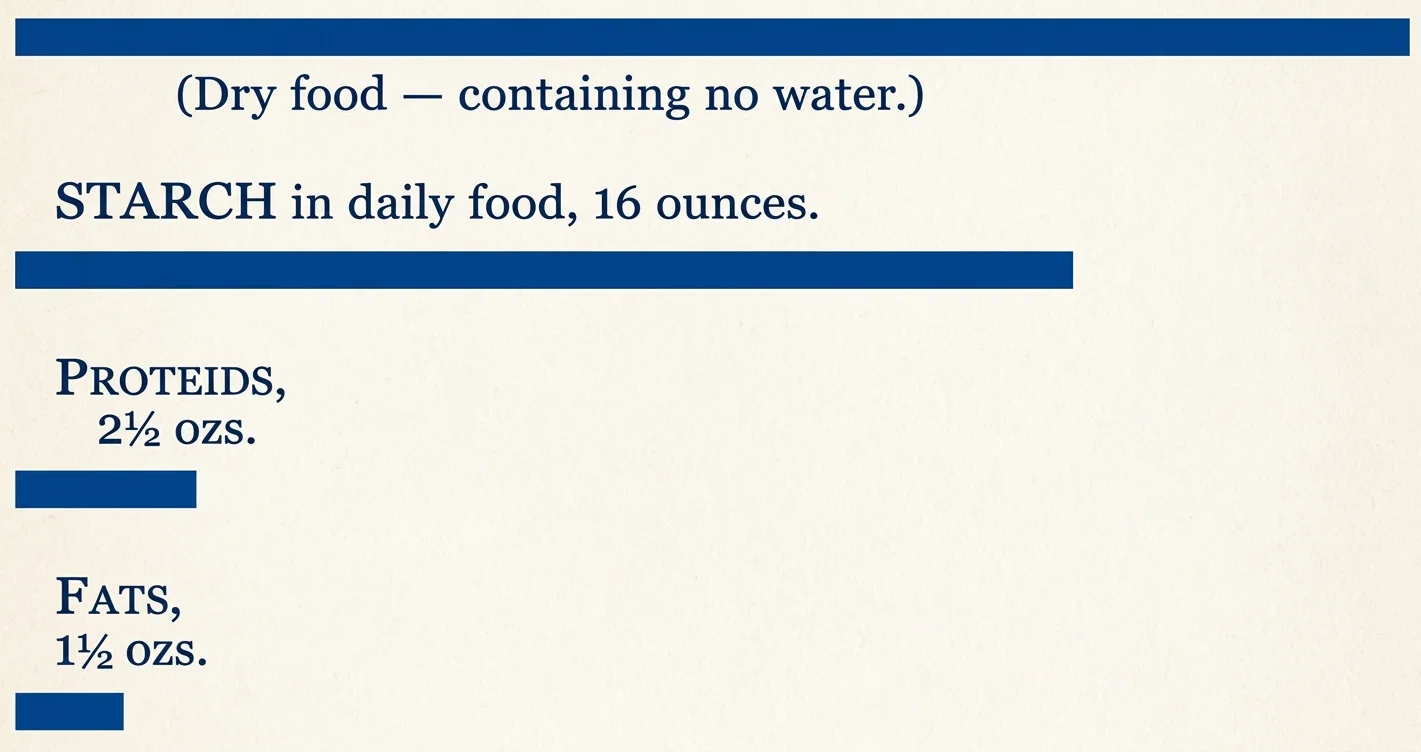
Average Daily Food for One Person, 20 Ounces.
(There is a small per cent of salts,—mineral element,—together with cellulose,—woody matter,—etc., which is not shown in the preceding diagram.)

TABLE SHOWING THE PER CENT OF STARCH FOUND IN VARIOUS FOOD SUBSTANCES.

FLOUR.
Food Per cent Food Per cent
Graham 69.9 Spinach 4.3
Wheat 75.4 Head Lettuce 2.2
Rye 69.7 Potato 21.
Barley 71.2 White Turnip 3.
Oat 67.2 Beet 9.
Corn 69.5 Parsnip 7.2
Buckwheat 74.3 Sweet Potato 25.3
Bean 59.4 Cucumber 1.4
Pea 57.2 Asparagus 2.3
Banana 77.9 Cauliflower 3.4
Arrowroot 82. Squash 5.2
Macaroni 76.8 Onion 8.
Pumpkin 5.1
Peas, green, garden 12.
String Beans 5.5
NUTS.
Nut Per cent
Chestnut 69.
Walnut 13.
Hazelnut 7.2
Sweet Almond 7.8
Peanut 1.8
Cocoanut 8.
LEGUMES.
Legume Per cent
Peas, small 52.6
“ African 57.8
“ Green, shelled 57.7
Beans, field 48.3
“ French or Kidney 55.6
“ White 48.8
“ Lima 60.6
Lentils 53.
Copyrighted, 1900, by David Paulson and W. S. Sadler.
Continue reading: THE OTHER SIDE