Your ShelfYour Projects

Signs of the Times, Vol. 30, No. 10.

LIVING FOR CHRIST
Earlier text: WAR AS A CIVILIZER

THE BUSINESS OF ALCOHOL.

BY JUSTUS ALBOR.
In the minds of all earnest, thoughtful people there is an abhorrence of the manufacture of alcohol, because from the time it issues from the coiled and poisonous worm in the distillery until it empties itself into the grave, it demoralizes every one with whom it comes in contact.
Can one stand by and calmly contemplate this thing unmoved? Look at the stream of death banked on either hand by dishonor and crime and thronged with the wrecks of humanity! Behold the ignorance, the insanity, the destitution, the suicides! See the wee babes who turn with a piteous, unsatisfied wail from faded and withered breasts, the weeping and despairing mothers, the wives asking for bread! See the man of genius it has wrecked, now struggling with imaginary serpents produced by this vile thing!
Think of the jails, the almshouses, the asylums, the prisons and the scaffolds built upon the banks of this river of death, and do you wonder that every thinking man and woman turns shudderingly away from this vile stuff—alcohol?
Intemperance cuts down youth in its vigor, manhood in its strength, old age in its weakness; it breaks the father's heart, bereaves the doting mother, extinguishes natural affections, erases conjugal love, blots out filial attachment, blights hope and brings down mourning age in sorrow to the grave! It produces weakness not strength, sickness not health, death not life! It makes wives, widows; children, orphans; fathers, fiends; and all of them paupers and beggars!
It feeds rheumatism, invites cholera, imports pestilence and embraces consumption. It fills the land with idleness, misery and crime. It fills the almshouses and demands the asylums, populates the penitentiaries and furnishes victims for the scaffold! It engenders controversies, fosters quarrels and cherishes riots!
Alcohol is the life-blood of the gambler, the element of the thief, the prop of the highwayman and the support of the midnight incendiary. It invites the father to butcher his helpless children, helps the husband to massacre his wife, and the child to grind the paracidal ax. It burns up men, consumes women, detests life, curses God and despises heaven!
Intemperance suborns witnesses, nurses perjury, defiles the jury box, and stains judicial ermine. It degrades the citizen, debases the legislator, dishonors the statesman, and disarms the patriot. It brings shame, not honor; misery, not happiness; despair, not hope; danger, not safety; and with the malevolence of a fiend it calmly surveys its frightful and unsatiated havoc!
It poisons felicity, kills peace, ruins morals, blights confidence, slays reputation, wipes out national honor, then curses the world and laughs at its ruin!
It does all this and more—it murders the soul, blotting out that divine image in which man was created, imprinting in its stead the diabolical likeness of "that old serpent, the devil."
All this and more is the business of alcohol in this world. Knowing this, can we harbor it in our homes? Can we deal it out to our friends, neighbors, and loved ones? Can we assist it in its devastating work by helping to make it legal or respectable? He who compromises with it in any way yields to it, and in that yielding encourages the baleful business.

MAINE'S DOG DETECTIVE.

OLDTOWN, ME.—His name is Scip, and he is one of the most wonderful dogs in Maine. A veritable four-legged detective is Scip.
Scip lives in Oldtown when at home, and is an undersized cur, with bright eyes and sharp ears, of badly mixed lineage—just a common dog as far as breeding goes. He is owned by one of the State game wardens, whose duty it is to examine certain trains coming down from the game region. Every piece of game must be checked up, and suspicious packages examined.
The Maine law positively prohibits the taking out of the State of game-birds in any way whatever.
As the people alight from the train, few notice a little dog dodging about among them, sniffing at this hand-bag and that bundle.
Soon his master hears a little bark. He knows what that means, and, dropping everything, finds Scip dodging and nosing about the heels of a passenger. The warden closes in on the "game" pointed by Scip, quietly invites the suspect into the baggage room, and questions him about the game which he has concealed about his person or effects. The dog has never been known to fail in "pointing" game. He may have possibly missed some, but when he has made up his doggish mind that there is a violation of the law he has always been correct so far.
But inspecting the hand baggage is not all of the little detective's work by any means. After the passengers are all out he hops into the baggage and express car and applies his sharp little nose to everything in sight.
While making his usual inspection of the express car the other day, he came across a barrel, to all intents and purposes, containing fish. It certainly had fish in it. Scip sniffed at it, went on, and then came back and sniffed again. Round and round the barrel he went, whining and dancing as if it were full of rats.
With a faith in the little animal, born of long experience, the officer investigated the barrel and found in the center of a liberal lining of fresh shore cod, several dozen of plump partridges.
Fish shipments from a certain Washington County station have suddenly ceased.—Boston Record.

INGERSOLL'S EULOGY ON WHISKY.

“I SEND you some of the most wonderful whisky that ever drove the skeleton from the feast or painted landscapes in the brain of man. It is the mingled souls of wheat and corn. In it you will find the sunshine and the shadow that chased each other over billowy fields, and the breath of June, the carol of the lark, the dew of the night, the wealth of summer, and autumn’s rich content, all golden with imprisoned light. Drink it, and you will hear the voice of men and maidens singing the ‘Harvest Home,’ mingled with the laughter of children. Drink it, and you will feel within your blood the starred dawns, the dreamy, tawny dusks of perfect days. For forty years this liquid joy has been within staves of oak, longing to touch the lips of man.”

DR. BUCKLEY’S REPLY.

“I send you some of the most wonderful whisky that ever brought a skeleton into the closet, or painted scenes of lust and bloodshed in the brain of man. It is the ghost of wheat and corn, crazed by the loss of their natural bodies. In it you will find a transient sunshine chased by the shadow as cold as Arctic midnight, in which the breath of June grows icy, and the carol of the lark gives place to the foreboding cry of the raven. Drink it, and you will have ‘woe,’ ‘sorrow,’ ‘babbling’ and ‘wounds without cause,’ ‘your eyes shall behold strange women,’ and ‘your heart shall utter perverse things.’ Drink it deep, and you shall hear the voice of demons shrieking, women wailing, and worse than orphaned children mourning the loss of a father who yet lives. Drink it deep and long, and serpents will hiss in your ears, coil themselves about your neck, and seize you with their fangs; for ‘at last it biteth like a serpent and stingeth like an adder.’ For forty years this liquid death has been within staves of oak, harmless there as purest water. I send it to you that you may ‘put an enemy in your mouth to steal away your brain.’ And yet I call myself your friend.”— Exchange.

SIGNS OF DEATH.

Very Important to Physicians and Others.
J. D. JOHNSON, M. D., one of Pennsylvania's eminent physicians, in the sixteenth edition of his Therapeutic Key, published in Philadelphia, writes as follows:—
In all cases of apparent death occurring suddenly, or from external violence, and whenever there is any doubt in the matter, extraordinary precautions should be taken in order to settle the question. The cessation of respiration and circulation (so far as can be observed) does not determine the matter, and even the absence of animal heat is not conclusive, for life may exist and recovery take place where this is not an attendant. In all doubtful cases the following tests should be applied:—
1. Apply the stethoscope to determine if the heart is acting.
2. Put the body in a dark room, place the hand (with fingers close together) between the eye and a lighted candle; if life is not extinct, hand will show transparent redness as in life.
3. Tie a cord tightly around a finger; if the end becomes swollen and red, life is not extinct.
4. Inject a few drops of aqua ammonia under the skin; if life still exists a red or purple spot will form.
5. Insert a bright, steel needle into the flesh; allow it to remain half an hour; if life is extinct it will tarnish by oxidation.
6. Place the surface of a cold mirror over the mouth; if moisture condenses on the surface respiration has not ceased.
7. In from 12 to 18 hours after death eyeballs become soft, inelastic, feel flaccid.
8. In from 8 to 12 hours after death hypostasis or congestion of blood in capillaries begins to form in all depending parts of the body.
9. Putrefaction is positive proof of death, and unless this takes place by the end of the third day, interment should be postponed until it does.
As our own father, having been pronounced by the physicians dead, and all preparations made for his funeral, came very near being buried alive, we feel, perhaps more than any of our readers, the importance of the above subject.—Geo. T. Angell.

IN CHURCH.

[I don't want to make you uncomfortable, girls ; but it is possible that it was one of you who had a bird's wing in your hat.]
JUST in front of my pew sits a maiden— A little brown wing in her hat, With its touches of tropical azure, And sheen of the sun upon that. Through the bloom-colored pane shines a glory By which the vast shadows are stirred, But I pine for the spirit and splendor That painted the wing of the bird. The organ rolls down its great anthem; With the soul of a song it is blent; But for me, I am sick for the singing Of one little song that is spent. The voice of the curate is gentle: "No sparrow shall fall to the ground;" But the poor broken wing on the bonnet Is mocking the merciful sound.
—Our Sunday Afternoon.

THE SMALL COIN OF LOVE.

A LADY stepped into an elevator in a tall office building, and as she did so said pleasantly to the colored elevator boy, "Good morning." The boy looked up with pleased and grateful surprise, then replied, "Dat is de fust time anybody ever said, 'Good mornin',' to me here."
Ah, how we shrink from paying out the small coin of love! How we hoard the mills and cents of goodwill, like veritable heart misers! How often do we hear a kind word spoken, or see a kind act performed, as people brush up against each other in the intercourse of daily life? And yet many of these people are making large donations of love and life to others, toiling, self-sacrificing, self-denying, that others may be happier and better. Surely it is not because their hearts are selfish or unloving that they are so chary of those little words and acts of kindness and sympathy that come like sunshine to lonely, longing souls. It is simply because they underestimate the value of the small coin of love. They do not think it worth the trouble of paying out. Their minds are fixed upon the ministry of large and lavish giving, and so they utterly overlook the blessedness of the smaller giving.
The truly Christlike Christian will keep in circulation the small coin of love as well as the great. For to him the cent of the kind word bears as truly the image and superscription of the great King as the gold coin of the larger gift and the costlier sacrifice. He will not neglect to give the smile and the, "Good morning," because his heart is full of benevolent zeal for his church, or his family, or any noble cause. Blessings really have no absolute, fixed value in this world. A glass of water, sweetened with love, or a sunny, "Good morning," may go farther, in the end, than checks honored at the bank, or services paid out of the very costliest life of the giver.—James Buckham.

THE SLEEPING SICKNESS.

BESIDES the awful horrors of Belgian administration of the Kongo Free State, our (Baptist) missionaries have to contend with the terrible devastation of the sleeping sickness. From the Kongo the dread disease spread over to the Uganda country. From the first outbreak, two years ago, until now, over 68,000 persons have died in Uganda alone. The British authorities have used every effort to check the disease, but all in vain. A special commission, headed by Colonel Bruce, decided that the sleeping sickness is caused by the bite of a fly called "kivu." But no antidote to the fly's bite has been discovered, and a commission is now working over that problem. In the meanwhile, efforts are being made to stop its progress by some means. Segregation is impossible, and would not succeed, because the kivu fly could not be segregated. The English Church Missionary Society also finds itself greatly afflicted by the calamity.—Frank S. Dobbins, Baptist.

OUR CURRENCY.

UNTIL 1785 no national coinage was established, and none was issued until 1793. English, French, Spanish and German coins, of various and uncertain value, passed from hand to hand. Beside the nine-pences and four-pence-ha'-pennies, there were bits and half-bits, pistareens, picayunes and fips. Of gold pieces there were johannes, or joe, the doubloon, the moidore, and pistole, with English and French guineas, carolins, ducats, and chequins. Of coppers there were English pence and half-pence and French sous; and pennies were issued at local mints in Vermont, Massachusetts, Connecticut, New Jersey and Pennsylvania. The English shilling had everwhere degenerated in value, but differently in different localities; and among silver pieces the Spanish dollar, from Louisiana and Cuba, had begun to supersede it as a measure of value. In New England the shilling had sunk from nearly one-fourth to one-sixth of a dollar; in New York to one-eighth; in North Carolina to one-tenth. It was partly for this reason that, in devising a national coinage, the more uniform dollar was adopted as the unit. At the same time the decimal system of division was adopted instead of the cumbersome English system, and the result was our present admirably simple currency, which we owe to Gouverneur Morris, aided as to some points by Thomas Jefferson. During the period of Confederation, the chaotic state of the currency was a serious obstacle to trade, and it afforded endless opportunities for fraud and extortion. Clipping and counterfeiting were carried to such lengths that every moderately cautious person, in taking payment in hard cash, felt it necessary to keep a small pair of scales beside him, and carefully weigh each coin, after narrowly scrutinizing its stamp and deciphering its legend.—John Fiske.

Cooling the St. Louis Exposition

"THE air at the St. Louis exposition is to be cooled by immense fans. They will bring down cold air from a height of eight hundred feet above the earth and distribute it over the grounds, thus greatly reducing the temperature."

CHRIST, THE WAY, THE TRUTH, AND THE LIFE.

BY MRS. CARRIE K. BUTCHER.
WHERE'ER I look, whate'er I see In nature's realm, all prove to me There is a God above. Each swaying bough, each falling leaf, Each fragrant flower, each ripening sheaf, All whisper, "He is love!"
The world may scoff, the skeptic sneer; Yet faith in Him my heart doth cheer, And joyful, I press on. Though friends forsake, and foes assail, The hosts of sin shall not prevail, The victory shall be won.
The Saviour came, for man He died, Rose from the tomb, and opened wide A royal road to heaven. Himself became the Living Way That leads from death to endless day. What more could He have given?

EN ROUTE TO CHINA.

A Glimpse of Japan.
BY A. C. SELMON, M.D.
We sailed from Vancouver, British Columbia, October 5, on the royal mail steamer, "Empress of India," en route for the province of Honan, China. This is one of the three fastest trans-Pacific boats, making the trip of forty-three hundred miles to Yokohama in thirteen days. On this trip she carried two hundred first-class passengers, twenty intermediate, and four hundred steerage, besides the officers and crew.
We had very nice weather, with the exception of two stormy days. The route lying so far north brought us into a very cold climate, and we were obliged to put on all our winter clothing. We sighted several islands belonging to the Aleutian group, which were very barren-looking places. A race of little people called the Aleutians makes its home here. Crossing the hundred and eightieth meridian, we dropped one day. Retiring Monday night, we awakened on Wednesday morning.
As we neared Japan, one of the first things that attracted attention was Mt. Fujiyama. It is twelve thousand three hundred and sixty-five feet high, and its snow-capped summit, towering up into the clouds, can be seen for hundreds of miles in every direction. It is an old volcano, and even yet occasionally grumbles and belches out smoke and ashes.
October 20 we anchored in the fine harbor of Yokohama. Here a busy scene was presented. There were large freight and passenger steamers, and several war vessels, among them two American men-of-war.
No sooner had we cast anchor than the ship was fairly besieged by every kind of Japanese craft, from a steam launch to a sampan. The sampan is a Japanese boat but little larger than the ordinary rowboat. It is propelled from the stern by a peculiar bent oar, that is moved from side to side in the water in a manner they call sculling.
Going ashore, we had our first real taste of Japanese life in taking a ride about the city in a jinrikisha, which is a two-wheeled cart that carries one passenger. The seat is provided with a good spring, that breaks the force of the jolts and jars, and the motive power is furnished by a sturdy little 'rikisha man, who steps into the shafts and starts off at a rate almost as fast as a horse will trot. These men have wonderful endurance, for they will keep up this rate for hours at a time. We paid them twenty sens for an hour's ride. This is equivalent to ten cents, United States money.
It is remarkable to see how the Japanese are imitating American and English ways. Every Japanese is eager to learn the English language. They have quarantine laws as strict as those of the United States. They have a gold standard for their money. The streets are well paved, tho only half as wide as those we have been accustomed to see. Bicycles are a great favorite, and they are very numerous. At present large numbers of automobiles are being introduced.
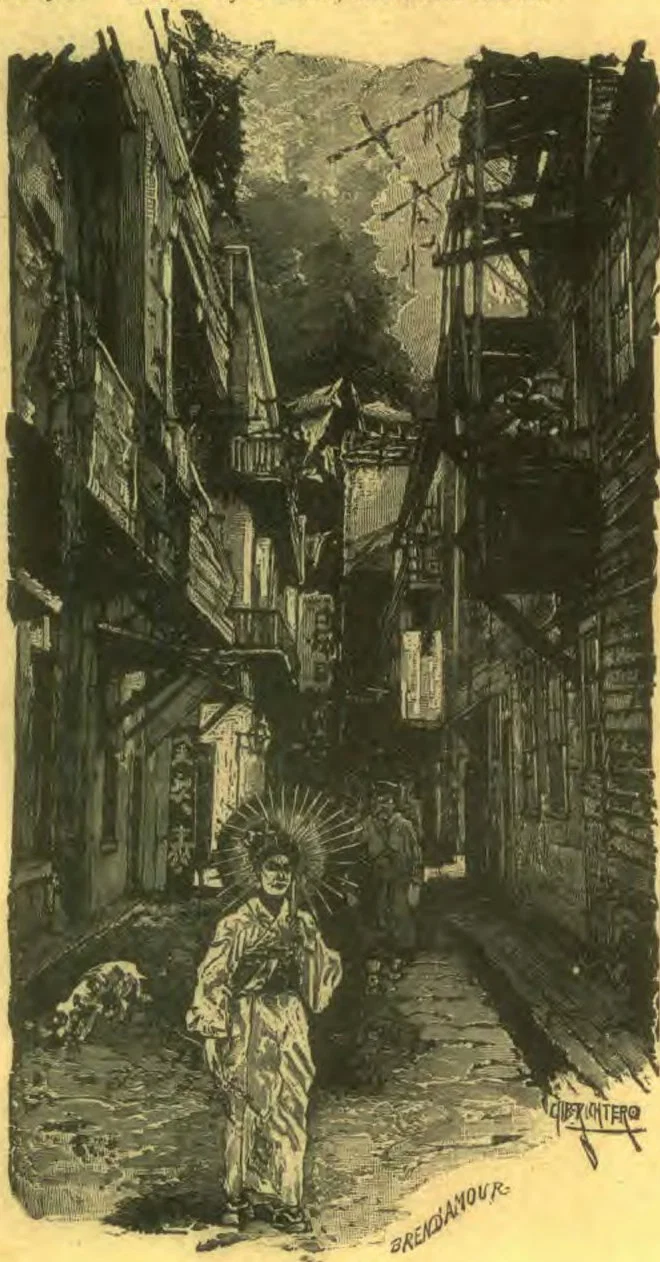
Passing along the streets, one sees an endless variety of shops. The front of the shop, facing the street, is open, and in this way the whole stock of goods is displayed in such a manner as to catch the eye of the would-be purchaser. Looking in, you see the shopkeeper seated on the raised floor, with samples of his goods all about him. When you go to make a purchase, you can count upon it that he will ask you double the price he expects to receive.
On our tour of the city, we did not see more than a dozen horses, and the majority of these were used by the foreigners for carriage horses. Some few are used by the Japs for dray horses. They are always hitched single, and are led by a halter, and never driven.
A Street Scene in Yokohama.
The women dress in a kind of kimona, with flowing sleeves and a large sash. The loose sleeve is made to do service for a pocket, as well as a sleeve.
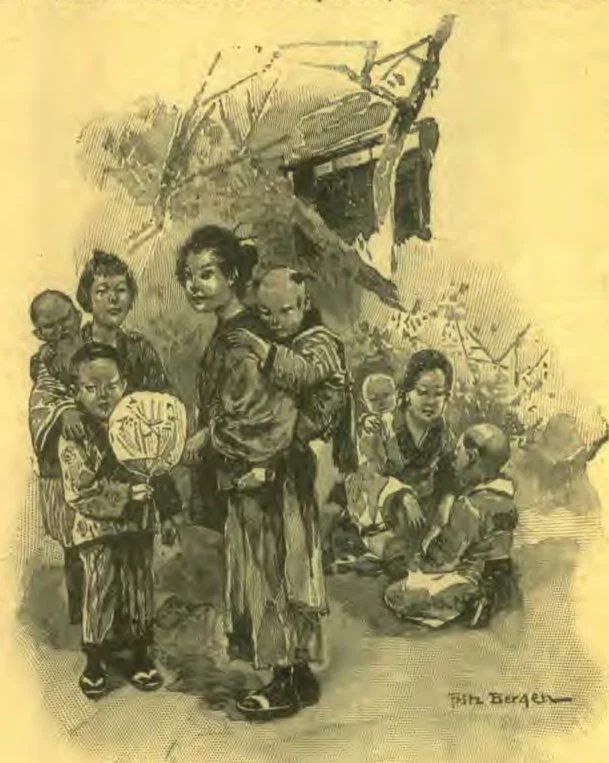
Children of the Flowery Kingdom.
Mothers carry their babies on the back, slipped inside the kimona, and held up by the sash. One mother we saw was washing at the tub, and the baby on her back was sound asleep. Most of the business men and scholars also wear long kimonas. The dress of the laboring classes, which include the coolies, 'rikisha men, and boatmen, is very simple, and consists of a shirt and a narrow cloth about the loins.
There are very few saloons. The only intoxicated men we saw were some of the sailors from the war vessels. Cigaret-smoking is becoming the national vice, and is very common among all classes.
Leaving Yokohama, our next stop was at Kobe, a city of two hundred thousand population. It has a fine harbor on the Gulf of Osaka, and is one of the most important export cities of Japan.
Our vessel touched next at Nagasaki. The way lies in and out, among the islands of the Inland Sea, a most picturesque stretch of enclosed ocean. The ship seems to float enchanted on its placid surface. The sea throughout the greater part of its extent is but a few miles wide, and in many places the channel is so narrow that the boat can barely pass. It is a day's travel, with mountains and hills on either side laid out in one grand landscape garden. The energetic little Japs farm most of these hills and mountains, from the base to the very top. The whole side is cut into terraces, and the appearance is that of a huge stairway, the treads of the stairs being carpeted with various shades of green and brown, and here and there a bushy tree is dotted in to add to the effect. The people live in villages made up of quite a compact bunch of houses all one story high, most of them brown, but a few white. The land lying about the villages is farmed.
This Inland Sea, and in fact all of the harbors of Japan, are strongly fortified, and one can not help but notice the rapid strides that are being taken in the preparation for war. Nagasaki is a large city on the island of Kyushu. The large coal mines are here, and make this an important port of call for the Asiatic fleets of all nations.
It was an interesting sight to see the coal loaded into the bunkers of the large steamers. The coal barges are drawn up alongside. Ladders reach from these to the port-holes of the ship. On the ladders there is a double row of men, women, and even little children. The coal is passed up from the barges in baskets which hold about a bushel. These baskets stream into the port-holes at such a rate thatfifteen hundred tons of coal can be loaded in five hours.
Leaving Nagasaki, we crossed the Yellow Sea, en route for Shanghai, October 24. Excluding two stop-overs, the trip thus far, of eight thousand five hundred miles, from our home in Iowa, has been made in twenty-three days.

THE LEGION PERIODICALS OF THE UNITED STATES.

A CLASSIFIED list of periodicals is given in the Scientific American's Special Number on "Modern Aids to Printing."
Period of issue:— Daily …………………… 2,226 Triweekly………………… 62 Semiweekly ………………… 637 Weekly ………………… 12,979 Monthly ………………… 1,817 Quarterly ………………… 237 All other classes…………… 268 ───────────── Total ………………… 18,226
Character of publication:— News, politics, and family reading 14,867 Religion ……………………… 952 Agriculture, horticulture, dairying, and stock-raising …………… 307 Commerce, finance, insurance, railroads, and trade…………… 710 General literature, including magazines…………………… 239 Medicine and surgery…………… 111 Law………………………… 62 Science and mechanics …………… 66 Fraternal organizations………… 200 Education and history……… 259 Society, art, music, and fashion… 88 Miscellaneous………………… 365
The average number of inhabitants to each publication is 4,170. News, politics, and family reading form the bulk of all publications, 81.6 per cent being taken up by them; religious periodicals come next with 5.2 per cent; finance, railroad, insurance, and kindred topics follow with 3.9 per cent; agriculture and allied subjects follow with 1.7 per cent; and the other subjects, while most important, follow with very small percentages, which can practically be neglected, as none of them exceeds 2 per cent, and most of them come nearer 1 per cent or below. The publications devoted to specialties have been steadily superseded by the large dailies, which have invaded every field of journalism. The Sunday edition has become a most important factor in journalism, which, when aided by the linotype or other composing machines, have done the work of four to nine men. The line cut and the tin cut, called "half-tone," have made the rapid production of a counterfeit presentment of a photograph possible.

OUR WORK AND WORKERS.

BOTH the churches of Indianapolis are planning for the erection of new houses of worship.
A NEW house of worship was recently dedicated at Maple Grove, Mich. Brother W. C. Hebner conducted the service.
THE Life Line Mission, Des Moines, Iowa, reports four persons keeping the Sabbath of the Lord, as a result of Mission Labor.
DURING a recent five days' meeting at Corsicana, Texas, says the Union Record, a church of nineteen members (colored) was organized.
THE West Michigan Herald says, "About seventy more are awaiting baptism, as a result of the revival meetings held in Battle Creek church, making a total of over two hundred."
SEVEN converts to the truth are reported in the Worker's Record, as a result of meetings held by Brother D. E. Scoles, in a country district fifteen miles from Rolla, Mo.
AT Montreal, Mo., Brethren H. M. Stewart and J. L. Burgess have been holding meetings in the M. E. Church. The people take a good interest in the meetings, and pay all expenses.
AT the close of the week of prayer services at Elgin, Ohio, five heads of families began the observance of the Lord's Sabbath. The services of the week were conducted by Brother H. H. Vataw.
MEETINGS held in a schoolhouse ten miles from Red Lodge, Mont., by Brethren J. C. Foster and S. H. Kime, have resulted in seven adult Sabbath-keepers. They also report five members added to the Red Lodge church.
IN the Southern Illinois Herald Brother Chas. Thompson reports the addition of six adults to the church at St. James. He also reports that four have recently accepted the faith at Bloomington, where a Sister Kimlin has been giving Bible readings.
THE Indiana Reporter says the meetings at Unionville, conducted by Brother J. C. Harris, resulted in the addition of six members to the church. Also that Brother F. M. Roberts reports twenty-two new Sabbath-keepers at West Lebanon. Also that four recent converts united with the church at Windfall.
FROM Ephesus, Va., Brother T. H. Painter writes that he is holding meetings in the M. E. Church, with a good interest. The pastor and his wife attend most of the services, and are much interested in the subjects presented. He has five other churches in charge, and is anxiously seeking to know the whole Gospel truth.
SISTER BELLE JOHNSON, who is teaching a church school in the Indian Reserve, at Kauyengeh, Ont., writes as follows: "I opened school with four pupils, January 11, but have seven now. I expect ten more when the weather gets milder. I canvassed two days, and made enough to purchase books, pencils, pens, copy-books, etc., for a dozen pupils."—Canadian Union Messenger.
THE Upper Columbian Conference will hold its next annual session beginning April 5, and if arrangements can be made satisfactory to all, a ministerial institute will be held, at which ministers, canvassers, Bible workers, and church officers will spend a little time together in studying the best methods and plans to carry on the work, and how to meet the many demands that are upon us for this time.—The Reaper.
WE are made sad to record the death of an efficient worker in our publishing house, Brother Silas Coombs Stickney, who had been connected with us for twenty-three years, during a greater part of that time filling positions of responsibility, as secretary of the company, chief bookkeeper, manager of counter check-book department, assistant manager in the office, and twice special representative of the house to the government of Guatemala. In all positions he has been painstaking, accurate, faithful. He was twice married, both wives dying of "the great white plague," the first dying in 1896, the latter, 1903. Upon his two children, the fruit of his first marriage, and especially upon Barbara, the daughter, the blow falls heavily. We are sad at the loss of a useful fellow-laborer. The children mourn a father. May the great Father help these dear ones, lambs of the flock, to be strong to bear and faithful to do, and lead them to the eternal Eden home, which shall know no death. We laid the father to rest to await the coming of the Lifegiver.

OUR PERSONAL TOUCH.

[L. A. Banks, D.D., in S. S. Times.]
“He laid His hands on every one of them.” An old man, who was blind and crippled, sat at the edge of the icy stone pavement on a cruelly cold day, playing his old hand-organ, while in the other hand he held out a tin cup to receive such gifts as his music and evident poverty might attract. But it was so cold that music had no charms, and the people hurried by. The old man was very cold and discouraged, when an old woman, ragged and poverty-stricken in appearance herself, came out of an alley near by with a huge bundle of sticks and boards on her bent back. Some of the boards were so long that they were dragged on the ground behind her, and it had evidently taken her a long time to tie all the boards and bits of timber together on her back. She came along, bending low under her burden, until she was within a few feet of the old organ-grinder. As she noticed his condition, she paused, a flash of sympathy came to her eyes, and then she untied the rope which bound the bundle to her back, and in a moment the boards were lying on the ground. The old man’s cap had been blown off by the wind. She picked it up, and brushed it, and placed it kindly but firmly on his head, and tied it down with a tattered handkerchief taken from her own neck. “Cold,—hain’t it?” she said. He nodded. “Hain’t gittin’ much to-day?” were her next words. He shook his head again. She fumbled in her pocket till she found a copper, which she dropped into his little cup, hoisted the great bundle on her back, and went on her way. She had done what she could. She had laid her hands on him, and it had brought comfort to his heart. We, too, must follow the example of our Master, and come into personal contact, if we would help the world.

THE MISSIONARY PROSPECT IN CHINA.

IT is said that China is being somewhat enthused by the successes so far achieved in Japan's war with Russia. It would seem that the Chinese are impressed that, after all, the Orientals are a power of themselves, hence a revival of the anti-foreign sentiment. It is also stated by an English missionary that the reform, upon which the government started after the late Boxer troubles, had received a decided check, even before this later reverse. He says:—
New educational ventures are few, but the closing of the doors, the discouragement of Western ideas, and, above all, the exclusion of Christianity, are subjects of almost daily experience. Whether the Chinese Government will ever attempt another fight, on the same lines as before, it is hard to say; but the trend of affairs would lead to the conclusion that Christian teaching, even of the most diluted description, will never be allowed a place in Chinese institutions under the present régime. The opportunity which now presents itself to the Christian church is, therefore, more than ever important. Education on Western lines is indispensable. The people demand it. The government schools are discredited for a great variety of reasons. A Christian education, which is the one thing above all others that China needs, can only be supplied by private institutions carried on by Christian educators for the sake of the Gospel, tho not necessarily dependent upon funds supplied entirely by the promoters themselves. Now is the time, while things are in abeyance.

WANTED FOR MISSIONARY WORK.

(Always prepay postage.)
[As some persons take advantage of these requests to palm off literature inimical to the truth, hoping that some of the recipients will be unguarded enough to circulate it, our missionary workers should carefully examine anything out of the usual line, to be sure that they are not being imposed upon. Some of the worst counterfeits are very close imitations of the genuine.]
SIGNS, Instructor, and tracts, a liberal supply. Address, Mrs. Eva Patterson, Salix, Iowa.
LATE clean copies of our denominational papers and tracts, in English. Address, Ples E. Watson, Call Box 62, Sour Lake, Texas.
CLEAN, back numbers of our periodicals and tracts. Address, L. Trowbridge, City Mission, Omaha, Neb.
SIGNS, Pacific Health Journal, Instructor, and Little Friend. Address, Mrs. W. T. Hicklin, Willamette, Ore.
ANY of our denominational literature. Address, E. A. Rose, Stevens Point, Wis., R. F. D. No. 1.

PACIFIC UNION CONFERENCE.

The regular biennial meeting of the Pacific Union Conference of Seventh-day Adventists is called to convene at Healdsburg, Cal., at the hour of 9 A.M., March 18, and to continue until the 27th, 1904, for the purpose of selecting the officers and the executive committee of the Pacific Union Conference of Seventh-day Adventists, who will serve during the next biennial period, and for the transaction of such other business as may properly come before the meeting. Each local conference and mission field is entitled to one delegate in the sessions of the conference, without regard to numbers, and an additional delegate for every three hundred church-members.
W. T. KNOX, president. J. J. IRELAND, secretary.

THIS WILL INTEREST YOU.

THE Correspondence School for Nurses, connected with the Sanitarium Medical Missionary Training School, will begin a new class the first of April, 1904. Lessons are sent weekly to students who are unable to leave home duties in order to take a regular course at one of our sanitariums. This is the sixth year this work has been in progress, and hundreds are availing themselves of it. One who desires to do Bible or Missionary work or canvassing can illly afford to miss this opportunity. Studies in eleven subjects are given, among which Christian help work and the care and treatment of the sick are prominent. Our lessons have recently been re-written and enlarged, and are in every way improved.
The tuition fee is six dollars for the entire course. This amount is to cover the cost of sending out lessons, correcting the replies, and returning the reports to the pupils. The few textbooks required for this work are furnished at actual cost price. We shall organize a new class in April, which will continue one year. By taking double lessons, some students finish in six months. We shall be glad to hear from all who are interested. A descriptive circular giving full particulars, also testimonials from those who have taken the course, will be sent free on application. Address,
Correspondence Department Sanitarium Training School, Battle Creek, Mich.
Continue reading: LESSON 12.—MARCH 20.—JESUS FEEDS THE FIVE THOUSAND