Your ShelfYour Projects

Signs of the Times, Vol. 22, No. 14.

A Story about Fishing

Signs of the Times

Apr 2, 1896

Pacific Press Publishing Company · Oakland, Cal. · Apr 2, 1896

A Story about Fishing.
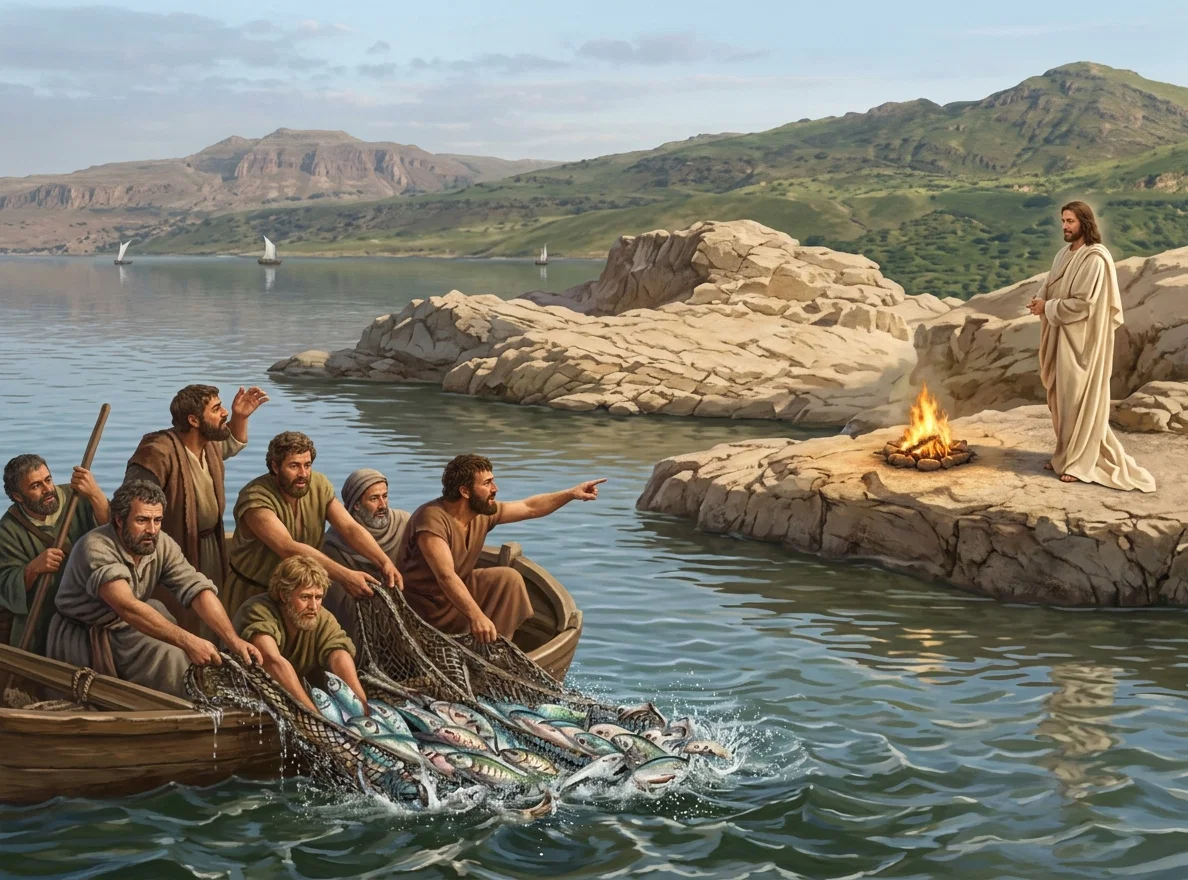
Our illustration presents a boat load of men on the sea hauling in a net full of fishes, and on the adjacent shore a single watcher standing by a small fire. The figure on the shore is Jesus of Nazareth; the men in the boat, seven of his disciples. The sea is that of Galilee. The time is after his resurrection. The narrative runs thus:—
"After these things Jesus showed himself again to the disciples at the Sea of Tiberias, and on this wise showed he himself. There were together Simon Peter, and Thomas called Didymus, and Nathanael of Cana in Galilee, and the sons of Zebedee, and two other of his disciples. Simon Peter saith unto them, I go a-fishing. They say unto him, We also go with thee. They went forth, and entered into a ship immediately; and that night they caught nothing. But when the morning was now come, Jesus stood on the shore; but the disciples knew not that it was Jesus. Then Jesus saith unto them, Children, have ye any meat? They answered him, No. And he said unto them, Cast the net on the right side of the ship, and ye shall find. They cast therefore, and now they were not able to draw it for the multitude of fishes." John 21:1-6.

Doubt and Perplexity.

The brief story has its important lessons, some of which we wish to notice. Jesus had told the disciples after his resurrection that he would meet them in Galilee, and it was to keep this appointment that the disciples were here. They were not yet fully enlightened. They did not yet understand the nature of Christ's kingdom. They knew he had risen from the dead, that he lived a conqueror; but what they were to do, where they were to go, they did not yet know. As they returned to Galilee, the home of their early life, the old recollections and associations of their former life as fishermen returned. Not knowing the prospect before them, they seem to have concluded that it was best for them to return to their old occupation.

Looking Backward.

They evidently had forgotten the scene three years before, when, fishing on the same sea, they had heard the voice of the Master saying, "Come ye after me, and I will make you to become fishers of men." See Mark 1:16-20. Doubtless they had felt confirmed in the truth of these words on more than one occasion as the great crowds had followed their Master and them; but now all men had forsaken him, and even one of the twelve had proved a traitor. What could be better or wiser than for them to return to their old occupation, and again earn their living by fishing? They must have reasoned somewhat after this sort, forgot the command of the Master, and followed their own devices.

Human Schemes.

Simon Peter makes the proposition, "I go a-fishing." The other disciples, ready to fall in with the old occupation, said, "We also go with thee." The result of that purely human plan and human effort is thus given: "They went forth, and entered into a ship immediately; and that night they caught nothing." Alas, how many times has the experience been repeated! God has called his church, given his own divine directions, his own divine organization, his own divine means and equipments, and told his servants to go forward, whether his leading was visible or invisible. But how often have they become discouraged, disheartened, lost sight of the Master, forgotten his commands, directions, and means, and started out for themselves! They have organized some beautiful society in theory. Some Simon has said, "I go," and he has always found others ready to say, "We also go with thee." They have adopted their own plans and ways and methods and means, and have toiled, oftentimes through the days and nights and years and centuries, and have accomplished nothing; and when the Master has asked, "Children, have ye any meat?" They could only answer, "No."

Apart from Christ.

Without Christ we can do nothing. Human wisdom, human effort, human expedients, human organizations, human might; coupled even with former successful experience, will accomplish nothing for God. Man may praise and flatter, may admire the beautiful fabric we wear, but without Christ it is hollow, vain, empty. "Without me ye can do nothing," are his words to all. This was the important lesson conveyed in his delicate question, "Children, have ye any meat?"

With Christ.

But with Christ the story is different, the scene changes. His words ring across the water and thrill the souls of the disciples with a deeper meaning than had similar words on a former occasion (see Luke 5:4): "Cast the net on the right side of the ship, and ye shall find." There is no particular significance in the term "right side," except its definiteness. It was the right-hand side; they probably were then fishing on the left-hand side, and had doubtless fished all around the boat. Jesus might have said the left-hand side; the result would have been the same. When he commanded to cast the net, there were fish to be caught. Either side if commanded by him was the right or true and only place, and either side without him was the wrong side. It all rested in hisword, in his instruction. In the command of God is all potency. It is itself a promise. What he commands, however impossible it may seem, will be accomplished if we will but submit to it.

The Great Twofold Lesson.

The result of obedience to Christ's command was a net full of fishes, and a welcome meal waited the weary fishers on the shore. Their duty in Galilee was to wait for the Saviour, not to return to the old life; but they went a-fishing in their own wisdom, and caught nothing. They went back from the exalted mission of being fishers of men to fishers of fish. They turned from the service of Christ to the service of self. And the service of self proved, as it always proves, fruitless. The great twofold lesson of the narrative is that apart from Christ man can do nothing, and following Christ's command always brings success. Fishing themselves for themselves, there was no success; fishing in the same sea, by the same boat, in the same place, at the command of Christ, there was success. O, that the servants of God would but heed the Master's teaching, simple and unreasonable tho it seems! Toiling all night—the best hours for fishing—in their own strength and wisdom, they may think that with the dawning morning and the seemingly barren sea there is no further use to fish for souls; but let them by simple faith say with the disciples of old, "Nevertheless at Thy word I will let down the net." Luke 5:5. "No word of God shall be void of power." Child of God, trust the word of the Master. Do his service in his way, and you will reap the sure harvest.

CRUCIFIED, BURIED, AND RAISED.

IN beginning the study of the sixth chapter of Romans, it must be remembered that we have but a continuation of the fifth. The subject of that chapter is superabounding grace, and the gift of life and righteousness by grace. As sinners we are enemies of God, but are reconciled, that is, freed from sin, by receiving the righteousness of Christ's life, which has no limit. No matter how greatly the sin may abound, grace does much more abound: "That as sin hath reigned unto death, even so might grace reign through righteousness unto eternal life by Jesus Christ our Lord." This brings us to a consideration of the particulars of our

Union with Christ.

"What shall we say then? Shall we continue in sin, that grace may abound? God forbid. How shall we, that are dead to sin, live any longer therein? Know ye not, that so many of us as were baptized into Jesus Christ were baptized into his death? Therefore we are buried with him by baptism into death; that like as Christ was raised up from the dead by the glory of the Father, even so we also
should walk in newness of life. For if we have been planted together in the likeness of his death, we shall be also in the likeness of his resurrection; knowing this, that our old man is crucified with him, that the body of sin might be destroyed, that henceforth we should not serve sin. For he that is dead is freed from sin. Now if we be dead with Christ, we believe that we shall also live with him; knowing that Christ being raised from the dead dieth no more; death hath no more dominion over him. For in that he died, he died unto sin once; but in that he liveth, he liveth unto God. Likewise reckon ye also yourselves to be dead indeed unto sin, but alive unto God through Jesus Christ our Lord." Rom. 6:1-11.

Questions on the Text.

For what purpose did the law enter? "The law entered, that the offense might abound." Rom. 5:20. But what do we find when the offense abounds? "Where sin abounded, grace did much more abound." Verse 20. "What shall we say then? Shall we continue in sin, that grace may abound?" "God forbid." (Not by any means.) And why not? "How shall we, that are dead to sin, live any longer therein?" If we have been baptized into Jesus Christ, into what were we baptized? "So many of us as were baptized into Jesus Christ were baptized into his death." What does baptism mean? "We are buried with him by baptism into death." What further? "That like as Christ was raised up from the dead by the glory of the Father, even so we also should walk in newness of life." If we have been "planted" together in the likeness of his death, what will surely follow? "We shall be also in the likeness of his resurrection." What has taken place? "Our old man is crucified with him." Why is the "old man" crucified with Christ? "That the body of sin might be destroyed." And what will be the result of that? "That henceforth we should not serve sin." From what is he that is dead free? "He that is dead is freed from sin." Of what may we be confident if we are dead with Christ? "That we shall also live with him." Why have we this confidence? "Knowing that Christ being raised from the dead dieth no more; death hath no more dominion over him." Why not? "For in that he died, he died unto sin once." And what of his life? "In that he liveth, he liveth unto God." Therefore since we are dead and raised with him, what must be the case with us? "Likewise reckon ye also yourselves to be dead indeed unto sin, but alive unto God through Jesus Christ our Lord."
An Important Question.—"What shall we say then? Shall we continue in sin, that grace may abound?" The student will doubtless recall a similar question in the third chapter, verses 5, 7, and the answer in verses 6, 8. It is another form of the question, "Shall we do evil, that good may come?" The answer must be apparent to all,—"Not by any means," for this is really the force of the words improperly rendered, "God forbid." Altho grace superabounds where sin abounds,
that is no reason why we should willfully pile up the sin. That would be most emphatically to receive the grace of God in vain. 2 Cor. 6:1.
The Reason Why.—"How shall we, that are dead to sin, live any longer therein?" It is simply an impossibility, and there is really no question as to whether or not we may do it; for it is certain that if we are dead to sin, we can not live in it, at the same time. A man can not at the same time be both dead and alive. Now the previous chapter has emphasized the fact that we are reconciled to God by the death of Christ, and are saved by his life. Reconciliation to God means the being freed from sin; so that being "saved by his life," means that we have "passed from death unto life." The life of sin, that was enmity, has been ended in the life of Christ.
"Baptizing into Jesus Christ."—Baptism is the symbol of putting on Christ. "For as many of you as have been baptized into Christ have put on Christ." Gal. 3:27. "For as the body is one, and hath many members, and all the members of that one body, being many, are one body; so also is Christ. For by one Spirit are we all baptized into one body, whether we be Jews or gentiles." 1 Cor. 12:12, 13.
Where Christ Touches Us.—It is in death that we come into contact with Christ. He touches us at the lowest possible point. That is what makes our salvation so sure, and so sure for every one, without any exception. Sin and sickness are tributary to death. Death is the sum of all the evils possible to man. It is the lowest depth. And it is there that Christ comes in contact with us. We become united to him in death. As the greater includes the less, the fact that Christ humbled himself even to death proves that there is no ill possible to us that he does not take upon himself.
Baptized into His Death.—"So many of us as were baptized into Jesus Christ were baptized into his death." And what is it to be baptized into his death?—Verse 10 tells us: "For in that he died, he died unto sin once." He died unto sin, not his own, because he had none; but he "bare our sins in his own body on the tree." 1 Peter 2:24. "He was wounded for our transgressions, he was bruised for our iniquities." Isa. 53:5. Now since in that he died, he died unto sin, it follows that if we are baptized into his death, we also die to sin.
A New Life.—"Christ being raised from the dead dieth no more." "Like as Christ was raised up from the dead by the glory of the Father, even so we also should walk in newness of life." "If we be dead with Christ, we believe that we shall also live with him." It was impossible for the grave to hold Christ. Acts 2:24. Therefore, just as surely as we are baptized into the death of Christ, so surely shall we be raised from a life of sin to a life of righteousness in him. "For if we have been planted together in the likeness ofhis death, we shall be also in the likeness of his resurrection."
Crucifixion.—Christ was crucified. Therefore, being baptized into his death means that we are crucified with him. So we read, "I am crucified with Christ; nevertheless I live; yet not I, but Christ liveth in me." Gal. 2:20. Crucified, yet living, because crucified with Christ, and he lives. Christ said, "Because I live, ye shall live also." John 14:19. How can we live a new life?—We have no power at all of ourselves; but Christ was raised from the dead by the glory of the Father, and in his prayer to the Father he said, "The glory which thou gavest me I have given them." John 17:22. Therefore, the power that raised Jesus from the dead, is exercised to raise us from the death of sin. If we are willing to allow the old life to be crucified, we may be sure of the new.
"Our Old Man" Crucified.—We shall be in the likeness of his resurrection, "knowing this, that our old man is crucified with him, that the body of sin might be destroyed, that henceforth we should not serve sin." If we are crucified with Christ, our sins must also be crucified, for they are a part of us. Our sins were on him as he was crucified, and so of course our sins are crucified if we are crucified with him. But here is a difference between us and our sins when crucified,—we are crucified in order that we may live again; our sins are crucified in order that they may be destroyed. Christ is not the minister of sin. It was the life of God that raised him from the dead, and in that life there is no sin.
A Separation.—The reader will notice that the separation from sin is in death. That is because death is in sin. "Sin, when it is finished, bringeth forth death." James 1:15. Therefore nothing less than death will effect a separation. We could not separate ourselves from sin, because sin was our very life. If it had been possible for us to effect the destruction of sin, it could have been only by the giving up of our lives, and that would have been the end of us. That is why there will be no future for the wicked who die in their sins; their life having been given up, or, rather, taken from them, they are out of existence. But Christ had the power to lay down his life, and to take it again; and therefore when we lay down our lives in him, we are raised again by his endless life. Remember that he does not give us our own life back again, but that he gives us his own life; in that life there never was a sin; and so it is that our crucifixion and resurrection with him is the separation of sin from us. This thought must be borne in mind when we come to study the next chapter.
Living with Him.—"Now if we be dead with Christ, we believe that we shall also live with him." When shall we live with him?—Why, as soon as buried and risen with him, of course. Our life with Christ in the world to come is assured to us only by our living with him now in this world. We are separated from sin, by death with him, in order that we may be joined to him. The reader is asked to bear this in mind also until we come to the study of the next chapter.
"Buried."—"We are buried with him by baptism into death." Baptism, therefore, is burial. If men were content to follow the plain reading of the Scriptures, there never would be such a thing as a question concerning "the mode of baptism." No one from reading the Bible could ever get any other idea than that baptism is immersion, and nothing else. "Buried with him in baptism, wherein also ye are risen with him through the faith of the operation of God, who hath raised him from the dead." Col. 2:12. Baptism represents the death and resurrection of Christ, and by it we show our acceptance of his sacrifice; and the very act is an actual burial, in order to make the lesson the more impressive.
Why the Change?—How is it that there has been a change from Scripture baptism to sprinkling?—The answer is very easy. Baptism is a memorial of the resurrection of Christ. But "the church," by which is meant the bishops, who loved the praise of men more than the praise of God, and who wished to curry favor with the "better class" of the heathen, adopted the pagan sun festival; and in order to appear to justify themselves in so doing, they claimed that the rising sun, which was worshiped by the heathen, was a symbol of the resurrection of "the Sun of Righteousness," namely, Christ, and that by observing Sunday they were celebrating his resurrection. But they did not need two memorials of the resurrection, and so they dropped the one that the Lord had given. In order, however, not to appear to throw baptism away, they claimed that the heathen "lustration," or sprinkling with "holy water," which they very naturally adopted with the heathen sun festival, was the baptism enjoined in the Scriptures. The people trusted in the "fathers," instead of reading the Bible for themselves, and so it was very easy to make them believe that the Bible was obeyed. It is true that there are some who follow the word in regard to immersion, who also observe Sunday; but the two practices are entirely inconsistent. The word is neglected in one particular in order to provide a memorial for an event which they already celebrate in accordance with the word. We are sorry to learn, what however might naturally be expected, that scriptural baptism is falling into disuse among those who observe the first day of the week. It must be the case that sooner or later they will wholly give up one or the other. E. J. W.

Question Corner.

"Enquire, and make search, and ask diligently."
No. 289. Binding and Loosing of Satan.
PLEASE explain verses 3 and 8 of Revelation 20? J. H. Cox.
Verse 3, in connection with verses 1 and 2, declares that a mighty angel of God lays hold of the devil, casts him into the bottomless pit, shuts him up, and sets a seal upon him for a thousand years, that he might not deceive the nations during this period. After that he is loosed a little season. The word rendered bottomless pit is from the Greek word abussos, rendered in the Revised Version abyss. It is the same word which in the Septuagint stands for the word "deep" in Gen. 1:2. It there refers to the chaotic, void, empty condition of the earth before the creation of man. In Rev. 20:3 it refers to the earth when it is reduced to that condition again, void of human life. See Jer. 4:23. The same word, abussos, occurs in Luke 8:31, where the demons besought Christ that he would not consign them to the deep. At the beginning of the thousand years, at Christ's second coming, the righteous dead are raised, the righteous living changed, and taken to the mansions above (1 Cor. 15:51-54; 1 Thess. 4:16, 17; Rev. 20:5, 6; John 14:1-3; Rev. 14:1-3; 19:1), while the wicked are all destroyed by Christ's presence (Rev. 19:21; 2 Thess. 2:8; Isa. 24:1-3, 21, 22). Upon this desolate earth, keeping its Sabbath, which man refused it, for 1,000 years, Satan and his angels will be confined. During this time he can not work to deceive the righteous, or inhabitants of other worlds, for they are far removed, and the wicked are all dead. At the end of the 1,000 years the wicked dead are raised, and Satan is again given opportunity to ply his arts of deception all over the earth, among the wicked of all generations. This is shown in Rev. 20:8. Then will be demonstrated what the books of heaven have already revealed,—that man of himself, given a "second probation," would reject Christ and rebel against God.

The Temple of God

No. 290. The Temple of God.

I WOULD be pleased to have the SIGNS OF THE TIMES explain 1 Cor. 3:14-17.
In order to an understanding of verses 14, 15 it will be necessary to read farther back. The apostle is speaking of his work and that of other apostles in their work in God's vineyard or temple. They were simply servants, who planted or watered; God gave the increase. They were simply workmen in building God's spiritual house; God furnished the foundation, the material, the life. The foundation, the only one, is Christ Jesus. Verse 11. If a man build on that Rock that which will stand—in other words, if the minister of Christ gathers in, by the grace of God, well-instructed, converted souls in Christ—his work will stand. Such converts are likened to precious stones, gold, and silver—materials which will endure the fire (see Isa. 33:14, 15)—while, on the other hand, if his converts are not converted to Christ, they are likened to wood, hay, and stubble, consumable by fire. The minister may thus lose his work, yet he himself will be saved as by fire. If his converts are to Christ and are genuine, he will receive a reward; if his converts are not genuine, he will suffer loss, even tho he may be saved. This is the teaching regarding the minister. But the apostle desires the church to realize their part, and so he continues:—
"Know ye not that ye are the temple of God, and that the Spirit of God dwelleth in you? If any man defile the temple of God, him shall God destroy; for the temple of God is holy, which temple ye are."
Those who hear and heed the words of the minister of Christ are the temple, or building, of God. God designs to dwell in them. If they will let him, he will make them gold, silver, precious stones, which will endure the fire. If they will not yield to him the whole heart, if they defile themselves by unholy thoughts and practices, they will be destroyed with the sins they love. God will not divide the heart temple with any one or anything.

W. A. CULBERTSON, M.D

No. 291. The Holy Spirit.

Is it right to address the Holy Spirit in our prayers as we do God and Christ? Ought we to say, "To the Father, Son, and ever blessed Spirit, be present and everlasting praises"?

W. A. CULBERTSON, M.D

We recall no Scripture injunction or example of prayer to the Holy Spirit. We are, however, told to pray for the Spirit. In the benedictions given by the Bible writers the Holy Spirit is mentioned but once, namely, in 2 Cor. 13 : 14, the common form of benediction used in many pulpits to-day. But nowhere do we recall a passage where praises are ascribed to the Spirit. Yet in the baptismal formula the Father, Son, and Holy Ghost [Spirit] are mentioned. It is one of the manifestations of God to men. In speaking of these things it is always safe to keep close to Bible language.

HEART PIETY ESSENTIAL.

BY MRS. E. G. WHITE.
"This is the love of God, that we keep his commandments; and his commandments are not grievous."
Wherever the holy precepts of God are observed, it is an evidence that the word and the Spirit of God have penetrated the human heart and transformed the natural character. The law of God is the true standard of character, and the commandments can not be disregarded and ignored without detriment to character. Wherever there is departure from the precepts of Jehovah, the moral attributes are deformed. "The law of the Lord is perfect, converting the soul."
As the law of God was in Eden, so it stands to-day. It requires of us what it required of our first parents,—"purity of heart." Through Jesus Christ moral power may be imparted to man, and when it is combined with human effort, we may reach the divine standard. The faith that works by love is an active agent, and purifies the soul, separating from the character everything that is out of harmony with the standard of righteousness. Outward conformity to the law is not sufficient. In his sermon on the mount, Jesus says, "Except your righteousness shall exceed the righteousness of the scribes and Pharisees, ye shall in no case enter into the kingdom of heaven."
The Pharisees, tho professing to keep the commandments of God, were exalting their own traditions above the law, and requiring needless exactions from the people. Many in our day are doing as did the Pharisees, and, while laying claims to high piety and sanctification, they are following their own ideas, and refusing to meet the condition upon which God has promised eternal life. Paul presented the true steps by which men may come to God. He says: "I have not shunned to declare unto you all the counsel of God." "I kept back nothing that was profitable unto you, but have showed you, and have taught you publicly, and from house to house, testifying both to the Jews, and also to the Greeks, repentance toward God [because of the transgression of God's law], and faith toward our Lord Jesus Christ," by which men may return to allegiance to the law of heaven.
Christ came to our world because the human race had departed from God, broken his law, and multiplied transgression upon transgression. Among the religious teachers at the time of Christ, deception and hypocrisy were practiced. Men built themselves up in their own self-righteousness, and misled the people by presenting before them a false standard. That which they presented as true piety was a spurious article; it misinterpreted the precepts of God to the people, and broke the principles of the divine law. While claiming to be the people of God, they transgressed his word, and, instead of a Thus saith the Lord, they substituted their own requirements. They were zealous in carrying out a round of ceremonies, and satisfied themselves with forms, while their lives were corrupt before God. Jesus came to exalt the law and make it honorable. In his sermon on the mount he weeded out the traditions of men, and proclaimed the truth, placing it in sharp contrast with errors that were hoary with age. He made truth appear in its preciousness and value before the multitude.
The Pharisees substituted external ceremonies for true heart piety, and made occasions of religious observances serve for their own exaltation. They made a show of paying tithe, and of abstaining from food, and taught that these outward semblances of humility met the demands of the whole law of God. Self-flattery became woven with every phase of their religious life, and thus they lifted up their souls unto vanity. But Christ described the religion of the Pharisees as like salt that had lost its savor. Christ, the Author of truth, was fully able to separate truth from the companionship of error, and to place it where it would shine in its original brightness.
Christ was a teacher from his youth up. At twelve years of age he was found among the doctors, listening to them and asking them questions. He asked such questions as suggested the discovery of deep truths that had been lost from the doctrines that were taught, and yet which were vital to the salvation of souls. Wherever he went, he presented himself as one hungering and thirsting for a knowledge of God. His questions were of such an order as baffled the wisdom of the wise men, yet every question he asked put before them a divine lesson, and placed truth in a new aspect. They could see that their teachings were out of harmony with the real meaning of the Scriptures. But while presenting deep truths to their minds, his manner was modest and humble. Tho perplexing the scribes and learned doctors with his deep questions, yet he was gentle and unassuming.
Curious to test his knowledge, the doctors and the scribes turned upon him with questions, and they were amazed at his answers. He expounded the inspired word, giving a spiritual significance to the utterances of the prophets that the wise men had not seen nor conceived. While in the temple he had laid out lines of truth which, if followed, would have worked a great reformation in the religion of the day. But he looked in vain to see the leaders of the nation leading the people upward by presenting to them in simplicity the word of the Lord. The Old Testament Scriptures which he had expounded to them were vital with truth, and would have made both teachers and learners wise unto salvation.
If these truths had been presented and obeyed, a deep interest in spiritual things would have been the result. But the truth, which should have brightened and expanded through contemplation and practice, became the condemnation of the priests, scribes, and Pharisees. Instead of becoming elevated, ennobled, and sanctified through the truth which had been presented to them, they allowed its precious, vital influence to pass away from them, and let the truth slip. If they had opened their hearts to receive the truth which Christ presented in his sermon on the mount, their minds would have been illuminated, and they would have seen that their sacrificial system was but a shadow and example of the life and teachings of Christ. If they had not turned their hearts from God, they would not have become envious of Christ, nor would they have refused the precious truths which he came to unfold to them. They would not have exalted their human inventions and traditions as sacred; they would not have set aside the Scriptures, and made them a confused jumble of inconsistencies; but they refused Christ, and, tho they had been made the depositaries of sacred truth, yet they persisted in misinterpretation of the Bible, and thus closed the word of God to the people.
In our day there is similar danger of closing the Bible to the people through misinterpretation of the word of God. Many are casting contempt upon the Old Testament Scriptures, but these are not to lose their sacredness; throughout all time they are not to be dropped out of our instruction. Paul writes concerning the experiences of the people of God in ancient times, "All these things happened unto them for ensamples; andthey are written for our admonition, upon whom the ends of the world are come." The prophets spoke less for their own time than for the ages which have followed, and for our own day. Peter says: "Of which salvation the prophets have inquired and searched diligently, who prophesied of the grace that should come unto you; searching what, or what manner of time the Spirit of Christ which was in them did signify, when it testified beforehand the sufferings of Christ, and the glory that should follow. Unto whom it was revealed, that not unto themselves, but unto us they did minister the things, which are now reported unto you by them that have preached the Gospel unto you with the Holy Ghost sent down from heaven; which things the angels desire to look into."
In this age of the world we find the same influences at work to make of no effect the word of God. The traditions of men are again exalted above the commandments of God. But Christ declares, "In vain do they worship me, teaching for doctrines the commandments of men." Christ declared that he came to our world not to destroy the law or the prophets, but to fulfill every specification of the law by living out its precepts. "The Word was made flesh, and dwelt among us (and we beheld his glory, the glory as of the only-begotten of the Father), full of grace and truth." The light that shines from the Old Testament Scriptures is the light that was imparted to the prophets and wise men by Jesus Christ.
Let us see to it that we study the words of Christ in both the Old and the New Testaments, and take heed that we be not agents who shall work to make of no effect the word of God by exalting the traditions and opinions of men.

Jesus Saves His People from Sin

"Thou shalt call his name JESUS; for he shall save his people from their sins."

CHOOSE.

ONCE to every man and nation comes the moment to decide, In the strife of Truth with Falsehood, for the good or evil side; Some great cause, God's new Messiah, offering each the bloom or blight, Parts the goats upon the left hand, and the sheep upon the right, And the choice goes by forever 'twixt that darkness and that light.
Hast thou chosen, O my people, on whose party thou shalt stand, E'er the doom from its worn sandals shakes the dust against our land? Tho the cause of evil prosper, yet 'tis truth alone is strong, And, albeit she wander outcast now, I see around her throng Troops of beautiful, tall angels, to enshield her from all wrong.
Careless seems the great Avenger; history's pages but record One death grapple in the darkness 'twixt old systems and the word; Truth forever on the scaffold, wrong forever on the throne,— Yet that scaffold sways the future, and, behind the dim unknown, Standeth God within the shadow, keeping watch above his own.
We see dimly in the present what is small and what is great. Slow of faith, how weak an arm may turn the iron helm of fate, But the soul is still oracular; amid the market's din, List the ominous, stern whisper from the Delphic cave within,— "They enslave their children's children, who make compromise with sin."
Then to side with truth is noble when we share her wretched crust, Ere her cause bring fame and profit, and 'tis prosperous to be just; Then it is the brave man chooses, while the coward stands aside, Doubting, in his abject spirit, till his Lord is crucified, And the multitude make virtue of the faith they had denied.
For humanity sweeps onward; where to-day the martyr stands, On the morrow crouches Judas with the silver in his hands; Far in front the cross stands ready, and the crackling fagots burn, While the hooting mob of yesterday, in silent awe return, To glean up the scattered ashes into history's golden urn. —James Russell Lowell.
Continue reading: GOD’S LIKENESS