WORK has been commenced on our new sanitarium at Guadalajara, Mexico.
THE church at Ovajuk, Armenia, with some assistance from the Foreign Mission Board, are about to erect a house of worship.
A CHURCH of twenty members was recently organized at Grand Ledge, Mich., the services being conducted by Elder I. H. Evans and A. O. Burrill.
ELDER J. G. MATTESON, whose labors have included both the American and European fields, has been compelled to give up his work in connection with the college at College View, Neb., on account of failing health. His address is now Santa Monica, California.
AT the recent meeting of the General Conference Association, it was decided to put two general canvassing agents in the field in the United States, the dividing line being the Mississippi River. Brother F. L. Mead was given charge of the work in the eastern division, and Brother E. M. Morrison in the west.
THE Foreign Mission Board has decided to increase the working force in India by the addition of a physician, one or two nurses, and a couple of canvassers. The work in that country has opened up very encouragingly, and Elder D. A. Robinson, who has charge of the work there, has been authorized to establish a school for girls at Calcutta.
THE Evening News, Kettering, England, of March 3, publishes reports of four discourses delivered the previous Sunday by Elder J. S. Washburn and Brother H. Champness. The discourses were all on the general subject of "Sun Worship the Root, Life, and Soul of Heathenism—Sunday as Its Representative Day." It is said there was a good attendance at all the services, and a very large turn-out in the evening.
WE note two recent dedications of church buildings in California, one at Sebastopol, on the 22d ult., and the other at Petaluma, on the 29th. Elder N. C. McClure, president of the conference, and Elder E. E. Andross attended these services. Both of these localities are in Sonoma County. Petaluma was the scene of the first public effort to introduce this work in California, when, in 1868, Elders J. N. Loughborough and D. T. Bourdeau conducted a series of tent meetings there. That was the beginning, not of a large church in Petaluma, but of an extensive work on the Pacific Coast.
TENNESSEE seems determined to be the "banner state" in the matter of religious persecution. Of the five cases of persecution for Sunday labor pending in Lake County, one, that of Brother J. W. Lewis, was tried on the 13th ult. Or rather there were two indictments against him, and his conviction entails a fine and costs amounting to $61.46. This he will serve out in prison at the rate of twenty-five cents a day, a total of 246 days. The religious people of that vicinity, like those in other parts of the state, have not yet begun to enforce the reception of the "mark of the beast" upon any but Seventh-day Adventists. The cases of the other four brethren, L. A. Callicott, W. S. Lowry, J. H. Dowdy, and Otto Wilson, were continued until the next term of court.
EVERY doctrine held by Seventh-day Adventists is found in the Bible, and may be taught from the Bible alone. Notwithstanding the fact that we issue papers, tracts, and books, calling attention to these Bible doctrines, our workers are not, or ought not to be, dependent upon these for their advocacy or defense. Many persons have accepted these doctrines from reading and studying the Bible alone, who believed differently previous to such study. Question: Who ever became convinced that Sunday is the Sabbath, or that sprinkling is baptism, or that man is possessed of inherent immortality, from a study of the Bible alone?
THREE of our ministers, A. O. Burrill, P. M. Howe, and W. Simpson, are now under sentences for doing some labor in connection with the laying of a foundation for a church at Darrell, Ontario, on the 3d of last November. Brother Burrill's sentence amounts to $20 and costs, or sixty days in jail; the sentences of the other two amount to forty days each. The tyranny of the sentence is especially marked by the fact that friends are not allowed to give them anything in the way of food, and prison fare is generally anything but healthful. It is worthy of note here that the first magistrate before whom the brethren were arraigned refused to have anything to do with the cases, because the charges were so manifestly unjust.
ONE of the many curious things that are happening in these days is reported by Elder D. T. Bourdeau in the Review. He was laboring among the French population about Green Bay, Wis., and, after being personally abused and misrepresented, was finally challenged for a discussion. And after the time had been agreed upon, his opponents went around among the people and urged them not to come. As might have been expected, this only aroused the curiosity of those who were thus importuned, and there was a large attendance. Not one of the Protestant ministers who had been opposing Brother Bourdeau was present, and the people listened to him attentively for three hours, while he thoroughly exposed the opposition and presented the truth.
THE spirit that always touches the button for setting Sunday laws in operation has been discerned in the prosecution of Brother Ira Babcock, of Greenboro, N. C. The law under which he was arrested is an old provincial law of 1741, which forbids labor, etc., on Sunday, under penalty of a fine of $1.00 and costs. He was bound over by a justice of the peace for trial at the county seat. The grand jury found a bill which did not even mention Sunday, the charge being disturbance of a religious meeting, although the work done was out of sight and out of hearing distance from the church. When the case came to trial, it was shown that the bill was not correctly signed, and the trial went over until the May term of court. It is probable that the case will be dropped, but the spirit behind the original action is the same as that which is behind all such persecution. It is the spirit of the dragon, "the accuser of our brethren," which works through the church and state "beast" in the Old World governments, and through his "image" in the United States, to carry out his "war" with the "remnant" seed of the church, "which keep the commandments of God, and have the testimony of Jesus Christ."
Study to show thyself approved unto God.
LESSON III.—SABBATH, APRIL 18, 1896
ORIGIN, NATURE, AND POWER OF DEATH.
Topics for review:—
(a) Show by Scripture man's exalted position by creation, his nature, and the kind of life he possessed.
(b) Through what change must he pass before he can be restored to that which he lost by sin?
(c) Who only can work this change?
Divisions of the lesson: (1) Death Came by Disobedience. (2) Nature of Death. (3) Power of Death.
QUESTIONS.
DEATH CAME BY DISOBEDIENCE.
1. How did death come into the world?
"Wherefore, as by one man sin entered into the world, and death by sin; and so death passed upon all men, for that all have sinned." Rom. 5:12.
Upon how many did death come, and why?
What is sin?
"Whosoever committeth sin transgresseth also the law; for sin is the transgression of the law." 1 John 3:4.
4. What is the wages of sin?
"For the wages of sin is death." Rom. 6:23.
5. How many came under the death sentence through Adam's transgression?
"For as in Adam all die." 1 Cor. 15:22.
NATURE OF DEATH.
6. What is said of the thoughts of man in death?
"His breath goeth forth, he returneth to his earth; in that very day his thoughts perish." Ps. 146:4.
7. What is said of the memory?
"For in death there is no remembrance of Thee; in the grave who shall give Thee thanks?" Ps. 6:5.
8. What does the apostle Paul say of those who fall asleep if Christ be not risen?
"Then they also which are fallen asleep in Christ are perished." 1 Cor. 15:18. See note 1.
What occurs at man's death?
Where are the dead at the time of the resurrection?
"Marvel not at this; for the hour is coming, in the which all that are in the graves shall hear His voice." John 5:28.
Are individuals who are asleep conscious of things taking place around them? See note 2.
What is the condition of those that are asleep in their graves?
"There the wicked cease from troubling; and there the weary be at rest. There the prisoners rest together; they hear not the voice of the oppressor." "His sons come to honor, and he knoweth it not; and they are brought low, but he perceiveth it not of them." Job 3:17, 18; 14:21.
"For the living know that they shall die; but the dead know not anything, neither have they any more a reward; for the memory of them is forgotten." "Whatsoever thy hand findeth to do, do it with thy might; for there is no work, nor device, nor knowledge, nor wisdom, in the grave, whither thou goest." Eccl. 9:5, 10.
14. What can be said of time as related to those who are asleep in death? See note 3.
THE POWER OF DEATH.
15. What sentence was pronounced upon Adam in case he transgressed?
"But of the tree of the knowledge of good and evil, thou shalt not eat of it; for in the day that thou eatest thereof thou shalt surely die." Gen. 2:17.
What power is there in death? See note 4.
What is death called?
"The last enemy that shall be destroyed is death." 1 Cor. 15:26.
18. Who has the power of death?
"Forasmuch then as the children are partakers of flesh and blood, he also himself likewise took part of the same; that through death he might destroy him that had the power of death, that is, the devil." Heb. 2:14.
19. For what purpose was Christ manifested?
"He that committeth sin is of the devil; for the devil sinneth13from the beginning. For this purpose the Son of God was manifested, that he might destroy the works of the devil." 1 John 3:8.
NOTES.
1. A more literal reading of 1 Cor. 15:18 would be, "They which have fallen asleep in Christ have gone to nothing." Paul follows the above with these words: "If in this life only we have hope in Christ, we are of all men most miserable." In his reasoning, he regards the first Adam as a whole, a material man made of the dust, and that without redemption man would certainly go to nothing at death. As water, when the hydrogen and oxygen are separated, ceases to be water, so, when the elements that made man are separated, man ceases to exist.
2. One of the marked characteristics of sleep is unconsciousness. An individual may feel a sense of drowsiness and yet realize what is going on around him, but we do not say that he is asleep until he is lost to all that is around him. Sight, smell, hearing, and touch fail, and all voluntary motion ceases. This is sleep, a profound unconsciousness. The Saviour, who knew its nature full well, in the case of Lazarus used it to express the condition of man in death. John 11:11.
3. In unconsciousness there is no account of time. This has been illustrated many times in case of accident. Persons receiving a stroke upon the head have been unconscious for several days. If they have received the blow while speaking, the sentence is broken off till consciousness is restored, when they finish the sentence, having no knowledge of the intervening time. So in death, there may be a long time from death to the resurrection, but to the dead it is nothing. One moment it is losing consciousness, while the next it is awakening by the voice of Jesus Christ. The sleep of the saints in Jesus Christ is not, therefore, a gloomy doctrine.
"Asleep in Jesus! soon to rise,
When the last trump shall rend the skies:
Then burst the fetters of the tomb,
And wake in full immortal bloom."
4. SATAN is the author of sin (1 John 3:8), and death came by sin (Rom. 5:12); therefore all the power of Satan is in death. Sin is disorganizing and destructive, not merely of happiness, but of life itself. James 1:14, 15.
heaven, and in thy sight, and am no more worthy to be called thy son.
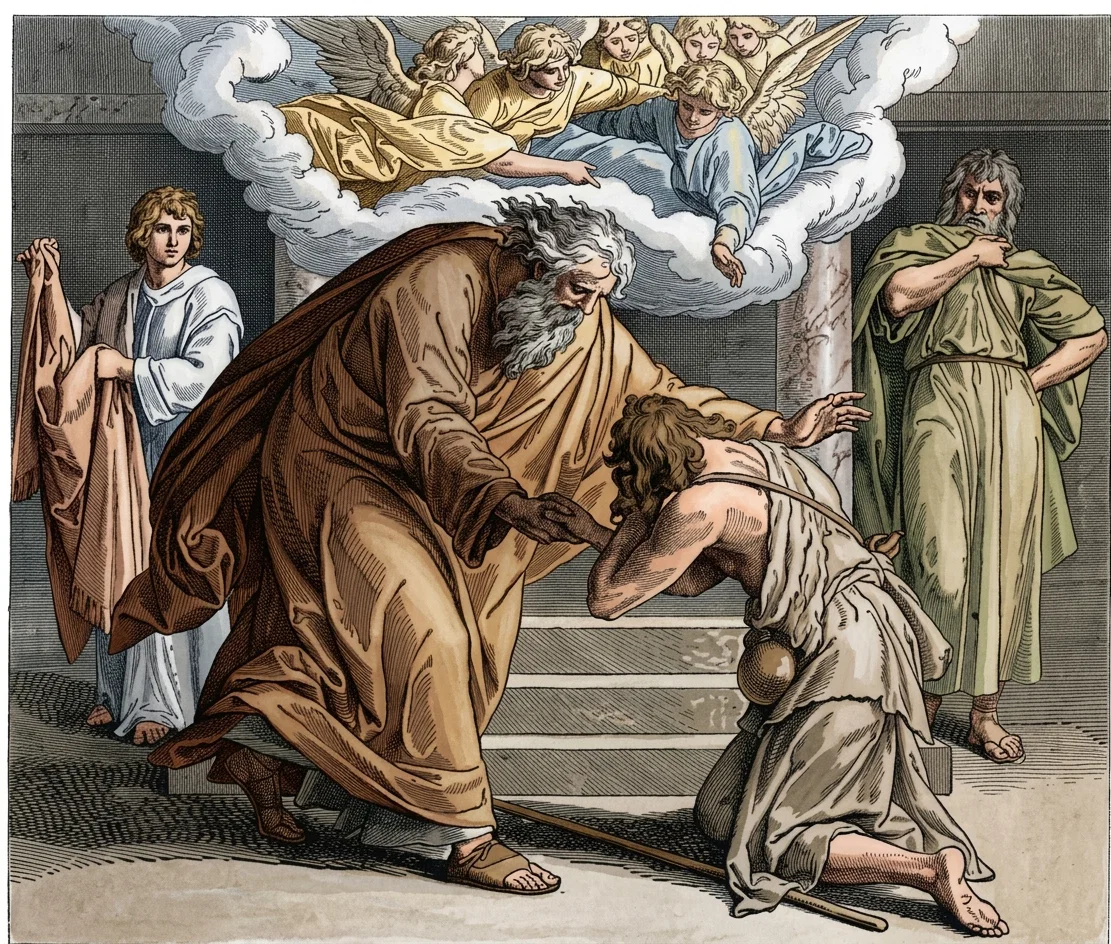
But the father said to his servants, Bring forth the best robe, and put it on him; and put a ring on his hand, and shoes on his feet;
And bring hither the fatted calf, and kill it; and let us eat, and be merry;
For this my son was dead, and is alive again; he was lost, and is found. And they began to be merry.
(Memorize verses 18-20.)
Golden Text: "Likewise, I say unto you, there is joy in the presence of the angels of God over one sinner that repenteth." Luke 15:10.
NOTE.—Read the whole chapter, carefully comparing the three parables, which teach the same lesson. In the first, a shepherd loses one sheep from his flock of one hundred; in the second, a woman loses one piece of silver from her store of ten pieces; in the third, the father of the two sons loses one son by his going astray. In each there is a search, a finding of the lost one, and great rejoicing, all illustrative of the return of those lost in sin to the house, the fold, the possession of the All-Father.
SUGGESTIVE QUESTIONS.
(1) How did Jesus introduce the parable of the prodigal son? Verse 11. (2) What did the younger son say? Verse 12. Note 1. (3) What did the father do? Same verse. (4) What did the son proceed to do? Verse 13. (5) How did he prosper? Verse 14. (6) What did he do for relief, and what work was he given to do? Verse 15. Note 2. (7) To what extremity did he finally come? Verse 16. Note 3. (8) When he came to himself, what did he say? Verse 17. Note 4. (9) What did he determine to do and say? Verses 18, 19. (10) How did his father meet him? Verse 20. Note 5. (11) What did the son say? Verse 21. (12) But what command did the father give? Verses 22, 23. Note 6. (13) What reason did he give for this manifestation? Verse 24. (14) What was the happy result? Same verse, last clause, also verse 7. Note 7.
NOTES.
1. The portion of goods.—According to Jewish law the older son inherited a double portion. Deut. 21:17. In this case the younger would inherit one-third of the estate at his father's death. But he desired his father to anticipate the future and give him his share now in money or jewels, "which is a common form of investing wealth to this day in the east." "And he divided unto them his living," that is, the portions were indicated by giving the younger son the value of his third. The Lord endows all men with life and the possession of reasoning faculties, with power to act. As the parable indicates, there are two ways, two courses, that one may exercise his choice upon. The Lord does not exercise coercion, but simply sets before man the blessings of righteousness, and shows him the end of wickedness. He has the power to choose the right or the wrong.
2. Joined himself to a citizen.—Literally, "glued himself" to a citizen. That is, he virtually became his slave. He was sent to feed swine, the lowest and most degraded occupation one could have, especially for a Jew, which we suppose the son, from the customs mentioned, to have been.
3. Would fain.—Literally, he was coveting, longing for, ardently desiring, so hungry was he. The husks were the pods and seeds of the locust or carob tree, "a common evergreen tree bearing an abundant crop of fruit,—long, curved pods, which are used for feeding cattle, and are largely exported to England for feeding horses, under the name of locust beans. They are capable of sustaining human life, like the acorns of the oak; . . . and as in Germany and England the swine are driven into the woods to feed on the fallen acorns, so in Syria they feed under the locust trees."—Canon Tristram. The pods are "six to eight inches in length, and one inch in breadth, and about a quarter of an inch thick." No man gave unto him, not necessarily of the husks, but of proper food. He had not one friend, is the idea.
4. When he came to himself.—Note some of the points in his downward career. He went into a far country, wasted—scattered—his substance, spent all; there arose a famine; because he had not one friend in his poverty, he was in want, hired out to feed swine, and probably ate swine's food. A desperate picture indeed! Yet one which has had its counterpart many times in actual life. At the last extremity he came to himself. He suddenly awakened to a consciousness of his deplorable condition. The Satanic spell that had lured him on as in a dream towards ruin was broken. And how often it is that financial reverses or the total failure of plans for this world's gain bring a man to his senses! The squandering of the gifts of mind and of wealth go hand in hand, for the serving of mammon, or security in riches, results in forgetfulness of God. So it is with all worldly ambition, in whatever line. "The friendship of the world is enmity with God." James 4:4. But happy is that soul, no matter to what depths it has fallen, that comes to itself, and realizes, even at the last moment, that the Father still remains, and is ever the same. There is all hope for such an one.
5. His father saw him.—The inference is that the father was on the lookout continually for the return of the son who had gone astray. And when he saw him, his love caused him to run to meet him, and fold him in his arms. That love had been reaching out without ceasing after the prodigal during his entire absence. This represents the attitude of God towards the sinner. In a sense the sinner is the erring son, and the love of God, with all its fullness and power, is continually searching for an entrance to his heart to bring him home. In the parable of the lost sheep is represented the successful mission of the Son of God in rescuing the lost world,—the world lost through sin.
"But none of the ransomed ever knew
How deep were the waters crossed,
Nor how dark was the night that the Lord passed through
Ere he found his sheep that was lost.
Out in the desert he heard its cry,—
Sick and helpless, and ready to die."
6. The best robe.—The first, outer, chief robe, kept for special occasions. Here it means the robe of righteousness, indicative of a changed life, really the life we obtain through Christ. The ring on his hand, the symbol of rank, or authority, a restoration to dignity and power. Shoes on his feet. "Shoes were worn only by free men, never by slaves."
7. My son was dead, and is alive again.—Sin is a condition of death, for the end is death. So the return was as tho from the grave. He was lost, but found. And they began to be merry, for their great joy. Note the extreme danger of the sinner. Deliverance from some small pain or danger would occasion no such joy. The greatness of the joy in heaven (verse 7) is a measure of the greatness of the danger. It is "a brand plucked out of the fire."
NOTICE TO QUEBEC CONFERENCE.
AFTER April 1, the office of the Quebec Tract Society and Conference will be removed from 294 Marie Anne Street, Montreal, to Dixville, P. Q. All correspondence for above should be addressed to Miss Laura E. Cushing.
On account of ill health, I shall return to my home in West Enosburg, Vt. All private letters should be addressed to me there.
MRS. A. E. TAYLOR.
RANCH FOR SALE.
By Editor
SISTER M. GOULD CROUCH, of Toll House, Fresno Co., Cal., writes us that she has for sale 160 acres of land, which she would like to sell in order to put the proceeds in the cause; and if she can not sell it, she would like to rent it to some good Adventist family. For particulars, address as above.
The Testimony of History to the Truth of Scripture.
By Editor
By Rev. George Rawlinson, M.A., author of "Seven Great Monarchies." This is a pamphlet of 240 pages, takes up the most recent archæological discoveries, and shows how thoroughly they agree with the Bible record. "The religion of the Bible, unlike almost all other religions, has its roots in the region of facts," are his opening words in this valuable work, and the whole book is just as forcible and to the point as this opening sentence. We say again, it is a valuable aid to those who wish to briefly study the subject. Price, paper covers, 35 cents.
PACIFIC PRESS PUBLISHING CO., Oakland, Cal.
LESSON III.—SUNDAY, APRIL 19, 1896
"Take heed unto thyself; and unto the doctrine;" "that thy profiting may appear to all."
12. And the younger of them said to his father, Father, give me the portion of goods that falleth to me. And he divided unto them his living.
13. And not many days after the younger son gathered all together, and took his journey into a far country, and there wasted his substance with riotous living.
14. And when he had spent all, there arose a mighty famine in that land; and he began to be in want.
15. And he went and joined himself to a citizen of that country; and he sent him into his fields to feed swine.
16. And he would fain have filled his belly with the husks that the swine did eat: and no man gave unto him.
17. And when he came to himself, he said, How many hired servants of my father's have bread enough and to spare, and I perish with hunger!
18. I will arise and go to my father, and will say unto him, Father, I have sinned against heaven, and before thee.
19. And am no more worthy to be called thy son; make me as one of thy hired servants.
20. And he arose, and came to his father. But when he was yet a great way off, his father saw him, and had compassion, and ran, and fell on his neck, and kissed him.
21. And the son said unto him, Father, I have sinned against
FOREIGN.
—The Italian senate has voted 100,000,000 lire to carry on the war in Abyssinia. In the meantime peace negotiations are under way with Menelik. It is now said that the African king demands a large indemnity as one term of peace.
—M. Berthelot, French minister of foreign affairs, has resigned. This move is believed to have been brought about by Russian criticism of his conduct of French policy in Egypt, and an expression of lack of confidence by other members of the cabinet.
—The predicted rise in price of sugar due to the devastation of plantations in Cuba has showed itself in London. There the price has advanced from $2.10 to $3.10 per hundredweight. Heavy demands are being made upon sugar-producing sections everywhere, and prices in the United States may be expected to rise soon.
—On March 13 a meeting occurred between Queen Victoria of England and Emperor Francis Joseph of Austria. The meeting was their first, and to most people is interesting because of that fact, seeing their kingdoms are only a few hundred miles apart—and the length of the reign of each, the former having been 59 years on her throne, and the latter 48 years on his.
—The Egyptian Debt Commission has voted £500,000 to defray the expenses of England's proposed advance on the Soudan. Just how far the matter will go is hard to say at present, as it is reported that the Russian and French members of the commission protested, and voted against the proposition. But already England has thrown out an advance guard towards Dongola, and the latest report is that it has met a body of Dervishes, and suffered defeat.
—The news comes from Cuba that Pinar del Rio, in the extreme western province of the island, was taken by the insurgents under Maceo, on March 27. The city, which has been considered the western stronghold and relief center of the Spanish, is a place of 20,000 inhabitants, and was garrisoned by 4,000 troops. The attacking force was 9,000, well armed, and assisted, it is believed, by American artillery men. The rout was complete, but, as usual, the insurgents chose not to take possession at the risk of attack by a superior force. The city was given to the flames, stores captured, and the wily chief has left for parts unknown. Later news will probably give more details.
—The proposed route of the Nicaragua Canal is from Greytown, on the Atlantic side of the San Juan River; thence to the San Carlos River; thence three and a half miles to Lake Nicaragua; across the lake and through the valley of the Rio del Medio and the Rio Grande to Brito, on the Pacific Coast. The whole distance of 170 miles involves only 27 miles of excavated canal, the rest of the way being by rivers and Lake Nicaragua. This lake is 105 miles long by an average width of 40 miles. Three locks only on each side of the lake are said to be necessary, with a dam at Ochoa, on the San Juan. Who will see the enterprise through? is the question now troubling those interested in the project.
—President Hippolyte, of the Haytian republic, is dead. He was chosen president in 1890, after successfully defeating Legitime and putting down the revolution of 1889. His election was virtually a victory for the pure-blooded blacks, as he had no mixed blood in his veins. Legitime was the star of the Creoles. The administration has been characterized by severeness towards state offenders, several conspirators having been summarily shot, but in private life the president was described as a mild-mannered, genial, well-educated gentleman, of benevolent disposition. The ending of his rule, which period was one of peace for Hayti, again awakens fears for the island, as politics are not very firmly organized, and a political fight may bring on another revolution. A British war ship has already proceeded to Port-au-Prince to look after British interests in the island.
—Japan is evidently making an effort to compete with Great Britain for a share of the carrying trade of the world. A line to Bombay is already arranged which will compete with the Pacific and Oriental Company. A line is to be opened to Austria, and an agent is on his way to England to place an order for 6 steamships, of 5,000 tons each, which, with one of the same size already starting, will be put on a European line. The island kingdom has undergone a mighty reformation in the last generation, and is still changing, and bids fair to take its stand among the great nations of the earth. Already its manufactured articles are pushing into the great foreign markets and causing consternation among other manufacturers because of their high grade and cheapness. Just what shall be done in the revision of laws so as to afford what is believed to be necessary protection to home producers, and at the same time recognize Japan on an equality with other powers under the "most favored nation" clause of treaties, is a question agitating politicians at the present time.
—The trial of Jameson in England has drawn attention from South Africa, which for the time being appeared to have resumed a comparative state of quietude. But it appears from reports from that section that every preparation is being made to make a further and real crisis, which it is confidently believed will come when England has disposed of the Jameson affair. The Boers are resolved to effect their recognized independence, and to this end are aiming, and it is reported have made an alliance with the Orange Free State. To add to England's anxiety, the Matabele in two districts have revolted and fallen upon white settlers, many of whom are reported killed. Fugitives are seeking refuge in Bulawayo and Gwelo, whither a detachment of volunteers with a Maxim gun have been sent from Cape Town. This sudden move of the natives is quite probably due to the repulse of Jameson. England seems just now to have a heap of trouble on hand.
—The present strength of the Cuban insurgent army is estimated closely at 43,000 men, altho the Cubans claim there are 60,000 in the field. No doubt many would join the army were it not for lack of arms. Of the army proper, not counting local bands, two-thirds are well mounted, and about half are well armed. The others have shotguns, revolvers, or only the machete. Some are armed with muzzle-loaders, and lead is so scarce that telegraph wire chopped into short lengths often serves for the charge. Besides these small arms the insurgents have a number of field pieces captured from the Spanish troops. A recent despatch announces the safe landing of arms, ammunition, and a body of volunteers by the steamship Bermuda, which successfully evaded officials in New York two weeks ago. The stores will be of immense assistance to the rebels. They consist of 4,000 repeating rifles, 1,000,000 rounds of cartridges, 4 Hotchkiss rapid-repeating guns, 2 Gatling guns, 2,000 pounds of dynamite, thousands of matches, several hundred rubber coats, which will be useful as the rainy season comes on, and a supply of money for the purchase of provisions. This expedition, with that of the Three Friends, which has landed nearly as large a quantity of stores, will enable the insurgents to meet the Spanish more on an equality than before. Captain-General Weyler has issued another proclamation to the effect that henceforth he will treat the Cuban forces as bandits because of their runaway methods of fighting. Just what he will do in his wrath it will be interesting to see. The world at large has supposed the general was doing his best, but from his words evidently he has not been. He now proposes to annihilate the Cubans, it seems. He will quite probably learn to his amazement that the smaller and poorer armed forces, after inflicting what damage they can, will in the future, as in the past, have the audacity to refuse to stand up and be shot down according to his military ideas.
DOMESTIC.
By Editor
—Six million Bibles were printed in 1895.
—An exploring expedition under the charge of Professor Hite, of the University of Pennsylvania, will sail for Labrador this season. Already over fifty scientists and students have engaged passage. The work of the expedition will be along the lines of zoology, geology, botany, and archæology.
—The new battle ship Iowa was launched on March 28 at the Cramp's Shipyard, Philadelphia. The ship will carry eighteen guns and five torpedo tubes, but while not so numerously supplied with arms as some others, four of her guns are twelve-inch rifles, making her a terrible engine of war.
—Field Marshal Yamagata, of Japan, the organizer of the modern Japanese army, and the man to whom is due the success of Japan in the late war, is now in this country on his way to Moscow to attend the coronation of the czar in behalf of his country. He is described as a small, gray-haired man, with the most polished and polite manners, in whom one sees the most advanced type of the Japanese race.
—The Roentgen X rays are still in the front rank of popular interest, and the latest material development must be credited to "wizard" Thomas A. Edison. Mr. Edison, by means of a fluorescent screen manufactured by himself, and the Crookes tubes, has succeeded in penetrating the human body with the naked eye, without the aid of photography. The subject stands between the tubes and the screen, and the observer looks through an eyehole in the center of the screen from a position behind it. When the subject stood near the ray, nothing but light was discernible. A step near the screen revealed the bones, and a step further away from the light showed the internal organs, minute examination being made by gauging the distance. Clothing offered no obstacle to the passage of the wonderful rays. The achievement is a marvelous one, and we await with wonder and interest the next advance.
—A despatch from New Orleans states that a force of 300 whites in the town of Palmetto gathered about the place of registration a few days since, and by threats prevented the negroes of the parish from registering for the purpose of voting. Several who did register were on the following night taken from their homes and unmercifully flogged. One negro refused to come out on the mob's invitation, and fired upon the crowd, killing one man, whereupon the mob returned the fire, killing two blacks.
—A few months ago it was announced that chemists had succeeded in reducing invisible air to a blue liquid capable of being poured from glass to glass like water. Lately a means has been found to produce this liquid on a large scale for commercial purposes, when it will be used for refrigerating purposes. It is explained that the process of liquefaction is arrived at by reducing the temperature of the air to a very low point, and consequently when the liquid is allowed to expand to a gaseous state, so much heat is absorbed as to cause a great fall of temperature in its immediate surroundings. Properly controlled it will be unsurpassed as a refrigerating agent. Its production will be by the aid of powerful compressing engines recently invented by Herr Linde, instead of the slow laboratory process.
—A bill has passed both Houses of Congress removing all naval and military disabilities from those who participated in the War of the Rebellion on the southern side, a move which should have been made long ago. Such action would probably have been taken fifteen years ago, had it not been for the stand of one or two prominent generals of the Southern Confederacy, who refused all advances. There is hardly a question but what a stronger government and a slow union would have resulted had no such disabilities been imposed even upon those willing to help build up the nation, as witness the course of Japan after its great revolution. Leaders in the rebellion were given prominent positions in the government, thus gaining their everlasting adherence and the friendship of their former supports.
St. Helena Sanitarium.
(Formerly RURAL HEALTH RETREAT.)
A Health Retreat under regular management, where all natural methods of treatment are used, including pure water, fresh air, beautiful scenery, healthful foods, gymnastics, Swedish movements, electricity in various forms, baths of all kinds, massage, and the rest cure, as may be deemed best suited. Besides, our surgical wards are in the hands of skilled surgeons and trained nurses where the best care can be given.
Send for a circular. Address,
St. Helena Sanitarium,
St. Helena, Napa Co., California.