Your ShelfYour Projects

Signs of the Times, Vol. 31, No. 28.

JEHOVAH'S POWER AND DOMINION CELEBRATED

Signs of the Times

Jul 12, 1905

Pacific Press Publishing Company · Mountain View, California · Jul 12, 1905

JEHOVAH'S POWER AND DOMINION CELEBRATED


Jehovah reigneth; let the earth rejoice; Let the multitude of isles be glad. Clouds and darkness are round about Him; Righteousness and justice are the foundation of His throne. A fire goeth before Him, And burneth up His adversaries round about. His lightnings lightened the world; The earth saw, and trembled. The mountains melted like wax at the presence of Jehovah, At the presence of the Lord of the whole earth. The heavens declare His righteousness, And all the peoples have seen His glory. Let all them be put to shame that serve graven images, That boast themselves of idols; Worship Him, all ye gods. Zion heard and was glad, And the daughters of Judah rejoiced, Because of Thy Judgments, O Jehovah. For Thou, Jehovah, art most high above all the earth; Thou art exalted far above all gods. O ye that love Jehovah, hate evil; He preserveth the souls of His saints; He delivereth them out of the hand of the wicked. Light is sown for the righteous, And gladness for the upright in heart. Be glad in Jehovah, ye righteous; And give thanks to His holy memorial name.

PUBLISHED WEEKLY

(Entered September 15, 1904, as second-class matter at the Mountain View, Cal., post-office, under act of Congress of March 3, 1879.)
H. H. HALL, - - - - - BUSINESS MANAGER.

Terms of Subscription.

Per Year, post-paid . . . . . . . . . . . . $1.50 Six Months, 75 cts. Three Months, 40 cts. To Foreign Countries, per year, $1.75.

SPECIAL TERMS.

1. One new yearly subscription and one renewal, or two new yearly subscriptions, sent at one time, $2.50.
2. Two new yearly subscriptions and one renewal, or three new yearly subscriptions, sent at one time, $3.25.
3. Three new yearly subscriptions and one renewal, or four new yearly subscriptions, sent at one time, $4.00.
Sample copies sent on application.

TO OUR PATRONS.

Please be careful to write all names of persons and places plainly.
Send money by Post-office Money Order, Express Order, or Bank Draft on New York, Chicago, or San Francisco.
Orders and Drafts should be made payable to the Pacific Press Publishing Co.
Paper money or silver should be sent in a registered letter.
Registered mail is safe. Unregistered mail is at the risk of the sender.
Postage-stamps in five or ten cent denominations will be accepted for small amounts.
The address label on your paper will indicate the time to which your subscription is paid. In case of non-receipt of papers, or any other irregularity, please notify us immediately.
When subscriptions expire, no more papers are sent to the party except by special arrangement.
You are requested to watch the date on your label, and renew early, and save the loss of papers. We can not always furnish missing numbers.
When requesting change of address, be sure to give both old and new addresses.
Important.—If you order SIGNS, Our Little Friend, books, etc., at the same time, use a separate sheet of paper for each. If this request is complied with, it will materially assist in the prompt and accurate despatch of the business.
When writing to the editor, be sure to use a separate sheet of paper.

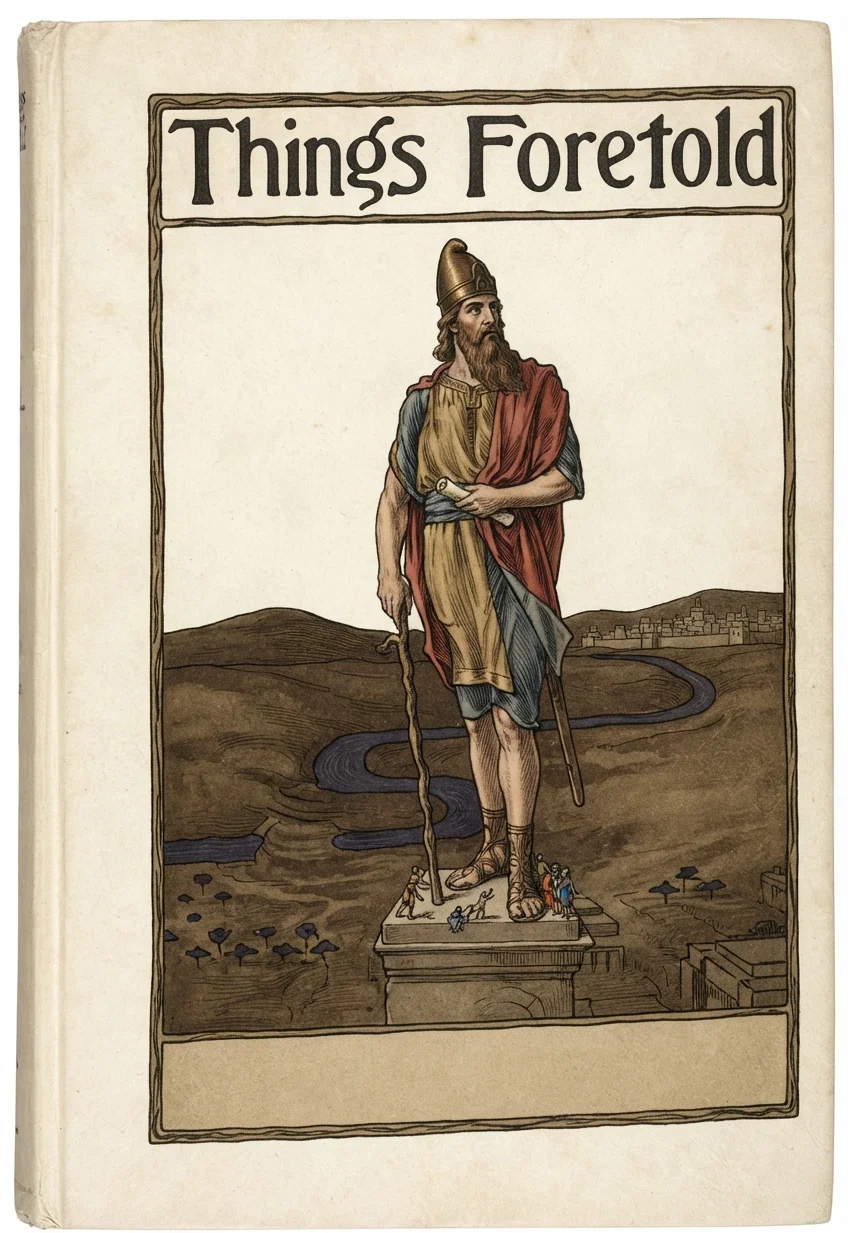
Things Foretold.

Every one is interested in what may take place in the future. Even the children like to hear papa and mama tell about something that is going to happen.
Well, our heavenly Father knew that His children would be anxious to know about some of the things that were to take place in the future, and He knew that we ought to know about them, too, so He has told us a great many things beforehand in the Bible.
But some are confused over these prophecies, so our good Brother Glenn has been kind enough to write it all out in plain, simple language that even the children can understand. The book tells about some things that have already taken place, and others that are taking place right now, and still others that must take place pretty soon.
You want to know about these things don't you, and read the interesting stories about Daniel and his companions in the land of Babylon? You will enjoy the nice pictures in this book, too.
Bound in board covers. Price 50 cents.

The House We Live In.

How many of the children ever saw a house built? If you have, you remember how the frame was put up, the roof put on, the frame sided up, and the windows put in. Then it was divided into rooms, such as the kitchen, bath-room, dining-room, music-room, and maybe a place for a telephone.
Did you ever stop to think that your body is something like a house,—that it, too, has a frame, enclosed and partitioned off into rooms or apartments, has windows, and servants, and a perfect telephone system? The author of this book, Mrs. E. W. Farnsworth, has found a great many interesting comparisons, and withal the very best materials to put into the body house to make it grow up strong and healthy, and the best locks to use to keep out the thieves and murderers that try to get in to steal and destroy.
You would like to read a book like that, wouldn't you? It contains over 200 pages, with pictures on every page. Price 75 cents.
The HOUSE WE LIVE IN

Our Paradise Home.

Suppose your father was going away to some other state or country to secure a new home, promising that when it was all fixed up he would come back and take you there. You would be very anxious for the day to come when you could see the new home, and you would want your father to write and tell you something about it beforehand, wouldn't you?
Our Saviour just before going away, said that He was going to prepare a place for us, and when it was all ready would come back to get us. He knew that while we were waiting here we would be anxious to know something about it, and so He has given us some glimpses of the Goodly Land in the Bible.
Thinking that the children might not be able to find all the interesting things about the Land of Promise, Elder Lane has picked out these items and put them into a book, so that you may read them in connected form. He gives you some fine pictures, too. Price, in board covers, 25 cents; cloth, 50 cents.

Jack the Conqueror.

How many of you have to meet things that are hard to bear, difficulties that are not easy to overcome? Every one, perhaps, and sometimes you are entirely defeated. Would you like to know how to be victor every time?
We want to introduce to you Jack the Conqueror, a boy that has met many trials like yours, and has conquered in them all. Let him tell you his experiences in meeting and overcoming difficulties, as they will certainly help you to conquer, too. The stories are very interesting as well as helpful, and in the book you will find a picture of Jack and some other things. Price, in paper covers, 25 cents; cloth, 50 cents.

PACIFIC PRESS PUBLISHING COMPANY

MOUNTAIN VIEW, CAL.
285 SALMON ST., PORTLAND, ORE.
1109 EAST 12th. ST. KANSAS CITY, MO.

A TALK WITH THE LITTLE FOLKS ABOUT BOOKS

Uncle Ben's Cobblestones.

Uncle Ben is a real pleasant old gentleman, and one the children around home all like because he knows how to tell just the very best kind of stories.
In some way Uncle Ben has found out that all the little boys and girls like to hear stories, too, and he would like very much to go around and visit you all, but that would take too long and some of you would get tired waiting. So in place of a personal visit, Uncle Ben has decided to print his stories into book form so that you may all have them right away.
He tells you about very common things, such as air, water, sunshine, fire, smoke, glass, coal, salt, paper, matches, etc., but he tells so many remarkable things about how they are made and what they are made of that you begin to wonder if they are really the things that you have been using every day. Uncle Ben is a good man, too, and so, of course, weaves in little lessons of truth that will help you to grow up and be good and kind, too.
You would give one cent, and more too if you had it, wouldn't you, to hear a good story? Well, try Uncle Ben, he gives you more than 200 pages of stories, and about twice that number of pictures for only 75 cents.

"REVIEW" TESTIMONIALS.

"When I embraced present truth in the year 1852, Elder James White gave me all the back numbers of the Review and Herald which I carefully read, and I have read every number that has since been published. Any one who expects to be informed on the progress of the Message can not for any reason dispense with this most excellent periodical."
J. N. LOUGHBOROUGH,
Mountain View, Cal.
"In behalf of our workers in foreign fields, I wish to express my appreciation of our good old church paper, the Review and Herald. It is indeed a 'tie that binds our hearts' in the love of the truth. Without its weekly visits the lives of our missionaries would be dreary indeed."
F. W. FIELD,
Tokyo, Japan.
"Having been a weekly reader of the Review and Herald for the last thirty-eight years I now regard it as important as my daily food. Its columns are filled with spiritual nourishment."
H. W. COTTRELL,
South Lancaster, Mass.

XI. THE POWER OF FORGIVENESS.

The Sick of the Palsy.

ONLY in an accommodated sense can man forgive sin. He may overlook the wrong that the act of another has brought upon him; and so, as far as his feelings are concerned, may bury it forever. But his forgiving does not take the sin from the heart of him who did the wrong, whatever his attitude may be. God alone can fully forgive sins. He alone can cleanse the guilty soul. He alone can take the crimson, the scarlet, soul and wash it as white as wool, as white as snow.
BUT it takes divine alchemy to do it. By no sort of human process can it be done. Man knows no acid, no chemical, which can take away sin's stain without the destruction of the fiber which sin has dyed. By no human law of growth can man eliminate the evil in his nature. By no process of dieting can he remove the plague. He may cover the sore; over the eating ulcer skin may seem to form; but sooner or later the corruption becomes manifest, deeper, more widespread, and more virulent than before. God alone can forgive, can cleanse, can take away, the sin; for only by divine creative power can it be done.
By one of His mighty miracles Christ has shown us this. The instance is recorded in Mark 2:1-12; Matt. 9:2-8; Luke 5:18-26. These notes are based on all three accounts. The miracle occurred in Capernaum, in Christ's home, evidently. The people heard He was there and filled the house and court, and "the power of the Lord was with Him to heal" both soul and body. There were among the people critical, keen-eyed, adverse, doctors of the law and Pharisees.
WHILE He was teaching there came, among the other ailing ones, a palsied man, borne by four friends. They sought to reach Jesus by the door and failed. The sick man's case was urgent; his soul was in agony. He could not wait till the people were gone. His soul was more burdened with his sins than his body with disease. And so he suggests another way of reaching the Master, and his bearers take him to the flat roof, uncover the inner court where Jesus is, and let down the pallet, on which the sick man lay, before the Saviour.
JESUS did not reprove their temerity, or irregularity. He looked upon the sick of the palsy. He read the longing of his heart; for the Spirit which gave birth to the longing was the life of His life. He therefore met the greater need of the poor man: "Son, thy sins are forgiven thee." More than the disease was the sin. Body might be destroyed by disease, the loss was but temporary; but remaining sin leaves an eternal blight. The Pharisees accused Him of blasphemy. Surely, said they, "who can forgive sins but one, even God?" and their observation was true as to the fact, but wrong as to the charge; for the God-Man stood before them—Divinity clothed with humanity. For their own salvation He longed that they should learn this fact. For ours, in His providence, it is recorded.
SEEING their reasonings, He thus appeals to them; "Why reason ye these things in your hearts? Whether is easier, to say to the sick of the palsy, Thy sins are forgiven, or to say, Arise, and take up thy bed, and walk." The former could be said by mere man, and the soul deceived into believing the falsehood. It is only God who can cure the palsied unto death. It is only God who can forgive sin. Therefore Jesus continued: "But that ye may know that the Son of Man hath authority on earth to forgive sins (He saith to the sick of the palsy), I say unto thee, Arise, take up thy bed, and go unto thy house." The latter was a test of the power and authority to forgive sins. And even we may pray, "Create in me a clean heart."
THE result demonstrated the test. He that had his soul freed from sin's hypnotism by forgiveness, now feels his body freed from the paralyzing power of disease: "and he arose, and straightway took up the bed, and went forth before them all; insomuch that they were all amazed, and glorified God, who had givensuch authority to men, saying, We never saw it on this fashion;" "and they were filled with fear, saying, We have seen strange things to-day."
AND even so would God show strange things in this day if His professed people would believe, simply believe, in the divine power of Jesus Christ for the forgiveness of sin. Heathen philosophy, evolution, and agnosticism have robbed souls of their belief in God and His creative power, because of ignorance in the Scriptures. Yet His word stands, "I am Jehovah; I change not." He is "Jesus Christ the same yesterday, to-day, and forever." To you, O sinner, He would say to-day, as to the palsied in that far-away yesterday, with the same love and the same potency, "Son, thy sins be forgiven thee." Will you not believe and accept His gracious message?

EQUALITY IN RIGHTS.

THE Declaration of Independence declares that "we hold these truths to be self-evident; that all men are created equal; that they are endowed by their Creator with certain unalienable rights."
If it is a fact "that all men are created equal," then no man or combination of men has a right to disturb this equality. In what, therefore, does this alleged equality consist? is a pertinent question. It is not in stature, nor in color, nor in intelligence, nor in disposition. However equal, or similar, these conditions might have been in all men, had sin not entered to disarrange for the time the harmony of God's work in the earth, is not the question. Civil government is concerned with the best temporal good of man as he is. Then it is here and now that we must contemplate, as a self-evident truth, the doctrine of equality. So, in the consideration of man as he is here and now, there is but one point of view from which this God-designed equality is apparent, and that is in the matter of rights. And here is the place where the framers of the Declaration stood, when, in laying the foundation of this government, they acknowledged and asserted that "all men are endowed by their Creator with certain unalienable rights."
The government which they proposed to establish was not designed to create rights, but to "secure" the free exercise of the rights with which the Creator had already endowed mankind. The government to which the Colonies were then subject was denying this exercise of rights, hence the colonists declared for "a new order of things"—a government having for its object to provide for the best good of all the people.
The idea prevails to a great extent to-day that the government is designed to provide for the best good of the majority; but that is a perversion of the true spirit of government, for it ignores the rights of a part of the people. It is but a slight modification of the monarchical doctrine that governments are established for the special benefit of rulers and their friends, be they never so few. This is always the tendency even of republics, when they become strong, and imbued with the spirit of partyism, and therefore corrupt. Hence the necessity of a constant reiteration and maintenance of the principle that all men are endowed by their Creator with an "unalienable" equality of rights. G.

A DANGEROUS RESPONSIBILITY.

THERE is a peculiar kind of theological teaching in the following from the Ram's Horn, of Chicago. It is worthy of note only because it is the expression of a belief that is very prevalent at the present time:
Every day is a holy day to the right kind of a Christian. Sunday calls for no higher standard of conduct than Monday or Wednesday. By common consent and through divine injunction we are forbidden to do certain things on the Sabbath, but they are tasks which are not in themselves wrong, but because they interfere with Sabbath rest and worship. Sunday is not universally observed as the Sabbath. The Greeks observe Monday; the Persians, Tuesday; the Assyrians, Wednesday; the Egyptians, Thursday; the Turks, Friday; the Jews, Saturday, and the Christians, Sunday. Thus a perpetual Sabbath is being celebrated on earth. The important thing is not the particular day, but the giving one-seventh of our time to rest and worship.
It is indeed true that "Sunday calls for no higher standard of conduct than Monday or Wednesday." In the first place, the Bible nowhere recognizes Sunday as a holy or sacred day; and in the second place, God has nowhere taught us in His Word that we are to be better one day than another. We can not impute any such teaching to the "Lord of the Sabbath day." But he who tries to make a Sabbath of every day is just as far in the wrong as he who imagines he must be better on Sunday or on the Sabbath than on any other day.
The Sabbath institution was established as a memorial of creation; was blessed and sanctified by the Creator for the purpose of a memorial; He set it before the race and commanded its observance as a memorial, a day of worship. The Founder of that institution "rested and was refreshed." So we are to find rest and refreshment. He blessed and hallowed it for a purpose, and we totally ignore that purpose when we set up our own choice of a day for a Sabbath, or try to make a Sabbath of our own out of all the days of the week.
The writer of the above extract overlooks the fact that God gave the Sabbath as a perpetual reminder of Himself and His completed work. The Bible says upon that point:
"And God blessed the seventh day, and hallowed it; because that in it He rested from all His work which God had created and made." Gen. 2: 3.
God did not rest on every day in the week from all His work; nor did He bless and sanctify every day in the week, because that in them all He had rested from all His work which He had created and made. Therefore all the days of the week could not be Sabbaths. He did not rest on any single day of the first six days of the week; nor did He sanctify and bless any single one of the first six days of the week. Therefore it is impossible that any one of the first six days of the week should be the Sabbath of the Lord.
The extract says: "Thus a perpetual Sabbath is being celebrated on earth;" and that because each day of the week is being observed by some people. That is not true in the light of God’s Word. It is but another illustration of the Babel of confusion into which the world has permitted itself to drift by departing from the Word of God. The fire-worshiping Persian is not keeping a Sabbath to the Lord by performing his fire-worship on Tuesday; the whirling Dervish is not keeping a Sabbath to the Lord God by performing his brain-befogging gyrations on Thursday; and the Roman Catholic is not keeping a Sabbath to the Lord Jehovah by going through religious rites and ceremonies on the day which the ancient pagan world dedicated to the worship of the sun god. Nor are Protestants keeping a Sabbath to Jehovah by following the Roman Church in this and trampling upon the only Sabbath which Jehovah ever recognized as His or ever gave to men to keep.
"The important thing," the above extract says, "is not the particular day, but the giving one-seventh of our time to rest and worship." Who authorized any man to make such a statement as that? Nowhere in God’s Word is any man given authority to change the statutes and ordinances of the Lord. God declares, "My covenant will I not break, nor alter the thing that is gone out of My lips." Ps. 89: 34. What is God’s covenant? In Exodus 31: 16 the Lord calls the Sabbath "a perpetual covenant." What was it that went forth out of His lips?—"And God spake all these words, saying." What are "thesewords" which Jehovah spoke with His own lips?—They follow immediately—they are the Ten Commandments, in the bosom of which rests the fourth, the Sabbath commandment. God’s own promise, then, is that He will not break that Sabbath "covenant," nor alter His Sabbath commandment.
Thus it stands, and will stand forever. It is a fearful thing to take upon one’s self the responsibility of attempting to change the commandments and ordinances of God. Some of the ancient Israelites thought it made no difference about the particular day of the Sabbath, and they paid for their thoughtlessness with their lives. Some thought it made no difference if ordinary fire was used in the sanctuary service. They were slain. It is just as unholy business now as it was then to tamper with God’s law and His requirements when thousands of souls are in the balances deciding for eternity. "Verily I say unto you, Till heaven and earth pass away, one jot or one tittle shall in no wise pass away from the law, till all things be accomplished. Whosoever therefore shall break one of these least commandments, and shall teach men so, shall be called least in the kingdom of heaven; but whosoever shall do and teach them, he shall be called great in the kingdom of heaven." Matt. 5: 18, 19.

SPAIN AS OUR EXAMPLE.

SPAIN is listed as a “Christian nation.” This fact is the cornerstone of the claim that the United States is a Christian nation. In delivering the opinion to this effect, the Supreme Court gave as a basis certain historical facts, first of which is the commission to Christopher Columbus from “Ferdinand and Isabella, by the grace of God king and queen of Castile.” This commission expresses the hope that, “by God’s assistance, some of the continents and islands in the ocean will be discovered,” etc.
So the people who are laying so much stress on the evidences adduced by the court that “this is a Christian nation” would do well to remember that even yet Spain can not give up her bull-fights; and if we are to follow in the footsteps of Spanish national Christianity, they should also remember that Spain still insists on having her bull-fights on Sunday. This is official action. The Council of State and the Cortes has decided that the prohibition of bull-fights on Sunday would be contrary to the spirit of the Sunday-rest law, since the torreros and bull-fighters, having no work to do during the week, do not need rest on Sunday; secondly, if bull-fights were to be held on any other day of the week they would have the effect of taking people away from their work, and also because the work of the torreros can not be considered as labor, but rather as an art, on a line with that of the actors of those semi-sacred plays and dramas, the performance of which is expressly permitted by the new law on Sunday. So in Spain Sunday is to continue as the one day of the week devoted to the national sport of bull-fighting. How much further shall we follow Spain’s example in national religion?—Until the Inquisition, which Ferdinand and Isabella fostered, shall have been set up for dissenters from the national faith? G.

ANARCHY AND ITS ONLY CURE.

THE rapid growth of Anarchy, and of societies of socialistic and communistic nature, is causing great concern throughout the governments of earth. Those governments wherein Anarchy was born are laying the blame for its promotion and growth upon those countries in which the people are given greater liberties. The countries that are granting to the people the greatest liberty are putting the blame back upon the countries in which anarchy was first manifest.
For the cure of Anarchy one class advocates greater respect to the rights of individuals; the other class advocates more rigorous measures, severer punishment, restriction of the liberties of speech and of the press.
But what may we expect along these lines from what the world itself is able to do for the cure of the menace of Anarchy? We are told that the nations must better the conditions of the oppressed and down-trodden and poverty-stricken; that in that they will lay bare the root of Anarchy, and pluck it out of the world. Let us examine the prospect along this line. What are Italy, Hungary, and Russia doing to alleviate the distress and poverty of the discontented who are swelling the ranks of Anarchy?—Heaping on taxes, and banishing, whipping, and imprisoning the discontented, thereby increasing the discontent and the occasion for punishment.
What is being done by the legislative departments of other nations to alleviate the suffering of the masses?—Enacting legislation in the interests of the powerful—legislation which makes it possible for great monopolies, or syndicates, to grasp and control the wealth-producing industries of the different countries, and thus increasing the cost of living for the purpose of piling millions on millions. This certainly does not better the condition of the suffering and poverty-stricken, but, instead, heaps upon their backs a load heavier than the one which they had been bearing before.
Look over the legislative acts of Congress and the Legislatures, and you may be surprised to see how few of them are in the interests of the unfortunate and depressed. Great affairs of finance, and great state, national, and international affairs consume almost the entire attention of the law-making bodies. The legislative bodies of the world will furnish no lotion capable of healing the raw sore of Anarchy. It is utterly useless to look to them for any such healing balm.
Is there, then, no hope for the cure of Anarchy?—None in the way in which the world is looking for it. Nations can not legislate hate out of the human heart, nor love and contentment into it; neither can men drive out hate by the sting of the whip and the fear of banishment and death; and while nations and individuals are striving for mastery and for gold, the cry of distress and oppression will continue to go up unheard or unheeded. Hasty and unwise laws may be passed against Anarchy, out of pure personal fear for what the Anarchist may do, and in the hope that the law may deter him; but legislation will never reach and eradicate the root of that perennial and pernicious weed.
Anarchy means against law, without law,—lawless. It began with Lucifer in heaven; it will end with Lucifer in the consuming fires of God’s judgment. Rev. 20: 7–10. Anarchy will come to its end, but that end will be only when the twin sisters, selfishness and sin, are burned out of the world with all the dire results that they have brought into it. That burning will be the burning of the great day of God. 2 Thess. 2: 8; 2 Peter 3: 10–12; Mal. 4: 1–3. Then Anarchy, the revolt against God’s law, will have compassed its own destruction, will have suffered the result of its own misguided course.
But there is a cure for Anarchy. It is not a human cure; it is not brought about by legislation. It comes through the great Physician, and through Him alone. It will not only cure Anarchy; but it will save the Anarchist. It will do this in the individual, but only in the individual who willingly allows it to be done for him. There will be no compulsion about it; there will be no salvation of Anarchy en masse, or as a society. That work of cure must go on in the heart until every root of bitterness is eradicated, until every selfish impulse is banished, and submission to the will of God is complete.
Satan was the first Anarchist; he revolted against the law of God. He sought the overthrow of government; he sought the exaltation of self. Now the cure for Anarchy must be the very opposite of that, and we find it in Christ Jesus. This is the all-important admonition: “Let this mind be in you which was also in Christ Jesus.” That mind which was in Christ Jesus led Him to lay down His life for those who had merited death through the breaking of God’s law. Thus was the majesty of the law upheld, and at the same time a way opened that men might be saved from the results of their own anarchistic course.
The heart of the carnal man is the heart of Anarchy; for we read: “The carnal mind is not subject to the law of God.” Then, in the regeneration of the heart of man, is the cure for Anarchy; that is, letting the mind of Christ displace the carnal mind. That takes Anarchy out of the individual; that saves the individual—and it is the only thing that can. That is Anarchy’s only cure. And in the application of that cure, submission to the will of God, is the only true and perfect liberty. s.
Continue reading: Question Corner