Your ShelfYour Projects

Review and Herald, Vol. 90, No. 26.

Sabbathless Christianity

Review and Herald

Jun 26, 1913

Review and Herald Publishing Association · Takoma Park Station, Washington, D. C. · Jun 26, 1913

Sabbathless Christianity

ABRAM HERBERT LEWIS, D. D.
So long as the early church followed Christ’s example, and kept the Sabbath as He left it to them, the spiritual life of the church remained at “full tide.” After the time of the New Testament when pagan philosophy and prejudice against the Jews began to teach the falsehood that the Sabbath was only a “Jewish affair,” and that it was not binding on Christians, the spiritual life and power of the church declined in swift and increasing ratio. This was especially true after Christianity became a religion of the Roman Empire, by civil law, and Sunday and other festivals appeared.
These influences culminated in the papal power and the long midnight of the dark ages. Other influences contributed to this decay, but first and foremost was the falsehood which pushed God, His law, His Sabbath, and hence communion and fellowship with Him, out of the hearts and lives of men. All that was given in return was the authority of the church, backed by the law of the state. The dark years of the wilderness life of Christianity between the middle of the fifth century and the time of the German Reformation, are crowded with lessons showing that a Sabbathless Christianity is correspondingly a godless Christianity, and one from which all the better elements of spiritual life are driven.—Sabbath Recorder.

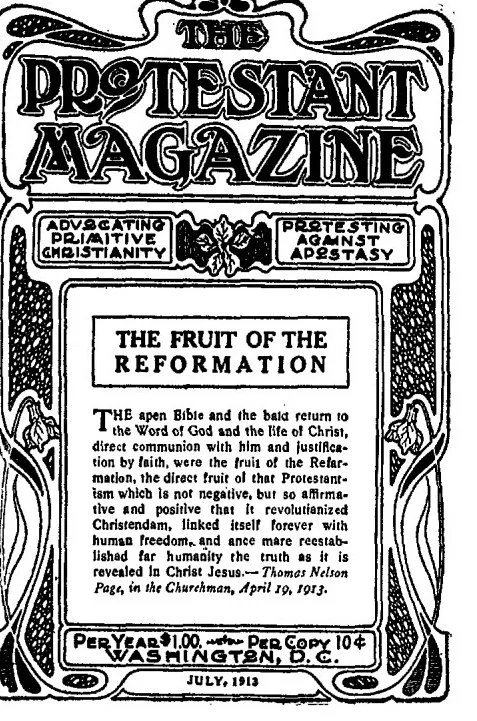
The Heart of Our Message

In These Two Numbers!

FOR $1.00 WE WILL MAIL THEM TO TEN OF YOUR CATHOLIC FRIENDS
Note how the BIBLE PICTURES of the PAPACY appear in Rome’s own WRITINGS.
See articles: “The Priest as God,” “Creator of His Creator,” “The Mass, Meat, and Murder,” “A Convent Tragedy,” “Rome Versus Free Press,” etc.
Or, for 50 cents we will mail these two numbers to five different addresses—yours and four others, if desired.
No minister, teacher, Bible worker, or student of prophecy should be without these latest documents confirming the Bible prophecies concerning Rome!
Ten two-cent stamps will pay for one set.
If desired, we can start a few more subscriptions with the March number containing Part I of “A Convent Tragedy.”
Yearly Subscription, $1.00  Six Months, 50 Cents

ORDER THROUGH OUR NEAREST AGENCY

(If you do not know the address of our Agency, ask “Protestant Magazine,” Washington, D. C.)

THE HAND OF GOD IN HISTORY

By W. A. Spicer
In this age of research, history and the Bible should be found side by side on the table of every student of the times.
We are not only “making history,” but discovering it. The translations made from tablets, rolls, and statues exhumed from mounds, tombs, and buried cities, corroborate and supplement the records found in the Holy Scriptures. In “The Hand of God in History” the discoveries of the archeologist are made to emphasize the statements of Holy Writ; history is shown to have fulfilled the predictions of the prophet; and the testimony of astronomy is given on the side of history and prophecy. Much historical information is given in connection with the description of the prophetic periods of the Scriptures; the development of Christianity by eras is outlined; and the advent message is described as the finale of earth’s history, and the means of disseminating it as providential. The book has about 250 pages, and is bound in two styles.
Cloth, 50c                 Paper, 25c

GOOD FORM AND SOCIAL ETHICS

By Fannie Dickerson Chase
“Good manners are best conserved by every-day usage.”
If you are preparing for a life of usefulness; if you are endeavoring to make your influence count for most in good society, then you should study the new book “Good Form and Social Ethics.”
Whatever his educational advantages have been, the pastor will appreciate the chapter entitled “The Minister.” To the one whose preliminary training has been limited, or whose early environment was unfavorable, “Good Form” is invaluable.
Over thirty pages of the book are devoted to a chapter to “The Gentleman,” the contents of which are indicated by the subheads:—
Practical Jokes
General Suggestions
Personal Habits — Some Insistent Don’t’s
Relation to Liquor and Tobacco
His Relation to Woman
Relation to People in General
Price, in attractive cloth binding, 75c
REVIEW AND HERALD PUBLISHING ASSOCIATION, Washington, D. C.
Order of your tract society

A Short Sermon

How Divine Love Is Expressed

H. A. ST. JOHN
“As many as I love, I rebuke and chasten: be zealous therefore, and repent.” Rev. 3: 19.
DIVINE love is expressed and revealed to the lukewarm professor, first, by rebuke or reproof. If this is not effectual, then follows chastisement. Neither of these are agreeable at the first, but if we are rightly exercised by them they will be followed by the peaceable fruits of righteousness. How precious the love of our Lord, as manifested by rebukes, and even chastisement with misfortune, affliction, and suffering, in order to bring back his wayward children to the way of light and life, that leadeth to himself, and to glory.
Again his great love is revealed by the following words: “Behold, I stand at the door, and knock: if any man hear my voice, and open the door, I will come in to him, and will sup with him, and he with me.” Reader, do you hear the moving Saviour’s voice in this testimony? Are you doing everything as fast and as far as you know to open the long-closed door? If so, you may be hopeful and may exercise strong faith that in due time the door will be opened wide. And then what?—O! joy inexpressible, and full of glory. What a helpful and lovely guest will come in and abide with you, to sup with you, and you with him! Who can describe the blessedness, helpfulness, and sweetness of such association, fellowship, and communion? Then the receiver will become all light in the Lord. All around you will take knowledge of you, that you are constantly learning of Jesus. Your light will break forth as the morning; your spiritual and perhaps physical health will spring forth speedily, your righteousness will go before you, and very soon the glory of the Lord will gather you up. For soon the Lord will come personally, and in great glory, and his angels will gather all his saints together unto him, and so shall they ever be with the Lord.
Jesus is near, even at the door of the hearts of his remnant church, now. When fully received, they will very soon give the loud cry of the last gospel message to all the world, and that will open the door of the heavens, and Jesus will come personally and visibly to all the world, to make up his jewels.
Sanitarium; Col.

Order and Organization

J. N. LOUGHBOROUGH
It has been very truthfully stated that “order is heaven’s first law.” This is manifest in the precise and orderly movement of the planets. Of this the prophet Isaiah said, “Lift up your eyes on high, and behold who hath created these things, that bringeth out their host by number: he calleth them all by names by the greatness of his might, for that he is strong in power; not one faileth.” Isa. 40:26.
Concerning the accuracy of these movements I quote from a French work entitled “God’s Glorious Creation,” written by Harmon Kline and Thorne, English translation: “In two thousand years the day has increased in length the eighty-third part of a second. Observations since 1850 [about fifty years] show that the earth has gained in its passage around the sun two seconds.”—Vol. I, page 22.
Not only has the Lord established order in the movement of the heavenly bodies, but also in the church. When he brought Israel out of Egypt with Moses as a visible leader, it was not a promiscuous motley crowd, but they were “harnessed” (“five in a rank,” margin). Ex. 13:18; Joshua 1:14. In all the arrangement of erecting and removing the tabernacle and in their encamping, the most perfect order was observed. In the days of David the commendation was for those who “could keep rank.” 1 Chron. 12:33.
In apostolic times they were troubled with men who, like Diotrephes, exalted themselves in their independent ways. 3 John 9, 10. To guard the church from heresy there was an examination and ordination of those who stood firm on the gospel message, thus preserving harmony in the work. 1 Tim. 3:1-15; Titus 1:5-11. As the work advanced, it became more and more important to “set in order the things that were wanting.”
When the work of the third angel’s message was developing before there was any form of organization among us, there was nothing to guard the church from the encroachment of false teachers. As early as 1850 a testimony was given, found in “Early Writings,” calling attention to the course pursued by the apostles when commending teachers who were known to be in full harmony with the work. Our people were told that it is just as essential now for us to pursue a similar course. This resulted in granting to an approved minister a card of recommendation, showing that he was approved by the leaders in the work. I shall quote the words of the one I received in 1853, as a sample:—
“This is to certify that Brother J. N. Loughborough, of Rochester, N. Y., is one whom we recommend to the church to labor among them. “(Signed) JAMES WHITE, “JOSEPH BATES, “Leading Ministers.”
Such action cleared our ranks of those who had false theories to present. Then the public interest arose to hear the message. The number of ministers increased, and it became apparent thatthere should be a systematic distribution of labor. This led to the organization of State conferences, the first of which was the Michigan Conference, organized Oct. 6, 1861. As other State conferences were organized, it was evident that for the unity of action and systematic development of the work there must be concert of action among the State conferences. So to accomplish this the General Conference of Seventh-day Adventists was organized in Battle Creek, Mich., May 21, 1863.
As we met at Washington, D. C., in this jubilee year of the General Conference, and heard the reports from all parts of the world, demonstrating what order has accomplished, with God’s blessing, in the harmonious advancement of the message, we say this of itself is a proof that the Lord has led in the work. On this fiftieth anniversary year of the General Conference organization it is the unanimous sentiment of thousands of Seventh-day Adventists to push on the work under the same banner of systematic order.

Lord, Lead Us On

WORTHIE HARRIS HOLDEN
BEHOLD I send Jehovah's messenger To keep thee in the way, And leading on, to bring thee to the place Prepared for thee for aye.
So Israel journeyed, by the pillar led, Through all the desert drear; By day or night, in cloud or mantle bright, The Christ was ever near.
Still lead us on. We cannot see our way, No track lies in the sand; But yet we know that thou wilt be our guide E'en to the promised land.
When Israel within that place prepared Shall sing the triumph song, May we, as wondrous trophies of thy grace, Be found amid the throng.
Portland, Oregon.

“Prepare to Meet Thy God”

F. D. STARR
“I HAVE overthrown some of you, as God overthrew Sodom and Gomorrah, and ye were as a firebrand plucked out of the burning: yet have ye not returned unto me, saith the Lord. Therefore thus will I do unto thee, O Israel: and because I will do this unto thee, prepare to meet thy God, O Israel.” Amos 4: 11, 12. A preparation for the great day of God, so near at hand, is imperatively demanded. The impending judgments of God, like those that fell upon Sodom and Gomorrah, are cited as an incentive to cause men to make this preparation.
Those wicked cities of the plains are set forth in the Scriptures for an example of final punishment to all who should after live ungodly. 2 Peter 2: 9; Jude 7. The cities of today are fast becoming like those ancient corrupt centers of population, and the judgments of God in various forms are being felt by earth’s inhabitants. But the prophet declares that these judgments, falling heavily upon the land, have not aroused the guilty to repentance, nor caused them to return unto the Lord; therefore more and greater calamities must be visited upon the impenitent race. “And because I will do this unto thee, prepare to meet thy God, O Israel.”
For every special event a special preparation is necessary. To neglect this preparation is fatal. “That servant, which knew his lord’s will, and prepared not himself, neither did according to his will, shall be beaten with many stripes.” It is necessary to do the Lord’s will strictly, to obey his commandments fully, but this can be done by those only who have made the necessary preparation. At the time of our Saviour’s first advent, a special work of preparation was demanded and was accomplished by the preaching of John the Baptist. “The voice of him that crieth in the wilderness, Prepare ye the way of the Lord,” make straight in the desert a highway for our God.” Isa. 40: 3. See also Matt. 3: 3; John 1: 23.
But no more certainly was the way to be prepared before the work of Christ at his first coming than is the way to be prepared before his second appearing. “Go through, go through the gates; prepare ye the way of the people; cast up, cast up the highway; gather out the stones; lift up a standard for the people. Behold, the Lord hath proclaimed unto the end of the world, Say ye to the daughter of Zion, Behold, thy salvation cometh; behold, his reward is with him, and his work [“recompense,” margin] before him.” “Cast ye up, cast ye up, prepare the way, take up the stumbling-block out of the way of my people.” Isa. 62: 10, 11; 57: 14.
In preparing the way of the Lord, the way of his people will also be prepared. The conditions and signs of the times show this to be the day of his preparation (Nahum 2: 3), just as the time while the ark was preparing was the day of preparation for the antediluvians. 1 Peter 3: 20.
“The good Lord pardon every one that prepareth his heart to seek God.” 2 Chron. 30: 18, 19. This heart preparation is the all-important thing. “Lord, who shall abide in thy tabernacle? who shall dwell in thy holy hill? He that walketh uprightly, and worketh righteousness, and speaketh the truth in his heart.” Ps. 15: 1, 2. The one hundred forty-four thousand who are ready for translation have made the necessary preparation. “In their mouth was found no guile: for they are without fault before the throne of God.” Rev. 14: 5.
Guile is deceit, the opposite of truth. In the last days truth will be to a great extent disregarded. “Truth is fallen in the street, and equity cannot enter. Yea, truth faileth; and he that departeth from evil maketh himself a prey.” Isa. 59: 14, 15.
The conduct of the people is aptly described by the prophet thus: “They bend their tongues like their bow for lies: but they are not valiant for the truth upon the earth. . . . And they will deceive every one his neighbor, and will not speak the truth: they have taught their tongue to speak lies.” Jer. 9: 3, 5. With the largest professedly Christian organization teaching that it is a religious privilege to tell a falsehood instead of the truth when circumstances demand it, what else can be expected but that lying will, by all who come under such influence, come to be regarded as a very light offense? Notice the following statement by Alfonso de Liguori: “It is permissible to swear to anything which is false by adding in an undertone a true condition, if that low utterance can in any way be perceived by the other party, though its sense is not understood.” Of this same organization, the prophetic declaration is, “It cast down the truth to the ground.” Dan. 8: 12.
Truth as a system of belief must be restored, and believers be established in the present truth. Not only must God’s eternal truth be received instead of Satan’s falsehoods, but we must so “hate and abhor lying” (Ps. 119: 163) that we shall not prevaricate in the least degree, nor deviate from strictly telling the truth in every matter. “These are the things that ye shall do; Speak ye every man the truth to his neighbor; execute the judgment of truth and peace in your gates.” Zech. 8: 16.
Not even the so-called white lies are justifiable. “As a madman who casteth firebrands, arrows, and death, so is the man that deceiveth his neighbor, and saith, Am not I in sport?” Prov. 26: 18, 19. “He that will love life, and see good days, let him refrain his tongue from evil, and his lips that they speak no guile.” 1 Peter 3: 10. Surrounded by the prevailing custom of deceiving practised among our fellow beings, we shall need to use the utmost diligence to speak the truth in our hearts and with our tongues, that in our mouths no guile may be found. Thus may we be prepared to meet our God with the righteous nation that keepeth the truth.

Growing Up Into Christ

W. REED
“Then shall we know, if we follow on to know the Lord.” Hosea 6:3. It is very plain to us from these words of Scripture that there is no standing still in the Christian life. It is a progressive life,—growing up into Christ day by day. “As thy days, so shall thy strength be.” The most essential thing for us to have is a knowledge of Christ, of his holy and divine will; for how can we grow up into Christ without a knowledge of his will? The Lord says, “My people are destroyed for lack of knowledge.” Hosea 4:6. In order to grow up into Christ and become strong Christians, we should apply wisdom with knowledge,—heavenly wisdom. Wisdom is a knowledge of Christ put into practise, lived out in our lives day by day. If we have the wisdom from above, we shall have the fruits of the Spirit, which are love, joy, peace, long-suffering, gentleness, goodness, faith, meekness, temperance.
The Word tells us that if these things abound in us, we shall be found neither barren nor unfruitful. We may compare the Christian life to a seed sown in the ground. When it first springs up, it is very weak and tender. In order that it may grow, bud, and blossom, it should be placed in the care of a florist or gardener, to be cultivated and protected from the weeds. Then as the warm sunshine and rain from heaven descend upon it, it springs forth into full bloom and perfection, and scatters fragrance all around.
In order that we may grow up into strong Christians, we should enter the school of Christ in the bright morning of youth, and in prayer and study sit daily at the Saviour’s feet, hold sweet communion with him, be obedient children, and learn the lessons that he would have us learn. Then the weeds, which are the temptations and snares of life, will be rooted out and overcome.

Uses of Tomatoes

MRS. D. A. FITCH
WHILE from a digestive standpoint it is not well to combine at the same meal fruit and vegetables, yet there is one excellent article of food which combines well with either fruit or vegetables. Tomatoes are, botanically, a fruit, though commercially usually reckoned a vegetable. Perhaps there is no other one vegetable or fruit that may be utilized in so many palatable ways as can the tomato. Its agreeable acid adds piquancy and flavor to other foods, its beauty of color appeals to the appetite through the eye, while its inexpensiveness brings it within the reach of the poor, so that none need be deprived of this tempting food.
A common complaint against tomatoes is the difficulty of keeping them when canned. Personally, I have no more difficulty than in the preservation of other fruit. However, it is wise to keep all canned fruit in a dark, cool place.
Perhaps it is not generally known that string-beans, green peas, green corn, okra, cabbage, and some other vegetables, cooked in tomato, afford a pleasing variety on the bill of fare, and that they may be canned with an excellent degree of success, thus insuring them for use all the months of the year.

How to Can Vegetables

Cook the vegetable very thoroughly in the usual manner, but in as little water as practicable, the water being evaporated when the vegetable is very tender. Then pour over the vegetable enough strained tomato to well cover it. Add salt to taste, and cook for twenty minutes. Can as you would any fruit. If to be eaten at once, there may be added butter or any other seasoning desired.

Oleomargarin

H. P. BUZZELL
IT was recently the writer's privilege of taking a trip through Packington, as the section of Chicago exclusively devoted to the meat-packing industry is known. About one square mile of almost the exact center of the city is occupied by several of the largest packing concerns of the country, prominent among which are the Swifts and Armours. In this square mile 40,000 persons devote their entire time to the slaughtering of animals and the preparation of their flesh for human consumption. Some idea of the magnitude of this business may be gained from the fact that in the year 1912 there were slaughtered and shipped from Packington 8,000,000 hogs, 6,000,000 sheep, 2,650,000 cattle, and 500,000 calves. It takes more than one million dollars a day to carry on this immense business. While it is true that each animal must be passed by a government inspector, when we saw the rapidity with which the work was done we must confess that our confidence in that inspection was not increased, neither did it increase our assurance that the animals were free from disease simply because they were impressed with the government stamp.
During the past few years the manufacture of oleomargarin has grown to be one of the most important branches of the meat-packing industry. During the first three months of 1913 there were manufactured in Chicago 25,280,713 pounds of this substitute for dairy butter, enough each day to fill eight freight-cars of 40,000 pounds capacity.
Public sentiment is rapidly undergoing a change in regard to this compound, and it is now accepted largely on its own merits. This has been brought about by an extensive advertising campaign on the part of the manufacturers, and by the fact that it has been indorsed by some eminent authorities and also by the public health commissioners of several of our large cities. Then, too, it sells for about one third less than a good grade of butter, which is quite an item with the average consumer.
Although it is being rapidly accepted as a proper article of diet, comparatively little is known as to the ingredients entering into its composition. According to the guide who conducted us through the manufacturing plant, oleomargarin is composed of oleo-oil (from which it takes its name), neutral oil, vegetable oil, cream, ordinary butter, whole milk and salt, with a little coloring added. It sounds very innocent, does it not? Upon further investigation we found that the “oleo” was extracted from beef suet, and the “neutral” from leaf-lard. These two ingredients form the basis of the product, the other elements being added to give it bulk and weight, and to make it approach as nearly as possible to the accepted standard of dairy butter. The vegetable oil mentioned is a refined grade of peanut- or cottonseed-oil.
While from the standpoint of the world at large there is nothing objectionable that enters into the composition of this product, with our light upon the subject of health reform, the teaching of God's Word in regard to the use of animal fat, and the directions against the use of swine's flesh, it would seem that we who are striving to attain the highest standard of physical, mental, and spiritual attainment would better omit it from our dietary.
Chicago, Ill.

Our Weaving

MRS. MARY H. WILLIAMS
Ho! toiler at the loom of life, What hast thou woven today— Woof of gladness, or gloom and sadness In threads of somber gray?
The warp’s bright sheen, like the tender green Of promise, is fair to see, As in the loom hope’s radiant bloom Is woven eternally; And each loving thought with grace is wrought, Like beautiful tapestry.
Of purple there’s wealth, and the glow of health Where the flying shuttle sped; There’s a line of blue where the life was true, And black where the heart has bled; But through and through runs the gleaming hue Of faith’s bright golden thread.
What colors art thou weaving? As the shuttle runs to and fro Canst see in the length’ning fabric No beauteous pattern grow? Indulge not idle grieving, Toil on, for even so, When finished at last each weaver’s task, The Master’s design will show.
To him alone is the pattern known Who each shade and blending can see; Wise is the plan that hides it from man In the mists of futurity.
Charles City, Iowa.

Being Happy

Just being happy is a fine thing to do; Looking at the bright side rather than the blue; Sad or sunny musing Is largely in the choosing, And just being happy is brave work and true.
Just being happy helps other souls along; Their burdens may be heavy, and they not strong; And your own sky will lighten If other skies you brighten By just being happy with a heart full of song.
—Ripley D. Saunders.

Patience in All Things

WE have need of patience with ourselves and with others; with those below and those above us and with our own equals; with those who love us and those who love us not; against sudden inroads of trouble, and under our daily burdens; in our own failure of duty, or others’ failure toward us; in disappointment, bereavement, losses; in heaviness of the heart; or in sickness amid delayed hopes. In all these things patience is the grace of God, whereby we endure evil for the love of God.—E. B. Pusey.

Secret Prayer and Power

“SECRET prayer is secret power, and without the secret of prayer the secret of power will never be known.”
Continue reading: THE STATISTICAL REPORT FOR 1912