Your ShelfYour Projects

Signs of the Times, Vol. 27, No. 43.

GOD THE JUDGE

Signs of the Times

Oct 23, 1901

Pacific Press Publishing Company · Oakland, California · Oct 23, 1901

GOD THE JUDGE.
[For Scripture text, see next page.]
By His prophet Jeremiah the Lord declared that, with the second generation from Nebuchadnezzar, the end of Babylon would come, and the great empire which had spoiled the nations should be spoiled of them. The fifth chapter of Daniel, our present study, records the termination of that kingdom, which had, to a greater or less extent, molded the world from the time of its founding by Nimrod.
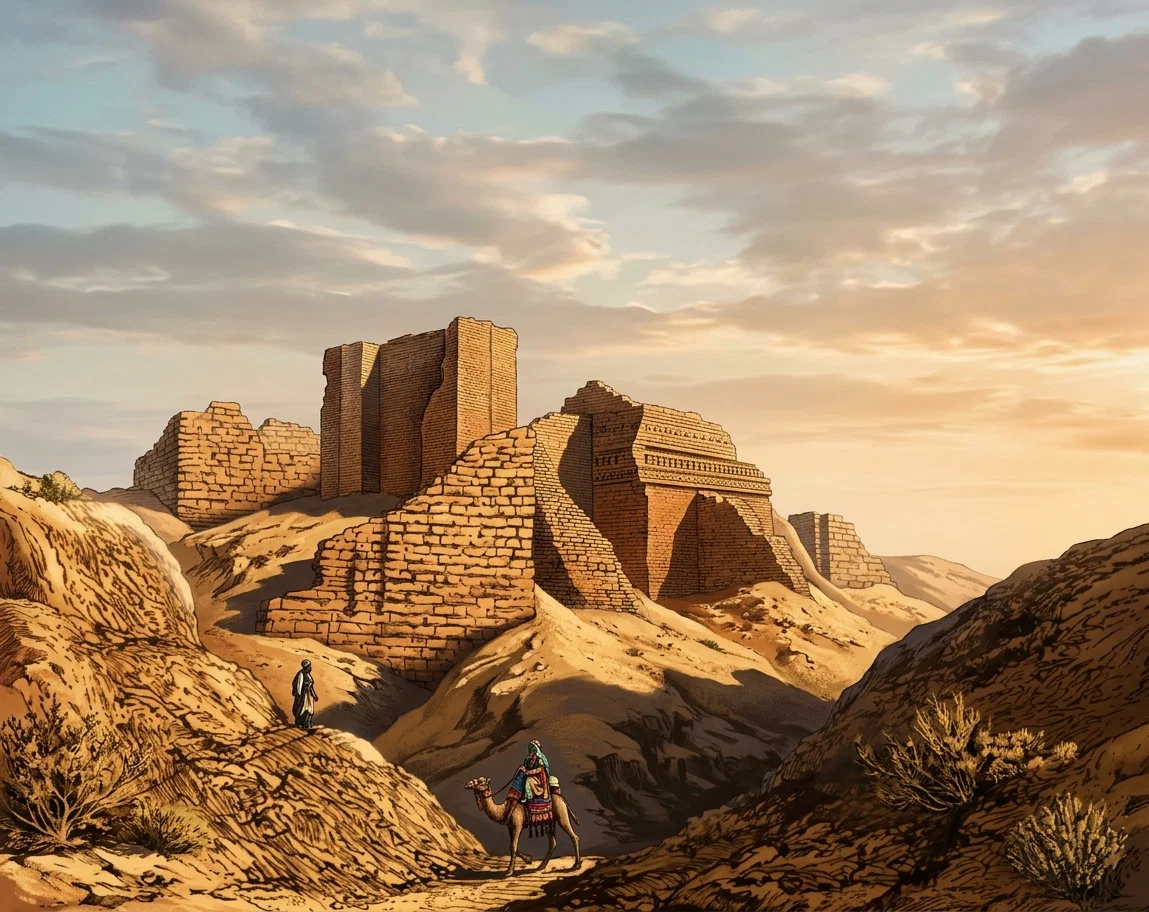
Ruins of the Palace of Nebuchadnezzar, Called “Kasr.”
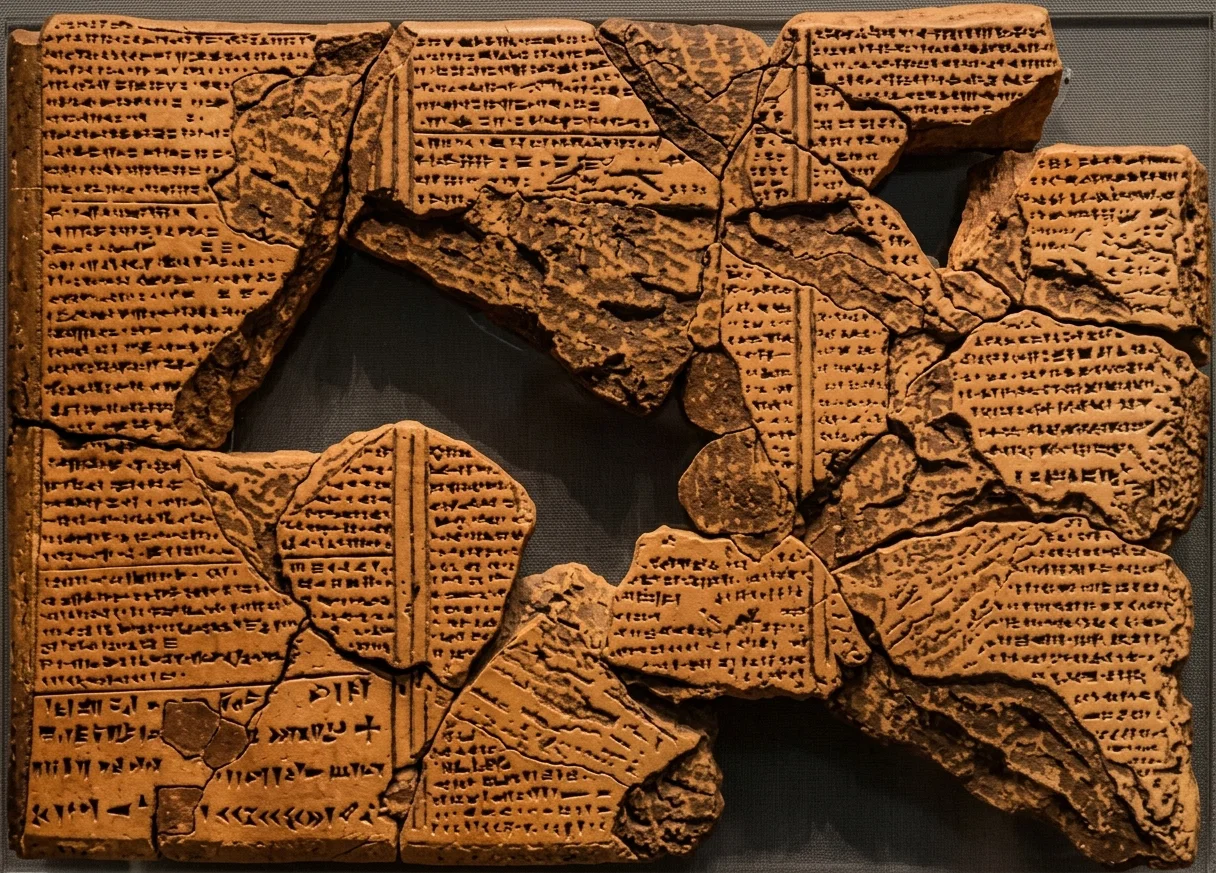
Back of Tablet with Account of Deluge. (From “Chaldean Genesis” by Smith.)
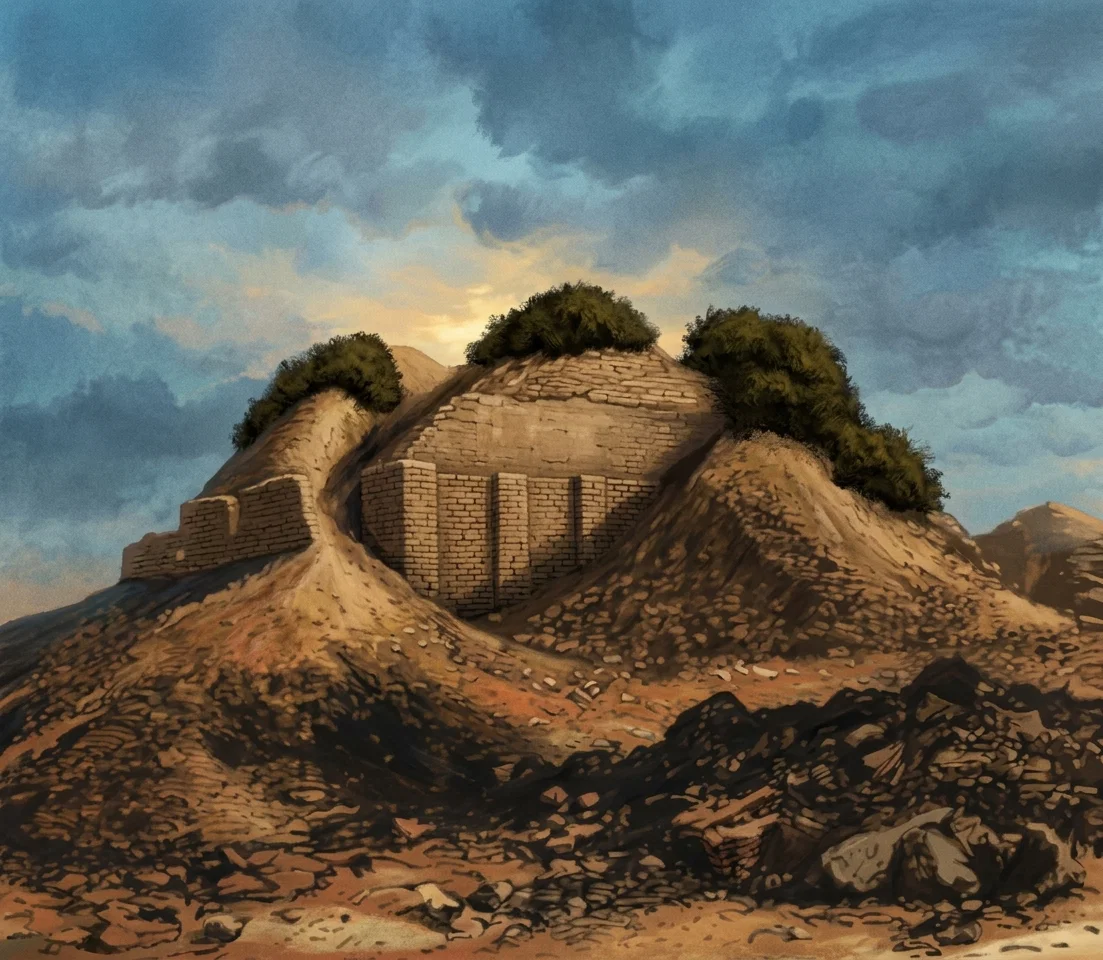
Ruins of Mugheir, the Ancient Ur of the Chaldees, where Abraham was probably born.
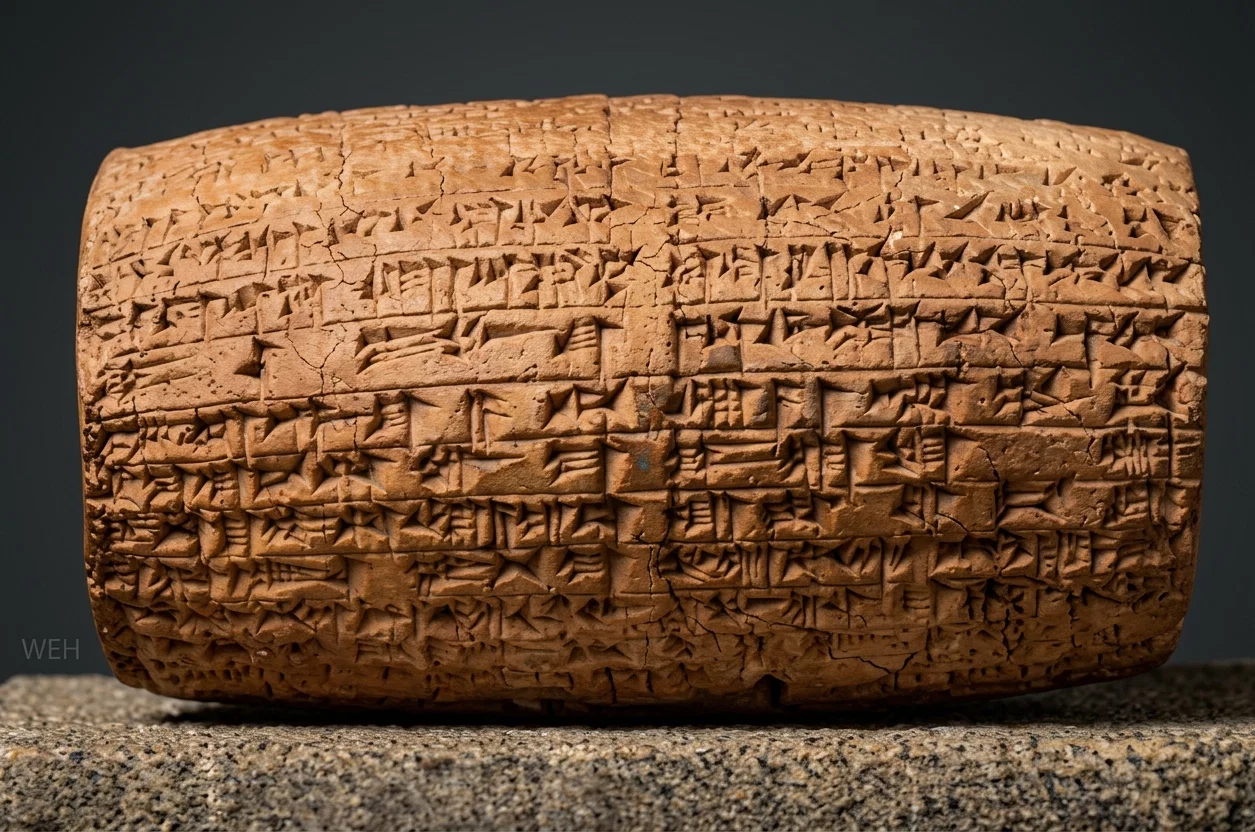
Cylinder of Nabonidus (Nabonadius), Containing a Prayer for His Son, Bel-shar-usur (Belshazzar). See note 6.
Nebuchadnezzar closed his glorious reign, a converted man, in the year B.C. 561. He was succeeded by his son, Amil-Marduk (servant of Marduk), the Evil-Merodach of the Bible, whose brief reign ended in B.C. 560. The chief thing of note recorded of him is that he, in the first year of his reign, took the Hebrew king Jehoiachin out of prison, and extended to him royal favor. For this he seems to have aroused the wrath of the hierarchal, or national, party, and he fell a victim to assassination.
The plot to assassinate was devised by Nergal-shar-usur (Neriglissor), and executed at his command. He had been an influential man at court early in the days of Nebuchadnezzar’s reign. He had married one of the great king’s daughters, and was, therefore, brother-in-law to Evil-Merodach, whose death he caused, and whom he succeeded. The tablets indicate that he had been prominent in affairs of commerce and diplomacy. He was a devout idolater, expending large sums in building and repairing the temples of the gods. He lived in the palace of Nebuchadnezzar, and followed that great king in his works of improvement. Notwithstanding his prayers for long life, which he has left on record, his reign ended in B.C. 556. He was succeeded by his son, Labashi-Marduk (Laborosoarchod), who was but a mere child. A conspiracy was formed against him, and he was killed at the end of nine months. So retribution quickly followed the house of Neriglissor.
The conspirators chose as a king Nabonidus, “a man of distinguished position,” a native Babylonian, and a man of piety even beyond those who preceded him. His energies seem to have been exhausted in the building and restoration of temples, going oftentimes to the original foundations, finding on the foundation bricks the names of the first builders. The affairs of State and defense of his kingdom seem to have been secondary matters. As Rogers puts it: “In the crucial hour of his country’s history, his whole thought was of ‘gods, and not of men. He would save gods, men might save themselves as best they might.’” One of his chief works was the rebuilding of the temple of the sun—E-babbara—in Sippar, in honor of the sun-god Shamash.
During the last three years of his reign, which closed in B.C. 538, he associated with himself as joint-ruler, Bel-shar-usur (Belshazzar), his son by a daughter of Nebuchadnezzar. For years the captious, unbelieving critics had contended that Daniel’s record had no foundation for naming Belshazzar as the last king of Babylon. Those who believed the Bible had endeavored to identify him with Evil-Merodach and Nabonidus. But tablets left by Nabonidus, containing prayers of his, show the prophet to be correct. Belshazzar’s last year marks the close of the great empire of Babylon.
Belshazzar’s great feast to a thousand of his lords was evidently at a great festival of the gods. The degeneracy of Babylon is clearly indicated by this royal revel. Four and one-half centuries before the wise king of Israel had written: “Woe to thee, O land, when thy king is a child, and thy princes eat in the morning! Blessed art thou, O land, when thy king is the son of nobles, and thy princes eat in due season, for strength, and not for drunkenness!” The exemplification of that truth on its good side had been before Babylon from the beginning of the reign of Nebuchadnezzar, in the course of the four young Hebrews, notably Daniel, who had occupied such prominent positions in the empire. Pure and untarnished in character, noble andgenerous and upright in all conduct, uncontaminated by the corruptions and plots and counterplots of the empire, these men from their youth had stood forth shining examples of sobriety, temperance, and righteousness.
In Belshazzar was exemplified the opposite side. No greater curse can come upon a land than to have its young men reared in wealth and ease and idleness and debauchery. When that time comes, that land is near its fall. Such a time had come to Babylon; and her king was leading in the revelings and licentiousness of gross nature-worship.
Lifted up in his drunken, bestial madness, he commands that the holy golden and silver vessels, taken from the temple in Jerusalem, should be brought, that he, and his nobles, wives, and concubines might drink to the gods of Babylon. In this sacrilegious act, which no other king of Babylon had presumed to do, Belshazzar filled up the cup of Babylon’s iniquity, and demonstrated her unfitness to reign longer. There were nobles at that feast, doubtless, who had heard the interpretation of Nebuchadnezzar’s dream,—it was only about three-score years before,—but they remembered it not. There were great men present who saw the great golden image, the fiery furnace, and the manifestation of the power of that God they were then dishonoring,—less, probably, than fifty years previous,—but they heeded not the lesson. There were many more at that lascivious feast of Tammuz and Ishtar who knew of Nebuchadnezzar’s seven years’ humiliation under the hand of the Most High, and the king’s subsequent royal proclamation,—it was but three decades in the past,—but they protested not at the sacrilege of the king and his courtiers. The holy candlestick was filled and lighted; the holy vessels were filled with wine drunk to the impure rites of the Babylonian Adonis and Venus. The revel was at its height; all were mad with reckless mirth.
All at once, over on the palace wall, before the candlestick, are seen fingers,—only fingers,—writing, in letters of light, words which the king can not read, but which he feels foretell his doom. Only four words are written, but the erstwhile mad revelers are pale and trembling. Wise men are called, but they can neither read nor interpret the blazing words which are burning themselves into the now sobered king’s heart. A promise is made that he who interprets them shall be clothed in royal purple, shall bear the gold chain of authority, and shall be third ruler in the kingdom.
In God’s providence Daniel was again brought forward by Nitocris, the queen-mother. He told in brave faithfulness of how God had warned Babylon through his ancestor Nebuchadnezzar, of how that mighty king had, in his humiliation, been forced to acknowledge all this; yet, in the face of all these great facts, which Belshazzar knew, he had not only not learned the lesson, but had lifted up his puny self against that God who ruled in the kingdom of men, and upon whom he was dependent for his very breath. God had warned Babylon of its certain doom. Belshazzar had placed himself upon the judgment-seat and defied God. Now God had come to judgment upon Babylon. “And this is the writing that was written:—

MENE, MENE, TEKEL, UPHARSIN.

Only four words, but how pregnant with meaning. Literally translated, they read,—

NUMBERED, NUMBERED, WEIGHED, DIVISIONS.
And this is the interpretation:—
“God hath numbered the kingdom, and brought it to an end.
“Thou art weighed in the balances, and art found wanting.
“Thy kingdom is divided, and given to the Medes and Persians.”
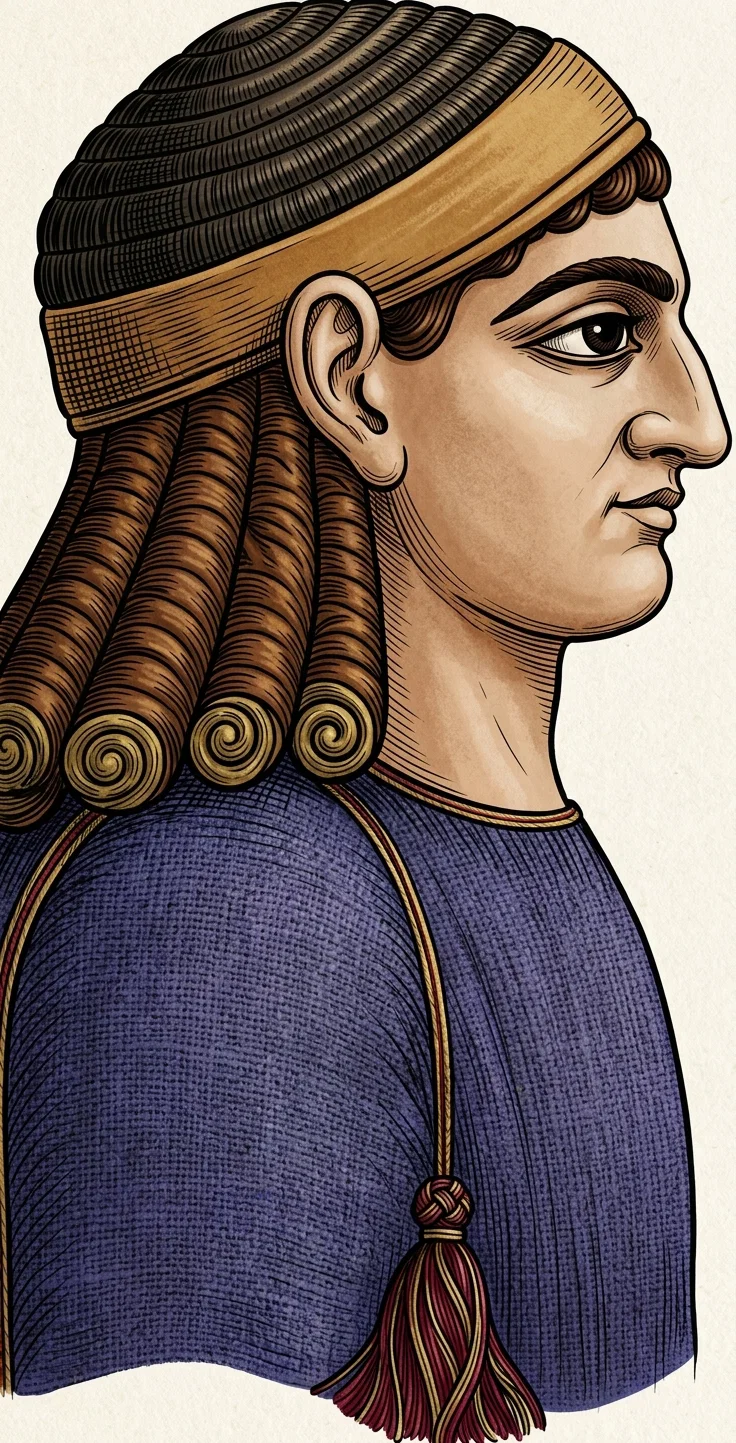
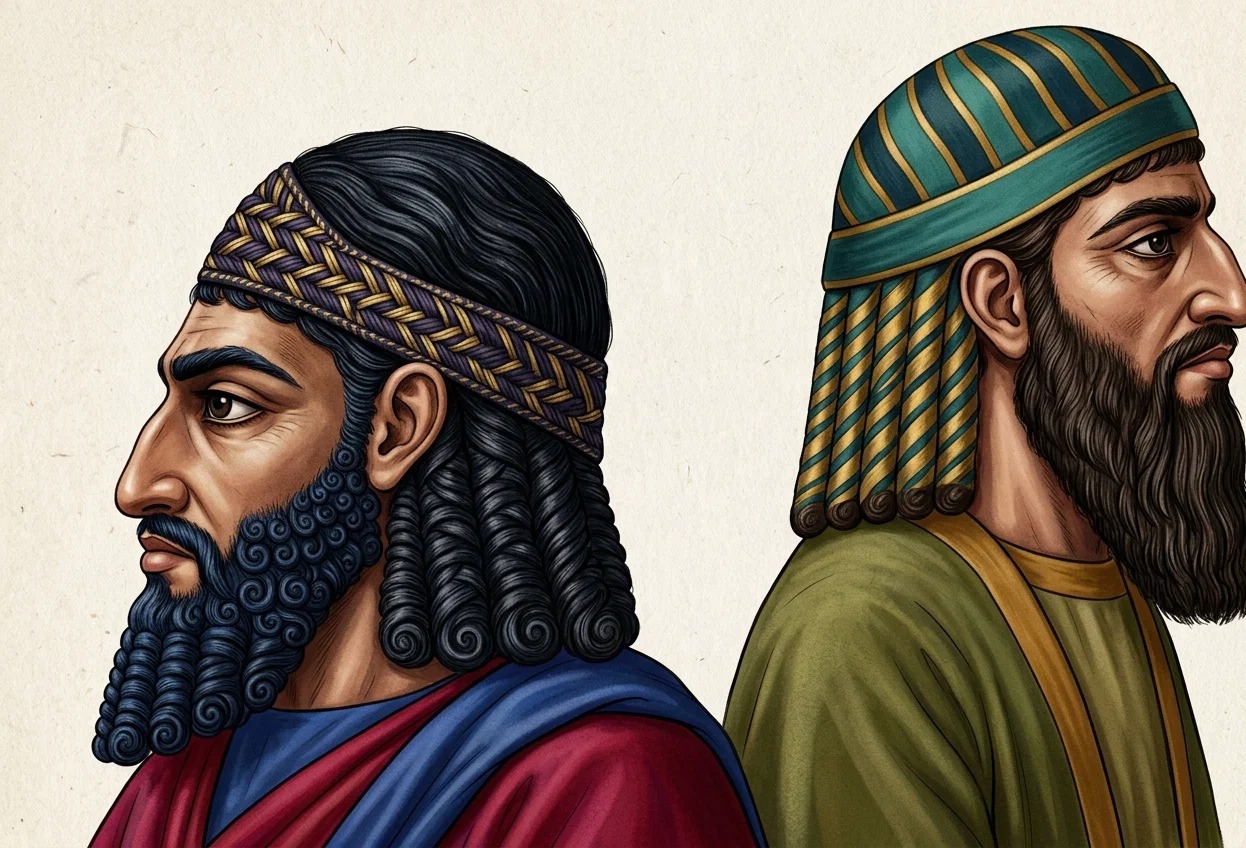
Men and Woman of Babylon, from Assyrian Monuments.
The whole lewd feast of Belshazzar is so forcibly and beautifully expressed by the poet, that we feel constrained to here repeat it:—
“Belshazzar is king, Belshazzar is lord, And a thousand dark nobles all bend at his board; Fruits glisten, flowers blossom, meats steam, and a flood Of the wine that man loveth runs redder than blood. Wild dancers are there in a riot of mirth, With the beauty that maddens the passions of earth; And the crowds all shout till the vast roofs ring,— ‘All hail to Belshazzar, Belshazzar the king!’ “‘Bring forth,’ cries the monarch, ‘those vessels of gold, Which my father brought forth from the temple of old.’ They are brought, and before him the vessels all shine; And they bow unto Baal, and they drink the dark wine, While trumpets all bray, and loud cymbals ring,— ‘All hail to Belshazzar, Belshazzar the king!’ “But what cometh? look! without menace or call, What writes with the lightning’s bright hand on the wall? What pierces the king like the point of a dart? What drives the bold blood from the cheek to the heart?— ‘Chaldeans, magicians, the letters expound!’ They are read, and Belshazzar is dead on the ground; For the Persian is come on the conqueror’s wing, And a Mede’s on the throne of Belshazzar the king.”
The revel is over. The army of Medes and Persians, under Cyrus, tho the great conqueror seems not then to have been with it, is at the gates. Yea, more; they are even then marching into the city, with no leaders, no army, to resist them. Nabonidus is at Borsippa, where he surrenders. At Babylon, the very night of the shameless feast, Belshazzar is slain.
The record continues: “And Darius the Mede received the kingdom, being ‘about threescore and two years old.’”
Who Darius is, is a query over which there has been and is as much discussion as was waged over Belshazzar. In Dan. 9:1 he is said to be “the son of Ahasuerus, of the seed of the Medes, which was made king over the realm of the Chaldeans.” He has been identified with a half dozen, more or less, but there is no settled evidence outside of Scripture as to his existence. Some of the critics have declared that no such person reigned in any such power as indicated in Daniel; but we may rest assured that the prophecy of Daniel will be as certainly vindicated as in the case of Belshazzar. As far as now known, the facts seem to be these:—
1. Ahasuerus is identical with Astyages, king of the Medes, the grandfather of Cyrus.
2. Astyages was especially noted for his cruelty and inhumanity. When Cyrus came to the throne of Persia, he revolted, and in conjunction with Tigranes of Armenia, and the many foes of Astyages in his own government, defeated the Median king, and united the two kingdoms.
3. In a most politic way Cyrus did not assume the throne of Media at once, but to win the Medes, placed the son of Astyages, Cyaxeres II., on the throne, or some other Median prince, called by Daniel, Darius.
4. This action of Cyrus is indicated by Dan. 9:1, which states that Darius was made king; and Dan. 5:31, that he received the kingdom.
5. He was then sixty-two years old, having no heirs. When he died, Cyrus became ruler of both kingdoms. Whatever light there is yet to be thrown upon the question, the Bible-believer may be assured that the Scriptures will be confirmed.
This chapter has its great lesson: “Jehovah judgeth among the‘nations.” He as truly is the judge of every soul. Men may deny it; men may hide it from their eyes; they may shut it out of their hearts by greed and lust and pleasure; but some time, sooner or later, the hand of God will write upon the palace wall of every sinful, impenitent soul,—

NUMBERED, WEIGHED, WANTING.

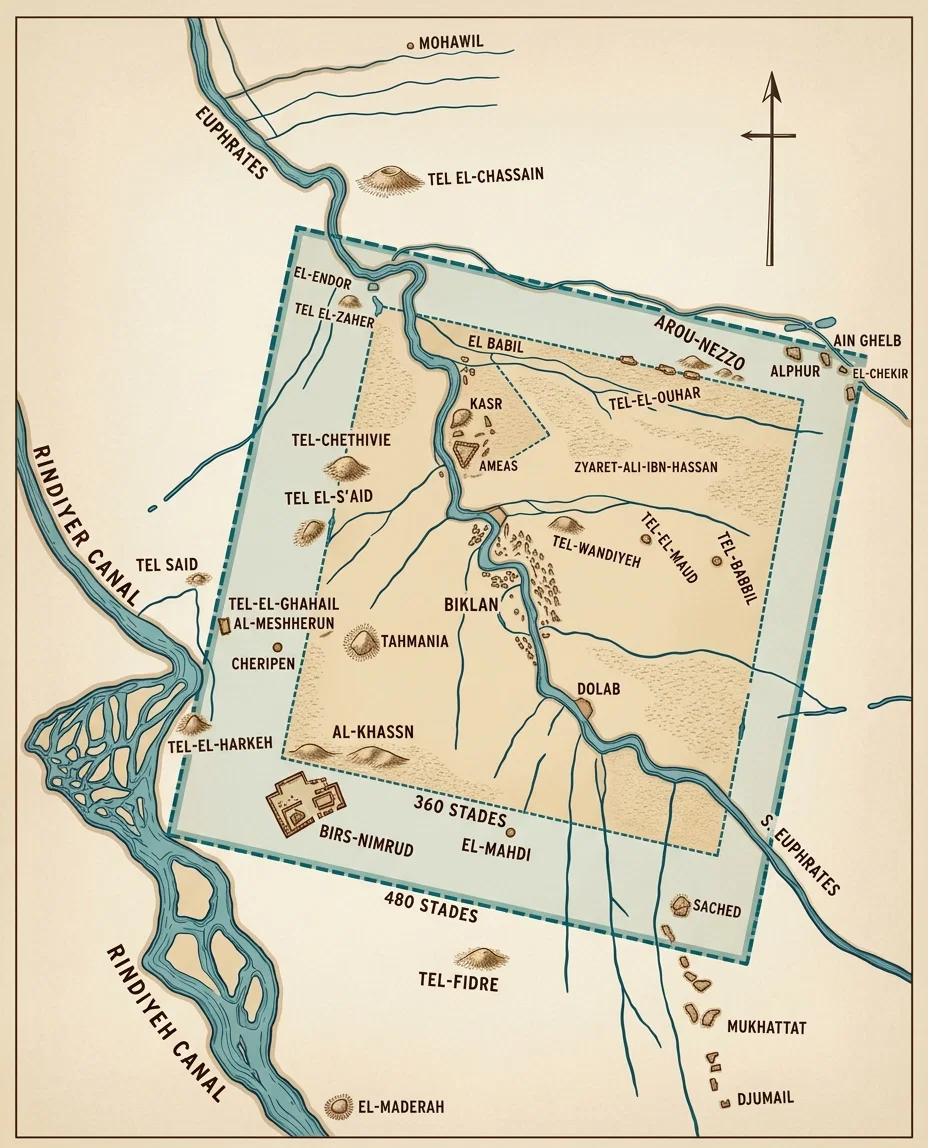
Chart of Country around Babylon, within limits of ancient city, according to Oppert.
Now, the blessed golden now, is the time for all to examine themselves whether they be in the faith. Cast out the sin. Let every soul, let the church of Jesus Christ, empty from the holy vessels of God’s cleansing and choosing ‘the wine of Babylon’s fornication,’ and let God fill them with ‘the water of life.’ Let those who profess to be Christ’s disciples cast from them the idolatrous feasting of Babylon’s gluttony and lewdness, and feed upon the pure Word of God. The great Jehovah waits to be gracious; but soon will He send the Righteous One. Are you ready for His sentence? You may be ready, clothed in the righteousness of Jesus Christ.

THE LIVING WORD IS LIGHT AND TRUTH.

The living Word is living Truth. Truth is the foundation upon which all must build, would they see the face of Him who is full of grace and truth, for through truth the soul is regenerated.
Where can we find truth unmixed with error? Jesus said of His Father’s Word, “Thy Word is truth.” Here is truth given by inspiration of God,—literally, “God-breathed,”—and it is “profitable for doctrine, for reproof, for correction, for instruction in righteousness.” And yet it is a sad fact that “The Bible has been placed in the background, while the sayings of great men, so-called, have been taken in its stead, the inestimable treasures are in the Bible, and it is like a mine full of precious ore. It is not valued, it is not searched, and its riches are not discovered.”
“Thy Word is a lamp unto my feet, and a light unto my path.” It is the shining forth of Jesus, the Sun of Righteousness. Were these glorious beams of light to be withdrawn from the world, we should be left in the darkness of eternal night. “Jesus spake as never man spake.” He poured out to men the whole treasure of heaven in wisdom and knowledge. He is the “Light which lighteth every man that cometh into the world.” Every phase of truth was evident in Him. He is manifest in His Word, which, to the soul following its light, “shineth more and more unto the perfect day.”
“As the will of man co-operates with the will of God, it becomes omnipotent. Whatever is to be done at His command, may be accomplished in His strength. All His biddings are enablings.” Thus when God said to Joshua by the mouth of Moses: “Be strong and of a good courage; for thou must go with this people unto the land which the Lord hath sworn unto their fathers to give them; and thou shalt cause them to inherit it. And the Lord, He it is that doth go before thee; He will be with thee, He will not fail thee, neither forsake thee; fear not, neither be dismayed;” that word enabled Joshua, through faith, to accomplish what God commanded.
These words are for us also. When faith takes hold of them, there is no fear of inability to go up and possess the heavenly Canaan, on whose borders we are; “for God hath not given us the spirit of fear, but of power, and of love, and of a sound mind.” Then when our Father commands us, “Arise, shine; for thy light is come, and the glory of the Lord is risen upon thee,” we will, in faith, make the effort to arise. When He says, “Unto you that fear My name shall the Sun of Righteousness arise with healing in His wings,” to the heart of faith these words become a living reality.
Not alone are we to teach the Word contained in the Bible, but we are to draw rich lessons of faith, love, and knowledge from God’s growing Word,—“the mysteries of the visible universe;” “the wondrous works of Him which is perfect in knowledge.” It is said of Adam and Eve that “they held converse with leaf and flower and tree, gathering from each the secrets of its life. With every living creature, from the mighty leviathan that plays among the waters to the insect mote that floats in the sunbeam, Adam was familiar. God’s glory in the heavens, the innumerable worlds in their orderly revolutions, the ‘balancings of the clouds,’ the mysteries of light and sound, of day and night—all were open to the study of our first parents. On every leaf of the forest, or stone of the mountains, in every shining star, in earth and air and sky, God’s name was written. The order and harmony of creation spoke to them of infinite wisdom and power. They were ever discovering some attraction that filled their hearts with deeper love, and called forth fresh expressions of gratitude.”
As man, fallen from this glorious first estate, is brought back into harmony with his Creator, by the working of that incorruptible seed, the Word of God, “his capacity to know God in His created works, to enjoy, and to love, will continually increase, and he will be constantly gaining new treasures of knowledge, discovering fresh springs of happiness, and obtaining clearer and yet clearer conceptions of the immeasurable, unfailing love of God.”
LILIAN OTIS McPHERRON.

FAITHFULNESS IN SERVICE.

The parable of the talents should receive prayerful, critical attention. By it we are shown the importance of trading diligently and conscientiously on our Lord’s goods. Not one thread of selfishness is to be woven into His work. Worldly ambition is not to be cherished. We are to keep self out of sight, holding Christ before the world. We are to bring glory to God by doing our best to be perfect men and perfect women.
Christ gave the parable of the talents to show us that all the blessings we have come from God. Our gifts belong to Him. They are not to be used according to human judgment, but according to the directions given in God’s Word. We are to study how we may use these gifts for the up-building of the cause of truth.
In the parable our Saviour says, “And unto one he gave five talents, to another two, and to another one; to every man according to his several ability.” Here we are shown that different gifts are entrusted to different individuals. With the talents given him, be they many or few, each one is to do his utmost to glorify God. Talents improve and multiply as they are used in the service of the Master.
In the parable, the one who received five talents and the one who received two are represented as trading wisely on their talents, so that when their lord returned, they were able to present to him that which he had entrusted to them, together with what they had gained by trading. And to each were spoken the words of commendation, “Well done, thou good and faithful servant; thou hast been faithful over a few things, I will make thee ruler over many things: enter thou into the joy of thy lord.”
“But he that had received one went and digged in the earth, and hid his lord’s money.” When the time came for him to render an account, he said, “Lord, I knew thee that thou art a hard man, reaping where thou hast not sown, and gathering where thou hast not strewed; and I was afraid, and went and hid thy talent in the earth; lo, there thou hast that is thine.” His lord answered and said unto him, “Thou wicked and slothful servant, thou knewest that I reap where I sowed not, and gather where I have not strewed; thou oughtest therefore to have put my money to the exchangers, and then at my coming I should have received mine own with usury. Take therefore the talent from him, and give it unto him which hath ten talents. For unto every one that hath shall be given, and he shall have abundance; but from him that hath not shall be taken away even that which he hath.”
To-day thousands are doing as the unfaithful servant did. They live for self, when God desires them to improve their abilities for Him, that they may act their part in His work. They excuse themselves by saying that they have but one talent. But if used for God, that one talent would accomplish much. By careful use the slothful servant might have doubled the talent, which instead of using he hid in the ground.
This parable shows the need of using every gift aright. To all comes the opportunity of blessing others by speaking helpful, uplifting words. This is a talent, and the failure to improve it brings great loss.
In our work the thought of glorifying God is to be made prominent. The business man is to bring the principles of heaven into every line of his work. In all he does the Christlikeness is to be clearly revealed. He who tills the soil is to make his work an object-lesson of the careful, thorough work which must be done in the culture of the soil of the heart. The mechanic is to do his very best, bringing his work as near perfection as possible.
“He that is faithful in that which is least is faithful also in much.” The Lord can not unite with those who are careless and slothful in their work. He leaves them to themselves, choosing for His service those who do well every piece of work they handle, those who manage economically, gathering up the fragments, so that nothing will be lost.
Those who work for the Lord must remember that they are members of the royal family, and that they are to do all their hands find to do as in the sight of the heavenly universe. Never must they slight their work, doing it in such a way that He who has redeemed them will be ashamed of it. They are to guard against doing anything that will lead to carelessness or irreverence. They are ever to remember the words, “Ye are God’s husbandry; ye are God’s building.” By following principles of strict integrity, they are to build up a symmetrical character.
Christ will increase the talents of every faithful worker. This is the principle He always follows in dealing with His servants in this world. But the full honor in store for the one who in this life works with an eye single to the glory of God, will not be bestowed until the day of judgment. Then Christ will say to him, “Well done, good and faithful servant; thou hast been faithful over a few things, I will make thee ruler over many things: enter thou into the joy of thy Lord.”
MRS. E. G. WHITE.

“TAUGHT OF GOD.”

THE divine wisdom manifested by our Saviour was a constant source of wonder to the Jews. We read that “the people were ‘astonished at His doctrine; for He taught them as one having ‘authority, and not as the scribes.’” Matt. 7:28, 29. And they asked, “How knoweth this man letters, having never learned?” John 7:15.
This superiority, which they secretly had to admit, was due to a thorough knowledge of the Holy Scriptures, the plain truths of which He fearlessly presented, unhampered by the traditions and ideas of the Pharisees and the scribes. He was conscious of His heavenly mission, hence His authority. He had not received His knowledge in the learned schools of His day; but at His mother’s knee, and in the pure environments of nature, He had learned to understand the significance of these words of Scripture: “And all Thy children shall be taught of ‘the Lord.’” Isa. 54:13.
But this was a secret which the Jewish people, and especially the scribes and Pharisees, did not understand; and they said, “Whence ‘hath this man this wisdom, and these mighty works? Is not this the ‘carpenter’s son? is not His mother called Mary? and His brethren, ‘James, and Joses, and Simon, and Judas? and His sisters, are they ‘not all with us? Whence then hath this man all these things? And ‘they were offended in Him.’” Matt. 13:54–57.
Poor, narrow-minded Jews! They looked only upon the outward appearance; they saw in Jesus only the carpenter’s son; and to the truth that flowed from His precious lips they turned deaf ears. Jesus appealed to their better sense, and said, “Ye judge after the flesh.” “Judge not according to the appearance, but judge righteous judgment.” John 8:15; 7:24. They received honor one of another; but the honor that comes from God only, they sought not.
Of His own teaching Jesus said, “My doctrine is not Mine, but ‘His that sent Me.’” This they might have understood if they had been willing; for Jesus added, “If any man will do His will, he shall ‘know of the doctrine, whether it be of God, or whether I speak of ‘Myself.’” “He that is of God heareth God’s words; ye therefore ‘hear them not, because ye are not of God.’” John 7:16, 17; 8:47. And this is as true to-day as it was at that time.
“As He is, so are we in this world.” 1 John 4:17. No learned school, no theological institution, is able to impart the knowledge that can make one wise unto salvation. This God alone can do. Jesus said, “It is written in the prophets, And they shall be all taught of God. ‘Every man therefore that hath heard, and hath learned of the Father, ‘cometh unto Me’—he cometh unto ‘the Word’ that ‘was made flesh, and dwelt among us.’” John 6:45; 1:1, 2, 14.
It is our privilege to come to the divine source of all knowledge, the Bible, and draw from its pure, refreshing well the water of life and peace. The Spirit of the Lord is our promised teacher, and He shall guide us into “all truth.” John 16:13. And the blessed promise is, “And they shall teach no more every man his neighbor, and every ‘man his brother, saying, Know the Lord; for they shall all know Me, from the least of them unto the greatest of them, saith the Lord; for I will forgive their iniquity, and I will remember their sin no more.” Jer. 31:34.
The one who thus learns to know the Lord and His truth, will speak “as one having authority,” for he knows whom he has believed. Matt. 7:29; 2 Tim. 1:12. Like his Master, he will be misunderstood and persecuted; but let him take comfort in the thought, that “the ‘sufferings of this present time are not worthy to be compared with the ‘glory which shall be revealed in us;” “for our light affliction, which ‘is but for a moment, worketh for us a far more exceeding and eternal ‘weight of glory.’” Rom. 8:18; 2 Cor. 4:17. C. CASTBERG.
Continue reading: Its Final Deception