Your ShelfYour Projects

Signs of the Times, Vol. 27, No. 43.

GOD THE JUDGE
Earlier text: QUESTION CORNER

CHANGES IN ANIMAL LIFE.

In creating man God placed him at the head of all His created works. He gave him dominion and authority over all the earth, and the other creatures which lived thereon. God intended that man should through the exercise of this authority cause all life to be a praise to its Creator. Had man remained unselfish as God created him, this would have certainly resulted. But when the one in whom this authority was vested, departed from the principles upon which that authority rested, all nature suffered, so that the whole creation groaneth and travaileth in pain until now.
The true object of nature study is not one of curiosity simply, observing the wonderful and astonishing things which animals and plants do; but it is to enable us better to co-operate with the work of the Creator in His plan of redemption. Not a sparrow falls to the ground but our Father's heart of sympathy is touched; and when we seek to produce conditions by which animals and plants can best develop, it can but be pleasing to the Giver of their life. This can not refer to the pests, which are directly the result of sin; one way in which conditions of right development of God's creatures can be presented is in the removal of these pests.
The spirit of destruction—the spirit of wrong—is so manifest in the animal world that one of the keenest and most affectionate observers of animal life says that the life of nearly every wild animal of whatever kind or nature ends in a tragedy, and that a natural death is of the rarest occurrence. To make this thought plain, suppose that every man, woman, and child who dies, expires by the hand of a murderer, who generally devours his victim. This would be a condition similar to that which exists in all animal life; and yet for all animals, from the gigantic elephant to the little insect floating in the sunbeam, our Father has the tenderest care. So, then, it can be only reasonable to say that the greatest, if not the one purpose, which we should have in studying this life about us is to alleviate its suffering.
The crane.
The crane.
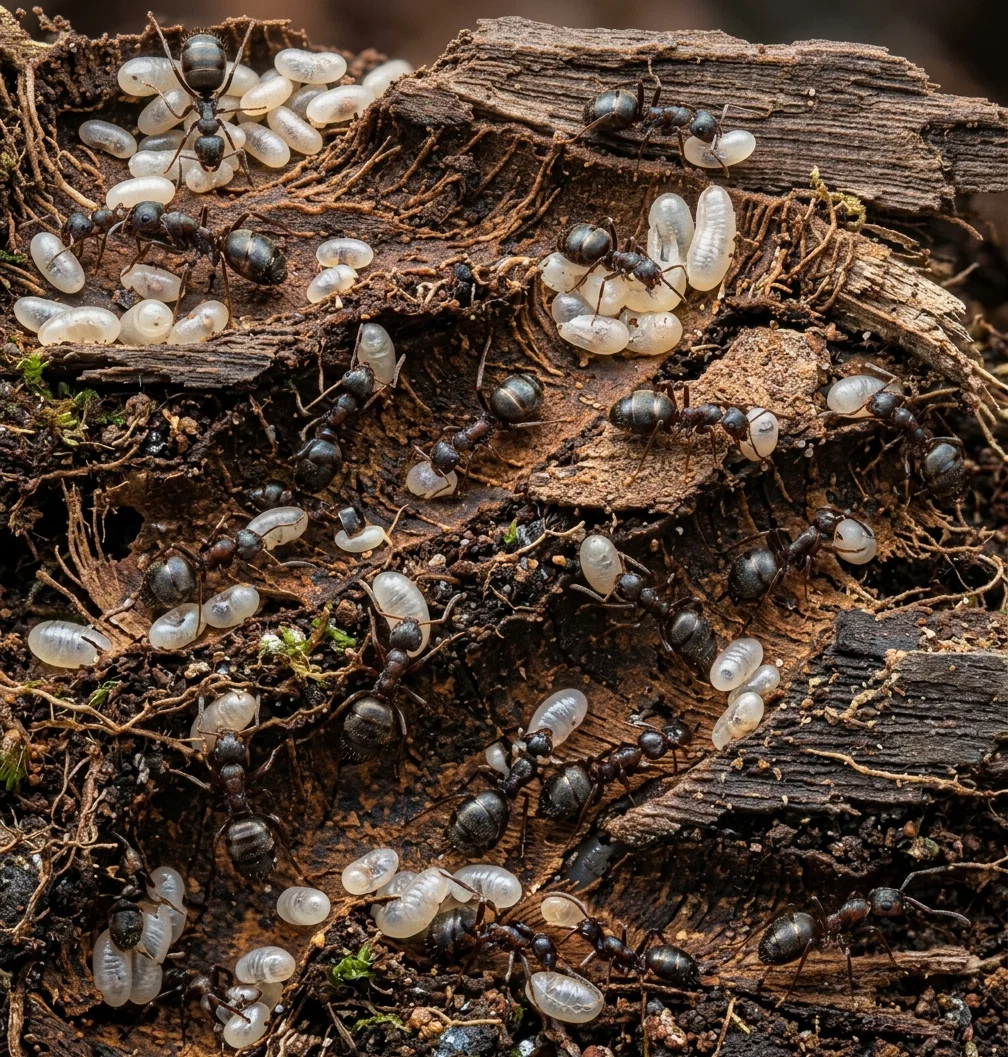
The animals (and by this word it will be seen that I mean all animate life) will teach us valuable lessons. “But ask now the beasts, and they shall teach thee; and the fowls of the air, and they shall tell thee.” Even the ants, which are naturally considered so very inferior to us, have their lessons for us. They have no guide or overseer; yet they prepare their meat in the summer, and gather their food in the harvest. This lesson of providing against want is one which the majority of men never learn; and yet the one who studies these little creatures can not but be impressed by it. In this way would our Father teach us.
Each season brings its changes to all living things both animal and plant. Consequently one of the most profitable ways in which to study animals is to observe their various changes and phases of life appropriate to the season. One of the most wonderful laws of life is that of adaptation. The form and structure of a plant or animal will change to meet different conditions in its life. To illustrate, plants which are taken from a warm to a cold climate will change in structure quite materially to defend themselves against the cold; the bark becoming thicker and the fiber firmer. The fur of animals which are taken from the North to warmer climates, gradually becomes thinner. Not only may these gradual changes in the working out of the law of adaptation be observed, but more plainly seen are these yearly or regular changes caused by the seasons.
Higher and higher the sun appears in the heavens, rising earlier each morning and retiring later each evening. He is endeavoring to awaken this sleeping earth. He begins by removing the snowy cover. A robin greets us some morning with its cheerful song. Other birds soon come, and assist him in his apparent endeavor to drive out the cold. Frogs begin to croak, tho their voices are at first weak, resulting from their non-use during their long sleep. They, however, soon get their throats cleared out, and begin in earnest their chorus. A toad comes hopping along—joints pretty stiff from his long nap; a cricket chirps; a spider spins his web; an earth-worm crawls out to look at the weather; a moth floats lazily by; the buds swell; the leaves put forth; and spring is on. Birds mate, build their homes, and rear their young. Insects of every kind and description whir by. This is summer time, and all is life and motion; even the reptile which crawled forth so slowly and heavily from his winter house now glides swiftly along his way. The sun reaches its zenith, and apparently feeling that his greatest work is done, rises later in the morning and retires earlier at night. As he ceases, for long hours each day the air becomes chill. Now and then it creeps on us, cutting us with a sharp edge which it has acquired in some northern snow-field.
Ants moving their eggs to shelter after their home has been disturbed.
This is autumn, and all animal life begins to cease its activity and prepare for the changes which the sun is thus making. The birds—those which have never seen a flake of snow, together with the old and experienced veterans—gather themselves together, and are soon basking in sunnier climes. The Lord through Jeremiah teaches us a very forcible lesson in this migration of birds and the hibernation of animals when he says, “Yea, the stork in the heaven knoweth her appointed times; and the turtle and the crane and the swallow observe the time of their coming; but My people know not the judgment of their Lord.”
As the cold bears in more strongly, the reptiles appear with less and less frequency, and finally in the farthest part of the burrows give themselves up to their death-like sleep. Many of the insects, even with garments rent and torn, mere wrecks of their former selves, refusing to abandon their pleasures even for a moment, stiffen and die wherever the too chill air may find them. Others, however, do happen—for chance it seems to be—to find a lodge in a crack in some old log or board or under a stone or in a hole in the ground. These giddy, gaudy, stylish creatures are not wise as is the ant in her simple Puritan dress of brown—another lesson.
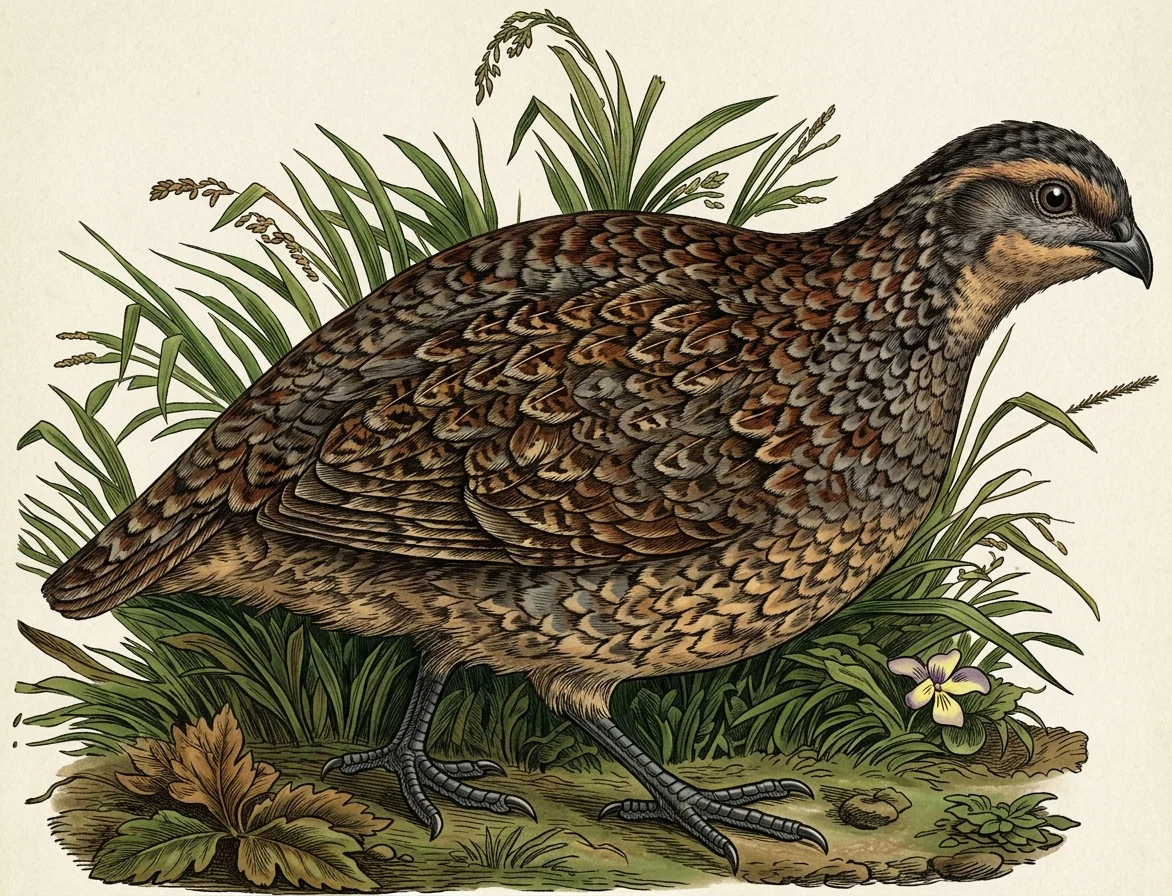
The partridge—a bird that spends the winter with us.
Other creatures, preferring to brave the old winter, put on underclothes in the shape of fat, and overcoats in the form of thicker furs. But in times of plenty they made these garments. The “craws” have dug for themselves dens into which they have backed, and where they will rest. The fish also have found their winter abode among the rocks and recesses in the bottom of their watery world. The tadpoles, too, seek a snug bed under some sunken stick or stone, or in a crevice in the bottom of the pond, and shortly, in their land of nod, forget all their purposes to be frogs.
With the sharper cold, the ceiling of the ponds and the rivers with ice and the spreading again of the coverlet of snow, repose comes to the earth, and the cycle of the year is completed. This yearly change has meant a complete change in the life of the animals. It has taken place so gradually and silently as to be almost imperceptible. Many of the causes which produce these changes are not yet understood. To lead a child to the study of these causes is to lead him to a love of the Creator’s works. And how wonderful these works are! They are manifold, but all made in wisdom.
So. Lancaster, Mass. FREDERICK GRIGGS.

THE CHILD'S IMAGINATION.

[Harriet A. Eager, in the Congregationalist.]
TWO children were standing by the window, watching the hunter's moon come up in all her wonderful splendor. “Sister, I see God right through that moon,” said the boy. The little sister was a practical maiden and exclaimed, in horror: “Why, you know you can’t. That’s a wrong story. You know it is.”
Poor little brother was shocked, too, for a bit, being brought so suddenly down from the top of the golden stairs. He rallied himself, however, to ask, in a pitying tone, “Sister, can’t you see anything except with your eyes?”
“No, I can’t, and you can’t either. You know you can’t.”
Here is where the difficulty lies. Some of us can not see anything “except with our eyes,” and in our limited vision try to impose the conditions of our poverty upon the little ones. Fortunately, this dear little fellow had an understanding mother. When the shocked sister appealed to her, that wise woman took their hands firmly in hers, and away they all went, through the moon, up among the angels, right to the foot of the great white throne. Does it surprise you that the boy, grown to a youth now, has laid his heart there, and that the proper little maiden still questions the reality of it all?
God has endowed most children with imagination; but we, in our weakness, do not perceive that their wonderland is the most real of all places, and is the country through which they must journey to theirFather in heaven. We do not realize that to keep the child always upon this earth is to bind the man or woman to the ground. Some children are so richly endowed that away they will go in spite of everything. The poets and artists are the result of such persistent vagrancy. But most little ones are checked in their development by having the idea thrust upon them, all too soon, that the things of this world are wholly material.
Have you watched little ones at play? It is worth your while to journey with them, with their toys, into fairyland. Enter with them into the ecstasy that transforms a few blocks into a palace, the home of a lovely princess. People this life for them with heroes who live the ideal. Use these denizens to illustrate qualities which you would have them emulate. Here can be men and women who need not be hampered by earthly modifications. Too soon must the young lives be chilled by the human frailties of their fellows.
Let us teach the children how to walk by faith, seeing, yet not seeing, and believing. Let us train them to see with the inner eye, cultivating this greatest gift, by which they can roam where they will. It is by imagination that all things are conceived. The great general must first, in imagination, go through the victory before the battle begins. He must see the end from the beginning. “We have nothing without imagination, God least of all.”
But we must also clearly understand that this superb power, like others, has its time of infancy, and must have a chance to grow in a baby's way, with feeble journeyings and often with grotesque maneuvers. Exercise it must have, or extinction will come. It needs food suitable for its stage of development as much as the little body needs its proper nutriment.

MY ALL IN ALL.

Come, Christ, my brother be In life's reality; I need with whom to talk, Who lonely walk.
Come; now in vain no more A friend shall try the door; Tho once at eventide Thou wert beside.
And in that night gone by, I heard a child's low cry, But feared too much the storm To let him warm.
Now, since my hearth is cold, I hear Him as of old; But with a father's cheer He draweth near!
Come, Child that was, and be The Man of Light in me; Burst in my spirit's room; Come, Christ, illume!
W. S. BISSONNETTE.
Colorado Springs, Colo.

A RIGHT KIND OF CONFESSION AND FORGIVENESS.

[By Hugh S. Dougall, M. A., B. D., in Toronto Christian Guardian.]
It was the Sabbath evening, and the close of a glorious summer day. The service in the little Methodist church was almost completed before the gathering shades rendered the face of the minister indistinct to those farthest from him. A singular impressiveness had attended his words. Someone afterwards remarked that there was “a tear in his sermon.” It had affected the audience strangely.
Before the final words of dismissal were spoken the minister said:—
“The friends of this church are requested to remain a few minutes longer after the close of this service. Those who desire may retire.”
There was not much seemingly in this simple announcement, but it produced a visible sensation in the little assembly. When the words of dismissal were pronounced, not a person but again took his seat. In the silence which followed, the sexton lighted a lamp near the pulpit. It had the effect of suddenly drowning the last rays passing through the windows, and draping the corners of the room in obscurity.
When the minister arose to speak, he held in his hand something white.
“Brothers and sisters, this letter explains itself, please listen while I read it:—
“My Dear Pastor,—It is a little favor I desire at the hands of yourself or of the people among whom I once sat as a man and a Christian brother; but I request that at the close of the service on Sabbath evening I may be permitted to speak a few words to those who may care to remain. What I desire to say relates to my downfall and career during the last few weeks. In granting me this privilege, you will make me once again ‘Your most grateful servant, ‘Con Madas.’”
“In my reply to Brother Madas I said the privilege he requested would be accorded to him. He is here. We will be glad to listen to him now. Brother Madas, will you speak?”
Con Madas was seated in a center pew nearest the pulpit. By him sat his wife, deeply vailed. She shuddered as her husband arose to his feet. Partially turning to the congregation, the light fell upon his face. It was pale but resolute. Every eye was fixed upon it or upon the bowed figure in the seat by his side. The stillness was not pleasant. For a moment he stood silent, and then began abruptly:—
“I thank you for this courtesy. It may be needless to inform you of my downfall at a point in my life when every sentiment and principle of manliness called upon me to shelter another whose honor and happiness were about to be committed to me. On the morning of my wedding I was induced to drink wine by a guest. He may not have known about my great frailty and my endeavor after reform, but I did. The fault lies at no door but my own. Any man, by the grace of the Christ whom he professes to serve, should be able to defend himself. But I fell, and on my wedding day and for days after I was intoxicated.
“I would not make this public confession of my sin and my repentance, did not I think that I owe it to the Christ, upon whom, as my Lord, I have brought dishonor, and to this church, upon which I have brought disgrace. So, standing here in the pew made sacred and holy by its associations with my sainted mother and godly father, I as publicly confess as I have sinned, and ask you, as I have already asked my God, to forgive me.”
He sat down. The women were sobbing. Something trembled in the eyes of many a man as he sturdily strove to suppress a certain undesirable fulness in the throat. Perhaps it was the light which caused the old, white-headed minister to shield his eyes with his hands. Then the unexpected happened.
Probably the minister’s wife had daughters of her own, but arising, she proceeded swiftly to the pew in which sat Con Madas and his new bride. Stooping, she put an arm about the shoulders of the weeping girl. Then raising the vail she kissed her tenderly. Turning to the man, she reached out her hand. He rose to accept it. To him that clasp was the pledge of forgiveness, a token of his redemption. Bending over her hand, one hot drop splashed upon it.
Following the minister’s wife came the aged minister, and then, one by one, the church officials. Each clasped the hand of the repentant man, and then the hand of his wife. Not a word was spoken. There are times when words are poor cheap things. We possess for such moments another language—a language not artificial. The minister raised his hands. All arose. A few simple words giving thanks to the heavenly Father for a wandering son reclaimed, and then the benediction.
The congregation did not move, but stood in the pews while Con Madas, with his young bride upon his arm, passed down the aisle, as if once again proceeding from the marriage altar.
And so was my friend forgiven.

NIGHTMARE AND HOW TO PREVENT IT.

SOMETIMES nightmare is due to prolonged wakefulness, a radical change in diet, or faulty position of the body, such as lying upon the back or face. Sometimes it is due to some mechanical interference, such as an aneurism or even swollen tonsils. West has reported a case in which, in spite of all hygienic treatment, nightmare continued every night for a long period, due, it was discovered after careful consideration, to a prolonged uvula, which, during sleep in the prone position, hindered free respiration. Cutting off the point of this mischievous uvula caused the permanent discontinuance of the visits of the nightmare.
In nervous persons, emotional in character, nightmare may be caused by gruesome tales or woeful spectacles, grief, discouragement, hatred, anger, etc. In fact, the most intense nightmare is due to exhalations of passion, due to the loss of dearly loved relatives or friends, sudden and extreme reverse of fortune, disappointed ambition, the fear of disease, or even a shock to one's self-love and esteem, which, as has been aptly said, slays more victims than love.
The treatment of nightmare consists in awakening the subject, and, if there is perturbation of mind, giving some mildly sedative potion, such as warm water sweetened with syrup of lettuce. Following this, care should be taken to remove the supposed cause, to prevent recurrence of the nightmare. In the case of children intense moral impressions, weird stories, and gruesome tales should be avoided, at all times.
The child should be put to bed early to avoid the exciting environment of the social circle, of animated conversation and convivial jollity. The evening meal should be a light one, both as to quantity and quality of food and drink, avoiding highly spiced relishes and stimulating drinks. The chamber should be spacious and well-ventilated, the bed not too soft and without too much bedclothing. Perfect muscular relaxation, avoidance of false positions, and perfect freedom; all compression interfering with respiration or circulation must be avoided. The feet ought to be warm and lower than the head. The body should be extended and not cuddled up into a ball. When the bed is in an alcove or surrounded by heavy curtains, nightmare is sure to lurk within, for they prevent the free circulation of air, and the brain is stupefied, as it were, by laughing gas produced by the sleeper, the air vitiated by him being breathed over and over again.
The bed ought to be slightly inclined from head to foot, but the proper elevation of the head varies according to temperament. Anemic people need to have the head quite low, but full-blooded people rest easier if the head is higher.—Selected.

WHAT WILL YOU DO WITHOUT HIM?

I could not do without Him! Jesus is more to me, Than all the richest, fairest gifts Of earth could ever be; But the more I find Him precious And the more I find Him true, The more I long for you to find What He can be to you.
You need not do without Him, For He is passing by. He is waiting to be gracious Only waiting for your cry; He is waiting to receive you— To make you all His own! Why will you do without Him And wander on alone?
Why will you do without Him? Is He not kind indeed? Did He not die to save you? Is He not all you need? Do you not want a Saviour? Do you not want a Friend, One who will love you faithfully, And love you to the end?
What will you do without Him In the long and dreary day Of trouble and perplexity, When you do not know the way, And no one else can help you, And no one guide you right, And hope comes not with morning And rest comes not with night?
Why will you do without Him? He calls and calls again; “Come unto Me! Come unto Me!” O, shall He call in vain? He wants to have you with Him; Do you not want Him, too? You can not do without Him, And He wants—even you. —Frances Ridley Havergal.

Keeping Fine Houses Healthful

An old writer says, “When men lived in houses of reed, they had constitutions of oak; when they lived in houses of oak, they had constitutions of reeds.” This is a very picturesque description of the injury which may come to us from fine houses too closely sealed, thus keeping out the fresh air, and too heavily curtained, preventing the entrance of sunshine, which is almost or quite as important as air. But it is not at all necessary to have our fine houses unhealthful, and it only requires intelligence and thoughtfulness to render a house of oak as promotive of health as a cabin. Fresh air will come into a well-ventilated oaken house as well as through the open cracks in a house of reeds, and sunlight through a window in a palace as well as a hovel.—Health.

The Craving Created by Smoking

The smoker seems to enjoy himself in the indulgence of his appetite, but he only courts the peace of release from a craving that smoking creates. He is a slave to the craving until he smokes, and then he purchases a limited freedom from the craving. The peace of the temporary freedom he mistakes for pleasure residing in the habit.

The Dangers of Tobacco Smoke

“Coop up a child in a poorly-ventilated room during the winter, and allow him to sleep in the same bed with a tobacco-using father, so that he is compelled to inhale the poisonous nicotin as it is eliminated by the skin, and when spring comes more than likely there will be a funeral in that family.”

THE LATEST CONCERNING PITCAIRN ISLAND AND ITS PEOPLE.
[The following is from the London (England) correspondent of the New York Sun. It might be well to say that the defective speech mentioned is probably inherited from the Tahitian mothers. We do not know for certain, but we believe it to be true that there has been improvement in pronunciation rather than otherwise. We know this; the language of the Pitcairn Islanders is much purer than in many of the shires of England. The history of Pitcairn Island, written by a native, Miss Rosa Young, will speak for itself. Our readers will be interested in this last news from the island.]
THE unique community of Pitcairn Island is threatened by the restless reforming eye of Mr. Joseph Chamberlain. He finds that they need an overhauling before they can be brought into line with the general pace of an empire marching on a business basis. They are not very anxious to trade or consort with their neighbors dotted about in their region of the Pacific. To learn the reason of this the colonial secretary called upon the British Government’s high commissioner for the Western Pacific for a report. The reply is remarkably instructive to any one attracted by the little side histories of those human oddments who leave the track of their neighbors, and at vast distances contrive to maintain through several generations an ordered community of their own devising.
This official report finds that these descendants of the mutineers of the British ship Bounty are temperate, healthy, and industrious. After a century of acclimatizing and social self-adjustment, they display on a microscopic scale the features of similar groups who, in other parts of the earth, have elected to live ‘apart,’ “the world forgetting, by the world forgot.” Against certain attractive developments, comforting to those who are optimists in the matter of human nature, there appears in the story of Pitcairn Island the phenomenon, so regularly noticed elsewhere, that when a small fraction wrenches itself free from the main body, and hopes to live on as a self-sufficient unit, it succumbs to a habit which makes its growth tend downward.
The naval officer who sends the report of his personal association with the islanders to the high commissioner, speaks very highly of the mode of life of the few hundred dwellers on Pitcairn; but he notes “a tendency growing among the islanders to make use of a sort of language of their own, which, I am ‘told, is a clipping of English words, and which is ‘at the best a species of pigeon English. This ‘shows signs already of making some of them slow ‘of comprehension when addressed in English.’” This officer, Commander Knowling, of the British cruiser Icarus, gives this pithy account of his visit to them:—
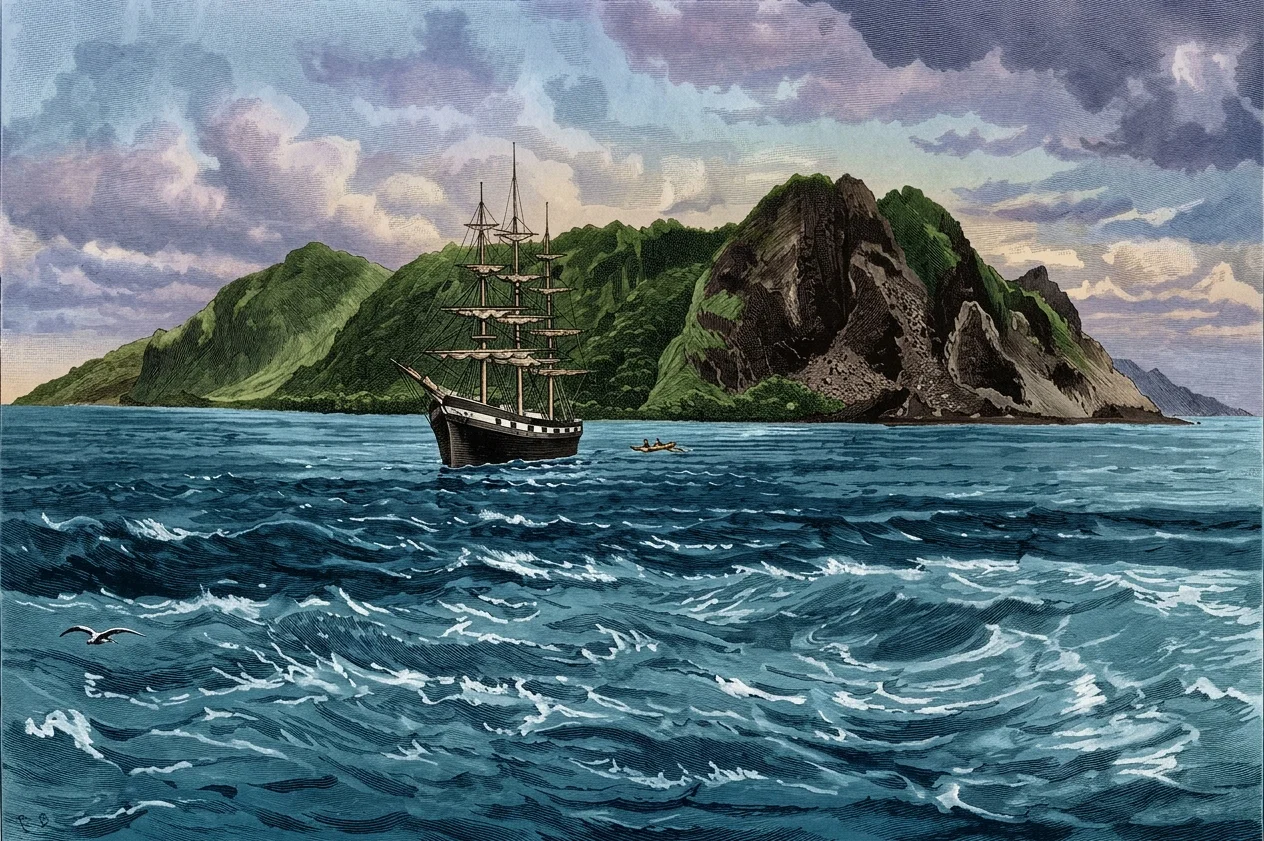
PITCAIRN ISLAND.
PITCAIRN ISLAND.
I arrived in Bounty Bay at 5 P.M. on February 21, 1901. A boatload of islanders (men) came off, but in view of there still being several cases of dengue fever in the ship, I only allowed Mr. James R. McCoy, the chief magistrate, on board. He reported all well in health, 126 people on the island, the women being rather in excess of the men. Arranged to land next day, and then proceeded to northwest anchorage, where there was less swell. Anchored there—losing an anchor which was afterward recovered—for the night, and landed at Bounty Bay the next morning. After this I communicated with the island each day, myself and a few officers landing; but by the surgeon’s advice no islanders were allowed on board. The swell continued more or less heavy in both anchorages, so we stood off and on, or lay too off the island, during the remainder of our stay. Mr. McCoy has only recently returned to the island; he having very pluckily piloted a burning ship to Mangareva, beaching her there rather than agree to her captain running her, as he wished to do, onto the coast of Pitcairn.
The soil and temperature are all that could be wished for, and there is scarcely a wholesome root or fruit that does not grow most readily. Commander Knowling proceeds:—
During the last four years thirty-five vessels on an average have called at the island each year, but the islanders generally seem to see very little of the crews of merchant vessels. In most cases the master only of the vessel lands for a short time, the ships scarcely ever anchoring. During his stay last month in Mangareva (Gambier Islands), Mr. McCoy endeavored to arrange something in the way of a regular trade between the two islands, and one of their vessels has since called at Pitcairn, taking away large quantities of bananas, pumpkins, and arrowroot. The leading men here think that they will be able to maintain this trade.
The men have to give all their labor during the early part of the day—viz., from after an early breakfast at 5 A.M. until 2 P.M.—to work for the public good, directed by the local parliament of seven. At the present time twenty-nine men are available, and their labor is divided between building a new church adjoining the present school-room, a new whaler, and the necessary boat work, shooting of goats, etc. Two o’clock is the dinner hour, and the remainder of the day the people employ themselves about their own business of gardening, etc. The women of the family do all the housework, and many of them smooth and paint coconuts, plait and decorate mat bags, etc.
Disease appears to be still almost unknown. The typhoid of 1894 was brought here by a shipwrecked crew, and no other epidemic has touched the island since. The leading people prefer to continue, as hitherto, without medicines of any sort. One small boy has been recently killed by a fall while chasing goats on the cliffs. Thursday October Christian, son of a man of the same name and grandson of Fletcher Christian, master’s mate of the Bounty, is the oldest man on the island, aged now 83; two other men are over 75, and the oldest woman is 72. None of these old people suffer from anything beyond the weakness of old age, and all seem thoroughly contented and happy.
The early loss of the front teeth in the upper jaw continues among many of the islanders; but the teeth of numbers of adults, as well as of the children, are without a flaw. Some families, in which up to the present there has been practically no intermarriage, still suffer from this loss of teeth. No one smokes or uses intoxicating liquor. Men, women, and children seem without exception in robust health and full of vigor. Thanks to the care of the elected parliament—consisting of seven members, with Mr. McCoy as president—full employment is found for every one. The discipline seems to be all it should be, the islanders contented, and the day’s work often, to my knowledge, such as would astonish many a British laborer, as it astonished, on more than one occasion, myself and the ship’s company. Their religion remains that of the Seventh-day Adventists. The Saturday services are well conducted, and the strong religious feeling which was once so marked a characteristic of the islanders appears—after the check it received some few years ago—to have again gathered strength.
After paying an admiring tribute to Mr. McCoy’s administrative sagacity, Commander Knowling proceeds to the difficulties which the island has to face. First, he places the absence among the men of early middle age of a fitting successor to their present chief magistrate. Then there is the surplus of women in the present and rising generation, a difficulty, naturally accentuated in a small and secluded community. Any arrangement which would include the removal and care of some of these young women—of whom some of the grown ones would now willingly leave—he thinks would be a work of useful philanthropy. He mentions the tendency to clip English words which is growing, but he feels that the islanders are an interesting community.
The colonial secretary’s grievance is that they will not come out and trade with their neighbors. The high commissioner replies with the opinion that they will not be got readily to go into the export business, and that “some new enterprise is essential to the moral and physical well being of the ‘people.’” The mission of the Seventh-day Adventists, to which denomination the islanders belong, is about to take their condition in hand. He reports that “the mission, whose vessel has recently called ‘at Pitcairn and Tahiti, has offered to give employ- ‘ment on their plantations at Raiatea, and at this ‘island, to a few young men of Pitcairn, in order ‘that they may obtain a knowledge of the cultivation ‘and preparation of those productions most suitable ‘for trade purposes, and that the missionaries of the ‘sect to which the Pitcairn people belong are them- ‘selves giving some attention to the question of open- ‘ing up the desired communication by way of Rara- ‘tonga and other of their missionary stations in this ‘region. Whether anything will ultimately be done ‘in the matter is difficult to determine at this juncture; but there can be no doubt that steps in thisdirection have already been taken, and that if funds can be found, and the sanction of the missionary board obtained, the service will be established within the next twelve months by vessels sailing under the American flag.”
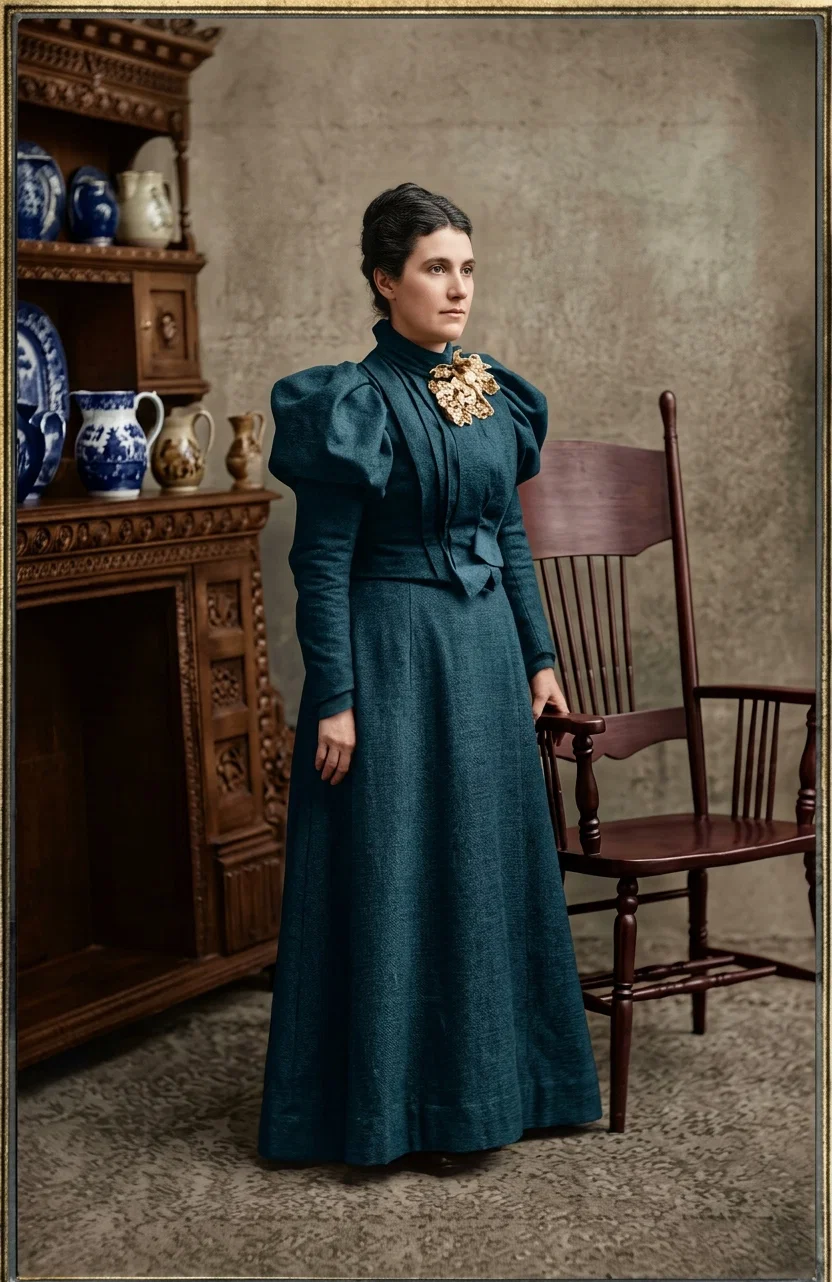
MISS ROSA YOUNG, a native of Pitcairn Island, author of "The Story of Pitcairn."
Continue reading: AS YE WOULD