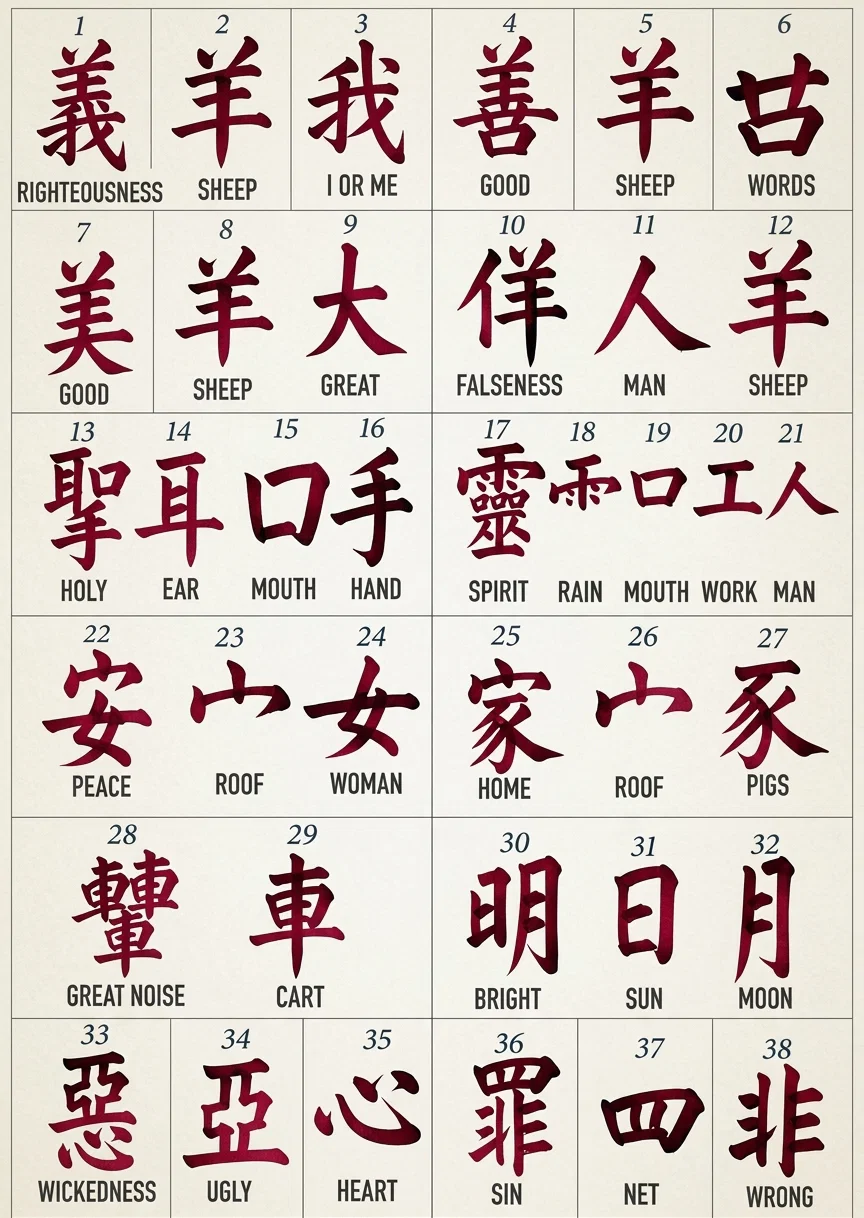
The characters of the Chinese language are ideographic, that is, they are pictures of the thought they are intended to convey. There are said to be six classes of characters. One of these is called “nwei ih dy dzi,” which literally means “think of the thought characters.” It is with this class of characters that the present article deals.
A character is usually made up of two parts. The more important part is called the radical, and gives a clue to the meaning; the other part is called the phonetic, and gives a clue to the sound.
Some one has said that “the Chinese language was invented by the devil to prevent the easy spread of the gospel.” However, it will be seen from the characters used in this article that this is not so, but that, on the contrary, the ancient Chinese characters can be used to teach in a forceful way the fundamental truths of the gospel.
From Fu Hsi, the first of the “Five Monarchs,” whose date, according to Chinese records, goes back to 2953 B. C., the Chinese date the ceremony of marriage, the slaying of animals for clothing, writing, and the commencement of learning, also music. It is also stated on good authority that at that time the Chinese did not worship idols, but that they worshiped the one true God, idol worship being introduced at a much later period. Certain it is that the Chinese characters12give abundant evidence that they are not of satanic origin, but, on the other hand, give conclusive evidence that God has not left himself without a witness even in this most ancient language.
With these thoughts in mind, let us now proceed to examine that wonderful word, righteousness. Righteousness by faith is the fundamental thought of the gospel; for without it no man can see God. The Chinese character for “righteousness” (see Fig. 1) is made up of two characters. The first of these is the radical of the character, and is the word for “sheep” (see Fig. 2). The second word is placed under the “sheep” character, and is the character for the pronoun I or me (see Fig. 3). Thus righteousness in the Chinese language literally means “I under the sheep or lamb” (see Fig. 1). This thought readily suggests that beautiful text, “Behold the Lamb of God, which taketh away the sin of the world” (or, personally, my sin). John 1:29. See also Isa. 53:7.
A further lesson can be learned from the position that these two words, which make up the character “righteousness,” occupy. The precise order must be maintained; for if the pronoun I were placed on top of the word sheep, no Chinaman would read that word as “righteousness;” in fact, to him it would have no meaning at all. In like manner no Christian will ever be taken, or read (for we are the only Bibles some people will ever read), for a true Christian, who does not exalt the Lamb of God, putting “I” or “self” out of sight, or under the “Lamb.” In other words, “He must increase, but I must decrease” (John 3:30), and then “I [Christ], if I be lifted up, . . . will draw all men unto me.” John 12:32.
Another character that shows that the word sheep, when associated with other characters, usually has a good meaning is the word for “good” (see Fig. 4). This word is made up of two characters. The top one is “sheep” (see Fig. 5), and under the “sheep” character is the character for “words” (see Fig. 6). Thus a good man is one who is lamblike in his bearing, and his words in harmony with his lamblike character. This is in distinct contrast to the figure used in Rev. 13:11, which is understood to represent apostasy, and is a sheep speaking with the voice of the dragon.
THE GOSPEL IN THE CHINESE WORD-CHARACTERS
Those who understand the prophecy of Rev. 13:11 as applying in a particular way to the United States of America will be surprised to know that the character that has been selected to represent that country in Chinese is the character “mei,” which means “good” (Fig. 7). This is made up of two characters. One is the word sheep (see Fig. 8), and the other, which is placed under the word sheep, is the character for “great” (see Fig. 9). Thus the character that stands for America in Chinese means literally “a great sheep,” and thus truly reveals the peaceful nature of the principles upon which the American Republic was founded. It does seem too bad that the time will come when it will speak with the voice of a dragon.
To represent the idea of “falseness” (see Fig. 10), the Chinese use a character which has on one side the word for “man” (see Fig. 11), and on the other side the figure for “sheep” (see Fig. 12). Thus, for a man to pretend to be a “sheep” when he is not really so harmless, is the Chinese idea of falseness or pretense. It makes one think of the Saviour’s words about the wolf in sheep’s clothing.
Let us now examine the words for “Holy Spirit.” These are important words; for it is only through the mighty agency of the Holy Spirit that sin can be overcome and the sinful man become righteous.
The word holy (see Fig. 13) is made up of three distinct characters. The first is the word for “ear” (see Fig. 14); the second the word for “mouth” (see Fig. 15); and the third, according to the ancient form of writing, is the character for “hand” (see Fig. 16). An intelligent Chinese teacher who is not a Christian told me that the meaning of this combination of characters is that a man who is truly “holy” is one whose ear hears only that which is good, whose mouth speaks only that which is good, and whose hand does only that which is good. What better definition of holiness can be found anywhere? To listen to truth is not enough, to preach truth is not enough; we must be doers of the Word.
The word spirit (see Fig. 17) has for its radical the character for “rain” (see Fig. 18), and under the “rain” character the word for “mouth” (see Fig. 19) is written thrice; under these three mouths the word work (see Fig. 20) is written; and finally, to complete the word, the character for “man” (see Fig. 21) is used twice. Thus the word spirit in the Chinese contains a stirring lesson to those who are acquainted with the Bible and understand the operations of the Holy Spirit. According to the Bible, the people of God are to look for a special outpouring of the Holy Spirit to be given, before the end of the world comes, to ripen the harvest. This is termed the “latter rain.” The radical of the character, being “rain,” can be used to indicate the source and the abundance of the supply. The three mouths also indicate the abundance of the gift, and also suggest the receptive attitude that the Christian should maintain. The word work indicates that when the Spirit is received in all its fullness, it will do its work. And the object of the work it does is clearly shown in the word for “man,” which is repeated twice, thus suggesting that it will do its work not only upon the outer man, but also upon the inner man, and the whole man will become holy in the sense given above.
The character for “peace” is a very suggestive character (see Fig. 22). The radical is the word for “roof” (see Fig. 23). Under the “roof” is the word for “woman” (see Fig. 24). Thus according to the Chinese idea, peace can be maintained only when the woman attends strictly to home duties. This is in keeping with Paul’s advice that the young women be “discreet, chaste, keepers at home, good, . . . that the word of God be not blasphemed.” Titus 2:5. It also suggests that woman amid the many duties of the home can have the peace of God abiding in her heart, and thus keep the peace of the home.
The word home (see Fig. 25) is very dear to the heart of the Occidental. In the Chinese the top part of this character is “roof” (see Fig. 26), and under the “roof” character is the word for “pigs” (see Fig. 27), the idea being that the home that is well supplied with pigs is the ideal home. The writer has seen as many as a dozen pigs quartered in the same house with the family.
The character “hung,” which means a “great noise” (see Fig. 28), is made up of the character for “cart” (see Fig. 29) used thrice. Three Chinese carts on a Chinese road do indeed make a dreadful noise, for they have no springs.13
The idea of “brightness” (see Fig. 30) is made clear by first writing the character for “sun” (see Fig. 31), and then placing the word for “moon” (see Fig. 32) alongside it, the inference being that if the sun and moon were both shining at the same time, it would be very bright indeed.
Turning from such words as “righteousness,” “Holy Spirit,” etc., let us examine the words for “wickedness” and “sin.”
The word wickedness (see Fig. 33) has for its radical the word heart (see Fig. 35), thus clearly indicating the source of all wickedness. Above the word heart is written the character ya, which is defined in the dictionary as ugly, inferior, secondary (see Fig. 34). Thus wickedness is literally an “ugly heart.”
In conclusion, let us now examine the word sin (see Fig. 36). This word is composed of two very significant characters. The radical is the word for “net” (see Fig. 37). Under the net is written another character, which is defined as “wrong” (see Fig. 38). Thus we learn that by continuing in “wrong,” we fall into Satan’s “net” and are bound. What a warning of the power of sin is contained in this character!
Progress in South Africa
By W. B. WHITE
W. B. WHITE
THE work is onward in this field, and we have much to encourage us. At last the great drought which has pressed us so heavily for three years seems to be broken, and plenty of rain is falling in all parts of the country. As a consequence, crops are good and grazing was never better. In Rhodesia an overabundance of rain has fallen, retarding both the planting and the cultivating of crops; but more settled conditions now prevail, and a good average crop is expected. Some tell us that with an abundance of rain usually comes plenty of fever, but so far all our stations are quite free from this disease, and we are hoping and praying that we may be kept from its ravages.
Never in the history of our mission work have so many students been in our mission schools. They are coming in such numbers that we hardly know what to do with them, and have been obliged to turn some away, not being able to accommodate them. Calls are coming to us to enter new fields and open new schools, but not much new work is contemplated at present on account of the unsettled conditions in the world. When these calls come, however, it is very hard to be unable to respond because of a lack of men and means; but God knows best, and we must wait his time and watch for his opening providences.
As we have but few workers in this field to carry the truth to the thousands of our white population, we are now endeavoring to do an evangelizing work with our English and Dutch papers, the Sentinel and De Wachter, the last named being a translation of the former. From a few hundred yearly subscriptions, which we had a few weeks ago, the list has now grown to over three thousand, and is rapidly mounting upward. Agents are having splendid success in taking subscriptions from door to door; and as these papers go forth to the people, many of whom live in remote regions, far away from towns and cities, they are creating an interest in many minds, and a desire to hear more of the truth.
One of our conferences took a club of 3,000 Dutch papers in December, and mailed them to the Dutch people living in the most retired parts of its territory. As a result of this work more than one hundred and twenty-five yearly subscriptions have been received, which indicates that an interest is springing up, and that many desire to hear what we believe on these great Bible themes. The success that is attending the circulation of these papers is very encouraging to us, and we look for good results.
The Cape Conference is mailing 5,000 copies of the April Sentinel and De Wachter to the people of its territory, and we trust that similar results may be seen. The union conference is also sending 3,000 copies of the April Sentinel to the white population of Rhodesia. We trust that from these efforts many yearly subscriptions may be obtained, and the truth established in many hearts and minds.
During the last few months the union conference has placed in Kafirland a superintendent to take the general oversight of a growing work in that field, and it is now arranged that a man shall be chosen to superintend the work in Rhodesia and Nyasaland. This territory lies far away from the union conference headquarters at Cape Town, and it is felt by the union conference that some one should be on the ground who can give immediate attention to the work. We have a large number of workers in these sections of Africa. Sickness is quite prevalent. Crises are likely to occur at any time, and it is felt that the field should have a nearer administration than can be given by the union conference office. This we trust may be a step in advance for Rhodesia and Nyasaland.
The courage of all our workers is excellent, but we greatly feel the need of a few evangelists to preach the message in the cities and towns. Our ministerial force is not very strong. We certainly feel thankful to our brethren and sisters in the United States who are so cheerfully sending men and means to this field. We appreciate this, and shall try to make the best possible use of what is sent to us. Pray for us here on the Dark Continent.
New Mission Opened in South India
By V. E. Peugh
V. E. PEUGH
IN August of 1914 we opened up work in Pondicherry, a seaport belonging to the Republic of France. In a most wonderful way God has been stirring the hearts of the people in this place to study the present truth. Already seven persons have been baptized, and as many others are preparing for baptism. Many of these have gained decisive victories over the use of betel nut, tobacco, and liquor, and several of the women have taken off their jewels. Some have had to give up remunerative positions that they might keep the Sabbath; but these struggles have given them a live missionary spirit, and they are distributing tracts and papers, and holding Bible readings with their neighbors.
Pondicherry is a stronghold of Roman Catholicism. The French government prohibits any regular gathering of more than twenty adults without a permit from the government. Consequently our work has had to be done in a very quiet way. At present we have before that government a petition asking for the privilege of conducting public meetings, and we are praying that this liberty may be given us.
As our company of believers increases, we are confronted with new problems. We now feel very keenly the need of a school for our children. All the schools in this district hold regular sessions on Sabbath, making it very difficult for the children of our people. Moreover, we believe that these bright boys and girls should have an education that will fit them to carry the gospel to their own people.
It strengthens our faith in the saving power of God when we see the change in the lives of these dear people, and especially when those who have grown hoary amid the superstitions of heathenism, destroy their idols and manifest a strong faith in God. Only a few days ago a woman bent with age, replied, when I asked her how old she was, “I am seventy-seven years old, but I expect to live to see the Lord come.” We believe that such faith will be rewarded, and that many others from this place will be looking forward to the glorious appearing of our Lord.
In the Danube Union
By L. R. CONRADI
L. R. CONRADI
One of the most recent union organizations in the European Division Conference is the Danube Union. Hungary, Croatia, Bosnia, Roumania, Serbia, and Montenegro compose the territory of this field. There are three conferences, two of which are in Hungary proper and one in Roumania, and four mission fields in the union. A union and some local meetings were planned for last autumn, but on account of the war these meetings had to be indefinitely postponed. However, I spent a few days with our brethren in Budapest and Bukharest in the middle of November, while en route to Constantinople. At that time three ministers were ordained.
Making the best use of the Easter holidays, we appointed a session of the union committee at Budapest, April 1-4, to attend to the annual audit, and to consider plans for the development of the work. As the Levant was in need of means, Elder Frauchiger, who was in Constantinople, was invited to meet with us for counsel. Formerly four days sufficed for mail from Hamburg to Constantinople; now two weeks are the least required. My letter did not reach him until March 28, and he immediately telegraphed me at Hamburg. As the way was open through Silesia, I took the shorter route, in nineteen hours reaching Budapest from Berlin. Passing so close to the seat of war, evidences of its nearness were not lacking. Trains passed us with soldiers going to the front. Red Cross trains were full of wounded from the struggle in the Carpathian Mountains. Then there were trains full of ammunition and provisions.
Elder Paulini, the president of the Roumanian Conference, was unable to attend. Elder Kessel, the director of the North Hungarian field, who is serving in the German Sanitary Corps, spent a few hours with us on his way to his family, on furlough. Otherwise all the members of the committee were present.
In spite of war, the past year has been the most prosperous this union has ever had. Roumania, where our people had to endure a severe trial of their faith, and are actually persecuted by the state church, showed the best increase. With only seven gospel workers, they baptized 165 believers. This brings their membership up to 608. The tithe showed a slight decrease, but amounted to $5,524, and their offerings were $1,400. After settling with their workers, and paying their tithe to the union, they were still able to turn over $1,300 surplus tithe to the union toward their general deficit. We are the first Protestant denomination that has ever gained a good foothold in this country. No session of the Roumanian state church passes without spending some time in considering new methods of stopping our progress. The priests went so far as to visit the employers of our people, and to urge them to dismiss our members. Publications antagonistic to our work are appearing, and yet the workers are of good courage.
The strongest conference is the Transylvania; numbering 722 members. Last year eighty-five persons were baptized, but the net increase was small. There was a great lack of efficient workers in the Hungarian language. The tithe was nearly $4,000, which did not quite suffice to pay the present workers.
The Middle Hungarian Conference, including the city of Budapest, had, with eight gospel workers, 110 additions, bringing its membership up to 561. In the city of Budapest there are three churches, with 153 members. At Bekes-Gyula is a church of fifty-five; at Szekudvar, forty-three; at Arad and Macsa are thirty-eight, the remainder are smaller churches. The tithe of this conference amounted to $5,500, and it had to have considerable financial help.
The Theiss-Save Mission, which includes the Serbian-speaking portion of Hungary as well as Serbia, also had a good year. Its workers are still in the field, and sixty-seven believers were added, bringing up their membership to 229. Our worker in Serbia, cut off by the war, received help via Canada, from Washington, D. C. As the director of the Adriatic field could not be replaced, Elder Schillinger, of the Theiss-Save Mission, has to look after this field also. This mission will hereafter be known as the Save Mission, because Dalmatia, bordering directly on the Adriatic and belonging to the Central European Union, has claimed the name Adriatic Mission for Dalmatia and Istria. In the new Save Mission, fourteen believers were baptized, and in the West Hungarian, ten. The North Hungarian Mission is still without a director or an ordained minister, but thirty-two united with the church there last year.
With only sixteen ordained ministers, five licentiates, and twenty-two Bible workers, there were altogether in the union, 483 baptized, increasing the membership from 1,599 to 2,324. The tithe also showed an increase of $1,800, amounting to $16,154. The average tithe, however, demonstrates the effects of the war, by decreasing from $9.13 to $7.37. The total offerings amounted to $3,700, a decrease of $100. There were thirty-six canvassers at work, selling literature to the value of nearly $10,000. There was quite a large increase in the sales during the first six months of the year, but the six war months lowered the increase to $500 for the year.
All our meetings were well attended, both by our own people and by others interested. A good spirit prevailed. Although Serbia and Hungary are at war, we had quite a little group of Serbian-speaking Sabbath keepers with us, who came from southern Hungary. They had come for a special occasion. Brethren Mocnik and Ludewig, who had for several years past labored successfully among the Serbian-speaking people of Hungary and Serbia, were to be ordained Sabbath afternoon. These two brethren, quite closely associated in their work for a number of years, have had rather a trying experience in their labors. Elder Ludewig is a native of Germany, a graduate14of our Friedensau School, where he came in contact with Brother Mocnik, a Slavonian who embraced the truth in Germany, and from him Elder Ludewig learned the Slavonian. In July, 1908, Brother Mocnik was sent to Agram, Croatia, and a year later to Semlin, opposite to Belgrade. Brother Mocnik had learned the Serbian language in Semlin. That same year Brother Ludewig was sent direct to Belgrade.
In the evening after the Sabbath, I was invited to speak in a large public school building, to about 140 wounded Hungarian soldiers. A brother translated for me. There are about eight hundred patients in this building. Sister Huenergardt and two of our nurses are doing very acceptable work here. As most of these soldiers were Catholics, I spoke to them about our mission work in Africa, avoiding all allusions to doctrines. They seemed to appreciate the words spoken.
Elder Frauchiger did not arrive till Monday afternoon. His train through Turkey was stopped several times, as the officers were hunting for spies. Then he was considerably delayed crossing the three borders. I spent till midnight with him in considering the work in the Levant Union Mission. The war greatly hinders our missionary operations and traveling. Elder Baharian has returned overland to his field in old Armenia. As horses are scarce, the trip was much more expensive and tiresome than formerly. Our people, however, are of good courage. They are doing what they can in the trying circumstances under which they are placed.
We felt thankful to God that we had the ready means to supply our workers in that field and the mission in Syria for some time to come. On his way back, Brother Frauchiger expects to stop in Bulgaria.
On my return trip I stopped several days at Friedensau, and spoke there one evening on the experiences of our missionaries in different lands. It was quite a new sight to see one half of the chapel filled with wounded soldiers instead of with students. All listened, however, very attentively.
Thus in the midst of war, trials, and persecutions, God’s truth ever advances, gaining new victories.
African Boys’ Offerings to Missions
By S. M. KONIGMACHER
S. M. KONIGMACHER
LAST week the Week of Prayer Readings were read during the chapel period, and it was announced that we should take up an offering. This was something new to most of the boys, and on Friday I called some of them and asked if they wanted to work for threepence. They were glad to do so. They kept coming till I had fifteen working. Some hoed out the paths, and some cleaned up for the Sabbath. Others came too late for me to give them work. On the Sabbath a little boy came to me looking very troubled. I asked, “What do you want, Tongotongo?” He said he had no ticky (money) to give to the Lord, and he wanted some to put in, the same as the rest of the boys. I told him to come to the house. He came and was not disappointed. Seeing his success, others came also, until I had given out to about fifteen, with the promise that they should work for it the following week.
Well, when I rang the bell, or rather beat a plowshare, they came. After telling them what the money was for and where it was going, and showing some of the pictures in the Harvest Ingathering Review, the collection was taken, and I believe every boy had something to give. Our only village church member came and brought some eggs. When I was coming home after the service was over, a boy came running after me, and I stopped to see what he wanted. With a big smile on his face, he took an egg out of his vest pocket and gave it as a donation. The total was not so great, but with the blessing of the One to whom it is given, it will do its share in winning souls for his kingdom.
Calcutta, India
By L. J. BURGESS
L. J. BURGESS
SEVERAL months have passed since my wife and I reached India, after a pleasant and profitable furlough spent in the homeland. We wish to take this opportunity to send back greetings to the brethren and sisters and friends whom we had the privilege of visiting while in America, and to all others who we know are following us with their prayers, although we have not met them personally.
At our general meeting in December last, it was decided that we should remain in Bengal for the present. This was contrary to our expectations; but as we believed that the Lord was leading, we gladly settled down in Calcutta, to remain until Providence should send us elsewhere.
The Bengalis are a warm-hearted and affectionate people. Their likes and dislikes are strong, and they are very free in expressing their feelings. We were fortunate in having the good will of our Bengali brethren, which made the task of taking up work in this new field easier. It was to Bengal that our first zenana worker came about twenty years ago, Miss Burrus, who afterwards became Mrs. Burgess. Much good seed has been sown here; and although large results have not yet been seen, we are glad that some faithful workers have been developed, and the prospects are bright for a plenteous harvest in the near future.
We are now addressing ourselves to the task of mastering the Bengali language. My wife once spoke the Bengali quite freely, and it will doubtless come back to her in a few months; and as this language is somewhat akin to the one I already speak, I hope soon to gain a working knowledge of it. I am studying two hours each day with a native language teacher, or pundit, as he is called. My pundit is the same man who taught the language to our Brother Little who laid down his life in east Bengal some years ago. The pundit has a good knowledge of the Bengali language and of Sanskrit, and has also a keen interest in the truth. Although between seventy and eighty years of age, he is quite strong, and able to journey fourteen miles in a day on foot.
We expect to have all our native workers together for a two weeks' institute next month. Brother James, of South India, has promised to be with us to take a leading part in the program of the institute. We are hoping for a special blessing upon the meeting, and trust that it may mark a new era in our work here.
We are both well and of good courage, and believe that the Lord has set his hand to the finishing of the work in Bengal. We desire to walk humbly with him, that he may use us to that end.
Woman's Work in Japan
By MRS. F. H. DE VINNEY
MRS. F. H. DE VINNEY
Our denominational work for women in Japan was opened in the autumn of 1910 in Tokio, as a department of the mission, by the formation of a society known as the Fujinkai (Ladies' Society), or, in the English, Dorcas Society.
The main feature of our meetings is the Bible study, usually given by one of the Japanese ladies of the society. This is followed by a demonstration of simple treatments, a talk on the care of children, or on cooking, or a lesson in English language, something in which the ladies are interested. We go from door to door, and invite them to attend, telling them of the special feature of the meeting. In this way we get the attention of the most progressive women.
At our last meeting, a large bundle of tracts and papers had been obtained, with wrappers to be addressed. After the meeting every one present was given the privilege of wrapping and sending to her friends such as she thought would be useful. It was blessed to see the eager, happy way in which they went at this work. When all was ready for the mail, we spread them out before the Lord, and asked him to open hearts to read and accept the message they contained.
Our faith reaches out and claims many lives transformed, and precious souls saved in the kingdom, as the result of faithful work by the Fujinkai, blessed by the Spirit of God. Pray for us.
Tokio.
Fourteen Baptisms in Chicago
FROM Chicago comes the report of fourteen baptisms by Elder Adolph Johnson since the beginning of the present year.
The Crisis in Persia
THE Christians in Persia are crying aloud to God for help, as did the children of Israel in the days of Pharaoh’s oppression. Fifteen thousand of them are in the mission compounds of Urumiah, and thousands more are facing death or worse in cities and villages. Rev. Robert M. Labaree, who went out ten years ago to take the place of his brother who had been murdered by the Kurds, now writes appealing for help for these starving thousands, who are suffering because they are Christians and not Mohammedans. Turks and Kurds are bearing down upon them, burning villages, looting property, killing men and boys, and carrying away women and children to a fate worse than death. More than fifty thousand dollars are needed immediately if these sufferers are not to die of starvation on the mission premises.
In the days of Pharaoh there were no human servants of God who could be called upon to relieve his people’s distress, and he called into operation his mighty forces of nature to effect their release. Today millions of men and women profess to be ready to follow his bidding, “Inasmuch as ye have done it unto one of the least of these my brethren, ye have done it unto me.” This call comes to Christians in America most loudly and insistently. They are most free from the awful strain of war, and their missionaries have been working in Persia for eighty years, and are the only ones in a position to render the needed help.
Persia is undergoing a baptism of blood; and if the Christian church gives the needed sympathy and assistance, we may see even more wonderful results than have followed in China, where the attempt to stamp out Christianity fifteen years ago resulted in the physical death of 10,000 Christians, but has borne fruit in the awakening into spiritual life of hundreds of thousands of those who were spiritually dead in Boxer days. Truly, Christianity in Persia is at a crisis, but it may be a crisis that may be turned to victory.—The Missionary Review of the World.
Cheerfulness
By MRS. T. D. ROWE
MRS. T. D. ROWE
“If you wish to be miserable, think about yourself, about what you want, what you like, and the respect people ought to pay you.”
Why are we constantly meeting so many persons with woebegone, sad, despondent, downcast faces? One reason is found in the sentence quoted above—thinking about self. If only self could be satisfied, then the countenance would be changed. Would it?—Ah, no! It is only those who sacrifice self for some one else, for friend or foe, or for their love for God and his work, who carry habitually a happy, pleasant face.
Those who have borne the heaviest burdens, whom God has asked to pass through the most severe trials and sorrows, are those who most often have a forehead unmarred by frowns.
What a grand lesson we have learned inwardly, and can teach outwardly, when we do not stamp our cares upon our faces nor exhibit them in our manner. Let us learn to say, with Alice Wellington Rollins:—
“The inner side of every cloud
Is bright and shining:
I therefore turn my clouds about,
And always wear them inside out,
To show the lining.”
Oshawa, Ontario.
MRS. C. L. STONE
By Mrs. C. L. Stone
Training in Habits of Order and Helpfulness — No. 4
MRS. C. L. STONE
We often hear quoted the words of Isaiah: “For precept must be upon precept, precept upon precept; line upon line, line upon line; here a little, and there a little.” Nowhere is this more true than in training the little child to habits of order and helpfulness. It is impossible to take great strides in this training. It is the little touch here and the little touch there which count in the end for great results. And the giving of these little touches requires infinite patience on the part of parent and teacher. If they are to guide in the development of these youthful minds, it is evident that this cannot be done passively. It must be done actively, aggressively. The mind of parent or teacher must precede that of the child, and show him the possibilities of the simple things about him. In a spirit of destruction the youth might set fire to and burn up the grass, but he can be taught to weave it into beautiful baskets.
Says Miss Dopp: “Could parents and teachers take even a few minutes a day or a few hours a week to help children to see the possibilities in a pile of sand, an unoccupied piece of ground, the tough grasses and woody fibers growing in waste places, a neighboring tree, dry goods boxes, paper and paste; in short, in any of the legitimate materials in the environment of the child, there would be a saving of time for adults, and a more normal and happy growth in the child.”
Habits of Perseverance
“Children frequently engage in a piece of work, and become perplexed or weary of it, and wish to change, and take hold of something new, although they entered upon the work with enthusiasm,” says the author of “Christian Education.” “Thus they may take hold of several things, meet with a little discouragement, and give them up; and thus pass from one thing to another, perfecting nothing.
“Parents should not be so much engaged with other things that they have not time patiently to discipline those developing minds. They should not allow the love of change to control their children. A few words of encouragement or a little help at the right time may carry them over their trouble and discouragement, and the satisfaction that they will have in seeing completed the task they undertook will stimulate them to greater exertion.”
In our efforts to establish the principle of perseverance let us not overlook the fact that it is impossible for the youthful mind to concentrate for any great length of time on any one thing. We have abundance of scientific proof for this. Holding to our principle of setting our tasks within the capacity of the child’s capabilities, we shall obviate the disastrous results that come from overfatigue.
On the other hand, let us not underestimate the capabilities of our children, and weaken them in character as in physique by making their tasks too easy. On this point, Dr. McMurray says: “Many parents and teachers make the fatal mistake of thinking they must make the task easy. The result is a pitiful feebleness, flabbiness, and helplessness on the part of good, stout boys and girls who are fully capable of doing tasks twice as difficult. . . . Any one who supposes that he is increasing the interest of children in their work by directly helping them over all their hard places, does not understand human nature in children.”
This does not necessarily imply that children should never be helped. The point is, having once learned how to do a thing, the child thoroughly enjoys trying his powers, developing independence.
Takoma Park, D. C.
MRS. VINA SHERWOOD-ADAMS
By MRS. VINA SHERWOOD-ADAMS
Bird Studies With Our Children — No. 1
MRS. VINA SHERWOOD-ADAMS
DURING the warm months we can more easily reach the ideal nature study; for instead of depending on pictures and stories to form the child’s concept of animals, birds, flowers, trees, etc., we may have the real objects before him. Flowers are an interesting study, but birds are even more so, with their incessant activity and bewitching manners. The construction of the nests alone, in which each kind of bird exhibits its own taste, is an interesting study, but is best undertaken when the trees are bare of leaves. Many lessons on thrift, neatness, etc., may be learned from the manner in which different birds construct their homes. The quarrelsome bluejay shows his rude nature in the hastily made nest of ugly black twigs; while the dear little16goldfinch, a gentle, refined little fellow, constructs a nest so light, so dainty (often decorating it with wood moss from the tree bark), that it can rest on the leaf branches of the thistle plant.
It does not call for much effort to teach our children about the birds. While on the way to market one early spring day, with our two-year-old boy and his sister, we saw our first bird arrival—a robin. Sister spied him first. Looking up to the tree, we said, “Listen!” Baby was all attention. He heard the robin’s clear call, and said, “Bird.” We told him it was “robin bird.” He repeated the name after us a few times. By trying to imitate the older children in the use of their crayola, he had learned to distinguish the colors blue and red; so we told him robin’s breast was red, somewhat like the red sweater suit he was wearing. Then we listened to robin’s call a few minutes, calling baby’s attention to its sweetness. Now when he hears that call, he says, “robin bird,” and, putting his hands on his red sweater, “like me.”
Baby can tell the whistle of the train from that of the street car. Why not teach him the call of a few of the birds? We made robin his bird of special study this spring. He watched robin hopping about in the yard, his head on one side, as he listened for the tiny stirrings of a worm in the ground. He watched him gathering materials for his nest, and later he had a peep at the hungry baby birds with their wide-open mouths. Very simple little lessons, but in them he learned to think of robin bird as his friend, and to keep sensitive little ear nerves alert for the small sounds of nature.