It is very clear, from the Scripture, that the apostle Paul, to illustrate certain truths of the Gospel of Christ, introduced among the Gentile Christians a number of customs which had been in vogue among the Jews. Some of these customs were introduced for the carrying forward of the work of God, as they were strongly established among the Jewish people, and there was much in them which the Spirit of God saw could be utilized for the advancement of the work of God.
Custom of Helping Poor in Jerusalem
Several centuries before the advent of Christ, there had arisen a custom among the Jews providing for the needy poor at Jerusalem. It came about something as follows: It is well known that when the Jews entered the seventy years’ captivity in Babylon, many of them were scattered in different parts of that great empire. When the time came that the Lord desired the children of Jacob to return to their own land, Palestine, He had the kings of Media and Persia issue a decree to that effect. Cyrus, Darius, and Artaxerxes accordingly did declare that the people of God could return to their own land, and the kings did all they could to assist the Jews in restoring their worship at Jerusalem.
But we know, from the records of the Bible, that not all the Jews who went into captivity did go home to their own land. We find thousands returning to Palestine at the time of the command of Cyrus, king of Persia; and this was equally true when the other kings, previously mentioned, issued their decrees. But there were many tens of thousands of Jews who still remained in the countries whither they had been scattered. This is evident from reading the books of Esther, Jeremiah, Zechariah, and Haggai. It is made clearer still that this is so, by reading Acts 2, the first eleven verses.
During the several centuries before the advent of Christ, hundreds of thousands of Jews flocked to Jerusalem, and the holy city contained more Jews than it could support properly. Frequently there were insurrections, pillages, and other causes of devastation, until thousands of Jews of the land became poor, and were greatly in need of assistance.
Then, again, many thousands of Jews would make pilgrimages to the city, and not infrequently large numbers of these would remain in Jerusalem. This, too, naturally added to the poverty of the people, until there were very many of the children of Abraham who were destitute. Several times a year thousands of Jews from these other lands would come to Jerusalem to worship before the Lord. At the festivals and at other holidays, a great number of these loyal children of Abraham would still come to the temple and to the holy city to worship before the Lord their God. Many of these tourists were wealthy, having established large business interests in these eastern lands. When they came to the Holy Land, and saw the poverty of many of their brethren in the flesh, they realized that something had to be done in order to assist them in their need.
Money Set Aside Each Week
These Jewish brethren in the foreign lands decided that they would set aside a certain amount of money each week for these poor Jewish brethren, and then when some of the merchants would go to Jerusalem on business, or when some of the people would go to the city to worship, or when some of the proper persons would come from Jerusalem to visit their brethren in these different lands, this money could be sent back to the poor Jewish brethren in Jerusalem.
About the time of the advent of Christ, this had become an established custom, and in this way thousands of the poor Jews were greatly helped during their poverty and their distress. The rabbis had taken the matter up, and had systematized it in such a way that the Jews in all the lands well understood the method which had been adopted to assist the poor Jewish brethren. During the year, the rabbis would send duly constituted authorities to collect this money, and these funds were known as the money for the poor Jews at Jerusalem.
After Christ had come and had declared His Gospel to men, a bitter prejudice had arisen amongst many of the Jews in Jerusalem as well as out of it, against all those who should accept the teachings of the Nazarene. In fact, the time had come, when any person who would accept the Saviour was anathematized, and cast out of the synagogue. To the Jew who was wealthy, this meant social ostracism; but having means of his own, such a person did not mind the effect it had upon him from a monetary point of view. But to the Jew who was poor, especially to the one who was dependent upon the gifts of his brethren, this worked a great hardship, for we know that the Saviour preached the Gospel to the poor, and there were many of His followers from among this class of people. But the Lord Jesus never left those who trusted in Him.
Rise of First Day of the Week Appropriations
He had made provision for the poor, and told His followers that they had the poor with them always and they could help as they desired. But we read that there came a famine in Jerusalem, and this famine was predicted by the prophet Agabus. The apostle Paul, knowing the custom that was in vogue among the Jews to help their poor Jewish brethren, suggested, through the influence of the Holy Spirit, that this plan be carried out to help the poor brethren in Christ at Jerusalem, as it had been so well established among the Jews. Being impressed with the utility of this plan, everywhere he went he taught the Gentile Christians that they should adopt this plan as a method to raise funds to help the poor brethren. Thus it became a part of the Gospel plan, that every person should lay by himself at home, every first-day morning, a certain amount of money, according to the degree to which God had prospered him during the previous week. If he had been blessed of God abundantly, then when he considered his financial standing on the first-day morning, prior to the beginning of his labors for that week, he should deal with the poor Jewish brethren as God had dealt with him.
The writer well remembers how, when he was a boy at home, his father followed this custom regularly and methodically; for the same plan is still followed by the orthodox Jews the world over, to support the poor Jews at Jerusalem. Many a time have I seen my father early Sunday morning take account of the amount of business he had done during the previous week; and then he would take some of his money and deposit it in a tin box, which had an opening in the top of it, and around the face of it was placed a label bearing this inscription, written in Hebrew letters: “Alms to the Poor Jews at Jerusalem.” When friends call at the house who do not live in thickly settled Jewish communities, they are invited to share the blessings of giving to their poor brethren. But the regular, pious, orthodox Jews attend to this matter most generally as the first item of business after they have conducted their worship on the morning of the first day of the week.
Thus we can see how the apostle Paul introduced this custom in the early Christian church to support the poor brethren in Christ, and at the same time he taught the early Christian church what should be their first item of business on the first day of the week. It also illustrates how methodical the work should be for the carrying forward of the Lord’s cause, and how every person may have a part in assisting the poor.
Strikes Throughout the World
To attempt to give a list of the places where strikes are in actual operation, or else are seriously considered as a thing for the near future, would be indeed a very tedious task. For there is social unrest and strikes or rumors of proposed strikes in every quarter of the globe, both in the Old World and in the New.
The conditions in England, in France, in Spain, in Germany, in Austria, and elsewhere in Europe and Asia, are too well known to require more than the merest mention to bring the facts of the general unrest to mind. In this country we are led to hope that the locomotive engineers' strike has been overcome and averted; we are beginning to have the same hopes in regard to the coal-miners' strike that threatened to make a coal famine that would have been nation-wide. And then there are the smaller strikes in numerous cities and villages throughout the length and breadth of the land.
Hundreds of books are written upon the subject of ways and means to settle these social difficulties. There is no end to newspaper and magazine articles discussing the same topic. Each one has some plan or plans, and theories in great variety are presented, and each supporter of these different notions is sure that if his theory could only be fairly tried the troubles would all be ended. But most of these plans have been tried to a greater or less extent, and the conditions keep on getting worse and worse.
There is no mistaking the fact that society is in a state of excitable turbulence, and it takes only a little spark to start a great conflagration. Some are saying that all this spirit of turbulence is caused by the agitators that are allowed to make so many inflammatory speeches, and to write and circulate such disquieting literature. But are there not conditions that are causing all this? Do not these agitators have real rather than imaginary things to talk about? Unmistakably there are great problems before the world. Men may differ in regard to their theories as to how these problems shall be treated, but there is no difference of opinion on the actual existence of these social conditions that can not help making trouble.
The two great political parties of this nation are split into factions over the social issues that confront us. And aside from the two leading parties that are thus divided, we have still other parties with a large following that owe their excuse for existence to the conditions that have formed a great part of the basis for the splits in the older political organizations.
The unprecedented aggregations of capital on the one hand, and the unequal divisions of profits with labor on the other, is one of the favorite topics. And connected with this is the extravagant expenditure of the wealthy in foolish pleasures, whims, and luxuries, while there are thousands upon thousands of others who are in distressing, hopeless need.
Hundreds of men and women see the dangers that these conditions portend, and they are lifting their voices in warning notes. Senate and house committees in State and nation are struggling with the problems that are forced upon them by the greed and avarice of the controlling trusts and combines that are gathering the wealth of the world into their coffers at an appalling rate. Citizens' committees and other voluntary organizations are formed in city and town in order to grapple with the graft and greed that center in those places. But still the all-controlling power of money goes on like a resistless avalanche, and everything is ground beneath it.
Whenever and wherever in the past money has gained the power to dominate affairs, there has been the unvarying rule of history that vices, corruptions, and the luxuries that debase men are the result. The greed for gain and the luxuries that wealth brings, shut men away from the suffering and afflictions of humanity. The squalor of the poverty-stricken alley is so repulsive to the delicate tastes of luxury, that the hopeless misery of the poor is effectually shut away from the wealthy. They are not aware of its existence. Luxury seems to put the man in the place where inconsistencies do not appeal to him. The man of great wealth and luxurious tastes will tell of his difficulties in properly supporting himself and family on $50,000 a year, and then contend that the laboring man is unreasonable and inconsistent because he talks of "striking" to have his wages increased twenty-five cents a day, from $1.75 to $2.00.
Along with the sentiments of luxury goes the spirit of haughty superiority that makes the man of wealth a sort of superior being. He shuns the man of poverty, and treats him with disdain and contempt, as if he did not belong to the same race. Many of these poorer men and women are the superiors, both mentally and morally, of the haughty individual of money and wantonness. And the air of superiority assumed, and the menial service required, are doing their full part to widen the breach between these two classes.
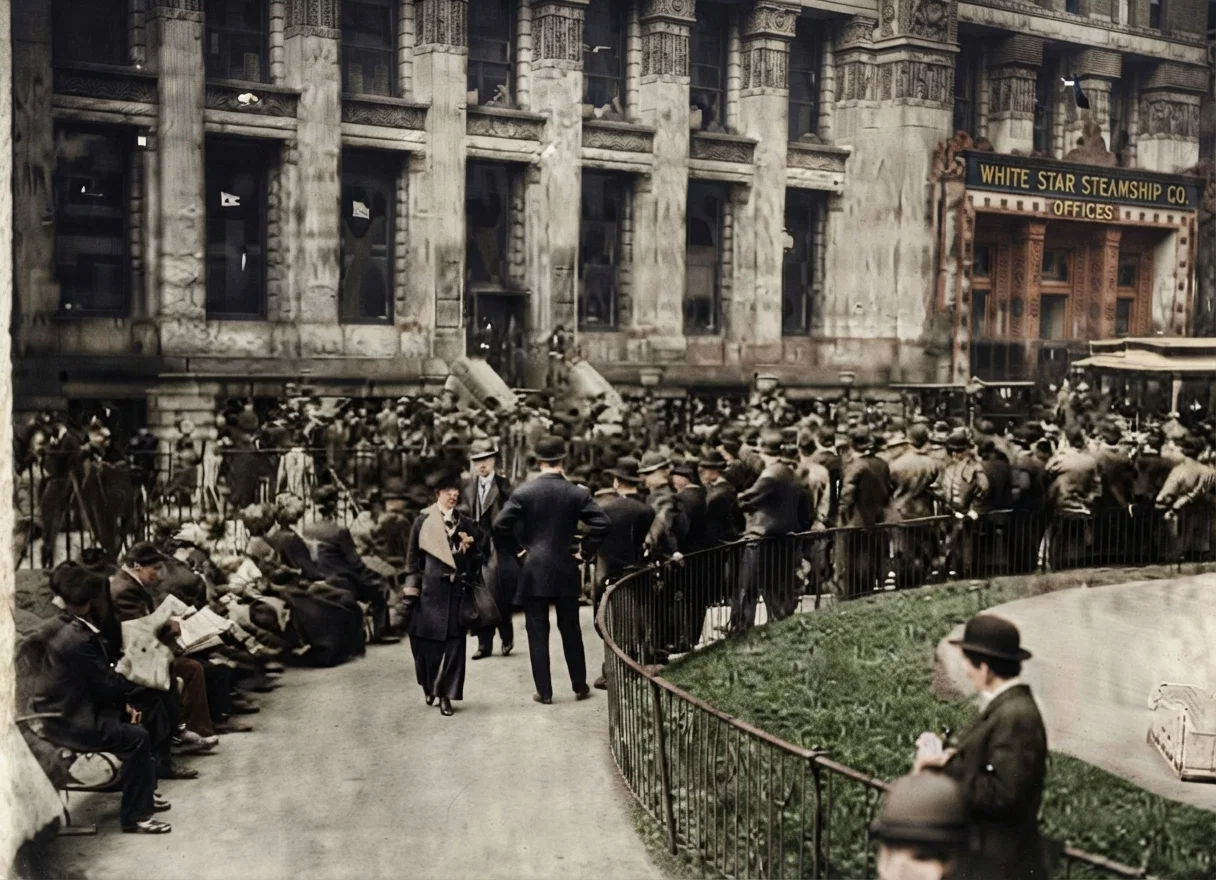
Crowd in front of the office of the White Star Steamship Co., New York City, anxiously awaiting news from the ill-fated Titanic, even tho it was given out that all hope was gone
When the vices that come with luxury are confined to some small locality, or afflict only one nation, there is always hope that the evil will be corrected. But in this time the contagion has become world-wide, and is so strong that there are no powers that can cope with it, except the infinite arm of the Almighty. Men seemed to toy with these problems at first, and laughingly and often deridingly said that the difficulties would take care of themselves. We have been told over and over again that the "civilization of the twentieth century would have no difficulty in meeting every problem that came to it."
But some of the best men of the nation and of the world are coming to take a very serious view of the conditions that confront us. College presidents, leading lawyers, statesmen, and journalists are becoming alarmed. And while they sound a note of hope, yet the tone is such that it shows that the note is coming from a hopeless heart. The God of heaven has known from the beginning what would be the end of the history of this world's career in sin, and He has spoken plainly of these very times in which we now dwell. His words are:
And there shall be signs in the sun, and in the moon, and in the stars; and upon the earth distress of nations, with perplexity; the sea and the waves roaring; men's hearts failing them for fear, and for looking after those things which are coming on the earth: for the powers of heaven shall be shaken. And then shall they see the Son of Man coming in a cloud with power and great glory. And when these things begin to come to pass, then look up, and lift up your heads; for your redemption draweth nigh. Luke 21:25-28.
The foregoing scripture makes it clear that the coming of the "Son of Man" is immediately preceded by "distress of nations." And furthermore, it is a distress of nations that has "perplexity" in it. And it is a "distress of nations" with such "perplexity" as to cause "men's hearts" to be "failing them for fear" as they are "looking after those things which are coming on the earth."
The very conditions that are called for in this prophecy are even now looming big above the world's horizon. God can not be mistaken; therefore we should give careful heed to what He is saying in His Word.
Another scripture that speaks of this time says:
But know this, that in the last days grievous times shall come. For men shall be lovers of self, lovers of money, boastful, haughty, railers, disobedient to parents, unthankful, unholy, without natural affection, implacable, slanders, without self-control, fierce, no lovers of good, traitors, headstrong, puffed up, lovers of pleasure rather than lovers of God; holding a form of godliness, but having denied the power thereof: from these also turn away. 2 Tim. 3:1-5.
This text says that the "last days" shall be marked by "grievous times," or, as in the Authorized Version, "perilous times." The text explains what is the cause of these "grievous times." Love of self, love of money, boastfulness, haughtiness, disregard for parental authority, the loss of the natural affections that tie families together, stand at the head of the list. And then there is the slanderer, the man who has no self-control, and who is fierce; and all these people are "lovers of pleasure rather than lovers of God." And yet they are "holding" to "a form of godliness." They are professors of religion, but in their lives they have "denied the power" of the God they claim to worship.
This last text most strikingly shows that the "last days" will be strongly marked by the glaring inconsistency of great religious professions on the part of men who are making the times "grievous" or "perilous" by their self-love, and money-love, and ferocity, etc., etc., to the end of the list.
Take these Scripture presentations of the conditions that are to prevail in the last days, and put them side by side with what is taking place in society to-day, and it may readily be seen that the conditions are in exact harmony with the predictions. To the one who is unacquainted with these prophecies, or who disregards them, the social outlook may indeed be very dark and foreboding. But to him who knows God's Word the outlook is freighted with joy. For are not the indications clear that Jesus is coming again very soon? And Jesus is the world's Redeemer, and He is coming to save everlastingly every one who trusts in Him.
Never was the immediate future before this world so bright as now. For the doom of misery and sin is about to be sounded, the resurrection day that will unite the good and true of all the ages lies just before us, and soon, O, very soon, the evergreen wreath of immortality will deck the brow of every one who is prepared for the glorious day.
Social problems will grow darker and darker. Violence and strife will spread their pall of gloom over the world. But none of these things can drive joy from the mind of him whose heart is palpitating with the delightsome hopes that center in the incontestable evidence that the "Desire of all nations," the Christ of the living God, is about to return for His own. T.
Schoolboys as Train Wreckers
By T.
A two-hour battle was fought on April 19 between the Italian fleet and the shore batteries of the Turks on the Dardanelles. The Italians made the attempt to destroy some Turkish torpedo-boats, and other war-ships, but were not able fully to carry out their design, because of the fire from the shore.
"Schoolboys as Train Wreckers"
UNDER the title that stands at the head of these paragraphs, the Examiner of San Francisco has the following to say:
The attempt of half a dozen boys to wreck a passenger-train on the New York Central Railroad presents an appalling moral problem. The outrage took place within the city limits. The boys seen flying from the place as the train dashed into the railroad ties that had been heaped upon the tracks, appeared to be youngsters of public school age — from twelve to fifteen years.
It is to be borne in mind that criminal exploits of this character are no novelty in this country. A long list of like events could be compiled out of a year's files of any newspaper. Also it is to be borne in mind that boys are gregarious creatures; it is impossible for any small group of boys to be very different from the larger group to which they belong.
Thus it is to be inferred, from this incident, that not merely six boys, but many more boys in the district where this outlawry was perpetrated, are capable of sharing the motives and states of mind that go to the wrecking of a passenger-train — "for fun."
Of course the boys that did this thing should, if identified, be punished in a severe and exemplary way. "Boys will be boys" — but there is no reason why boys should be felons.
The real question is, How did it become possible for half a dozen schoolboys to think so basely and squalidly of human life as to be able to conceive and execute such a project? And again, What changes should be made in the training of schoolboys in New York and elsewhere so that such a deed can be satisfied with mere retribution?
Certainly there have been times and places in which six schoolboys could not be found to wreck a passenger-train for fun. What is the matter with our times and our towns? What is the matter with our teaching, that such a thing can happen here and now?
That is the question which reflective minds will consider upon hearing of the shocking and significant event of last Saturday.
A little attention to the foregoing from the Examiner will serve to show that the editor who wrote those paragraphs recognizes that juvenile criminality has become sufficiently frequent to constitute a problem for "reflective minds." Not only do we have adult criminality alarmingly on the increase, but the children and youth of the rising generation are becoming so lawless as to cause deep concern among men and women who think.
The overpowering corporations that control the money, the transportation, and the commodities of the nation, have not hesitated to use bribes to persuade men to violate the principles of right. Legislatures and city councils have been corrupted by the same means. This kind of work has been carried on everywhere, and the moral sense of large numbers of men has been blunted. And with the morals of men thus weakened, is it any wonder that there is lacking in the home the moral strength that would deter boys from such crimes?
The committing of such crimes can not, in justice, be charged to the school. It is not what the public school teaches or fails to teach that is responsible for this juvenile criminality. It comes as a result of the lowering standard of morals in the home. Such youthful criminals do not come from the homes where the Ten Commandments are properly respected and taught. And where the morals of the home are not as they should be, no amount of work done by the school-teacher can correct the evil.
The general intelligence of the world seems to be advancing in a very commendable way. But the recognized increasing criminality among mere children is only one of the many things which show that the morals of this world will soon reach the point where divine justice will have to strike against the prevailing iniquities.
Peace, Ships, and Safety
A representative from Persia has come to the United States to talk with men interested in international peace and arbitration. He thinks that there is sufficient common ground between the Mohammedans, the Christians, and the followers of Zoroaster, to enable them to work for world's peace. He says that all of these organizations unite in the belief that "the people of the world should love each other, should serve each other; they should become as members of one family; they should throw into the corner of oblivion national, religious, patriotic, and commercial prejudices. They must become united men and women." There are plenty of people who will assent to these beautiful teachings, but a very superficial observer may see that the majority of those who advocate these teachings the most strongly are filled with resentment when their path is crossed.
The Aquitania, of the Cunard line, is to be the largest and also one of the speediest ships in the world. She is to be about 915 feet long, which will be some twenty-five feet longer than the large vessels being built in Germany. Her speed is to be 26½ miles an hour; and no vessels in the Atlantic service, except the Mauretania and the Lusitania, will be able to go faster. After the terrible disaster to the Titanic, will not ship-builders be a little cautious about trying to reach the length of a thousand feet with ocean-going vessels? And then on the other hand, would not a smaller vessel have been more completely wrecked and no lives saved at all? On the whole, the large vessels of to-day are many times safer than the smaller ones of twenty-five years ago.
The submarine boat Carp, built by the Union Iron Works of San Francisco for the United States navy, recently dived to a depth of 200 feet in San Francisco Bay, and remained there for something over an hour. The vessel was asked to make this test, and her crew claim that she did the work admirably. This is the deepest dive, so far as the records show, of any submarine vessel up to the present time.
King George V of England is arranging to learn how to operate an aeroplane. It is said that the queen objects to it, but that the king is quite enthusiastic, and intends to make his first attempt very soon.
"The Mighty Titanic"
ON the evening that the Titanic went down, a dinner was served at which the general toast was, "The mighty Titanic." It is stated that at this dinner much wine was dispensed. Preparations had already been made for a great banquet in New York when the Titanic should arrive.
The Titanic's officers were cognizant of the fact that three mammoth icebergs menaced their pathway. They had received warning more than six hours before the disaster, that they were liable at any time to meet one of these icebergs. The wireless operator of the Titanic admitted, in fact, that as early as 4:30 o'clock a vessel had called him with an "ice report." But these warnings were not taken very seriously.
And after the iceberg was struck by the Titanic, her officers and crew were so confident she was "unsinkable" that they did not take the matter with overgreat alarm. And, as people were passed out to the life-boats, many of those who remained behind laughingly said that they would be safer where they were. One of the women that was saved from the wreck said, before the congressional investigating committee, that when she went into the life-boat she did it more as "a lark" than anything else.
Here was one of the mightiest achievements of the greatest men of the twentieth century. It was stated over and over again that the Titanic as she started on her maiden voyage was "the last word" in ship-building; and yet this greatest achievement of man is ground to pieces among some of the very smallest forces of nature. Those icebergs were very large, it is true, when compared with the Titanic, but how small when compared with the great things of nature that God has created! This age has grown very boastful of its achievements, but the failure of the Titanic under such circumstances should cause men to place the veil of modesty over their faces. If the Titanic had been driven against this iceberg in a furious storm something might have been said in her favor. But when the sea was the calmest, and the sky was the clearest, she met her doom.
How such things as this should impress our minds with the fact that, after all, the greatness of mankind is only in proportion to his connection with the Infinite One! If he recognizes and accepts the fact that he is a son of the infinite God, then he becomes truly great. But otherwise man, with his mighty achievements, is very insignificant.
There is another wonderful lesson in the sinking of the Titanic. After she struck that iceberg, she represented in a very marked way the condition of this whole world. The sins and the crimes of men in this time have given the death-dealing blow to this world, and she is doomed. The only hope is in launching the life-boats; and the only chance for rescue is for those who will accept of the help thus proffered. The people of this world, like the voyagers on the Titanic, are calling her the "unsinkable," and saying that she can not go down, and that she is growing better and better; whereas those who closely observe the facts, and especially if they observe these facts in the light of God's Word, know that she has already reached the place where she must soon sink to her everlasting doom.
We need to study the conditions of this time, in order that we may understand them in their true light.
The "ice report" from the prophecies of the Bible has been given, the dangers ahead have been pointed out. There can be no mistake in regard to the signals. Without doubt the doom of this world lies just before, and without doubt the men of this world are seeking to do everything in their power to shut away from their vision the facts of the great issue.
T.
Monsignor Bonrano, Papal Delegate to the United States
Monsignor Bonrano, Papal Delegate to the United States