THE Bible has been robbed of its power, and the results are seen in a lowering of the tone of spiritual life. In the sermons of many pulpits of to-day there is not that divine manifestation which awakens the conscience and brings life to the soul. The hearers can not say, "Did not our hearts burn within us, while He talked with us by the way, and while He opened to us the Scriptures?" There are many who are crying out for the living God, longing for the divine Presence. Philosophical theories or literary essays, however brilliant, can not satisfy the heart. The assertions and inventions of men are of no value. Let the Word of God speak to the people. Let those who have heard only traditions and human theories and maxims hear the voice of Him whose Word can renew the soul unto everlasting life.
To a failure to study and obey the Scriptures may in a great degree be attributed the widespread iniquity in our world to-day. When the Word of God is set aside, its power to restrain the evil passions of the natural heart is rejected. Men sow to the flesh, and of the flesh reap corruption.
And here, too, is the great cause of mental weakness and inefficiency. In turning from God's Word to feed on the writings of uninspired men, the mind becomes dwarfed and cheapened. It is not brought in contact with deep, broad principles of eternal truth. The understanding adapts itself to the comprehension of the things with which it is familiar, and in this devotion to finite things it is weakened, its power is contracted, and after a time it becomes unable to expand.
All this is false education. The work of every teacher, every parent, should be to fasten the minds of the children and youth upon the grand truths of the Word of inspiration. This is the education essential for this life and for the life to come.
And let it not be thought that this will prevent the study of the sciences, or cause a lower standard in education. The knowledge of God is as high as heaven and as broad as the universe. There is nothing so ennobling and invigorating as the study of the great themes which concern our eternal life. Let the youth seek to grasp these God-given truths, and their minds will expand and grow strong in the effort. It will bring every student who is a doer of the Word into a broader field of thought, and secure for him a wealth of knowledge that is imperishable.
The education to be secured by searching the Scriptures is an experimental knowledge of the plan of salvation. Such an education will restore the image of God in the soul. It will strengthen and fortify the mind against temptation, and fit the learner to become a co-worker with Christ in His mission of mercy to the world. It will make him a member of the heavenly family, and prepare him to share the inheritance of the saints in light.
Human theories and speculations will never lead to an understanding of God's Word. Those who suppose that they understand philosophy think that their explanations are necessary in order to unlock the treasures of knowledge, and to prevent heresies from coming into the church. But it is these explanations that have brought in false theories and heresies.
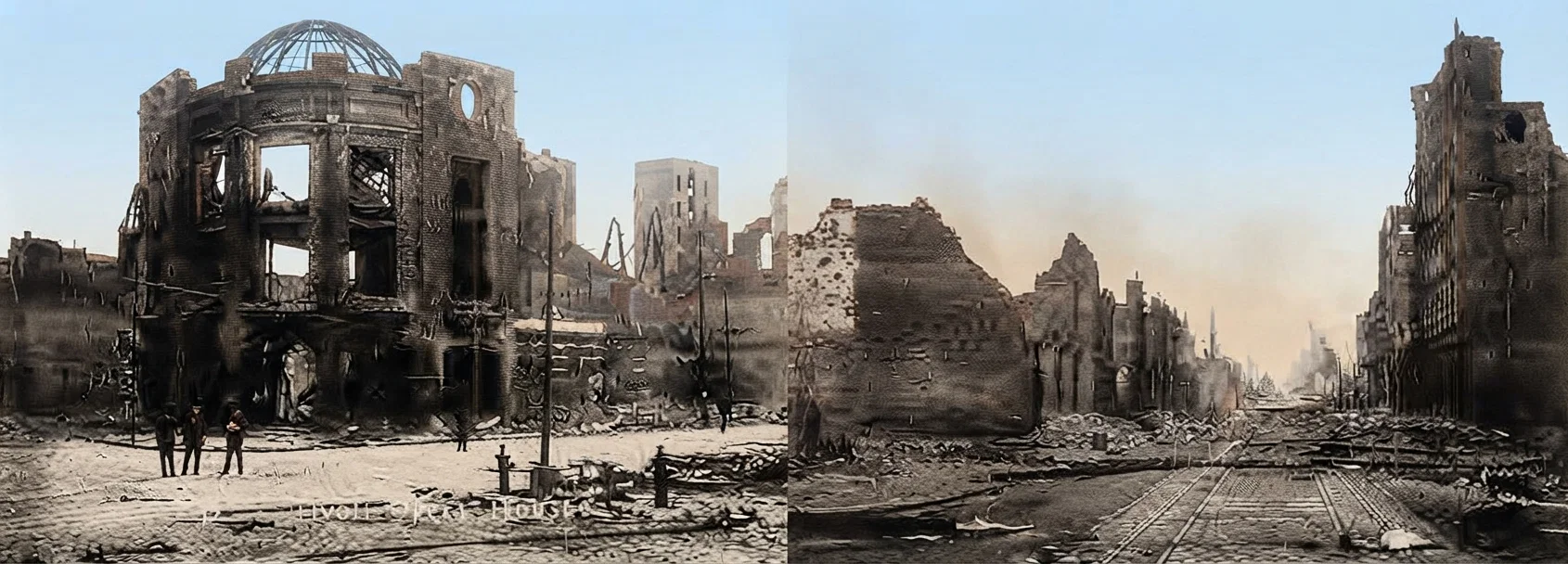
Theaters of San Francisco: The Tivoli. The Orpheum, The Alcazar, Fisher's.
Men have made desperate efforts to explain what they thought to be intricate scriptures; but too often their efforts have only darkened that which they tried to make clear.
The priests and Pharisees thought that they were doing great things as teachers, by putting their own interpretation upon the Word of God; but Christ said of them, "Ye know not the Scriptures, neither the power of God." He charged them with the guilt of "teaching for doctrines the commandments of men." Tho they were the teachers of the oracles of God, tho they were supposed to understand His Word, they were not doers of the Word. Satan had blinded their eyes, that they should not see its true import.
This is the work of many in our day. Many churches are guilty of this sin. There is danger, great danger, that the supposed wise men of to-day will repeat the experience of the Jewish teachers. They falsely interpret the divine oracles, and souls are brought into perplexity and shrouded in darkness because of their misconception of divine truth.
The Scriptures need not be read by the dim light of tradition or human speculation. As well might we try to give light to the sun with a torch, as to explain the Scriptures by human tradition or imagination. God's holy Word needs not the torch-light glimmer of earth to make its glories distinguishable. It is light itself—the glory of God revealed; and beside it every other light is dim.
But there must be earnest study and close investigation. Sharp, clear perceptions of truth will never be the reward of indolence.
No earthly blessing can be obtained without earnest, patient, persevering effort. If men attain success in business, they must have a will to do, and a faith to look for results. And we can not expect to gain spiritual knowledge without earnest toil. Those who desire to find the treasures of truth must dig for them as the miner digs for the treasure hidden in the earth. No half-hearted, indifferent work will avail. It is essential for old and young, not only to read God's Word, but study it with a whole-hearted earnestness, praying and searching for truth as for hidden treasure. Those who do this will be rewarded; for Christ will quicken the understanding.
Our salvation depends on a knowledge of the truth contained in the Scriptures. It is God's will that we should possess this. Search, O, search the precious Bible with hungry hearts. Explore God's Word as the miner explores the earth to find veins of gold. Never give up the search until you have ascertained your relation to God and His will in regard to you. Christ declares, "Whatsoever ye shall ask in My name, that will I do, that the Father may be glorified in the Son. If ye shall ask anything in My name, I will do it."
HOW SAN FRANCISCO SUFFERED.
An Attempt to Illustrate It.
WILLIAM RANDOLPH HEARST after looking over the ruins of the city he knew so well, attempts to tell the people of the East what it means to San Francisco by the following illustrations:
I know that while I myself was very familiar with the locality and the conditions here I had failed to appreciate exactly the situation until I had visited the scene.
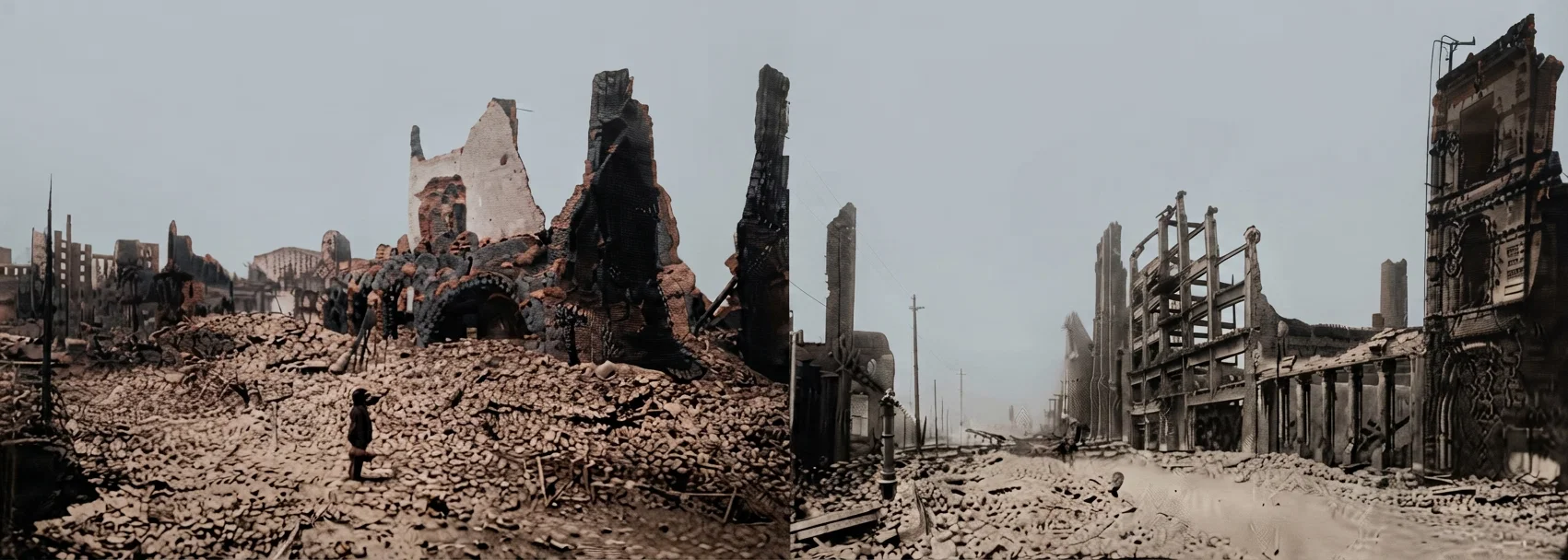
When I landed from the ferry the awfulness of the disaster almost overpowered me. There was nothing to be seen but a desert of tumbled brick, twisted7iron and blackened timbers. Out Market Street, as far as the eye could reach, there was nothing but ruins. North to the Bay, west to the Mission, nothing but ruins. The wholesale district was destroyed, the retail district was destroyed, the manufacturing district, the financial district, the water front section—all destroyed. The hills rolled to the seas as bare as when the pioneers landed in the days of '49. But the hills that welcomed them were shining in green and covered with grass and shrubs and trees. While now they are a blackened waste. Instead of grass there are acres of ashes; instead of shrubs there are but twisted iron and steel; and instead of tall trees there rise burnt brick chimneys and ragged fragments of walls towering above the desolation that surrounds them.
I will not attempt any detailed description of this scene. I know that no description gave me the slightest understanding of what had occurred, and I do not believe that any words of mine could convey to a reader the slightest comprehension of this interminable area of wreck and ruin. Indeed, to get any sort of accurate impression one must free the mind of the idea that there has merely been a fire, no matter how great, in San Francisco, and must realize that there has been a fire of San Francisco; that the whole city has gone up in one mighty blaze that roared and raged and burned for three days and nights and left nothing standing but a fringe of houses along the southern and western limits.
If a bonfire of barrels and boards and packing boxes had burned until it had burned itself out there might remain some few sticks on the edges that had not been wholly destroyed. So it is with San Francisco. The city burned unchecked for days without water, without effective hindrance of any kind. When the fire stopped it had practically burned itself out. It had got to where the houses were so thinly scattered that there was difficulty in finding fuel for the flames.
California Theater. The Grand Opera House.
Think of this fact:
The area of the Boston fire, added to the area of the Chicago fire, added to the area of the Baltimore fire would not make altogether one-half the area of the San Francisco fire. New York is so much larger than San Francisco that a mere comparison of square miles does not give an adequate idea of the situation, but considering the matter proportionately it is as if the whole of Manhattan had been destroyed, save a mere handful of buildings at the Battery, and as if there remained only the Bronx and Brooklyn.
Brooklyn corresponds in a way to Oakland, altho Oakland is several miles from San Francisco and across the Bay. The Bronx corresponds to the section of more or less scattered residences remaining on the western edge of the city.
Think of the water front districts of New York swept clean by fire. Think of Wall Street in ruins. Think of the East side and the West side destroyed. Think of all Broadway burned to the ground. Think of the wholesale districts destroyed. Think of all the big stores from Wanamaker to Macy's in heaps of ashes. Think of the beautiful residences on Fifth Avenue burned or blown up by dynamite. Think of the very trees in the parks bare and black and shriveled by the flames. Think of the streets littered with brick and iron and charred timbers two or even four and six feet deep, so that you can hardly walk on them or climb over them.
Think of men, women, and children huddled in Central Park and on Riverside Drive, living in tents or under shelter of sheets stretched upon posts. Think of men turning over the ruins of their homes and women weeping over them. Think of soldiers everywhere. Think of temporary tracks of the New York Central laid from Forty-second Street to the Battery, through the heart of the town, and wrecking trains carrying off the débris. Think of what all this would mean to you, and you will have some idea of the great disaster in San Francisco.
Mr. Hearst and others minimize the earthquake and its effects, and lay San Francisco's loss to the fire. But the fire was the indirect result of the earthquake, started in a half-dozen places at once. Many of the shattered buildings would have remained standing after the earthquake, but they were ruined, and the fire swept from them their frail supports, and they fell. The magnificent City Hall was not ruined by fire, but by earthquake. And that is true of hundreds of other buildings.
The earthquake had its freaks, all sorts and kinds. Here it demolished a building which looked as if it would stand forever. There it passed under without harm one so frail that it scarcely seemed able to stand alone. Some part of a house was badly shaken while the rest was not injured in the least. Some tall, thin chimney stacks stood, while others thick and strong crumbled.
But ask Santa Rosans which damaged them more, the fire or the earthquake, and the answer is ready, The earthquake. It was not the fire which wrecked the City Hall or the Grand Opera House, the fire swept them afterward. It was not the fire which wrecked St. Dominic's mighty pile on Steiner Street, and moved great three-story houses four and five feet off their base. It was not fire which for four blocks, from Valencia Street to Folsom Street, dropped the street bed from one to ten feet for rods, and slid the whole section down toward the Bay three or four feet. If the Call, the Crocker, the Flood, and other buildings had stood upon this ground, how would they have fared? Let men know the facts. It does not help matters to minimize the facts; they are too sad to magnify.
A LESSON FROM THE RECENT EARTHQUAKE.
By K. Blossom Wilcox
How uncertain is life! We do not know at what moment we may be called to lay aside our work, lay down our burdens, and respond, whether we will or not, to the summons of that dread enemy—Death. Well did an apostle write: "What is your life? It is even a vapor, that appeareth for a little time, and then vanisheth away."
But is death an enemy?—"The last enemy to be destroyed is death." But, praise God, it is to be destroyed. "Yea, all that a man hath will he give for his life." But what will money or riches avail? It will not buy back the sweetest and most precious thing in this world—life. During the recent great catastrophe in San Francisco, it is said that one hundred dollar bills were torn in pieces and cast to the winds. Ah, money, no amount of money, could stop, or even check, the mighty convulsions of nature.
But we know that this sad calamity is simply a foretaste of what will come upon the world when the restraining hand of God is withdrawn, and His judgments fall upon a wicked and rebellious people, when the dregs of the cup of God's wrath, unmixed with mercy, shall be poured out upon the earth.
Many thought at this time that the end of the world had come, and faces blanched with terror, forms trembling with fear, without hope, without refuge to which they could flee, were seen on every side.
But how different was, and will be, the experience of those who are truly God's people at such times as these. They have a Refuge to which they can flee, a Fortress in which they can hide.
O, why do we not trust Him more? Does it take an earthquake like this to teach us the lesson of perfect trust, of implicit confidence in our heavenly Father. If so, let us learn the lesson well, and thank God for the warning before it is forever too late. Let us make everything right with God and with our fellow men, and walk so carefully and prayerfully before Him that we may ever rest in the fullest confidence on the precious promises with which His blessed Word abounds.
"He that dwelleth in the secret place of the Most High shall abide under the shadow of the Almighty. I will say of the Lord, He is my Refuge and my Fortress, my God; in Him will I trust." "Because thou hast made the Lord,8which is my Refuge, even the Most High, thy habitation; there shall no evil befall thee, neither shall any plague come nigh thy dwelling." "I will never suffer the righteous to be moved." And there are many more. "And when the last mighty convulsions shall shake the earth, and the sea, and the sky, and the fragments of a thousand barks, richly freighted with intellect and learning, are scattered on the shoals of error and delusion, their vessel [the righteous, those who rest upon God's promises] shall in safety outride the storm, and enter in triumph the haven of eternal rest."
K. BLOSSOM WILCOX.
The ROYAL LAW
By F. C. Gilbert
BY F. C. GILBERT.
(A Hebrew Christian.)
III. WHY THE LAW WAS GIVEN ON SINAI.
IF the law of God was known by Adam and his descendants prior to the time of the giving of it upon Mount Sinai, why then was it necessary for Jehovah to make so grand and glorious a demonstration amid fire, and smoke, and thunder, bringing ten thousand times ten thousands of His angels, to proclaim His law from the summit of Horeb? Deut. 33:2; Judges 5:5; Ex. 19:18. Because the Ten Commandments were proclaimed amid such awful grandeur to the Israelites, is the reason often assigned why these ten precepts are called Jewish. But there is a reason why Jehovah declared again His law to Israel.
The Israelites Lost the Knowledge of God's Law.
Abraham was a commandment-keeper. He obeyed the voice of the Lord and observed all His commandments. Gen. 26:5. Because Abraham was such a faithful and devoted man of God, the Lord made promise to him that through him and his seed the earth would be blessed. Gen. 12:1-3; 18:18. This promise had a double application, including the literal seed as well as the spiritual seed. Gal. 3:16. As a result of the Israelites mingling with the Egyptians, or rather as a result of their stay in the bondage of Egyptian slavery, they largely lost the knowledge of the true God. Jacob and his sons were dead. The next generation had also passed away; and now that the fourth generation had come, the laws of Jehovah and His requirements had been almost entirely lost. The time had come, however, when God was to deliver His people according to the promise made to Abraham. Gen. 15:13-16. He raised up Moses and Aaron to be the outward leaders of their deliverance. These men went to Egypt to declare the news of what God was about to do. Ex. 4:27-31. The tidings were received with great joy among the people, and they bowed their heads in worship to God. But Israel was not yet prepared to leave Egypt. He must have some conception of the wonder-working power of the God of his fathers. Therefore Moses introduced among them the memorial of God's creative power, namely, the Sabbath, which they had lost while serving as slaves to Pharaoh. Pharaoh was informed of what was taking place among the Hebrews, and immediately he remonstrates with Moses and Aaron, thus:
"Wherefore do ye, Moses and Aaron, let [hinder, Hebrew] the people from their works? . . . And Pharaoh said, Behold, the people of the land now are many, and ye make them rest from their burdens." Ex. 5:4, 5. The word "rest" in this verse is in the Hebrew,
V'hish-ba-tim, literally, ye make them sabbatize, ye make them keep the Sabbath.
On the one hand God was seeking to impress upon the minds of the people the memorial of His creative and redemptive power, and preparing them to be rid of their idolatry; on the other hand the cruel and hard Pharaoh refused to allow them to obey God and to keep His law. Consequently the time had fully come when God would bring Israel forth from their slavery where they should know and understand God's law, and then be able to obey it. Ps. 105:37, 38, 45.
Israel's Murmuring—God's Mercy.
Tho Israel began the observance of the Lord's Sabbath, they were not familiar with the true knowledge of God and of His law. This is evident from their experience which followed for a time after their deliverance from Egypt. God brought them out with great signs and mighty wonders. Egypt literally thrust them forth, for fear that if they did not depart all the Egyptians would be dead. No sooner had Israel crossed the Red Sea on dry land than they began to murmur against Moses for not taking care of them. Moses cried unto the Lord, and Jehovah immediately satisfied their needs. After this was done, then came this message to the people: "If thou wilt diligently harken to the voice of the Lord thy God, and wilt do that which is right in His sight, and wilt give ear to His commandments, and keep all His statutes, I will put none of these diseases upon thee, which I have brought upon the Egyptians; for I am the Lord that healeth thee." Ex. 15:23-26.
A few weeks more had elapsed when the Israelites again broke forth in murmuring against Moses, Aaron, and this time, against God. "Would to God," they cried, "we had died by the hand of the Lord in the land of Egypt." Ex. 16:3. Immediately, without the slightest provocation on the part of God, the Lord said, "I will rain bread from heaven for you." Verse 4. God furnished them with a table in the wilderness, and had made no charges against them for the murmuring, even tho He had done great things for them. All the time they were sinning against God who had delivered them; but they had lost the knowledge of sin, and their centuries of oppression had hardened them so that they had lost the sense of sinning against God.
After the passing of a few days more, again there goes up a cry from the camp of Israel, "Wherefore is this that thou hast brought us up out of Egypt, to kill us and our children and our cattle with thirst? And Moses cried unto the Lord, saying, What shall I do unto this people? they be almost ready to stone me." Ex. 17:3, 4. Moses receives instruction from the Lord to get the people water; and in this experience God gives them the first object-lesson of His power to save them from
their murmurings, viz., the smiting of the rock and the bringing forth of the water. But they could not understand this yet; for they had not learned what sin meant. They must first know the sinfulness of sin; then they could appreciate the meaning of God's way out of it.
Shortly after this, after they had murmured and complained and had accused God, the Lord commands Moses to come up unto Him in the mount, and to prepare the people for the awful majesty and presence of God. He Himself is about to descend among the people and proclaim to them His statutes, His voice, His law. When they were to hear this, they would then know God's requirements, they9
would learn what God demanded of them. God then spoke His law; the people agreed to heed what God said.
Israel's Great Sin and Remedy.
After this was finished Moses was called of God to again ascend the mount, this time to receive in writing what God had already spoken to the people. During Moses' absence the people sinned; they made them a golden calf. "And the Lord said unto Moses, Go, get thee down; for thy people, which thou broughtest out of the land of Egypt, have corrupted themselves; they have turned aside quickly out of the way which I commanded them; they have made them a molten calf, and have worshiped it, and have sacrificed thereunto. . . . Now therefore let Me alone, that My wrath may wax hot against them, and that I may consume them." Ex. 32:7-10. Now the conditions were different. God had proclaimed to them His law. They had violated it, for they had sinned. "Sin is the transgression of the law." 1 John 3:4. But "the wages of sin is death." Rom. 6:23; Eze. 18:4. Therefore the God of righteousness and justice demanded they should forfeit their lives as a penalty for their sin. If Moses had not stood in the breach and plead for them the great mercy and kindness of God, they undoubtedly would have died. Moses, however, knew God would make provision; for he was aware that God was merciful. And thus the way now was open for God to instruct them in the way of salvation, His own means whereby they might not only know they were sinners, but God's remedy for sin, salvation through the shed blood as illustrated in the services and ministrations of the sanctuary. This was why the law was given on Sinai. The people had lost the knowledge of God and of sin, and they did not know the way of salvation.
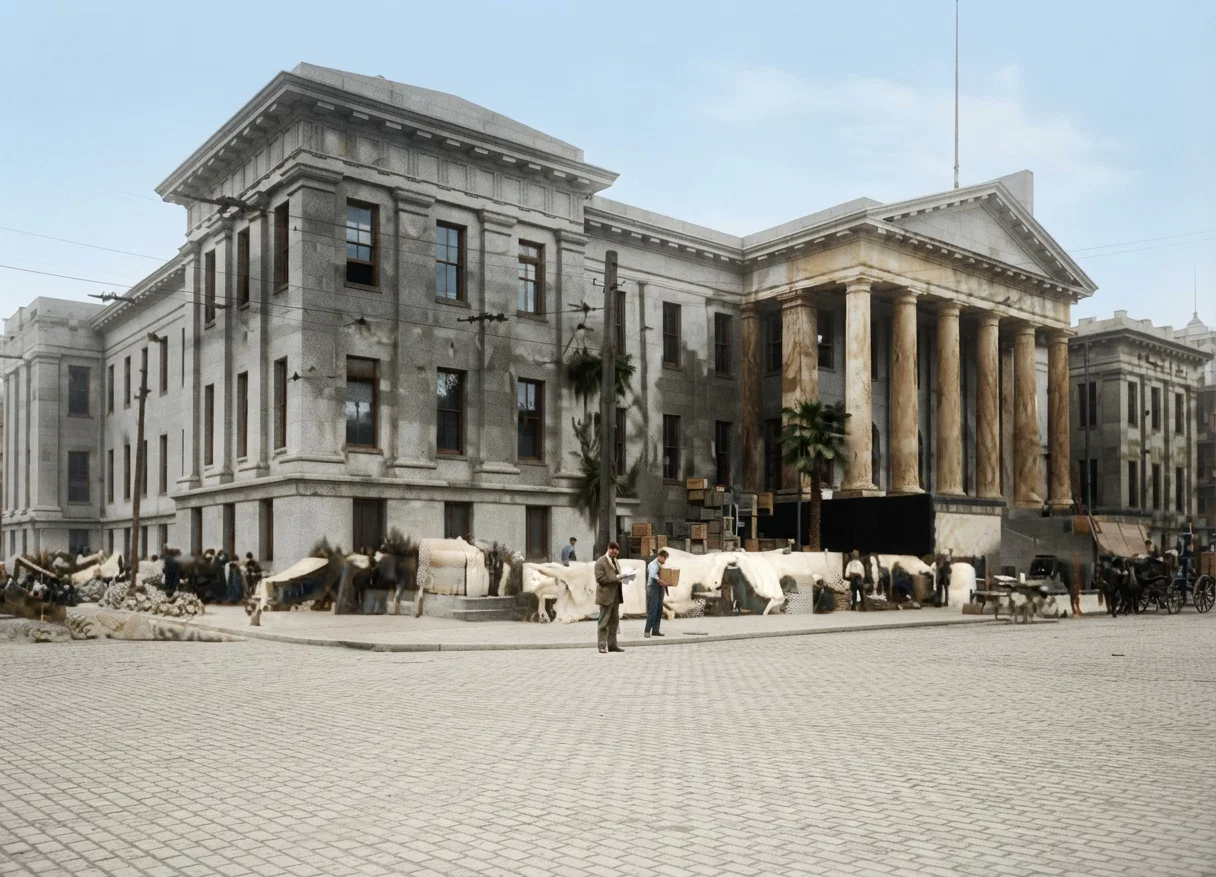
United States Mint, San Francisco—An Oasis in the District of the Ruined City.
After the Lord had declared unto them His law, then the way of salvation was made plain to them, and to their posterity ever afterward. But had they not lost the knowledge of God, of sin, of His law while in Egypt, there would have been no need for this grand display on Sinai. All these precepts had been known before, as was suggested in the previous article. When Moses expostulated with the people at their gathering manna on the seventh day he
told them that the Lord had already given them the Sabbath. They knew of it. Ex. 16:27-29. But how did they know it?—Moses told them when he first went to them in Egypt. See Ex. 5:5. But how did Moses learn of it?—He knew it; for God originally gave it at creation. Gen. 2:23.
How could the children of Jacob have sinned against their father when they brought that terrible grief upon him by selling Joseph, if there were no knowledge of the commandment which says, "Honor thy father and thy mother"? It is evident they considered it a sin by the way they confessed it to Joseph in later life. See Gen. 50:16-20. It is plain,
therefore, that the fifth commandment was known before Sinai.
The Last Five Commandments.
And it is equally true of the last five commandments of the Decalogue. Cain killed his brother and was a murderer. But where there is no law, there is no transgression. Rom. 4:15. Joseph, that pure and noble young man, was terribly tempted by his mistress to violate the seventh commandment. But hear his words: "How then can I do this great wickedness, and sin against God." Gen. 39:9. If, however, there were no law against adultery, how could Joseph have known this to be sin; for sin is not imputed where there is no law. Rom. 5:13. Joseph had been taught the law by his father, Jacob, and when the hour of temptation came he remained true to God's truth. Jacob violated the eighth commandment when he stole the birthright. His children violated the ninth commandment when they bore false witness against their brother to their father after they sold Joseph. Abimelech violated the tenth commandment when he coveted Abraham's wife. Gen. 20:1-7; 12:14-20.
Thus we see that every one of the Ten Commandments had been violated before Sinai. They then must have been known; therefore the people must have been taught them. Satan sought to blind the minds of men to the force of the obligations of this law, until its knowledge was almost entirely lost. Jehovah rehearsed it upon the summit of Sinai to Israel that the world once more should hear the
immutability and greatness of the law of Jehovah. It was Israel's duty to teach it to the world.
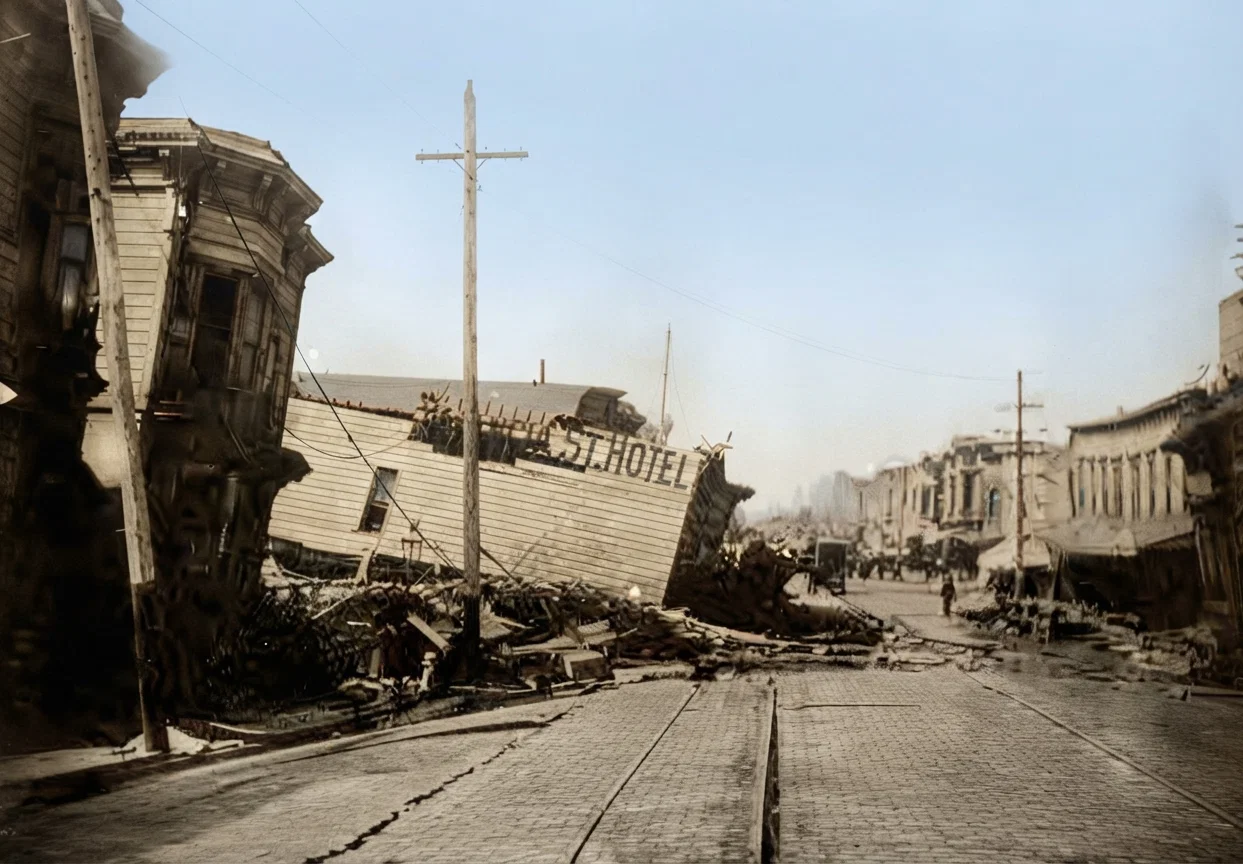
Valencia Street Hotel, out of which 30 bodies were taken. The third story rests upon the ground.
THE CHIMES OF DAWN.
By C. M. Snow
WHILE the larks are singing sweet, in the early morn,
Waken, hasten, classmates, and yourselves adorn.
Out beneath the sky so fair,
Fling aside your load of care,
Sing the song of morntime, sing it with a will.
Come away, haste away
Into the verdant fields to-day,
List the song that nature sings; she can not be still,
Singing, ever singing, telling her tale so true,
In her way, day by day, teaching me and you.
Open is her living book,
Grassy field and running brook,
Flower and fruit, leaf and tree,
Sturdy kine and humming bee,
Singing breeze and sparkling dew—
Telling me and telling you
Of the love and tender care
God Himself is giving there.
While the sparrows twitter sweet, at the break of day,
Toss aside the veil of sleep, hasten thou away;
Leave the book of printed page—
Better it than you should age—
Out into the early morn, breathe the fragrant air.
God has blessings there for you;
Seek ye them—He bids you to—
You must seek them each for each in their dewy lair.
Ringing, ever ringing, jubilant bells of dawn
Sweet in tune, mellow rune, tinkling down the lawn.
Up in the trees that choir is,
In the bell of the blooms I'm hearing this;
Under the leaves they chirp in time,
Cadence sweet and rhythmal rhyme,
Telling the tale so new, so true—
Telling to all, to me, to you—
Telling of the love and care
God is manifesting there.
While the morn is fresh and young, like a blooming flower,
Hasten out to drink the sweets of this early hour.
Scattered fragments you will see,
On the grass, on flower and tree,
Of some radiant rainbow wreath fallen from the sky,
Hanging there on [a] blade,
Rubies bright and diamonds made,
By the glinting shafts of light swiftly flashing by.
Shimmering, dancing, sparkling orbs make a jeweled wreath
'Decking' bud and bursting bloom, and the grass beneath.
These the gems of early morn—
Richer ones were never worn.
What a wealth of splendor lies
Underneath the bending skies!
Shout and tell from dew to dew
All His love has wrought for you.
C. M. SNOW.
COUNTED WORTHY.
By Ella Cornish
THERE'S no merit I can boast,
Sinful, weak, undone, and lost,
Saved by grace abounding, free,
In the Gift of Calvary.
Christ is now my Teacher, Friend;
He will keep me to the end.
Prison bars may shut me in,
I have liberty in Him;
Sland'rous tongues may evil speak,
But His favor I still seek;
Daily comfort I receive,
For each promise I believe.
When my journey here is o'er,
I shall enter heaven's door;
Then the cross of earth lay down,
Then receive a heavenly crown,
Bear my Lord's and my new name,
Never more to suffer shame.
ELLA CORNISH.
TACT WITH CHILDREN.
THE mother was sewing busily, and Josie, sitting on the carpet beside her, and provided with blunt, round-pointed scissors and some magazines, was just as busily cutting out pictures.
"It will litter the carpet." So said Aunt Martha, who had come for a cosy chat.
Mama knew this; but she knew that a few minutes' work would make it all right again, and Josie was happy.
All went well until the little boy found that he had cut off the leg of a horse he considered a marvel of beauty. It was a real disappointment and grief to the little one.11"Mama see!" and, half crying, he held it up.
"Play he's holding up one foot," the mother said, quickly.
"Do real horses, mama?" "O yes, sometimes."
"I will;" and sunshine chased away the cloud that in another minute would have rained down.
It was a little thing, the mother's answer; but the quick sympathy, the ready tact, made all right. The boy's heart was comforted, and he went right on with no jar on nerves and temper, and auntie's call lost none of its pleasantness.
"I am tired of cutting pictures mama," said Josie after a while.
"Well, get your horse and wagon, and play those bits of paper are coal, and you are going to bring me a load. Draw them over to that corner and put them into the waste paper basket; play that's the coal house."
Pleased and proud, the little teamster drew load after load till the paper was all picked up, without his ever thinking that he was doing anything but play.
"Well, I declare," said Aunt Martha. "Old as I am, I've learned one thing to-day, and I wish Emily would come in and take lessons as I do!"—Selected.
MOTHER LOVE.
By Mary Ware
Tho other friends may join
To soothe life's bitter cares,
None but a mother's love
Can stay the falling tears.
No voice like hers can thrill
With music's sweetest tone,
No love like hers forgive
And bless the erring one.
From hopeless, tottering youth
To sorrowful old age,
The memory of mother love
Will gild life's golden page.
The kindness that seemed
To us so very small
Will gather meaning when
She is beyond recall.
The tears we caused to flow
Will rend our hearts with pain;
Each unkind word of ours
Will seem to live again.
God pity those who learn
Too late, or fail to prize
A mother's sympathetic love,
The truest 'neath the skies.
—Mary Ware.