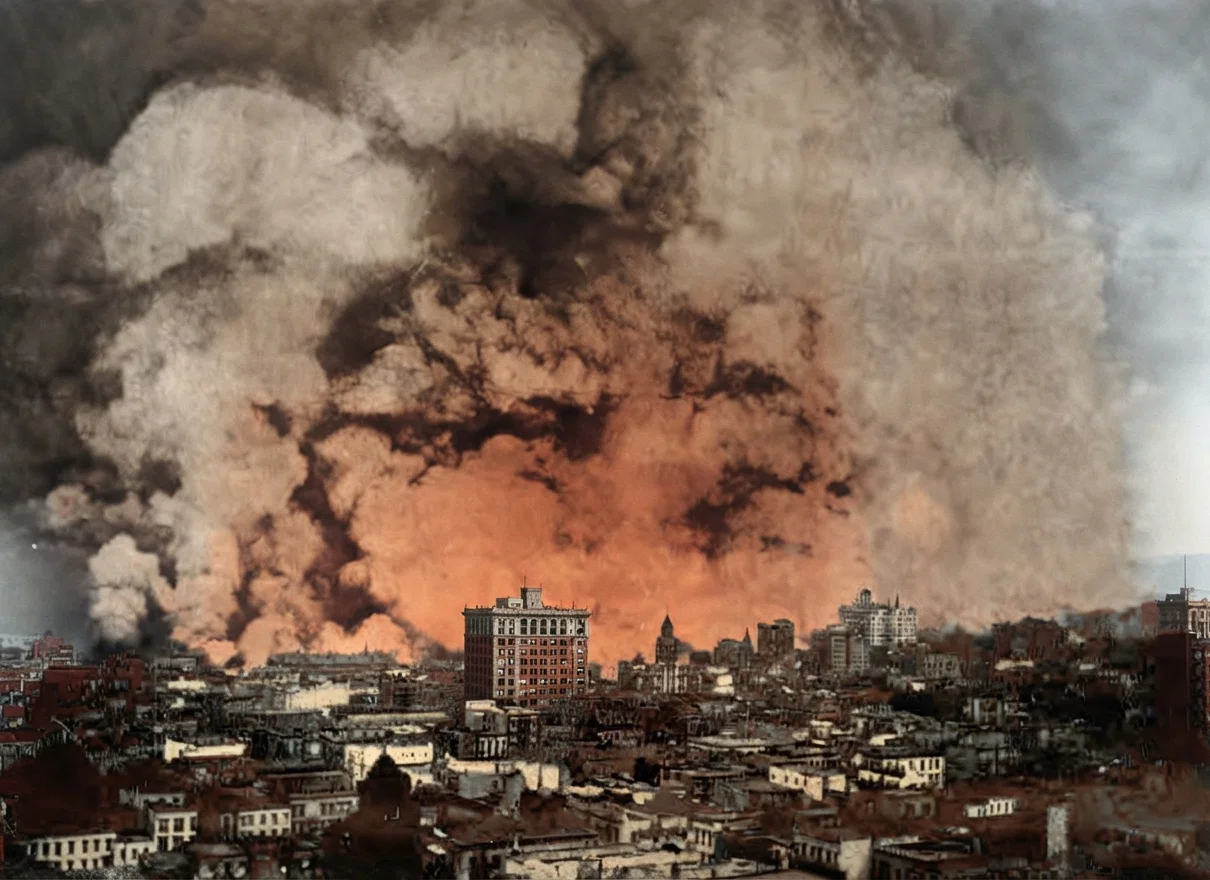
A Striking Picture of the Great San Francisco Fire,
Page 1
Signs of the Times
Jun 6, 1906
Pacific Press Publishing Company · Mountain View, Cal. · Jun 6, 1906
A Striking Picture of the Great San Francisco Fire,
Taken April 18, 1906.
A GENERAL view of San Francisco's devastating holocaust, taken from Nob Hill, looking toward the Ferries. The sweep of the picture is from near the foot of Telegraph Hill to Howard and Folsom Streets, including several square miles. The square eight-story building in the center is the Cowell Building. The building with the tall tower at the right is the Hall of Justice. Both of these were badly damaged by the earthquake. To the right of the Hall of Justice stand the New York Life Insurance, the Kohl (Haywards), Merchant's Exchange, and Mills Buildings. All the buildings in the foreground were subsequently destroyed by the conflagration.
“And after the earthquake a fire.” 1 Kings 19:12.
Our Publications
By Editor
All book lovers should watch this space each week for the interesting items it contains.
Ministry of Healing
By Mrs. E. G. White. All sickness and pain, all suffering and sorrow, are the results of law transgressed. The wonderful human machinery has been tampered with, and its delicate mechanism has been made to run counter to the law of its life and persistency; disease and death are the result.
What is the remedy?—First of all, knowledge. What are the laws of our being, both spiritual and physical? In this book, the author, a woman of large experience in the practical affairs of life, has brought within the reach of every intelligent father and mother, every man and woman, lay and professional, a vast fund of information on life and its laws, on health and its requisites, on disease and its remedies.
It presents a better way, which, tho in the shadows of a sick world, is flecked with the sunshine of God's love and ever-healing hope. Through the example of Christ, the Great Physician, it reveals to us a simpler, sweeter life, full of joy and gladness, with more room for helpful service.
The book is written in clear, simple, beautiful language, instructive to the learner, hopeful to the despondent, cheering to the sick, and restful to the weary. All the profits of both author and publisher are dedicated to the relief of sick and suffering humanity, hence the book is sold at a net price, with postage additional.
A subject of prophecy and a sign of the times. This work treats "Spiritualism" from the standpoint of the Scriptures, which have pointed out its character, and warned against its presence and teachings. New revised edition. Four full-page half-tone illustrations.
The Evolution of a Recluse. By Mary Henry Rossiter. (Life of Mrs. S. M. I. Henry.) The personal history of a life made beautiful through motherhood. The story of a woman who was transformed by her love for her children from a timid, shrinking girl to a speaker and evangelist, known and loved by thousands of those who have felt the bondage of sin and sorrow. 353 pages.
By Rev. Henry Rice. A most interesting description of the social and religious characteristics of the Hindus. The writer of this book spent eighteen years in India. The book is fully illustrated with cuts that are made from native sketches. 160 pages.
In two parts. By M. E. Cady. This is a drawing book designed to be used in connection with Bible Nature Studies. In the hands of the children, in grades one to five, it will greatly aid the teachers in carrying on nature study work.
I have read the book entitled "The Conflict Between Capital and Labor" by Elder E. T. Russel. This book presents a compilation of striking and startling facts, gleaned from a wide range of reliable sources. It is an up-to-date work dealing with one of the gravest problems confronting society at the present time. It should have a wide circulation.
A. T. Robinson, President Nebraska Conference.
The above-mentioned book of over one hundred and sixty pages, bound in substantial board covers, will be mailed post-paid upon receipt of 50 cents. Address Pacific Press Pub. Co. Mountain View, Cal., or 1109 East 12th Street, Kansas City, Mo.
THE ISLAND WORLD
By Editor
Of the Pacific Ocean. An intensely interesting volume of over 300 pages, with many illustrations, some of which are colored plates. It also contains a large double-page "map of the Pacific Ocean, showing currents and volcanic fire-belt." This handsome cloth-bound book is well worth $1.50; but while the stock lasts we will send it post-paid for only 95 cents. Order, at once. Address Pacific Press, Mountain View Cal.
1. One new yearly subscription and one renewal, or two new yearly subscriptions, sent at one time, $2.50.
2. Two new yearly subscriptions and one renewal, or three new yearly subscriptions, sent at one time, $3.25.
3. Three new yearly subscriptions and one renewal, or four new yearly subscriptions, sent at one time, $4.00.
Sample copies sent on application.
TO OUR PATRONS.
By Editor
Please be careful to write all names of persons and places plainly.
Send money by Post-office Money Order, Express Order, or Bank Draft on New York, Chicago, or San Francisco.
Orders and Drafts should be made payable to the Pacific Press Publishing Co.
Paper money or silver should be sent in a registered letter.
Registered mail is safe. Unregistered mail is at the risk of the sender.
The address label on your paper will indicate the time to which your subscription is paid. In case of non-receipt of papers, or any other irregularity, please notify us immediately.
When subscriptions expire, no more papers are sent to the party except by special arrangement.
You are requested to watch the date on your label, and renew early, and save the loss of papers. We can not always furnish missing numbers.
When requesting change of address, be sure to give both old and new addresses.
Important.—If you order SIGNS, Our Little Friend, books, etc., at the same time, use a separate sheet of paper for each. If this request is complied with, it will materially assist in the prompt and accurate despatch of the business.
When writing to the editor, be sure to use a separate sheet of paper.
THE WAY OF THE NATIONS.
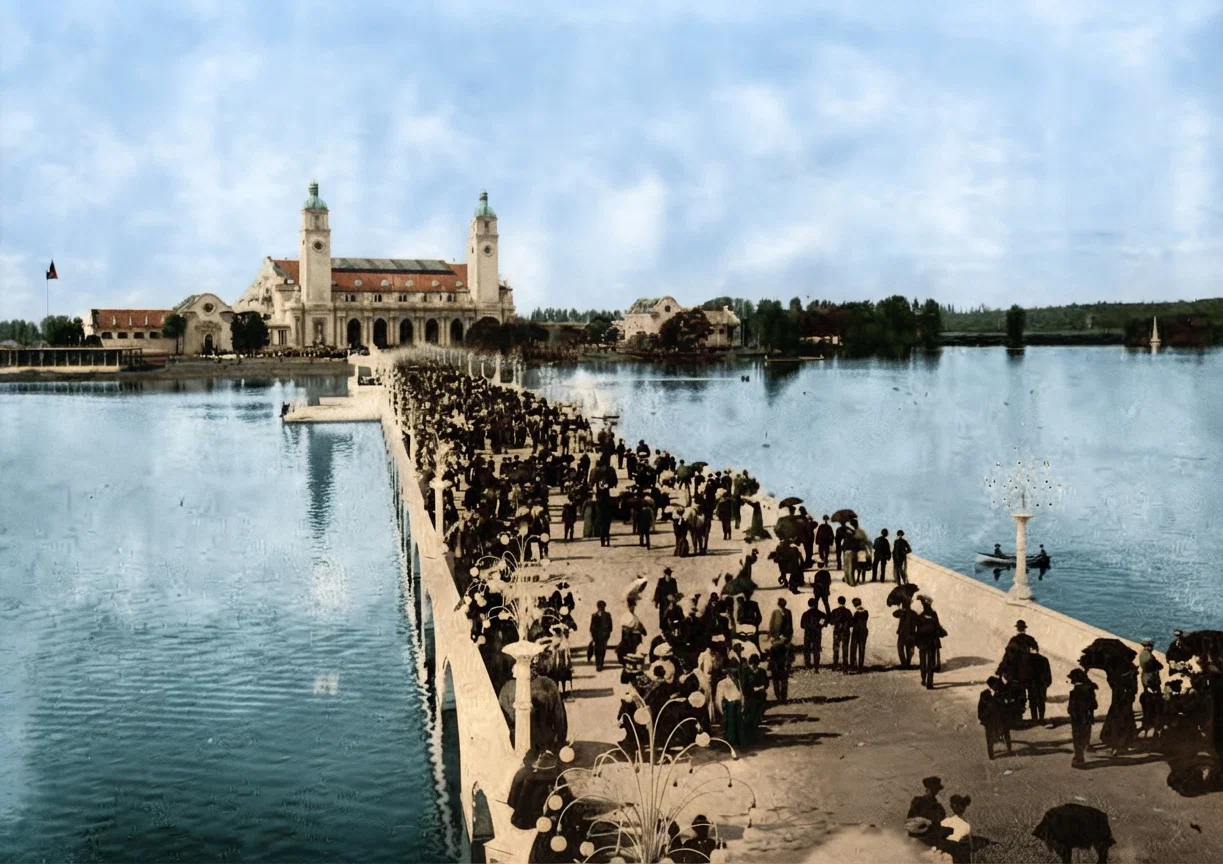
VERY pleasing, indeed, is our illustration on this page; and it will be readily recognized by all our readers who visited the Lewis and Clarke Exposition at Portland, in 1905. It is the great bridge, or broadway, which connected the two parts of the Exposition grounds. At the one end was the "Trail," or the "Midway," the place of folly and fun and fakirs, of iniquity, of wantonness, of vice. At the other end were the government buildings. On the broadway of the bridge were the people of the nations in singles, in couples, in trios, in groups, in crowds, mostly on pleasure bent. On either side, the bright waters rippled and danced in the sunlight or electric glare; overhead bent the blue dome in the day, or the star-bespangled sky at night.
WHAT a picture it is of this present world and the great life-way of the nations. Well is the world represented by the "Trail." Some were there engaged in serious businesses of buying and selling, of providing food and drink to the madding crowd. Some were there for knowledge, picking up a thought, an idea, here and there, which in time they might use for profit. But the greater number were there either to make pleasure or to get pleasure, from the harmless donkey rides to the wicked exhibitions of despoiled virtue, to which the passer-by was invited on every hand.
THE way of the nations is a broad way.
There is plenty of room, plenty of company, smooth and easy to the feet, and straight ahead, but it is comparatively short and soon over. So it is in this life. The broad way is an easy way, filled with a multitude of people whose minds are bent on the things of time, things which perish with the using. The Trail may be likened to the Vanity Fair of this world, the bridge to death, the government buildings to the great judgment of the government of God which lies beyond. All the nations of earth must pass over the bridge of death; for "it is appointed unto men once to die, and after this cometh judgment."
BUT it is not the death we have to fear. Its gloomy way lies before us all, bright tho a perverted theology has pictured it. It is the way on this side of death which counts. One is the broad way which our Lord tells us "leadeth to destruction, and many are they that enter in thereby." Matt. 7:13. That way is "the way of sinners," of "transgressors" (Ps. 1:1; Prov. 13:15), hence it is a hard way, ending in death. It is the way of a fool, which seems right in his own eyes, but the end is the way of death. Prov. 12:15; 14:12; 16:25. Sometimes it is the way of the harlot, which leads down to death and hell. Prov. 7:27. It is the way of "evil men," "the way of the wicked," perverted by the folly of man. Prov. 4:14; Ps. 146:9; Prov. 19:3. Those who follow that way will eat of its certain fruit, and perish in the corruption of the path they have chosen. Prov. 1:31.
THE other way is "the narrow way" "that4leadeth unto life, and few are they that find it." Matt. 7:14. It is the perfect way for character building. Ps. 18:30. It is the way of His "precepts" and "commandments." Ps. 119:27, 32. It is the way of peace and rest, of which the wicked know nothing, because it is the way of righteousness and life. Isa. 59:8; 32:17; Prov. 10:17; 12:28. It is the way of "His steps." "Righteousness shall go before Him, and shall make His footsteps a way to walk in." Ps. 85:13. It does not always lie beside the "still waters" or pass through the "green pastures." It climbs steep ways, over ragged rocks, down Hills of Difficulty into Valleys of Humiliation. It leads along by the enemy's land, and there are many smooth by-paths to allure us away. It passes through Gethsemanes of darkness and up Calvarys of crucifixion. But every foot of the way is marked by the oftentimes bloody footprints of Jesus our divine Lord, and always hallowed by the fragrance of His holy presence.
IN His infinite mercy God calls us from the broad way of folly, defeat, disaster, deceit, disappointment, despair, death, to the blessed way of the cross and the crown, to the way of righteousness and life. With infinite love He pleads: "Let the wicked forsake his way, and the unrighteous man his thoughts; and let him return unto Jehovah, and He will have mercy upon him; and to our God, for He will abundantly pardon. For My thoughts are not your thoughts, neither are your ways My ways, saith Jehovah of hosts." The way of the world may be broad and pleasing, and men accept it because they can see more or seemingly present worth in it. The end thereof is death and oblivion. The way of God is narrow, and the selfish heart sees so little in it that it rejects it. But "the true gain is the long gain;" the narrow way broadens out into the unfenced fields of God's Paradise, into the boundlessness of eternal life. Why not choose it now?
TOUCHING INCIDENTS OF THE GREAT CALAMITY.
THERE is nothing that brings the hidden things of character into the light of day like the X-ray of great calamity. Men generally exhibit themselves then at their true worth. While some show all the niggardliness, the sordidness, the miserliness of their shrivelled and seared souls, others are giving unlooked-for demonstrations of kindness, unselfishness, generosity, and the true nobility of character.
“A touch of grief makes all the world akin,” says the poet. It is a beautiful sentiment; but there are some so steeped in the bitter brew of selfishness that no amount of human suffering can soften the heart, or open the purse, or move to any act of kindness.
Utterly exhausted by the fearful experiences of earthquake and fire and the constant tramping to escape the sweep of the veering flames, a young, pale-faced woman lay upon the sidewalk in San Francisco. Beside her stood her husband urging and begging a hack-driver to take them to the ferry, a distance of perhaps two miles. The hack-driver was demanding fifty dollars for the service; the husband had but eleven dollars and was offering it all. Untouched by pity, the heartless extortioner drove off. After some little time an expressman, with a rickety load of furniture drove up, learned the circumstances, deposited his load on the sidewalk, helped to lift the exhausted woman into the wagon, and drove the couple to the ferry. He refused to take a nickel for his service. The one was out for blood money, the other had flowing through his veins the blood of true nobility. This world has too many of the one kind, far too few of the other.
A poor woman with little to protect her from the cold, was trying to cook something over a fitful little blaze between some bricks in the street. It was growing dusk and the San Francisco fog was stealing through the blackened streets. She was shivering with the cold. A cavalry man with a snub-nose sauntered by. He had on a warm cape lined with red flannel. He approached the woman, saw her need, threw his cape over her shoulders, and sauntered on. She shivered no more, but forgot to stir what she was cooking, while she watched the figure of the capeless young nobleman fading away in the dusk.
An old woman sat on her front porch, her black bonnet tied under her chin, watching the blaze marching toward her home, pushing the dynamiters and the firemen steadily before it. She was just waiting until the fire patrol should warn her off the block. “No,” said she, “I am not afraid. It is God’s will. If the fire comes, it comes. I am ready; but I am not5afraid.”
One writer says: “I saw women with diamonds on their fingers, and pearls about their throats, begging a big sergeant of the guard to allow them to go into those stores for just one can of green corn. I saw a woman wrapped in sealskins eating baked beans from a tin can, and eating them with her fingers, too. These were women of refinement, women with money; but they had to suffer with the poorest on those fateful days.” Well dressed men could be seen scrambling like children for handfuls of walnuts thrown out of a wrecked fruit store.
A well-known theatrical critic and his wife fled from their apartments with but little clothing. The man was barefoot. A man he did not know piloted him to a Japanese shoe-store. There he discovered that he had forgotten his purse. “You forgot your money,” said the kind-hearted stranger; “but this is no time to think about money. Help yourself to mine.” Three gold twenties and a five-dollar piece were on his palm, and with his thumb he was forcing a twenty toward the critic. The latter took the five dollar piece, paid the Jap for a pair of bath slippers, and handed the change to his new friend. “No, indeed; put it in your pocket, and I wish you’d take some more.” “You don’t know me,” said the critic. “You don’t know me,” replied the other, “and this is no time for exchanging cards.” After five minutes’ argument, the critic succeeded in getting his benefactor’s name and address.
In Portsmouth Square a Chinaman noticed that the critic had no stockings inside his new slippers. “A pair of socks will warm your feet,” said the Chinaman, “and I’ve got another pair for the lady. Come with me.” “I went,” said the critic, “got two pairs, and came back with a sneaking regret that I was ever guilty of stoning Chinamen. I offered him a dollar. He would not take it.” “If you helped me when I was barefoot,” said the Chinaman, “what would you say if I offered you money?”
As soon as the street railways began to run where street-car traffic was possible, they began turning their gross receipts over to the Relief Committee, and kept it up. Some members of the committee suggested that this should not continue indefinitely. The railway official declared, however, that “no request for a discontinuance of the arrangement would ever come from the United Railroads; that it remained for the general committee to decide just how long it wanted the company to turn over its receipts.”
The milk of human kindness has been flowing freely during the days of this twin calamity in the city by the Golden Gate. Human suffering and human sympathy have been tenting together among those ruined walls, have been wandering together up and down these flame-rasped streets, hand clasped in hand. Five hundred thousand people have learned to know the brotherhood of misery. The millionaire has stood in the same bread line with his char-woman and his coachman, and received the same rations. If out of this calamity there spring a kindlier feeling between man and man, the sacrifice will not be wholly in vain.
THE SPIRIT OF PROPHECY.
To BE a prophet it is not necessary for one to proclaim himself a prophet. It is not essential that one go about declaring, “I am a prophet.” False prophets usually herald themselves, and aim to draw disciples to themselves. Christ has forewarned His people that down to the end of probation there will be false prophets. This implies that there will be true prophets all the way through; for the false is always in imitation of the genuine. Satan always works by misrepresentation of the truth. The Spirit of prophecy is necessary “for the perfecting of the saints,” etc., until the end. Eph. 4:11-13.
John the Baptist was a man sent from God, but we have no record of his ever saying that he was a prophet. He could have made many people believe that he was the Prophet spoken of by Moses (Deut. 18:15; John 1:21-23), but he would not yield to the temptation. However, he did proclaim himself a messenger, and he had a decisive message: “I am the voice of one crying in the wilderness, Make straight the way of the Lord, as said the prophet Isaiah.”
Was John the Baptist a prophet?—Ask Him whose messenger he was. He testifies: “What went ye out for to see? A prophet? Yea, I say unto you, and much more than a prophet.” So one need not say, “I am a prophet,” need not ostentatiously pose as a prophet, in order to be recognized of the Lord. Nor does the loudest heralding of one’s claims give evidence of the gift of prophecy. “To the law and to the testimony; if they speak not according to this Word, it is because there is no light in them.”
WHAT IS IT THAT RETURNS TO GOD WHEN MAN DIES?
By G.
“Then shall the dust return unto the earth as it was; and the spirit shall return unto God who gave it.” Eccl. 12:7.
THIS text is frequently quoted to prove that man is naturally possessed of immortality. But it can not be so construed without directly contradicting other texts, even in the same book, the meaning of which is too obvious to be misunderstood. For instance, in chapter 9: 5, 6, we read: “The living know that they shall die; but the dead know not anything, neither have they any more a reward; for the memory of them is forgotten. Also their love, and their hatred, and their envy, is now perished; neither have they any more a portion forever in anything that is done under the sun.”
It is no argument to insist that it is only the love and hatred and envy and memory of the body that are perished; for these attributes are functions of the conscious man solely; the body without the spirit never could exercise these. And these attributes having perished is proof positive that the spirit can not exercise them when separated from the body. In order that a human being may exercise love, hatred, envy, or memory, there must be a union of body and spirit. This fact is emphasized by the psalmist: “Put not your trust in princes, nor in the son of man, in whom there is no help. His breath goeth forth, he returneth to his earth; in that very day his thoughts perish.”
Then the question naturally arises, What is the spirit that returns to God at death? Or what is it that God gave to man that can return at death? The sacred Record says that “the Lord God formed man of the dust of the ground, and breathed into his nostrils the breath of life; and man became a living soul.” It is not said that a living soul was put into the man, but that he “became a living soul,” by the “breath of life.” Previous to this in-breathing he was a lifeless soul, or inanimate creature. This breath of life, acting upon the organs of the body, imparted the power of motion—of voluntary action—and of thought. Hence, there followed love, hatred, envy, memory, etc. All these functions were made possible by the union of life with the body.
When God breathed into man’s nostrils the breath of life, He did not impart that which was of itself a conscious entity, but that which acted upon the man—the body—in such a way as to make him a conscious entity. Therefore the withdrawal of the breath of life from the body means the cessation of the functions operated by a union of the two. According to the Word, the only thing given to man at his creation by the Lord was this breath of life; hence this is all that could return to God at the death of the man. The life principle belongs to God, to give or to withdraw at His pleasure.
It is not claimed that the word “spirit” always means breath of life. It has a variety of meanings, which must be gathered from the connection, without doing violence to other scriptures. The original Hebrew word is translated in sixteen different ways, among which are breath, spirit, wind, mind, smell, blast, anger, courage, air, etc. But in no case can it be construed to mean an immortal part of man without contradicting or making nonsense of many plain texts of Scripture. G.
The Old Book Stands
Yet, reader, the Old Book stands. "Because the foolishness of God is wiser than men; and the weakness of God is stronger than men." Read 1 Corinthians 1, and rejoice.
Please explain Matt. 22:30. Will people live in families in heaven or have husbands and wives? See Isa. 34:15, last clause.
Jesus says, "They neither marry nor are given in marriage." It seems to us that settles it. The "mate" referred to in Isa. 34:15 pertains to the wild beasts and birds which inhabit the desolated land. Verses 11-13. There will be tribes and families in the new earth, but on just what plan, we do not know; but we do know that it will be all right in every way, the very best for God's children.
Please say how you understand 1 Cor. 15:35-38. What is the seed? Where does it stay till it receives the body?
The seed is the seed which men sow, mentioned by Paul to illustrate the great fact of the resurrection. The one thought that illustration is designed to enforce is this, that the righteous will be given the body of the righteous. That similitude, like other figures, should not be pressed out of its design. There is, however, one seed which the child of God must have, and that is, the incorruptible seed of the Word of God (1 Peter 1:23), centering in Christ Jesus the Seed (Gal. 3:16), the righteousness of the life of God. When man dies, his "life is hid with Christ in God," and when Christ appears, then shall all His children be manifest with Him. Col. 3:1-4.
1827.—Did Paul Know.
Did the apostle Paul think it possible for a man to go to the third heaven?
You must not misapprehend the apostle's words. He was caught up to the "third heaven;" of that there is no question. "In the body" and "out of the body" do not refer to death; but to vision or actual sight. Was it in vision that the third heaven was made to appear before him? or did Paul actually go there in body? Paul did not know. It was so vivid and real he did not know whether God took him up to the third heaven bodily, or whether he saw it in vision. Let us leave it with God. In the body would be seeing it with his actual, physical eyes. Out of the body would be seeing it in his mind by the power of God.
How was it that the Lord appeared and talked to Abraham, when the Bible says that no man could see God and live? See also Ex. 33:20; 1 John 4:12; Gen. 32:30; Ex. 24:9-12.
What Moses wanted to see was God's undimmed glory, to see God as He is. Ex. 33:18. No man could bear the sight of God's glory. When the Lord has appeared to man, His glory has been veiled. He appeared to Abraham in the form of a man. He also appeared to men as an angel. But never has He been seen by mortal man in His ineffable glory. 1 Tim. 6:16. Never will that glory be revealed till Christ shall come. Matt. 16:27. Men saw God in Jesus Christ. John 14:9. But they did not see God in His glory as Moses desired to see Him.
1829.—For Man's Need.
Do the Scriptures forbid taking the life of anything for food?
We know of no such prohibition. On the other hand, we know that our Lord fed the people upon food which was once living creatures. He divided among the multitude the bread and the fish. Is not all the earth given for the welfare and blessing of man?
It simply means that those who were dead to the great things of God may do many of these common things of life; the children of God should give themselves to His call.
The Greatness of a Cause
By New Voice
A CAUSE is always greater than any man who serves it, and the sin of a follower or a leader in no way detracts from the righteousness of the Right.—New Voice.
WHAT IS LEFT US.
A Review.
THE book noted below, an unpretentious looking volume, is the publication of "the Nathaniel William Taylor lectures" for 1905, given before the Divinity School of Yale University. From the friends of the "higher criticism" this book has received much praise and commendation. Because of this we have tried to read it calmly, candidly, fairly, from cover to cover, but entirely apart from its utter antagonism under seeming friendliness, to the Scriptures and Jesus Christ their Author, we do not see how it could be tolerated, not to say commended, from the view-point of its logic and conclusion. Starting out to help its readers "toward the right using of the Scriptures," it proceeds utterly to condemn their infallibility and inspiration, and adopts as the principle by which all scripture is to be tested the following:
"The principle is, that the Christian element in the Scriptures is the indispensable and formative element in Christian theology, and is the only element in the Scriptures which Christian theology is either required or permitted to receive as contributing to its substance."
Of Jesus Christ, Mr. Clarke declares:
"The primary fact is His revelation is true."
And yet the only record we have of Christ and His work comes to us through common men, whose inspiration Mr. Clarke denies.
He tells us again that:
"There certainly is non-Christian matter in the Old Testament, and for aught we know there may be in the New."
How may we know?—This is his rule:
"That is Christian which enters into or accords with the view of divine realities which Jesus Christ revealed."
Again:
"If any proposed doctrine contradicts the large meaning and spirit of Christ, of course, Christian theology must have none of it. . . . Nothing may rank with that which Christ has directly given, except that which belongs with it by true affinity."
And again we say: All that we know of what Christ has directly said comes to us through the Evangelists, whose writings, in the author's view, are uninspired. He sees the lameness of this arguing; and thus hedges:
"It is not Christ represented by the conceptions of Paul or John."
How then may we know what is Christian? This is the answer:
"Inspiration was an outward mark, but the inward certifier is quality; and quality can certify itself only by appeal to judgment, or discernment."
The final test, then, the only standard, the sole basis of hope, which Mr. Clarke gives us in our "Christian" theology is the purely human, our own conception, our own judgment, our "discernment, which is the power of vision in the spiritual world."
In this way we may proceed to cut and carve, to mine and dig, and select and reject, both Old and New Testaments, and among us all, refractory mortals as we are, the whole Bible goes—Christ and all. In Mr. Clarke's "discernment," "judgment," the record of creation, of the origin of the world, of the race, and of sin, all go. The Old Testament revelations of God are rejected. God "is not a God of sacred places." "The doctrine that God saves men by imparting to them merit which He has provided for them in Christ, will retire into history." The hope of the second advent goes, as "part and parcel of Judaism, and no part of the gift of Christ at all;" and altho Jesus gave genuine utterance to such hopes, he judges it "to be no part of His gift to the world;" for Jesus, "is the limitations of humanity, thought in the manner of His time."
And there the book and "higher criticism" bring us—with no standard, with no perfect example, no Bible, no Christ; all have been tried at the supreme bar of Mr. Clarke's concepts of Christian theology and mostly found wanting, not excluding Christ's own teaching. And the serpent said, "Ye shall be as God." Many love to believe the old lie still.
The Use of the Scriptures in Theology
"The Use of the Scriptures in Theology," by William Newton Clarke, D.D., Professor of Christian Theology in Colgate University. 178 pages, cloth, price $1.00 net. Charles Scribner's Sons, New York.