Your ShelfYour Projects

Review and Herald, Vol. 83, No. 16.

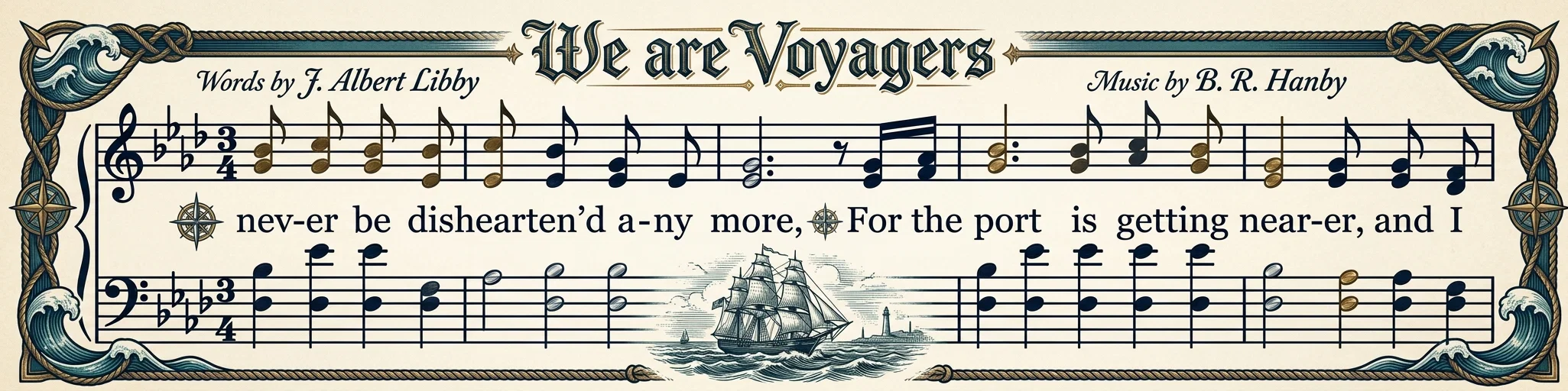
We are Voyagers

Review and Herald

Apr 19, 1906

Review and Herald Publishing Association · Washington, D. C. · Apr 19, 1906

We are Voyagers.

Words by J. Albert Libby.
Music by B. R. Hanby.
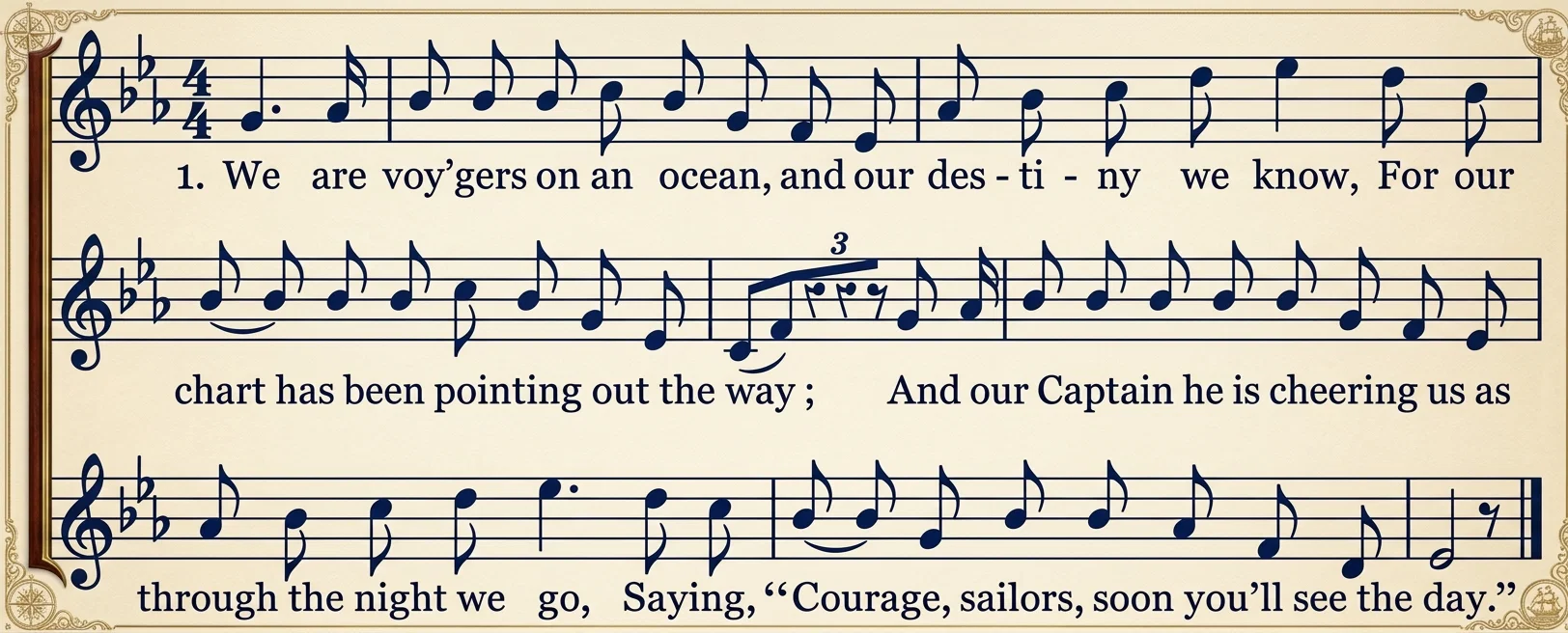
1. We are voy'gers on an ocean, and our des-ti-ny we know, For our chart has been pointing out the way; And our Captain he is cheering us as through the night we go, Saying, “Courage, sailors, soon you'll see the day.”

CHORUS.

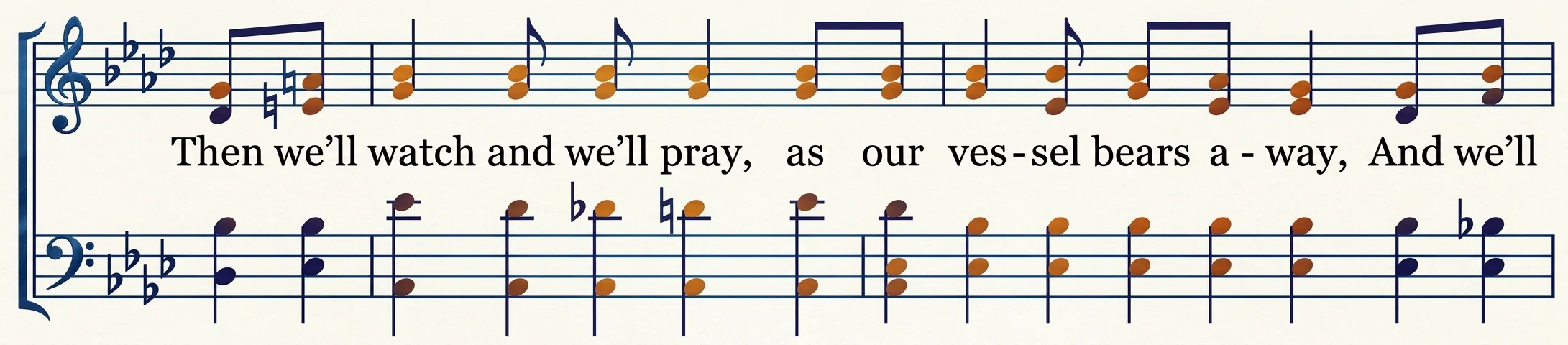
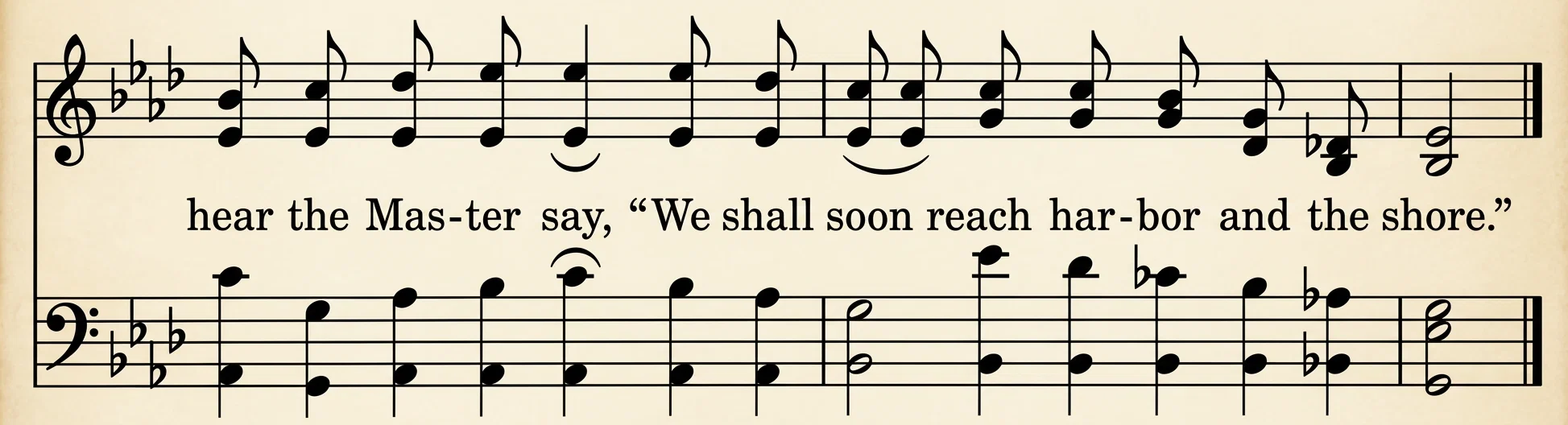
Then we'll watch and we'll pray, as our ves-sel bears a-way, And we'll nev-er be dishearten'd any more, For the port is getting near-er, and I hear the Mas-ter say, “We shall soon reach the har-bor and the shore.”
2. Though the winds are strongly blowing, and though high the billows roll, It will only make us sigh for land the more; And our rest will be the sweeter when we reach that heav'nly goal, There to shout our voyage over on the shore.—Cho.
3. We have passed the coast of Babylon, and Medo-Persian piers, We have left the realm of Grecia far behind; We've been sailing down the Roman coast for eighteen hundred years, And our chart declares the port we soon shall find.—Cho.
4. Oh! how glorious the moment when our keel shall strike the strand, And our watching eyes once greet the hills of home! There our stay will be eternal with the holy, happy band, And the blissful bow'rs of Eden we may roam.—Cho.

Our Publishing Work

The Lord gave the word: great was the company of those that published it. Psalm 68:11.
See last paragraph on this page for instructions where to order.
THE following is a very attractive series of illustrated books for children: “My Garden Neighbors,” $1; “Home, Haunts, and Habits of Wild Animals,” 75 cents; “Happy Days on the Farm,” 35 cents; “Wild Animals at Home,” 35 cents; “Wood’s Natural History,” 50 cents.
THE new Year-book for 1906 is only 25 cents a copy, post-paid, yet it contains much denominational information upon the general union and State conference organizations in all parts of the world, together with a directory of workers in all departments. It contains a full list of all denominational institutions, with their boards of managers, all periodicals, and much other matter that will assist one in studying the progress of the work of the church.
WE quote the following from a letter recently received: “The cook-book, ‘A Friend in the Kitchen,’ continues to work well with Life and Health. Out of fourteen calls I took thirteen orders for the book, and thirteen subscriptions for the journal from as many delighted patrons. I find, with but few exceptions, the wealthiest and most cultured people of any community subscribe readily for Life and Health, and take the cook-book with it.” The two are furnished together, the journal for one year, and the book, for $1.
DURING the past two or three months the publishers of the Youth’s Instructor have received a large number of requests for sample copies of the Instructor from those not connected with our denominational work. The Instructor is one of the best youth’s papers published, and the general public are recognizing it as such. Every Sabbath-school member should select individuals to whom he could send sample copies of the Instructor, and write personal letters soliciting their subscriptions. The Instructor is one of the best papers published to place in hospitals. Sick people in all parts of the country have written the publishers of their special appreciation of the cheerful, clean, helpful matter the Instructor contains. Annual subscription price, 75 cents.
“THE COMING KING” is a book that everybody likes on account of the practical and intensely interesting manner in which it treats themes that are of the greatest moment to men at the present time. Beginning with creation, it treats briefly, yet clearly, the development of the plan of salvation down to the time of Christ. Then taking up the Saviour’s wonderful outline of the future history of the world, beginning with the overthrow of Jerusalem, the fulfilment of his words is traced down through the Dark Ages to the time when the King of kings will come to bring to an end the reign of sin. Special consideration is given to the great questions and problems that are now stirring the hearts and minds of men. Neatly and substantially bound in cloth, $1. Presentation edition, gilt edges, $1.50. Published in English, German, Danish, and Swedish.
PARENTS who desire to secure something for their children to read, ought to have “Sabbath Readings,” Vols. I and III, which the publishers have on hand at the present time. These two volumes contain 752 pages of the very best stories for young people. These volumes are bound in cloth, and will be sent, post-paid, for 40 cents each.
No one can read “The Lover’s Love, or John Three-Sixteen,” without receiving great benefit. It possesses rare merit and essential human interest. It sparkles with divine truth, and glows with lofty thought. It reasons with moving tenderness, exalting Christ, glorifying God, cheering saints, and winning the hearts of sinners. In neat cloth binding, 176 pages; price, 75 cents, post-paid.
WE quote a few Bibles and Testaments for children as follows: No. 1205, Bible, bound in red leather, red edges, with small but readable type, one color illustrations; price, 50 cents. No. 1405, Bible bound in red leather, and printed in larger type, full illustrations with colored engravings; price, $1. No. 3, New Testament, bound in black leather, gilt edges; price, 30 cents. No. 4, New Testament, with soul-saving texts marked in red, 13 cents. No. 5, New Testament, bound in cheap cloth; price, 10 cents.
THERE is much interest concerning the future home of man. All are desirous of knowing what the future world holds in store for them. The book “Our Paradise Home,” by Elder S. H. Lane, will clear the mystery to the satisfaction of all. It reveals the Bible facts about the wonderful kingdom of glory, and the beautiful city, New Jerusalem, in a manner that will please and profit the reader. In treating this subject, the writer touches on other topics closely allied with them, such as the judgment, millennium, resurrection, etc. Bound in board, 25 cents; cloth, 50 cents.
THE Sabbath School Worker is to the Sabbath-school teachers and officers the same as improved agricultural implements are to the farmer. It enables them to do their work much more effectively and easily. Many testify to this fact. The following is a sample of encouraging words often received by the publishers: “To me the Worker is a valuable and indispensable instructor. I am anxious for those who do not have it in their schools. Some think it costs so much to get all the supplies necessary for their schools, but they do not realize that it costs more to lose the benefits derived from such a help. The better equipped the school, the better it will prosper financially and spiritually.”
Orders for any publication mentioned on this page may be sent to any conference tract society or to Review and Herald Publishing Association, Washington, D. C., or Battle Creek, Mich. Also Pacific Press Publishing Company, Mountain View, Cal.; Portland, Ore.; Kansas City, Mo.; Southern Publishing Association, Nashville, Tenn., and Fort Worth, Tex.

Witnesses of the Resurrection

Editorial

As the coming of the Lord draws nearer, there seems to be a more determined purpose than ever before to occupy the minds of all so completely with the things of this world that there shall be no time to consider the things of eternity. “Take heed to yourselves, lest at any time your hearts be overcharged with surfeiting, and drunkenness, and cares of this life, and so that day come upon you unawares.” We may easily spend our whole time over trifles, the inconsequential details of the ordinary routine of life, and utterly neglect the glorious possibilities of a life of fellowship with heavenly beings—not a life of spiritual dreams and reverie, but of earnest endeavor as laborers together with God. Do not permit the earth to rob you of heaven.

Witnesses of the Resurrection

THE resurrection of Jesus distinguished him from the mere philosopher, and placed the stamp of divinity upon his work as a revealer of the message of salvation. To be a witness of his resurrection is to be a witness of the power which makes alive those who are dead in trespasses and sins. Therefore when the eleven disciples chose one to take the place of Judas, they declared that “of these men which have companied with us . . . must one be ordained to be a witness with us of his resurrection.” On the day of Pentecost Peter said, “This Jesus hath God raised up, whereof we all are witnesses,” and of their work in general it is recorded that “with great power gave the apostles witness of the resurrection of the Lord Jesus: and great grace was upon them all.” This was the experience of the first generation after the advent of our Lord, and there is the same demand for witnesses of the resurrection in this last generation before the second advent. Not only is this true on general principles, but the need is emphasized by the fact that just now the resurrection of Jesus is being denied by some who profess to be his followers. We may be thankful that their denials do not change the fact, when we remember that “if Christ be not raised, your faith is vain; ye are yet in your sins. Then they also which are fallen asleep in Christ are perished.” The most effective testimony to the resurrection of Jesus is borne by living the resurrection life. This is the experience of victory over sin. This is the experience of walking with God. This is the experience of knowing him, and “the power of his resurrection.” The faithful witnesses of his resurrection will soon enjoy the full fruit of all that was provided for them by the death and resurrection of the Son of God. “Blessed and holy is he that hath part in the first resurrection.”

Divine Election

The whole plan of salvation finds its center in Christ. In him there is salvation; apart from him there is no salvation. He is the beloved Son in whom the Father is well pleased. All who are in him and who reveal his character are through him well pleasing to God. Of his well-beloved Son the Father thus spoke through the prophet Isaiah: “Behold my servant, whom I uphold; mine elect, in whom my soul delighteth; I have put my Spirit upon him: he shall bring forth judgment to the Gentiles.” And concerning him we have this wonderful assurance: “Behold, I lay in Zion a chief corner-stone, elect, precious: and he that believeth on him shall not be confounded.”
Jesus Christ, the Son, is the elect or chosen of God. And this is because he fully revealed the character of God. So also those who are identified with Christ and abide in Christ are the elect or chosen of God. This is clearly set forth in the following scripture: “Blessed be the God and Father of our Lord Jesus Christ, who hath blessed us with every spiritual blessing in the heavenly places in Christ: even as he chose us in him before the foundation of the world, that we should be holy and without blemish before him in love: having foreordained us unto adoption as sons through Jesus Christ unto himself, according to the good pleasure of his will, to the praise of the glory of his grace, which he freely bestowed on us in the Beloved: in whom we have our redemption through his blood, the forgiveness of our trespasses, according to the riches of his grace, which he made to abound toward us in all wisdom and prudence, making known unto us the mystery of his will, according to his good pleasure which he purposed in him unto a dispensation of the fulness of the times, to sum up all things in Christ, the things in the heavens, and the things upon the earth; in him, I say, in whom also we were made a heritage, having been foreordained according to the purpose of him who worketh all things after the counsel of his will.”
Several things are here declared: we are blessed “in Christ;” we are chosen or elected “in him;” we have been foreordained unto adoption as sons “through Jesus Christ;” this is to the praise of his grace bestowed on us “in the Beloved;” his good pleasure was purposed “in him,” and this was “to sum up all things in Christ;” and “in him” we were made an heritage. It is thus plain that only in Christ, the elect or chosen, are we elect or chosen. The divine election is therefore not an election of certain individuals as distinguished from certain other individuals, but an election of character. Those who through faith in Christ have received the gift of righteousness are the elect of God. Those who through faith have been conformed to the image of Christ are foreordained unto salvation. This is the eternal purpose which he purposed in Christ Jesus. But there is no election apart from character, and there is no foreordination apart from Christ.
Those who teach that a certain portion of the human family is destined to salvation, while certain others are by the same divine decree destined to be lost, irrespective of the character of either class, pervert the fundamental idea of the gospel. “God so loved the world, that he gave his only begotten Son, that whosoever believeth in him should not perish, but have everlasting life.” “He that believeth and is baptized shall be saved; but he that disbelievethshall be condemned.” “I call heaven and earth to witness against you this day, that I have set before thee life and death, the blessing and the curse: therefore choose life, that thou mayest live, thou and thy seed.”
The choice and faith of each individual determine whether or not he is found at last among the elect.

A Last-Day Peril

Among the perils of the last days, as prophetically described, one of the greatest is the prevalence of iniquity. It is stated that “because iniquity shall abound, the love of many shall wax cold.”
All persons are more or less susceptible to the influence of the example set by their associates. This is true in the matter of one’s religious belief and practise; for it is a sad but true commentary on the weakness of human nature that it is a common thing for a person to cease the service of God and lose his religious faith because of an erratic course pursued by some fellow mortal. The tendency to man-worship is inherent in human nature, and the short-sightedness of human nature causes us to fail to look beyond the human leader and teacher to the Creator, from whom alone comes all the truth and wisdom that any being can possess.
As Christians, we are directed to look steadfastly unto Jesus; and we have the infallible word of God given us, that we may not be dependent upon the word of any man, even of the greatest and wisest. If it could be proper to look to any other being than God, we would be justified in looking to Satan and being influenced by his example, for of all created beings he was the highest, standing next to the Creator, and being “full of wisdom.” No other created being could be so fully entitled to confidence as a leader possessed of inherent wisdom and uprightness, as was Lucifer. Yet without God, he is what the Christian knows him to be,—the father of lies, the instigator of all fraud, the author of every delusion that prevails in the world.
We know that the Christian faith rests not upon the word and example of men, but upon God’s word alone; yet we are not safe from the danger of being wrongly influenced by the example of men. We are not safe from the dangerous influence of abounding error and iniquity. But the chief danger lies not in the fact that iniquity abounds in the world. The world has always been full of iniquity, and Christians do not expect it to be in any other condition. It is in the church that the most dangerous iniquity is to be found. It is by those who depart from the truth that the most dangerous influence will be exerted. It is when those who have been prominent in the work of God, who may perhaps have stood as leaders and teachers in the camp of Israel, forsake the accustomed path, that the faith of others is most likely to wane and their love of God and his truth to wax cold.
This danger is to be met in the last days,—the days of this generation,—and we must be prepared to meet it without surprise and without for a moment losing sight of the true foundation of faith, which “standeth sure.” L. A. S.

Breaking Down Barriers

I RAN in to the Bible house, in London, the headquarters of the British and Foreign Bible Society. Its sign is the Bible carved in stone. But this quiet-looking gray-stone building is the center of a grand work in the world.
It is particularly pleasing just now to note how its output is getting into lands closed against ordinary missionary work. Such Moslem countries as Morocco and all north Africa, and Arabia, for instance, are most difficult of access by the evangelist, but the Bible colporteurs are threading their way into these hotbeds of fanaticism, and are surely preparing the way for the advent message in a little from now. The following paragraph from one of their reports illustrates the experience in Morocco:—
At Sook-el-Arba I took up a position in the heart of the market, where I pitched my tent and displayed my books. Several were sold, including two copies of St. Luke in Magrebi. Soon the purchaser of these two books returned, saying angrily, “Give back my money; this is the Nazarene’s book, and we must not read it.” Before returning the price I took the opportunity of explaining the sacred character of the Gospel, but I had not finished speaking when his brother, a very passionate man, seized the books and tore them to pieces, shouting, “Nazarene! Infidel! give back the money!” In face of the torn Gospels and the angry crowd, I lifted my heart to God for help. At that moment a Kaid rode up to my tent, and learning what had happened, said to the offending Moors, “Collect the torn books and be gone!” When they had left, the Kaid said to me, quietly, “Hide your books in the box, and do not sell any more, for it is dangerous.”
But these workers are continually going to and fro in these lands, and the barriers are giving way. The Society has had some interesting tokens of even friendly interest from the heir to the Persian throne, and in all Persia the Bible is being liberally circulated. An agent reports that in eastern Arabia colporteurs and missionaries have sold over four thousand copies of the Scriptures in whole or in part, and in seventeen languages.
It is truly encouraging to see the way so rapidly being prepared in these Moslem countries. The leaven of Bible truth must work, and now that our own cause is just beginning to touch the edge of the Mohammedan lands, we may well thank God that he has agencies at work to break down barriers and turn the attention of the honest-hearted to the word of light.
Again, there is Nepal, just north of India, lying along the south slope of the Himalayas. It is closed to the missionary evangelist. But native colporteurs are doing the work that will surely break down the barriers from within. The Bible Society is scattering the Scriptures there. A colporteur gives the following account of a few weeks’ trip, which will illustrate how the Lord is sending the fishers of men into the most out-of-the-way corners:—
It is the custom in Nepal, as in many other places, to sprinkle water for the purpose of purification, over the floor, after any one who is not a Hindu has entered; but the subedar [officer of soldiers] would not allow this to be done in our case, as he said he regarded us as men of God. And when the people who gathered around asked us why we had ceased to worship idols, the subedar boldly stood up and spoke in our defense, and finally bought a number of Gospels from us, to distribute among his friends. He also gave us food, such as rice, dried fish, etc., and before leaving we prayed with him, asking God to save his soul.
On the fourth day, after prayer we started out from Shilgari on our homeward journey, and all along the route at each halting place we talked with the people about Jesus. Night overtook us again while we were passing through the dense forest, and we had no shelter except the trees. The rain began to pour down, so we opened our umbrellas, and, crouching beneath the shelter of a wild raspberry bush, we spent the night in prayer—for we could not sleep—pleading for the salvation of Nepal. In spite of the bodily discomfort we were experiencing, our hearts were full of joy, for we felt that Christ’s presence was with us in the lonely forest, and we were not afraid. Though we had taken no food since the early morning, nor was any obtainable, and we were very wet and very hungry, yet we were happy.
When day broke, we again started off, and toward evening emerged from the forest. We finally reached Jhulaghat, where we crossed again over into British territory.
The tour occupied three weeks, during which time we had traveled a hundred miles inland, sold a number of Naipali and Hindi Gospels, distributed many Scripture text cards, and preached the gospel and talked to the people about salvation in some fifty Nepalese villages, where most of them had never before heard of the name of Jesus Christ.
So up and down the world the light is being sown, and the harvest hastened on. The Lord has made bare his arm, and all the nations are to see of his salvation. This Bible Society movement is truly one of the mighty creations of God’s providence for these last days.
W. A. S.

Religious Legislation Demanded

The agitation in favor of a rigid Sunday law for the Dominion of Canada is being vigorously maintained in the religious papers. From an editorial in a recent issue of the Christian Guardian of Toronto we take the following paragraphs:—
In all Christian countries the state is bound to legislate on that important matter of the proper observance of Sunday. This is so for two reasons. In the first place, the worker has right to his rest one day in seven, and that right can only be properly secured and safeguarded by strict legislative enactment. And in the second place, the conservation of Sunday, not only as a day of rest, but as a day of religious worship, is recognized as in the highest interests of the people at large, and such conservation is possible only by legislation that will shut out certain things inimical to this. We know that the argument is frequently made that with Sunday as a day of religious worship the state has nothing to do, but such argument is far from conclusive. As a Christian people we are overwhelmingly of the conviction that Sunday should be, above all things else, a day for religious exercises, and given up largely to the consideration of spiritual things. The state has a duty to see that this conviction is possible of realization, and that no extreme secularizing of the day make religious service and worship impossible. . . .
A stronger objection [than some others previously mentioned] comes from those who for conscience’ sake wish to observe our present Saturday as their day of rest and worship. We are free to admit that if it were possible, we would like to see the hardship of having to observe two rest days in the week removed from those who feel compelled to keep Saturday as their day of rest. But the utter impossibility of so doing without breaking down every barrier that would conserve the one day in seven to its legitimate purpose makes us a willing party to what might be judged a real hardship. We are convinced, however, that the Jews, for instance, would lose more in the case of a general breaking down of Sunday observance than the doing away with all of the hardships of this proposed legislation would atone for. There is no more than one per cent of our population who ask for the Saturday-Sunday. That small number are in duty bound to consider the highest interests of the whole, and are justly called upon to make the sacrifice asked of them. Modern society is built up upon that law of individual sacrifice for the good of the whole.
There is no attempt made in this editorial to conceal the demand for religious legislation, and the expediency of oppressing the minority, even in matters of conscience, for the supposed benefit of the majority is frankly avowed.
One of the reasons given in justification of Sunday legislation is that “the conservation of Sunday, not only as a day of rest, but as a day of religious worship, is recognized as in the highest interests of the people at large,” and it is further declared that “Sunday should be, above all things else, a day of religious exercises,” and it is affirmed to be the duty of the state to see that such an observance of the day “is possible of realization.” We regard such straightforward acknowledgment of the real purpose in all Sunday legislation as much more creditable than the effort to hide the real issue under the “civil sabbath” plea.
But what prevents any person from devoting Sunday to “religious exercises”? Does the fact that some choose to follow their usual vocations on the first day of the week make it impossible for others to go to church? If so, would not the next step logically be a demand for cessation from labor on all days commanded to be recognized as holy days by the church? But all observers of the seventh day of the week, and their number is constantly increasing, find it altogether possible to devote to “religious exercises” a day which the great majority of people devote to labor. This demonstrates that when it is a matter of conscientious conviction, there is no necessity of legal enactment prohibiting all secular business in order for some to be religious.
The declaration of a willingness to impose “a real hardship” upon those who “for conscience’ sake wish to observe our present Saturday as their day of rest and worship” is a brutal announcement of religious persecution. It is worthy of the Inquisition, and could easily lead to it. What a travesty upon Christianity is this!
Canada is certainly a good field for missionary effort in behalf of religious liberty, and we are glad that our workers there are making the most of their opportunities.

A Catholic Political Threat

The question whether the recently formed federation of American Catholics is a political body, or will use its power in the field of politics, has been answered by a leading Roman Catholic organ of this country, and the answer is in the affirmative. Such an answer was given to the question by discerning Protestants when the federation was formed; but it was strenuously asserted by Catholics connected with the movement that it had no political significance whatever, but that the federation would keep wholly out of politics, and concern itself with purely Catholic questions. This was true to the extent that there was no intention of forming a distinct Catholic political party, or an open alliance with any of the existing parties; but it did not mean that the federation would not bring pressure to bear upon one or both of the dominant political parties to secure governmental action favorable to the interests of the Roman Catholic Church.
Now comes the New World (Chicago), a prominent Catholic organ, with an open threat of opposition by the federation to the administration of President Roosevelt if certain reports which it has heard prove to be correct. It says:—
We have been informed on excellent authority that the Masonic sect is to be entrusted with the ceremonial rites of the laying of the corner-stone of the new Congressional building in Washington, D. C. The announcement will fall like a thunderbolt from the blue sky on the fifteen millions of American Catholics who had learned almost unanimously to look upon President Roosevelt as the fearless champion of the equal rights which the Constitution guarantees to all American citizens.
The Roman Catholic Church is greatly opposed to Freemasonry, and upon this ground sets up a claim that the Masonic order is constitutionally prohibited from the supervision of the laying of a corner-stone of a government building.
It is not a question of one church being favored by the government against the interests of others, but of a contest between two secret organizations; for the Catholic Church, no less than the Freemasons, is essentially a secret order.
There is not an organization in the world more secret than the Jesuits, who are the most intensely Catholic of all Catholics, and exert a controlling influence in shaping the policy of the church.
The different orders of monks and nuns in the church are all secret. The higher conclaves of the papacy, at which the important questions of papal policy are decided, are secret.
We have nothing to say in favor of the Masonic order, or of its participation in ceremonies connected with governmental affairs; but there is nothing in the Constitution or in republican principles of government that would oblige the government to take cognizance of the controversy between this order and the Catholic Church.
The granting of the proposed privilege to the Masonic order does not violate the Constitutional principle of the separation of church and state, nor that of the equal participation of all citizens in the government.
To assume that the government was bound to debar the Masons from this ceremony in the interests of the Catholic Church, would be to assume a virtual alliance of the government with that church.
The New World concludes its consideration of the subject by saying:—
Will you, Mr. President, force the Catholics of the United States, hithertoyour most loyal comrades in every crisis of your life, into active opposition to you in the future? The federation of Catholic societies will infallibly sound the tocsin, and all their Catholic fellow citizens . . . may be trusted to actively protest against the most notorious official insult that has ever been leveled in the United States against their church.
The Catholic federation will “sound the tocsin.” It will exert its political influence against the present administration if the Catholic Church is “insulted.” And this is a good illustration of what all federations, Protestant as well as Catholic, are for; they exist to exert power in the government,—to bring overwhelming pressure to bear upon legislatures, government officials, and the courts, to force the government to fight the battles of the church. To this condition of affairs we are now rapidly coming. L. A. S.

Sunday Rest for Horses

WHAT is there about Sunday rest which is so superior from a physiological standpoint to rest on other days of the week? One would think some peculiar hygienic virtue must be inherent in such rest when it is found (as is claimed) that not only men, but animals, need rest on that particular day in order to meet the demands of their physical natures. The following, which we note in the Northwestern Christian Advocate, will explain this statement:—
A press dispatch from Vienna states that the Society for the Prevention of Cruelty to Animals of Hungary has taken a very important step in the interest of horses. The members of the society, believing that a Sunday off would be good for horses, exerted itself to this end. It has secured the passing of a law providing Sunday rest for horses and other domestic animals. If Sunday rest is necessary for horses and other domestic animals, is it not necessary for men? Nine tenths of the Sunday labor now performed is unnecessary, and in the interest of working people should be prohibited by law, and the law enforced.
Is it believed that “horses and other domestic animals” can derive any benefit from the religious character of Sunday? Or is it believed that Sunday rest is more restful to such animals than Monday or Tuesday rest would be?

State Religious Teaching in England

It is quite instructive to note the effort which is being made in England to solve the problem of imparting religious education in the public schools. Under the Balfour administration the problem had been solved to the satisfaction of the established church party and the Roman Catholics, by giving them control over the religious teaching at the expense of the nonconformists. A popular political revolt has put an end to this regime, and now the effort is being made to find a way to do justice to all parties, and yet retain the feature of religious teaching in the government schools. A recent London dispatch speaks of the difficulties which the new proposed measure encounters. It says:—
The education bill, the main measure on the Liberal program for the present session, was introduced in the House of Commons to-day by Mr. Birrell, president of the board of education. The difficulty in completely satisfying any single religious group, and the impossibility of framing a measure acceptable to all political parties, speedily became apparent as Mr. Birrell unfolded his effort to arrange a compromise.
He recognized his difficulties by a reference to the “icy blasts of sectarian tenets” which prevented progress and peace.
Mr. Birrell, having wound up the debate by declaring that the measure was an honest attempt to deal with a difficult problem, the bill was formally passed on first reading.
Sir William Anson, Liberal, representing Oxford University, declared that the bill was not based on a broad principle which made a settlement of the religious difficulty possible.
James Ramsay McDonald, Labor and Socialist, speaking in behalf of the Labor party, supported the bill, but said he would oppose any attempt to teach “the skeleton of religion” as proposed in the bill.
L. A. S.
Continue reading: Women’s Associations and Sectarian School Funding