Your ShelfYour Projects

Signs of the Times, Vol. 39, No. 35.

Signs of the Times

Signs of the Times

Sep 10, 1912

Pacific Press Publishing Association · Mountain View, California · Sep 10, 1912

Signs of the Times

A Forecast of War

PROCLAIM ye this among the nations; prepare war; stir up the mighty men; let all the men of war draw near, let them come up.
"Beat your plowshares into swords, and your pruning-hooks into spears: let the weak say, I am strong.
"Haste ye, and come, all ye nations round about, and gather yourselves together: thither cause Thy mighty ones to come down, O Jehovah.
"Let the nations bestir themselves, and come up to the Valley of Jehoshaphat; for there will I sit to judge all the nations round about.
"Put ye in the sickle; for the harvest is ripe: come, tread ye; for the wine-press is full, the vats overflow; for their wickedness is great.
"Multitudes, multitudes in the valley of decision! for the day of Jehovah is near in the valley of decision.
"The sun and the moon are darkened, and the stars withdraw their shining.
"And Jehovah will roar from Zion, and utter His voice from Jerusalem; and the heavens and the earth shall shake: but Jehovah shall be a refuge unto His people, and a stronghold to the children of Israel."

IF YE WILL INQUIRE, INQUIRE YE

This Inquirers' Department is conducted for the purpose of helping those who are studying the Bible. The answers are oftentimes only suggestive. They are never to be considered infallible, only as they agree with the infallible Word. The writer who may answer them does not consider that his opinion is infallible. He will simply give the best that he has, and plead with the inquirer to search the Word. Such questions only will be answered as, to the editors, seem to minister to the good of the readers and to the mission of the paper. We can not answer repeatedly in the same volume questions upon the same scripture. The name and address must accompany question, not for publication, but as an evidence of good faith, and that answer may be made by letter if deemed advisable. No letters are answered which do not contain the name of the writer. It is well always to enclose stamp for reply.

3848 — Has God a Body?

I have been told by many who profess to know the Bible, and I have heard ministers preach, that God has no body. At the same time, they believe and teach that the scripture in Matt. 5:8 really means what it says, that the pure in heart shall see God. Please give the scriptures telling God has a body.
It is not the wisest thing to endeavor to describe the great God. There are descriptions given in the Bible, but many of these are figurative and symbolical, indicating more the character and working of God than the form of God. If men knew what God looked like they would be likely to form images of Him and worship them, and it is for that very reason that the Lord tells the children of Israel that "ye saw no similitude." The visible revelation of God is our Lord Jesus Christ. It is said of Jesus that He was the effulgence of God's glory, and the "very image of His substance." Heb. 1:3. God is spoken of as having a throne. Dan. 7:9; Ps. 103:19. Jesus came from Him and went to Him. John 17:8; 8:13-24; 16:28. All these things show very clearly that the great God of heaven and earth is a personality, is somewhere as He is nowhere else, that He has a local habitation and a throne, the great center of the kingdom of His universe. While no mortal eye has seen Him, there will come a time when they shall see His face. More than this it does not seem to us profitable to discuss.

3851 — Sorrow after Christ Comes

Will there be sorrow after Christ comes, among His people? J. F.
It would seem so from the fact that freedom from sorrow is not promised till the new-earth state begins. See Isa. 65:17; Rev. 21:1-5. It would be expected that when God's children examined all the records of the deeds of men, during the thousand years (Rev. 20:4; 1 Cor. 6:2, 3), they would weep over their own mistakes and over the loss of friends; but when that examination is finished they will see such manifestations of God's love and grace that they will be constrained to believe and acknowledge His mercy-tempered justice. Thenceforth there shall be no more sorrow nor sin nor tears nor pain. The former things are passed away.

3846 — Will-Worship

Is not the celebration of Easter and Christmas will-worship? Col. 2:23.
A. K.
They may be and they may not. It depends on the motive which prompts their observance. There may be those who truly celebrate them, and think that they are required of the Lord. In such case the spirit itself would be acceptable to the Lord, altho the institutions themselves are worthless; but if there are those who think that by the celebration of these they can build up character, or do good works acceptable in the sight of God, it certainly would be in the line of will-worship. The observance of the things which God has not commanded, or which are not directly in harmony with His commandments, is of no profit whatever to the Christian, unless he is conscientiously ignorant regarding them, and then it is not the institution which brings the profit, but the spirit which prompts the obedience. All these extra-Biblical things are inclined to, and almost invariably do, take the mind away from the things which God has Himself commanded, and constantly multiplied, build up a great system of ceremonialism, which is opposed to the simplicity of the worship of God. Both Easter and Christmas are in their origin pagan festivals.

3847 — The Sabbath in the Greek

Please explain Matt. 28:1. What is the original? I heard a preacher say that Matt. 28:1 was a mistranslation, and that in the Greek it stated that all the Sabbaths passed and the first-day sabbath had come.
First of all, we commend to our inquirer the little tract entitled "The Sabbath in the Greek," No. 154, Bible Students' Library, price one cent, in which testimony is given from good scholars who keep the Sunday. The original of Matt. 28:1 is as follows: "Opse de Sabbaton te epiphoskouse eis mian Sabbaton elthen Maria," etc. As rendered by the Interlinear New Testament: "Now late on Sabbath, as it was getting dusk, toward the first day of the week, came Mary," etc. The following facts ought to be sufficient for any candid reader of the New Testament. The translators of the King James Version were Sunday-keepers, and presumably good Greek scholars, but they rendered as we have it in our Common Version. The translators of the Revised Version were eminent Greek scholars, and they have translated it similarly; so with the translators of the American Revised Version, and so with many, many other versions which might be cited. Almost invariably they have justified the rendering of "Sabbath" and "the first day of the week" by the King James Version. It is only ignorance of the Greek that would lead men to render as the minister suggested. It is one of the last resorts to uphold a failing cause. Greenfield suggests this thought, which seems to us worthy of consideration,—that there should be no break whatever between the 27th chapter and the 28th chapter. Connecting those two verses, Matt. 27:66 with Matt. 28:1, it would read as follows: "So they [the chief priests and Pharisees] went, and made the sepulcher sure, sealing the stone, and setting a watch in the end of the Sabbath [or, literally, "late on the Sabbath"]. As it began to dawn toward the first day of the week came Mary Magdalene and the other Mary to see the sepulcher." This would be in perfect harmony with Mark and Luke, and seems to us worthy of consideration.

3849 — Life in the Day of the Lord

Question No. 3814, in your issue of July 30, seems to conflict with the statement in Jer. 4:25, which says, "All the birds of the heavens were fled." Also Zeph. 1:2, 3 says, "I will consume man and beast; I will consume the birds of the heavens, and the fishes of the sea." Please harmonize.
The whole subject will be easily understood if we will remember that the day of the Lord is more than one thousand years long, and that these judgments often refer to its very close, when the execution will culminate. Of course, the birds of the heaven would flee from the overwhelming glory of the Lord's coming, and would hide in the rocks and secluded places; but all men will perish in the presence of that glory. See the close of Rev. 19:21; and 2 Thess. 2:7, 8. All animal life is not destroyed at the beginning of the day of the Lord. See Isa. 34:8-15. This multiplied animal life will furnish food for the wicked as they come up at the end of the thousand years. Rev. 20:7, 8. But in the close of that day of wrath, the wicked will perish (Rev. 20:9), and the beasts of the earth will perish with the wicked (Zeph. 1:2, 3). Therefore while this destruction comes in the day of the Lord, it is not till its very close. See also 2 Peter 3:10.

3850 — Eternal Life, and When Received

Is the promise of eternal life made to unbelievers, or to them that believe? and when do they receive it?
J. R.
The promise of eternal life is made to all, whoever they are, but it is given on the condition of believing; "for God so loved the world, that He gave His only-begotten Son, that whosoever believeth in Him should not perish, but have everlasting life." (The word "everlasting" is the same as "eternal;" see Revised Version.) And those who believe have it as soon as they believe. This is taught very emphatically in the Gospel of John, and in his first epistle. We quote from the Revised Version: "He that believeth on the Son hath eternal life; but he that obeyeth not the Son shall not see life." John 3:36. Note that it is not future—will have eternal life; but it is present—"hath eternal life." See also the 6th chapter of John, where the thought is repeated again and again. But the strongest, clearest testimony is in 1 John 5:10-12: "He that believeth on the Son of God hath the witness in him: he that believeth not God hath made Him a liar; because he hath not believed in the witness that God hath borne concerning His Son. And the witness is this, that God gave unto us eternal life, and this life is in His Son. He that hath the Son hath the life; he that hath not the Son of God hath not the life." God wishes His children to grasp this great thought now, that He gives eternal life by faith now, yet actually and truly given. Sometime it will be given absolutely to the overcomer. It is to that which Rom. 2:6, 7 refers, to the absolute eternal life. We hold it now by living faith.

3852 — Political Parties

A friend asks for our position on the political situation before us. He remarks that the first two conventions were opened by Roman Catholic prayers, and asks if Roosevelt will do better, and what about Socialism.
The "Signs of the Times" has no advice to give regarding politics. The Republicans, Democrats, and Progressives want the Catholic vote, of course. Catholic clergymen were asked first because they were the strongest in the cities where these conventions were held. After the first meeting, other clergymen were called for the same purpose. These parties are wholly political in aims, objects, purposes, motives. The Progressives are of the same order—political. It is presumed that the Socialist party would be equally glad of the Catholic vote if it could be secured in accordance with the principles of that party. We may have our personal preference, but we wish to say just this: No political party can save mankind or save the country. We sympathize with many good men in each party, Socialist as well as others. The diagnoses of the nation's ills are measurably correct; but there is no cure save that which will heal the natural heart of man, and the only cure for this is the gospel of Christ.

3853 — It Repented God, Gen. 6:6

Did God know all things from the beginning? If so, why did it grieve God because He had made man, as He surely knew man would fall from his perfect state?
God knew man would fall, and all provision was made for any exigency that might occur, in His great and wise plan. The language of Gen. 6:6 and other passages is the language of humanity; it is God addressing humanity in language which man can understand. If that had been the end, if at that time of the Deluge there was nothing more to come out of the Lord's creation than what was then manifest, it certainly would have been a thing to be repented of that the earth was made. In other words, had earth's career then closed, it would not have been a matter of glory to God that the world was created, but a matter of sadness and repentance. But after expressing the sorrow of heart because man had turned away from every opportunity, God gives promise of better things that are to come; and after the Flood, He sets His bow in the cloud as a token of the faithfulness of His covenant.

Bible Reading Schedule September 15–21

Schedule for Week Ending September 21, 1912

Schedule for Week Ending September 21, 1912

Sunday September 15 Matthew 28; Psalm 89
Monday " 16 John 1
Tuesday " 17 " 2
Wednesday " 18 " 3
Thursday " 19 " 4
Friday " 20 " 5
Sabbath " 21 Psalms 97, 98, 99, 100, 101

This Week’s Bible Readings

Our week's reading begins with Matthew 28, the triumph of our Lord in the resurrection. It is fitting that we should connect with this, Psalm 89, David's prophetic song of deliverance. We omit Mark and Luke. These may be taken up in another year's reading. It is necessary in order to shorten our readings for the year.
We proceed directly to John, "the beloved disciple," whose Gospel was written about fifty years after that of Matthew. He does not deal with the beginning of the earth life of our Lord, plunging right into the very doctrine, the spiritual meat of it, at once. He wishes to impress upon us the great fact that He who came and lived and died for us was the eternal Word. The great lesson is the lesson of life which God offers, and how we may receive that life. The readings in John for this week close with John 5. Note the closing verses, and the endorsement which our divine Lord gives to Moses and what Moses wrote. The Sabbath readings cover Psalms 97-101.

Prophecy, Reliable and Definite

MEN are apt to think, when considering the subject of prophecy, that it is a sort of indefinite thing that deals in great generalities but can not be depended on for real detail of definite truth. But so surely as the God of all creation is the God of the Bible, just that surely should we look for absolute accuracy and definite and specific predictions when we enter the realm of prophecy.
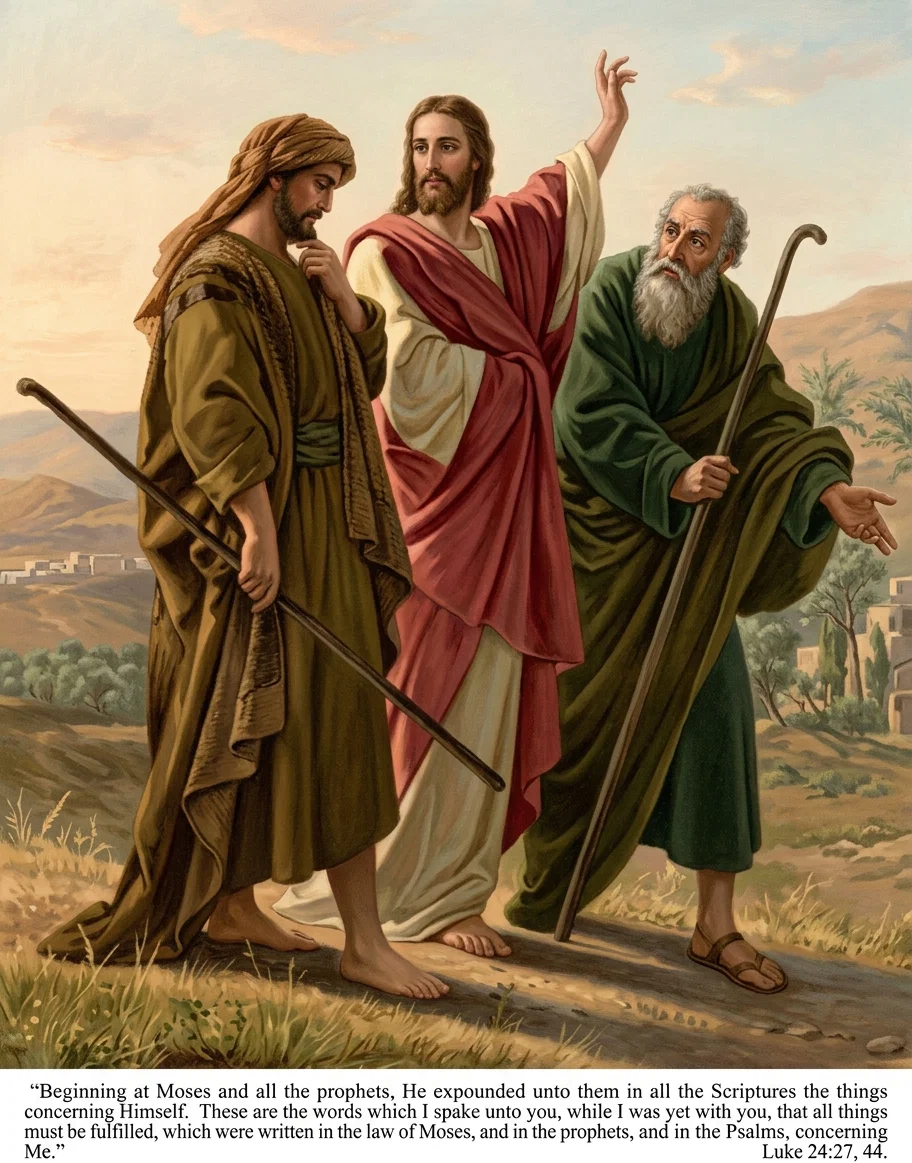
Beginning at Moses and all the prophets, He expounded unto them in all the Scriptures the things concerning Himself. These are the words which I spake unto you, while I was yet with you, that all things must be fulfilled, which were written in the law of Moses, and in the prophets, and in the Psalms, concerning Me. Luke 24:27, 44.
The infinite and all-powerful Jehovah who created every world that we see in the measureless expanse of space, is the one who lays claim to foretell the future. And He claims that He alone is able to do the wonderful deed of reading in advance the millenniums that are ahead, so that as prophecy is unrolling into history we may know that He understands what is to come just as well as He knows what has already passed by. Read one of the Lord's own declarations upon this point:
"Assemble yourselves and come; draw near together, ye that are escaped of the nations: they have no knowledge that set up the wood of their graven image, and pray unto a god that can not save. Tell ye, and bring them near; yea, let them take counsel together: who hath declared this from ancient time? who hath told it from that time? have not I the Lord? and there is no God else beside Me; a just God and a Saviour; there is none beside Me. Look unto Me, and be ye saved, all the ends of the earth: for I am God, and there is none else." Isa. 45:20-22.
God has declared things from ancient times, and there is none of the gods besides Him that can do this. Upon this one point of accurate foreknowledge He challenges all the gods of the whole heathen world. He says in another text:
"Produce your cause, saith the Lord; bring forth your strong reasons, saith the King of Jacob. Let them bring them forth, and show us what shall happen: let them show the former things, what they be, that we may consider them, and know the latter end of them; or declare us things for to come. Show the things that are to come hereafter, that we may know that ye are gods: yea, do good, or do evil, that we may be dismayed, and behold it together. Behold, ye are of nothing, and your work of naught: an abomination is he that chooseth you. I have raised up one from the north, and he shall come: from the rising of the sun shall he call upon My name; and he shall come upon princes as upon mortar, and as the potter treadeth clay. Who hath declared from the beginning, that we may know? and beforetime, that we may say, He is righteous? yea, there is none that showeth, yea, there is none that declareth, yea, there is none that heareth your words. The first shall say to Zion, Behold, behold them: and I will give to Jerusalem one that bringeth good tidings. For I behold, and there was no man; even among them, and there was no counselor, that, when I asked of them, could answer a word. Behold, they are all vanity; their works are nothing: their molten images are wind and confusion." Isa. 41:21-29.
This scripture is also vibrant with the challenge that Jehovah throws out to the whole heathen world. He asks them to bring forward a god that can show something that is to come, so that we may believe him to be a god of some consequence. But since he can not do that, it still remains that the mighty Creator is the only one who can read the future; and because of His infinite powers in every direction, and because of His infinite accuracies and His perfect righteousness, He calls upon us to worship Him as our Father and our God. But read one more of the several scriptures that speak in this same way of the foreknowledge of God:
"Remember this, and show yourselves men: bring it again to mind, O ye transgressors. Remember the former things of old: for I am God, and there is none else; I am God, and there is none like Me, declaring the end from the beginning, and from ancient times the things that are not yet done, saying, My counsel shall stand, and I will do all My pleasure: calling a ravenous bird from the east, the man that executeth My counsel from a far country: yea, I have spoken it, I will also bring it to pass; I have purposed it, I will also do it. Harken unto Me, ye stout-hearted, that are far from righteousness: I bring near My righteousness; it shall not be far off, and My salvation shall not tarry: and I will place salvation in Zion for Israel My glory." Isa. 46:8-13.
Here again the Lord affirms that He declares the end from the beginning; from the ancient times He tells the things that are not yet done. He emphasizes the fact that His counsel shall stand. The man from the far country is called upon to execute the counsels of Jehovah; and since He has spoken it, He will bring it to pass. The Lord makes it clear that He desires that we shall see in the prophecies of the Bible the evidence of His accurate foreknowledge. And as we see these things, we become not only intensely interested, but indescribably delighted in watching the curtain of prophecy unroll into history. We know what is before us in the world, because the prophecies declare it explicitly. We do not look into the future as a great chasm of darkness, but we stand in the focused rays of the search-light of prophecy, and know beyond a peradventure what the future of our world is to be.
The man whose life is spent among the accuracies of true and exact science, and especially the man who devotes himself to the important science of astronomy, ought to be able to see that the prophecy of the Bible is just as accurate in its unfolding as the planets and the stars and their constellations are accurate in all their movements. A New Testament writer speaks on this wise of the dependence we may put in prophecy:
"We have not followed cunningly devised fables, when we made known unto you the power and coming of our Lord Jesus Christ, but were eye-witnesses of His majesty. For He received from God the Father honor and glory, when there came such a voice to Him from the excellent glory, This is My beloved Son, in whom I am well pleased. And this voice which came from heaven we heard, when we were with Him in the holy mount. We have also a more sure word of prophecy; whereunto ye do well that ye take heed, as unto a light that shineth in a dark place, until the day dawn, and the day-star arise in your hearts: knowing this first, that no prophecy of the Scripture is of any private interpretation. For the prophecy came not in old time by the will of man: but holy menof God spake as they were moved by the Holy Ghost.” 2 Peter 1:16-21.
Observe that the last part of the foregoing quotation says that the will of man was not exercised in giving the prophecies, but men of God were moved to speak. A man who is moved to speak something from God, speaks the words of God. This puts God Himself, and not the man, behind the prophecy. The dark places of this world, and the still darker place of the future that is before it, not to speak of its origin and past history, would be indeed hopelessly engulfed in gloom if it were not for the prophecies that tell us of what is on before. They light up this great sea of darkness for the one who believes and studies the predictions that God has given.
In the foregoing quotation, Peter refers to his experience in the mount of transfiguration. He tells of what he saw and heard on that occasion. And these things that were heard and seen are evidences that we are not following the cunningly devised fables of the heathen oracles when we make known the power and coming of the Lord Jesus Christ. But even these things that he saw and heard are not so sure as the word of prophecy. For, as expressed in the Revised Version, he says, “We have the word of prophecy made more sure.” At first it might seem inconceivable that Inspiration would declare that prophecy is sureer than what we actually see and hear. But when we consider that God Himself moved the prophets to speak the sublime predictions of the future, then we can see that the human element of imperfection is eliminated, and that God alone assumes the responsibility of the prophecy.
In view of what God’s Word says in regard to the dependability of its prophetic utterances, is not the wise thing for us all to study them closely and reverently?
T.

EDITORIAL

Loyalty to God

IF there is one thing more than another which is demanded in this day of changing opinions and tottering thrones, it is loyalty. We do not mean loyalty to a mere party, or sect, or government, however corrupt or wrong that party or sect or government may be, but loyalty to truth, to principle, to God, instead of adherence to mere men.
This is a day of man-worship; a day of human exaltation; a day when man will stand by man in a wrong because of some fancied friendship or so-called code of honor between them, instead of standing by the right even at the loss of all friendship. A man becomes involved in questionable transactions with others; he believes that it is wrong—in fact, knows that it is, but a sort of social code of honor declares that it would be a breach of fidelity for him to withdraw from his dishonest associations and dishonorable transactions. When he knows that others are being wronged, deprived of rights or property, swindled, perhaps, by those with whom he is associated, he will not protest to the wrong-doers, and he retains those associations because to his mind it would be a betrayal of trust to divulge the dishonorable dealings of his fellows.
The same practise holds true in great institutions and corporations. Men will see the most flagrantly dishonest practises carried on continually before their very eyes day after day, causing loss to employers or to the institution, but in no way will they protest against or reveal it. They do not believe in “peaching on the boys.” In our legislative bodies, where it would seem that loyalty to country, to oath of office, and to constituents would lead a man to expose every attempt to defraud, he is bound by that same regard for purely selfish friendship, which amounts to disloyalty to country and truth.
Sadder than all other cases, the same cloaking of sin is seen in the church of Christ. Men see and know of evil practises continually repeated, disgraceful in a Christian, dishonoring to God’s work; but they think it would be “mean” to give information to proper authorities respecting such a course, and matters are allowed to go on in this way till the cause of God is disgraced.
What the times demand is unswerving loyalty to God, to truth, to honesty, integrity, and fidelity everywhere, tho one stands alone in its exercise, as did Milton’s Abdiel when Satan rebelled.
Loyalty demands on the part of the workman fidelity to his employer just as long as he employs honorable methods in an honorable business. It demands faithfulness in his time, faithfulness in the doing of his work. David Maydole thought it beneath him to make a poor hammer, and his hammers have become noted. If the employee has as fellow workers those who are unfaithful to their employer, it is his duty to endeavor, privately, to help them to see their evil course. If they will not do this, it is his duty to protest to them vigorously against their unfaithfulness. If they still continue their evil course, it is his duty, his loyal duty, to inform his employer, and to abide the consequences.
It is the duty of the public servant of the people to pursue the same course. Loyalty to country, constituents, and oath of office—to go no farther—demands of every legislator, or other official in the affairs of government, that he should be faithful in the discharge of his own duty, protesting against evil wherever found, even among those who assisted him into office, exposing corruption in methods and practises wherever found. “But such a man would soon be ‘retired’ from office.” Well, so let it be. It is better to be defeated honorably, or die loyal, than to win dishonorable and inglorious success.
It is the duty of the Christian to be loyal to the law of his God above all things else. Loyalty to his fellow men demands it; for he can only truly help his fellow in God’s way, which is ever the way of truth and righteousness. If he sees a brother sin, he should in a proper spirit at a proper time endeavor to win him from it. “Brethren, if any of you do err from the truth, and one convert him; let him know, that he which converteth the sinner from the error of his way shall save a soul from death, and shall hide a multitude of sins.” James 5:19, 20. “Brethren, if a man be overtaken in a fault, ye which are spiritual, restore such an one in the spirit of meekness; considering thyself, lest thou also be tempted.” Gal. 6:1.
If a brother will not be won, he should be faithfully warned of the evil of his course and its inevitable consequences. But if he will not heed this, his case, for the good of his own soul and for the honor of God’s cause, should be presented before the church of Christ. Loyalty to God demands this, whether that soul be a mere acquaintance or the dearest relative and friend. We can only help our brethren in God’s way; and God’s way never whitewashes sin or cloaks evil.
Loyalty on the part of a minister of Christ demands that he shall be faithful in his ministrations to the people. He is to give them medicine sometimes as well as meat. He is to probe wounds sometimes as well as to dress and soothe them. He is to call sins—even tho they be practised by the most popular members of his church—by the right name, and faithfully warn his flock against them. He may not be considered up to the times. He may be considered an “old fogy,” or at least “old fogyish,” but that to him is incidental. Loyalty to God, whose servant, whose ambassador, he is, demands faithfulness to duty. The result may seem to be different many times from what he expected; he must leave that with God. His business is to preach the Word. It may lead from old opinions, from hoary traditions; loyalty demands that he shall follow Christ in His truth, in His humiliation, in His integrity and faithfulness, in His mercy and zeal. God will care for the honor and glory. The ministers of Christ should ever say, “But as we were allowed of God to be put in trust with the gospel, even so we speak; not as pleasing men, but God, which trieth our hearts.” 1 Thess. 2:4.
Loyalty on the part of a Christian journal demands the same unswerving faithfulness to truth.
O, for more of the old-time loyalty manifested in Moses, in Levi (Ex. 32:26-29), in Phinehas (Num. 25:6-13), in Elijah, in all the prophets! God does not ask that we shall execute judgment; that belongs to Him. But He does demand loyalty to Him, loyalty to truth, and separation from sin. There would be with it all a corresponding burden of soul for sinners. W.
Continue reading: The Workings of Power