Your ShelfYour Projects

Review and Herald, Vol. 88, No. 31.

PRAISE GOD
Earlier text: Helpful Sympathy

Panama and the Canal Zone

H. C. GOODRICH
OUR work in the Canal Zone and Panama, where are gathered people from all parts of the world, is prospering. Of this multitude nearly forty thousand are employed by the Isthmian Canal Commission, whose work is now nearing completion. A few words about the canal may be of interest. Two years more, and the principal part of it will be finished. The great locks, three at each end of the canal, one thousand feet long and one hundred ten feet wide, which will raise the water in the canal eighty-five feet above sea-level, are well under way; and the first ship-load of structural iron for the gates has arrived.
Each gate is to be composed of two leaves; each leaf to be seven feet thick by sixty-five feet wide, from forty-seven feet and four inches to eighty-two feet in height, and to weigh from three hundred to seven hundred tons. In the construction of these locks, 4,284,000 cubic yards of concrete will be used. Of this, fifty-two per cent was in place May 1. Of the 20,000,000 cubic yards of “fill” estimated for the building of Gatun Dam, seventy per cent had been placed May 1. Of the 138,000,000 cubic yards of excavation that remained to be moved at the time of the American occupation in May, 1904, there remains less than 45,000,000 cubic yards; this is being moved at the rate of nearly 1,500,000 cubic yards a month.
During the past year our canvassers have sold $17,519.62 worth of books and periodicals, the larger part being in the English language. Many of these books have been sent to friends in the islands of the Caribbean Sea by those who bought them, so that the work done here will be felt in all the West Indies.
Little has been done in the Canal Zone during the past year in the way of ministerial effort; yet by the influence of books and periodicals sold, and the missionary efforts of our churches, eight have been baptized during the last quarter, and more than twenty are in the candidates’ class awaiting that ordinance.
Some of these have had experiences which have tried them, and proved them faithful. One of these was a young Spanish woman, who had lived with “her man” for several years. (This is a common custom in all these countries, and is practised by a majority of the people in the region of the Canal Zone.) When she was converted, she told him that they must be married, or that she would leave him. He refused, on the ground that then they would be bound, and could not do as they pleased. She immediately left him, and in time was baptized. Her life since has proved her an earnest, faithful Christian. She lives alone and supports herself.
As a rule, our people are faithful in paying the tithe; and although nearly all are very poor, yet they consider the tithe as holy to the Lord.
I was talking to a young man a few days ago who had asked for baptism. He had been employed as a bartender in a saloon at good wages, but for Jesus’ sake had given it up, and taken another position at half the price. He was left with three little children by their unnatural mother, who had no sympathy with his determination to live a Christian life. I asked him if he gave the Lord his tithe. He said no, that he could not spare it out of his salary. I read to him what the Bible says about the tithe, and why the Lord required it of his people, saying to him, ‘You study this matter, and let me know what you think of it.’ He answered: ‘I know now what I think of it; for I have determined already to do whatever the Bible commands. I will give the Lord his tithe.’ If only those who have large means entrusted to their stewardship would feel the same responsibility resting upon them as rested upon this humble man, who gave up position, salary, and companion for Jesus, there would be no lack of funds to send missionaries to the uttermost parts of the earth.
It is so also with the Sabbath; the Lord takes the humble ones to be witnesses for his truth. A young man who was employed in one of the stores of the Canal Commission has lately begun to keep the Sabbath. In this he was bitterly opposed by his wife, who finally left him. His employers gave him two hours to decide between the Sabbath and his position. In half an hour he returned, and said he would give up his position. He was then told that if he would sign a contract and work every Sunday, he would still be employed. This he willingly did, and kept his place. Some time after this, he was offered the position of watchman, as there was no work in this, and he could keep his place on Sabbath. But he told them it was the Lord’s Sabbath and was twenty-four hours long, and that he could not fill any place that would demand his presence on the Sabbath. Last month the pay-car came unexpectedly on the Sabbath, and his foreman sent for him. He left the meeting to see what was wanted. His pay was handed him, but he refused to accept it, saying he could not do business on the Lord’s Sabbath.
The influence of these lives consecrated to God is carrying conviction to the hearts of others, who are also inquiring after truth. May the truth fill all our hearts, and make us a power to win souls to Christ.
Cristobal.

Japan

JOHN N. HERBOLTZHEIMER
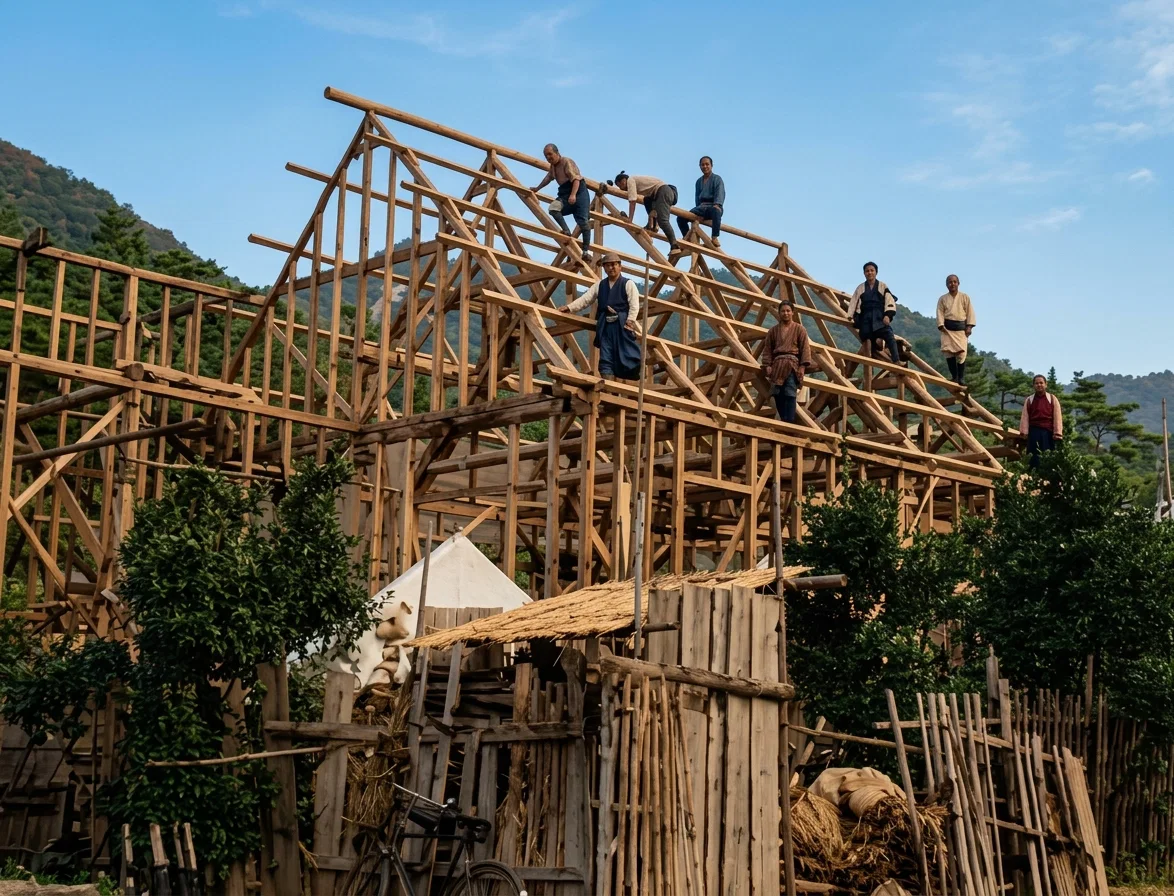
It has been some time since I have reported our work in Kobe. We are all well and of good courage. The Lord is blessing the work to such an extent that it is necessary to erect a new house of worship. We are building a church just double the size of our old one, and putting it on a better piece of ground. The second Sabbath in April, four young women were baptized, and on the thirteenth of May two men. These are bright, intelligent people. It took one man two years to make up his mind to keep the Sabbath, although he knew from the beginning that he ought to obey God. Thank God for these souls; they will be a help in bringing others to a knowledge of the truth.
CHURCH BUILDING IN PROCESS OF CONSTRUCTION AT KOBE, JAPAN
While giving treatment in a wealthy Chinese home about four years ago, I met a young woman who was nursing at the place. She saw that I came every day except the seventh, and inquired why, as Christians keep the first day. This gave me an opportunity to tell her of our message. About six months ago I met her again, not the same healthy-looking nurse, but thin and emaciated, having contracted consumption. One of our brethren took her to his home, and Dr. Noma and her nurses gave her every attention. She realized that the disease was fatal, and that she soon must go to rest. One Sabbath she made the request through our elder,Brother Noma, that she be baptized, and permitted to cast her lot with us. Although she knew that soon she must lay down her life, she was glad to know that when Jesus comes, he will give her a new body, a new life, and take her to a mansion prepared for her. There were few dry eyes in the congregation, and we all consecrated our lives anew to him who is faithful and just.
Kobe.

S. W. CARR

British New Guinea — No. 2

S. W. CARR

WHILE the people with whom we are working are simple-minded, and have to be treated like children, they are not slow to see anything which is to their advantage.
It is not always easy to get sufficient local labor, but recently all the men, women, and children came to work without our even asking them, so four acres of land were given them to clear. Their anxiety to work for us was explained later by one of them, who said that a planter five miles away had told them that they would all be compelled to work for him as soon as he received a letter from Australia. The whole tribe had come to work for us in order to present that as an excuse if the expected letter came from Australia.
Later we found the natives bringing in many yams, taro, etc., to plant, whereas formerly they had brought only a few. They had been told by a policeman sent out by the government, to make a track to another village, eight miles away; their excuse was that they were too busy working for Misi Ka!
This same tribe built our first native mission house, 24 x 20 feet, and for payment received, above the usual rate in large goods, the following articles, valued at twenty-three dollars, at the New Guinea store prices: 4 enameled billy cans [pails], 6 tin billy cans, 3 blankets, 12 loin-cloths, 6 large weeding-knives, 6 small knives and pouches, 4 chemises, 6 spoons, 6 belts, 4 belt pouches.
For carrying much of our furniture, etc., the last ten miles of the distance from Port Moresby up a steep mountain two thousand feet high, and along to Bisiatabu, the mission station, they received the following, valued at thirteen dollars: 12 handkerchiefs, 12 strings of beads, 6 billy cans, 6 loin-cloths, 6 pairs scissors, 6 spoons, 6 large and 6 small mugs, 6 weeding-knives, 2 pouches, 3 canvas sling-bags, matches, and salt.
They were well satisfied with the payment; but later, “pay offs” were made in cash, so as to get the people used to money, also to allow them to buy exactly what they want. The mission keeps a small stock of articles like those listed above, and the money returns shortly after it is paid out. We sell only to those who work for us, not wishing to be looked upon as competing with the stores, or to be thought of as a money-making mission.
While there is a great demand for native labor through the opening up of considerable agricultural work, and as much as four pounds a head is paid to native recruiters for each “boy,” yet boys are hard to get. We, however, have no difficulty that way; for Bisiatabu is becoming well known as a place where they need not work out in the rain; where there is plenty of good food (all grown on the place); where, when sick, they receive attention; and last and best, where the truth of the great and true God is taught.

Our Missions on the Victoria Nyanza, German East Africa
B. OHME
By the help of God, the work here in the district of Shirati is onward. We see that the Lord opens the way before us, and we need only to follow in his providence.
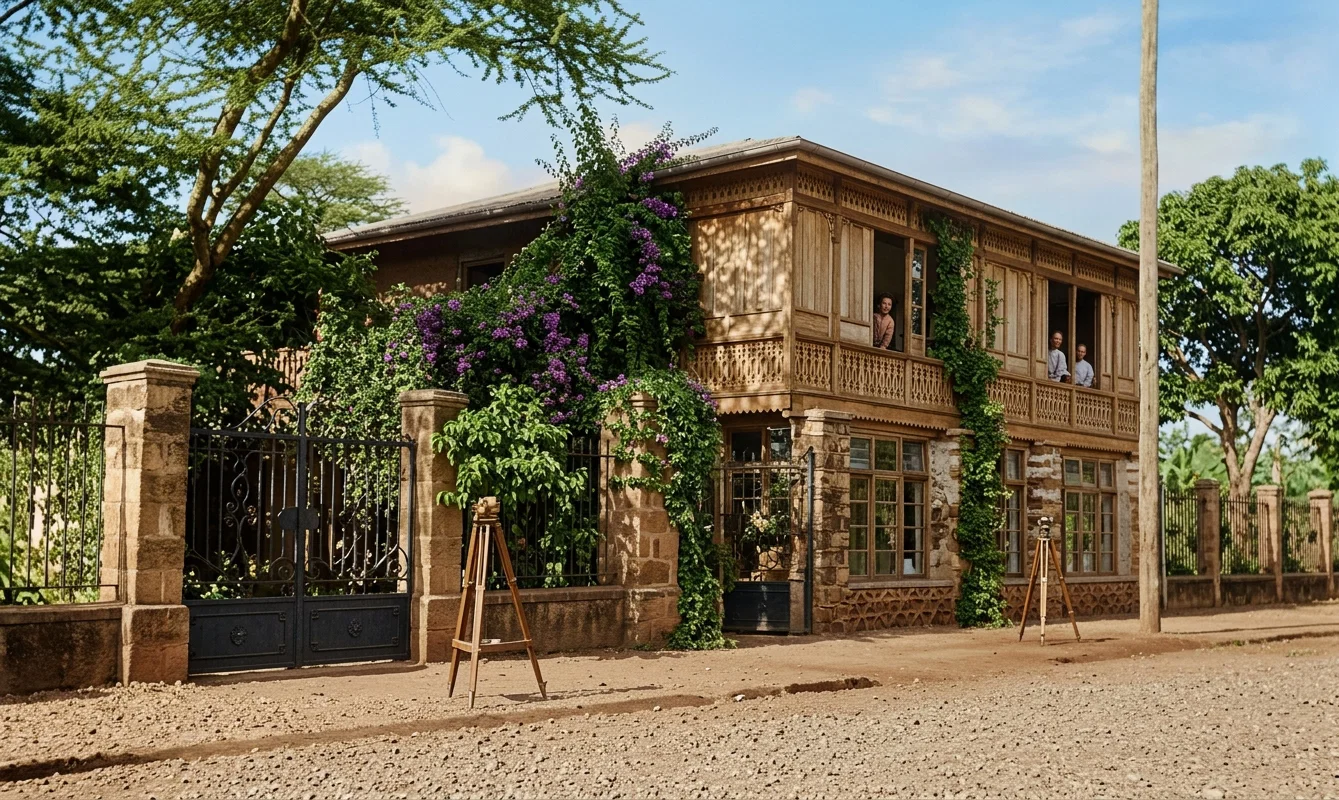
A MISSIONARY'S HOME AT BUSEGWE, EAST AFRICA
In the district of Shirati, there are about two hundred thousand people. A large part of the district is closed on account of the ravages of the sleeping-sickness. How many souls are dying in this region without hearing the message of salvation! For this reason we are anxious to bring the glad tidings to those who are living, as their life is but a span, and passes away like a vapor.
Our forces in the district number eleven white missionaries—seven brethren and four sisters. We should still enlarge our three stations of Majita, Busegwe, and Kidzo, and we expect to open three other new stations this year. Suitable sites for these have already been found at Nyabangi, Ngruimi, and Ntussu. We also have permission to start two stations in the district of Muansa, near Ntusu and Tutwa.
The country surrounding our Majita station, which is located on the peninsula of the same name, is inhabited by a large and industrious tribe. As the country is thickly populated, the land is well cultivated, and one can pass through green fields for hours at a time. Millet, rice, sugar-cane, bananas, and edible roots are raised.
The head of the local government is the sultan. Worshiping God, and giving honor to him, here means kneeling before the sultan, clapping one's hands, and saying, “I worship thee, god.”
We have gained the confidence of the natives, and the youth attend our schools, though they have to be admonished to be regular in this. About one hundred come daily. Workmen eagerly come to labor for us, that they may earn something. They are given opportunity, at morning and evening worship, to hear the Word of God. Six have signified their intention of being baptized, and they come thrice a week for instruction. Our Sabbath meetings are well visited. We hope to be able to baptize our first converts in this district during the present year. We are working upon a primer and a song-book in the native language.
Our second station in this district is Busegwe. It is three days' journey from Majita, in the country of the Wasamiki, a people fond of war and of the chase. These people are shepherds, and cultivate only a few orchards; they do not like physical labor, and it is hard to train them to work; therefore, our station at Busegwe has been not a little care in this direction. However, the youth are more willing to learn to work, and are easily influenced. Many of them have heard the Word of God at our station.
Although the altitude at our mission station is over 4,500 feet, yet our workers at this place suffer from fever. In April, Brother E. Raessler, who, with his wife, began the work here two years ago, was taken ill with blackwater fever, to which he succumbed after an eight days' illness. Thus another of our missionaries has fallen at his post; but we are assured that we shall meet him in the resurrection morning. His wife, who has been a true helpmeet to him, will continue the work he has laid down, seeking to educate the youth who come under her care. May the Lord soon give fruit as the reward of the work among these people.
The third station is Kidzo, and it is established among a large tribe known as the Kidzu people. The station was opened nine months ago. About one hundred pupils are in daily attendance at the school. The sick have also learned to trust us, and they come every day for medicine and the binding up of their wounds. Our Sabbath meetings here are well visited.
We plan to open the fourth station in June, at Nyabangi. This is a military and business place in the district of Shirati. A large number of natives live in this neighborhood; and twelve Indian shops conduct the mercantile business. The place is located directly on the Victoria Nyanza, at the mouth of the Mara River. It is the port for our mission stations Busekwe and Kidzo, and it will serve the same purpose for our futurestation at Ngruimi. As soon as workers are furnished us, we are planning to open Ngruimi as our fifth mission station. I was with Brother E. C. Enns in the tour throughout this district last January, and we found here a favorable opening for the establishment of a mission. As the people are mostly shepherds, it was not the most easy thing to secure just the proper place here for opening a station, because of the migratory life led by the inhabitants, who often change their place of residence every year. We hope that in course of time they will become more settled, cultivate the soil, and settle near our mission.
The sixth station planned will be located among the Wasukuma people. This is a promising people for our work; there are about ten thousand of them, and they should hear the gospel. May the Lord provide workers who can be trained at the Hamburg Colonial Institute in the language, so that they may join our forces here soon.
During the next year or two we expect to begin our work in four other places besides those named. As we see the fields white to harvest, and the souls who should soon be prepared to meet Jesus when he comes, our cry is that the Lord of the harvest will send forth more laborers to gather in the precious sheaves.
Post Shirati.

Come Unto Me

,BURTON CASTLE
“Come unto Me”— Blest invitation kind. I come to thee, And leave the world behind.
Bring what it may, This year untried, I look to thee to-day To be my guide,
Not for another day Not yet begun; But I would daily pray, “Thy will be done.”
Dear Lord, my life to thee I gladly give, Who gave so much for me, That I might live.
My life is not enough, Though given free, To repay half the love Thou gavest me.
And so I pray for power To work alway, That I may hour by hour Some love repay.
Fairland, Ind.

With You Always

WHEN David Livingstone returned to Scotland, after an absence of sixteen years in Africa, the University of Glasgow desired to honor him by conferring on him the degree of Doctor of Laws. On such occasions, candidates for honorary degrees usually expected an embarrassing reception at the hands of the young collegians, who were present in full force, bubbling over with boyish fun. But when Mr. Livingstone appeared on the platform, they received him with silent respect and reverence. He was gaunt and weary from exposure to sixteen years of African sun and twenty-seven attacks of African fever; one arm, having been injured by the bite of a lion, hung useless by his side.
There stood a real hero, who had fought many a battle for humanity, and whose presence inspired a feeling of awe in the minds of all present. He told them he was going back to Africa, partly to open new fields for British commerce, partly to suppress the African slave-trade, and partly to open the way for the preaching of the gospel. But the sentiment that stirred all hearts most was this: “Shall I tell you what supported me through all the years of exile among people whose language I could not understand, and whose attitude toward me was always uncertain and often hostile? It was this, ‘Lo, I am with you alway, even unto the end of the world.’”—Gospel News.
To know God and make him known is our business here.—Thoburn.

Basutoland

SINCE last reporting, I have again visited the new out-school near Berea, where the oldest mission station in Basutoland is situated. At this time the chief and five of his people requested that they might become members of the church. While we can not receive them yet, until they have studied and know more about the truth, we are glad to report that a class is being started tostudy the fundamental points of truth, and those who accept all will become members of a Seventh-day Adventist church near Berea. The school is still small, but growing. In revisiting this place, I am greatly encouraged at the prospects. M. E. EMMERSON.

The Call for Ministers

THE salvation of the lost is accomplished through the Word of God, and those who are called to be preachers of the word have a most sacred responsibility in connection with God's work. The time was in the history of the advent message when the ministry was about the only calling open to our young men; but as the cause has developed, and demands have arisen for so many kinds of workers in connection with it, there has been a scarcity of young men who have entered the ministry.
This should not be. All departments of the work are important and have their place; but the majority of the strongest, brightest, and most consecrated young men among us should give their lives to the direct preaching of the gospel both at home and abroad. Some, because of a sense of the sacred character of this work, and of the high standard to be reached by the gospel minister, have hesitated to express their convictions that God is calling them to the ministry. But let our young men rejoice that God has a great work for them to do. Let them seek by consecration, activity in service, and thorough education, to make themselves worthy of the call. Hundreds of good ministers are needed in the great cities of the home land and in the foreign fields.
The Foreign Mission Seminary is endeavoring to do its part in supplying the demand of the hour. The faculty has been chosen with reference to this very idea of developing evangelistic workers. Our pastoral training teacher is a successful evangelist, and is this summer making a special study of Eastern city work.
The following is an outline of our —

Ministerial Course

First Year

History of antiquity, three terms.
Greek or Hebrew, three terms.
Pedagogy, one term.
General diseases, or tropical hygiene and diseases, and skin diseases, one term.
Hydrotherapy, practical and theoretical, one term.
Public reading and speaking (two recitations a week), two terms.
Accidents and emergencies (two recitations a week), one term.
Industrial subject, three terms.
Vocal music (two recitations a week), three terms.

Second Year

Historic and prophetic review, three terms.
Pastoral training, theoretical and practical, three terms.
Greek or Hebrew, three terms.
Reform epochs, three terms.
Government and international law (one recitation a week), three terms.
Advanced rhetoric or journalism or Biblical literature (two recitations a week), three terms.
Voice culture and vocal music (two recitations a week), three terms.
Some may need to take prerequisite work (which includes the academic course, grades nine to twelve) along with these special lines; and others may require a slightly different course than the one here outlined. Each case will be studied with reference to the attainment of proficiency in the ministry.
Are there not mature young men who already have considerable education, and who are engaged in successful business or professional work, who will leave all for Christ and the finishing of his work, and take up a course of training for the gospel ministry? We should be very glad to correspond with such. Ask for the calendar.
“The day is short; the work is vast; the reward is great; the Master urges.”
M. E. KERN,
Pres. Wash. For. Miss. Seminary.

Western Oregon Camp-Meeting

The Western Oregon camp-meeting and conference were held at Forest Grove, June 8-18, in a beautiful grove near the town. The camp was neatly arranged; there was a good attendance from the first, nearly all remaining to the close; and the weather throughout was all that could be desired.
The conference committee had taken great pains to provide for the comfort of the people, and had laid plans so that all departments of the work should receive due consideration. Several German and Scandinavian workers were present, and special services were held for their people. Careful attention was given to the young people and children. It was indeed encouraging to see such an army of young people consecrating themselves to the Lord and his service.
In many respects this was a wonderful meeting. The enemy was at work; but the Spirit of God came in, and many victories were gained. The conference business was not allowed to interfere with the spiritual and revival work. Every day that passed seemed to be the best day. On the two Sabbaths the Lord came near, hundreds reconsecrated themselves to him, and many started in his service for the first time. Forty-one were baptized.
The conference work passed off harmoniously. Few changes were made in the officers and heads of departments. The reports from the president, the secretary and treasurer, and the heads of departments, were very encouraging. Although the conference had been divided since the last report, the territory and membership that now comprise the Southern Oregon Conference having been cut off, several of the items reported were as large as before the division.
The treasurer's report showed the tithe for 1909, before the division, to be $26,022.83, and for 1910, after the division, $26,592.29, an increase of $569.46. The amount raised on the ten-cent-a-week plan for 1910 was $7,689.88, or $1,059.88 more than the quota for the conference. A unanimous vote was taken to raise the amount to at least fifteen cents a week for 1911, which was more than raised at this meeting.
The report of the Sabbath-school was very encouraging. It showed that many young people had given their hearts to the Lord as a result of faithful work done in this department, and that there had been a steady increase in offerings to missions. The field missionary secretary's report was $6,859.75 on sales for literature for 1910, an increase of $1,399.05 over the previous year. The crops are good this year, therefore the prospects for a good gain during 1911 are excellent.
A deep interest was taken in missionary work, both home and foreign. The day devoted to the work in foreign fields will long be remembered by all present. After the facts were presented, showing the great need for means at the present time, an opportunity was given to assist in this work. The Holy Spirit came into the meeting, and $20,890.68 was given in cash and pledges in a few moments. A little later $1,500 more was pledged.
Two days later, when we presented the needs of our Oakwood Training-School for colored workers, about $1,500 more was pledged, making in all about $25,000 that was raised in cash and pledges at this meeting. This liberality on the part of the people made us think of the experience recorded in Acts 4: 34, 35.
Sabbath afternoon, after the writer had spoken on the high and sacred calling of the gospel minister, Brethren C. F. Falkenburg, N. C. Ernston, and Adolph Johnson were set apart to this important work. A. J. HAYSMER.

Jamaica

We are very busy here at Riversdale. The Lord has been leading and blessing in every way, and we give him the praise. The regrettable loss we sustained in the destruction by fire of our publishing-house at Cristobal, has caused the union conference office to return to this place, also the transfer of the publishing work here. These have added much importance to our work in Riversdale. We are glad to welcome our brethren, and to cooperate with them as best we can in the cause that lies nearest to the heart of every true Seventh-day Adventist.
Our tent work is still in progress, and the interest is good. We have met much opposition, superstition, and immorality, but the mighty truth has power for pulling down these strongholds. Some who have been bound by the strong cords of sin for many years have been set free, and are rejoicing in the message. There have been several remarkable cases of conversion.
As a result of our tent-meetings so far, more than fifty, including children from five years upward, are keeping the Sabbath. The majority of the new converts, however, are adults. Besides these, many are interested. Nineteen were baptized May 21, and others are awaiting the next baptismal service in July.
Two days each week are devoted to church work. The lumber for our church building is being prepared, and the brethren and sisters are manifesting much interest in this work.
There is a large field of labor here, and much to be gleaned. Our greatest material need at present is a church building. Remember us in your prayers.
HUBERT FLETCHER.

Wisconsin Camp-Meeting

THIS meeting was held in Portage, June 8-18, in the fair-grounds just in the outskirts of the city.
We were glad to see nearly everything in readiness at the opening of the meeting, and the people looking forward to a spiritual feast. Whenever the people of God place themselves in an attitude of longing and waiting for the blessing of Heaven, the windows from above will be opened, and showers of spiritual blessing will fall. We were not disappointed.
The spiritual lessons each day from the Word of God were such as to arouse the people to seek a deeper personal experience and a fuller consecration as a preliminary work to the reception of the greater blessing which is in store for God's people, to fit them for a greater work. “The great outpouring of the Spirit of God, which lightens the whole earth with his glory, will not come until we have an enlightened people, who know by experience what it means to be laborers together with God. . . . When we have entire, whole-hearted consecration to the service of Christ, God will recognize the fact by an outpouring of his Spirit without measure; but this will not be while the largest portion of the church are not laborers together with God. God can not pour out his Spirit when selfishness and self-indulgence are so manifest; when a spirit prevails that, if put into words, would express that answer of Cain,—‘Am I my brother’s keeper?’”— Mrs. E. G. White, in Review, July 21, 1896.
The spiritual work at this meeting deepened from day to day, and the last Sabbath was a day long to be remembered. The Holy Spirit was manifest in a marked degree. It rested upon the people like a gentle dew.Tears flowed freely; several were converted, backsliders were reclaimed, and a spirit of prayer for relatives and friends came in. At the close of the Sabbath-school in the afternoon, twenty-five were baptized. One more was baptized the next day.
Services were conducted each day among the Germans and Scandinavians. Some interest was manifested by the people of the city, especially among the Germans, some of whom signified their desire to walk in the present truth.
The laborers from abroad, all of whom remained a part of the time, were Elders Allen Moon, O. A. Olsen, R. D. Quinn, H. Shultz, L. H. Christian, C. E. Weber, G. F. Haffner, J. E. Hansen, Professors Caviness and Berthelsen, Brother J. B. Blosser, and Sister Allen Moon.
The business of the conference was attended to during the meeting. Each department of work received its share of attention. The business was executed with despatch and harmony, and there was a general desire to labor for the success and upbuilding of all departments of the work.
Considerable attention was given to the financial condition of the sanitarium. The gain made by this institution in eight months, including the winter months, was fully $2,900 (received from the sale of “Ministry of Healing”), against a loss in operation the previous year of about $1,400. A strong effort will be made to put this institution on a better financial basis.
The schools were reported in a prosperous condition. Bethel Academy made a substantial gain last year. The Waldorf school reported encouragingly. The Clearwater Lake school is free from debt, and has been from its beginning. The tithe showed quite an increase.
Two churches, Beloit and Cumberland, with a total membership of thirty-two, were added to the conference. Elder W. H. Thurston was unanimously re-elected to the office of president. We were glad to see a general spirit of confidence in the management of the work.
Six tent companies will be in the field this season. May God bless their labors.
H. R. JOHNSON.

Alaska

WE meet men here from all the walks of life, from the highest to the very lowest. Graduates from the best colleges may often be found with a shaggy growth of whiskers and dressed in oil-skins. One never knows whom one is meeting. Often wealthy men are attracted to the care-free atmosphere of Alaska during the summer, and throwing off all style and form, plunge into a beach-comber’s life.
The boat I am now running is built on especially seaworthy lines, and with it I hope to do a more active, serviceable work than I could have done otherwise. It is my plan to make the boat a little floating mission, and carry a large variety of books, Bibles, and papers in various languages; a stereopticon for Biblical and temperance work; a small folding camp-organ for short services at the isolated stations and camps; a sewing-machine with which assistance can be given to poor mothers who are deprived of this useful household agent; and an emergency medical cabinet for first-aid work.
FRED W. TEMPLE.

Ministers’ Meeting at Port Antonio

PORT ANTONIO.—I arrived at Port Antonio on July 9, in excellent health. Everything seemed strange, but the most beautiful scenery that I ever saw met my eyes. I soon looked over the town, and found our neat church building. A little later in the day I received a telegram from Elder D. E. Wellman to attend a ministers’ meeting at Buff Bay, about twenty miles from Port Antonio. I was pleased to find about twenty earnest workers and ministers engaged in a careful Bible study, the chief topic being the Holy Spirit’s workings. A devotional service was held in the morning, a question box was opened every afternoon, and the evening service was devoted to a further study of the message. H. J. FARMAN.
Continue reading: Walla Walla College