The standard for the gospel ministry has been placed high by the speakers thus far in this convention, but none too high; and it is only reasonable that we, as Seventh-day Adventist ministers, should, more than any others, determine to reach it in the name and by the power of the Lord of hosts.
If we improve our ministry, we must give more time and thought to it. I consider that the discussion of this question at this session of our General Conference will prove to be a good step toward the much-desired result. The end sought is worthy of the time and labor bestowed. “Agitate and educate,” is as truly important in this line as in any other.
1. We should study carefully what constitute the qualifications necessary to a successful ministry in this cause. It is not enough to do this occasionally at our sessions of the General Conference. Doubtless more might be done through our periodicals, and by work in the local field, to stimulate prayerful thought on this subject; but the real power must be found, and will be found, by us each, in our closets. Our motto should be, “As for me and my house.” It is useless for us to give rules, unless our lives constitute an inspiration for improvement.
2. We must encourage only such men to enter the field as give evidence of fitness for the work. On this point I would ask, first, Is the man spiritual? Second, Has he a proper education? Under this head I would know that he knows the great foundation truths which have made us a separate people, and that he regards them as his message.
3. Adaptability, or aptness to teach. A man may be spiritual and educated, but if he is not “apt to teach,” he is not fitted for the ministry. 1 Tim. 3:2.
4. Earnestness and diligence. A lazy man is a curse anywhere, but especially so in the Seventh-day Adventist ministry. It matters not what other qualifications a minister may have, if he is not giving evidence of doing honest, faithful service daily, he needs improving or removing. He who is each day seeking to do his best is each day fitted to do better and still better service, and can say with the apostle, “I die daily.”
As “ministry” means “service,” the only way we can improve the ministry is to improve the service. Service should be considered from the standpoint of both quantity and quality. One may do much, and another do little, and neither do anything well. It has been said, “Not how much, but how well.”
I wish to say a few words first concerning pulpit service. We need to study simplicity, clearness, and brevity. A minister who holds his audience an hour to tell them a little truth that he might tell them plainly in thirty minutes, ought to join the ministerial improvement society. He is like the farmer who made his cow drink a large pailful of water to get a lone potato or two at the bottom. If the minister has only a potato to give, let him give it in the name of the Lord, and direct the people to the well of salvation for water.
The only watering of truth that God accepts is tears whose well-springs are hearts burdened for the salvation of men. If our pail is full of good food, let us bear in mind that too much food at one meal is injurious.
One of the heaviest crosses we as ministers have to take up is marked “brevity,” but I am convinced that it constitutes one of the necessary steps to the improvement of our ministry.
Our Study
“God forbid that I should glory, save in the cross of our Lord Jesus Christ.”13
We each need daily to study the cross of Christ, and we must see it in the light of the everlasting gospel message of to-day. We are told that the cross of Christ will constitute the science and the song of the redeemed throughout eternity. Let us study that science, and learn that song as a present reality, or we can not do the work before us. To the extent that we do this as ministers, the ministry will be improved.
Some seem to think that almost any one can preach. But true preaching is as certainly a science as anything in this world; and he who thinks this science is gained without heartfelt struggles and painstaking effort is most sadly mistaken.
Our ministry is not so strong to-day as it might be, and as it ought to be, because we have not counted the cost, or, after counting it, have not paid the bill.
We are told that many of our ministers will have an account to render to God for rusted talents, that many who are weak to-day might be intellectual giants if they had properly used their God-given powers. “Of all sad words of tongue or pen, the saddest are these, It might have been.”
The doctor spends from three to four years of hard study to fit himself to minister to man's physical needs. The laws of the land demand this, for the life of man is at stake. Shall these things be, and we encourage men, either by word or by vote, to go out and practise upon the souls of men without a test of ability or fitness?
I do not claim that a college course is necessary to fit a man for the ministry, but I do hold that every man who is allowed to enter the ministry either as an ordained evangelist or as a Bible worker, should have a good understanding of the language he is to speak to the people.
I am far from making this the essential thing, but it should be recognized as one of the essentials. I can not think of a sadder travesty upon the religion and work of Christ than for his church to sanction or tolerate a cheap, or incompetent, ministry. The message we have to give to the world may properly be called the last book, or, if you please, the advanced calculus of gospel science. It embraces the graduation lessons on truth that fit a people for translation. I would that we might sense deeply our high calling and the demands of the hour.
While we can not get our fitness alone from school-books, or even from the study of the Bible in our schools, the times demand, and reasonably too, that our ministers study books and apply themselves till they can read and pronounce and arrange words properly. Every minister should have a good vocabulary of choice words. Let us avoid slang phrases, and all questionable expressions.
We have the grandest and most beautiful truth the world can ever know, and it seems sad to hear men clothe it in ragged grammar and tattered rhetoric. While we have no right to depend upon grammar or rhetoric to convert a sinful heart, we do have the right to expect the power of the Spirit of God to rest upon the minister, who, not for his own glory, but for the glory of God, seeks to clothe God's precious truth in as respectable a dress as possible, that the ears of men and women of letters who come to hear may not be jarred, and they be driven away by discords in expression.
I have no disposition to try to catch my ministering brethren in their speech, but I have heard such expressions as the following over and over again in a single sermon: “Jesus loves you and I;” “He died for you and I;” “He came to save you and I;” “We hadn't ought to reject his offers of mercy;” “He had went,” “government,” or worse even, “guvmunt,” for “government;” “Jeruslum,” for “Jerusalem;” and “doin'” and “goin'.” I once heard quite an energetic Seventh-day Adventist minister quote the Saviour's sad doom upon Jerusalem as follows: “O Juicelum, Juicelum, etc.”
It is sad to stand at the tent or church door as the people pass out, and hear such expressions as the following: “Well, that fellow knows how to slaughter the king's English, doesn't he?” I believe that these blunders are not all the result of ignorance, but are due to lack of thought, and, brethren, we must not be careless in God's work, for God has said, “Cursed be he that doeth the work of the Lord negligently [carelessly].” Careless attitudes and actions in the pulpit also tend to cheapen our work, and weaken our ability to do the sacred work of God.
I believe our ministry might be improved in these things if we had the moral courage to tell one another of these mistakes, in the spirit of Christ, and “between thee and him alone.”
We are also in danger on the other side of this question, when unnecessary time is spent in shaping and polishing language. When this is the case, the dress hides the soul-saving truth. The speaker sees his words and sentences; he watches anxiously to bring his climax at such a time and in such a way that it will sparkle just so, and thus he loses sight of souls who are waiting before him for the bread of life. The congregation usually sees what the minister sees. If he sees himself, they see him, and when they go out they say, “What a wonderful sermon!” instead of, “What a wonderful truth!”
The science of preaching lies with the men who know how to hide behind the cross; who see Christ and him crucified, and enable their audiences to see all their clean-cut words and beautiful figures adorning not a man, but a soul-saving truth. Rhetoric and oratory are most blessed gifts if in the hands of a sanctified minister.
The ministers who are improving are the ones who are crying daily to God for help to speak his word faithfully. They are the men who, at the close of every sermon, cry earnestly, “Lord, teach me how I can do better next time.”
All-Round Men
Success in our ministry demands more than pulpit service, however good that may be. The Testimonies to ministers have said that the minister should realize, when he leaves his desk, that his work is but just begun. The science of true study and ministry is to be largely learned in the homes of the people. He who shuts himself away from this part, or excuses himself from it without excellent reasons, is severing the very sinews of his strength, and he need expect but little fruit from his labor. The minister, in the highest sense, yea, in every sense, is a missionary. His business is the science of getting to the people—meeting them where they are, and convincing them that both he and God are seeking them in love. The world's greatest minister, and greatest preacher too, “for no man spake like this man,” met the people in the home, in the field, by the sea, in the mountain, everywhere. He walked and talked with men daily; he touched blind eyes, leprous flesh, and said with tenderness, “Go in peace.”
Christ called Zacchaeus down from the tree, and invited himself to dine with that rich man, and before he left, he said to him, “This day is salvation come to thy house.” This ought to mean much to us.
The most comprehensive testimony concerning Christ's ministry is found in the words, “Who went about doing good.” I can but believe that his talks by the way, which doubtless caused many more than the two disciples to say, “Did not our heart burn within us, while he talked with us by the way, and while he opened to us the scriptures?” were as powerful sermons as that one so often quoted, “the sermon on the mount.”
As we cease to study the life and work of Christ, we shall cease to preach Christ. We may preach about Christ, and about “our message,” but he who really preaches these great gifts of God to man, must have them as a part of himself.
How can a minister give proper direction to his Bible workers if he is not a Bible worker himself? How can a minister lead others to pay tithes if he does not pay tithes himself? How can he properly impress upon his people the value of our papers and books if he has not read them, and does not read them himself? How can he enthuse men with the importance of the canvassing work if he has never canvassed, and does not himself sell our literature?
The value of a minister in this cause depends much upon how he is born and educated. We need all-round men—men who have the message, not a fragment.
Whom Shall We Encourage to Enter the Ministry?
I strongly plead for young men who14are willing to study to show themselves approved of God,—men who are willing to step on the first round of the ladder first, and not the last round first,—men who are willing, and will keep in touch with each round as they go forward and upward. As the three messages of Revelation fourteen are a threefold message, a message in which the first joined and went with the second, and the first and second joined and are going with the third, and no man can preach “our message” unless he preaches it that way, so I believe the different parts of our evangelistic work constitute natural steps, each one of which leads to the next one, and goes with it step by step till one grand whole moves forward to victory.
I believe the most successful ministers are those who are willing to and will take the steps in their order. The first step toward the ministry is the study of the gospel as revealed in the messages for to-day. Who can say, I have finished that step, and can leave it behind as I reach the second? As the personal reading and study of the truth is the first step toward the ministry, that, instead of preaching, must be the laborer's first work with the people. Can he ever cease working to place the pages of truth in the hands of the people and helping them to study them?
The Bible worker or minister who comes again and again in contact with the same individuals has the greatest influence (if he will use it) to get men and women to study the life-saving truth. The canvasser can bring it to the door, and leave it on the center-table, but the minister of Jesus Christ can lead the people to open the book and study.
When a young man says to me, “I have no burden for the canvassing work, but I feel that the Lord is calling me to enter the Bible work or the ministry,” I decide positively that I shall not lay hands suddenly on his head. The young man who longs to be called “elder,” and hastens to have it printed on his Bible and hymn-book, has little conception of the sacred work to which he aspires. He needs to study Phil. 2:5-8, and pray for an understanding heart.
In closing this topic, “Whom shall we encourage to enter the ministry,” let me suggest that our schools are designed of God to furnish the men needed.
Our ministers, and also the teachers in our schools, should be carefully watching the young men in our academies and colleges, and should encourage them to fit themselves for the work of God. Those young men who show themselves to be students, those who master difficulties, and reveal a true missionary spirit, and who are ready to go anywhere and do anything they can to forward the work of God, should be encouraged to enter the field. They will not seek or desire to jump into the pulpit. The thought of it will cause them to tremble; but they will seek by contact with the people on the first round in the ladder to prepare for the great and sacred work of the gospel ministry.
Improvement of the Ministry
By E. T. Russell
E. T. RUSSELL
Recruits Needed
RECRUITS are needed to supply the lack in every department of the work. There should be scores of workers both in home and foreign fields where there is now but one. Conference committees should feel that they have resting upon them the sacred responsibility of encouraging such persons to labor as ought now to be engaged in gospel work.
Our most promising young men and women should be persuaded to engage actively in the work of saving souls. Scores, if not hundreds, of our young people are leaving our ranks annually to engage in worldly occupations. There is a reason for this. The responsibility for their loss to the cause, to a great extent, rests upon many of our conferences. After spending years in school preparing themselves for the work, many young people have been informed by the conference officials that they can not employ them, as they do not have the means for their support.
Those who desire to enter the ministry should receive a suitable literary training in order to be properly prepared for the work. They should also be educated in habits of thrift, tidiness, and industry. Shiftless and lazy men will never succeed in the work of the gospel ministry. Men are wanted who will prosper in the midst of difficulties,—men who will endure discouragements, temptations, and privations. Men are needed who dearly love the message, such as are willing to sacrifice for it. May the Lord deliver this cause from those who are preaching for the loaves and fishes, and not from a deep love for souls! They should engage earnestly in the work, praying and studying as they labor; and especially should they learn of the Great Teacher.
Although ministerial institutes may prove beneficial to workers, yet they can not develop them like the knowledge gained through actual service in the field. If promising young men desiring to enter the ministry were encouraged to spend some time in the canvassing work, or in teaching in our intermediate or church-schools, they would thus obtain an experience which would help them in their ministry. In the canvassing work, as they go from door to door, meeting men representing all classes, they learn to read character. As they explain the truths contained in the books they carry, and as they persuade individuals to buy, they are learning to help people to decide. Without this element of character they can never lead souls to a decision in regard to the truth. In the school work they would have an excellent opportunity for Bible study and to develop their ability to explain the truth, to teach the way of salvation, and to lead souls to Christ. The influence of such a class of teachers would add strength to the school work, and be of untold benefit to the churches where they teach. Experience, next to the Great Teacher, is the best educator. The cause needs self-made men,—men who are proved, true, and faithful.
The successful laborer must have more than book knowledge. He needs integrity, energy, and tact. Combined with these, he needs a gentle spirit. He should be “apt to teach, patient.”
The best way the ministry can be improved is by the reception of the Holy Spirit. Without the Spirit’s power, its efforts will be weak and fruitless. Jesus said, “Without me ye can do nothing.” Divine power will ever respond to Jacob-like faith. It is given to those who hunger and seek after it. To the soul that cries out in anguish, as it realizes its need of divine power, the answer will come, “As a prince hast thou power with God and with men, and hast prevailed.” We must have power with God, and then we shall have power with men. To carry this truth in the face of bitter opposition, we need a faith similar to that manifested by John Knox when he cried, “Give me Scotland, or I die.” It is said of that man of God that Queen Mary feared his prayers more than an army of twenty thousand men.
How We May Obtain Divine Power
Jesus says to every one of us, “Tarry ye in the city of Jerusalem, until ye be endued with power from on high.” Tarry where you are. Commune with your God until you realize in every fiber of your being that you have prevailed. Then will be fulfilled the promise, “Ye shall receive power, after that the Holy Ghost is come upon you,” and only then are we prepared to witness for God. Then we can go forth in the strength of Israel’s God with the assurance that success will crown our efforts, and that souls will be converted as the result of our ministry.
The Holy Ghost can do more in ten minutes in the improvement of the ministry than can be accomplished through months and years of study in connection with literary institutions. I would not in any sense discourage education. It is essential that workers have literary finish, but it is more essential that they enjoy the fulness of the Holy Spirit. A worker may have quite a fair knowledge of the sciences, and may speak eloquently, yet without the abiding presence of the Holy Spirit in his heart, his words will be like “sounding brass, or a tinkling cymbal,” because, like Cain’s offering, it contains no Christ.
Profitable Books to Study
Above all books, gospel workers should study the Book of books. It is able to build them up. A knowledge of its teachings will impart mental and moral refinement and spiritual strength. A careful study of its teachings will give them understanding in all things. It will bring joy and rejoicing to their hearts, and, as they impart what they15learn to others, it will also bring rejoicing to the hearts of many.
It is said of Zwingli that when he turned toward the Bible, Switzerland turned toward the Reformation, and of his own experience he said, “When I studied the Word, it became plainer than all the commentaries.” The Bible should be studied in preference to all other books. I would also recommend students to become familiar with such books as “Patriarchs and Prophets,” “Great Controversy,” “Desire of Ages,” “Gospel Workers,” “Thoughts on Daniel and the Revelation,” and “Christ’s Object Lessons,” and other books containing present truth. There are many books of history with which they should become familiar; among the number I might mention such books as D’Aubigné’s “History of the Reformation,” and “Ecclesiastical Empire.”
How to Save Souls
In order to win souls for Christ, we need the instruction set forth in the Bible. Jesus, the world’s greatest missionary, says, “Follow me, and I will make you fishers of men.” “Abide in me, and I in you. As the branch can not bear fruit of itself, except it abide in the vine; no more can ye, except ye abide in me. I am the vine, ye are the branches: he that abideth in me, and I in him, the same bringing forth much fruit: for without me ye can do nothing.”
The great apostle to the Gentiles admonishes us as follows: “Study to show thyself approved unto God, a workman that needeth not to be ashamed, rightly dividing the word of truth.”
“Neglect not the gift that is in thee. . . . Meditate upon these things; give thyself wholly to them; that thy profiting may appear to all. Take heed unto thyself, and unto the doctrine; continue in them: for in doing this thou shalt save thyself, and them that hear thee.”
“Flee also youthful lusts: but follow righteousness, faith, charity, peace, with them that call on the Lord out of a pure heart. But foolish and unlearned questions avoid, knowing that they do gender strifes. And the servant of the Lord must not strive; but be gentle unto all men, apt to teach, patient. In meekness instructing those that oppose themselves, if God peradventure will give them repentance to the acknowledgment of the truth.”
Peter instructs gospel teachers in these words, “Feed the flock of God which is among you, taking the oversight thereof, not by constraint, but willingly; not for filthy lucre, but of a ready mind; neither as being lords over God’s heritage, but being ensamples to the flock.”
Great Caution Should Be Exercised in the Selection of Workers
Great caution should be exercised in the selection of men for the ministry. To-day a large amount of tithe is being expended on laborers who give but little if any evidence of becoming efficient workers. All through our ranks are those who, judging from their actions, seem to think that they have a claim on the conference treasury, although they bear but little if any fruit. Though they do not labor faithfully in the field, they are faithful in drawing their salary from the treasury. Too often we are biased by personal preference in the selection of laborers, and do not consider their qualifications and fitness for the work.
Through the influence of their friends, many have been granted papers, and placed on the pay-roll of the conference, without giving evidence of developing into able workers. After it has been demonstrated that they can not become efficient laborers, it seems almost impossible for the conferences to relieve themselves of the burden of their support, as their friends are zealous in sounding their praise, and plead earnestly that they be continued in the work.
Experience has demonstrated the fact that it is not always safe for conferences to act upon the recommendation of individuals or churches in selecting laborers. Great care should be exercised in this matter, as careless work in this respect not only saps the finances of the denomination, but results in bringing discouragement upon our people, many of whom do not consider it right to pay tithe to have it consumed by a worthless class of laborers.
Thousands of dollars are expended annually with little or no benefit to the cause. In many conferences the conference committee seems unable or unwilling to grapple successfully with this problem. The situation demands action, as God’s cause is suffering as a result of their negligence. In this respect conference officials are not dealing with the Lord’s work as they would manage their own business. We would consider it frenzied finance for any man to employ from year to year an unprofitable laborer. I am confident that if conference committees would as zealously guard the tithe as they would their own finances, a large corps of unprofitable workers now connected with the different State conferences would be dispensed with. If we do not exercise more care in the selection of gospel workers, and place on the pay-roll only such as give evidence of making a success of the work, can the Lord ever say to us, “Well and faithfully done”?
Those That Fail to Bear Fruit
In many of our conferences there are workers who have been going the rounds, visiting the churches at such times as they are not actively engaged on their farms, or in other occupations. In most cases they give their own work the preference; and at such time as it is agreeable to them, they do the Lord’s work; thus they make God’s work a matter of their own convenience.
These workers, after they have thus labored, expect to be supported from the tithe. This cuts down the funds in the conference treasury, so that conferences do not see their way clear to encourage young workers. This non-producing class of laborers should be purged from among those who are supported by the tithe, thus making it possible for conferences to employ those who would make a success of the work. In some conferences laborers seem inclined to excuse themselves from doing work that is not agreeable to them, and when it is suggested by the conference committee that some one ought to be employed to do the work that they have excused themselves from doing, they are not, in many cases, willing to go to another field of labor, although the conference may be so situated financially that it is not able to take on any additional help. Thus the work that they ought to have done, and which they have excused themselves from doing, is neglected.
It is a sad fact that many of our ministers have lost the true missionary spirit, and are standing in the way of those who would, if properly encouraged, take hold of the work and carry it forward earnestly and successfully. All such should be encouraged to engage in self-supporting work; and consecrated, energetic, intelligent persons should be selected to take their places. The tithe is holy unto the Lord, and should not be expended in a careless manner. This work is too sacred to be trifled with.
Bible Women in South India
THE Church of England Zenana Missionary Society has Bible women in many south India villages. One is in a village many miles from the nearest Christian church, so that she can not go to church at all. Another is of low caste, and therefore must live outside the village where she works. By walking six miles, she can attend church, however, every Sunday. Such workers, patient, earnest, but lonely and isolated, are the ones who are laying hold upon heathen women in south India, and they need all the sympathy that Christians can give them.
Paulu’s Raid Into Tibet
PAULU, one of the Moravian native preachers on the western border of Tibet, has recently returned from a daring raid into the forbidden territory. He crossed the border from Spiti to Kyurig, where all the villagers came together to hear him preach. Then he went on to Tsorub, where a governor appeared in his path. “What do you want?” was the question. “Nothing,” said Paulu, “but to proclaim God’s Word.” “We are forbidden on pain of death to allow Englishmen and suspicious persons to cross the frontier. Outwardly you seem like a real Tibetan, but inwardly you are evidently filled with the English religion. You must wait until I talk over the matter in the village.” Still, he let Paulu pass the night in the village and preach there. The next morning he was quite friendly, but immovable in forcing Paulu to recross the frontier. Tibet is not yet opened, but Christians are actively using all the cracks in the wall.
Straits Settlements
By G. F. JONES
SINGAPORE.—We are glad to have entered this large city of many nationalities. There is a very great work to do here, and we are praying that more help will speedily come. We have to face the problem of reaching all nations in this city, therefore it is a very important center for our work in the East. The majority of the Chinese using the Malay tongue, eagerly take the educational advantages offered by the different denominations here, and by the government. They are industrious and persevering, and with this education are employed in all banks and mercantile offices as clerks. Many are not averse to Christianity, but, through fear of breaking ancestral ties, they remain in heathenism. The Chinese are among the richest people of Singapore, and such help as we are able to give them by medical missionary work they would gladly welcome. Several of the Europeans have told us that a good sanitarium would do well here, as it is very necessary. The truth of this statement is seen by the willingness of the people to take the Australasian Good Health. And although the missionaries are working up a strong prejudice against us, we are finding substantial friends by means of the health journal. Truly, medical missionary work is the “right arm of the message.”
No time should be lost in establishing the medical work here. We trust that the needs of this pivotal center of our17island work in all its branches will be considered and supplied very soon.
Brother Munson’s last letter from Sumatra tells of an invitation to us by the resident to work among a hill tribe of twenty thousand living in forty villages, hitherto unentered by any denomination. This is an opportunity which we think must not be overlooked. And, furthermore, in two months from now the resident will visit them and encourage them to build a missionary’s house and schools, ready for us. Here is a work waiting for us, and it is expected that we shall take it up. Shall we fill this opening? We hear a distinct voice in this, saying, “Come over and help us.”
A small printing-press is needed here to print our tracts and a small paper in the Malay tongue. Penang and other important cities are as ready for our work as Singapore. We are overwhelmed at the magnitude of the work to be done, but rejoice in the hope that there shall be delay no longer.
An interest has begun here, and it is spreading before us. We are eagerly pressing on. A few are considering the importance of obedience; and when a real beginning has been made, others will not be so shy to identify themselves with a peculiar people.
Our climate is a moist heat, and enervating; but the evenings are pleasantly cool, redeeming the effects of the hot day. I have seen thus far that we are blessed with far better health than the majority of the people, not excepting the very native in his own climate. God is fulfilling his promise.
G. F. JONES.
Trinidad
By S. A. WELLMAN
PORT OF SPAIN.— My last report told you of the baptism conducted by Elder Sweeney in the church here. God has blessed our labors since. As a result of continued services and personal work, seven others are now preparing, and will be baptized when Elder Enoch comes.
The church, though having passed through deep trouble in the past year, is of good courage. During the past three or four months, over two thousand copies of The Family Bible Teacher have been used by the tract society, besides several thousand of the Watchman and English Good Health. Much more might have been done, and we hope will be done in the remaining portion of the present year.
Since September we have printed, in addition to the Watchman, sixty thousand copies of The Family Bible Teacher, and a large amount of other work for this and the Jamaica Conference, and for those not of our faith.
It somewhat disheartened me to hear from Brother Enoch that we were to lose two of our workers. How we shall get along, I am unable to see, but our Father knows. One thing comes home to me, and that is that it will require greater faithfulness on the part of those who remain. And yet this will mean a heavy strain; but I believe all are willing to hold the colors. Pray for us, that we may have grace and strength.
S. A. WELLMAN.
Colorado
By C. H. Bates
Four weeks ago the ministers of Cripple Creek district decided to send for Mr. Gamble, of Kansas, to come to settle the minds of the people of that place on the Sabbath question. He came, and spent eight days fighting our people, the truths that we hold, and especially that part of the message known to us as the spirit of prophecy. I attended three of his lectures which were, as just stated, a tirade against our people.
The ministers called a special meeting with the object of getting Mr. Gamble and me together. He, of course, took the time usually occupied by the minister, and spent about one hour and a half protesting against the truth of the Sabbath and building up the Sunday institution.
I asked for a little time in which to review Mr. Gamble before the meeting closed. I was given half an hour. The Lord assisted me, and I believe some of those who were there saw the weakness of Mr. Gamble’s arguments and the truth of the Sabbath question.
I remained in Cripple Creek until after Mr. Gamble left, and then reviewed him at Rebecca Hall, after thoroughly advertising the meeting. We had a fair attendance, and with some good selections from our “Christ in Song,” assisted by some of our sisters from the Victor and Cripple Creek churches, the meeting we believe was a success.
Mr. Gamble came with the idea of convincing some who had taken their stand for the truth, of the error of their ways, and of bringing them back, but of the number who had accepted the truth not one was deceived by his so-called “new discovery.” I baptized three new converts to the faith just before leaving, took three good, substantial members into the church on their former baptism, making a total of thirty-nine members added to the Cripple Creek and Victor churches since I came in that district.
I stopped over at Colorado Springs on my way to my new field of labor, where I held two services, and baptized six new converts, most of whom had been brought to the light of truth by Sister Finch. To the Lord I give all the praise for what little I have done for him.
C. H. BATES.
Chile
By Frank H. Westphal
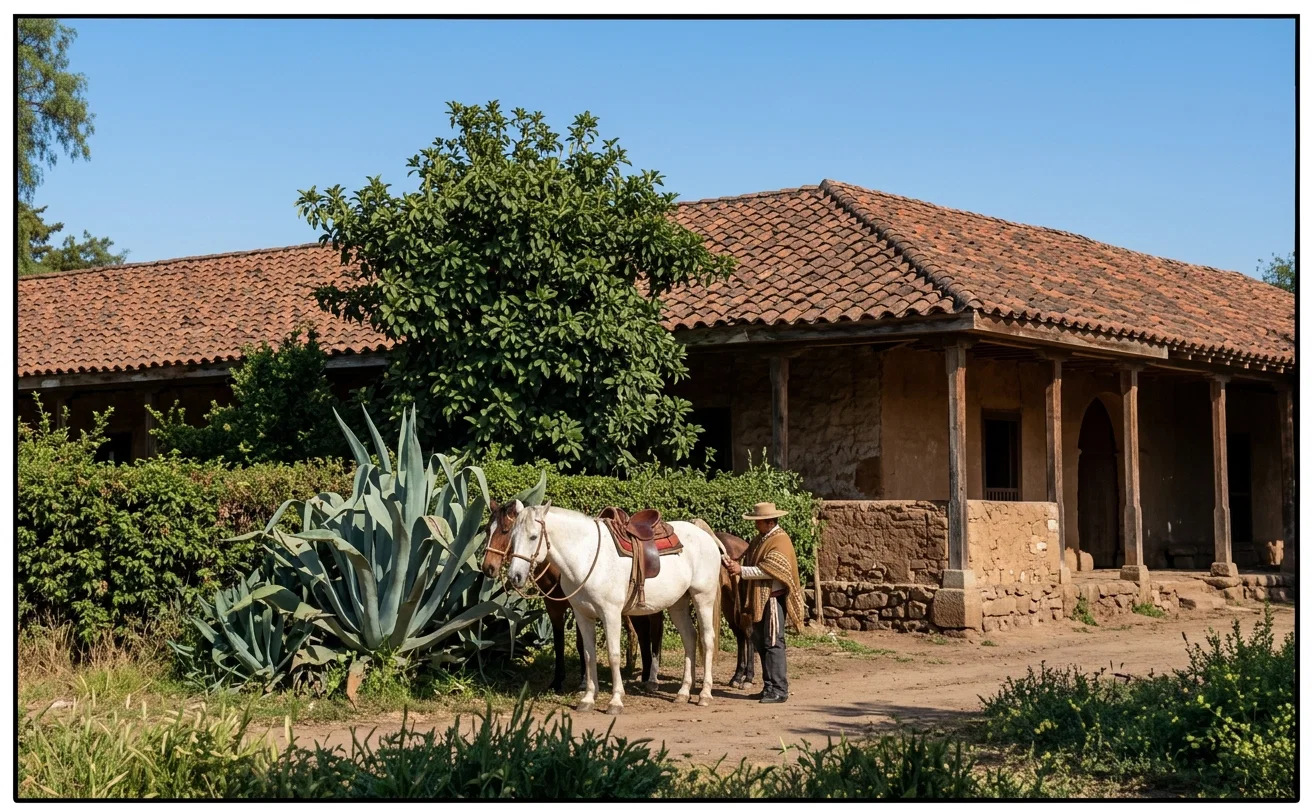
PUA.—The work is opening up some among the Germans in this country. There were but few German-speaking people living in the place where we had our tent-meeting, so the attendance was not large. A few took their stand for the truth, and others are interested. Since we took down the tent, one lady has become interested, and has promised to keep the Sabbath. That makes nine individuals who are now keeping the Sabbath in that place. A young man visited us from another part, and remained to two services, and then invited me to come to his neighborhood to hold some meetings. I promised to do so. Since then I have received a letter, stating that they would be very glad to have me come, for they have but one or two meetings in a year. If the Lord is willing, I shall go there in a few weeks.
A CHILEAN FARMHOUSE
During the winter it rains almost all the time; this is a hindrance to progressive work here in the south. In the winter I can visit the churches in the north, and labor there, and during the summer I can push the work among the Germans in the south. There is work enough to be done, but how to economize the time, is the great question before us. Time is short, there is much to do, and the field is large. We must hasten to get the truth before the people.
F. H. WESTPHAL.
South Africa
By O. O. FORTNER
Our work is getting on a little better footing in the Cape Colony Conference. Since the camp-meeting, Brother Groenewald, who was ordained at the camp-meeting to work among the Dutch people, has been laboring among these, and has baptized thirteen who have been awaiting this rite. I expect a goodly number of people in the Dutch districts between the Cape and Port Elizabeth, will accept the truth as soon as our laborers can go to them. We have been corresponding from the office with quite a number, and have sent out a large amount of literature, and many are interested. One of the brethren who returned from Bermuda has been doing good missionary work in the Orange River Colony, and several are interested in his vicinity, and a few have begun already to keep the Sabbath. I have received letters from those whom this brother has brought into the truth. These people are all Dutch.
We are just now trying to find a location in the country for our sanitarium. The work is now being carried on in the building that was formerly the orphanage, in Plumstead, a suburb of Cape Town. We have felt for some time that this institution should be in a locality more in harmony with the specifications of the spirit of prophecy.
O. O. FORTNER.