WHAT is regarded as the oldest coin in the world was recently discovered by a German archeologist, during his explorations in North Syria. It is a coin of pure silver, bearing a perfect Aramean inscription of Panammu Bar-Rekub, king of Schamol, who reigned eight hundred years before Christ. Up to the present, Lydians have always been regarded as the inventors of money, but this new find shows that the Semitic Arameans, who lived two centuries before the Lydians, are the oldest known coiners of money.—Selected.
German Union Conference Council
By Louis Richard Conradi
(Concluded)
L. R. CONRADI
THE next largest field is the Hungarian Mission. It now has a membership of about three hundred and twenty. There were one hundred and three additions last year, and the tithe was twelve hundred and fifty dollars. Five different languages are represented in its membership, and we have every reason to believe that a strong field will be developed here.
The Holland and Flemish Mission field comes next, with a membership of one hundred and fifty-three. During 1906 there were thirty-three additions, and the tithe was ten hundred and fifty dollars. Elder Klingbeil has been able, by the grace of God, to raise up a little church in Antwerp, and he is now entering Brussels, the capital city, with its six hundred thousand inhabitants. He is assisted by a French worker. We are glad that the work in Holland is slowly recovering from the effects of the falling away there years ago, and that progress is being especially made in the canvassing work.
Another promising field is the Balkan Mission, which now has one hundred and twenty-one members; there were fifty-six additions last year. Most of the increase was in the city of Bucharest, where we have a church of eighty-five members. We have one ordained minister in Rumania, and one ordained minister in Bulgaria (the latter just learning the language), and there is one licentiate and one Bible worker—four workers in all. The Rumanian Church has tried in every way to cause us trouble, but thus far, God has always given us the victory. The tithe last year was about twelve hundred and seventy-five dollars.
Last, but not least of the European fields in the German Union is Austria. When we remember that here are twenty million people, half of whom speak the German, while the rest are Poles and Bohemians, we can see the great importance of putting a strong force into this land. Thus far we have had to work under great difficulties. Elder Mathe, who was formerly there, has been called to take charge of the North German Conference. Brother J. Wolfgarten has since gone to Vienna, to help in that important city. We have now sixty-eight members in Austria. There were twenty additions during the year. Their tithe was about seven hundred and fifty dollars. As we felt that more help was needed in the field, it was decided at the union council that Elder Prillwitz go to Bohemia to assist in the work, and take charge there.
We should not neglect to mention the work in German East Africa. Here we have five brethren and three sisters at present (lately one sister went down to join the force of workers). There are three mission stations—one at Kihuiro, one at Friedenstal, and one at Vuasu, and there are two smaller out-stations. The mission cost us about four thousand dollars last year, and this year it is estimated that they will need about five thousand five hundred dollars. The roofs in Friedenstal and Kihuiro must be repaired, and a solid building needs to be erected at Vuasu. When all these improvements are made, we hope to enter new territory in German East Africa. The first-day offerings of the German Union, and the special gifts that are received, are enough to support the mission at present, and we have sufficient capital to start new stations farther in the interior. There are also persons who offer their services to increase our working force in Africa. We now have from three to four hundred young natives in our schools, and several seem to be turning their hearts to God. Although our missionaries would gladly see them baptized, yet, on the other hand, they feel that it is very important that the first-fruits from the heathen be genuinely converted, so that they will be a worthy example to the heathen around them; otherwise they would be more of a hindrance than they would be a blessing. The health of the workers has been far better, in general, than during the previous year.
During 1906 our Hamburg Publishing House has had the best year it ever enjoyed. Its business is steadily developing. When we hardly knew how to turn for room, the Lord in his providence so shaped matters that we were able to secure a house adjoining our office, at the very reasonable rate of $8,500. As the house was built at the same time as ours, the two really seemed to belong together, and there was very little trouble in breaking a door through the adjoining walls of the two houses, and making an entrance, for the floors are on the same level in both buildings. This gives us four nice new office rooms on the ground floor, needed storage rooms for our paper, etc., and some neat dwellings for our employees on the upper floors. In view of the constant growth of our work, we are trying to secure more help in our various departments.
The Friedensian school has had an attendance of about one hundred and thirty, for which we are grateful to God. At the close of the year we found that, after striking off all the doubtful accounts, we still had a net gain of about fifteen hundred. Not only is the school now paid for, but from the income derived from the sale of “Christ’s Object Lessons,” and from gifts, we are getting together a nice little sum for the further enlargement of the school. We have also strengthened our faculty by securing a good Russian teacher, so we can have a full Russian department. At this session of the union committee, eleven promising young persons who just finished the Biblical course were appointed to fields of labor among the various conferences. There were also several other exchanges of laborers.
God has blessed the German Health Association, so that both institutions showed a gain of about five thousand dollars. All of this sum will be needed for necessary improvements. It was voted to secure the services of Dr. Meyer as further help for the sanitarium. As we have over forty nurses in the field, and a large class preparing for this kind of work, we see the need of having a medical man in the field.
As the conferences are now better supplied with means, the interest in the medical missionary work was such that several of the conference presidents asked if they might not be granted the privilege of employing a nurse in the conference to assist as a deaconess, especially where there are several large churches in a field. Seven nurses were thus called for, and we shall make a trial of this kind of work.
We were grateful to God to find that at this meeting we had raised eighteen thousand dollars in cash donations and four thousand dollars in legacies for the Old People’s Home, and we expect that this will cover the cost of the building, which is to be finished by the first of July. Careful plans were laid with regard to receiving inmates into the home, and for securing proper help for its management and maintenance. We have also raised four thousand dollars on the Material Fund for the “Ministry of Healing”—sufficient to pay for the first edition of ten thousand. There are still a number of outstanding pledges. Our people are taking hold of the sale of this excellent book heartily, and the proceeds will go directly to the medical and philanthropic work.
As we finished the audits in the various conferences and for our missions, and found that everywhere God’s blessing had been with us, we could but say that he had been true to his promises; as the people have been faithful in tithes and offerings, he has indeed kept his word, and in each storehouse there has been sufficient brought in so that the new year begins with a small surplus in the treasury.
At the present time we have nearly one hundred and fifty young people in our school. Since the July meeting, we have been able to ordain six ministers, and quite a number of young people have been given licenses, and about twenty were recently sent out as Bible workers. We feel grateful for the increase of our laboring force; but what is all this when we consider the two hundred and eighty million people in the territory of the German Union who must hear this message? And yet, brethren, God is at13work.
Our publications are finding their way into the courts of emperors and kings. Hundreds of faithful canvassers are carrying our literature from house to house. In certain portions of our field, there is hardly a house without some little stock of our publications. Our periodicals in the German, Russian, Hungarian, Bohemian, and Dutch are entering these homes. Our Sabbath-school lessons appear in ten different languages of the German Union, while we have a field force of nearly two hundred ministers, licentiates, and Bible workers, laboring in Europe and Asia and Africa. Our ship missions in Hamburg and at Rotterdam are scattering the printed page among the thousands of seafaring men who visit these ports; so that the truth is going by land and by sea. The year 1906 has been the best we have enjoyed in the union, but we hope that God’s grace may make the year 1907 still better, and that his work on the earth may soon be finished.
Hamburg, Germany.
G. F. JONES
By G. F. Jones
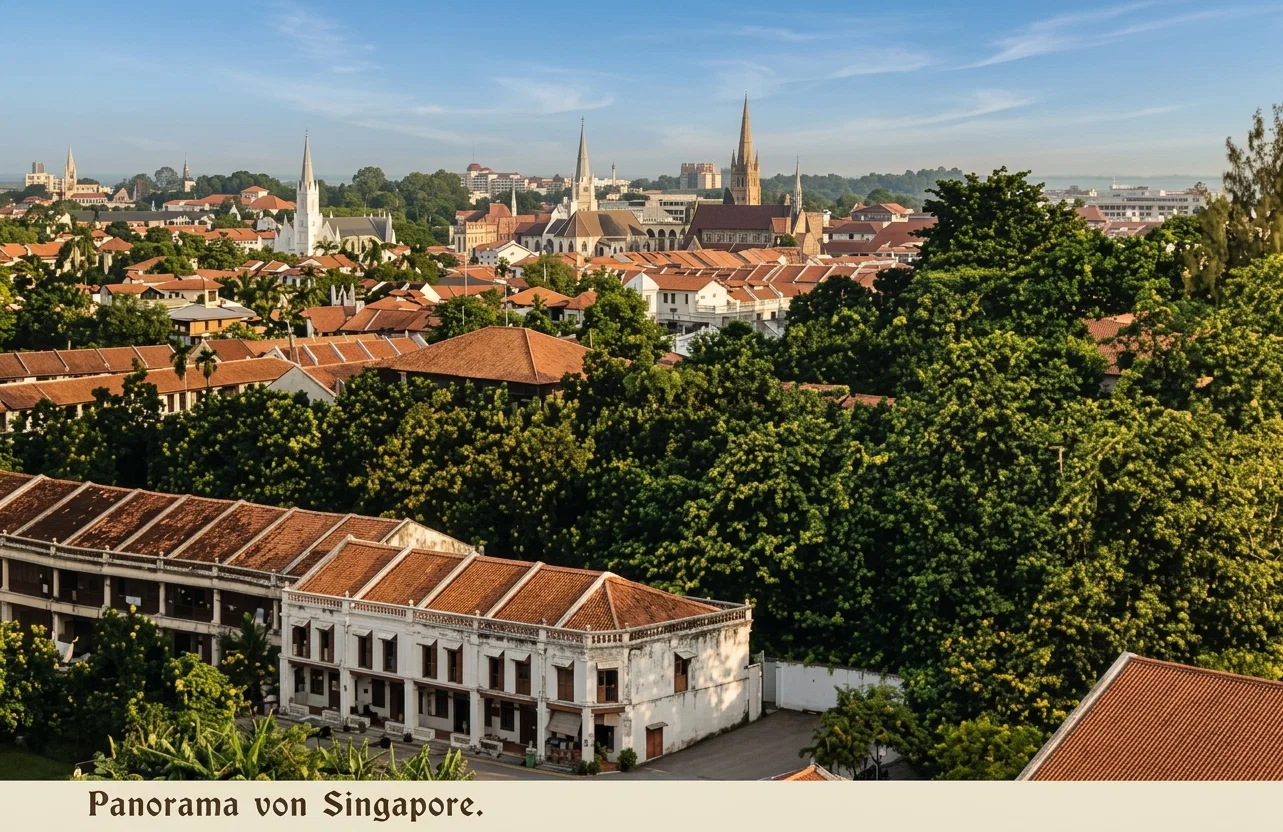
Singapore
G. F. JONES
“AND he set his right foot upon the sea, and his left foot on the earth.”
We have just been visited here by two brethren from a British ship of war, who heard the truth in the West Indies, through Sister Zettie Simmonds, of St. Lucia. There was one feature of the message they had unmistakably imbibed from this dear sister, and that was her faith and love and courage and zeal for her work. These two sailor boys were full of it. They had caught the fire of her spirit, and they carried it everywhere with them. Indeed, they were never tired of telling of the faithful zeal of Seventh-day Adventists as they had seen it in Sister Zettie Simmonds. As we listened, our hearts were gladdened by the good news and the impressions made by our workers upon others in other lands. These two had just come from Calcutta, where they also met with our people in conference once or twice, and then again they were renewed in courage by the love and unity among the brethren. We welcomed them at Singapore, and after two days they again sailed, carrying with them a bundle of tracts and periodicals for missionary work on their ship. Since leaving Calcutta, and while here, Seventh-day Adventism was the talk on their ship, and the chaplain on board last Sunday took up the Sabbath question. There is now a live interest, and since the service several are studying the question; some accepted the truth after reading the Sabbath tracts we sent on board.
One of the sailor brethren, Brother Anderson, is the ship’s organist. He displayed marked courage the other day in refusing to use his talent in a cheap concert gotten up by the crew, although pressed by chaplain and officers. Brother Besford is the first one who accepted the truth, and he also fears neither commander nor officers in the question of conscience. These two brethren are examples of brave warriors for the cause. We supplied them with ammunition for the warfare, and instructed them how to use it, so as to win recruits. There is a good opening in Singapore for ship work, and we trust to find some warm-hearted worker to carry on that work.
A VIEW IN SINGAPORE
Singapore is also a military station. When we opened up work here, we became acquainted with the Christian soldiers of the regiment, and induced them to come to our house, where we had interesting meetings with them. There were not many, about twelve in all, but they were earnest. When the ministers of other churches heard that they came to us, they raised a hue and cry of alarm, and succeeded in scaring away all but one. So for a time only one came faithfully. Then after the storm had subsided a little, another returned, then another, until very soon five of these soldiers had accepted the truth. This raised another uproar among the missionaries, worse than at the first; but the others who became ashamed of us lost their hold on even what they had, and drifted back into the world, and became drunkards and unbelievers; for this we were branded as infidel-makers. But the quality of men the truth turned out causes us to rejoice. Two of these men have returned home, having finished their time in the army, and I believe both of them will soon land in America, to connect with our people and our schools. Two others have gone with the regiment to India, and will buy themselves out if possible.
They are having trying times because of their faith, but remain true. There are others convinced, who have not yet had courage to stand like the brave and face the foe. The regiment newly come has been warned to avoid us, but in due time we shall attract this earthly regiment, and rescue the Lord’s soldiers from their captivity. The Lord is with us, and we are of good courage.
The people generally are glad to meet us, and in their hearts believe we are right. The Lord allows them to see only the victorious side of our work; and were they let alone by the missionaries, it would be comparatively easy to win them. Rahab’s confession to the two spies fits in well here concerning the people and the missionaries. “I know that the Lord hath given you the land, and that your terror is fallen upon us, and that all the inhabitants of the land faint because of you. For we have heard . . . what ye did; . . . and as soon as we had heard, our hearts did melt, neither did there remain any more courage in any man, because of you: for the Lord your God, he is God in heaven above, and in earth beneath.”
It was given out a little while ago from the cathedral pulpit that we are liars and deceivers, and must be shunned as vipers. The Lord is good to us, and encourages us in our work. By patience, faith, and perseverance the work is gradually building up, so that there is neither hammer nor ax nor any tool of iron heard in the house while it is in building.
Two excellent young brethren have been recently sent us from Australia, to help in the work, and they are blessed with good courage. Brother Mills has charge of the educational department, the printing work, and the keeping of the mission books; while Brother Fletcher does the work of visiting, etc. The Sabbath-school numbers over fifty, and the church-school is slowly growing. Several fatherless children have been offered us to bring up, but our home is already full, as we are caring for several orphans. We must lengthen our cords and strengthen our stakes; we hope soon to find an industrial home in the country for our educational work.
Singapore is a large city of many languages, which makes it difficult to reach the different kinds of people, but the Lord knows his people, and by our searching for them they will all soon leave Babylon.
“Thou shalt arise, and have mercy upon Zion: for the time to favor her, yea, the set time, is come.”
GEO. M. BROWN
By GEO. M. BROWN
Mexico
GEO. M. BROWN
THAT honest souls are seeking the truth is illustrated by an interesting experience that we have had in the work in the city of Mexico.
During Professor Caviness’s absence in the States last fall, I had charge of the services, and being ill one Sabbath, was unable to go to the Sabbath-school and meeting. In the afternoon several members of the church called at our house to see how I was; and while they were there, an old gentleman and his wife came, asking for literature.
I asked one of the visiting sisters to go out and talk with the man as I was unable to do so. After a few moments she returned and joyfully announced that the seeker for truth was a man whom14she had known many years before, and that he was one of the first Mexicans who accepted Protestantism.
At last he came into the house, and another sister who was present recognized him as one with whom she had been associated many years before in the first Protestant church that was established in the city. They were much pleased to meet after the lapse of years, and naturally had many things to talk of. About the first thing that the sisters spoke of was the truth which they had found. They told him of the Sabbath and of our meetings, and introduced me as their pastor.
ENTRANCE TO OUR MEXICAN MISSION AND PRINTING-OFFICE
He seemed to be greatly interested in what he had heard, and after receiving some literature went away, promising to attend our meetings, which he has done. This man was for years associated with the Episcopal Bishop Reily, who at his death left him in charge of the congregation over which the bishop had presided.
The Mormons having led some of his flock astray, the old gentleman came to me in deep trouble for help. I did what I could for him, and thus another link was added to the chain which was drawing him closer to us and to the truth.
He has continued to attend our meetings and receive instruction at his house until he has become thoroughly convinced of the Sabbath truth, and has taken his stand for it. He has invited Elder Caviness to accompany him and assist him in explaining the truth to his church, numbering some two hundred members.
Nearly all of those who in the early seventies espoused the cause of Protestantism in Mexico were true seekers for light, and when they cut loose from the domination of Rome, it was to follow the teaching of the Bible, and not that of men. It is very encouraging to see some of these aged veterans, who in the past have been in the van of the Lord’s army in Mexico, continue their march toward the celestial city by uniting with those who are banded together to “keep the commandments of God, and the faith of Jesus,” and to carry the advent message to all the world in this generation.
As these dear friends met in our home that Sabbath day, and we saw their faces light up with joy at the sight of each other, and heard them recount the experiences of former days, we rejoiced with them. Since then we have had much greater cause for rejoicing as we have seen the brother come into the light and accept the Sabbath truth. These are some of the experiences that make the life of the missionary happy, and repay him for the absence from the home land and the friends of former days.
Sometimes it seems as if the Lord grants to us a little foretaste of what we shall enjoy when the ransomed of all ages and from all nations gather before the throne of God after the final victory over sin and Satan has been won. Such experiences give us courage, and we press forward with renewed energy.
“Forward then with courage go.
Long we shall not dwell below;
Soon the joyful news will come,
Child, thy Father calls, Come home.”
Brethren, pray for the work in this field.
Mexico, D. F.
Health Advice for Our Missionaries
By S. H. CARNAHAN
S. H. CARNAHAN
Many of our missionaries go from a temperate to a tropical climate; and a few words of caution from publications on tropical countries may be of inestimable value to some of them.
These all invariably advise against the free use of spirituous liquors. This precaution, however, is unnecessary for Seventh-day Adventist missionaries.
From a book on Hayti we quote: “If one receives the sting of a wasp, or a shock from a fall or a wound, or ‘catches a cold,’ a slight fever may result. But the ordinary fevers are not by any means regarded as serious or in any way dangerous.” “Among the natives, the worst type is the pernicious, the dreaded yellow fever, which is now considered infectious, but not contagious. The alkaline treatment has met with marked success.”
“Tetanus, a muscular disease, seems much more common here than in colder countries. Persons sometimes bring on lock-jaw from the merest abrasions by so slight an indiscretion as bathing while the abrasions last. The precaution for a person having any flesh wound, however slight, is to keep from bathing, and from all avoidable dampness.”
The following valuable hints translated from a work of Dr. David J. Guzman, on Salvador, will be helpful:—
“When the European lands on our shores, he soon feels the moist heat which prevails, particularly in the wet season. His strength begins gradually to fail, and his appetite soon languishes; his habitual energy declines. He will observe that the native, notwithstanding that he is acclimatized, knows how to resist the heat and escape fatigue, by moderating his work and performing it in the cool hours of the morning and evening.
“He should avoid the immoderate use of fruits, which, although to him new and delicious, will disarrange the gastrointestinal functions, and produce grave disorders in them. A necessary precaution for the immigrant to take is to provide against sudden changes of temperature. Frequently, before a rainfall, an oppressive moist heat is felt, causing a profuse perspiration. While in this condition a fresh breeze frequently springs up, which, unless precaution is taken against a sudden chill, may occasion grave disorders of the organs of respiration and digestion, producing dysentery and inflammatory affections of the chest, especially if the immigrant is stout and full-blooded. Light flannel clothing constantly worn will provide against chills. Although at first they may appear to be uncomfortably warm, use will soon make them preferable to cotton and linen, which have the disadvantage of cooling the wearer too quickly, thus producing conditions deleterious to health.
“The skin should be kept in good condition, as perspiration, which is active in hot climates, should be unobstructed. For this purpose, sea or river baths, combining exercise with cleanliness, are very salutary. Care should be taken to avoid sleeping in low and damp places. The air, laden with miasma arising from decomposing vegetables and animal matter, occupies by its specific gravity the lower strata of the atmosphere. It is from this cause that houses in low and damp locations are attacked by fevers of all kinds and types, which at times occasion ravages among newly arrived people. If situated in the country, houses should be located on the high grounds, and as far distant as possible from swamps and marshes. Clothing should be loose, so as to admit free circulation of air and perspiration, and unencumbered movement, and should not be dark in color, as dark colors absorb the heat, and lighter ones best resist the solar radiation.
“In hot climates like ours, digestion is weak and slow. Animal foods, and fats in particular, which are heat-producing, are injurious to the inhabitants,15as much from the difficulty of their digestion as from the additional labor imposed on the liver, which has to secrete a greater quantity of bile to dissolve the excess of fatty matter introduced. This extra work will in time produce the various forms of inflammation to which this organ is liable in tropical countries.
“It may also be logically inferred that the colonist, on arrival in a tropical country such as ours, ought not to radically change the habits acquired at home. It will be sufficient to introduce some slight modifications which will not violently and suddenly change his former methods of life.” He also advises properly proportioned foods, free from excess of spices and condiments.
Further, the Bulletin, No. 58 (Salvador) of the Bureau of the American Republics, itself says:—
“In the majority of cases where foreigners suffer from the change of climate, the cause can be traced to their own imprudence and careless habits of life. With only ordinary attention to hygienic laws, and particularly to temperance in eating and drinking, there is no reason why any person of good constitution should not enjoy as good health in Salvador as in any other part of the world.”
How thankful we as a people should be for those principles direct from the Spirit of God in the Testimonies, and epitomized for more ready reference, in the little book, “Healthful Living”! Should not we believe and live these?
Greater New York
By C. H. Edwards
The work in Greater New York is going steadily forward, and we are daily seeing evidences of the leadings of our Heavenly Father. The work is developing so fast among the different nationalities that a separate report might be given of each one with profit.
The German Work
At the present time we have two German churches. One is located in New York City, and one in Brooklyn. Connected with the German work are the following-named workers: Elders O. E. Reinke and C. F. Knott; Brethren Bernard Voth, Henry Pankoke, and Henry Tonjes; and Sisters Eliza Kehrein and Alice Myers. While the work among the German people is difficult, yet the Lord has signally blessed in that work.
Danish-Norwegian Work
The interest in the Danish-Norwegian work continues, and quite a number have recently accepted the truths presented. Elder M. L. Andreason, and Brother P. E. Brotherson, and Sister Borchgrevink are laboring among this people. The portable tabernacle on Hamilton Avenue, South Brooklyn, is filled at nearly every service.
The Swedish Work
Brother G. E. Nord is greatly encouraged in his work among this people. Several have recently been baptized into the message, and the New York Swedish church is one of the most prosperous we have in the city.
The Italian Work
Connected with this work are Brethren Louis Zecchetto, Caldarona, and Scattaregia. The Lord has gone out before these brethren in a remarkable manner, and several new ones have been added to the Italian church. That church at the present time numbers about twenty. There are about six or eight others who will soon be baptized. We have two missions for them now where services are being conducted every night. The interest is good.
The Spanish Work
Brother Horace Geraldi is laboring among the Spanish people with varied success. Several promising openings have appeared, and he is entering them as rapidly as possible. Brother Geraldi was formerly the pastor of one of the leading Spanish churches of the city, but left his position to become a teacher of present truth. At the present time we have another excellent Spanish brother who ought to enter that work, but our finances will not warrant our setting him at work.
The Chinese Work
Brother Henry Thomson, a Chinese brother who has been in the truth for several years, has begun a work among the Chinese. A Sunday-school has been started at the tabernacle on 110th Street. The first session opened with about twelve men, and the school continued with about the same number of pupils. He expects to start another school in Brooklyn in the near future. This is, perhaps, the most perplexing and important question we have to solve. The Lord is leading out in this work, and we are trying to follow his leadings.
The Bible Training-School
The Bible training-school has been a source of much encouragement to us all. Not only have the students been trained in the study of the message, but their personal experiences have been excellent, and it is our honest conviction that the personal, house-to-work work is the most satisfactory of any work we have. A detailed report of the school and its work will appear later.
The Work Among the English People
The work among the English people has been blessed with good results. While we would be pleased to see hundreds embracing the message, yet we are exceedingly thankful that some are weekly coming to a knowledge of the truth.
Elder H. C. Giles has been conducting a series of lectures at the tabernacle. The interest is good, and several have started in the message. Brother J. J. Kennedy has been laboring in the Bronx, where several have embraced the truth. Elder L. H. Proctor and Brother Amos Mitchell have each held lectures in Brooklyn. Both have fruit of their labors, and there is a bright prospect for the future.
Work Among the Colored People
Elder J. K. Humphrey and Sisters Alice Williams and E. S. Snyder have been doing a good work among the colored people of New York, Brooklyn, and Corona. Several have been baptized, and others are waiting. The writer and Sister M. A. Scribner have been connected with the work at Mount Vernon. The interest has not, at any time, been large, yet we have kept steadily at it, and yesterday, Sabbath, April 6, we organized a church of fifteen members, and there are about ten others who will join in the near future.
The Immigrant Work
Brother P. L. Hoen is spending his entire time among the immigrants who arrive and leave the city. He is scattering thousands of pages of literature, and we hope to see the fruits in the kingdom. This work will soon be enlarged by the help of Capt. J. L. Johnson, and his missionary yacht, “Sentinel,” which is to connect with the work here.
Taking all things together, we feel that we have great reason to be thankful to our Heavenly Father. Since our last conference, which was held about the first of last October, one hundred and eighteen souls have been baptized, and there are at least twenty more who are awaiting baptism, besides quite a number who have been admitted into the church on profession of faith, having previously been baptized.
We greatly desire the prayers of our brethren that the work of the Lord here may be speedily accomplished before the great calamities which have befallen other cities shall reach New York City.
C. H. EDWARDS.
The Breaking Down of Caste
To the Hindu, the greatest sin is the violation of his caste. A man may lie or steal, and commit no sin. But if he eats with a man of lower caste, he has committed sin. It is all right for him under certain circumstances to lie and cheat and steal; but by breaking caste, he has violated a law which provides for his salvation. The railroads have had something to do with the breaking down of caste. There is so much travel that those of different classes are obliged to come in contact with one another.
Mexico’s Population and Indigenous Heritage
THE census of 1900 showed a population of 13,605,919 in Mexico. So rapid has been the increase that well-informed and conservative authorities estimate the present population at 15,000,000. About nineteen per cent are of pure white blood; thirty-eight per cent are of Indian blood, and forty-three per cent are mixed. In 1895 there were still nearly 4,000,000 Indians speaking different Indian dialects. There is no more interesting pastime than to read of the civilization, government, and religion of the Indians who have inhabited Mexico in past ages.
It is to be understood that these Indians were greatly superior to those that lived in the United States, and the mixed race which has sprung up as a result of the intermarriage with the whites is fully equal to the pure whites in every respect. Indeed, the ruling class in Mexico has been made up largely of men who were either of pure Indian or mixed blood.
F. L. PERRY
By F. L. Perry
Peru
LIMA.—The work continues to grow here. There is a spirit or power with this message that transforms the characters of those who fully accept it. Since coming to Peru I have stayed by the little work started in Lima, endeavoring to get established here at the headquarters of things Peruvian a definite, firm, and lasting memorial for God, in the form of an organized company of united believers in this message.
This has been a long and trying effort, but at last the clear light of victory seems dawning. Some have left us, but we are glad to see and feel the sweet influence of the Spirit of God drawing the believers together in love and union. There is a small company about ready for organization. Among them are some who can bear burdens in the local work, and who may develop into workers, so that now we are planning to leave this work here with Brother Robison and native helpers, and spend some time in visiting and instructing the few isolated ones who have waited so patiently for a visit.
One can hardly comprehend the density of the ignorance by which these people are surrounded. We must needs begin with the A B C of Christianity. They can pray, and do pray much, to an image of gold, or iron, or wood, or, perhaps, as is very common, to merely a picture of a supposed saint; but it is difficult for them to believe that they can lift their burdened hearts directly to God in prayer. They can confess their sins to a priest; but to confess to God would be a great innovation. And to acknowledge faults one to another, entirely foreign to their minds; in fact, it is a difficult thing to get a professed Christian to acknowledge a fault to his brother.
One should live in a Catholic country awhile, to see and hear of miracles (?) in abundance. For instance, in Quito, Equador, a few months ago, in a church, a large picture of some saint began to move its eyes in wonderful fashion. The church was visited by thousands of people, and the affair was printed in most of the South American papers. It is said that the sick also were healed. Down in Arequipa, Peru, it is said, in a certain church are two saints, which at times incline toward each other, as if in conversation. At such times the adoring multitudes may be seen kneeling in the street before the church. Here in Lima is a large and beautiful image, which is carried through the streets in times of much sickness, and is said to have the power to avert such epidemics.
About the first of December, in the church in Calle Prado, one block from where we lived in Lima, a large image of a saint began to sweat. Every Tuesday and Saturday it sweat during certain hours. This attracted much attention. It is said that even the president’s wife visited the church. As is usual in such cases, the priests had an eye to the financial opportunities presented, and they were kept busy wiping off the sweat with bits of cotton, and these were sold at good prices to the credulous people, as charms to guard them in time of disease or danger. Some said the image sweat blood, also; but I rather think that the cause of this appearance was a recently applied coat of paint. I have heard that a perspiring proposition of this sort in Chile some years ago was discovered to have at the base of the hollow image a charcoal fire under a basin of water. There are many such miracles (?), but the greatest wonder to me is that so many believe in their reality. And what a dreadful responsibility those are assuming who, in the name of God and Christ, perpetrate such miserable deceptions upon a confiding people. But the deceptions are being exposed. Many people, with a few words, can be led to see the foolishness of such things. Many have a reverence for the Bible.
The spirit of opposition is also active. There is a general agitation for stricter Sunday laws. Congress refused to pass a strict Sunday law about two years ago, after full discussion, but the Lima council has quite a strict ordinance in this city. We have just had a little difficulty. Brother Ramon Beltran keeps a small shop with dry goods and notions. On January 13 he was presented with a demand for a multa, or fine, for keeping his shop open on a certain Sunday in November. Without any sort of proof or trial, he was commanded to pay his fine, and this for an offense (?) two months old. He refused to pay, and a soldier was placed at his door, and no one was permitted to buy a thing there until the fine was paid. He paid, on advice of his counsel, who promised to institute proceedings against the government here, because of the injustice, he being a citizen of Ecuador. This is a sample of the justice one may expect here. But the light must and will shine forth, and all who truly desire to be saved will hear and accept the message—“the commandments of God, and the faith of Jesus.”