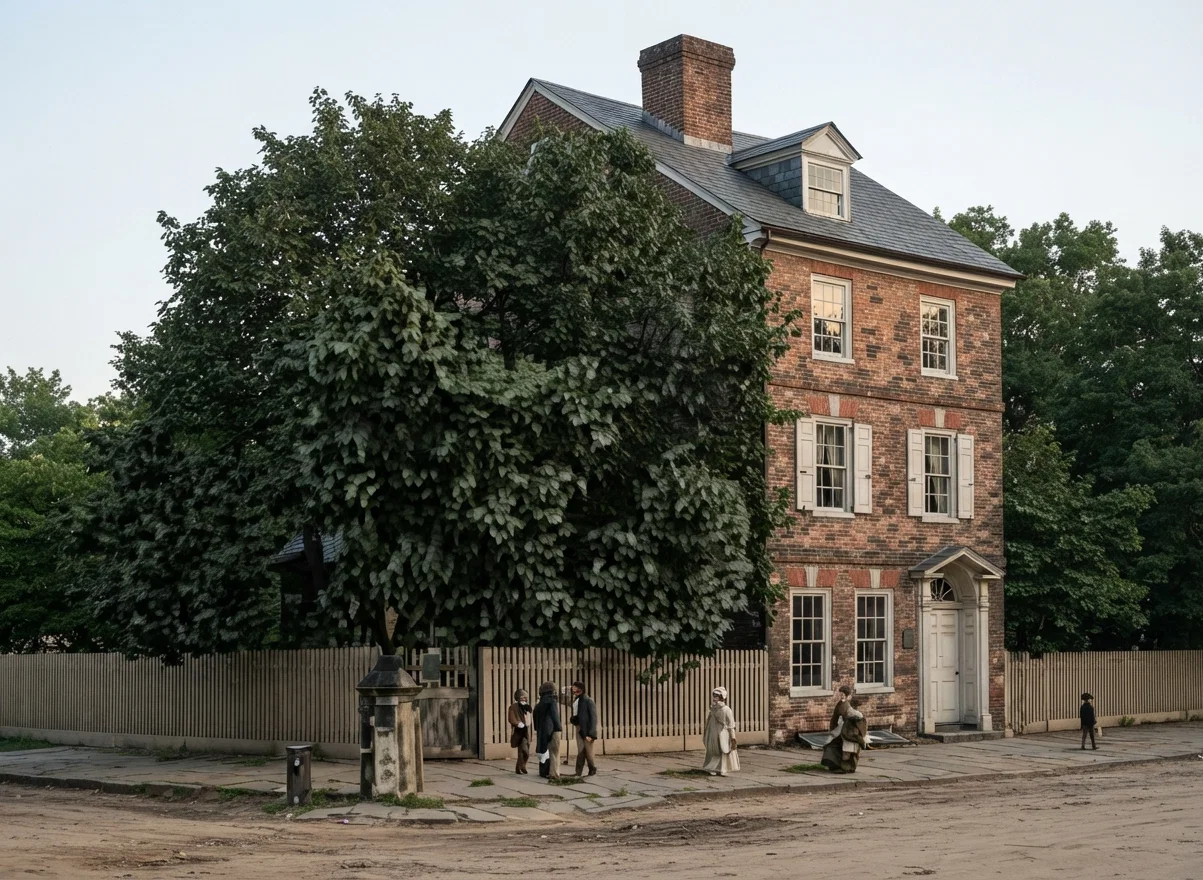
The House of Thomas Jefferson, where the Declaration of Independence was written.
WHEN, in the course of human events, it becomes necessary for one people to dissolve the political bands which have connected them with another, and to assume, among the powers of the earth, the separate and equal station to which the laws of nature and of nature's God entitle them, a decent respect to the opinions of mankind requires that they should declare the causes which impel them to the separation.
We hold these truths to be self-evident, that ALL MEN ARE CREATED EQUAL; that they are endowed by their Creator with certain UNALIENABLE RIGHTS; that among these are LIFE, LIBERTY, AND THE PURSUIT OF HAPPINESS. That TO SECURE THESE RIGHTS, governments are instituted among men, DERIVING THEIR JUST POWERS FROM THE CONSENT OF THE GOVERNED; that whenever any form of government becomes destructive of these ends, it is the right of the people to alter or to abolish it, and to institute a new government, laying its foundation on such principles, and organizing its powers in such form, as to them shall seem most likely to effect their safety and happiness. Prudence, indeed, will dictate that governments long established, should not be changed for light and transient causes; and, accordingly, all experience hath shown that mankind are more disposed to suffer, while evils are sufferable, than to right themselves by abolishing the forms to which they are accustomed. But when a long train of abuses and usurpations, pursuing invariably the same object, evinces a design to reduce them under absolute despotism, it is their right, it is their duty, to throw off such government, and to provide new guards for their future security. Such has been the patient sufferance of these Colonies, and such is now the necessity which constrains them to alter their former systems of government. The history of the present king of Great Britain, is a history of repeated injuries and usurpations, all having, in direct object, the establishment of an absolute tyranny over these States. To prove this let facts be submitted to a candid world:
He has refused his assent to laws the most wholesome and necessary for the public good.
He has forbidden his governors to pass laws of immediate and pressing importance, unless suspended in their operation till his assent should be obtained; and, when so suspended, he has utterly neglected to attend to them.
He has refused to pass other laws for the accommodation of large districts of people, unless those people would relinquish the right of representation in the legislature; a right inestimable to them, and formidable to tyrants only.
He has called together legislative bodies at places unusual, uncomfortable, and distant from the depository of their public records, for the sole purpose of fatiguing them into compliance with his measures.
He has dissolved representative houses repeatedly, for opposing, with manly firmness, his invasions on the rights of the people.
He has refused, for a long time after such dissolutions, to cause others to be elected; whereby the legislative powers, incapable of annihilation, have returned to the people at large for their exercise; the State remaining, in the meantime, exposed to all the danger of invasion from without, and convulsions within.
He has endeavored to prevent the population of these States; for that purpose obstructing the laws for the naturalization of foreigners, refusing to pass others to encourage their migration hither, and raising the conditions of new appropriations of lands.
He has obstructed the administration of justice, by refusing his assent to laws for establishing judiciary powers.
He has made judges dependent on his will alone for the tenure of their offices, and the amount and payment of their salaries.
He has erected a multitude of new offices, and sent hither swarms of officers to harass our people and eat out their substance.
He has kept among us, in times of peace, standing armies, without the consent of our legislature.
He has affected to render the military independent of, and superior to, the civil power.
He has combined, with others, to subject us to a jurisdiction foreign to our Constitution, and unacknowledged by our laws; giving his assent to their acts of pretended legislation.
For quartering large bodies of armed troops among us:
For protecting them, by a mock trial, from punishment for any murders which they should commit on the inhabitants of these states:
For cutting off our trade with all parts of the world:
For imposing taxes on us without our consent:
For depriving us, in many cases, of the benefits of trial by jury:
For transporting us beyond seas to be tried for pretended offenses:
For abolishing the free system of English laws in a neighboring province, establishing therein an arbitrary government; and enlarging its boundaries, so as to render it at once an example and fit instrument for introducing the same absolute rule into these Colonies:
For taking away our charters, abolishing our most valuable laws, and altering, fundamentally, the powers of our governments:
For suspending our own legislatures, and declaring themselves invested with power to legislate for us in all cases whatsoever.
He has abdicated government here, by declaring us out of his protection, and waging war against us.
He has plundered our seas, ravaged our coasts, burnt our towns, and destroyed the lives of our people.
He is, at this time, transporting large armies of foreign mercenaries to complete the works of death, desolation, and tyranny, already begun, with circumstances of cruelty and perfidy scarcely paralleled in the most barbarous ages, and totally unworthy the head of a civilized nation.
He has constrained our fellow-citizens, taken captive on the high seas, to bear arms against their country, to become the executioners of their friends and brethren, or to fall themselves by their hands.
He has excited domestic insurrections among us, and has endeavored to bring on the inhabitants of our frontiers the merciless Indian savages, whose known rule of warfare is an undistinguished destruction of all ages, sexes, and conditions.
Old Ephrata Press on which the Declaration was printed.
In every stage of these oppressions, we have petitioned for redress in the most humble terms; our repeated petitions have been answered only by repeated injury. A prince whose character is thus marked by every act which may define a tyrant, is unfit to be the ruler of a free people.
Nor have we been wanting in attention to our British brethren. We have warned them, from time to time, of attempts made by their legislature to extend an unwarrantable jurisdiction over us. We have reminded them of the circumstances of our emigration and settlement here. We have appealed to their native justice and magnanimity, and we have conjured them, by the ties of our common kindred, to disavow these usurpations, which would inevitably interrupt our connections and correspondence. They, too, have been deaf to the voice of justice and consanguinity. We must, therefore, acquiesce in the necessity which denounces our separation, and hold them, as we hold the rest of mankind, enemies in war, in peace friends.
We, therefore, the Representatives of the United States of America, in General Congress assembled, appealing to the Supreme Judge of the world for the rectitude of our intentions, do, in the name and by the authority of the good people of these Colonies, solemnly publish and declare, That these United Colonies are, and, of right, ought to be, FREE AND INDEPENDENT STATES; that they are absolved from all allegiance to the British crown, and that all political connection between them and the State of Great Britain is, and ought to be, totally dissolved; and that, as FREE AND INDEPENDENT STATES, they have full power to levy war, conclude peace, contract alliances, establish commerce, and do all other acts and things which INDEPENDENT STATES may of right do. And, for the support of this Declaration, with a firm reliance on the protection of Divine Providence, we mutually pledge to each other our lives, our fortunes, and our sacred honor.
What They Say.
When religionists in America are beginning to talk of tolerating or not tolerating those who do not agree with them, it is well to recall just what the original American principle is. Here are a few excerpts worth reading:—
There is a very great difference between toleration and liberty. Toleration is a concession which may be withdrawn. It implies a preference for the ruling form of faith and worship, and a practical disapproval of all other forms.—Schaff's Church and State in the United States, p. 14.
The free exercise of religion, according to the dictates of conscience, is something which every man may indeed demand as a right, not something for which we must ask a privilege. To grant to the State the power of tolerating is implicitly to grant to it the power of prohibiting.—Appleton's Cyclopedia of American Biography, vol. 4, p. 165.
Toleration denotes neither the freedom from State control nor the equality of all religions before the law. Toleration is the allowance of11that which is not wholly approved. Religious liberty, on the other hand, is absolute freedom of religious opinion and worship.—Thompson's Church and State in the United States, p. 12.
What other nations call toleration we call religious rights. They are not exercised in virtue of governmental indulgence but as rights, of which government can not deprive any portion of citizens however small. Despotic power may invade those rights, but justice still confirms them.—U. S. Senate Report, 1829.
The framers of the U. S. Constitution recognized the eternal principle that man's relation with his God is above human legislation, and his rights of conscience inalienable. Reason was not necessary to establish this truth; we are conscious of it in our own bosoms. It is this conscientiousness which, in defiance of human laws, has sustained so many martyrs in tortures and in flames. They felt that their duty to God was superior to human enactments, and that man could exercise no authority over their consciences. It is an inborn principle which nothing can eradicate. The bigot, in the pride of his authority, may lose sight of it; but strip him of his power, prescribe a faith to him which his conscience rejects, threaten him in turn with the dungeon and the fagot, and the spirit which God has implanted in him rises up in rebellion and defies you.—U. S. Senate Report, 1829.
Roman Catholic Indian Schools Denied the Use of Indian Treaty Funds.
By John D. Bradley
By John D. Bradley.
THE violation, especially on behalf of the Roman Catholic sect, of the spirit and letter of the repeated declaration of Congress enforcing the principle of separation of Church and State with respect to public money and sectarian Indian schools, has at last been brought face to face with the law in court and given a severe blow. A decision to the effect that while Indian "trust funds," or the interest thereon may, upon the request of the Indians for whom held in trust, be applied to the education of Indians in sectarian schools, "treaty funds," which are made up of moneys appropriated by Congress annually to carry out treaty stipulations of the government with the Indian tribes, CAN NOT BE LEGALLY PAID BY GOVERNMENT OFFICIALS TO SECTARIAN INDIAN SCHOOLS, was rendered in the Supreme Court of the District of Columbia by Justice Gould on April 4.
This important decision was rendered in a test case raised by the suit of Reuben Quick Bear and other Sioux Indians to restrain Indian Commissioner Leupp, Secretary of the Interior Hitchcock, and other government officials from paying $27,000 out of the treaty funds of that tribe on a contract "with the Catholic Indian missions for the education of Sioux Indians." The suit was begun under the auspices of the Indian Rights Association of Philadelphia, which organization has been keeping a close eye on the diversion of money from the public fund of the Indians to Roman Catholic schools. It contended that under the declaration made by Congress in the Indian appropriation act of 1896 and repeated in that of 1897 in the words, "It is hereby declared to be against the settled policy of the government hereafter to make appropriation for education in any sectarian school," the government or its officials could not make payments of any kind for education in sectarian schools.
The association was represented at the hearing of the case by Charles C. Binney of Philadelphia; Edgar H. Gans, a Baltimore lawyer and a prominent Roman Catholic layman, appeared as counsel for the Roman Catholic Indian Bureau, which, of course, was opposed to the contention of the Indian Rights Association. The Federal officers were represented by District Attorney Baker, who also is a Roman Catholic, and Assistant District Attorney McNamara, from whose name it is pretty safe to infer that he also is a Roman Catholic. After pointing out that the treaty funds arise from obligations, including education, assumed by the United States toward the Indians in consideration of certain concessions and agreements, and that they are not fixed and definite sums but are in the form of appropriations by Congress from year to year for the fulfilment of the obligations assumed by treaty, Justice Gould decided for the plaintiffs and upheld the contention of the Indian Rights Association so far as treaty funds are concerned in this language:
"Now, it seems to me that this sum, which is annually appropriated in accordance with the obligations of Article Seven of the treaty, is an appropriation by Congress within the meaning of the terms of the acts of 1896 and 1897, which declared that hereafter no appropriation whatever for education in any sectarian school shall be made. The obligation which was imposed upon the United States, or which the United States imposed upon itself, in entering into this treaty with the Indians, was not a legal obligation in the strict sense. It was susceptible of change at any time on the part of the United States—the United States might violate it entirely. It seems to me this money, which was annually appropriated in the execution of the treaty obligation, which is called the treaty fund, is an appropriation within the meaning of the inhibition of the acts of 1896 and 1897, and thus is not such a fund as can be applied by the executive officers to the payment of the obligations contracted for in this contract of July 1, 1905."
But with respect to the moneys known as the trust funds, which are fixed amounts held in trust by the government for the Indians, and which in the case of the Sioux is $3,000,000, the justice held that the interest thereon could, at the request of the Indians, be paid for education in sectarian schools. He held that this is not prohibited by the Congressional declaration of 1896 and 1897 on the ground that such payment, requiring no act of Congress, is not payment by Congressional appropriation.
This may conform to a strict construction of the declaration of Congress, but it is exceedingly doubtful if it conforms to its spirit and intent. It is said that the opinion of Justice Gould, in substance, "upholds a view taken by President Roosevelt in 1905, when the President decided that the government could legally use the trust funds for education in sectarian schools, but that there was considerable doubt as to the propriety of a similar use of the treaty funds, and ordered that payments on the contract be suspended until a decision be rendered by the court."
This order by the President was doubtless caused by the protests of the Indian Rights Association against the diversion of public moneys to sectarian schools, which the President, at the solicitation of Roman Catholics, had himself permitted and authorized, and which he has continued to permit and authorize with respect to trust funds.
But the declaration of Congress on this subject was a declaration of policy and principle not merely for itself but for the entire government, a declaration of "the settled policy OF THE GOVERNMENT," and so, notwithstanding the view of the President and of Justice Gould, it is certain that in so far as the government or any of its departments or officials control the trust funds of the Indians their diversion to sectarian schools is in violation of what Congress has enacted into law as the settled policy of the government in the matter. But as it is, it is said that this ruling of the Supreme Court of the District of Columbia will affect "practically all the Catholic Indian mission schools, as well as many Protestant schools, operating among the Indian tribes of the West. Some of them will find their revenues seriously interfered with hereafter." We are told that while both are affected, Roman Catholics will be much more "seriously" affected than Protestants. Which serves to indicate the extent to which the declaration of Congress enforcing the principle of separation of Church and State with respect to public moneys and sectarian Indian schools has been disregarded and violated in one phase in which the violation is perfectly plain and unmistakable, and also as to what sect has been chiefly favored and has chiefly profited by this violation.
Canada's Rigorous Sunday Law.
THE new Sunday law of the Dominion of Canada, passed at the solicitation of the religious champions of Sunday observance at last year's session of the Dominion parliament, and perhaps the strongest measure that has been enacted in any country in Christendom in the last half century, went into effect on March 1. It is said to penalize "every kind of secular, commercial, and industrial activity, except the running of drug stores, livery stables, and boat-houses." "Severe penalties for violation of the law are prescribed against persons who direct Sunday work to be done as employers, as well as against those who do it. While it is intended to discourage Sunday passenger trains, work in connection with the transit of passengers and mails and the operation of ferry lines and drawbridges is classified with the supplying of gas, water, and electricity, the maintenance of fires and power plants, and carrying perishable products, and the making of maple sugar as 'works of necessity and mercy.' The Dominion railroad commission may on application authorize Sunday work in connection with freight traffic, and crews may handle cars in yards certain hours. But all excursions and entertainments which charge an admission fee outside of churches are forbidden. The operation of street-car companies is left to be governed by provincial or municipal legislation.
"The discrimination against Sunday newspapers is so severe that one is inclined to suspect this to be a main purpose of the law. There are few Sunday newspapers in Canada, most of those read there being imported from the United States. This importation is prohibited as well as the sale and distribution of domestic Sunday papers, and no work can be done on the Monday morning issue before 6 P.M." The penalty for the violation of the provision relating to newspapers is a fine of $250 or two months in jail.
A meeting of Canadian newsdealers was held in Toronto on March 9 to see what plan, if any, could be devised for handling American Sunday newspapers, but "the legal advice was that no loophole existed by which the papers could be paid for in advance or on Monday and given or delivered in rooms or at the homes of customers on Sunday." It is doubtful if there will be a literal enforcement of the law, at least for any length of time. It is said to be "full of loopholes and contingent exceptions." The most important and significant of these is "the curious provision that no prosecutions shall be begun under the act without the consent of the attorney-general of the province in which the prosecution is to be made. This gives that functionary power to enforce the act in full, in part, or not at all, as he may elect."
Great Northern Train Wreck
A broken rail plunged a train of nine cars down a 220-foot embankment of the Great Northern Railway near Palermo, N. D., June 15. Seventeen persons were injured and all but the mail car burned.
"Financial Insanity."
By Christian Advocate
An ex-"prosperous business man" of Massachusetts was tried in the United States Court on the charge of criminally concealing his assets from his trustee in bankruptcy. Insanity "experts" claim that he was affected with a "mania for spending money, and that he had no idea where it went." His counsel set up the plea that he suffered from "financial insanity," and the jury acquitted him. Whereupon the District Attorney moved that the accused be committed to an asylum. But the court denied the motion, on the ground that "the defendant was not legally insane." It bodes no good when the courts of justice become a laughing-stock; but they will soon become so, unless there is a general reformation concerning modes of trial, order in the courts, and the morale of juries, as well as the rectification of the laws where they are full of holes for criminals.—Christian Advocate.
A Significant Missionary Council in Switzerland.
By Jean Vuilleumier
ON the shores of Lake Geneva, half way between Lausanne and the city of Calvin, an important missionary council has just been holding session for two entire weeks. It was the biennial meeting of the Seventh-day Adventist General Conference Committee.
About fifty small tents and two circular tents were pitched on the romantic grounds of the Latin Union Sanitarium and School for evangelists. Emblematic of the beauty and grandeur of the work to be considered, were Lake Geneva with its everchanging colors and the majestic summits of the Alps with Mount Blanc's silvery mass in the center.
The motto of the council was: "The Gospel to all the world in this generation," with this other one as the secret and all-powerful motive power: "Receive ye the Holy Ghost."
No clearer evidence could be given of the earnestness with which this assembly of missionaries considered their God-given task than to mention the countries represented and the fields reported from. About twenty workers, among them twelve members of the General Conference Committee, had crossed the ocean to represent all the parts of North America. Eighty more workers, among whom four were also members of the General Conference Committee, represented Europe and the Orient.
Three members of the General Conference Committee, residents of America, were just back from world-wide tours of inspection to visit far-off fields. W. W. Prescott, editor-in-chief of the Review and Herald and professor at the Washington Missionary College, had been to Japan, Korea, and China. G. B. Thompson, chairman of the Sabbath-school Department, had visited India and Burma. And G. A. Irwin, vice-president of the General Conference, had attended the general meetings in Australia and Africa.
The following countries of Europe were represented by the above mentioned workers: England, Scotland, Ireland, Sweden, Norway, Denmark, Iceland, all parts of Prussia, Wurtemberg, Grand Duchy of Baden, Bavaria, Russia, Austria, Hungary, Bulgaria, Italy, Spain, Portugal, France, and Switzerland.
Every one of these fields was heard from. From every one came cheering evidences of the progress of the work and of the conquering and sanctifying power of the everlasting Gospel in this age of pleasure and infidelity. From Southern Europe, Africa, India, China, and Japan came stirring and pitiful appeals for help to push the triumphs of the Cross and hasten the glorious coming of the King of Kings in order to restore all things.
And now, as the representatives of the largest and strongest constituencies have returned to America, their hearts filled with these appeals, may those who shall hear them be so moved upon by the Spirit of God, that they shall place themselves and all they have on the altar of sacrifice, and thus come up to the help of the Lord in one last, grand missionary campaign over the whole world, "and then shall the end come." "Even so, come, Lord Jesus."
JEAN VUILLEUMIER.
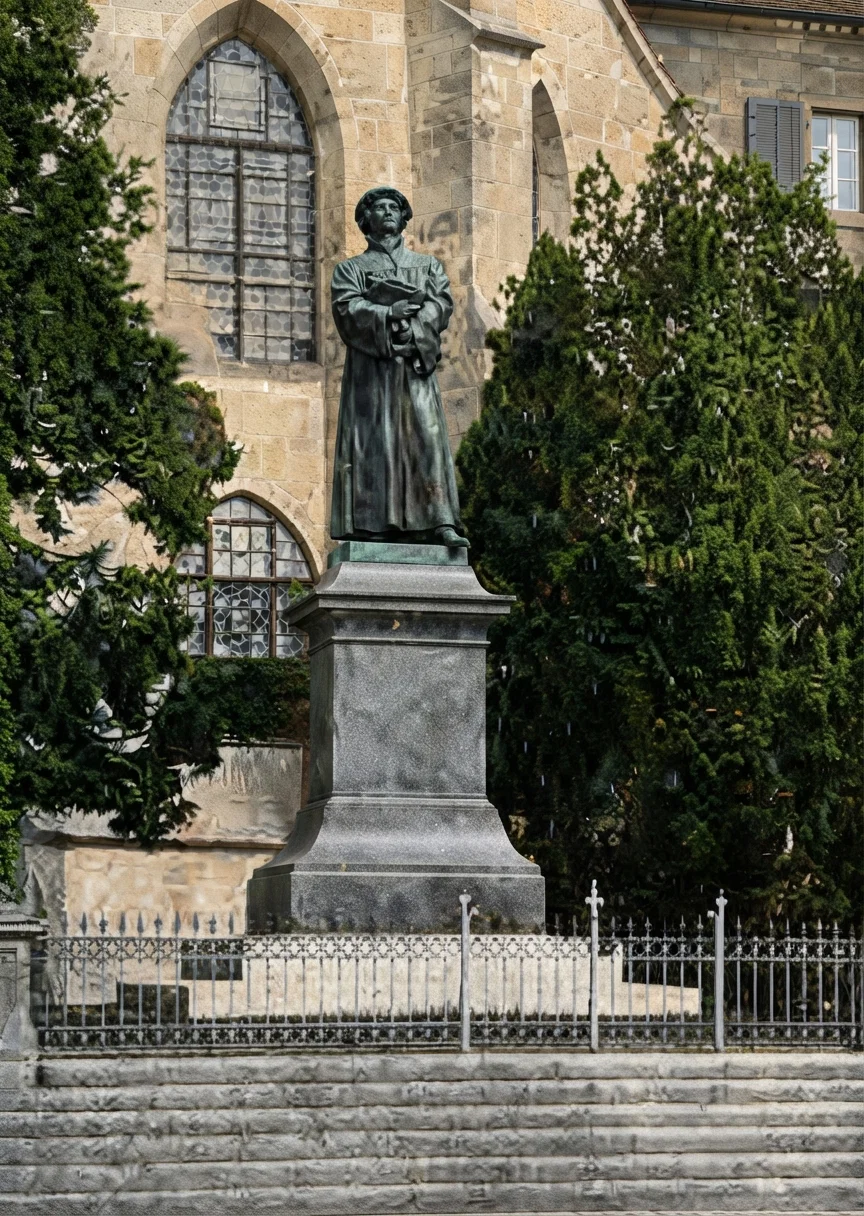
Statue of Zwingle, the Great Swiss Reformer, at Zurich, Switzerland.
Where There's a Will.
By Eleanor Root
(By Eleanor Root in S. S. Times.)
NOT long ago in one of our Eastern cities, prizes were offered by a benevolent and wealthy lady for the most thrifty plants grown in a certain congested district in the slums. On the day appointed for the awards, the committee began their tour of inspection. Their eyes and hearts were gladdened by the evidence of conscientious efforts at gardening in the little, restricted plots of ground, but not until the close of the day did they come across the two prize winners.
The first prize was given to a little girl, who, daily, after she had planted the seed, climbed a ladder to the roof of the poor shed where she lived, to water her pet and loosen the earth about its roots. She had no portion of ground, no sunny window in which to place it. This was all she could do. But the plant rewarded her love and care by sending out luxuriant foliage and handsome blossoms, a wonder and delight to all who saw it.
The second prize was given to a man who likewise had no plot of ground. In a broken place in the pavement about the tenement where he lived, he planted a sunflower seed. The soil was a poor clay, but he dressed it, and with the utmost care fostered the tiny green shoot which soon appeared, until it had become the glory of the alley, lifting its head regally almost to the second story windows on either side.
Our Work and Workers.
By Editor
AT Bartley, Neb., Brother Chas. Thompson baptized nine on Sabbath, May 18.
BROTHER J. W. Boynton reports four accessions to the truth at Stettler, Alberta.
FIVE have been added to the little company at Canton, Kan., thru the labors of Brother A. S. Bringle.
THREE members of the Soldier's Home in Grand Island, Neb., were baptized early in May by Brother J. K. Kroeker.
BROTHER C. H. KESLAKE reports that since the beginning of the year nine have accepted the truth in Newfoundland.
ON June 2, the last day of the Merced (Cal.) camp-meeting, twenty precious souls were buried with their Lord in baptism.
OUR workers in India are spending all the time possible in learning the native languages, that they may work with the people directly.
BROTHER W. F. MARTIN reports in the Montana Bivouac the baptism of three at Butte and the organization of a church of nine members at Rollins.
SIX of Sister Eva Hough's Bible readers in Kansas City, Mo., have decided to keep the commandments of God and walk in the light of His truth.
BROTHER W. C. DALBEY, M.D., has been holding Sunday-night meetings at St. John's, Ill., and as a result six have given themselves to the Lord. A Sabbath-school was organized June 1.
THE Nebraska Conference headquarters will be located in Hastings, Neb., as soon as buildings can be erected. There will also be a branch of the Nebraska Sanitarium established there.
BRETHREN S. T. HARE and A. Whitehead have just closed a series of meetings in Redlands, Cal. Twelve have been baptized and fifteen have united with the church as a result of their labors.
THE Denver (Colo.) church witnessed the baptism of six precious souls June 2, Brother G. W. Anglebarger administering the rite. Several others, mostly young people, were baptized June 15.
THRU work with the Family Bible Teacher in Flint, Mich., Brother B. F. Stureman has brought the light of truth to many of his readers, five of whom have taken a decided stand for the truth.
AT the fortieth annual session of the Iowa Conference, May 31 to June 8, $5,000 was voted to be used for foreign missions. In addition to this, $2,500 was raised on the grounds in cash and pledges.
TWENTY-EIGHT were baptized in the Mississippi river, Sabbath, June 8, the last Sabbath of the Minnesota camp-meeting, held at St. Cloud. S. E. Jackson was elected president of the conference; C. M. Everest, vice-president; Wm. Asp, treasurer.
BROTHER H. H. WILCOX, an aged minister of the Gospel, suffered the loss of his home at Norwood, N. Y., May 15. Having given his life to the work of the ministry, he is not rich in this world's goods. If any of our readers feel disposed to help him rebuild his home, it will be appreciated.
Wanted for Missionary Work.
THE following desire papers for missionary work:
JOHN REID, 1311 North 10th St., Tacoma, Wash. Any denominational periodicals and tracts.
J. S. KILLEN, 183 Flint St., Asheville, N. C. SIGNS.
RUTH WIGHTMAN, General Delivery, Reno, Nev. SIGNS for use in mining camps.
ETHEL HALFRICH, 1823 Dorr St., Toledo, Ohio. SIGNS, Watchman, Instructor, Life Boat, tracts on Sabbath question.
MRS. JAS. F. WOODS, 322 S. Detroit St., Warsaw, Ind. SIGNS and Watchman.
SIGNS, Watchman, Life and Health, Liberty, and tracts will be carefully used by George X. Bell, Louray, S. C., care Dr. W. B. Monsen.