Your ShelfYour Projects

Signs of the Times, Vol. 27, No. 19.

FURNITURE OF THE SANCTUARY

Signs of the Times

May 8, 1901

Pacific Press Publishing Company · Oakland, California · May 8, 1901

FURNITURE OF THE SANCTUARY.
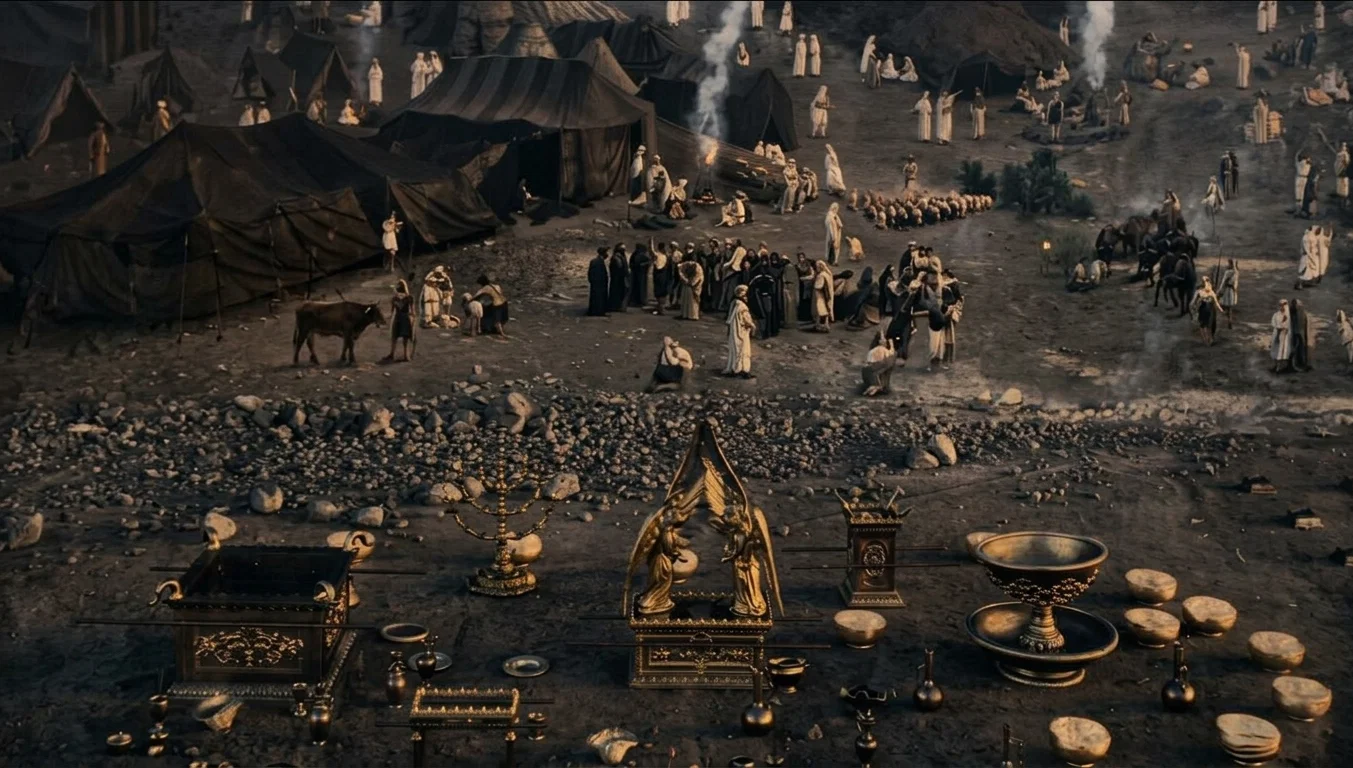
The Hebrew sanctuary was divided into two apartments. This was done by stretching a curtain from side to side, thus dividing the space within the building into what were called the holy and most holy places. Ex. 26:33. The Bible does not definitely state the dimensions of these two apartments; but by reference to a description of the temple sanctuary, which succeeded the one built in the wilderness of Sinai, it is seen that the most holy place in it was a perfect cube. 1 Kings 6:20. It has been concluded from this that the corresponding apartment in the first sanctuary must have been in the same proportion. As the earlier sanctuary was fifteen feet in height and width and forty-five feet in length, this would require the most holy place to occupy fifteen feet of the rear end of the sanctuary, and the front apartment, or holy place, thirty feet.
The Various Articles of the Sanctuary Furniture Shown in the Foreground.
The larger, which was the outer apartment, had, as furniture, a table, which stood at the north side of the room just inside the door; a seven-branched candlestick stood directly across the way, close to the south side of the apartment, while in the back part of the room, and in the center, stood the altar of incense. Back of the second vail, or curtain, and in the center of the most holy place, was located the ark, containing the Ten Commandments engraved in stone. Ex. 40:20-26.
The table in the outer apartment was to hold what was called “showbread.” This consisted of twelve large cakes, baked from fine flour, and arranged in two rows of six cakes each. Each Sabbath morning the stale cakes were replaced by fresh ones, and the priests ate the discarded bread. Lev. 24:5-9. These cakes were for a memorial, to turn the minds of the people toward the goodness of God in providing for the tribes. The loaves, twelve in number, indicated that every tribe was to be individually looked after in the way of heavenly sustenance. Being freshly placed in position every Sabbath morning, they were also a pledge of renewed blessings from heaven on that best day of the seven, to be continued all thru the week. But beyond all this, these loaves kept in mind the promise of that Bread of God's life, who was yet to come and restore all things. John 6:33-35, 51, 56. It was truly bread thru which God was revealed to the Hebrew nation, hence was appropriately named “showbread.”
To make the candlestick, or lamp, required a talent of pure gold, which was nearly twelve pounds Troy weight. It consisted of a main stock, with six branches, extending outward, and gracefully rounding upward from two sides to the same height as the main stem, all being similarly ornamented. Each of these was crowned with a bowl for the reception of oil, which was to be kept burning perpetually. Ex. 25:31-33; 27:20.
The practical significance of the sanctuary candlestick can not be overestimated. Christians are now called temples of God. 1 Cor. 3:16, 17; 6:19. Jesus, the light of the world (John 8:12), thru the constant exercise of faith, is expected to have His abode with these. John 14:1-3, 16, 17; 17:23. This constitutes each believer a light in the world. Phil. 2:15. It is the duty of every one, as the curator of his personal temple of the Lord, to keep the lamp supplied with the oil of grace and gladness, that his light may not grow dim. As God produced the source of supply for the pure olive-oil burned in the Hebrew sanctuary lamp, so now He liberally provides a constant supply of material with which to keep the Christian's lamp ablaze.
This assurance is found in the vision of Zechariah. Looking down the stream of time thru prophetic eyes, he saw an olive-tree on each side of a candlestick, which emptied oil of itself thru a golden pipe, or tube, for the supply of the candlestick. Upon inquiry as to the meaning of this singular sight, the prophet was informed thatthe two olive-trees represented “two anointed ones [sons of oil, margin] that stand by the Lord of the whole earth.” Zech. 4:11-14.
So, then, fresh supplies of heavenly oil from God come constantly to every one whose vessel is ready to receive it, conducted thru the golden tube of communication which has been established between heaven and earth. The Lord Jesus is said to walk in the midst of the seven golden candlesticks (Rev. 2:1), as tho He would supply them with material for light. But He says to those who have ceased to care for the light within themselves, “Remember therefore from whence thou art fallen, and repent, and do the first works; or else I will come unto thee quickly, and will remove thy candlestick out of his place, except thou repent.” Verse 5. Surely grave responsibility rests on all who become connected with our great High Priest, who walks among men to see who lives in the light of heaven's kindling.
J. O. CORLISS.

THE CONSTITUTION AND LAW OF THE KINGDOM OF HEAVEN.

The constitution of the kingdom of heaven is the divine nature. To this even the Creator of all things is subject. “If we believe not, yet He abideth faithful; He cannot deny Himself.”
The law of the kingdom is the will of God. “My Father,” said the Saviour, “is greater than I.” And again: “I seek not Mine own will, but the will of the Father which hath sent Me.” And finally, when the great controversy between Christ and Satan is over, and all things shall have been subdued to God, “then shall the Son also Himself be subject unto Him [the Father] that put all things under Him [the Son], that God [the Father] may be all in all.” 1 Cor. 15:28.
The Father’s will is Christ’s law even now; and that it is equally the law of the humblest subject of the kingdom we know from the words, “Not every one that saith unto Me, Lord, Lord, shall enter into the kingdom of heaven; but he that doeth the will of My Father, which is in heaven.”
The will of God—the law of His kingdom—is revealed in many ways. That will is just what God is, and every revelation of what God is, is in the nature of a transcript of His character. Such revelation was made first of all in nature. “The heavens declare the glory of God,” says the psalmist. God’s glory is not the visible brightness of His face; that is only the outward manifestation of His character, which is His real glory. And it would have meant just what it does now had the psalmist said, The heavens declare the character of God.
Again, God’s character is revealed in His written Word, especially in the “ten words,” the law given on Sinai. They are a transcript of what God is, of His righteousness. “Hearken unto Me, ye that know righteousness, the people in whose heart is My law.” Isa. 51:7. And again we have the words of the psalmist, “All Thy commandments are righteousness.” Ps. 119:172.
But neither in the brightness of the noon-day sky, nor in the azure dome set with countless suns, nor in the “bands of Orion;” nor in the beauty of the Pleiades, nor in the Milky Way, nor in the depths yetunexplored by unaided human eyes,—in none of these could fallen man find out God.
And then God spoke again—spoke “unto the fathers by the prophets;” yea, from Sinai’s smoking top His own voice was heard in mighty thunderings, declaring His righteousness, giving His law, that men might know and do His will. But still man was slow to learn, slow to discern God. Something more was needed than the law in rolling thunders, or written on tables of stone. And so God said, “I will put My law in their inward parts, and write it in their hearts.” And to do this the Creator first of all made that law—His Word—flesh, and sent Him to dwell among men, that that same law might become a part of every man who would open his heart to receive it.
Only those who love the divine law can keep it; and only those can love it who love its Author; and only those can love its Author who know Him. But “no man knoweth the Father save the Son, and he to whomsoever the Son will reveal Him.” Therefore, that man might know God, and knowing Him might love Him, and loving Him might love and keep His law, “God sent forth His Son, made of a woman, made under the law, to redeem them that were under the law, that we might receive the adoption of sons.”
Christ does not despise nor take the place of the law once spoken amid the thunders of Sinai and graven on tables of stone. He is the law, the living Word made flesh; for it is written: “In the beginning was the Word, and the Word was with God, and the Word was God. The same was in the beginning with God. . . . And the Word was made flesh, and dwelt among us.” John 1:1, 14.
“And in His life the law appears, Drawn out in living characters.”
The individual sinner is by conversion delivered from “the power of darkness,” and is translated “into the kingdom of His [God’s] dear Son.” Col. 1:13. Christians, tho in this world, are not of it; they are only sojourners. The apostle Peter says, “I beseech you as strangers and pilgrims.” 1 Peter 2:11. Again, in Phil. 3:20, R. V., we are told by the apostle Paul, that “our citizenship is in heaven.”
As the child of God is a citizen of the kingdom of heaven, the law of that kingdom is his law. Every act of his life is done with reference to the law of the kingdom to which he belongs. “Whether therefore ye eat, or drink, or whatsoever ye do, do all to the glory of God.” 1 Cor. 10:31. Therefore in rendering to Cæsar that which is Cæsar’s we are exhorted not to do it from fear of punishment, but “for conscience sake.” Rom. 13:5.
The Christian—the citizen of the kingdom of heaven—does not regulate a part of his conduct by one law and part by another, but because “the law of his God is in his heart, none of his steps shall slide.” The man of whom this is true will love his neighbor as himself, and “love worketh no ill to his neighbor.”
Apropos to this subject is the following from the author of “Arius the Libyan:” —
“The only relation which these Christians sustained to the ‘government’ of Cyrenaica, or to that of Rome, was to pay the taxes demanded of them; and they had no concern as to who might be emperor or proconsul, except so far as these rulers might be disposed to persecute the Christians, or otherwise. They paid taxes to avoid giving offense; . . . but they never acknowledged the Roman authority in any other way.”
“They never had recourse to any temporal penalties to enforce the law of Christian brotherhood; knowing that no one who refused to be controlled without the use of force was a Christian, they publicly disowned him, and that was the end of it. . . . They were citizens of a kingdom in but not of the world, desiring to be at peace with all worldly kingdoms.”
“They knew that Jesus proclaimed a good news, or Gospel, for the poor, the very foundation-stone of which is the absolute equality, liberty, and fraternity of man. And they learned from the same divine Teacher that kings, lords, nobles, all personal and class distinctions among men, are mere creations of legal fiction, sustained by unjust force, like slavery and piracy, and do not exist in the nature of things or by the will of God. . . . Hence, in place of teaching men a better slave code than the world had known before, Jesus taught freedom for all men. In place of teaching a more effective art of war, He proclaimed the Gospel of peace, love, justice. In place of ordaining only more wise and just regulations for governing the intercourse of men with their female chattels, He elevated monogamic marriage into a holy sacrament, and applied to man and wife alike the same divine law of personal rights, duties, and responsibilities. In place of teaching better laws for the government of men by other men as erring, sinful, and selfish as themselves, He taught that all such laws and government are unnecessary to any people who believe that there is something more sacred, higher, and holier than private rights, and are willing by faith to renounce all human, statutory advantages in order to acquire divine truth.”
“So in beautiful Cyrenaica, while Greek and Roman, Egyptian and Jew, concerned themselves about politics, and struggled for offices, and toiled beyond measure for useless gain, the Christian communities pursued the calm and even tenor of their way, meeting on every Sabbath for religious services and instruction; closing each week-day’s labor with a pleasant formula of evening prayer; training up their sons and daughters to despise all the false statutory and customary distinctions and vanities of worldly life, ‘after which the Gentiles seek;’ teaching them to seek knowledge, especially the knowledge peculiar to their faith; to love all men, especially the brethren; and to regard this earthly life as but the threshold of a higher, holier, and more perfect state of being that lay only a few brief, fleeting years away from every one of them.”
O, that the church might return again to the simplicity of the Gospel of our Lord and Saviour Jesus Christ, and to loyalty to the law of His kingdom.
C. P. Bollman.

FAITHFULNESS IN SERVICE.

God so loved the world, that He gave His only-begotten Son, that whosoever believeth in Him should not perish, but have everlasting life. For God sent not His Son into the world to condemn the world, but that the world thru Him might be saved. He that believeth on Him is not condemned; but he that believeth not is condemned already, because he hath not believed in the name of the only-begotten Son of God.”
Life is a manifestation of God’s love. It is a talent which God has committed to our care, and it is a very costly talent, as viewed in the light of the sacrifice of God’s Son. It is an expression of the ownership of God. We are His by creation, and doubly His by redemption. We derive life from Him. He is the Creator and the Source of all life. He is the Author of the higher life which He desires the beings formed in His image to live.
All nature is alive. Thru its varied forms of life it speaks to those who have ears to hear and hearts to understand; it speaks of Him who is the source of all life. Nature reveals the wonderful working of the Master-Artist.
Man is the highest and noblest of all God’s creatures. In the beginning, man was made in the image of God. God said: “Let us make man in our image, after our likeness. . . . So God created man in His own image, in the image of God created He him.” He formed us for His glory, and He desires us in every word and act to acknowledge this.
Life is to be regarded as a solemn, sacred trust. Those who have an understanding of their relation to God will carefully study the responsibilities of life, remembering that God desires human beings to place upon themselves the estimate He has placed upon them. Individually we shall be called to give an account in the Judgment for the way in which we have treated the talent purchased for us at so great a cost. No one with reasoning ability will be excused for neglecting to return to God His own. Improve your talents by exercise. Double them by using them in God’s service. As you do this, you will reveal to a world sunken in sin a character in accordance with the character of God. Those who do not live the life of Christ here below fail of reaching the mark of the prize of their high calling.
God has made every provision to enable us to reach the standard which He has placed before us. Christ died in order that we might be partakers of the divine nature, and thus escape the corruption that is in the world. God wants us to live on the plan of addition outlined in the first chapter of Second Peter. Constantly we are to press onward and upward. Our religion is to be progressive.
God calls for that which many refuse to give Him,—the highest, holiest service. He desires us to acknowledge our relationship to Him, to realize that we are His. Link your life with His. Live out the high principles which He came to this earth to reveal. Accept the invitation: “Take My yoke upon you, and learn of Me; for I am meek and lowly in heart, and ye shall find rest unto your souls. For My yoke is easy, and My burden is light.” When you accept this gracious invitation, you are sustained by One who has an inexhaustible supply of grace.
Remember that you are kept by the power of God. Give yourself to Him. You need no one to tell you how to do this. God is drawing you to Himself. Give up your will, your mind, your whole being, in submission to Him. He is knocking at the door of your heart, waiting to enter. Will you let Him in?
Christ has made every provision that we shall reach the ideal set before us. He left His exalted position in heaven, laying aside His royal robe and kingly crown, and clothing His divinity with humanity, that He might help those in need of help. He became poor, that we might come into possession of eternal riches. He says to us, “Whosoever will come after Me, let him deny himself, and take up his cross, and follow Me.” These are the terms of discipleship.
Christ is our example. “Learn of Me,” He says. These are stepping-stones on which we may safely plant our feet in following Him. But those who enter the service of the world are not following as He leads the way. It is impossible to please God and gain the friendship of the world at the same time. Let us not bind ourselves to the world with the cords of ambition. An ambition to serve God is wholly necessary; but an ambition fed by worldly ideas will bring failure after failure. Christ has never directed us to go to the world for wisdom and success. In Him we live and move and have our being, and to Him we are to go for help.
When a physician promises to do all in his power to save the life of a sufferer, he does so on condition that the patient complies with his directions. And those who engage in the work of God must meet Him, not on their ground, but on His ground. They must comply with the conditions on which He proposes to deal with His human agents. They must give cordial assent and willing obedience to His terms.
The prodigal was welcomed to his father’s house; but in order to enjoy the privileges of a son, he must comply with the conditions of sonship. The Gospel testifies that God in His boundless love for man assumed humanity in the person of His Son. Christ has made a propitiation for the sins of the whole world. He will co-operate freely and willingly with those who will receive Him as their Saviour. He is not far from any one of us. He will gladly receive all who will renounce the favor and friendship of the world, and make Him their all and in all. He calls upon us to walk in accordance with His Word. He says to us, “Ye are My friends, if ye do whatsoever I command you.” Our friendship with Him is measured by His dominion over us.
To acknowledge Christ as King, to submit to His authority, to consult His will, to make His law the rule of life, to be bound by His requirements, to make His life our Pattern, to obey the stern precepts of His Word, to deny self for His glory, to be willing to make any sacrifice for His sake,—this is the duty and privilege of the Christian. Christ enjoins His followers to be ready to part with all for His sake. This is contrary to human inclinations, and thus Christ tests His disciples. If He is received at all, it must be as King. If He enters the soul, it must be to reign. MRS. E. G. WHITE.

THE HOME OF THE SAVED.

(Concluded from last week.)
In closing this paper, additional testimony will be introduced in proof that the earth is the promised home of the saints, and scriptures will be selected which emphasize the truth that it is to be their final or permanent home.
It does not appear reasonable to conclude that after so great a price has been paid to redeem the purchased possession,—that after Christ has destroyed the works of the devil from the dominion and made of it a new earth wherein dwelleth righteousness, it should be but a temporary abode of the saints; nor is it Scriptural. Our Saviour says, “Blessed are the meek; for they shall inherit the earth.” Matt. 5:5. The psalmist bears the same testimony, adding this phrase, “and dwell therein forever.” Ps. 37:29. The prophet Isaiah writes, “Thus saith the Lord that created the heavens; God Himself that formed the earth and made it; He hath established it, He created it not in vain, He formed it to be inhabited.” Isa. 45:18. David by the Spirit tells us by whom it was formed to be inhabited: “The heaven, even the heavens, are the Lord’s; but the earth hath He given to the children of men.” Ps. 115:16. The wise man bears this testimony concerning the permanency of the purposes of God: “I know that whatsoever God doeth, it shall be forever.” Eccl. 3:14. The same writer bears this direct testimony concerning the subject: “The upright shall dwell in the land, and the perfect shall remain in it. But the wicked shall be cut off from the earth, and the transgressors shall be rooted out of it.” Prov. 2:21, 22. With this agrees the promise of God to Abraham to give him the land for “an everlasting possession.” Gen. 17:8.
The strongest possible proof that the earth will be the final home of the saints is found in the book of the prophet Daniel. In the second chapter is recorded the dream of king Nebuchadnezzar in which he saw a great image whose “head was of fine gold, his breast and his arms of silver, his belly and his thighs of brass, his legs of iron, his feet part of iron and part of clay.” Daniel said to the king:—
“Thou sawest till that a stone was cut out without hands, which smote the image upon his feet that were of iron and clay, and brake them to pieces. Then was the iron, the clay, the brass, the silver, and the gold, broken to pieces together, and became like the chaff of the summer threshing-floors; and the wind carried them away, that no place was found for them; and the stone that smote the image became a great mountain, and filled the whole earth.” Dan. 2:31-35.
Daniel interpreted the dream thus:—
“Thou, O king, . . . art this head of gold. And after thee shall arise another kingdom inferior to thee, and another third kingdom of brass, which shall bear rule over all the earth. And the fourth kingdom shall be strong as iron; . . . and whereas thou sawest the feet and toes, part of potters’ clay, and part of iron, the kingdom shall be divided. . . . And as the toes of the feet were part of iron, and part of clay, so the kingdom shall be partly strong and partly broken. And whereas thou sawest iron mixed with miry clay, they shall mingle themselves with the seed of men; but they shall not cleave one to another, even as iron is not mixed with clay. And in the days of these kings shall the God of heaven set up a kingdom, which shall never be destroyed; and the kingdom shall not be left to other people, but it shall break in pieces and consume all these kingdoms, and it shall stand forever.” Verses 37-44.
And now to show that this kingdom of God which is to fill the “whole earth” and “stand forever,” is the everlasting possession promised to Abraham and the rest of the saints, we turn to the prophecy of the seventh chapter of Daniel. Here the same four universal kingdoms, Babylon, Medo-Persia, Greece, and Rome, are symbolized by four great beasts, the fourth with ten horns corresponding to the ten toes of the image. “The fourth beast shall be the fourth kingdom upon the earth,” “and the ten horns out of this kingdom are ten kings that shall arise,” the divine interpreter declares. Dan. 7:23, 24.
Having thus brought us to the ten horns representing the ten divisions into which the original Roman Empire was divided in the fourth and fifth centuries A.D., whose successors are to-day found in the iron and clay, the strong and the weak governments of Western Europe, the angelic interpreter introduces the everlasting kingdomthus: “But the saints of the Most High shall take the kingdom, and possess the kingdom forever, even forever and ever.” “And the kingdom and dominion, and the greatness of the kingdom under the whole heaven, shall be given to the people of the saints of the Most High, whose kingdom is an everlasting kingdom.” Dan. 7:18, 27.
Some have expressed a preference for a home in heaven, rather than a home on the earth. But when the God of heaven shall have destroyed the works of the devil from this old groaning creation, when His hand shall have finished the work of the new heaven and new earth, when the prayer He taught us to pray, “Thy kingdom come; Thy will be done in earth, as it is in heaven,” shall be realized, this earth will have been transformed into that “heavenly country” which the saints saw when they confessed that they were pilgrims and strangers on the earth.
Who can read the following glorious description of this heavenly home as given by John the Revelator and retain a doubt that the new heavens and the new earth will be heavenly enough to satisfy the most exalted conceptions of any of earth’s pilgrim saints?
“And I saw a new heaven and a new earth; for the first heaven and the first earth were passed away; and there was no more sea. And I John saw the holy city, New Jerusalem, coming down from God out of heaven, prepared as a bride adorned for her husband. And I heard a great voice out of heaven saying, Behold, the tabernacle of God is with men, and He will dwell with them, and they shall be His people, and God Himself shall be with them, and be their God. And God shall wipe away all tears from their eyes; and there shall be no more death, neither sorrow, nor crying, neither shall there be any more pain; for the former things are passed away. And He that sat upon the throne said, Behold, I make all things new. . . . He that overcometh shall inherit these things [R.V.], and I will be his God, and he shall be My son.” Rev. 21:1-7.

UNITY AND UNIFORMITY.

WITHOUT the slightest approach to unity, there may be the most perfect uniformity. A lot of marbles may be exactly uniform as regards size and shape and color, but there is no unity among them.
So there may be uniformity among people, without unity. Since the days of Constantine strenuous efforts have been put forth by the ecclesiastical politicians to produce uniformity, and these efforts have been thought to be in the interests of Christian unity. In some cases uniformity has been attained, but there has been no more unity than there is in a gross of buttons fastened together by a string.
The Bible is full of the idea of unity in the church of Christ, but we do not read so much about uniformity. This unity is to be the unity of life and growth, and not a mere outward connection. In Christ’s prayer to the Father for His disciples, He said, “And the glory that Thou gavest Me, I have given them; that they may be one, even as we are one: I in them, and Thou in Me, that they may be made perfect in one.” John 17:22, 23. Here we see that the glory of the Lord is to effect the union of believers, and the union is to be that of the Father and the Son.
The union of the Father and the Son is union of spirit. We can not comprehend this union, but we may know that it is not a forced union, but that it results from their very nature. They have one life. Their thoughts and purposes are the same, not because they come together and compare notes and agree to be alike, but because one life is in them both. So the union of believers is to be a vital union, or it is not any union at all. It is not accomplished by strife and debate and decisions of majorities, but by yielding the mind to Christ and hearing His voice. They are to be united by the mind and Spirit of Christ. The life of the Father and the Son in each member of the church will produce the most perfect union in the whole body.
For the human body is the most perfect example of unity, and it is the example that the Bible gives us. Christ is the Head of the body, the church. Eph. 1:22, 23; Col. 1:18. “For as the body is one, and hath many members, and all the members of that one body, being many, are one body; so also is Christ. For by one Spirit are we all baptized into one body, whether we be Jews or Gentiles, whether we be bond or free; and have been all made to drink into one Spirit. For the body is not one member, but many.” I Cor. 12:12-14. In the human body there are many members, and each member has a different office from the rest; there is not uniformity of action among the members, but there is the most perfect unity. All work together in perfect harmony for one object. So it is in the body of Christ. “There are diversities of operations, but it is the same God which worketh all in all.”
This gives no ground for the idea that there may be divisions in the church of Christ, one division believing one thing, and another division believing and practising another thing. God has tempered the body together, “that there should be no schism in the body.” I Cor. 12:24, 25. “There is one body, and one Spirit, even as ye are called in one hope of your calling; one Lord, one faith, one baptism, one God and Father of all, who is above all, and thru all, and in you all.” Eph. 4:4-6. The apostle’s exhortation is, “that ye all speak the same thing, and that there be no divisions among you; but that ye be perfectly joined together in the same mind and in the same judgment.” I Cor. 1:10. But let it be borne in mind that this union is not artificial, but natural; not the human nature, however, but the divine nature.
The unity of belief in the church is not forced by the church coming together and the majority defining the creed to be believed. The church can not define doctrine, nor make laws for itself or anybody else. The church of Christ is made up of all who obey the Lord’s commands, not a body to issue commands. The Head directs, the body obeys. God speaks; each one must listen to His voice, for faith comes by hearing the Word of God, and no one can give faith to another. “It is the gift of God.” E. J. WAGGONER.

A REMARKABLE DELIVERANCE.

The Lord sent His angel and delivered Daniel from the hungry lions, the three Hebrew worthies from the fiery furnace, and Peter from the cruel Herod's prison.' Does He not still have the same care for His people, or has the angels' commission to encamp round about them that fear Him, and deliver them, been withdrawn? The following remarkable incident shows Him to be ever the same tender, loving Father.
The Rev. John Jones, a Welsh Calvinistic Methodist clergyman, was traveling alone on horseback thru a desolate country in North Wales, to attend an annual meeting, and was carrying money which he had collected for building chapels. On his way he met a dangerous-looking tramp, armed with a sharp sickle, who, when he had passed, turned and followed him, trying to keep out of sight, yet hurrying toward a gate which Mr. Jones would be compelled to open and pass thru. When the minister neared the gate, he discovered the tramp hiding near by in the bushes; and being a delicate man, and unarmed, he had cause to fear that he might be waylaid. Stopping his horse, he offered a silent prayer; then he says:—
“At this juncture my horse, growing impatient at the delay, started off; when happening to turn my eye, I saw, to my utter astonishment, that I was not alone. There, on my right hand, I beheld a horseman in dark dress, mounted on a white steed. In intense amazement I gazed upon him. Where could he have come from? He appeared as suddenly as if he had sprung from the earth. He must have been riding behind, and overtaken me. And yet I had not heard the slightest sound; it was mysterious, inexplicable.
“I described to the stranger the dangerous position in which I had been placed, and how relieved I felt by his sudden appearance. He made no reply; and, on looking at his face, he was intently gazing in the direction of the gate. I followed his gaze, and saw the reaper emerge from his concealment, and run across a field to our left. He had evidently seen that I was no longer alone, and had given up his intended attempt.
“All cause for alarm being now removed, I endeavored to enter into conversation with my deliverer, but again without the slightest success. Not a word did he give me in reply. I continued talking, however, as we rode toward the gate, tho I utterly failed to see any reason for, and indeed felt rather hurt at his silence. Only once did I hear his voice. Having watched the reaper disappear over the brow of a neighboring hill, I turned to my companion and said, ‘Can it for a moment be doubted that my prayer was heard, and that you were sent for my deliverance by the Lord?’ Then the horseman uttered the single word ‘Amen.’ Not another word did he give, tho I continued endeavoring to get from him replies to my questions, both in English and in Welsh.
“We were now approaching the gate. I hurried on my horse for the purpose of opening it, and, having done so, waited for him to pass thru; he came not. I turned my head to seek for him—he was gone. I was dumfounded; I looked back in the direction from which we had just been riding; he was not to be seen. He could not have gone thru the gate, nor have made his horse leap the high hedges which on both sides shut in the road. Where was he? Could it be possible that I had seen no man or horse at all, and the vision was but a creature of my imagination? I tried hard to convince myself that this was the case, but in vain; for unless some one had been with me,why had the reaper with his murderous-looking sickle, hurried away? No; this horseman was no creature of mine. Who could he have been?
“I asked myself this question again and again, and then a feeling of profound awe began to creep over my soul. I remembered the singular manner in which he first appeared. I recollected his silence, and then again that the single word to which he had given utterance had been elicited from him by mentioning the name of the Lord, and that this was the only occasion on which I had done so. What could I then believe?—But one thing, and that was, that my prayer had been heard, and that help had indeed been sent me at a time of peril. Full of this thought, I dismounted, and throwing myself on my knees at the side of the road, offered up a prayer of thankfulness to Him who had so signally preserved me from danger.
“I then mounted my horse and continued my journey. Thru the years that have elapsed since that memorable July day, I have never for an instant wavered in the belief that I had a special providential deliverance.”—Our Dumb Animals.

GOD’S LOVE FOR HIS PEOPLE.

If saints wept thru discouragement, or were in danger, the angel that ever attends them would fly quickly upward to carry the tidings, and the angels in the city would cease to sing. Then Jesus would commission another angel to descend to encourage, watch over, and try to keep them in the narrow path; but if they did not take heed to the watchful care of these angels, and would not be comforted by them, but continued to go astray, the angels would look sad and weep.”
“It is of the Lord’s mercies that we are not consumed.” It is thru His matchless love that He gave His dearly beloved Son to die for a guilty and sin-cursed race.
“No matter how low down you are, no matter what your disposition has been; you may be low in your thoughts, words, and actions; you may be selfish, your heart may be overflowing with corruption and wickedness; yet Jesus will have compassion on you. He will speak comforting words to you; He will not treat you coldly and spurn you as perhaps those of earth would, but will speak tender words—words of love, affection, and kindness. He is a faithful friend—a friend that sticketh closer than a brother.”
His love is never-failing. He loves all His creatures. “He giveth to all life, and breath, and all things.” “He maketh His sun to shine on the evil and on the good, and sendeth rain on the just and on the unjust.” And in return for His kindness and tender mercies, “we all like sheep have gone astray;” we have “sinned and come short of the glory of God,” for in our flesh “dwelleth no good thing.”
And while men were yet in this lost and undone condition, “in due time Christ died for the ungodly.” God so loved them that He gave His only-begotten Son as a ransom for the sinful world.
“Beloved, if God so loved us, we ought also to love one another.” “Let us be silent about such things as are a discredit to Christian character. Keep an ill report secret. Do not do like the young lady who called in a dozen friends to help her keep a secret. Remember you may yourself deserve rebuke sometime; and as you would like this to be done gently and privately, so keep your remarks on others within the happy circle of tender love.”
We should love one another as Christ has loved us. “Hereby perceive we the love of God, because He laid down His life for us; and we ought to lay down our lives for the brethren.” “And walk in love, as Christ also hath loved us.”
God does not love us for any good we have done. It is “not by works of righteousness which we have done, but according to His mercy,” that, even when we were dead in sins, He quickened and raised us up.
The Lord has another way in which He manifests His love for His people. He says, “As many as I love, I rebuke and chasten.” “For whom the Lord loveth, He chasteneth.”
“God’s rebukes are in love, and so should ours be; holy reproofs in the spirit of affection are snuffers of gold. Never use any other, and use even these with discretion; lest you put out the flame which it is your aim to improve. Never reprove in anger. Do not deal with a small fault as if it were a great crime. If you see a fly on your boy’s forehead, do not try to kill it with a sledge-hammer, or you may kill the boy also. Do the needful, but very difficult work of reproof in kindness, and the wisest style, so that the good you aimed at may be attained.”
God’s love for His children is able to raise them up, and to turn the curses of the enemy into a blessing, if they will put their trust in Him; for He loves them with an everlasting love, and nothing can turn aside the love of God from them that trust Him.
Alma, Neb. EMMA L. RUNCK.
Continue reading: THE STRONGEST OF LAWS