THE opening of the office of the Pacific Press Publishing Association in Mountain View, Cal., calls to mind the early experiences in the publishing work of this people. The work was very small in its first inception, but has steadily grown until it has reached large proportions, as is apparent in this fully-equipped plant, now located in this beautiful valley, and a score of other printing plants of like character, owned and operated by this denomination, located in various parts of the world.
The opening of the printing work for this people was on this wise: In the month of July, 1849, James White issued our first paper—a little sheet of eight pages—at Middletown, Conn. It was entitled The Present Truth.
The few believers of that date were of the very poor of this world, hence were unable to furnish the necessary means with which to begin an enterprise of this kind. The printing of even such a little sheet had been carefully and prayerfully considered for six months before the means was obtained for this purpose. In the month of June, 1849, Brother James White found an opportunity to cut, with a hand-scythe, forty acres of timothy grass, at seventy-five cents per acre. With money thus obtained, he secured the printing of 1,000 copies of the little paper. To make even this small beginning, he found it necessary to walk six times over the eight miles of road between his residence and the printing-office, the last time carrying upon his shoulders the 1,000 printed sheets. During the year following, eleven numbers of the paper were printed, and the expense for this was fully met by contributions from interested readers.
At that time there were only three persons publicly proclaiming the views held by this people, and not over one hundred adherents to the cause. These, however, had unbounded faith that the message they were heralding, with the divine blessing, would be spread to the remotest corners of the earth. Looking at their situation and anticipations, one might be led to inquire, like those in the days of the prophet Amos, "By whom shall Jacob arise? for he is small." Amos 7:2.
This is by no means the only instance in which a work of large proportions has developed from small beginnings. In a history of the introduction of Methodism in the Western states, in a book entitled "The Footprints of an Itinerant," when speaking of their first public place of worship in Cincinnati, Ohio, which was a log meeting-house, the writer said, "Every great work of God in the earth, has had a small beginning." The same principle is set forth by D'Aubigne, in his "History of the Reformation," in these words, "God, who prepares His work through ages, accomplishes it by the smallest instruments when His time has come. To effect great results by the smallest means, such is the law of God. This law, which prevails everywhere in nature, is found also in history." Book II, Chap. 1. Par. 1.
From July, 1849, to April, 1852, the only printing done by the denomination was the issuing of a semi-monthly paper, first entitled The Present Truth, and afterward the Advent Review and Sabbath Herald. The mechanical labor on these papers was secured from offices where they were printed, namely, Middletown, Conn., Oswego, N. Y., Paris, Maine, and Saratoga Springs, N. Y. These periodicals were sent gratis to all who chose to read them, the expense of publishing being met by contributions from believers.
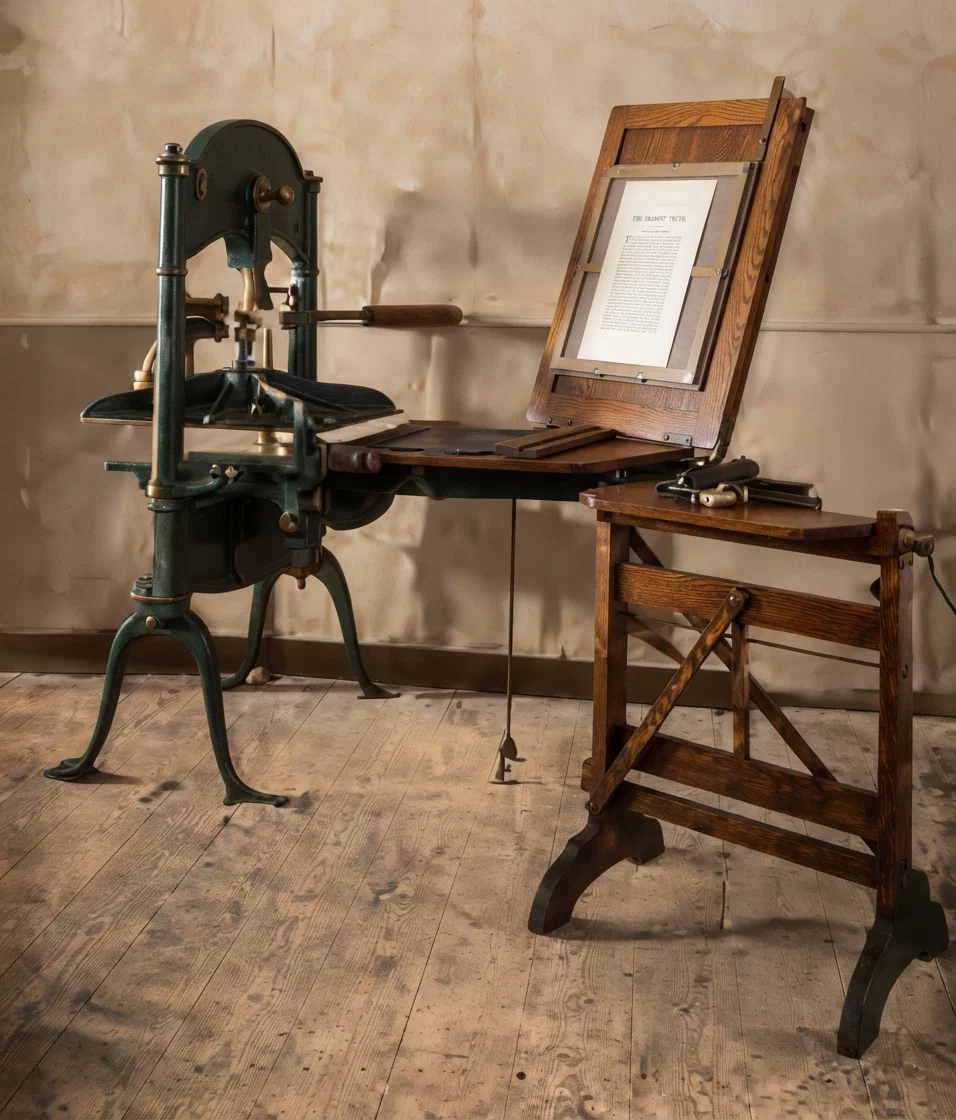
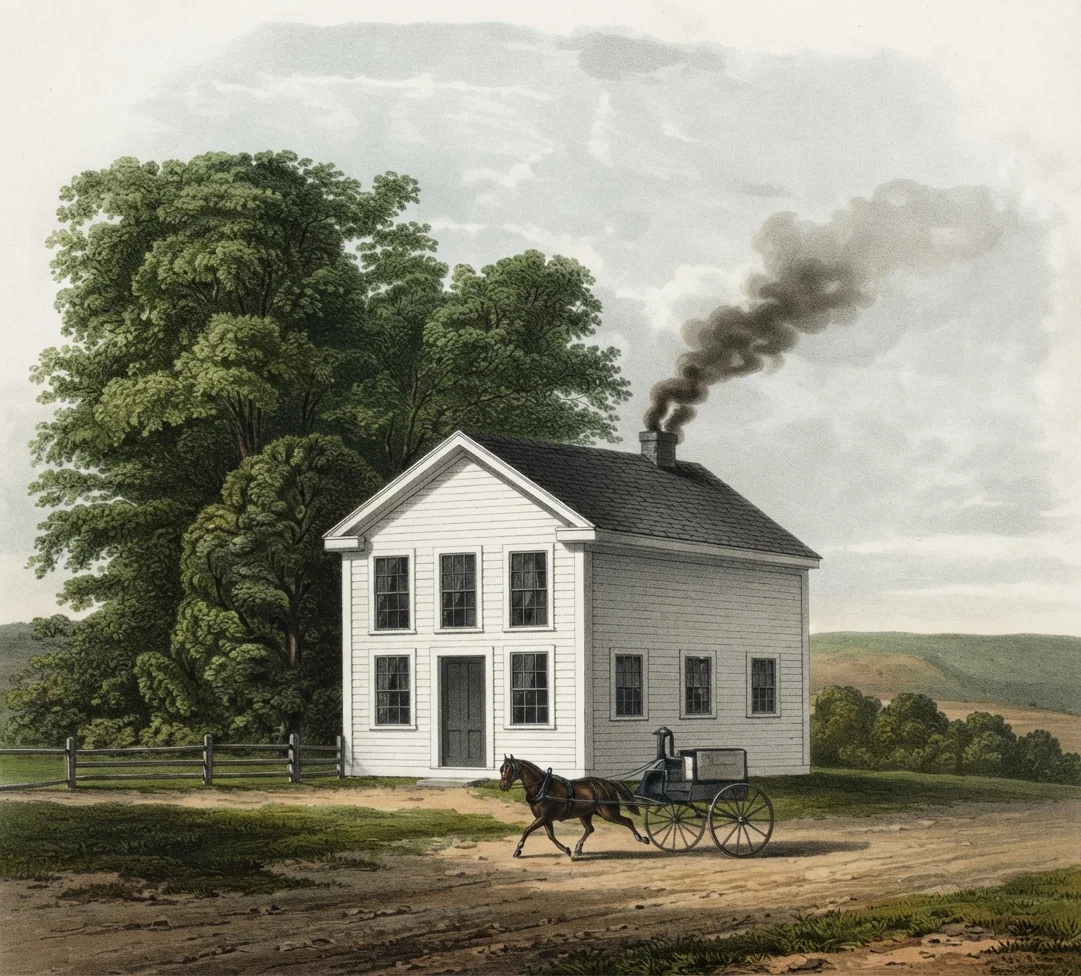
In the month of April, 1852, a Washington hand-press (a cut of which is here given) and an outfit of type was obtained at a cost of about $700, and the work of printing was begun at No. 124 Mount Hope Avenue, Rochester, N. Y., in a building occupied by James White, in a rented room 12 x 14 feet in size. After a few months—in the fall of that year—an office was rented, about 14 x 24 feet in size, in Stone's Block, South St. Paul Street, in the same city. There the work of printing the Advent Review and Sabbath Herald, and a few tracts and pamphlets, was accomplished. The office remained in this building for nearly three years, until the fall of 1855, when four brethren in the state of Michigan gave each $300 to secure a lot in Battle Creek and erect a two-story wooden building, into which the printing business was removed. For six years the publishing work was carried on in this, free of the expense of rent, until the year 1861, when the "Seventh-day Adventist Publishing Association" was organized.
First Press Used in Publishing the Truths Held by this People.
The writer well remembers the publication of the first 80-page pamphlet, upon the subject of the Bible sanctuary and the 2,300 days of Dan. 8:13, 14, printed on this hand-press, in Rochester, N. Y., in the fall of 1854. After the sheets had been printed a few members of the Rochester company assembled to fold, stitch, cover, and trim the books. For lack of machinery, we had to utilize such material as was accessible. After the folding and gathering of the signatures, the writer stabbed them with a shoemaker's pegging-awl; and when the sisters had pasted on the paper covers, and pressed them as best they could between small blocks, Uriah Smith trimmed them with his pocket-knife by a straight edge. It was a pleasant occasion, and a happy company, for we were actually producing our first book in our own office.
And what the result has been from the small beginning of our publishing work, is a proper question. The answer is this: The Gospel truth, as held by this denomination, is now proclaimed and printed in forty of the leading languages of the world. Instead of there being three ministers only, there are, counting ordained and licentiates, over 600, besides hundreds of others devoting their entire time to the work, such as physicians, Bible workers, teachers, and medical missionaries. The printed literature of the denomination is represented in over half a hundred different weekly and monthly periodicals, which are printed in a score of publishing houses located in Europe, Asia, Africa, North and South America, Australia, and the islands of the Pacific. In these offices there are published over 1,100 different books, pamphlets, and tracts, to obtain a copy of each, with all the periodicals for one year, requires about $340.00; and instead of there being only 100 adherents, there are over 75,000 who are rejoicing in this truth. In view of these results from the "small" beginning, we may well inquire, "Who hath despised the day of small things?" Zech. 4:10.
These figures and facts respecting the present status of the publishing work of the denomination, are not presented in a boastful spirit, but with gratitude of heart for the providence of God that has favored the movement. His blessing has been on every advance move, and had the message been pushed with the zeal, and earnestness, and spirit of sacrifice of the earliest workers, still greater results would be apparent.
The New Publishing Plant of the Pacific Press, Office of this Journal, at Mountain View, Cal.
First Publishing House of the Denomination.
LIMITATIONS.
By Charlotte De Forest
[Charlotte De Forest, in Christian Endeavor World.]
HEAVEN'S heart is never satisfied
When earth is cold,
And vain the beauty and the pride
Of streets of beaten gold,
When gold that human hearts might add
To God's high praise
Lies in the ore; then heaven is sad
For earth's cold ways.
Heaven's power may only half avail
When earth is slow
To claim its working in the pale
Of things below,
When ladders that our hearts might raise
For angel feet
Lie moldering on our toilsome clays,
For use unmeet.
DEDICATION SERVICE.
By Editor
ON the afternoon of April 16, the new buildings of the Pacific Press Publishing Company, at Mountain View, were formally dedicated by appropriate services.
On the day previous a solemn appeal had been made to the employees to consecrate themselves to God, preliminary to the dedication, and the most important part of it. At the chapel exercise the next morning there was hearty response to this call, all the employees, with few exceptions, dedicating themselves to the service of God.
At the beginning of the dedicatory exercises, M. C. Wilcox, president of the board of directors, named J. N. Loughborough, a pioneer in this field, and the first president of the incorporation, as chairman of the meeting.
The occasion was within one day of being also the first anniversary of the signing of the contract for the erection of the buildings. There was a large audience in attendance, comprising our own people and prominent residents of the village not of our faith.
After singing by the congregation, a scripture reading by W. T. Knox, and invocation by W. N. Glenn, a brief report was made by C. H. Jones, manager, and chairman of the building committee.
In addition to various reasons for seeking a location in the country, and especially for locating at Mountain View, it was stated that the cost of the new buildings was about forty thousand dollars, and all paid for. The entire investment is about two hundred thousand dollars. The company yet owns the property formerly occupied in Oakland, which is also unencumbered. We find the present location well adapted to the work, with excellent railroad, express, and other requisite facilities. There is also a good prospect for business, with about one hundred hands now employed.
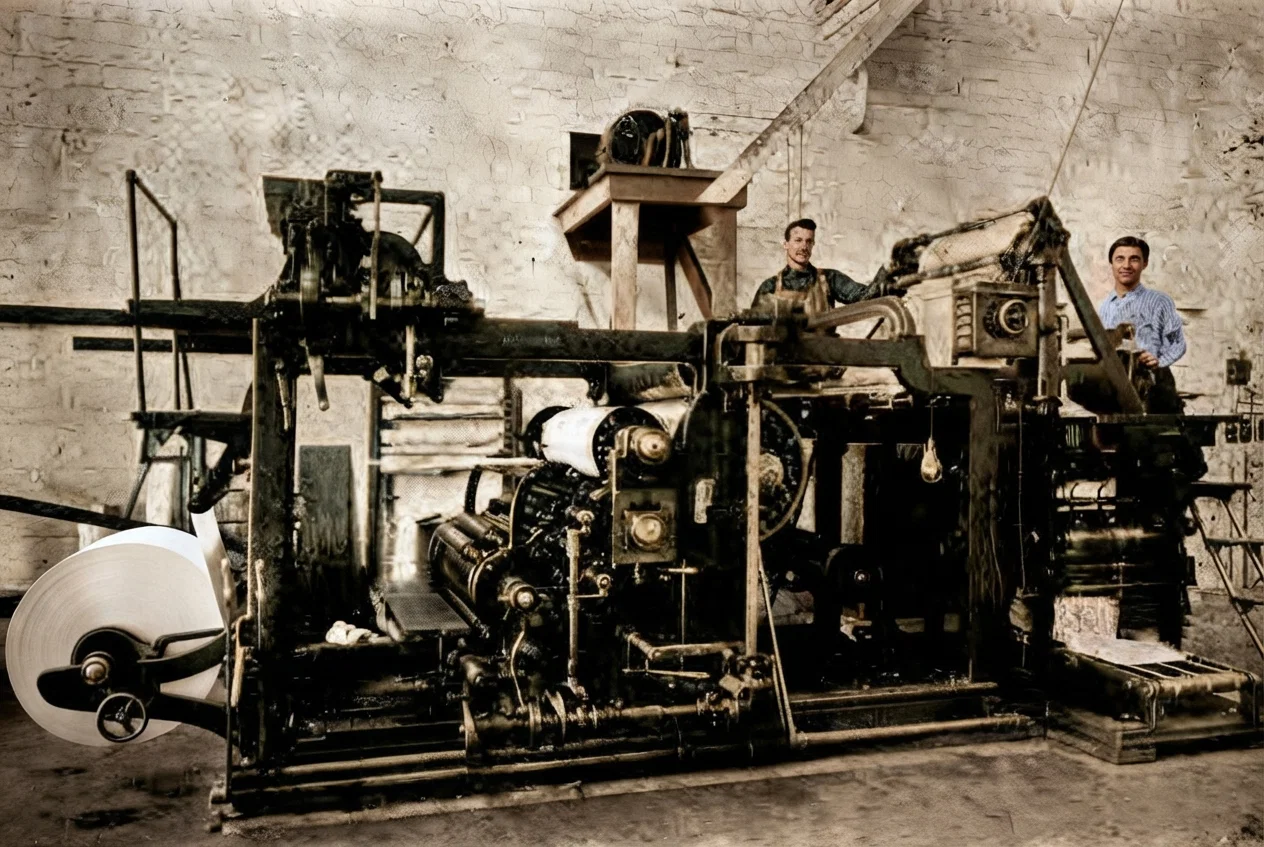
The Great Perfecting Press Now Printing the "Signs of the Times."
After another song by the congregation, an appropriate address was delivered by Editor M. C. Wilcox, of the SIGNS OF THE TIMES. He dwelt upon the principles for which the institution stands, especially that of absolute freedom of conscience for all men—of whatever state or persuasion, religious or political. He also expressed an earnest solicitude for the welfare of the people at Mountain View.
Following the address, the dedicatory prayer was offered by J. O. Corliss, in which the entire institution was solemnly set apart to the service of Him whose Gospel it is to publish. Then the following dedication song, written by C. M. Snow, assistant editor of the SIGNS, was sung by a double male quartet:
Praise the Lord, praise the Lord, we will praise Him to-day,
On His altar of labor our off'rings we lay.
In this temple of service our worship we bring,
While we sing of His goodness, our Saviour and King.
All the riches of heaven
For our life He has giv'n—
Praise the Lord, praise the Lord, praise ye the Lord.
Praise the Lord, praise the Lord; He has opened His hand;
He is sounding His message o'er ocean and land.
In the isles of the sea they are heeding to-day,
While the idols of self on His altar they lay.
In the glad harvest home
From the isles they will come—
Praise the Lord, praise the Lord, praise ye the Lord.
Tarry not, tarry not, let thy courage be strong,
For thy Captain is near, tho thy foes be a throng.
He will valiantly lead thee where'er thou must go;
And thy hope is in Him who has conquered thy foe.
Tho thou fall in the strife,
He will crown thee with life—
Tarry not, tarry not, tarry not now.
To the work, to the work, for the harvest is white;
Over valley and hill falls the soft evening light.
God is bidding you haste to the harvest to-day;
While His spirit still strives, He is pointing the way.
From the broad ways of sin
Haste to gather them in—
To the work, to the work—God bids thee go.
This was followed by remarks by J. N. Loughborough, who was one of the original incorporators of the publishing company. He spoke of the small beginning of this cause on the Pacific Coast in 1868, and compared it with what, under the guiding hand of the Lord, we see to-day. This publishing work was started in Oakland thirty-one years ago, with a plant that cost about seven hundred dollars. Other remarks concerning the growth of the publishing work will be found embodied in an article by Brother Loughborough in this department.
J. O. Corliss followed with a few remarks in the same vein, having had experience in starting the publishing work in Australia, which has also grown in like proportions.
Another selection was then sung by the congregation, and the benediction was pronounced by Brother Loughborough. Then the employees retired to their various departments, and engaged in work while the visitors were escorted through the building to witness operations.
While the employees were getting to their places, remarks were made by Judge B. E. Burns and others, expressing appreciation of the improvements that the publishing company had made in the community, and for the moral principles upon which the work was based.
Altogether the occasion was a pleasant and, we trust, a profitable one.
Four Accept Sabbath at McComb City
Four persons have accepted the Sabbath of the Lord at McComb City, Miss., under the labors of Brethren S. A. Jordan and W. H. Sebastian.
Nine Decide to Observe the Sabbath
THE Illinois Recorder notes that at a recent meeting at Brookline Mission, nine persons expressed a decision to observe the Sabbath of the Lord.
British Columbia Mission Office Moved
By Editor
The British Columbia Missionary Society has removed its office to Port Hammond, B. C. Correspondents will please note the change, and address accordingly.
Sabbath School Organized at Herman
IN connection with meetings held at Herman, Minn., by Brethren W. W. Ruble and A. C. Gilbert, a Sabbath-school of twenty-five members was recently organized. The presentation of the Sabbath question in that place attracted marked attention, and some took a firm stand for the truth.
Interest at Ashland Junction
Writing to the Wisconsin Reporter, Brother Claude D. AcMoody says: "Quite an interest has been worked up at Ashland Junction, where the writer has been holding meetings every Sunday, and teaching the adult Sunday-school class. The International Sunday-school Lessons are very interesting now, and, with the help of the SIGNS OF THE TIMES, I have been able to bring forth some precious lessons of truth in the Sunday-school, as well as in the service which follows."
WANTED FOR MISSIONARY WORK.
Any of our denominational publications. Address, L. W. Axton, Lock Box 344, Carrollton, Mo.
OUR WORK AND WORKERS.
By Editor
OKLAHOMA CONFERENCE is sending out eight tent companies this season.
THE general camp-meeting of Iowa Conference will be held at Des Moines, June 8-18.
DURING meetings recently held at North Liberty, Ind., by Brother B. Hagle, eight members were added to the church.
IMPORTANT NOTICE.
By Editor
UNION COLLEGE takes pleasure in calling the attention of its patrons to the following letter from the Department of Education of the State of New York. From this letter it appears that students who complete the third year of the Collegiate Course at Union College will be granted by the New York Board of Regents the "48 count equivalent credentials, including the medical student certificate," and also that, upon proper certification by Union College, credit will be assigned for less work. So many inquiries in regard to this matter have been received during the past year that it seems best to give general notice of this action of the New York Education Department.
April 13, 1905.
PRESIDENT C. C. LEWIS,
Union College, College View, Neb.
Dear Sir: I beg to acknowledge the receipt of yours of April 3, with inclosures. On the information submitted, we are warranted in registering Union College, and can recognize the completion of the third year of your collegiate course as meeting the requirements for our 48 count equivalent credentials, including the medical student certificate.
We can assign credit to certificates showing less work than the completion of the third year, provided it is certified in accord with the inclosed form.
Yours respectfully,
HOWARD J. ROGERS,
First Assistant Commissioner of Education.
WANTED
MIDDLE-AGED man without family who wants a good home with small salary. Must understand cows and light gardening. Garden City Sanitarium,
San Jose, Cal.
Dr. Godsmark's
By O. C. Godsmark
HYGIENIC COOKING-OIL.
A Pure Vegetable Shortening—Fine for Salads. No Rancid Taste. No Chemicals.
Like Olive Oil, and Keeps In Any Climate
Testimonials From Everywhere.
This is not an inferior compound, and we can not compete in price with cheaper goods.
Send stamp for Circulars or Money Order for trial can at following low prices.
5 gal. can $3.50; 10 gal. can (75 lbs. 9c. per lb.) $6.75.
(Refined Cottonseed Oil 10 gal. $5.50.)
Shipping Point
Louisville, Ky.
Address O. C. GODSMARK.
Sherman Heights, Chattanooga, Tenn.
THE NORTHWESTERN LINE
RUSSIA-JAPAN ATLAS.
Send ten cents in stamps to R. R. Ritchie, No. 617 Market Street, San Francisco, for Russo-Japanese War Atlas, issued by the Chicago & Northwestern Railway, three fine colored maps each 14x20, bound in convenient form for reference. The Eastern Situation shown in detail with tables showing relative military and naval strength and financial resources of Russia and Japan.
CARE OF MEN'S CLOTHING.
By A. M. H.
THE woman who is truly economical seeks, not only to make a garment last longer, but to preserve its credible appearance as well, and often a little work will make it look like new.
There is no cleaning fluid that I have ever had any experience with that equals gasoline as a clothes' cleaner, but it is very explosive, and care should be taken not to use it near a fire or light. The safest way is to use it in the open air.
To avoid the unsightly circle that often appears when a grease spot has been removed, the cloth should be rubbed lengthwise and with the weave, and the rubbing should be continued until the cloth is perfectly dry.
Honey, molasses, or any sticky substance, may be removed by rubbing with slightly diluted alcohol. A coat, vest, or pair of pants that are not much soiled, will come out of a good gasoline bath looking almost like new. First, brush and shake the garment until it seems perfectly free of dust; then remove the spots, and put the garment in the washbowl or a large bucket, and pour about a gallon of gasoline over it, or enough to saturate it thoroughly; then cover the bowl to keep the fluid from evaporating, and leave it for two hours. Wring the garment, and hang it over the line, and be careful to pull and stretch it into perfect shape, and it will need no ironing.
The liquid shoe polish is good for concealing discoloration on black, and black straw hats can be freshened by giving them one or two coats of the liquid polish. A black felt hat may be cleaned by sponging with the lather of soap tree bark, and the light shades of felt may be cleaned by rubbing with dry corn meal. Corn meal, dampened with warm water, is excellent for cleaning a white straw hat. There is nothing better than oxalic acid for cleaning white straw hats that have become much soiled, and five cents worth will clean two or three hats. Dissolve in warm water, and let it stand an hour or two before using; then scrub the hat with a small brush or a soft cloth dipped in the oxalic solution. Wash with clean water, put the hat into shape, and let it dry in the shade. A rusty black alpaca coat, a vest, and a pair of pants were first washed in warm suds, and then recolored a jet black by dipping them in black diamond dye for wool, and they looked as nice as new garments, after they were carefully pressed. A straw hat may be freshened by using some of the same dye. It is prepared by dissolving some dye of the desired color in a little alcohol, and is applied to the hat with a soft brush. When dry, the hat must be given a coat of thin varnish. Boys' hats, cleaned in this manner, and treated to a new lining and band of ribbon, will be given a new lease of life; and, if the straw is good, it is well worth the trouble, as it will save the dollar or more that such hats cost. A. M. H.
FEARLESS AND HONEST.
A SCOTCH lad arrived at Euston, the brightest, yet the loneliest, passenger by the London and North-western Company's Express. He was barely fourteen, had not a friend in London, and had only a sovereign in his pocket.
"Well, Sandy," said a fellow-passenger, who had befriended him during the journey from Glasgow, "don't you wish that you were safe now with your mother in Scotland?"
"No," said the boy, "I promised her when I left that I would be fearless and honest. I have her fortune to make as well as my own, and I must have good courage."
"Well, laddie, what can you do?" asked a kind voice behind him.
"I can be loyal and true to anybody who will give me something to do," was the quick response.
A well-known lawyer, whose experience with applicants for clerkships in his office had been unfavorable, was passing at the moment.
Sandy's fearless face caught his eye. The honest, manly ring in Sandy's voice touched his faithful Scotch heart.
"Tell me your story," he said, kindly.
It was soon told. Sandy's mother had been left a widow, with little money, and a child to bring up. She had worked for him as long as she could, but when her health failed, she had bought his ticket to London, and had given him what little money she could spare.
"Go, and make your fortune," she said. "Be fearless and honest, and don't forget your mother, who can not work for you any longer."
Having heard this story, the lawyer engaged Sandy as an office boy.
"I'll give you a chance," he said, "to show what there is in you. Write to your mother to-day that you have found a friend who will stand by you as long as you are fearless and honest."
Sandy became a favorite at once in the office. Many of the clients who entered the office paused to have a word with him.
He attended evening classes, and became an expert penman and accountant. He was rapidly promoted, until he was his patron's confidential clerk.
After sharing his earnings with his mother, he went to Scotland, and brought her back with him.
By and by he studied law, and, when he began to practise at the bar, his fearlessness commanded respect, and his honesty inspired confidence. Juries liked to hear him speak; they instinctively trusted him.
His mother had impressed her high courage and sincerity upon him. His success was mainly due to her.—Scottish American.
A FATAL TOOTHPICK.
A LARGE manufacturer, giving advice to young men in a recent issue of the Chicago Tribune, tells how he measured a young man once by his table manners. The latter, it appears, at the close of the meal reached for a toothpick, and began at once to remove the particles of food that remained in the crevices of a badly-cared-for set of molars. The manufacturer, who was a gentleman, became so disgusted with this exhibition of coarseness on the part of the young man, that he dismissed him from his mind as a probable candidate for a position he had thought him, perhaps, qualified to fill. His table manners were bad, very bad; no young man of the most ordinary refinement would do anything so boorish as pick his teeth in the presence of others, particularly at the table.
We should say this manufacturer was a trifle severe, certainly uncharitable and not a little prudish in condemning a young man for ignorance for which he, perhaps, was not responsible, and which might have so easily been cured, if only the manufacturer had had the good sense to have quietly told the young man of his fault, and of the importance of cultivating good manners at the table and elsewhere. But he condemned him on the spot. He had picked his teeth at the table in his very presence.
Polite society has very properly banished the toothpick from the table, nevertheless, in the preservation of the teeth, a toothpick is not a whit less important than the tooth brush in the morning after rising, or at night before retiring. A well-cared-for set of teeth indicates the gentleman, just as a dirty pair of shoes indicates the sloven. Of course the toothpick (a small-sized quill is the best kind) is necessary in the care of the teeth, but it should be used in private. After the toothpick, dental floss drawn between the teeth completes the work of removing particles that otherwise might decompose, and finally result in decay.
In this day of keen competition the young man whose manners are good, who is familiar with good books, who cultivates good company, who has acquired the jewel of self-control, who is gallant, yet natural, in the presence of ladies, who is respectful to those older than himself, who is free from the use of profanity, and so dignified, even in the presence of his nearest companions, that none of them would15think of telling him an obscene story—such a young man in this day is on the highway to success. On the other hand, the young man who is careless about his companionships, whose mouth is frequently befouled with profanity, whose ideas of books are the cheap, trashy novel, who is unfamiliar with the amenities that obtain among gentlemen, and who prefers the prize fight or dog fight to the helpful field sports of strong, clean young men—such an one is just as surely on the broad road to failure.
So, if our friend, the manufacturer, was a trifle severe in condemning the young man who picked his teeth in his presence, it was because he could find other young men quite as bright for his purposes, whose manners were more attractive.
Don't pick your teeth at the table.—San Jose Mercury.
ON SUMMER DAYS.
By Benjamin Phillips
BY BENJ. PHILLIPS.
On summer days come wander o'er
With me, a flower-bordered vale,
Where songs the pearly throats outpour,
Where nature's charms grow never stale,
Where babbling o'er its stormy way
The brook gives forth a deathless lay.
Ye hear no sound of stern regret,
But only praise;
Then do not bide a time to fret
On summer days.
How great doth His great works excel?
Each touch a master hand displays;
And silence weaves a wond'rous spell
O'er him who strays
To find a charm in glen or dell
On summer days.
AMERICAN TEMPERANCE LESSONS IN GREAT BRITAIN.
A LETTER from A. H. Plumb, D. D., chairman of the Bureau of Scientific Temperance Investigation and Department of Scientific Temperance Instruction in Schools and Colleges, writes:
A gratifying tribute to America's progressiveness has lately been paid by Great Britain in the adoption, almost verbatim, of our American Course of Study in Hygiene and Temperance, by a committee representing more than 15,000 members of the British medical profession. The committee, composed of the most distinguished representatives of the profession in the United Kingdom, has recommended the course of study to every local school board in England, Scotland, Ireland, and Wales, as a syllabus of study in this subject for all pupils in elementary schools.
From a statement issued by the advisory board of the bureau of which Dr. Plumb is chairman, we take the following extract:
All the nations are welcome to catch up with us in this achievement. We have blazed this educational way for freedom from slavery to alcohol at no small cost, and to no one in this interest more indebted than to Mrs. Mary H. Hunt, head of the department of scientific temperance instruction and investigation, for her thoughtful and heroic leadership. This scheme of study has grown up gradually, from protracted and exhaustive research and consultations respecting the unhygienic and other causes that lead people to drink, the scientific discoveries of hygienic truths, including those relating to the nature and effects of alcoholic drinks, and other narcotics, and those pedagogical principles which determine how and where those truths can be so taught to all the children of to-day as to shape the national life of to-morrow.
This movement holds in its grasp many millions of our youth, and has such regard for detail as is calculated to reach every child, and to save every child for a future of intelligent sobriety. As Americans, we are grateful that the scholars of Great Britain have recognized the sound learning and deep insight into the educational methods essential to save a nation from alcoholic demoralization, which have marked this great movement, and have paid such a tribute to our endeavors by recommending for the public schools of the United Kingdom the scheme of study prepared for the schools of America.
King Edward VII. is said to be advocating an Anglo-American alliance. Here is a step toward such a combination for warfare of an educational sort, against the greatest foe of the English-speaking race. The signs of the times point to Germany's joining us also, thus forming a "triple alliance."