Kindly state your reasons why Seventh-day Adventists should not vote. Daniel appears to have been connected with the government of Babylon; and the powers that be are ordained of God, then why should not the people of God, as well as others, in these days, have a voice in these things? H. C. H.
We have not said that Seventh-day Adventists should not vote. Whatever reason should debar them from voting should debar all other true Christians. Here are, however, some principles worthy of consideration:
1. All parties in power in nation, state, and municipality to-day have again and again betrayed the trust which good men thought they would keep. Under present political management of "boss rule" no man can be assured that his vote will count for righteousness, whether the party he votes for wins or loses.
2. Moral sentiment or principle is of little account in the politics of to-day. Largely it is a matter of spoils.
3. Where simple, direct local issues are at stake, where the question is clear and plain, it is well for the Christian to record his vote as a protest against wrong, as a witness to the right.
4. But to enter the corrupting pool of politics, to identify himself with the constant perversion of every true principle, is subversive of Christianity and vitiating to his Christian character. Read, for a picture of this time, Isaiah 59; 2 Tim. 3 : 1-5.
5. If a man undertakes to remedy the affairs of this world by any means, he should, to be consistent, be willing to follow it to the end. The bullet may be the logical outcome of the ballot.
6. The true child of God is a follower of Jesus Christ, whose kingdom is not of this world. John 18 : 36. Here he is a "pilgrim" and a "stranger;" an ambassador of another government; his "citizenship is in heaven." Heb. 11 : 9, 13; Phil. 3 : 20. Here are some other scriptures worthy of study: Ps. 146 : 3-10; Isa. 31 : 1-3; Zech. 4 : 6.
7. The Christian can always be the greatest help to any government or any community by living the Christ life. The true influence of the church is never strengthened by politics.
True, Daniel served in Babylon, but as a faithful slave, not as a politician. Rom. 13 : 1 is a general statement as to civil government, the worst of which is better than anarchy. God calls Nebuchadnezzar His servant. But some of our "Christian" politicians, had they then lived, might have endeavored to defeat him, and so have been found working against God. We are told to obey civil rulers; where are we instructed to elect, appoint, install, or do politics for them?
Please explain Mark 9:43-49. Will any person go through eternity with one eye or one hand? R. F. G.
The unquenchable fire and undying worm are explained in the Signs of May 3, article, “Wages of Sin.” As to the hand or the eye, the meaning, as we understand, is this: “Whatever trait of character we may have, whatever talent of mind or body, however dear to us, or however seemingly a necessity to success in this life, if it causes us to stumble, cast it off. Better, in this life, to be deprived of an eye, or a hand, or a foot, or anything else as dear as these members, rather than lose eternal life, where nothing shall be wanting, but all shall be perfect. There are young men to-day who have a hand to pitch right-and-left, up-and-down curves, slow and fast balls, so as to baffle all batters. The whole soul of the young man is swayed by the ability of that hand, a stumbling-block, skillful as it may be, in the path to eternal life. Now it would be better for him to actually, literally, cut off that hand rather than pitch his own soul to everlasting perdition on a curved ball. Our readers can supply similar instances concerning foot and eye. Things that are in themselves good become the worst of enemies, if they hold us back from the better and the best.
ENGLISH NONCONFORMISTS IN COUNCIL, AND THE LONDON REVIVAL.
By M. Ellsworth Olsen
(By our British correspondent.)
TWO thousand delegates attended the recent Free Church Council at Manchester. This was the tenth annual meeting held by an organization of great power and influence, including all the nonconformist churches in Great Britain. "Purely spiritual work" was its watchword to begin with, but, like many similar bodies, it has developed on quite other lines, and has become, according to a prominent newspaper, "one of the most potent political agencies in the country."
The meetings on the present occasion were quite in harmony with the political character of the organization. Of course, religious matters received consideration, and some evangelical discourses were delivered; but political questions were very prominent, and aroused by far the most enthusiasm. One could not but feel that the one thing that lay nearest the hearts of the members was to defeat the Conservative government (which now holds the reins of power), and bring in a new Liberal régime. A good idea of the temper of the audience may be gathered from the following brief newspaper paragraph describing one of the political addresses:
The lively and fervent speech of Mr. — roused the fighting spirit of the Council, and the resolution was passed enthusiastically, with cheers.
Passive Resistance.
Naturally the Education Acts came in for considerable attention. Passive resistance, it should be remembered, is still a live thing; hundreds are suffering imprisonment, or distraint on their household goods, for refusing to pay the education rate, which, according to the late Act, is used in part for the instruction of school children in the doctrines of the State Church. Much enthusiasm was manifested in the discussion of this question in the council, and essentially the following action was taken:
The council reaffirmed its demand for a national system of education, co-ordinating all its branches under complete popular control, and entirely free from both theological and ecclesiastical tests, and from sectarian teaching.
The council once more expressed its deepest sympathy with the men and women who, on conscientious grounds, had deemed it their duty to refuse voluntarily to pay the denominational portion of the education rate, many of whom had suffered imprisonment, or additional and unnecessary hardship through the harsh, and in some cases illegal, action of the authorities. And the council declared that it would never consent to any proposal to introduce into state-paid schools, during official school hours, the services and sectarian dogmas of any denomination.
Here we have the principles of religious liberty, as applied to public education. Unfortunately, there is not sufficient evidence that the council is in harmony with these principles, as applied broadly. Thus we have one speaker saying, amid great applause, that they wanted to create Puritan politicians, and he hoped they would live to see a Puritan prime minister, and that they would see him at the Free Church Council meetings. Such little straws show which way the wind is blowing, and make one distrust somewhat the entire disinterestedness of the movement against the Education Act. After all, it appears to be strongly tinged with politics; one feels that it is secular, rather than religious, and proceeds in large part from a strong dislike of the party now in power.
The Laborer and the Church.
Labor interests occupied a large share of attention, the president, in his opening speech, essaying to answer the question why the workingmen so generally absented themselves from church and chapel. The preaching, in his opinion, was not "strong enough or concrete enough to win and to hold them."
Moreover, the church, as such, was holding itself too much aloof from the social questions which so largely concerned the welfare of the workingman. The homely, practical teaching of Christ was held up as a model. Mr. J. E. Rattenbury attacked the same subject even more vigorously, in a paper read later on in the meeting. Many of their Free Churches, he said, were simply limited liability companies, run in the interests of the middle-classes, by the middle-classes. The workingman was not wanted. The gifts to the church were supposed to be given to God, but they still muttered "Corban."
The Institutional Church
was the subject of a paper by Mr. C. Sylvester Horne, which took strong hold of the meeting. Mr. Horne, a year or so ago, took charge of the Whitfield Tabernacle, in the west of London, and has made it into a typical institutional church, with various branch organizations. It can not be denied that the institutional church embodies many popular
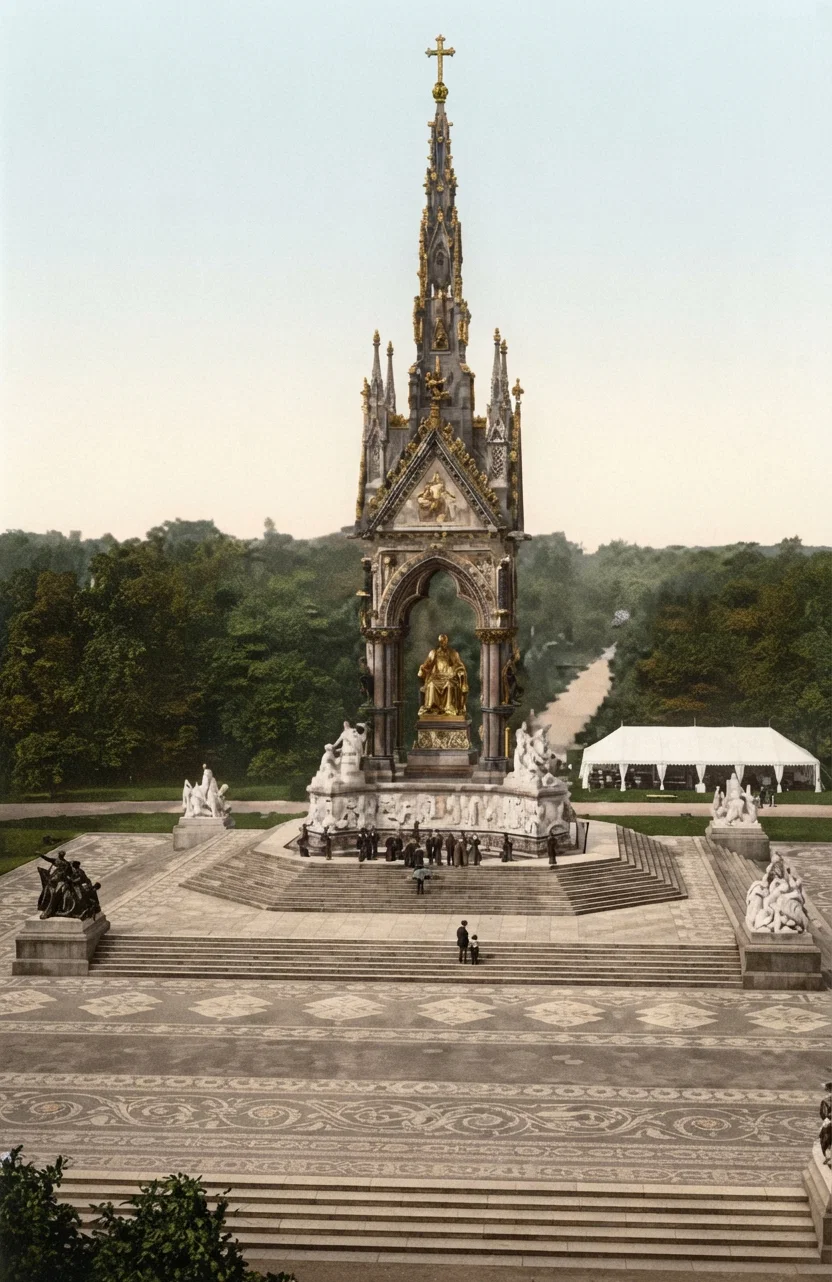
Albert Memorial near Royal Albert Hall.
features, some of which are most commendable, such as systematic visitation of the sick, efforts to secure work for the unemployed, and other philanthropic activities; but it has some distinctly downward tendencies. When the church takes upon itself to furnish amusement to its members, it is on debatable ground, and is pretty sure, sooner or later, to resort to methods which are the reverse of Christ-like, and to tear down with one hand what it is endeavoring to build up with the other. Pure religion and undefiled, can not pander to the modern rage for amusements.
Growth of Monastic Institutions.
A resolution was passed urging the government to institute an inquiry into the monastic and conventual institutions of the country, and the schools carried on by them. The discussion revealed some startling facts in regard to the growth of such establishments in the country within the last half century. Fifty years ago there were only fifty-two monasteries and convents in England; to-day there are no less than nine hundred and ninety, this being a greater number than when, as an intolerable nuisance, they were swept away by the Reformation. Many of these institutions, as I have before pointed out, have been transplanted to England in recent years, being driven out of France by the action of the French Government. They can hardly fail to exert a strong influence in the direction of rehabilitating Roman Catholicism in what has been one of the stanchest Protestant countries. It should be said that the foregoing figures refer to England alone, excluding Ireland, Scotland, and Wales.
The Revival in London.
Turning now to the revival services which Dr. Torrey and Mr. Alexander have been conducting in the West End of London, the question may be raised, What have they really accomplished? Meetings have been held day after day in the magnificent Albert Hall, and the nightly attendances have averaged close on to ten thousand people. About 4,500 are said to have passed through the inquiry-rooms at the hall; meetings for business men and other special services have been held in various parts of the city, with good attendances, and the daily papers, especially at the beginning, trumpeted the enterprise abroad with great gusto, as one of sensational importance. But, has anything at all in keeping with the enormous expenditure of labor and money been achieved in the forwarding of God's kingdom?—The answer must be an unequivocal—No. In the first place, the meetings have been attended almost exclusively by so-called church people, and these have come in large part, it must be feared, as a result of the reputation of the evangelists, and the somewhat spectacular character of the meetings. A trained choir of three thousand voices, under the direction of a skilled leader like Mr. Alexander, who has pronounced American ways, and is addicted to the telling of funny stories between the stanzas; then the uniqueness of conducting revival services in a fashionable resort such as the Albert Hall, and the large scale upon which everything was conceived—all this, together with the hearty co-operation of the London clergy, no doubt brought about the large attendance, and has given the color of an apparent success to the enterprise; but a revival in the true sense of the word, it can not be considered at all. The novelty of the thing having somewhat worn off, it is hardly likely that Dr. Torrey's further efforts in the south and northeast of London, will meet with quite so flattering a reception; still, he can not entirely fail while he enjoys such a hearty support from the clergy.
The revival in Wales is gradually coming to an end, tho not without leaving a considerable body of excellent results. Of course, the question, How lasting are these results to be? will depend largely upon what is done to follow up the work. The converts, of which there are said to be about 100,000, will naturally drift back to their old lives unless something is done to instruct them further in the Christian faith, and the elements of a daily walk with God. Some extravagance has tainted the movement in places, and fanaticism has not been wanting; but these must be regarded as excrescences, rather than so vitally connected with what, from all appearances, has been a remarkable manifestation of the divine power. M. ELLSWORTH OLSEN.
LAST-DAY CONDITIONS.
By Editor
Under the heading, "The Pace," the New York World thus speaks:
In 1868, in New York, for every 10,000 of population there were 13.5 deaths from heart disease and Bright's disease; in 1901 the number of deaths had risen to 29.68.
These are Board of Health figures. They are something to think about. High living, mental strain, worry, over-exertion, and too much alcoholic drink are among the conspicuous causes of the diseases named. The figures show, then, through an exhibit of penalties, a startlingly increased following of "the pace that kills."
When a man unused to such exercise runs hard and fast for a train, and falls fainting or dying at the end of his run, his folly is the theme of comment—but nothing prevents another man, equally unfitted for the test, from trying the same feat in self-destruction.
In New York, the rashness of the runner for the7train is daily and hourly emulated by racers for wealth and more wealth, for position and higher position, for a desperate "keeping up" with some equally foolish courser. The pace is such that no custom could harden one to it. The contestants multiply marvelously. It is too much to expect a warning Board of Health bulletin to stop the chase. But for all that, the simple life is not merely a fad.
This item teaches its own lesson: The drift from the simple normal life to the utterly unnatural life of pleasure and greed.
THE CHURCH AND STATE MOVEMENT IN WASHINGTON.
By John D. Bradley
BY JOHN D. BRADLEY.
THE regular meeting of the board of education of the District of Columbia, on the evening of April 12, was devoted almost entirely to another hearing on the matter of the introduction of religious instruction into the public schools of the District, which has become so prominent an issue, and been so warmly debated in Washington. One week before, a delegation representing the church conference, and headed by Hon. Hilary A. Herbert and Rev. Randolph H. McKim, appeared before the board in the interest of the demand for definite religious instruction in the schools. A batch of petitions was presented, and about three-quarters of an hour spent in urging upon the board the scheme fathered by Mr. McKim, and approved and recommended to the board by the church conference called at his instance.
The second hearing was accorded a delegation representing the Seventh-day Adventists, who have been perhaps foremost in opposition to the scheme advocated at the previous hearing. The delegation, which was composed of seven Adventist ministers, was headed by Mr. K. C. Russell, chairman of the Adventist Religious Liberty Bureau. A formal remonstrance "vigorously protesting against any change in the public school system in the matter of religious training," and a batch of petitions in harmony therewith, were presented, and these were supplemented by addresses by members of the delegation. The hearing lasted just three-quarters of an hour. It was not open to the general public, and the following regarding it is gathered from the newspaper reports.
In opening the discussion, Mr. Russell stated that the 126 petitions which were submitted in support of the remonstrance, had been signed by 2,562 persons, gathered from all classes. Many of them, he said, were members of the Baptist, Methodist, Episcopalian, Catholic, Unitarian, and People's churches, and a number of the signers were Hebrews. The point was made that the signatures were individual, and not representative. Mr. Russell declared that "religion is not a matter of majorities," and that "the conscience of one man is as sacred as the consciences of the many."
The formal remonstrance, which was headed "A Protest Based on Christian Principles," was read to the board by Prof. W. W. Prescott. The text of the remonstrance declared that the position of those presenting it was not one of hostility to religion, the church, the state, or the public schools. The church and state, it was contended, are both divinely ordained, but for entirely distinct purposes—one for spiritual and the other for temporal ends, and the prosperity of both depends upon the faithfulness with which each follows "the divinely-ordained plan of complete separation the one from the other."
The movement to introduce religious teaching into the schools was designated as a "violation of a fundamental principle of the Christian religion." "The adoption of the proposed plan can result only in friction, dissatisfaction, sectarian strife, and animosity," declared the remonstrance. "It will degrade religion from a matter of conversion and salvation, to a question of contention and courts." Professor Prescott characterized it as an unchristian act for professed Christians, even tho they be in a large majority, to seize upon the power and instrumentalities of the state, for the purpose of propagating religion, and said that the present situation presents a grand opportunity for the board to exemplify Christian principle by holding that there should be liberty, and a complete separation of church and state.
Prof. A. T. Jones delivered an address in which he contended that, in the interests of domestic tranquility, the whole question should be excluded, even from consideration, by the board. The matter, he said, was outside the province of the board. He stated that there was already in the schools the reading of the Bible and the teaching of "obedience to the laws of God." "Those who have raised this issue," he said, "have said this is not sufficient, and that there must be the specific teaching of religion. When that shall be gained, how long will it be before the demand will be made for specific sectarian, or even denominational, religious teaching? And it is perfectly plain that before the thing shall have gone that far, the chief question before the city of Washington will be how to maintain domestic tranquility. Another item which adds great emphasis to this point is the fact that, it has been stated in the public prints, if this matter shall be pushed to the limit the leaders have proposed, the issue will be contested even to the Supreme Court of the United States. Can it, then, be to the interest of the schools of the District of Columbia that the school board shall allow itself to be involved in such a course of litigation? And when that shall occur, then again one of the most serious phases of the whole question will be how to maintain domestic tranquility."
Mr. W. A. Colcord, who made the final address, said in part: "Because there are homes in which religion is not taught, it does not follow that the state, or some institution of the state, should undertake to teach it. The home, the church, and the private school are the natural, legitimate, and proper places for teaching religion. Because crime, immorality, and irreligion are on the increase, does it follow that religion should be taught in the public schools? If the church teaches religion and the state teaches religion, both are engaged in the same work; there is no distinction between the two. Furthermore, if it is a proper thing for the state to use its money and its instrumentalities to teach religion, it is proper for it to go a step further and use its power in requiring obedience to the religion taught. This is the next logical step, and this means persecution."
At this meeting of the board of education, in addition to the protest of the Adventists, petitions protesting against the introduction of religion in the schools, were received from the Brotherhood of Ohav Shulum Hebrew Congregation, the Grace Evangelical Lutheran church, A. S. Solomons, S. S. Burdette, and E. Burdette. A letter of protest from Rabbi Louis Stern was also read.
No action was taken by the board of education with reference to the matter, and it is understood that no action will be taken until the president of the board, Gen. H. V. Boynton, who has been quite sick for some weeks, is able to attend. It is desired that "the full membership of the body shall be present when the question is finally disposed of." So the question will remain pending indefinitely.
"BACKWARD STATES."
By W. N. Glenn
IN the Washington, D. C., Post, of April 3, Dr. W. F. Crafts indulges in one of his characteristic tirades against Seventh-day Adventists and the truth they are giving to the world. He refers sarcastically to "the few instances where, in backward states, some of them may have been fined for violation of Sunday laws, and imprisoned because they would not pay the fines, or allow others to do so." Apologizing for the present attempt to commit the general government to a policy of state religion, he would ascribe the past experience of the people in the working out of such principles to the action of "backward states." It should be remembered, however, that the instances which Mr. Crafts cites were merely the result of enforcing laws such as are on the statute books of nearly all the states.
It should also be remembered that this man who now speaks in an impliedly disparaging manner of those "few instances" of persecution, did himself indorse and encourage such persecution; moreover, he spent considerable time in California, engaged in a special effort to bring this state into the category of "backward states," by securing a state Sunday law, with, of course, the end in view that it should be enforced in the same manner as in the other "backward states." It is difficult to understand the logic of the argument that religious state laws are so beneficial to the people, while only the "backward states" enforce them. Such states as Massachusetts, Maryland, Pennsylvania, Illinois, Tennessee, etc., will hardly appreciate the compliment of being styled "backward states" by this champion of religious legislation.
But what shall we say of Mr. Crafts's efforts for several years to have the general government enact for all the country such laws as those which "backward states" enforced in a "few instances." He has taken an active part in several such efforts, and it is well that he recognizes that such a course is a "backward" step—if the religious laws he seeks should be enacted and enforced. Persecution is the logical outcome of all enforced religious legislation, and such legislation is therefore a "backward" step for any country in which a separation of church and state is a fundamental principle.
From the current reports of activity in the matter of enforcing Sunday laws throughout the country, it would appear that a number of states are just now rapidly falling into line as "backward states," and it is this growing sentiment that gives encouragement to the persistent efforts of certain individuals, associations, bureaus, etc., to commit the national government to the same "backward" course.
W. N. GLENN.
Chicago Teamsters’ Strike
An extensive strike is now on in the city of Chicago. It is probable that all the union teamsters will be out in a few days. The Employers' Association is attempting to furnish teamsters in the place of those who have gone on strike. Firms employing teamsters are insisting that their men shall deliver goods to firms boycotted by the unions. Union men are resisting this demand of their employers, and it is probable that the strike will extend to all union teamsters in the city, if not to other industries. Already several serious clashes have occurred between union and non-union men. The Federal Court for that district has enjoined the unions from picketing firms, or interfering with those employed to take their places.
Radium Treatment of Cancer
Important experiments are now being made in the Flower Hospital, New York City, to demonstrate the effectiveness of radium in the treatment of cancer. It is claimed that wonderful progress is being made, and that a number of patients have been completely cured. It is reported that radium combined with the X-ray treatment is being used in the case of Dr. Harper of the Chicago University with satisfactory results.
Schwab to Reconstruct Russian Navy
Reports from St. Petersburg state that Charles M. Schwab, of New York, has received a contract from the Russian Government for the reconstruction of the Russian navy. He is said to guarantee his ships to produce twenty per cent. better speed and much greater resisting qualities to gun-fire than the best ships now afloat. Just how many vessels the American steel magnate will construct has not been stated.
Morocco Causes European Anxiety
Germany's attitude toward Morocco and the Anglo-French agreement, in regard to that country, is causing much anxiety throughout Europe. France and England seem to be drawing closer together over the matter, and King Edward has paid another visit to France, evidently in relation to the question.
Gasoline Motor Cars on Railroads
The success of the gasoline motors on the Union Pacific Railroad, has influenced that concern to order the building of a large number of such cars. These cars will be used for the present principally on branch lines, tho it is expected that after a time they will be used on the main lines also.
Drugged Boston Baked Beans
Boston has discovered that its famous dish, baked beans, is heavily drugged with that indigestible substance, salycylic acid. As a result of the discovery, a number of manufacturers of the article found themselves with large quantities of baked beans left on their hands.
Russian and Japanese Armies Inactive
The Russian and Japanese armies remain inactive in Manchuria, so far as making any movement to engage each other is concerned. At the same time the two fleets of war-vessels are maneuvering in the China Sea, without coming to an engagement.
Tornado Strikes Laredo
A tornado struck the town of Laredo, Texas, and New Laredo, on April 29, resulting in the death of 21 persons and the serious injury of a large number. About 150 houses were blown down by the storm.
St. Louis Enforces Sunday Closing
The city of St. Louis is strictly enforcing the Sunday-closing law. Governor Folk has expressed his determination to enforce the law as long as it remains on the statute books.
Montana Sues Beef Trusts
The state of Montana has entered suit against the beef trusts operating in that state.
THE WORKERS NEEDED.
By Ellen G. White
BY MRS. E. G. WHITE.
GOD calls for humble, devoted workers, who will impart to others the blessings He has given them. He calls for men who will be wise counsellors, men who will act promptly when they see that the time has come for them to act. Let God's workers keep close by His side. All the way along the danger has been that those who were doing God's will would lose sight of His plans, and would fail to work with an eye single to His glory.
Christ is waiting for human agents through whom to impart to hungry souls the bread of life. Even the ignorant may understand the Scriptures; for heavenly angels are appointed to minister to them. While the day of retribution still lingers, the Gospel is to be preached to the unsaved, and its glad messages brought home to their hearts. God will co-operate with those who proclaim His truth to the unenlightened and the unwarned.
The enemy is continually working through half-converted men and women, leading them to speak words of discouragement, and to stand always on the negative side. Men of activity and clear thought, of spiritual and physical soundness, are needed,—men who can act as leaders and directors; men of wisdom, who, when a crisis comes, will stand boldly in the front ranks, presenting to the enemy an unbroken line of defense.
Those who proclaim the truth for this time must put on the whole armor of God, that they may stand bravely at their post, in the face of detraction and falsehood, resisting the enemy with the weapon that Christ used,—"It is written."
The Lord expects His servants to be diligent in business and fervent in spirit. But He does not want them to overwork. It is not work, but overwork, without periods of rest, that breaks people down, endangering the life forces. Those who overwork soon reach the place where they work in a hopeless way. The work done to the Lord is to be done in cheerfulness and with courage. He wants us to bring spirit and life and hope into our work.
Bring into the day's work hopefulness, courage, amiability. Do not overwork. Far better leave undone some of the things planned for the day than to overtax yourself, losing the courage necessary for the performance of the tasks of the next day. Do not to-day violate the laws of nature, lest you lose your strength for the days to come.
Every day consecrate yourself anew to God. Bring to Him an offering untainted by selfishness, and it will be accepted. This is your reasonable service. God calls for a complete sacrifice. It is complete trust in Christ that makes the sacrifice complete, wholly acceptable to God.
Keep yourselves where the three great powers of heaven, the Father, the Son, and the Holy Spirit, can be your efficiency. These powers work with the man who gives himself unreservedly to God, heart and soul and mind and strength. "If a man love Me," Christ says, "He will keep My words; and My Father will love him, and We will come unto him, and make Our abode with him." The power that comes with Christ's abiding presence is at the command of His believing ones. The man who makes God his trust is barricaded by an impregnable wall.
Let us take no backward steps, but ever move forward and upward in the pathway of light. Walking in this path, we are following Christ. We certainly have not wisdom to guide ourselves aright. We must be daily learners in the school of Christ, receiving instruction from the great Teacher, that we may impart it to others. We are to practise the lessons that He teaches us.
"Put on therefore, as the elect of God, holy and beloved, bowels of mercies, kindness, humbleness of mind, meekness, longsuffering; forebearing one another, and forgiving one another, if any man have a quarrel against any; even as Christ forgave you, so also do ye. And above all these things, put on charity, which is the bond of perfectness. And let the peace of God rule in your hearts, to the which also ye are called in one body; and be ye thankful."
CHRISTIAN PROGRESS.
By Thoro Harris
BY THORO HARRIS.
Two smooth surfaces, as of glass, will adhere together perfectly provided there be not a particle of dust on either one. But if there be even the minutest semblance of dust, you can not clap one upon the other. Similarly the smallest error of the life will prevent it from adhering to the Life divine. It is the little sin that severs the connection, the little fox that spoils the vine.
The Christian pilgrimage is like riding the bicycle. There are but few who can perform the almost impossible task of standing still on one of them; and these are generally found in our museums posing as wonders. On the bicycle you must either move ahead or fall off. In Christian experience one must advance or else lose his balance. It is a campaign and a continuous conquest all the way to the pearly gate.
Tho this principle is of universal application, men somehow imagine that it can be evaded in matters of a purely spiritual nature. My arm may to-day be perfectly sound and free from every taint of corruption; but if I carry it about in a sling and neglect to exercise it, it must eventually wither. Physicians assert that it will decrease in size one-half an inch yearly; and if this process be continued, the arm will finally become a lifeless member.
Therefore we are exhorted to "walk in truth" (3 John 4); for walking denotes progression; and the Christian life is one continuous march to the Eternal City.
"WHAT MUST I DO TO BE SAVED?"
By D. P. Zeigler
BY D. P. ZEIGLER.
LONG, long ago this question was asked under very peculiar circumstances in an old Philippian jail. Prior to this, One who was the Christ had been crucified on Mount Calvary, in the land of Judea, and over Him placed an inscription, "Jesus of Nazareth, the King of the Jews." This inscription was placed there at the command of Pontius Pilate, a pagan ruler, who, in his examination of this crucified King, had said to the Jews, "I find no fault in this Man."
Here, then, was one life so filled with the life of God that no fault could be found in it. This "just One" had been spoken of by prophet and seer ever since the fall of man; and His death on the cross, and that which caused it, had so wrought upon the hearts and minds of His followers that, even tho prison cells faced them, they dared proclaim Him as the world's Saviour.
There had been one, Saul of Tarsus, a sectarian Jew in the strictest sense, who had manifested much zeal in persecuting the followers of this crucified One. But, as he was on his way from Jerusalem to Damascus to continue his persecutions, and had come near the latter city, a great light from heaven shone around him. He heard a voice from heaven, the voice of this same crucified One, saying, "Saul, Saul, why persecutest thou Me?" Saul's heart was touched, his physical eyes were blinded, and he was led to the house of one, Judas, in the city, where he was afterward instructed what he should do. Thus the persecutor has now become the persecuted, as he was the one who was in the Philippian jail on the memorable night in which the question was asked, "What must I do to be saved?" he being the one of whom it was asked.
Paul and Silas had gone to Philippi to bring the light of the loving Christ to the poor sin-darkened people, and had been thrown into prison because of the truth which they proclaimed. At the midnight hour these devout men prayed and sang praises to God, so that the prisoners heard them. Suddenly there was a great earthquake, the foundations of the prison were shaken, all the doors were opened, and every prisoner's bands were loosed. The keeper, awakening from his sleep, was about to thrust himself through with his sword, supposing the prisoners had escaped. But Paul cried with a loud voice, "Do thyself no harm; for we are all here." The jailer then called for a light, sprang in, came trembling before these representatives of heaven, and said, "Sirs, what must I do to be saved?" The pointed arrow of conviction had touched his darkened heart.
The next thought that now comes to us is, Why ask such a question? What has befallen the human family?—The answer comes back from the voice of Inspiration, "All have sinned, and come short of the glory of God." Rom. 3:23. "Wherefore, as by one man sin entered into the world, and death by sin; and so death passed upon all men, for that all have sinned." Chapter 5:12. Sin entered by one man; who was the man?—"Thy first father hath sinned." Isa. 43:27. Who is the father of all living?—Adam, who was created and placed in the Garden of Eden, where he sinned.9
But what is sin?—"Whosoever committeth sin transgresseth also the law; for sin is the transgression of the law." 1 John 3:4. This being so, Adam violated the law of God. The violation of this law (the law of Ten Commandments, Rom. 7:7) caused him to come under the power of death; "for the wages of sin is death." Chapter 6:23. Then, as "all have sinned, and come short of the glory of God," "What must I do to be saved?" The answer is, "Believe on the Lord Jesus Christ, and thou shalt be saved." This was Paul's answer to the jailer, and it is the answer to all inquirers. "Therefore being justified by faith, we have peace with God through our Lord Jesus Christ; by whom also we have access by faith into this grace wherein we stand, and rejoice in the hope of the glory of God." Chapter 5:1, 2.