Your ShelfYour Projects

Review and Herald, Vol. 85, No. 44.

Enough to Show the Way

Review and Herald

Oct 29, 1908

Review and Herald Publishing Association · Takoma Park Station, Washington, D. C. · Oct 29, 1908

Enough to Show the Way

Amen: now lettest Thou Thy servant, Lord, Depart in peace, according to Thy word. Although mine eyes may not have fully seen Thy great salvation, yet surely they have seen Enough of sorrow and enough of sight To show the way from darkness into light: And Thou hast brought me, through a wilderness of pain, To love the sorest paths if soonest they attain.
Enough of sorrow for the heart to cry, “Not for myself, nor for my kind am I;” Enough of sight for reason to disclose— “The more I learn the less my knowledge grows.” Ah! not as citizens of this one sphere, But aliens militant we sojourn here, Invested by the hosts of evil and of wrong Till Thou shalt come again, with all Thine angel throng.
As Thou hast found me ready to Thy call, Which stationed me to watch the outer wall, And, quitting joys and hopes that once were mine, To pace with patient steps this narrow line, O, may it be, that coming soon or late, Thou still shalt find Thy soldier at the gate! Who, then, may follow Thee till sight needs not to prove, And faith will be dissolved in knowledge of Thy love.
— George J. Romanes.

THE BARGAIN COUNTER

The Review and Herald Book Department has a number of books that are slightly worn in handling, or that have been damaged in transit, which are unsalable as perfect copies. Much of the damage is so slight that it is hardly noticeable. A few of the covers are quite badly damaged, but in none of the books is the reading impaired.
Any of the books listed below will be sent, post-paid, on receipt of price marked, until the stock is exhausted. The figures at the left represent the number of copies included in this sale. In ordering, it would be well to make more than one selection; for the book which you desire may already be gone when your order reaches us:—

English

NO. OF COPIES                                                     PRICE
4   Great Controversy, cloth ........................$1.20
1   Desire of Ages, new edition .................... 1.40
1   Glad Tidings, cloth ............................... .15
1   Home Hand Book .................................... .95
1   Easy Steps, paper .................................. .10
2   Easy Steps, cloth ................................... .25
1   Colds ..................................................... .15
3   Gospel Reader, board .............................. .15
5   Christ’s Object Lessons .......................... .85
4   Seer of Patmos, cloth .............................. .60
3   Seer of Patmos, half cloth ........................ .50
2   Christ Our Saviour, board ........................ .20
1   Paradise Home ........................................ .10
1   Daniel and Revelation, library ................... 1.20
4   Best Stories, cloth .................................. .25
10  Best Stories, board ................................ .20
1   New Testament Primer, board .................... .12
1   Little Folks’ Bible Nature, cloth ................ .20
1   Vest-Pocket Dictionary, leather ................ .15
1   Good Form .............................................. .10
7   Coming King, plain .................................. .50
3   Coming King ............................................. .40
1   Parson’s Hand Book ................................ .50
1   Daniel and Revelation, plain ...................... .60
1   Land and Sea ............................................ .60
1   Early Writings, paper ............................... .23
1   Gospel Primer, cloth ................................ .15
2   Gospel Primer, board ................................ .10
2   His Glorious Appearing ............................. .10
1   Hymns and Tunes, morocco ....................... .50
2   Hymns and Tunes, plain ............................ .50
4   Steps to Christ, old, paper ........................ .10
1   Every-Day Dishes ..................................... .10
10  Breakfast, Dinner, and Supper ................... .25
8   Making Home Peaceful .............................. .45
1   Two Republics, library .............................. .60
1   Bible Readings, marbled .......................... 1.00
2   Battle Hymn of the Kingdom ...................... .12
1   Native Life in India .................................. .25
1   Sunshine at Home, plain ........................... .30
1   Sunshine at Home, gilt ............................. .40
1   Waiting on God—Murray ........................ .15
4   Christ Our Saviour, board ........................ .20
1   Patriarchs and Prophets, gilt ..................... 1.00
1   Bible Readings, half morocco ..................... 1.25
1   Bell’s Language, No. 3 .............................. .55

Danish

20  Glorious Appearing .................................. .10
1   Great Controversy, library ........................ 1.00
19  Prophecies of Jesus, plain ........................ .25
1   Life of Christ, cloth ................................ .75
1   Daniel and Revelation, morocco ................ 1.50
4   Christ Our Saviour, board ........................ .20
3   Bible Readings, library ............................. .95
1   Prophecy of Jesus, cloth .......................... .50

French

1   Bible Readings, library ........................... 1.00

German

1   Daniel and Revelation, morocco ................ 1.50
3   Daniel and Revelation, half morocco ........... 1.25
2   Life of Christ .......................................... .60
2   Glorious Appearing .................................. .10
1   Bible Readings, gilt .................................. .75
1   Life of Christ, gilt .................................... .75

Holland-Dutch

1   Hymns and Tunes, morocco ........................ 1.00
2   Daniel and Revelation, marbled .................. .75
5   Daniel and Revelation, morocco ................ 1.50
1   Daniel and Revelation, half morocco ........... 1.00

Swedish

1   Prophecies of Jesus, half morocco .............. .50
1   Daniel and Revelation, plain ........................ .50
1   Daniel and Revelation, half morocco ........... 1.00
2   Daniel and Revelation, morocco ................ 1.25
1   Prophecies of Jesus, plain ........................ .35
1   Hymns and Tunes, morocco ........................ 1.00
Order of
Review and Herald Publishing Association
Takoma Park, Washington, D. C.

Seventh-day Adventism

By invitation of the Secular League of Washington, the editor of the REVIEW delivered an address Sunday afternoon, October 18, before the members of that organization, the subject being “Seventh-day Adventism.” The purpose of this address was to define the scope and meaning of this term, as representing the religious movement with which the editor is connected. An abstract of this address follows:—
In order to make reasonably clear the full meaning of the term Seventh-day Adventism, it will be necessary to take a brief survey of a system of doctrine and of a historical movement. The people who are known as Seventh-day Adventists maintain and disseminate a system of religious teaching so distinct from that which is held by other religious bodies as fully to warrant a separate organization. While heartily accepting some of those fundamental doctrines which are common to the so-called evangelical denominations, they also maintain certain distinctive positions which would preclude their union with any of the other Protestant bodies. Some of their fundamental tenets may be stated thus:—
1. The integrity and reliability of the Holy Scriptures as a divine revelation.
2. The knowledge of a personal God and the truths of the plan of salvation, as acquired through revelation rather than through research.
3. The principle of the interpretation of Scripture by comparing one portion with another, and that no creed formulated by human authority is of any force upon the conscience.
4. That the divine revelation has been progressive, but that in this development there is no contradiction of any previous revelation.
5. The deity, divinity, and pre-existence of Christ, and the efficacy of his atoning work on the cross and his present ministry as priest.
6. That there should be a complete separation between church and state, or between religion and the government; and that every man should have the fullest right to believe or not to believe, to worship or not to worship, provided that in the exercise of that right he does not interfere with the equal rights of others.
7. That the apostasy of the church, or of any branch of it, has resulted from the exaltation of man and of human authority in place of God and divine authority.
8. That according to the prophecies there should be in this generation a world-wide reform movement to restore the pure gospel as taught by Christ and his apostles.
In further developing the meaning of these propositions, the editor stated that the Seventh-day Adventists maintain the plenary inspiration of the Scriptures, and believe that, as they were originally given, they are the word of God, spoken through human instrumentality.
That while nature gives abundant evidence of the power and wisdom of the Creator, there is still a necessity for a direct revelation, in order to furnish adequate knowledge of God as a personal being, and of his purpose concerning the world.
That the Scriptures are a sufficient guide to the individual believer, when studied under the enlightening influence of the Holy Spirit, and that the tendency of all human creeds has been to substitute the teachings of men for the revealed Word of God.
That while recognizing that there has been a gradual unfolding of the eternal purpose of God since the good news of man's restoration was first announced, yet Seventh-day Adventists maintain that the instruction given in the earlier times, and through the Old Testament writers, is just as authoritative as any messages which have come in later years, and that what has been once revealed in the olden time has not been set aside or supplanted by the fuller instruction imparted through Christ and his apostles.
That Christ is the eternal Son, equal with the Father, in whom and through whom there is forgiveness of sins, and who now ministers in the sanctuary in heaven in behalf of those who will accept him.
That one of the greatest gifts to man is freedom of choice, and what God has thus bestowed no human power has the authority to interfere with. That the Christian idea of religious liberty includes the privilege of not believing; and that when the state has protected every citizen in the exercise of the right to believe or not to believe, to worship or not to worship, according to his own choice, it has no further jurisdiction in matters of religion.
That any failure on the part of the Christian church at any time to reveal the ideals of Christianity has been due to a lapse from the divine plan, and the exaltation of the human in place of the divine. That the wrongs committed in the name of Christianity are an evidence of the perversity of human nature, and not a proof of the failure of Christianity.
That according to reliable prophecies, which the most astute scholarship has been unable to discredit, the end of the present order of things is near at hand; and the promise of a new heavens and a new earth, in which righteousness shall dwell, is about to be fulfilled. In preparation for this great transformation, and in fulfilment of prophetic utterances, a message of warning and a call for a return to the original gospel, must be proclaimed throughout the world in this generation; and that this is the work which Seventh-day Adventists have undertaken to accomplish.
The teachings of this body are diametrically opposed to all those views which, taken together, constitute what is termed the New Theology, as also to the application of the principle of evolution either in science or in theology.
As a practical result of the holding of these principles, the Seventh-day Adventists have undertaken to accomplish.ventists observe the seventh day of the week as the Sabbath, according to the plain reading of the commandment; believe that life and immortality are bestowed as a gift of God in Christ, and that man is not immortal by nature; practise the tithing system as the Scriptural method of raising money for all evangelistic work; place much stress in their work upon the advocacy of the Christian idea of religious liberty; practise strict temperance, including abstinence from the use of tea, coffee, and tobacco; maintain missions in nearly all parts of the world; and look for the second advent of Christ in the present generation, but do not set any date for that event.

Editorial

IN times of distress we turn from scientific speculation and human philosophy to divine certainties and well-proved promises. Something more assuring than “a working hypothesis” is needed in the hour when the eyes are closing upon worldly scenes. Something more definite concerning the future is demanded than “intimations of immortality.” Guesses at truth do not inspire courage in the hour of trial and disappointment. Let us build on the Rock.

The Rise and Fall of Religious Liberty in America

The Federal Constitution and State Legislation

On the tenth of May, 1776, the delegates of the thirteen original colonies, assembled at Philadelphia, passed a recommendation to the effect that each colonial assembly should meet and agree upon a constitution, or frame of government, for its people. On May 15 a preamble to this resolution was adopted, recommending that each colony declare it to be its intention to suppress the exercise of all British authority in that colony. Some of the colonies very explicitly and emphatically acted upon the recommendations of this general body; but, as pointed out in previous articles, all did not act upon the recommendations within the year. Some, interpreting aright the second sentence of the Declaration of Independence in reference to the equality of men, or having learned aright the lessons of religious tyranny rehearsed throughout their borders, asserted the equality of human rights in matters of conscience as well as in civil things. Therefore they were outspoken in their declarations in reference to freedom from human control in matters of religious faith and practise. Through flood and fire, through fine, imprisonment, and exile, the inhabitants of those colonies were learning the sacred value of soul freedom. Out of that turmoil was coming a statement of a principle that was to characterize this country as different from any other upon the earth. That was the tenet that man is accountable to God alone in matters of faith and conscience. Individuals had held it before, but no nation had ever espoused it. That doctrine was germinant in the Declaration of Independence; for the equality of men precludes the possibility of one man regulating the religious belief and practise of another. That doctrine spoke out more plainly in Article VI of the Federal Constitution, in these words: “No religious test shall ever be required as a qualification to any office or public trust under the United States.” It is significant also that the first amendment to the Constitution of the United States should deal with this factor so fundamental to true liberty. It reads: “Congress shall make no law respecting an establishment of religion, or prohibiting the free exercise thereof,” etc.
The language of these documents upon this question indicates that it was the purpose of their framers to leave religious faith unfettered and religious practise untrammeled by the enforcement of a legal ritualism. That doctrine, advocated by the Anabaptists on the continent of Europe and in the British Isles, and for whose advocacy thousands on thousands of them were slaughtered; that doctrine, whose acceptance and practise made martyrs of many New Englanders, and sent Roger Williams into exile to establish a better state and teach a more Christian brotherhood; that doctrine, whose every inch of progress the established church of Virginia hotly contested for a hundred years,—that doctrine was set forth as the very guiding star of the infant republic of the New World. A nation assumed the rôle of teacher and set a lesson for the world to learn. The world has taken note of it. Republics are springing up, monarchies are granting constitutions and calling the people into legislative assemblies, and nations centuries old in intolerance and persecution are granting to their people freedom of conscience and liberty of worship. The world can not deny to America the right to claim precedence in this matter of adopting, as a nation, this principle so vital to the best interests of both church and state and to the peace and happiness of men; nor can America shirk her responsibility of maintaining in its purity that doctrine given her of heaven. She has not done it, but the fault does not lie in the doctrine. The truths found in the Declaration of Independence and the Constitution are just as true, and their intrinsic worth just as great, as they were in the days when the life of the nation was trembling in the balance.
For more than a century the nation passed no law of a religious nature. But of no State in the Union can this be said—not even of Rhode Island. The tyranny of church-and-state union had been so amply illustrated in colonial days that the founders determined to separate the two, allowing each to achieve its high purpose unhampered. But every religious law passed by a legislature, either State or national, has helped to shatter the ideal upon which our government was founded; and that shattering process has been going on from the very days of the nation’s founding unto the present time. Many of the States denied the very liberty they professed to grant, and did it in the fundamental law of the State, by making religion, or the lack of it, a test of qualification for the fullest citizenship; and in all of them, to a greater or less extent, laws have been passed that deal with “religious concernments,” such as the proper observance of Sunday. Indeed, Vermont goes so far as to put in her constitution itself a clause demanding the observance of “the Lord’s day,” and a section requiring her representatives to declare belief in God, acknowledge the inspiration of the Scriptures, and own and profess the Protestant religion, and that, too, within a year of the signing of the Declaration of Independence.
It is indeed an anomalous situation, that, while the nation is founded upon the idea of a separation of church and state, the component parts of the nation are practically a unit in acting upon the opposite principle through the enactment of laws establishing a day of worship, and enforcing its observance under pains and penalties. It is not surprising that a nation should eventually cease to stand upon a principle repudiated in practise by all the States of which it is composed. That disintegrating process can not go on forever, and the nation maintain its stability upon the principle involved. In the early colonies, men were imprisoned for being out of harmony with the religious laws of the land. That fact proved a union of church and state, and that punishment was religious persecution. In our own day, again and again, men have been arrested, fined, and imprisoned for performing the most quiet, orderly, and unobtrusive labor on Sunday. This, too, proves a union of church and state, and this punishment also is religious persecution.
So, while our nation was founded upon right principles in the matter of religious freedom, and while our States have declared the rights of man and the freedom of the people in the matter of religious belief and practise, the position of both the States and the nation is being undermined by a subtle influence seeking to unite again the functions of religion and the state. The beginning of this blighting, destructive campaign will be pointed out in another article.
C. M. S.

It Is in the Book

OVER in the Balkans, where the war-clouds have been threatening, the message for the hour is making its way. A Rumanian, a Baptist, who could not read, had his attention drawn to the Sabbath truth by some of our brethren.
He went to the elder of his church, and said: “Will you please read to me the Sunday out of the Bible? I haveheard them read so much about the seventh-day Sabbath from the Bible.”
His pastor replied: “My brother, I am sorry I am unable to grant your request. I can not read to you about keeping Sunday in the Bible.”
“From now on,” replied the Baptist brother, “I will keep that day which can be read out of the Bible.”
The truth of God can be read out of his holy Word.
W. A. S.

The European Tangle

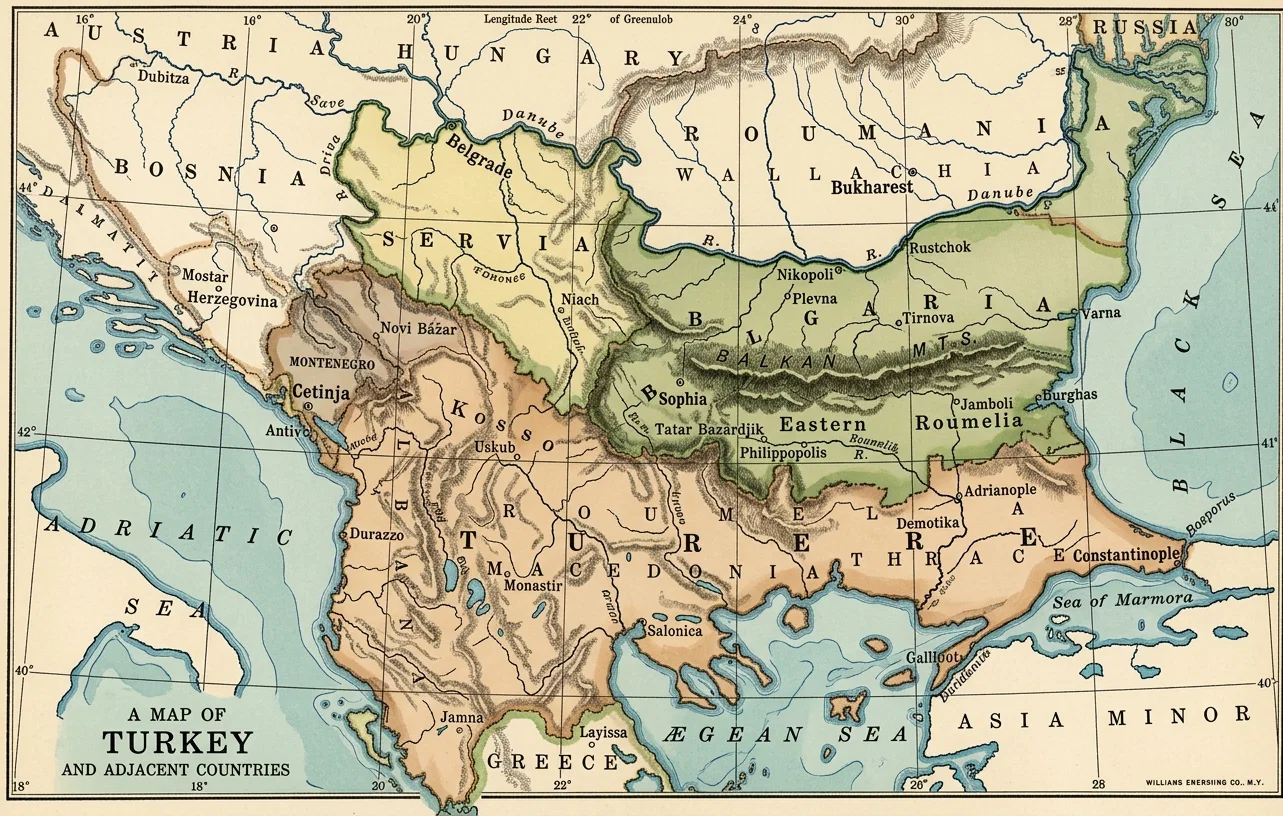
A MAP OF TURKEY AND ADJACENT COUNTRIES
A study of this map shows that Turkey has already lost more than half of her original European territory
A MAP OF TURKEY AND ADJACENT COUNTRIES A study of this map shows that Turkey has already lost more than half of her original European territory
THE accompanying map shows the larger portion of the territory immediately involved in the present unpleasantness in southern Europe. When the majority of the European powers united to compel Russia to permit a revision of the treaty of San Stefano, those powers declared by that act that any question involving Turkey must be settled by the powers rather than by any one of them. The revised treaty of San Stefano became the treaty of Berlin. Under that treaty Rumania, Servia, and Montenegro were made independent principalities. Bulgaria and Eastern Rumelia were taken from Turkey, the former being granted autonomy, and being given a guaranty against Turkish oppression; and the latter, while remaining nominally a Turkish province, was to have a Christian governor. Eastern Rumelia refused to accept this arrangement, and united itself with Bulgaria. Bosnia and Herzegovina, while remaining under the overlordship of Turkey, were to be under the administration of Austria-Hungary. The two latter provinces, as well as Montenegro, are peopled largely by Serbs (Servians), and it has been the ambition of Servia to unite Servia, Bosnia, and Herzegovina into one kingdom. It is the blocking of her cherished plans by Austria’s annexation of Bosnia and Herzegovina that has so angered Servia; and it is because of the strong ties of race that Montenegro has been so willing to join Servia against Austria. There is no doubt that both Bulgaria and Austria, fearing that Turkey, rejuvenated by the Young Turks and the new constitution, would seek to regain control of Turkey’s vanished possessions, decided to accomplish their purposes while Turkey was least prepared to resist. This seemed to Crete also an auspicious moment for throwing off the Turkish yoke. Bulgaria, in declaring her independence, and Austria, in annexing Bosnia and Herzegovina, have both violated the provisions of the Berlin treaty. England and France are not willing to see the treaty violated; Russia is not willing to see it violated unless she gains valuable compensation therefrom; Germany displays an inclination to permit Austria to have her way; and Italy, though one of the signatories of the Berlin treaty, has given no decided expression of purpose. Out of this tangle of conflicting purposes it will be a difficult task for even the wisest statesmen to bring peace. England’s notification to Crete that her annexation to Greece would not be permitted at the present time, and Russia’s threat to invade Bulgaria if the latter continued military preparations, have served to quiet the situation to some extent. Austria, because of the moral pressure of England, France, and Russia, has consented to discuss the annexation of the two provinces direct with Turkey. Russia’s demand that Bulgaria modify her attitude toward Turkey at once, has induced the latter country to express to Turkey her desire for peace, and her willingness to negotiate conciliatingly the railroad question and other matters. The great powers’ jealousy of one another is the only thing, humanly speaking, that guarantees to the sultan any portion of his European estate; and were it not for God’s special agents, commissioned to hold the winds of strife till his work is done, the European powers would have leaped upon one another long ago to determine the destiny of European Turkey.
C. M. S.

The Eastern Question

UNDER the heading, “Scenes of Many Wars,” there appeared in the Washington Post, of Oct. 12, 1908, an article upon the subject of Turkey and the present European situation. In this article, Turkey is referred to as “the sick man on the Bosporus.” The following paragraphs, taken from this article, are significant, and, to the careful student of prophecy, especially of the latter portion of the prophecy of Daniel and portions of the book of Revelation, they make very interesting reading:—
Again the public gaze is directed to the southeast of Europe, the dark corner from which much trouble has come in the past, and which place—representing a mixture between Orient and Occident—has always been regarded as the most probable source of international war. . . .
After the Turks invaded Europe, many hundreds of years ago, advanced victoriously toward Central Europe, and only slowly lost their grip upon some of the conquered lands, Turkey fell gradually into a stage of decay, from which it hardly ever will rise. As a matter of fact, Turkey has held its shaky position longer than many great statesmen expected—held only, though, by the other powers, similar to a rock standing on edge, and held in balance by opposing forces around it.
While the Young Turk party, or the Modernists in Turkey, may, in the course of time, be able to improve conditions, it is doubtful whether the time at their disposal, should they get full sway, would be sufficient to enable them to strengthen Turkey before the inevitable crash comes which will throw all Europe into a turmoil, and force the Turks back to Asia, to where, as ancient superstition tells them, they will eventually be forced to retreat.
The tension has been great in the Balkans for many decades, and nears the climax, although a general war may again be averted this time.
While much, regarding peace, depends on Turkey’s attitude and self-control as to Bulgaria’s recent step, an understanding may be reached; butshould Servia continue—of its own accord, or influenced by others (which is more likely)—in its present hostile attitude toward Austria-Hungary, or should it be imprudent enough to force Austria to take serious notice of its small sword-rattling neighbor, then the great European war is at hand, as hostilities between these countries would not be the only serious consequences. . . .
The seat of trouble is not the residence of the new “czar” of Bulgaria, nor that of the king of Servia, but is at the door of those governments which influence these small potentates, seemingly to act for themselves, but actually only to clear the highways—and not the least byways—for their policies and for their desires for extension of spheres of interest, and for future annexation of those which at present they use as trick cards in their games.
These statements are indeed significant. They indicate what we, for years, through the study of prophecy, have held,—that the driving of Turkey out of Europe and the drying up of this power would be the signal for general war and the great time of trouble. Although “a general war may again be averted,” still those who are giving study or serious attention to the situation among the nations as it really is, can not shake off the impression that ultimately such a war is inevitable, and that the question of its time centers in the fate of Turkey.
The statement that “Turkey has held its shaky position longer than many great statesmen expected,” shows how the winds of strife have been held in check, as described in Rev. 7: 1-4. And that it has been “held only, though, by the other powers, similar to a rock standing on edge, and held in balance by opposing forces around it,” likewise indicates that when these powers cease to give to Turkey their support, it will be driven from Europe, and will finally come to its end, as foretold in Dan. 11: 45.
Referring to the recent losses of provinces in European Turkey, the Post, of October 9, said:—
The Ottoman empire has lost Bulgaria, Bosnia, Herzegovina, and Crete within a week. It can expect no effective help from the powers.
This, again, is only a forecast of the time when this power “shall come to his end, and none shall help him.” And this, as we know, will be the signal that the time has come for all earthly governments to be brought to an end, and Christ to receive the kingdom, and begin his reign. In this mighty transition comes the “time of trouble” such as never was, which leads up to the coming of Christ, the pouring out of the plagues, the resurrection of the righteous dead, and the binding of Satan. Of this time, upon which we are soon to enter, the Scriptures have spoken in graphic language; the spirit of prophecy, likewise, has given us the following description:—
I was shown the inhabitants of the earth, in the utmost confusion. War, bloodshed, privation, want, famine, and pestilence were abroad in the land. As these things surrounded God’s people, they began to press together, and to cast aside their little difficulties. Self-dignity no longer controlled them; deep humility took its place. Suffering, perplexity, and privation caused reason to resume its throne, and the passionate and unreasonable man became sane, and acted with discretion and wisdom.
My attention was then called from the scene. There seemed to be a little time of peace. Once more the inhabitants of the earth were presented before me; and again everything was in the utmost confusion. Strife, war, and bloodshed, with famine and pestilence, raged everywhere. Other nations were engaged in this war and confusion. War caused famine. Want and bloodshed caused pestilence. And then men’s hearts failed them for fear, “and for looking after those things which are coming on the earth.”
The unbelieving world will soon have something to think of besides their dress and appearance; and as their minds are torn from these things by distress and perplexity, they will have nothing to turn to. They are not prisoners of hope, and therefore do not turn to the Stronghold. Their hearts will fail them for repining and fear. They have not made God their refuge, and he will not be their consolation then, but will laugh at their calamity, and mock when their fear cometh.—“Testimonies for the Church,” Vol. I, pages 268, 269.
Notwithstanding the great preparations being made by all nations for war, and the prevailing fear that war is impending, it is strange how many still dream of disarmament and a time of universal peace. Thus an editorial in the Washington Post, of Sunday, Oct. 11, 1908, on “Russia and Constantinople,” closes with the following words:—
When the prophecy of Isaiah shall be fulfilled throughout the world,—“And they shall beat their swords into plowshares, and their spears into pruning-hooks, . . . neither shall they learn war any more,”—then Constantinople, like a ripe pear, will fall into the lap of Russia. But as yet the sword is regnant.
But this, we know, is but an idle dream, a delusive hope, and a misunderstanding of the prophecy of Isaiah. The prophecy in Isaiah 2 simply tells what many people will say in the last days, not what they will do. The prophecy of Joel 3 tells what they will do,—prepare war, wake up the mighty men, beat their plowshares into swords, and their pruning-hooks into spears, and assemble for war.
We are certainly living in most solemn and interesting times. But while we are soon to enter the most awful time this world has ever seen, one thought brightens the prospect and cheers the heart, and that is that this time will be short, and that it will usher in the most glorious time the people of God have ever experienced. They will then see Jesus, who has redeemed them; meet loved ones from whom they have long been parted; enter upon that rest that remains to the people of God, the grand millennial Sabbath in heaven above; and bask in the sight of him in whose presence there is fulness of joy, and at whose right hand there are pleasures forevermore. Shall we not, then, as we see these things coming to pass, give heed to the injunction to lift up our eyes and rejoice, knowing that our redemption draweth nigh? W. A. COLCORD.
Continue reading: Thanksgiving