Your ShelfYour Projects

Signs of the Times, Vol. 31, No. 7.

THE MISSION OF CHRIST
Earlier text: EVOLUTION AND GEOLOGY

MY BURDEN.

GOD laid upon my back a grievous load,— A heavy cross to bear along the road. I staggered on; and lo! one weary day, An angry lion sprang across my way. I prayed to God, and, swift at His command, The cross became a weapon in my hand. It slew my raging enemy, and then Became a cross upon my back again. I faltered many a league, until at length, Groaning, I fell,—and had no further strength. “O God,” I cried, “I am so weak and lame!” Then straight my cross a winged staff became. It swept me on till I regained the loss, Then leaped upon my back, again a cross. I reached a desert. O’er the burning track I persevered, the cross upon my back. No shade was there; and in the cruel sun I sank at last, and thought my days were done. But lo! the Lord works many a blest surprise— The cross became a tree before my eyes! I slept; I woke to feel the strength of ten. I found the cross upon my back again. And thus, through all my days, from that to this, The cross, my burden, has become my bliss; Nor ever shall I lay the burden down, For God, some day, will make the cross a crown! —Amos R. Wells.

BIBLE DISTRIBUTION AMONG JAPANESE SOLDIERS.
[Report of Mr. Loomis, Agent of the American Bible Society.]
WE have now donated more than 32,000 Testaments and Gospels to the Japanese soldiers, and the most of them have gone to the sick and wounded in the hospitals. It is reported that there are already 45,000, and more are coming all the time. A request has come this morning for 5,000. The applicant writes: “Soldiers are begging for them.” Another missionary, to whom I had sent 500 copies, writes: “The soldiers are very glad to receive them, and are very ready—in many cases eager—to be instructed.”
Mr. McGinnis writes me from Karuizawa: “There are at present over one thousand men in Karuizawa, three hundred at Katsukabe, and six hundred and fifty at Oiwake. The officers in charge have given us every opportunity for getting at the men, and the men themselves seem most anxious to hear and to read about Christianity. The meetings are well attended, and on Sunday evening last hundreds were turned away from the Union Hall, unable to gain admission. After the meetings men stay behind to learn more about Christ. Already there have been some who have definitely decided to serve Christ, and many others are on the verge of decision. During the wet weather, when the men are unable to get out, I visit them in their houses, where I always find a glad welcome and attentive listeners. The men seem eager to get the tracts and Scriptures; and by the questions they ask they show that they have read them carefully.”
I have made application to the War Department for permission to visit and distribute the Scriptures and other useful reading matter in all the hospitals in this field. The work among the soldiers grows in interest all the time. Permission has been granted by the War Department to distribute Scriptures to the sick and wounded whenever the arrangements can be made with those in charge of the hospitals. Just now the extra care of the large number coming from the front has so engrossed the time and attention of the medical attendants in Tokyo that there is no opportunity to arrange for such visitation. I am assured, however, that as soon as such matters can be adjusted I shall be invited to come and hold service for all the 13,000 invalids now in Tokyo and vicinity.
In May last we had a call from Mr. Nettleship, of Hakodate, who has a school for the Ainus, and he reported that it was his desire to undertake some definite religious work among the soldiers during the summer. He expected to put up a tent for the meetings, and to utilize the school for a reading-room. He was given a supply of Scriptures and has sent a report, of which the following is a part:
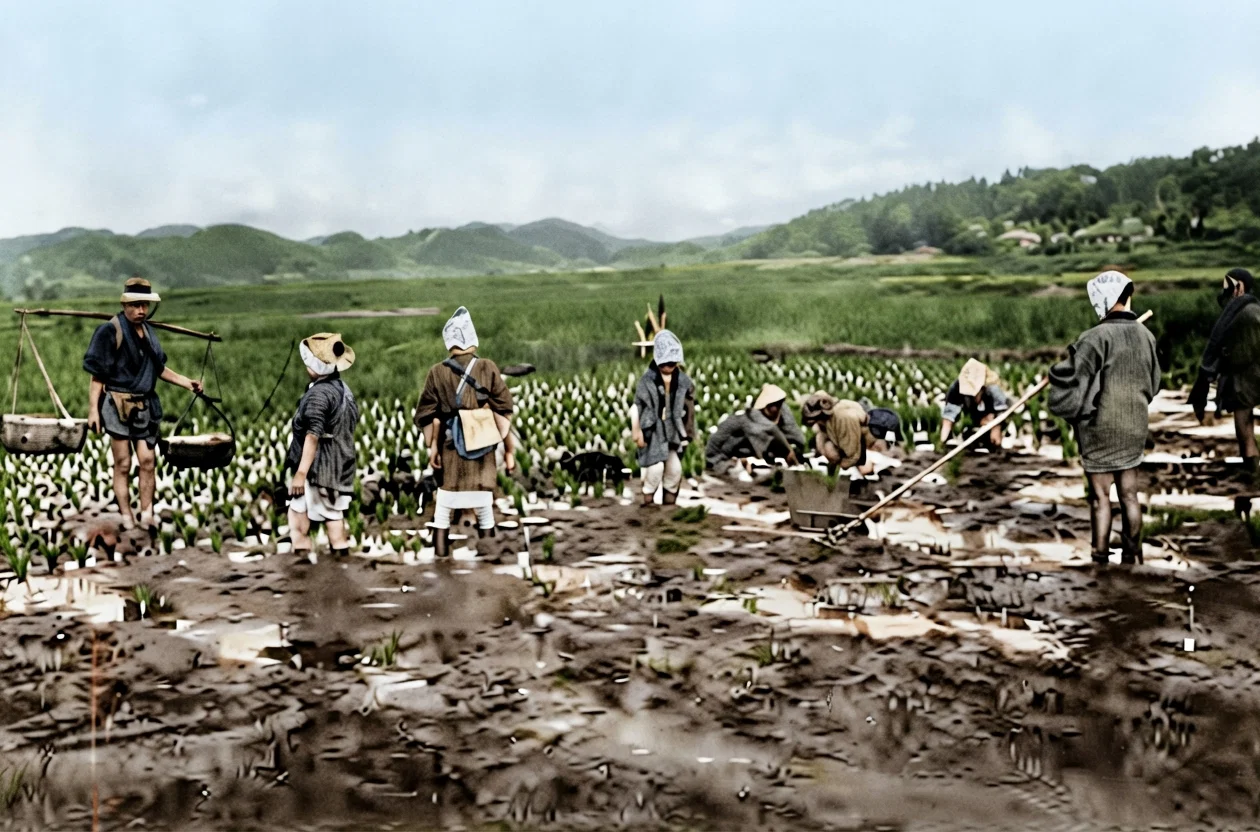
Planting-time in the Rice Fields of Japan.
The work has been carried on continuously since the end of May. The reading-room has given many opportunities for personal dealing with the men. The attendance at the general meetings has been anything from three to one hundred. Just now we are having daily meetings for Bible readings and hymn singing for the convalescents of the military hospital. Many, many Portions from you have been distributed.
The Bible and Tract Societies are doing a great work just now among the soldiers, the result of which will only be surely known in eternity. We do, indeed, thank you for all the help you have given in the Master's work in this corner of His vineyard; and we continually pray that His richest blessing may rest upon His own Word and upon His servants who are responsible for the distribution of the Bread of Life.
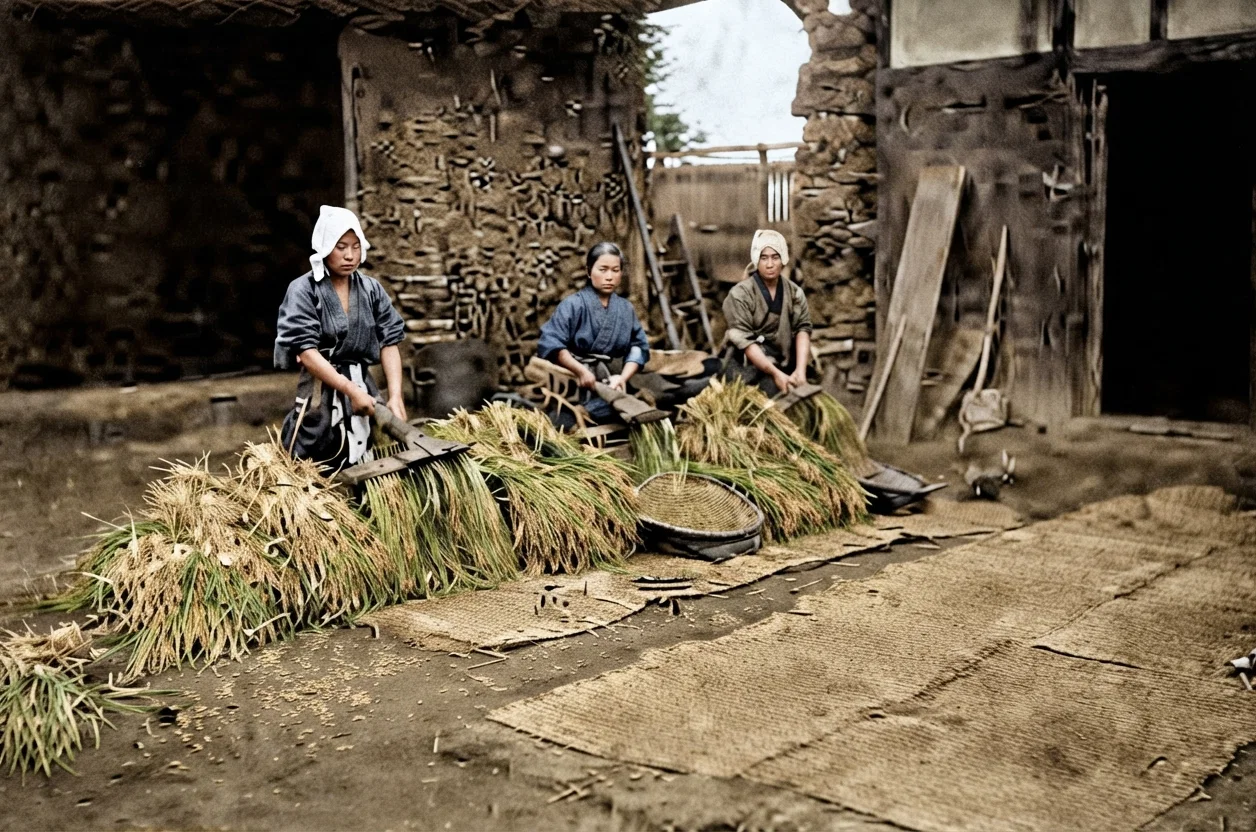
Thrashing Out the Rice.
Mr. Fulton reports from Kanazawa: “We have opened a resting and reading-room, and it is daily crowded with men to look at the pictures, enjoy singing, read books and tracts, and listen to the Word.”
Miss Zurfluh, of Sendai, asks a grant of 4,000 Gospels for the sick and wounded in the hospitals there, and adds: “They will be glad to have us come to distribute them. The head doctor has asked permission from the War Department and sent word that he would be pleased to have us come.”
A grant has been made of 10,000 Gospels to put into “comfort bags” that have been made for the soldiers, and are to be sent to the front; also 3,000 Gospels and Testaments for the Bible class, to be used by the representatives of the Young Men's Christian Association who have gone to Antung. The total donations thus far have reached above 50,000 volumes.
The publications for the last six months were 48,000 Gospels of Matthew, pocket edition.

SUGGESTIVE QUESTIONS

INTERNATIONAL SERIES THE SUNDAY SCHOOL

LESSON 9.—FEBRUARY 26.—THE MIRACLE OF THE LOAVES AND FISHES.

Lesson Scripture, John 6:1-14, A. R. V.
(1) "AFTER these things Jesus went away to the other side of the Sea of Galilee, which is the Sea of Tiberias. (2) And a great multitude followed Him, because they beheld the signs which He did on them that were sick. (3) And Jesus went up into the mountain, and there He sat with His disciples. (4) Now the Passover, the feast of the Jews, was at hand. (5) Jesus therefore lifting up His eyes, and seeing that a great multitude cometh unto Him, saith unto Philip, Whence are we to buy bread, that these may eat? (6) And this He said to prove him; for He Himself knew what He would do. (7) Philip answered Him, Two hundred shillings' worth of bread is not sufficient for them, that every one may take a little. (8) One of His disciples, Andrew, Simon Peter's brother, saith unto Him, (9) There is a lad here, who hath five barley loaves, and two fishes; but what are these among so many? (10) Jesus said, Make the people sit down. Now there was much grass in the place. So the men sat down, in number about five thousand. (11) Jesus therefore took the loaves; and having given thanks, He distributed to them that were set down; likewise also of the fishes as much as they would. (12) And when they were filled, He saith unto His disciples, Gather up the broken pieces which remain over, that nothing be lost. (13) So they gathered them up, and filled twelve baskets with broken pieces from the five barley loaves, which remained over unto them that had eaten. (14) When therefore the people saw the sign which He did, they said, This is of a truth the Prophet that cometh into the world."
Golden Text.—"I am the living Bread which came down from heaven." John 6:51.

SUGGESTIVE QUESTIONS.

(1) After the things considered in last week's lesson, where did Jesus go? Verse 1. Note 1. (2) Who followed Him? Why? Verse 2. Note 2. (3) On arriving at the other side of the sea, what did Jesus do? Verse 3. (4) What feast of the Jews was at hand? Verse 4. (5) What now attracted the attention of Jesus? Then what did He say to Philip? Verse 5. Note 3. (6) Why did Jesus ask this question of Philip? Why did Jesus not need the information thus asked? Verse 6. Note 4. (7) What did Philip say in reply to this question? Verse 7. Note 5. (8) Which of the disciples then volunteered information? Verse 8. (9) What did this disciple say? How did he regard this small supply? Verse 9. (10) Then what did Jesus say? What condition favored their sitting on the ground? How many were there in the company? Verse 10. Note 6. (11) What then did Jesus do with the loaves? And with the fishes? Verse 11. Note 7. (12) What expression indicates that the people all had an abundance to eat? Then what did Jesus say to His disciples? Verse 12. Note 8. (13) How much did they gather of the broken pieces? Verse 13. Note 8. (14) What was the impression made upon the people by this notable work?

NOTES.

1. "The other side," according to Luke (chapter 9:10), was the uninhabited region on the northeast side of the sea, near Bethsaida. There were two reasons why Jesus called His disciples away to this retired spot. (1) He had just heard of the death of John the Baptist, and would fain retire for meditation. See Matt. 14:1-13. (2) The disciples had just returned from an extended tour, and had reported their success to Jesus; and at this moment both Jesus and His disciples were very much overworked, and needed rest. See Mark 6:30-32.
2. The multitude saw Jesus and His disciples leave Capernaum in a boat, and noted which way they were headed. Then many of them started by land toward Bethsaida, and others joined them as they went. The people were attracted by the miracles. Thus Jesus used the people's physical needs with which to draw their attention to the spiritual food He desired to give them.
3. The second reference to a great multitude, in verse 5, is explained by verse 4. There were crowds of people on the highway going to Jerusalem, and many of these were attracted to the scene.
4. Jesus could properly turn to Philip with such a question, for he was one of the three disciples whose homes were in Bethsaida (John 1:44). But the Lord didn't need human counsel; He was directed from heaven in all His words and work. See John 8:28, 29; 12:49; 14:10, 11.
5. Philip answered very readily, and quite correctly, from the standpoint of human estimate, and the amount of his estimate (thirty-two dollars' worth) adds magnitude to the miracle. But Jesus gave opportunity for the disciples to realize that spiritual possibilities can not be reckoned by physical quantity or temporal values.
6. "Make the people sit down." Mark (chapter 6:40) says "they sat down in ranks, by hundreds, and by fifties." This was an evident preparation for a satisfactory meal, and the order assured that none should be passed by. It also demonstrated that Jesus knew beforehand what He would do. "About five thousand." Matthew (chapter 14:21) says "about five thousand men, beside women and children."
7. Jesus gave thanks for that which was not yet in sight, just as He would have done had the vast quantity of provision been heaped up before Him. He dispensed the food by the hands of His disciples, just as He dispenses spiritual blessings to the world through the ministration of His children. The Gospel is ever proclaimed through human agency. The people were given "as much as they would" eat of both loaves and fishes. So with spiritual food, there is no limit only in the desire and assimilation of the receiver.
8. The gathering of the fragments was at the command of Jesus, as a lesson in frugality. His power was not to be exercised to encourage wastefulness. The twelve baskets of remains would make another meal for the disciples. So the Lord gives spiritual blessings for use, and not to be wasted or employed for any purpose but the legitimate work of the Gospel. It is well to note, also, that this miracle is the only one mentioned by all the Gospel writers. Thus its importance is indicated by the Spirit that inspired their records.
9. The effect of the miracle was to convince the people that Jesus was the expected Prophet. But they showed the error of their time in regard to the mission of that Prophet by determining to make Him king. And this purpose was actuated by the thought that such a king could readily supply their temporal needs. When the same people sought out Jesus the next day in Capernaum, He told them that they were only seeking Him because of the loaves and fishes; and then He gave them and us this counsel: "Work not for the food which perisheth, but for the food which abideth unto eternal life." See verses 15 and 22-27 of lesson chapter.

OUR WORK AND WORKERS.

EIGHT members were added to the church at Moon, Wis., at the last quarterly-meeting.
AT the last quarterly-meeting of the church in Appleton, Wis., two members were received.
A REPORT in the Workers' Bulletin notes the addition of three persons to the faith, at Cincinnati, Ohio.
THE Minnesota Conference is now paying the expense of a laborer in Manitoba, Canada, for a time. Brother J. C. Christensen is the minister so engaged.
THE Wisconsin Reporter says that "nine of the students attending the church school at Cassville, taught by Sister Anna Johnson, have requested baptism and membership in the church."
IN the Minnesota Worker, Brother G. L. Budd reports from Senjen that nine persons have accepted the faith, as a result of his labor there, and a Sabbath-school of twenty-two members has been organized.
DURING the week of prayer, Brother B. E. Connerly organized a church of thirteen members at Mayaguez, Porto Rico. Brother Connerly and his wife have been on the island nearly three years, and they now feel that their work has really begun, as several others besides the new church members are deeply interested in the truth.
THE church at St. Peter, Minn., is rejoicing over the recent baptism of five young people, and the addition of others to the church. Brother W. W. Stebbins, who makes this report in the Worker, has also been visiting isolated Sabbath-keepers in the country who are deprived of church privileges. He notes one point of special significance—that wherever the Review or Signs is found in the family, the study of the Bible is kept up, and they know where the message is. From this class also, tithes and offerings were gathered.

Organization of Pacific Press Board.

AT the recent annual meeting of the Pacific Press Publishing Company, the following board of directors was elected: M. C. Wilcox, E. A. Chapman, C. H. Jones, W. B. White, M. H. Brown, H. H. Hall, A. O. Tait. This board was subsequently organized as follows: President, M. C. Wilcox; vice-president, C. H. Jones; secretary, B. R. Nordyke; treasurer, E. A. Chapman; auditor, J. J. Ireland. The working forces were organized as follows: General manager, C. H. Jones; manager book and periodical department, H. H. Hall; superintendent manufacturing department, C. H. Jones; assistant superintendent, F. H. Gage; manager Kansas City Branch, James Cochran; manager Portland Branch, W. V. Sample.
The Sabbath-school lessons have been discontinued. The Lesson Quarterly may be obtained, containing three months' lessons and notes, for five cents. Address, Pacific Press, Mountain View, Cal. The Sunday-school lessons will continue.

OLIVOILINE

Is the Hygienic Cooking Oil of To-day. A Pure Vegetable Shortening. No Animal Fat. No Taste and No Chemicals. Like Olive Oil, and Keeps In Any Climate Price, F. O. B., Cash with order 5 gal. can, $3.50; 10 gal. can (75 lbs.), $6.75. Write for circulars on Bbl. and ½-Bbl. lots. (Refined Cotton Seed Oil, 10 Gallons, $5.50) Address O. C. GODSMARK 2005 Magazine St. LOUISVILLE, KY
PRACTICAL LESSONS FROM THE EXPERIENCE OF ISRAEL FOR THE CHURCH OF TO-DAY.—By F. C. Gilbert, a Hebrew Christian. The prominent thought is to present Jesus Christ as He is,—Saviour, Messiah, Prophet, Priest, King,—which was the specific mission God had for the Jewish nation. The condition of the Jews at Christ's first advent on the earth and their refusal to accept Him as the Saviour are presented in a very practical way. Many of the customs of the Jews existing at the time of Christ are vividly portrayed. 400 pages; illustrated. Cloth, plain edges ....................... $1 00 Cloth, gilt edges .............................................................. 1 25 Half morocco, gilt edges ................................................. 2 00 Address PUBLISHERS OF THIS PAPER.
THE ATONEMENT.—An examination of the remedial system in the light of nature and revelation. By J. H. Waggoner. This work is a critical and exhaustive treatise on the plan of salvation as revealed in the Scriptures, showing its harmony with the principles of justice and mercy, its consistency with reason, and its final results as affecting the destiny of the human race. Third edition, revised and enlarged, 368 pp. Cloth. Sent post-paid for 90 cents. Address PUBLISHERS OF THIS PAPER.

A LESSON IN PARENTAL CONTROL.

BY MRS. CYNTHIA GOODWIN.
MRS. ADAMS had just placed a bright new doilie on the center table to brighten up the room. Little Lela must have her part in the work, too, and so she gathered a bouquet of the best flowers she could find, filled a vase with water, crowded the flower stems down into the vase till the water was flowing over the top, and then placed the dripping vase in the center of the new doilie.
"Why, you little blockhead," cried her mother, "don't you know any better than to put that wet vase and those trashy flowers on my new doilie? Take them away at once, and put them in the ash barrel. Go!"
Mrs. Adams then turned to her visitor with the petulant query: "Do you ever have your children spoil your things in that way?"
"Yes, dear; children are children; but I am very sorry to see how much you have spoiled."
"Why, what have I spoiled, Mrs. Brown?"
"Spoiled? why, you have spoiled the opportunity of letting that child see that you appreciate its toil for you. You have lost or destroyed a chance of getting a firmer hold upon your child's confidence. When you scold it so, you drive it from you, and it loses respect for you. You will excuse me for speaking so plainly, but do you not see that the little one worked hard to gather those flowers for you, thinking to please you? The thought never entered her childish head that she was injuring anything. The Bible says, 'Cursed is he that returneth evil for good.' I fear that we, as parents, are likely to bring that curse upon our own heads, if we treat our children unkindly in return for their efforts to please us. Just consider for a moment the child's feelings in the matter. You called her a blockhead. If I were to speak so of your child, you would quite likely order me out of the house; but you probably shocked the child's nervous system far more by thus speaking than I would shock you by making a similar remark. Sometime you will tell the little one that she is bright and sweet; and then it will begin to confuse your two statements, and doubt your truthfulness. Children are very matter-of-fact in their lives until we bring about a difference in them by the way we speak and the things we do."
"So many mothers find, when too late, that they do not have their children's confidence. They would give anything they possess to gain it; for mayhap their boys and girls are on the road to perdition; but it is in the seeming trifles that we knit and link their very hearts to ours. When we have their confidence so that they will tell us everything, we need have little fear of their going wrong."
"Yes, I know, Helen, what you say is all true; but this terrible temper of mine constantly gets the upper hand of me. Poor little pet, I must try to make amends to her; for she tries to do so many such things for me. I never thought of rendering evil for good to my child. What shall I do to control myself?"
"The only way, Ethel, is to confess and forsake, giving your life anew into the hands of your Saviour every morning, relying upon Him for grace to direct you in your dealings with your children. You will get nearer to your child now, if you confess your wrong, and her confidence will be strengthened in you."
Little Lela had fled to another room, and had cried herself to sleep. As Mrs. Adams looked down upon the tear-stained face of her little girl, and saw the intermittent twitching of the little body, as she sobbed in her sleep, she realized more than ever the wrong she had done, and the necessity for self-control in dealing with little lives. Mrs. Adams could not repress the tears herself, as she looked upon the result of her work.
The child awoke with a start. "O, did you really want the flowers, mama? I did not throw them away; I put them in my playhouse. I'll get them, if you want them."
The caresses and kisses and the prayers for forgiveness were beyond the child's comprehension, and why the doilie is now none too good for the flowers she does not understand, till Mrs. Adams takes the little one over the whole ground of the misunderstanding. Now she understands that they both like the pretty flowers. She has learned, also, why it is that the vase can stand on the doilie now, but could not before. She has learned a lesson in carefulness, and the mother one in self-control, and both are happy instead of miserable. Now the busy little hands and the busy little feet are more busy than ever to help mama, and her little arms are often put around mama's neck. Again and again she asks, "Mama, do you love me?" She sees the change, and is making very sure that mama does love her. She was not sure of it before.
Some weeks after this Mrs. Adams' visitor is again with her. This time Lela brings in a little kitten that is dripping wet. Her own dress is soiled with it.
"I didn't mean to get my dress dirty, mama; but a naughty boy threw the kitten in the mud, and I thought you would be sorry for it, and so I brought it in."
Mrs. Adams dried the mistreated kitten, while Lela stood looking sorrowfully at the dress that had been clean but a few minutes before. Here is the place where impatience can weaken the ties of her child's love and trust and confidence, or where the exercise of patience can bind the little one to the mother heart with stronger cords than ever before. But the temptation to yield to the tempter is mastered, and she says very gently: "Come, dear, you shall have a clean dress on. You felt sorry for the kitty, and mama does, too."
That patience and the few words of kindness, how they bind hearts, and fill the home with sunshine and joy!
"Mrs. Adams, God is teaching us wonderful lessons in character building, when we let Him control and guide. We must keep our hearts open by secret prayer. When Christ abides within, our loved ones see and know and feel the blessed influence that shapes our characters."

EXPERIENCES WITH TRAMPS.

BY MRS. W. H. ALLERNS.

OUR home used to be near the railroad track, and as that seemed to be an ideal place for tramps to congregate, we often had calls from them in rapid succession.
To know just how best to deal with these unfortunates, many of whom are no doubt worthy persons out of employment, is something that is entirely beyond us if we rely upon our own wisdom. The Lord has promised that His Word would be a lamp to our feet and a light to our path. We can therefore come to His Word for guidance in this matter. The Golden Rule is in itself an indication of how we should treat the matter: "As ye would that men should do to you, do ye even so to them." He tells us that He sends the rain alike upon the just and upon the unjust, and He admonishes us to be merciful even as our Father in heaven is merciful.
I have had many blessed experiences in giving to these generally neglected wayfarers the best I had—not because I was afraid of them, but because I was yearning for their soul's salvation. I have often felt that such experiences were somewhat similar to our Saviour's experience with the woman at the well of Samaria.
One Sabbath two travelers came to our home. It being our Lord's rest day, I invited them in to rest, explaining to them my reasons for observing this particular day as a Sabbath. They joined with us in singing praises to God, and we had an enjoyable little meeting. At its close, they felt they must take up a collection, and accordingly each of them left ten cents for the Lord's work.
On another Sabbath a young man came and asked for his breakfast. I gave it to him and then invited him into the parlor to sing with us. He joined in every song, and stayed for Scripture reading and prayer. He left us in good spirits. There is no loss in this work more than in any other Gospel work, andonly our Father knows how many may be rescued in this much-neglected field. In neglecting this field and turning away these needy ones so frequently without even the bread of temporal sustenance, and almost always without a crumb of the bread of life, are we not showing respect to persons?, "But if ye have respect to persons, ye commit sin, and are convinced of the law as transgressors."
A certain young man was advised not to call at our house lest he should become converted. He came, however—and got converted. I was led to talk to him about his soul's salvation. We read God's Word, and had an earnest season of prayer. He himself was led to pray, and when he arose from his knees, his countenance showed that he was a changed man. On the Sabbath following he met with us again, and during the season of prayer following the singing and reading of God's Word, two of my little girls were led to pray for him very earnestly. Tears ran down his cheeks, and he said, "This is like heaven." Surely heaven was filling our hearts with its blessings. He said, "I came here a perfect stranger, and now you seem like my own mother." We have only to open our hearts and our doors for work of this character, and the Lord will send us abundance. Let us lose no opportunity of helping poor sinners to find Jesus.
"Give to every man that asketh of thee; and of him that taketh away thy goods ask them not again." Luke 6:30.

OFFERING TO-DAY.

O, DO not bring your flowers To strew upon the bier; Keep them for those you flatter With kind attentions here; They will not ease one heart-ache, They will not dry one tear, They will not light one gloomy hour, Too late! too late to cheer.
"Let her alone," said Jesus, "The precious ointment pour, She waits not for My burial, The anointing comes before;" Uncork the fragrant spikenard, Let perfume fill the air, She comes to bathe the weary feet, Begrimed, but O how fair.
Thus would we bring sweet flowers, And all we have to give; The choicest and the best to share With friends while here they live. Thus would we sweet affections Twine round the forms we love, With choicest wreaths and garlands, Our true devotion prove.
Elmira, N. Y.

Devotional Songs

A DICTIONARY MADE BY SPECIALISTS GIVES YOU 1. The privilege of consulting an acknowledged authority upon every subject within the range of human knowledge. 2. A more complete collection of the words belonging to each separate department of study and investigation. 3. Fully up with the times; giving the results of the latest discoveries in every field of investigation. 4. Greater accuracy in definition, and more intelligent discrimination in bringing out the various shades of meaning. 5. Clearer and simpler form of statement. The more perfect the definer's knowledge of a subject, the more lucid his explanation of it. 6. More comprehensive treatment, i. e., full, adequate definitions. 7. The nearest approach to immunity from error that human intelligence can devise. 8. The best consensus of opinion on words of doubtful spelling and pronunciation. 9. Every great Religion or Creed has its specialist for defining the words peculiar to such creed or religion. 10. Every subject is treated by those whose training and skill best fit them to read it. 257 EMINENT SPECIALISTS MADE THE FUNK & WAGNALLS Standard Dictionary Mention this adv. and learn how this work can be sent you free for examination. FUNK & WAGNALLS COMPANY, Pubs., NEW YORK
ONE-HALF NEW SONGS THAT WILL NEVER GROW OLD. ONE-HALF OLD SONGS THAT WILL ALWAYS BE NEW.

Devotional Songs

By three famous composers, Doane, Kirkpatrick and Main.
256 pages, cloth, $25 per 100; 30c. each by mail. A returnable copy for examination will be mailed on request. Published by the publishers of the famous "Gospel Hymns." THE BIGLOW & MAIN CO., New York and Chicago.

Giant Flower Seed Offer

Did you ever see 5 straight or circular rows of Pansies side by side, each a different color? If so, you know that the effect is charming. Did you ever see Childs' Giant Pansies, marvels in beauty and true to color? If not, you have not seen the best.
As a Trial Offer we will for 10 cts. mail 5 Pkts. Giant Pansies, Snow White, Coal Black, Cardinal Red, Pure Yellow, Azure Blue; also Five Pkts. New Giant Sweet Peas for 10 cts., White, Pink, Scarlet, Blue, Yellow; also
Five Pkts. new early flowering Carnation Pinks for 10 cts., Scarlet, White, Pink, Red and Striped—or All 15 Pkts. for 25 cts.
Our Catalogue for 1905—Greatest Book of Flower and Vegetable Seeds, Bulbs, Plants and New Fruits. 148 pages, 500 illustrations, many plates—will be mailed Free. Scores of Great Novelties.
JOHN LEWIS CHILDS, Floral Park, N.Y.

A Word for the Signs

Denver, Col.
Publishers of the SIGNS OF THE TIMES, Mountain View, Cal.,
DEAR FRIENDS: I have been a reader of the SIGNS for a number of years, and only wish all could have its good timely visits each week. I have in the past, and desire to continue, to do all I can to increase its circulation, because of the good results it brings to its readers.
Yours in His work, L. A. SPRING.

WE HAVE FOUND A FEW SPECIAL SERIES.

SOME of our Societies, after quite thoroughly working the territory in their vicinity, have a limited number of the Special SIGNS, Nos, 1, 2, 3 and 4 on hand. Those who will apply to us quickly may obtain them at the regular rate of twelve cents a set in lots of ten, or ten cents a set in lots of twenty-five.
Address SIGNS OF THE TIMES, Mountain View, Cal.
Continue reading: HANDSOME BISQUE DOLL FREE