Your ShelfYour Projects

Review and Herald, Vol. 91, No. 14.

THE BUBBLE FOUNTAIN

Review and Herald

Apr 2, 1914

Review and Herald Publishing Association · Takoma Park Station, Washington, D. C. · Apr 2, 1914

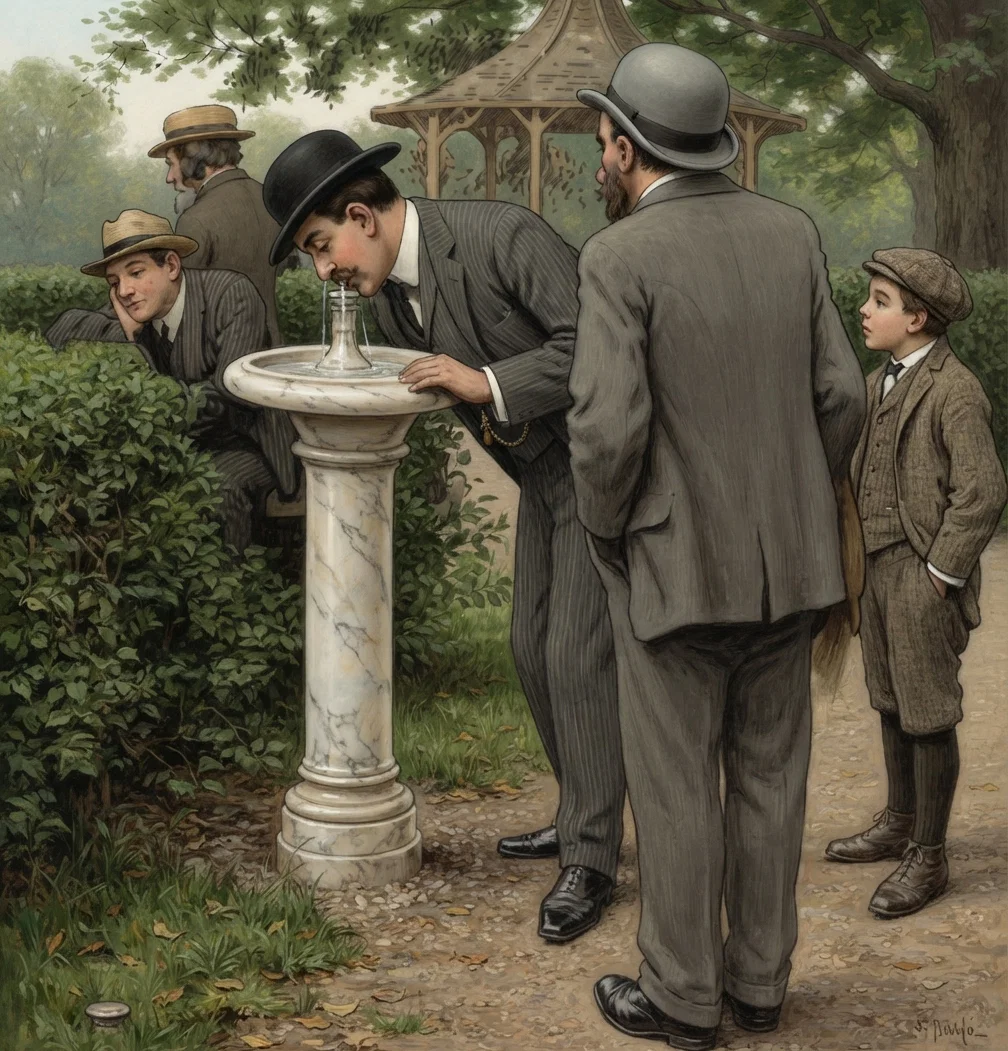
THE BUBBLE FOUNTAIN
EVA J. DEMARSH
[The bubbler is not always all that might be desired from a sanitary point of view; but possibly Miss DeMarsh has seen it at its worst. It has some redeeming features.—Ed.]
THE name sounds good and clean and sanitary, does it not? Men tell us it is all these
Would I drink from the bubbler?—Not on your life. Too many times I have seen foul lips touching its marble

THE BUSINESS MAN'S LUNCH

A.B. OLSEN, M.D., D.P.H.
THE average business man is obliged through force of circumstances to lead a highly without lunch. In the case of the high commissioner at least, this plan appears to have worked admirably, and we know

THE WORK AND THE WORKERS

FRIDAY, March 20, was a red letter day for our magazine department, the day's mail having brought orders for 8,741 copies of the three magazines, Life and Health, Liberty, and the Protestant Magazine.
A MEMBER of the house of representatives, State of Minnesota, sends his check for $1.00 for a four years' subscription to Liberty, using the order blank found in his sample copy.
THE day's mail for Friday, March 20, brought orders for a total of 8,411 copies of the February, March, and April Protestant Magazine. Have you seen the April number?
WE will honor your order for Life and Health, Liberty, and the Protestant Magazine to be sent to any public library or libraries, or Y. M. C. A. reading room, for one year, for only $1.90 — regular price, $2.35.
ONE order last week from the Massachusetts Conference called for 6,000 copies of the February Protestant to be mailed to 23 churches and agents. Each copy will be accompanied by a personal letter soliciting a year's subscription.
THE Greater New York Conference recently ordered 1,500 copies of the April Protestant Magazine. Have you seen the startling photographic and other proofs of Rome's un-American church-and-state teachings in this number?
FRIDAY, March 20, the manager of the Protestant Magazine ordered printed the third edition of the March and the sixth of the February Protestant. Total February copies printed to date, 75,000 — and the wave of Protestantism still rising!
A CARLOAD of paper to be used in printing the fifth February, second March, and first April editions of the Protestant Magazine, was caught in the big blizzard. This may explain why your order has been held up. Orders for 45,000 copies of this magazine were thus tied up for a week or more. Please be patient, as we are now working extra shifts to catch up.
THINK of what sanitation has done for the Philippine Islands, for Panama and other tropical lands! How many of the dreadful scourges and plagues that have attacked mankind might have been avoided had the people been privileged to read such practical instruction as is found in the April or Hygiene, Sanitation, and Business Man's number of Life and Health!
"ONE of our agents went to Philadelphia the other day," writes Brother H. A. May, of New Jersey, "and while there sold some of the February Protestant stamped with our address. A day or two later we received a card from a man down there who wants to act as agent. He said he would guarantee to sell 500 a week. We, of course, referred him to the East Pennsylvania Tract Society."
"Religious Liberty — What Is It?" was the title of a Protestant mass-meeting lecture to be delivered by Prof. Chas. S. Longacre, editor of Liberty, in the Chamber of Commerce Auditorium, Columbus, Ohio, Sunday afternoon, March 8. Contract canceled through threat of "boycott" made by the Knights of Columbus. Contract made next with owners of A. I. U. Hall. Contract canceled after visit of the Knights of Columbus. Lecture finally delivered in Seventh-day Adventist church. And this is "free" America! Circulate Liberty and the Protestant. Both stand for the American Constitutional rights of free speech, free press, and free assembly. Rome is the avowed enemy of these and all other liberties for the other man.

Just a Glimpse of Three of the Thirty Valuable Features Found in the April "Life and Health." Read and Circulate It

WE are shipping out thousands of copies of the great April or Hygiene, Sanitation, and Business Man's number of Life and Health. The first order we received was a telegram from a young lady for 1,000 copies. Note these other interesting features: "Hygiene of the Bedroom," "A Lath Summer House" (illustrated), "Sanitation on the Farm," "Why Ventilate?" "Housing and Health," "Vegetarian Menus for a Week in April," "Public Schools Made the Goat," cartoons showing front and back yards, "Questions and Answers" department, "Book Reviews," "News Notes," etc. Send $2.00 for 50 or $1.00 for 20 copies of this excellent number. Sell 20 or 10 to get your money back and give away the other 30 or 10. The beautiful "Royal Gorge in the Rockies" cover design, in three colors, will sell this number, to say nothing of the exceptional contents and profuse illustrations. Spend $1.25 on five trial subscriptions for your friends, for four months each; or $1.50 for five six months' subscriptions. Address your tract society, or Life and Health, Washington, D. C.

Health

Early Counsels on Medical Work — No. 1

Health

MRS. E. G. WHITE
[COMPILER'S NOTE.— During the few years following 1844, the great truths that now distinguish Seventh-day Adventists from other Christian bodies, were rapidly unfolding. The minds of the believers were absorbed in points of doctrine that required earnest study, and in the problems connected with the launching of a great religious movement. It is not surprising, therefore, that the health reform and medical missionary features of our denominational work were not at once fully developed. The earliest believers, in common with the general public, had very little technical knowledge of the remedial value of fresh air, sunshine, water, exercise, and a wholesome diet. Yet this early period of our denominational history was a time of preparation for a broader evangelistic work that should unite teaching with healing.
From the first, the faithful band of commandment keepers took a firm and uncompromising position against the use of intoxicating liquor. In this reformatory movement, they had a faithful leader in Capt. Joseph Bates, with whose remarkable experience in abandoning the use of alcoholic beverages, tobacco, tea, and coffee, many of the readers of the Review are familiar.
Regarding the progressive nature of the health movement among Seventh-day Adventists, Elder James White wrote in the Health Reformer for April, 1871:—
"This reform among us has been progressive. Our attention was first called to the injurious influence of tea, coffee, and tobacco about twenty years since. For thirteen long years the voice of truth, pleading in the name of Christian temperance, . . . was heard among us, calling our people to leave these slow poisons, before our attention was called to further advance, reformatory steps in habits of life. This was all we could then bear, till victory should turn in favor of purity and health, and against these popular evils. The good work went steadily on, until our tables were cleared of tea and coffee, and our homes and our persons were free from the stench of tobacco. . . .
"But the good work of reform among us by no means ceased with the victories gained over tea, coffee, and tobacco. About seven years since, the attention of our people was especially turned to the subject of ventilation, in order to secure all the benefits to be derived from pure air and proper food and clothing as important to health. The question of meat eating came up, and was candidly and fully discussed. It was decided that flesh was less nutritious than bread. This opinion is not only sustained by the best medical authorities in our country and in Europe, but by the experience of thousands who have tested the matter for periods of from five to twenty years."
The general movement among Seventh-day Adventists along the lines of healthful living was greatly broadened and strengthened near the close of the Civil War. While Elder James White and his wife were spending Sabbath and Sunday, June 6 and 7, 1863, in Otsego, Mich., where a tent meeting was being conducted by Elders M. E. Cornell and R. J. Lawrence, Sister White was given a vision in which she received instruction regarding the scope and importance of the health reform movement.
The counsels given at that time were plain and definite. The following extracts from this vision on health, as published in 1864, in "Spiritual Gifts," Vol. IV, chap. 39 ("Facts of Faith," part 2, pages 120-151), will reveal the general spirit of the message given.]
ADAM and Eve in Eden were noble in stature, and perfect in symmetry and beauty. They were sinless, and in perfect health. What a contrast to the human race now! Beauty is gone. Perfect health is not known. Everywhere we look we see disease, deformity, and imbecility. . . . Since the fall, intemperance in almost every form has existed. The appetite has controlled reason. The human family have followed in a course of disobedience, and, like Eve, have been beguiled by Satan to disregard the prohibitions God has made, flattering themselves that the consequence would not be as fearful as had been apprehended. The human family have violated the laws of health, and have run to excess in almost everything. Disease has been steadily increasing. The cause has been followed by the effect.
God gave our first parents the food he designed that the race should eat. It was contrary to his plan to have the life of any creature taken. There was to be no death in Eden. The fruit of the trees in the garden was the food man's wants required. God gave man no permission to eat animal food until after the flood. . . .
The people who lived before the flood ate animal food, and gratified their lusts until their cup of iniquity was full, and God cleansed the earth of its moral pollution by a flood. . . . Since the flood, as the human family have forgotten God, and have followed in a course of disobedience, and have transgressed his commandments, the curse has rested heavier and heavier upon men and upon the beasts. . . .
Many marvel that the human race has so degenerated, physically, mentally, and morally. They do not understand that it is the violation of God's constitution and laws and the violation of the laws of health that have produced this sad degeneracy. The transgression of God's commandments has caused his prospering hand to be removed. Intemperance in eating and in drinking, and the indulgence of base passions, have benumbed the fine sensibilities, so that sacred things have been placed upon a level with common things. . . .
God prohibited the Hebrews the use of swine's flesh because it is hurtful. It fills the system with humors, and in that warm climate often produced leprosy. Its influence upon the system in that climate was far more injurious than in a colder climate. But God never designed the swine to be eaten, under any circumstances. . . . Other animals were forbidden to be eaten by the Israelites, because they were not the best articles of food. . . .Tobacco, in whatever form it is used, tells upon the constitution. It is a slow poison. It affects the brain and benumbs the sensibilities, so that the mind cannot clearly discern spiritual things. . . .
Tea and coffee are stimulating. Their effects are similar to those of tobacco; but they affect in a less degree. . . . To just the degree that the nervous system is excited by false stimulants, will be the prostration which will follow after the influence of the exciting cause has abated. This prostration may in time be overcome by abstaining from the use of those things which created such a condition in the system. Those who indulge a perverted appetite, do it to the injury of health and intellect. They cannot appreciate the value of spiritual things. Their sensibilities are blunted, and sin does not appear very sinful, and truth is not regarded of greater value than earthly treasure.
There is a class who profess to believe the truth, who do not use tobacco, snuff, tea, or coffee, yet are guilty of gratifying the appetite in a different manner. They crave highly seasoned meats, with rich gravies, and their appetite has become so perverted that they cannot be satisfied with even meat, unless prepared in a manner most injurious. . . .
When drugs are introduced into the system, for a time they may seem to have a beneficial effect. A change may take place, but the disease is not cured. . . . There are more who die from the use of drugs than all who would have died of disease had nature been left to do her own work. . . .
I have been shown that a great amount of suffering might be saved if all would labor to prevent disease, by strictly obeying the laws of health. . . . Many have expected that God would keep them from sickness merely because they have asked him to do so. But God did not regard their prayers because their faith was not made perfect by works. God will not work a miracle to keep those from sickness who have no care for themselves, but are continually violating the laws of health, and make no effort to prevent disease. When we do all we can on our part to have health, then may we expect that the blessed results will follow, and we can ask God in faith to bless our efforts for the preservation of health. He will then answer our prayer, if his name can be glorified thereby. But let all understand that they have a work to do. God will not work in a miraculous manner to preserve the health of persons who are taking a sure course to make themselves sick, by their careless inattention to the laws of health. . . .
In order to preserve health, temperance in all things is necessary,—temperance in labor, temperance in eating and drinking. . . . The body, which God calls his temple, should be preserved in as healthy a condition as possible. . . . God requires his people to be laborers together with him. He requires them to "abstain from fleshly lusts, which war against the soul," and present their "bodies a living sacrifice, holy, acceptable unto God," which is the only service he will accept from reasonable mortals.
Jesus has stooped very low in order to reach man in his low estate. And God requires of man to make earnest efforts, and deny self, that he may preserve his vigor of mind, and elevate himself, and imitate the example of him in whom was no guile. Then will he be benefited with the atonement of Christ. As the Lord bade faithful Noah before the flood, "Come thou and all thy house into the ark," he will, previous to the time of trouble, say to his faithful saints, who have been preparing for translation, "Come, my people, enter thou into thy chambers, and shut thy doors about thee: hide thyself as it were for a little moment, until the indignation be overpast."
GENERAL ARTICLES
GENERAL ARTICLES

Springtime

WORTHIE HARRIS HOLDEN
'Tis the morning of the year. Hark to springtime's chanticleer,— Robin notes afar and near Chirping oft, "'Tis here! 'Tis here!" Crocus buds and daffodils, Snows that melt to flowing rills, Velvet green upon the mead, Strive within her van to lead, Buoyant spring with laughing mirth, Joy and hope, to waking earth.
Sometime,— sooner than we know,— Sin will vanish like the snow. Morn of resurrection day Then will dawn to hide for aye. Thrills of joy, delight supreme, Hopes fulfilled beyond our dream, Buried loves beneath the sod Waking at the call of God,— These amid heaven's glory light Shall dispel earth's gloom and blight. Hasten, morning, to appear,— Springtime of eternal cheer!

The Judgment

M. G. HUFFMAN
The subject of the judgment is a solemn one, from the fact that it is one which has to do with every man and woman in this world; for we must all stand before the great Judge of all the earth to give an account of our stewardship here below. All will be judged, the saint as well as the sinner.
The general supposition of the judgment is an erroneous one. This supposes that when a good man dies, his soul goes immediately to heaven, while the soul of the wicked man goes to hell, and each will remain in its respective place until the resurrection, at which time the body and the soul will reunite, and together go before the judgment seat of Christ, to receive a just recompense of reward. This view is open to serious question. Would it be just and right for any earthly court to send a man to the penitentiary and keep him there for ten years, more or less, and then bring him out and try him to ascertain whether or not he is guilty, and in case he is, send him back? Or would it be right to hang a man and then try him? In such a course there would be no justice and no reason. Is it reasonable to suppose that the Lord would send men either to heaven or to hell and keep them there for thousands of years, and then try them to see in which place they belong? Such a theory makes God a tyrant, when, in fact, he is just the reverse. God is love, and exercises loving-kindness, justice, judgment, and righteousness; and in dealing with the wicked, he will do the very best thing for them that love can do.
The Bible is plain in regard to the judgment—when, where, and how people are judged. First, the judgment will take place before Christ comes. Second, it will take place before the resurrection. Third, it will take place before probation closes.
Now, as to the first proposition, that the judgment will take place before Christ comes, we read in Paul’s letter to the Thessalonians the following: “For the Lord himself shall descend from heaven with a shout, with the voice of the Archangel, and with the trump of God: and the dead in Christ shall rise first: then we which are alive and remain shall be caught up together with them in the clouds, to meet the Lord in the air; and so shall we ever be with the Lord.” 1 Thess. 4:16, 17. And again we read: “And then shall that wicked be revealed, whom the Lord shall consume with the spirit of his mouth, and shall destroy with the brightness of his coming.” 2 Thess. 2:8. Thus we see from these texts that it has been decided who are dead in Christ, and who will be destroyed with the brightness of his coming.
Second, that the judgment will take place before the resurrection, is plain in the light of the Word. In answer to a question put to Christ by the Sadducees, who denied that there will be a resurrection of the dead, Christ said unto them: “The children of this world marry and are given in marriage: but they which shall be accounted worthy to obtain that world, and the resurrection from the dead, neither marry, nor are given in marriage: neither can they die any more: for they are equal unto the angels, and are the children . . . of the resurrection.” Luke 20:27-36. Thus we see that people are judged worthy to obtain that world and a resurrection from the dead before Christ comes to resurrect his people. Again we read: “Behold, I show you a mystery; we shall not all sleep, but we shall all be changed, in a moment, in the twinkling of an eye, at the last trump: for the trumpet shall sound, and the dead shall be raised incorruptible, and we shall be changed.” 1 Cor. 15:51, 52. Hence from these scriptures we certainly learn that the judgment takes place before the resurrection, from the fact that there is no time for judgment upon the righteous at the resurrection, as they are to be changed in the twinkling of an eye.
Third, the judgment will take place before probation closes. “I saw another angel fly in the midst of heaven, having the everlasting gospel to preach unto them that dwell on the earth, and to every nation, and kindred, and tongue, and people, saying with a loud voice, Fear God and give glory to him; for the hour of his judgment is come: and worship him that made heaven, and earth, and the sea, and the fountains of waters.” Rev. 14:6, 7. In reading verses 8-11 we learn that there are two other messages to go to the world after the hour of God’s judgment has begun. In Rev. 22:11, 12, we read of the final decision pronounced against the wicked and in behalf of the righteous: “He that is unjust, let him be unjust still: and he that is filthy, let him be filthy still: and he that is righteous, let him be righteous still: and he that is holy, let him be holy still. And, behold, I come quickly; and my reward is with me, to give every man according as his work shall be.” Hence we see that the final decree that fixes the destiny of every man will have passed before Christ comes.
It is not my purpose to dwell at length upon the points of where and when and how the wicked will be judged. Butsuffice it to say that the judgment is in session now, and has been since 1844. This date marked the termination of the longest prophetic period in all the Bible; namely, the twenty-three hundred years, beginning in 457 B. C. and ending in A. D. 1844, at which time the judgment began with the house of God, that is, with the righteous. And the judgment will end with the wicked during the one thousand years while the saints are reigning with Christ and participating in the judgment on the wicked during that period. Rev. 20:4-6.
The great question that confronts us is not so much when, where, and how we shall be judged, but for what we shall be judged. We read the following: “For we must all appear before the judgment seat of Christ; that every one may receive the things done in his body, according to that he hath done, whether it be good or bad.” 2 Cor. 5:10. And again we read the words of our Saviour when addressing the Pharisees: “I say unto you, That every idle word that men shall speak, they shall give account thereof in the day of judgment. For . . . by thy words thou shalt be condemned.” Matt. 12:36, 37. Our words are nothing more nor less than an index to our hearts, and our words have a great deal to do with our religion. Sometimes we hear persons say: “O, words are cheap!” But, my dear reader, when we come to give an account of what we say, we shall consider that they were not so cheap after all. Well, says one, are our words the only thing that we shall have to answer for?—O, no. After Solomon had written thirty-one chapters of the Proverbs, in which we find many wonderful sayings, and twelve chapters of the Ecclesiastes, he sums up all in few words, as follows: “Let us hear the conclusion of the whole matter: Fear God, and keep his commandments: for this is the whole duty of man. For God shall bring every work into judgment, with every secret thing, whether it be good, or whether it be evil.” Eccl. 12:13, 14.
The law of God, the ten commandments, will constitute the rule of judgment. That law will reveal every secret thing, the bad as well as the good. “Rejoice, O young man, in thy youth; and let thy heart cheer thee in the days of thy youth, and walk in the ways of thine heart, and in the sight of thine eyes: but know thou, that for all these things God will bring thee into judgment.” Eccl. 11:9.
We sometimes hear fathers say, to their shame, “My boys are just now sowing their wild oats; when they get older, they will settle down and do what is right.” But let me say to all who think this, If your boys or girls sow wild oats, they will reap wild oats. You cannot sow wild oats and expect to reap a crop of wheat. “Be not deceived; God is not mocked: for whatsoever a man soweth, that shall he also reap. For he that soweth to his flesh shall of the flesh reap corruption; but he that soweth to the Spirit shall of the Spirit reap life everlasting.” Gal. 6:7, 8. My dear young friends, you can upon reaching your majority do what you please. You can disregard the teaching of your parents; you can trample upon all that you have been taught to consider sacred; you can disobey the laws of your State and the laws of society and the laws of God; you can stamp failure upon your life and make your very existence a curse to your fellow men, and you can bring your father and mother in sorrow to the grave; but you cannot annul the sentence, “The wages of sin is death.” Rom. 6:23.
We are now living in the antitypical Day of Atonement, and have been since 1844, at which time Christ left the first apartment in the heavenly sanctuary, and went into the second apartment, or the most holy, where and at which time the investigative judgment began. Dear reader, soon your case and mine will come up before the great Judge of all the earth, and we shall have to answer for our stewardship here in this life. May God help us each to sense the fact that when our cases have been tried in the heavenly court, we shall be granted no new trial, and we cannot take an appeal, but must ever abide the decision rendered either in our favor or against us. Hence may the Lord help us to employ our Advocate to plead our cases when they come up for review. May we have pardon written opposite our names, and may we be accounted worthy to be subjects of God’s everlasting kingdom.

Easter; How It Originated

MARGARET WEIR
EASTER is the name given, with some small variation in the several languages and dialects, by the nations of Teutonic descent, to the festival erroneously kept in commemoration of the Lord's resurrection. It is the one great movable feast of the year, and does not fall earlier than March 22, nor later than April 25. The reason for this range is due to the fact that the Christians of the Asiatic churches kept, as the resurrection day, the fourteenth day of the month Nisan (April), which was the day on which the Jewish feast of the Passover began, and the Western churches, remembering that Christ rose on the first day of the week after the Passover began, kept that anniversary on the Sunday following the fourteenth of the month Nisan. This difference caused a very bitter controversy between the churches, which was settled by a decision of the Council of Nice, in 325 A. D., that the first Sunday after the full moon occurring on or next after the twenty-first of March, should be observed as Easter Sunday. It must be remembered, however, that it is not the actual moon in the heavens, nor even the mean moon of astronomy, that regulates the time of Easter, but an altogether imaginary moon, whose periods are so contrived that the new (calendar) moon always follows the real new moon.
Easter derives its name probably from Eostre, a Saxon goddess whose festival was annually kept about the same time as Easter.
"Many of the popular observances connected with Easter are clearly of pagan origin, and traceable to the feast of the Saxon deity Eostre, the Anglo-Saxon name of April having been Easter-monath, which still survives in the German Ostermonath. The worship of this deity, introduced into England by the Saxons, continued to be celebrated in many parts of the north of Germany down to the beginning of the nineteenth century, by the kindling of bonfires and numerous other rites. Like the May observances of England, it was especially a festival of joy. With her usual policy, the church endeavored to give a Christian significance to such of the rites as could not be rooted out. . . . The bonfires can be traced in the great 'paschal tapers,' or 'Easter candles,' sometimes weighing three hundred pounds, with which the churches were lighted on Easter eve."
Some of the medieval customs, especially in France and Germany, were very quaint; for example, that which prevailed in several French cathedrals of a solemn game of ball played by the bishops, canons, and other dignitaries. All these observances had a common purpose,—the expression of joy in the resurrection.
The Pasch, or Easter egg, is one of the most popular features of Easter. In Germany, though, an emblematic print is presented, in which three hens are holding a basket wherein are three eggs; in Vienna, the egg is composed of silver, pearl, or bronze, and filled with knick-knacks. Formerly in England the Easter egg was blessed by the priest, and, being elaborately colored, was often kept as an amulet. The custom of presenting eggs is believed to have had its origin in Persia; it was also prevalent among the Jews.
The early Christian emperors signalized the return of Easter every year by setting minor criminals at liberty.
Gregory, who was bishop of Nyssa, of Cappadocia, in A. D. 380, pictures the joyous crowds who, by their dress and their attendance at church, sought to do honor to the festival. He says: "All labor ceased, all trades were suspended; the husbandman threw down his spade and plow and put on his holiday attire. . . . The poor man dressed like the rich, and the rich wore his gayest and brightest attire, whilst those who had no good clothes of their own borrowed of their neighbors. Even the little children put on their new clothes and were bright and happy." It will, therefore, be seen that the present custom of wearing new clothes on Easter is at least fifteen centuries old.
From its origination and observances we can see that there is nothing in Easter which would permit the keeping of it in commemoration of the Saviour's resurrection. There is no trace of its celebration as a Christian festival in theentire Bible. The ecclesiastical historian Socrates states that neither Christ nor his disciples enjoined the keeping of this or any other festival, and that the apostles had no thought of appointing festival days, but of promoting a life of blamelessness and piety. The only memorial of the burial and resurrection of the Lord is found in Rom. 6:3-6,— baptism by immersion. This tradition of centuries should make no appeal to the Christian, and should be rejected. God's people should conform their lives to the Bible standard.
Although we may not join in the observance of Easter as popularly practiced by most of the churches today, we may all enter into the sentiment of the following verses:—
"Christ is risen, our Lord and King, Let the whole creation sing; Raise your joys and triumphs high; Sing, ye heavens, let earth reply. "Vain the stone, the watch, the seal, Christ, the mighty, to conceal; Death in vain forbids him rise, He hath opened paradise. "Lead us, Lord, where thou hast led,— Thou, our high, exalted Head; Made like thee, by thee we rise; Ours the cross, the grave, the skies."
Takoma Park, D. C.
Continue reading: Giving