AFTER reading some time ago of the attack made by the bishop of Puno on our mission station at Plataria, Lake Titicaca, the readers of the REVIEW will no doubt be interested to hear of further developments.
The Lord overruled that attack to greatly spread the work and influence of the mission. As soon as possible afterward, however, Camacho, the Indian who was used of God to begin the work, was sent to Lima, the capital, to present12before the parliament and the president a testimonial pleading for protection from the constant persecution to which the Indians were subject. Some liberal-minded men of influence interested themselves in the matter, and gave such publicity to it that a bill was introduced in the senate granting religious toleration. In spite of opposition on the part of the Roman Catholic press, so bitter that the archbishop of Lima himself condemned its extreme views, this bill quickly passed both houses by almost unanimous votes; and if it passes again next year, as we have every hope it will, religious toleration will be established by law in Peru.
This bill proposed an amendment of the fourth article of the constitution, which formerly read, "The nation professes the Catholic religion, apostolic and Roman, and the state protects it, and does not permit the public exercise of any other." The amendment called for the omission of the last clause, so that the article would read, "The nation professes the Catholic religion, apostolic and Roman, and the state protects it."
The president, who had received Camacho very kindly, gave him a free pass back to his home, and sent a commissioner to investigate the complaints that were continually reaching him from the Indians of various parts of the sierra.
Among those who study the Indian from a humanitarian standpoint, there is a deep conviction of the abundant justice of these complaints. A society has been formed called La Asociación Pro-Indígena (The Pro-Indian Association), with the purpose of ameliorating the lot of the poor Indian. One of the leaders of this society, Dr. J. Capelo, writes thus of the present condition of the Indian:—
"In Europe it is considered that the workingman has a right to receive for his work remuneration sufficient to provide him food, home, and clothing, and something in addition for his education and the wherewithal to bring up his family and to enjoy some of the benefits of life. And there in Europe the different branches of human activity, far from having decayed under the control of such ideas, have progressed, and progress more and more; and the worker is in those countries a social factor of great importance.
"In Peru we do not think like this. Here we believe that the workingman, especially if an Indian, and much more if he is of the sierra (high mountainous plateau), has no other raison d'être than that of spending all his energies in the service and to the profit of whoever can get control of them. If there is near, within a radius of fifty leagues (150 miles), a farming or mining company, the Indian is obliged to work for that company and spend there all his energies, as a slave, receiving merely enough in recompense to keep him alive one, two, or three years—sufficient time for the exhaustion of his entire being and his consequent death from tuberculosis, if some accident has not before this precipitated matters and cut short his life in some more violent manner.
"By the laws of Peru it is established that there are within her borders no slaves, and no prison for debt; but these laws are dead for the Indian. He is certainly a slave; for him there is certainly prison for debt; and he is pursued like a wild beast, tortured, and killed if he presumes to attempt to escape from his condition of slavery. Woe to the fool who tries to come forth in his defense—better had it been for him if he had never been born!"—El Deber Pro-Indígena, August, 1913.
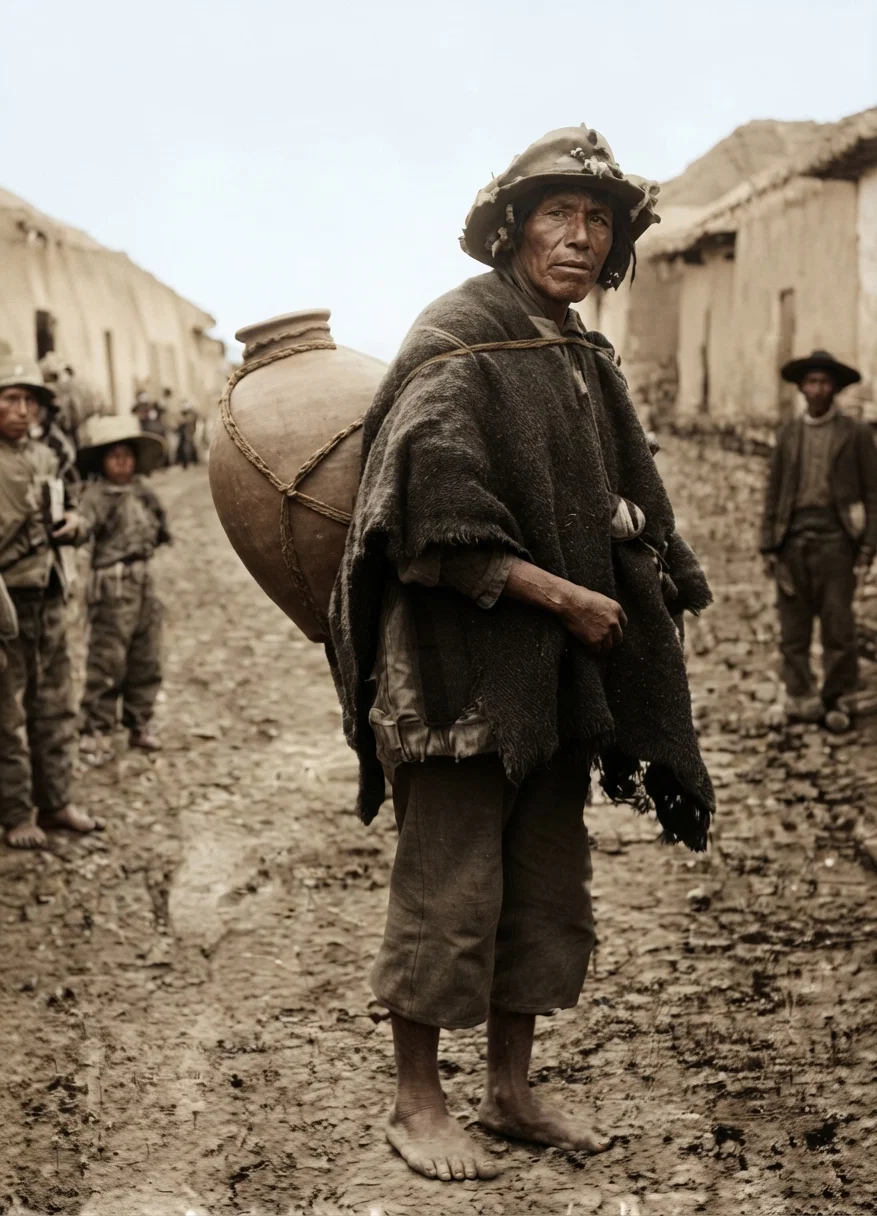
A WATER CARRIER IN CUZCO
The wording of this description is by no means overdrawn, as will be seen. Dr. F. Chuquihuanca Ayulo, a prominent lawyer of Indian descent, and a man devoted to the cause of his oppressed brethren, accompanied the official sent to investigate, and from a private letter written by him describing what they found, to a lawyer friend here in Arequipa, local correspondent of the Pro-Indian Association, I have been permitted to copy the following:—
"From the beginning the Indians had confidence in the commissioner, so that from the night of our arrival the number of Indians amounted to some four hundred. The poor people hoped for much, but what could the commissioner do if the authority of a criminal justice of peace and a criminal governor were superior to his own? . . . He did what he could, but he was only a human being. He was a moral menace to the murderers and robbers of the Indians—and you know what they have managed to do. [They sent such telegrams to Lima charging the commissioner with stirring up the Indians to insurrection, as caused his recall.] The insurrection of the Indians is all a lie. What have taken place were expeditions against the Indians, worse and more inexcusable than those of the Putumayo.
"Here is an example: On May 6, certain Indians who, after dozens of complaints to the prefecture, had managed at length to arrange that about this date the subprefect of Azangaro should go to Saman [a center of oppression], were greeted, as they approached the village, by shots, and pursued like wild beasts. They took refuge in a hut, which was burned over their heads. As a result, five were killed outright and five were wounded.
"Three days later, the subprefect and a judge of the supreme court arrived. They encountered five of the wounded men under arrest, two of them already dying. Do you suppose that either of these authorities initiated an investigation?—Absolutely none! They did not even take a declaration from them, or even order some examination of the wounded. They were both lodged in the house of Mariano Abarca Duenas, sleeping perhaps over pools of blood, for into this same house had fled three of the wounded Indians, whose murder was completed there, so that their corpses might not come to light.
“This seems a story from the ‘Thousand and One Nights,’ but it is the naked truth. Later, in August and September, men belonging to this Duenas and to Gonzalez, with some soldiers, held shooting practice with human targets. O, it is horrible!”
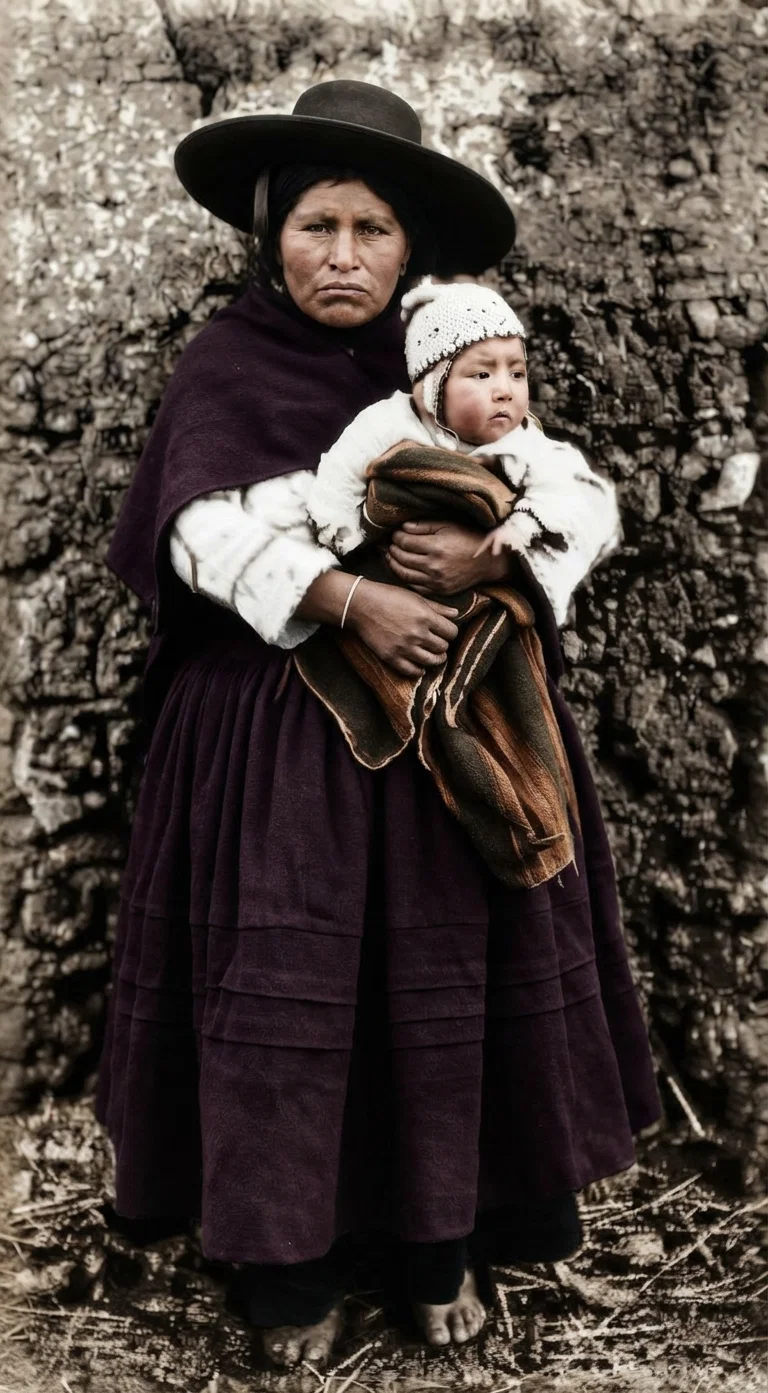
AN INDIAN MOTHER
From other cases cited by the doctor (all related in sworn declarations recorded by the commissioner), and from the statements of Indians who have presented themselves before my friend the lawyer here in Arequipa, it appears that poor, defenseless women and girls have suffered equally with men and boys. But the Lord’s13hand has been over our workers and believers at the mission. One old brother, it is true, was so cruelly beaten with cudgels that he is crippled for the rest of his days; but he remains true to the Saviour, and rejoices in his precious gospel. Surely there is need for missionary work here; and the rapidly growing membership of our church at Plataria, by the shore of Lake Titicaca, bears witness to the ready response of these poor people to the gospel, and the blessed hope it brings to the toiler and the oppressed.
British Guiana
By Mrs. E. C. Boger
MRS. E. C. BOGER
We wish to join in sending a word of cheer to fellow volunteers in distant fields, and the fields at home, from our corner by the sea. We returned from General Conference in July, with renewed strength. We enjoyed the hearty welcome from the brethren and sisters on our return to our chosen field; more than one tangible proof of sincerity was manifest. Many hundreds of pages of literature had been sold. A stubborn debt had been manfully struggled with and met, and, best of all, they had "sought to keep the unity of the Spirit in the bond of peace." Thus the pleasures awaiting us were fully enjoyed by all. They gladly welcomed Elder and Mrs. C. E. Boynton and their infant son, new recruits voted at General Conference time. We had hoped to bring back help with us, and thus they were not disappointed.
Elder Boynton was soon appointed elder of the Georgetown church, and he finds his time quite fully occupied in attending to the needs and growing interests of the company here. The membership of the church is now one hundred and twenty-one. Elder Boger's time is largely taken up in looking after the general work and keeping in touch with the scattered companies. He has been able to purchase a strong seven-horse power Indian motor bicycle, with which he can accomplish about double the amount of work in less time and at less expense; and as work, time, expense, and strength are greatly to be reckoned with, we consider the machine a blessing with which we could not now dispense. He is not so strong as last year, although we all enjoy fairly good health, and have not had the malarial fever yet. He is at present down the east coast visiting several companies, one being at New Amsterdam, the old Dutch settlement which was laid out in 1822 on the muddy banks of the Berbice River. We have a neat church building there, with a Sabbath school membership of forty. Brother Henry Beck has charge of the work there and in the near-by vicinity.
On his return from New Amsterdam, Elder Boger will visit two small companies before reaching the Public Leper Asylum. There he will also call, for we have a little company of fourteen brethren at the asylum. This company is growing in numbers, and I believe in grace also. Trials of various kinds are confronting them, and they very much enjoy frequent visits. One of the number, who is unable to walk, but is wheeled about, understands music sufficiently to teach them the hymns. I wrote them that we had no song books to send them, but they could learn hymns by heart during the week to sing at Sabbath services.
In October we prepared for a public tent effort here in Georgetown. Neat invitation cards were placed in the homes of the people, and thus a good class of hearers was called out. Not all the fruit ripened before the close of the meetings, but house-to-house visiting and the opening of a Bible class have developed a nice company. Others are still interested. Sunday, January 4, Elder Boger buried sixteen believers in baptism. In other places throughout the field many are awaiting the same rite.
We have been favored by receiving the help of a worker from the island of Trinidad, Brother A. Riley. He came to us in September, and now has charge of the work in Queenstown and vicinity, where he is doing all he can to build up and strengthen the brethren and bring in "such as shall be saved." Our neat church building at Queenstown was recently dedicated. Elder A. J. Haysmer, president of the West Indian Union, paid us a short visit December 18 to January 4. Several of the church companies were visited. We were cheered by his coming and appreciated his counsel. Such visits come to us down here but once each year, and we do appreciate them.
ALL OUR WORKERS IN BRITISH GUIANA EXCEPT ONE
From left: Ella Burrows, Mrs. J. E. Wilson, A. E. Riley, Mrs. Boynton, C. E. Boynton,
Mrs. Boger, E. C. Boger.
We are of good courage. Our blessings are more than we can number. The thanksgiving of the psalmist is ours: "And let them sacrifice the sacrifices of thanksgiving, and declare his works with rejoicing." To all the workers we send the sweet comfort of Ps. 5:11, 12.
Righteous Living
By P. W. Paulson
P. W. PAULSON
LIVE as the Saviour would have thee,
Treading the path that is right,
Doing the work that is nearest,
Doing it, too, with thy might.
Think as thy Saviour would have thee,
Guarding thy thoughts day by day;
Out of the heart's full abundance
Spring forth the words that we say.
Live as the Saviour would have thee;
Be not a slave to thy lust.
Eat, then, for health and endurance;
Live thou the life of the just.
Drink what the Saviour would have thee,
Shun that which harms and destroys;
Take, then, the drink which is purest,
Free from the world's vain alloys.
The Children
By MRS. S. N. HASKELL
MRS. S. N. HASKELL
WHAT phase of home missionary work is more important than the salvation of the dear boys and girls in our own homes? In the early years of childhood, the mold is given to the entire life. Those who have given years of study to this subject tell us that the training and influence of the first eight or ten years of the child’s life shape its future career.
“Viewed from its human side, life is to all an untried path. It is a path in which, as regards our deeper experiences, we each walk alone. Into our inner life no other human being can fully enter. As the little child sets forth on that journey in which, sooner or later, he must choose his own course, himself deciding life’s issues for eternity, how earnest should be the effort to direct his trust to the sure Guide and Helper!”
Parents, you who have your little ones around you in your homes, are you instructing them to put their trust in God? Are you teaching them to pray? Are you taking their tiny hands and placing them in the hands of the infinite God?
In many so-called Christian homes there is no family altar. There is plenty of time for even the card table, but none for family prayer. The daily service around the family altar, if properly conducted, wields a mighty power. I experienced its power in my own life. When but a girl of thirteen, I was left an orphan, and, losing my hold on God, I drifted out of the fold of the church into the world; but the memory of my father kneeling at the family altar and daily committing the keeping of his children into the hands of God, prevented me from attending the theater and other worldly amusements. That memory kept me until father’s prayers were answered, and I was brought back into the sunlight of God’s love.
The richest legacy you can leave your children is, by a godly life and earnest prayer, so firmly to bind their hearts to the throne of the infinite God that the world and all its allurements can never sever the connection. Teach your children to pray, not simply to repeat the Lord’s Prayer as they would a beautiful poem, but teach them to go to God, as they come to you, with all their childish trials. It is the privilege of every mother to take the perfect faith that each child has in its parents, and connect it with the Heavenly Father.
But, alas! this is a lesson that few parents have learned. They themselves fail of receiving the blessing of real communion with God. They are in too great haste. “With hurried steps they press through the circle of Christ’s loving presence, pausing perhaps a moment within the sacred precincts, but not waiting for counsel.” They have no time to lay their burdens at the feet of the Divine Teacher, but return to their daily tasks with their burdens and perplexities.
If you wish to save your little ones from the evil of the world, you must instill into their childish minds a reverence for the Word of God. Take time to study the Bible with your children; teach them to go to its sacred pages for help.
“It is one thing to treat the Bible as a book of good moral instruction, to be heeded so far as is consistent with the spirit of the times and our position in the world; it is another thing to regard it as it really is,—the word of the living God, the word that is to mold our actions, our words, and our thoughts. To hold God’s Word as anything less than this is to reject it. And this rejection by those that profess to believe it, is foremost among the causes of skepticism and infidelity in the youth.”
When you tell your little ones the story of the three Hebrews walking in the midst of the fiery furnace, do not neglect to repeat to them the promise given by the prophet Isaiah over one hundred years before: “When thou walkest through the fire, thou shalt not be burned; neither shall the flame kindle upon thee. For I am the Lord thy God, the Holy One of Israel, thy Saviour.” Isa. 43:2, 3.
It was faith in this promise, taught those Hebrew youth at their mothers’ knees, that enabled them, before they entered the furnace, to fearlessly say: “Our God whom we serve is able to deliver us from the burning fiery furnace, and he will deliver us out of thy hand, O king. But if not, be it known unto thee, O king, that we will not serve thy gods, nor worship the golden image which thou hast set up.” Dan. 3:17, 18.
As your children leave the shelter of your homes, they are asked to worship idols of greed, lust, avarice, bribery, and intemperance. On every side the tempter beckons them to bow down to some of the many idols the enemy of their souls has set up. What are you doing to prepare them to face these temptations? Are you filling their young minds with the promises of God’s Word? Are you teaching them that every promise in the Bible is like a check signed by the infinite God, and if they present it in faith at the bank of heaven they will receive full value? Nothing but a firm trust in God14and his word will save our youth.
Jesus was a perfect pattern in childhood, youth, and manhood. Luke tells us of Jesus' obedience to his parents when a lad of twelve years. In the prophecy of Isaiah we have a glimpse of his childhood: 'Behold, a virgin shall conceive, and bear a son, and shall call his name Immanuel. Butter and honey shall he eat, that he may know to refuse the evil, and choose the good.' Isa. 7:14, 15. From this we would infer that the control of appetite was a test in even the child life of Jesus. It was not the first victory won by Jesus over appetite when, weary and faint in the desert, he refused to satisfy his hunger at the dictates of Satan. May we not think that, as he was subject to his parents, Mary taught him self-control from childhood? What Mary did, every godly mother may do.
Let us notice the words of Isaiah again: 'Butter and honey shall he eat, that he may know to refuse the evil, and choose the good.' In the twenty-fourth and twenty-fifth chapters of Proverbs we have three verses containing a rule for eating honey, which may apply equally well in eating all good food. They read as follows: First, 'My son, eat thou honey, because it is good; and the honeycomb, which is sweet to thy taste.' Second, 'Hast thou found honey? eat so much as is sufficient for thee.' Third, 'It is not good to eat much honey. . . . He that hath no rule over his own spirit is like a city that is broken down, and without walls.'
The secret of strength is in taking only a sufficient quantity of good food, and never touching that which is injurious. The one who is the master of his own desires will not plunge headlong into evil, but will have judgment to 'know to refuse the evil, and choose the good.'
Some thirty years ago I was a frequent visitor in two homes. In each family were two sturdy boys who, like most children, were often given candy. The way their mothers managed them will illustrate the principle. After the boys had eaten a sufficient quantity of the candy, one mother cheerily said, 'Boys, you have had enough for today; put it away until tomorrow.' The boys, who had been taught from babyhood to be the masters of their appetite, replied, 'All right, mamma,' and putting the candy away, went with bright faces to their play. The other mother, after the children had eaten sufficient, diverted their attention until she hid the candy from their sight. They at once began to cry and she to scold, and the boys left their mother with their little hearts filled with anger and rebellion.
Where are the four boys today? The mother that taught her boys, when mere babes, to be the masters of their appetites, and after they had eaten sufficient of that which they desired, to themselves place the remainder within their own reach and not touch it, sent her sons out into the world, not like a city broken down without walls, but like a fortified castle. They were the masters of their desires, and today fill places of trust, an honor to their parents. Where are the lads who were not taught self-control? Ah! I scarcely need tell you that they are with thousands of others who have been reared in the same manner—they are drunkards. Their mother sent them from her home into the world with all its allurements, helpless to withstand temptations; for 'he that hath no rule over his own spirit is like a city that is broken down, and without walls.'
While the baby sits in the high chair at the family table, he should be taught to master his own spirit. The mother who removes every tempting object beyond the reach of baby instead of teaching him to sit within reach of it without touching it, is failing to teach her child to rule his own spirit. If your child is allowed to grasp everything within reach that he fancies, perilous will be his fate when he stands face to face with the temptations of the world.
Only the one who is the master of his appetite is fortified for the conflicts of life. Appetite has always been a test. It was the test given our first parents, Adam and Eve, in the garden of Eden, and they failed. It was the test given our Saviour, the second Adam, in childhood, and when at the age of thirty he entered upon his life work. He gained the victory, and in his strength 'whosoever will' may be victorious.
The foundations of a victorious life may be laid by the mother, during the first eight years of childhood. Though the control of appetite is important, that will not insure the salvation of your children. Prayer, faith in God's word, and a mastery over self, will safely lead your little ones through this sin-cursed earth, to the gates of the city of God.
Mothers, what answer will you give when, standing face to face with the Judge of all the earth, he asks, 'Where is the flock that was given thee, thy beautiful flock?' Jer. 13:20. Happy the mother who, in that great day, can reply, 'Behold I and the children which God hath given me.' Heb. 2:13.
Progress of the Work in Hankow
DR. A. G. LARSON, writing from Hankow, the Chicago of China, speaks of the good work being accomplished in that section of the field. He says: "I am glad to say that the work in Hupeh province is onward. At our general meeting in Hankow recently there were present about one hundred of our own people from different parts of the province. On account of the small size of the chapel, we could not make much effort for outsiders at this meeting. Most of the instruction was designed to help our own people to better understand the principal points of the truth. At the close of the meeting, Elder Cottrell baptized twenty-seven. Many more desired to be baptized, but it was thought better that they study the truth still further. We have now secured a new chapel in Hankow, located in about the center of the Chinese part of the city. It is the largest and best we have ever had in Hankow, and we trust and pray that results may be in proportion to the extra expense. There is a very good interest. The better class of people are attending the meetings."
The Jewel of Contentment
By Fuller
WHOEVER would have this jewel of contentment (which turns all into gold,—yea, want into wealth) must come divested of all covetous thoughts, else is he never likely to obtain it.—Fuller.
Successful Home Education
By Mrs. C. C. Lewis
MRS. C. C. LEWIS
I FEEL desirous that other mothers should know of the success one mother in Michigan is having in teaching her little boy the elements of reading. She has taken four lessons of the first grade in the Mothers' Normal Department of the Fireside Correspondence School, and writes of her experience as follows:—
"The teacher should give much time to ear training. Teach the child to tell words by hearing the sounds of which they are composed. I find that this method of teaching beginners is far ahead of the old method of learning the letters. When teaching the sounds, I put one sound on the board, 's,' for instance, and after talking to F— about the sound, I go to my work in the kitchen, and he goes with me. Then we think of all the different things in the kitchen with names beginning with that sound.
In this way he becomes very much interested, and often, when nothing is being said about sounds, he tells me of something else he has thought of that begins with a certain sound.
"I never tell him a word which I think he is capable of finding out for himself [a fundamental principle of education], and now he seldom asks me what a word is, but at once begins to separate it into its sounds.
"He is improving quite fast in writing. Often I see him writing words in the air with his finger."
This is genuine success. And how much better for the mother to teach the elements of education to her child in loving association with him about the daily duties of the home than to send him away to school, to receive less rational instruction from a stranger. Hundreds of our mothers ought to be pursuing this course of instruction with their children, and laying for them the foundation of a moral character that will endure throughout eternity. It will cost a little, to be sure; but the price is within reach of the average mother, and the results will be beyond computation.
An Emperor at the Forge
Boys often resent being called upon to do a piece of work which they think beneath them; especially if it is a task which generally belongs to some one else. But every one should cultivate an obliging disposition, and be able to help in any emergency to the extent of his ability.
Emperor Joseph set a good example in this respect, when traveling one day in Italy. A wheel of his carriage broke down, and he repaired to the shop of a blacksmith in a little village, and desired him to mend it without delay.
"I would," said the smith, "but this being a holiday, all my men are at church; even the boy who blows the bellows is away."
"Now I have an excellent chance to warm myself," said the unknown emperor. So, taking his place at the bellows, instead of calling an attendant to do so, he followed the smith's directions, and worked as if for wages. The work was finished, and, instead of the little sum he was charged, the sovereign handed out six golden ducats.
"You have made a mistake," said the astonished blacksmith, "and given me six gold pieces, which nobody in this village can change."
"Change them when you can," said the laughing emperor, as he entered his carriage. "An emperor should pay for such a pleasure as blowing the bellows."
I have known some shop boys who would have waited long, and sent far for help, before they would "come down" to blowing a blacksmith's bellows.
It is not boys with the best sense who thus stand upon their dignity. A readiness to oblige, and to take hold of unaccustomed work when necessary, has often been excellent business capital for a young man; while the opposite spirit never wins friends.—Youth's World.
THE FIELD WORK
A Visit to New York
By O. A. Olsen
After returning from my tour in Wisconsin, the call came for me to attend the Greater New York Conference, February 17-25. Other arrangements prevented me from getting there till the evening of the nineteenth. I found the meeting in full progress, with a good interest. There was a marked difference in this meeting from some that I have attended in the past here and elsewhere.
While due attention was given to the usual business of an annual conference, which all passed off very harmoniously, more time and stress were placed on the more spiritual part of the work, not so much in the way of formal preaching, but more in the form of practical studies from the Bible and the "Testimonies for the Church," of a nature leading to a closer examination of one's personal relation to God and his cause. The brethren leading in these studies were Elders R. D. Quinn and K. C. Russell and Dr. D. H. Kress. As the result of these studies, many were convicted of wrongs in their lives, and humble confessions were made. Thus it became necessary to give much time to the congregation.
Many were convicted of their sin in unfaithfulness in tithes and offerings. Many confessed to the sin of wicked criticism and faultfinding. Confessions were also made of unkindness and harshness in the home and family. All realized that they had been greatly at fault in their neglect of prayer and the study of the Bible and the "Testimonies for the Church," and realized that this was to a large degree the cause of their unsatisfactory Christian experience.
The Laodicean message was dwelt on in the Bible studies, and many were led to see that they had acted the part of the Pharisee rather than of a true and humble follower of Christ. They had been contented with a form, feeling rich and increased with goods, when the fact was that they were destitute of the real power of godliness, yea, miserable, and poor, and blind, and naked. It was indeed a heart-searching time, and the place seemed very solemn, as if an all-seeing eye was definitely looking into each individual heart, searching it through and through. The experience was much like that which we have heard related by the Adventist believers prior to 1844, when they were looking for the Lord to come.
Another feature of the meeting was that ministers, Bible workers, and workers in various branches of the cause, were among the foremost to take part in this heart-searching work and repentance. That is as it should be, for as sure as the word of the Lord is true, and that the Spirit of God has spoken through the "Testimonies for the Church," there is need that both ministers and lay members turn to the Lord with weeping, fasting, and prayer.
These meetings were very quiet, void of all excitement, and there was every evidence that it was deep heart work rather than surface ruffle. Neither was there any despondency, for the humble confession was followed by the incoming of the sweet, melting, tender Spirit of God and the assurance of acceptance in the Beloved. Some of the meetings continued for six hours, but still seemed short. Somehow, the atmosphere and the place seemed so comfortable, the divine Presence so near.
These meetings were held at different places, so as to give more of our people an opportunity to be present. The last one that I attended, on February 24, was held in the Scandinavian Mission House in Brooklyn, and it will long be remembered.
Personally, I greatly enjoyed a part in these meetings, for they presented just the features and the experience that we have long desired to see. We are glad to know that like blessings are coming to our people in other places also. We have surely reached the time for the finishing of the work. Not only is it to be finished in the world as a whole, but there is also to be a finishing of the work of grace in the individual experience that each and every one must have preparatory to the close of the work of our great High Priest in the heavenly sanctuary. May the good work begun hasten rapidly on until the whole earth shall be lighted with the glory of the Lord.