Review and Herald, Vol. 93, No. 12.

Who Changed the Sabbath?
Earlier text: Who Changed the Sabbath?

The Change of the Sabbath

A Bible Study

The Sabbath and the Law

1. Of what is the Sabbath commandment a part? The law of God. See Ex. 20: 8-11.
2. What, according to prophecy, was to be Christ's attitude toward the law? “The Lord is well pleased for his righteousness' sake; he will magnify the law, and make it honorable.” Isa. 42: 21.
3. In his first recorded discourse, what did Christ say of the law? “Think not that I am come to destroy the law, or the prophets; I am not come to destroy, but to fulfil.” Matt. 5: 17.
4. How enduring did he say the law is? “For verily I say unto you, Till heaven and earth pass, one jot or one tittle shall in no wise pass from the law, till all be fulfilled.” Verse 18.
5. What did he say of those who should break one of the least of God's commandments, and teach men so to do? “Whosoever therefore shall break one of these least commandments, and shall teach men so, he shall be called the least in the kingdom of heaven.” Verse 19.
NOTE.— From this it is evident that the entire code of ten commandments is binding in the Christian dispensation, and that Christ had no thought of changing any of them. One of these commands the observance of the seventh day as the Sabbath. But the practice of most Christians is different; they keep the first day of the week instead, many of them believing that Christ changed the Sabbath. But, from his own words, we see that he came for no such purpose. The responsibility for this change must therefore be looked for elsewhere.

“The Man of Sin”

6. What did God, through the prophet Daniel, say the power represented by the “little horn” would think to do? “And he shall speak words against the Most High, and shall wear out the saints of the Most High, and shall think to change the times and the law.” Dan. 7: 25, R. V.
7. What did the apostle Paul say the “man of sin” would do? “For that day shall not come, except there come a falling away first, and that man of sin be revealed, the son of perdition; and that is who opposeth and exalteth himself above all that is called God, or that is worshiped.” 2 Thess. 2: 3, 4.
NOTE.— There is only one way by which any power could exalt itself above God, and that is by assuming to change the law of God, and to require obedience to its own law instead of God's law.

A Papal Claim

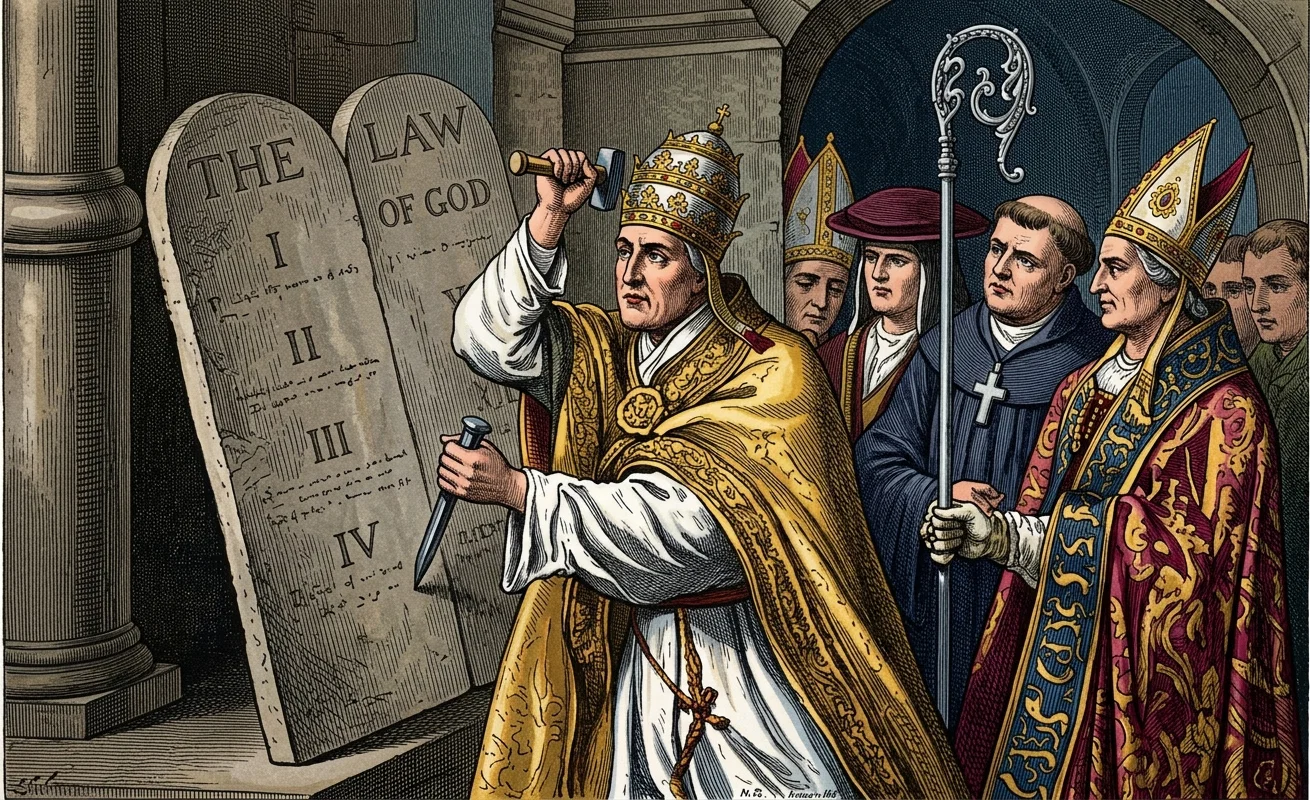
8. What power has claimed authority to change the law of God? The Papacy.
9. What part of the law of God especially has the Papacy thought to change? The fourth commandment.
NOTES.— “They [the Catholics] allege the Sabbath changed into Sunday, the Lord's Day, contrary to the decalogue, as it appears; neither is there any example more boasted of than the changing of the Sabbath day. Great, say they, is the power and authority of the church, since it dispensed with one of the ten commandments.”—Augsburg Confession, Art. 28. “It [the Roman Catholic Church] has reversed the fourth commandment, doing away with the Sabbath of God's Word, and instituting Sunday as a holy day.”—N. Summerbell, in History of the Christians, page 418.
10. Why did God command Israel to hallow the Sabbath? “And hallow my Sabbaths; and they shall be a sign between me and you, that ye may know that I am the Lord your God.” Eze. 20: 20.
NOTE.— As the Sabbath was given that man might keep God in mind as Creator, it can be readily seen that a power endeavoring to exalt itself above God would first try to cover up or remove that which calls man's special attention to his Creator. This could be done in no other way so effectually as by setting aside God's memorial—the seventh-day Sabbath. To this work of the Papacy Daniel had reference when he said, “And he shall ... think to change times and laws.” Dan. 7: 25.
11. Does the Papacy acknowledge that it has changed the Sabbath? It does.
NOTE.— “Question.—How prove you that the church hath power to command feasts and holy days?” “Answer.—By the very act of changing the Sabbath into Sunday, which Protestants allow of; and therefore they fondly contradict themselves by keeping Sunday strictly, and breaking most other feast days commanded by the same church.”—Abridgment of Christian Doctrine, by Rev. Henry Tuberville, D. D., of Douay College, France (1649), page 35. “Ques.—Have you any other way of proving that the church has power to institute festivals of precept?” “Ans.—Had she not such power, she could not have done that in which all modern religionists agree with her: she could not have substituted the observance of Sunday, the first day of the week, for the observance of Saturday, the seventh day, a change for which there is no Scriptural authority.”—A Doctrinal Catechism, by Rev. Stephen Keenan, page 174. “The Catholic Church of its own infallible authority created Sunday a holy day to take the place of the Sabbath of the old law.”—Kansas City Catholic, Feb. 9, 1893. “The Catholic Church, ... by virtue of her divine mission, changed the day from Saturday to Sunday.”—Catholic Mirror, official organ of Cardinal Gibbons, Sept. 23, 1893. “Ques.—Which is the Sabbath day?” “Ans.—Saturday is the Sabbath day.” “Ques.—Why do we observe Sunday instead of Saturday?”
“Ans.—We observe Sunday instead of Saturday because the Catholic Church, in the Council of Laodicea (A. D. 336), transferred the solemnity from Saturday to Sunday.”—The Convert's Catechism of Catholic Doctrine, by Rev. Peter Geiermann, C. SS. R., page 50, third edition, 1913, a work which received the “apostolic blessing” of Pope Pius X, Jan. 25, 1910. What was done at the Council of Laodicea was but one of the steps by which the change of the Sabbath was effected. The date usually given for this council is A. D. 364.

No Bible Authority for Sunday Sacredness

12. Do Catholic authorities acknowledge that there is no command in the Bible for the sanctification of Sunday? They do.
NOTE.— “You may read the Bible from Genesis to Revelation, and you will not find a single line authorizing the sanctification of Sunday. The Scriptures enforce the religious observance of Saturday, a day which we never sanctify.”—Cardinal Gibbons, in The Faith of Our Fathers, edition 1892, page 111. “Sunday is a Catholic institution, and its claim to observance can be defended only on Catholic principles. From beginning to end of Scripture there is not a single passage that warrants the transfer of weekly public worship from the last day of the week to the first.”—Catholic Press (Sydney, Australia), Aug. 25, 1900.
13. Do Protestant writers acknowledge the same? They do.
NOTE.— “Is there no express commandment for observing the first day of the week as Sabbath, instead of the seventh day?”—None whatever. Neither Christ nor his apostles nor the first Christians celebrated the first day of the week instead of the seventh as the Sabbath.”—New York Weekly Tribune, May 24, 1900. “The Scriptures nowhere call the first day of the week the Sabbath. ... There is no Scriptural authority for so doing, nor of course any Scriptural obligation.”—The Watchman (Baptist). “The observance of the first instead of the seventh day rests on the testimony of the church, and the church alone.”—Hobart Church News (Episcopalian), July 2, 1894. Papal claims and Protestant admissions show, therefore, who changed the Sabbath.

How the Change Came About

14. How did this change in observance of days come about, suddenly or gradually? Gradually.
NOTE.— “The Christian church made no formal, but a gradual and almost unconscious, transference of the one day to the other.”—The Voice from the Church, by Archdeacon F. W. Farrar, page 163. The fact of this itself is evidence that there was no divine command for the change of the Sabbath.
15. For how long a time was the seventh-day Sabbath observed in the Christian church? For many centuries. In fact, its observance has never wholly ceased in the Christian church.
NOTE.— Mr. Morer, a learned clergyman of the Church of England, says: “The primitive Christians had a great veneration for the Sabbath, and spent the day in devotion and sermons. And it is not to be doubted that they derived this practice from the apostles themselves.”—Dialogues on the Lord's Day, page 189. Prof. E. B. Brewwood, of Gresham College, London (Episcopal), says: “The Sabbath was religiously observed in the Eastern church three hundred years and more after our Saviour's passion.”—Learned Treatise on the Sabbath, page 77. Lyman Coleman, a careful and candid historian, says: “Down even to the fifth century the observance of the Jewish Sabbath was continued in the Christian church, but with a rigor and solemnity gradually diminishing until it was wholly discontinued.”—Ancient Christianity Exemplified, d, chap. 26, sec. 2. The historian Socrates, who wrote about the middle of the fifth century, says: “Almost all the churches throughout the world celebrate the sacred mysteries on the Sabbath of every week, yet the Christians of Alexandria and at Rome, on account of some ancient tradition, refuse to do this.”—Ecclesiastical History, book 5, chap. 22. Sozomen, another historian of the same period, writes: “The people of Constantinople, and of several other cities, assemble together on the Sabbath as well as on the next day; which custom is never observed at Rome.”—Id., book 7, chap. 19. All this would have been inconceivable and impossible had there been a divine command and plan for the change of the Sabbath. The last two quotations also show that Rome led in the apostasy and in the change of the Sabbath.

The First Sunday Law

16. What striking testimony is borne by Neander, the noted church historian, regarding the origin of the Sunday sabbath? “Opposition to Judaism introduced the particular festival of Sunday very early, indeed, into the place of the Sabbath. . . . The festival of Sunday, like all other festivals, was always only a human ordinance, and it was far from the intentions of the apostles to establish a divine command in this respect, far from them, and from the early apostolic church, to transfer the laws of the Sabbath to Sunday. Perhaps at the end of the second century a false application of this kind had begun to take place; for men appear by that time to have considered laboring on Sunday as a sin.”—Neander's Church History, Rose's translation, page 186.
17. Who first enjoined Sunday keeping by law? Constantine the Great.
NOTES.— “The earliest recognition of the observance of Sunday as a legal duty is a constitution of Constantine in A. D. 321, enacting that all courts of justice, inhabitants of towns, and workshops were to lie at rest on Sunday (venerabili die Solis), with an exception in favor of those engaged in agricultural labor.”—Encyclopædia Britannica, ninth edition, article “Sunday.” “Constantine the Great made a law for the whole empire (A. D. 321) that Sunday should be kept as a day of rest in all cities and towns; but he allowed the country people to follow their work.”—Encyclopædia Americana, article “Sabbath.” “Unquestionably the first law, either ecclesiastical or civil, by which the Sabbatical observance of that day is known to have been ordained, is the edict of Constantine, A. D. 321.”—Chambers's Encyclopædia, article “Sabbath.”
18. What did Constantine's law require? “Let all the judges and townspeople, and the occupation of all trades rest on the venerable day of the sun; but let those who are situated in the country, freely and at full liberty attend to the business of agriculture; because it often happens that no other day is so fit for sowing corn and planting vines; lest, the critical moment being let slip, men should lose the commodities granted by heaven.”—Edict of March 7, A. D. 321, Corpus Juris Civilis Cod., lib. 3, tit. 12, § 3. NOTE.— This edict, issued by Constantine, under whom the Christian church and the Roman state were first united, in a manner supplied the lack of a divine command for Sunday observance, and may be considered the original Sunday law, and the
model after which all Sunday laws since then have been patterned. It was one of the important steps in bringing about and establishing the change of the Sabbath.
19. What testimony does Eusebius (270-338), a noted bishop of the church, a flatterer of Constantine, and the reputed father of ecclesiastical history, bear upon this subject? “All things whatsoever that it was duty to do on the Sabbath, these we have transferred to the Lord's Day.”—Commentary on the Psalms, Cox's Sabbath Literature, Vol. 1, page 361.
NOTE.— The change of the Sabbath was the result of the combined efforts of church and state, and centuries passed before it was fully accomplished.

The Church Forbidden to Observe the Seventh Day

20. When and by what church council was the observance of the seventh day forbidden, and Sunday observance enjoined? “The seventh-day Sabbath was . . . solemnized by Christ, the apostles, and primitive Christians, till the Laodicean Council did, in a manner, quite abolish the observation of it. . . . The Council of Laodicea [A. D. 364] . . . first settled the observation of the Lord's Day.”—Prynne's Dissertation on the Lord's Day Sabbath, page 163.
21. What did this council, in its twenty-ninth canon, decree concerning the Sabbath, and concerning the Christians who continued to observe it? “Christians ought not to Judaize, and to rest in the Sabbath, but to work in that day. . . . Wherefore if they shall be found to Judaize, let them be accursed from Christ.”—Id., pages 33, 34.
NOTES.— Some of the further steps taken by church and state authorities in bringing about this change may be noted as follows: “In 386, under Gratian, Valentinian, and Theodosius, it was decreed that all litigation and business should cease on Sunday.” “Among the doctrines laid down in a letter of Pope Innocent I, written in the last year of his papacy (416), is that Saturday should be observed as a fast day. . . .” “In 425, under Theodosius the Younger, abstinence from theatricals and the circus [on Sunday] was enjoined. . . .” “In 538, at a council at Orleans, . . . it was ordained that everything previously permitted on Sunday should still be lawful; but that work at the plow, or in the vineyard, and cutting, reaping, threshing, tilling, and hedging should be abstained from, that people might more conveniently attend church.” “About 590, Pope Gregory, in a letter to the Roman people, denounced as the prophets of Antichrist those who maintained that work ought not to be done on the seventh day.”—Laws of Sunday, by James T. Ringgold, pages 265-267. The last paragraph of the foregoing quotation indicates that even as late as A. D. 590 there were those in the church who observed and who taught the observance of the Bible Sabbath, the seventh day.

To Whom Is Obedience Due?

22. What determines whose servants we are? “Know ye not, that to whom ye yield yourselves servants to obey, his servants ye are to whom ye obey?” Rom. 6:16.
23. When tempted to bow down and worship Satan, what reply did Christ make? “Get thee hence, Satan: for it is written, Thou shalt worship the Lord thy God, and him only shalt thou serve.” Matt. 4:10, 11.
24. What do Catholics say of the observance of Sunday by Protestants? “It was the Catholic Church which, by the authority of Jesus Christ, has transferred this rest to the Sunday in remembrance of the resurrection of our Lord. Thus the observance of Sunday by the Protestants is an homage they pay, in spite of themselves, to the authority of the [Catholic] church.”—Plain Talk About the Protestantism of Today, by Monsignor Segur, page 213.
25. What kind of worship does the Saviour call that which is not according to God's commandments? “But in vain do they worship me, teaching for doctrines the commandments of men.” Matt. 15:9.
26. When Israel had apostatized, and were almost universally worshiping Baal, what appeal did Elijah make to them? “How long halt ye between two opinions? if the Lord be God, follow him; but if Baal, then follow him.” 1 Kings 18:21.
NOTE.— In times of ignorance God winks at that which otherwise would be sin; but when light comes, he commands men everywhere to repent. Acts 17:30. The period during which the saints, times, and the law of God were to be in the hands of the Papacy has expired (Dan. 7:25); the true light on the Sabbath question is now shining; and God is sending a message to the world, calling upon men to fear and worship him, and to return to the observance of his holy rest day, the seventh-day Sabbath. Rev. 14:6-12; Isa. 56:1; 58:13, 14.
♦ ♦ ♦
“Thus saith the Lord, Keep ye judgment, and do justice; for my salvation is near to come, and my righteousness to be revealed. Blessed is the man that doeth this, and the son of man that layeth hold on it; that keepeth the Sabbath from polluting it, and keepeth his hand from doing any evil.” Isa. 56:1, 2.

THE LAW OF GOD

As Found in Roman Catholic Catechisms in General Use
He shall think himself able to change times and laws. Dan. 7:25, Douay Bible.

PAPAL ASSUMPTIONS

The Pope is, as it were, God on earth, sole sovereign of the faithful of Christ, chief King of kings, having plenitude of power, to whom has been intrusted by Almighty God the direction not only of the earthly but also of the heavenly kingdom.
The Pope is of so great authority and power that he can modify, explain, or interpret even divine laws.
The Pope can modify divine law, since his power is not of man but of God, and he acts as vicegerent of God upon earth with most ample power of binding and loosing his sheep. Ferraris, Ecclesiastical Dictionary, article “Papa.”
The Roman Pontiff . . . is the vicar of God on earth, not of mere man, but of the true God.—“The Decretals of Gregory IX,” book 1, title 7, chapter 3.
The following propositions are taken from the “Dictates of Hildebrand” (Gregory VII):—
Prop. 1: The Roman Church was founded by our Lord alone.
Prop. 2: The Roman Pontiff alone is justly styled universal.
Prop. 9: All princes should kiss the feet of the Pope alone.
Prop. 18: His sentence is not to be reviewed by any one, while he alone can review the decisions of all others.
Prop. 19: He ought to be judged by no one.
Prop. 22: The Roman Church has never erred nor will it, according to the Scriptures, ever err.—“Annals of Baronius,” 1076, Vol. XI, col. 506.

THE LAW OF GOD

1. I am the Lord thy God. Thou shalt not have strange gods before me.
2. Thou shalt not take the name of the Lord thy God in vain.
3. Remember thou keep holy the Sabbath day.
4. Honor thy father and thy mother.
5. Thou shalt not kill.
6. Thou shalt not commit adultery.
7. Thou shalt not steal.
8. Thou shalt not bear false witness against thy neighbor.
9. Thou shalt not covet thy neighbor’s wife.
10. Thou shalt not covet thy neighbor’s goods.

PAPAL ADMISSIONS

You may read the Bible from Genesis to Revelation and you will not find a single line authorizing the sanctification of Sunday. The Scriptures enforce the religious observance of Saturday.—“Faith of Our Fathers,” James Cardinal Gibbons, page 111.
Ques.—Have you any other way of proving that the church has power to institute festivals of precept?
Ans.—Had she not such power, she could not have done that in which all modern religionists agree with her; she could not have substituted the observance of Sunday, the first day of the week, for the observance of Saturday, the seventh day, a change for which there is no Scriptural authority.—“A Doctrinal Catechism,” by Rev. Stephen Keenan, page 174.
The Catholic Church . . . changed the day from Saturday to Sunday. The Christian sabbath is therefore to this day the acknowledged offspring of the Catholic Church, without a word of remonstrance from the Protestant world.—“The Catholic Mirror,” Sept. 23, 1893.
Ques.—Which is the Sabbath day?
Ans.—Saturday is the Sabbath day.
Ques.—Why do we observe Sunday instead of Saturday?
Ans.—We observe Sunday instead of Saturday because the Catholic Church, in the Council of Laodicea (A. D. 336), transferred the solemnity from Saturday to Sunday.—“The Convert’s Catechism of Catholic Doctrine,” by Rev. Peter Geiermann, page 50.
The observance of Sunday by Protestants is an homage they pay, in spite of themselves, to the authority of the Catholic Church.—“Plain Talk About the Protestants of Today,” from the French of Monsignor Segur, page 213.

A Challenge to Protestants

The Catholic Mirror, the official organ of Cardinal Gibbons, in its issue of June 12, 1897, reports a discourse by Father O'Keefe, delivered the Sunday before, in which some very grave charges are made from the Roman Catholic standpoint against Protestants in general. Mr. O'Keefe gives a concluding summary of a series of discourses he has been delivering in answer to some sermons of a Protestant pastor in Baltimore. The pastor maintained the Protestant doctrine that “the Bible is the word of God, his mouthpiece to us—our guide and our treasure.”
Mr. O'Keefe, on the contrary, held, in accordance with the established Catholic view, that the Bible is not a sufficient rule of Christian faith, but that it must be supplemented and supported by the traditions, interpretations, and authority of the Catholic Church.
True Protestants believe, as stated by Chillingworth, that “the Bible only is the religion of Protestants.” And when this fundamental principle is assailed in such strong terms as those employed by Mr. O'Keefe, it is important that every Protestant shall closely examine the foundations of his faith and practice, and be assured of the ground on which he is standing.
The following quotations are extracted from the report of Father O'Keefe's discourse, omitting such portions as are so personal and local in character as to be wanting in interest to the general reader. Mr. O'Keefe says:—
“[Reverend —] affects to believe it [the Bible] to be the embodiment of God's will toward man addressed to him under that form, as expressed within its pages and covers. He pretends to cherish it beyond every earthly treasure; he proposes to look to it for counsel and instruction in all that appertains to the present and future life. In a word, he almost imagines he hears the voice of God speaking through its pages. He is himself against all gainsayers who would disparage or seek to detract from its divine origin. And yet this [Reverend —], with the intense, and almost idolatrous worship of his Bible, if we take his word for it, has, I boldly assert, proved himself a base traitor to his own avowed principles, and abandoning that highly cherished boon and spiritual gift and treasure, has, with a treachery unparalleled in the annals of human sophistry, delivered himself and his following over to the Catholic Church, as surely as Judas sold his Master for thirty pieces of silver—a church that he never ceases to stigmatize and revile.
HE SHALL THINK TO CHANGE TIMES AND LAWS
“With the piercing appeal made with so much agonizing pathos, ‘Have we no Bible that logic and priests cannot destroy?’ before our minds, let us seek a correct appreciation of its sincerity.
“Before, however, doing this, let us investigate the true inwardness of this frantic appeal.
“‘The Bible is the word of God, his mouthpiece to us—our guide and our treasure. We clasp it to our heart of hearts daily, as did once—and ever after—the great Luther, when he discovered for the first time the chained copy in the library. It is the direct expression of “the way, the truth, and the life,” to us and all evangelical Christians. Without it and its soothing influences we should be lost both here and hereafter, etc.’”
“But this consoling picture happens to have a reverse side also; and as Dr. — has put it so aptly, ‘The great purpose of Protestant ministers must be to uphold the inspiration of the Scriptures,’ let us calmly inquire as to the record of the same Protestant ministers for more than ten generations, touching their respect for, and adherence to, the teachings of their inspired guide. Let me ask what teaching of Protestantism is more impressively inculcated by the ministers, in season and out of season, than the sanctification of the Sabbath? There is no lesson better conned in the Sunday school; none from the pulpit more energetically impressed than this, grounded in indelible characters on every page of our Bible. And yet a greater mockery, delusion, and snare was never before sought to be palmed off on the unsuspecting masses of Protestantism.
“Open the Bible with the book of Genesis,—when God rested from creation on the seventh day, called thereafter Sabbath, because God rested on that day,—and peruse every page of the Old Testament, and the New to the last page of the Revelation, and point me to a single passage or word in the Bible that deviates in the slightest point from the day of rest taken by the Creator, in the divine injunction, not only authorized but actually kept by the Master and his apostles.
“The Hebrew people have undeviatingly handed down this day of rest by keeping it every week since the command, ‘Remember the Sabbath day, to keep it holy,’ was promulgated, until last Saturday. They have the divine injunction for this obligation in their Bible, which they hold to be God’s Word; and it is equally certain that for over sixty years from the origin of Christianity, of which the Gospels and the Acts of the Apostles are, in the estimation of Protestants, their own witnesses, no word or act from the Master or the apostles has ever furnished any indication of a change of day.
“And here we are reminded furthermore of the perennial cry of the Reverend Doctor, ‘Have we no Bible that logic and priests cannot destroy?’ I answer emphatically, ‘You have a Bible, whether a divine or human work you cannot say, which you have been persistently antagonizing every week of your life. That guide and teacher of yours, which you hypocritically profess to regard as the word of God, orders you, under severe penalties, to keep the Sabbath day; that day first kept by the Redeemer every week while on earth; the same day kept to this hour by the Hebrew people, who in this particular are consistent followers of their and your Bible. Let me here ask this redoubtable champion of Protestantism whether he and his blinded followers have once obeyed during their whole lives this highly treasured teacher. I can answer for him and them most emphatically, No! What excuse or subterfuge can be offered by them in palliation of this lifelong infraction of a commandment which God himself calls a perpetual covenant?—None whatsoever. And does he not declare that the penalty of its infraction is death?—All this is undeniable. But have they no excuse to offer for their treachery to their inspired teacher?—None whatsoever.’”
All Protestantism stands this day before the world convicted of the grossest treachery toward their teacher, the Bible, without the shadow of excuse for their treason. And what is far worse, they have abandoned their divine guide, the Bible, and accepted the practice of the Catholic Church, which they stigmatize as a corrupt organization, steeped in error, while their own action in this particular brands them as the most illogical, self-convicted organization on earth.
“Before concluding this discourse, I will take occasion to address my remarks to Dr. — personally.
“You cannot help feeling, now that you have entered on the recent controversy, altogether unequipped with the qualifications necessary, whether natural or acquired. And I would suggest that, as an honest man who has the courage of his convictions, you have no resource left other than to apprise the good people who look to you for guidance, of the fact that a change has come over the spirit of your dream, which I will take the liberty to outline for you. You may use the following words or their equivalent in your own language:—
“‘Brethren, you are well aware of my recent encounter with a Catholic priest touching the origin of our dearly cherished teacher, the Bible. . . . Did you ever suspect that you had never once kept the Sabbath of the Lord? When I recall the earnest appeals made by me from this and other pulpits to my people to sanctify the Sabbath, and my manifold and severe remonstrances against its desecration, I feel mortified beyond expression that all my eloquence has been misspent and misapplied. Our Bible teaches absolutely that the Lord’s Sabbath is Saturday, not Sunday, and we have never kept it. Thus we are stranded high and dry by our apostasy in abandoning our teacher, the Bible, and borrowing Rome’s day. But what are we to do in the future? We may as well view the situation squarely.’”
“‘We can go on as ever, living down public sentiment and sound logical principles, but where is the truth—where the honesty involved in such a proceeding? This would be rank hypocrisy. On the other hand, if we adhere to its teaching, it is necessary as an honest man to brave all opposition, and decide on obeying God’s command to keep with the Jews the Bible Sabbath, and meet hereafter each Saturday, instead of Sunday. Honesty and truth demand this course.’”
“‘But there is still another alternative left. We are indebted to Rome for the Sunday arrangement. . . . Let us give her a hearing. If her claim can be maintained, we are no longer without a divine teacher, and that teacher ensures us the possession of Sunday. “All’s well that ends well.”’”
Such a challenge as the foregoing, thrown into the face of the Protestant world by a representative of the Catholic Church, should receive the candid consideration that the importance of the subject demands. We should investigate this matter, and on finding that the papal claim is true, should return to the Word of God, and reverently observe the seventh day, the Lord’s Sabbath, instead of the first day of the week as substituted by the Church of Rome.

The Change of the Sabbath

PERSONS desirous of making a careful study of the Sabbath question will find in "The Change of the Sabbath" a veritable store-house of information on the subject. Paper binding, 25 cents; cloth, 50 cents.

THE BEREAN LIBRARY

All who desire to study further the important Bible subjects presented in this series of Extras should order from this list of valuable books put up in paper covers, postpaid, at the following very low prices:—
Steps to Christ, 144 pages ........................ $ .25 Thoughts on Daniel, 345 pages ..................... .30 Thoughts on Revelation, 430 pages ................ .35 Religious Liberty in America, 448 pages ........... .35 His Glorious Appearing, 144 pages .................. .25 The Sabbath in the Scriptures, 216 pages .......... .25 The Sabbath in History, 600 pages .................. .50 Capital and Labor, 208 pages ........................ .25 Here and Hereafter, 360 pages ...................... .30 Bible Footlights, 320 pages .......................... .35 Our Paradise Home, 128 pages ........................ .15

You have reached the end of this edition.

Review and Herald · Mar 6, 1916