Your ShelfYour Projects

Signs of the Times, Vol. 42, No. 7.

DECLARATION OF THE “HOLY WAR”

Signs of the Times

Feb 16, 1915

Pacific Press Publishing Association · Mountain View, California · Feb 16, 1915

DECLARATION OF THE “HOLY WAR”
Islam Fighting for Her Existence—In the War-Stricken Balkans—The Decrees Calling All Mussulmans to Arms
By L. RICHARD CONRADI
THE solemn declaration of the holy war of Islam took place on November 14, in Constantinople. The writer did not arrive until a day later; but he could learn, during the days immediately following, a great many particulars.
A trip to Turkey at the present time is accompanied by many difficulties. During the past, an American passport and a visé of the Turkish consul sufficed. That is not the case to-day. Now the American passport must have attached to it a photograph of the owner, bearing the seal of the American consulate. Then one must declare under oath what countries he intends to visit. This is certified by the consul, and the statement is plainly made that as mission director of the European Division, the undersigned is entitled to visit such and such countries. Besides all this, Austria-Hungarian, Roumanian, and Bulgarian visés were necessary, as the journey takes one through these lands.

NO CERTAINTY OF TRAVEL

The question of the time-table presents still greater trouble. While formerly one could easily tell when he would leave home and when he would arrive in Constantinople, to-day all is uncertainty. One can ascertain the facts as to the time of prosecuting the journey, only as he goes from country to country. The same holds true in the purchase of the tickets. Formerly one could secure a return ticket without the least difficulty. To-day tickets can be bought for the journey one way through each country. Reaching Bulgaria, I even found that the price of the ticket is in gold, and not in paper value. But as I had sufficient time to see the exchanger, I could secure the gold at a discount of seventeen per cent.

WAR WAS IN THE AIR

Though Roumania and Bulgaria were still neutral, yet they were both exerting themselves to the utmost to strengthenthe fortifications of Adrianople, and everywhere along the railway line military guards carefully watched every crossing and every bridge. The noted Tshataldsha lines were passed once in the daytime, and thus we had every opportunity to view their strength. A big valley divided two high ranges of hills. The north was held by the Bulgarians, and the south by the Turks. Broken-down wire fences, and here and there signs of graves and ruined buildings, still witnessed of the battles fought here.
The trains were overcrowded with young recruits, called in one or two years before time for them to serve. Also old reserves were enlisted for a new course of military practice. War was in the air everywhere. The borders were strongly guarded, luggage and passports closely searched on both sides of the frontiers.
The two leading routes that formerly connected Budapest with Constantinople are to-day both closed to traffic—the one going through Servia, the other from Roumania by boat through the Black Sea and the Bosporus. But providentially a year ago a third route was opened. This route leads from Bukharest to Giurgevo, where one has to cross the Danube for Ruschuk; then by rail over the noted Shipka Pass to Tirnovo, whence we enter upon the old route from Belgrade. In other words, Bulgaria has succeeded in building a railway through the Balkan Mountains which connects the continent with Constantinople by land, without touching Servia.
Along the railway the Bulgarian border has been extended but very little. It is still over two hundred miles from the Bulgarian border to the city of Constantinople, because of the winding bed of the railroad through the mountains.
Nearing Adrianople, one still perceives many traces of the Balkan war; but the iron railway bridges, the stations, etc., were all renewed. Considerable work was going on to strengthen the fortifications of Adrianople, and everywhere along the railway line military guards carefully watched every crossing and every bridge. The noted Tshataldsha lines were passed once in the daytime, and thus we had every opportunity to view their strength. A big valley divided two high ranges of hills. The north was held by the Bulgarians, and the south by the Turks. Broken-down wire fences, and here and there signs of graves and ruined buildings, still witnessed of the battles fought here.

IMPROVEMENTS IN CONSTANTINOPLE

Reaching Constantinople late at night, I found the city changed for the better, during the last three years. A fine modern bridge now connects the old Turkish city with the European quarters, across the Golden Horn. The main streets have been widened to give ample space for fine modern electric street cars. The only thing Turkish about them is the small curtain that reserves the apartment in front for women. The soldiers all wore khaki; and even the red fez, which would be an excellent target in modern warfare, had given way to a khaki head covering. Military automobiles were rushing through the streets.

DECLARATION OF HOLY WAR

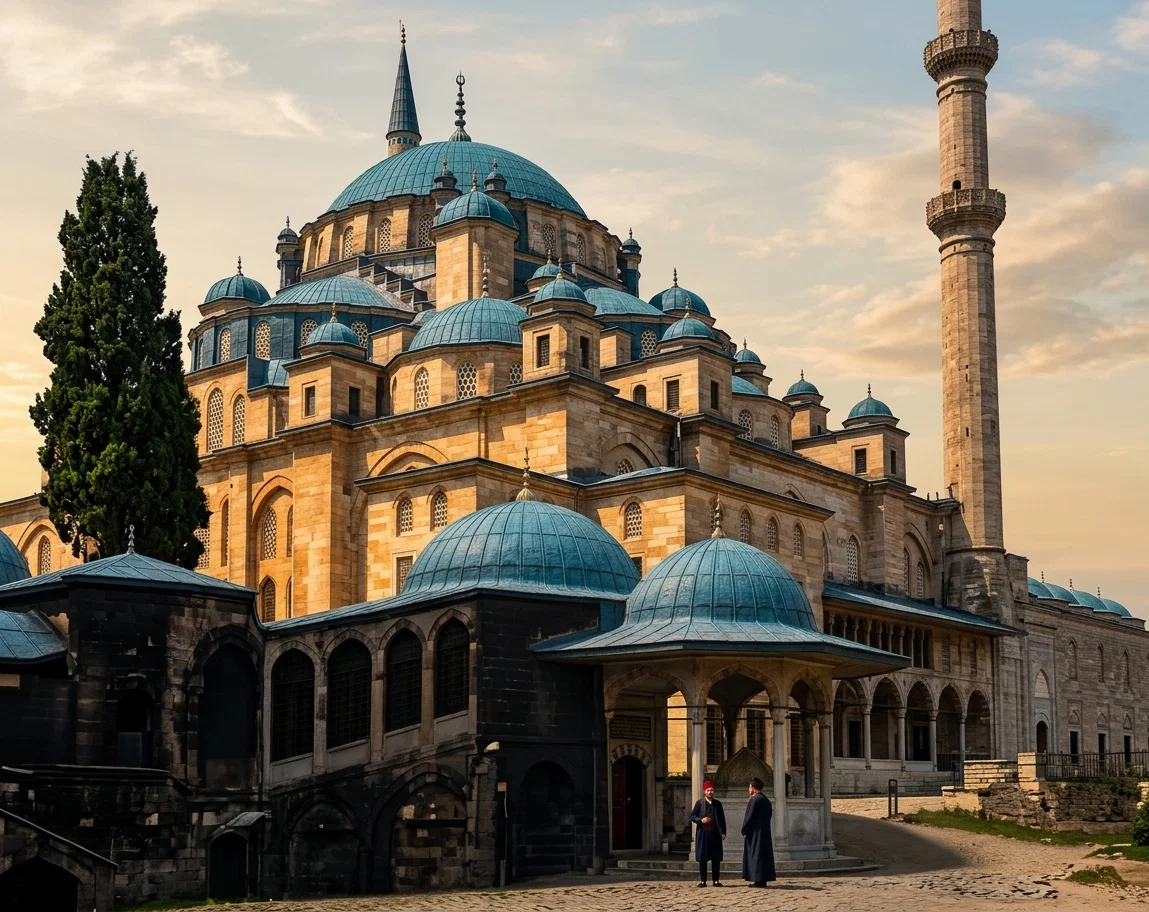
The streets were all adorned with Turkish, Persian, and also German and Austrian flags, in honor of the declaration of the holy war the day previous. This declaration took place in and before the mosque of Mohammed II, conqueror of Constantinople. The Greek architect Christodulos (the servant of Christ) erected this mosque during the years of 1463-1469 on the site of the church of the apostles built by Justinian. Divers earthquakes damaged it so it had to be restored several times. Two minarets about two hundred and fifty feet high adorn this mighty building. It consists really of a complexity of buildings, the main part serving as a mosque, the other parts for schools, dormitories, kitchen for the poor, hospital, inns, and baths.
Mosque of Mohammed II, from Which the Holy War Was Declared
The interior is marked by its great simplicity. On a marble slate the following prophecy of Mohammed is written in golden letters: “They shall conquer Constantinople; blessed the prince, blessed the army, which shall accomplish this.” Nearly eight hundred years passed before his successors were able to conquer this city, and now its fate is at stake, and they are about to lose it again.
The following report from the Osmanic Lloyd, November 15, about this great celebration, may be of interest:

“THE GREAT DEMONSTRATION OF THE OSMANS

“Yesterday Stamboul experienced such a day as she never saw before, perhaps. From the earliest morning hours the city presented a very animated picture. All houses were decorated with Turkish flags. In some streets and quarters there were also Persian flags, and here and there German and Austrian. An immense multitude streamed to the mosque of the conqueror in the Fatih quarter. Great crowds collected from all directions. All trade-unions and societies were headed by brass bands. All were bound for the holy place which should be the theater of a mighty demonstration. The people knew that the caliph had approved of the five futwas (decrees), written by the futwa Emini, which were to declare the holy war, and these decrees were to be read to the believers from the great platform of the Fatih mosque. The large public place before the mosque was crowded by an innumerable multitude of people. A special delegation of the sheik ul Islam arrived at noon, according to the program, in a court carriage, before the mosque. The delegation was accompanied by the fire brigades. The delegation at once went into the mosque to read the futwa shereef. After the noon prayers, the futwa Emini Ali Haidar Effendi ascended the pulpit, and read to the multitudes the text of the five decrees.

THE DECREES OF THE HOLY WAR

The Five Futwas.— These important historical documents which seal the participation of Turkey in the great European war read as follows:
“First question: The enemies assaulted Islam. They have appropriated and taken possession of Mohammedan countries. They have maltreated and subjected Mohammedan populations. As we have full evidence for these facts, the ruler of Islam has called the entire male Mohammedan population from seven to seventy years of age, to participate in the holy war. Is therefore the holy war a duty for all Mohammedans? and shall not old and young on foot or on horseback, Mohammedans of all countries, engage in this holy war, with all their possessions and with their blood, according to the words of the Koran: Raise an army of small and great, and enlist in the holy war with your substance and blood?” The answer of the sheik ul Islam is, “Yes.”
“Second question: The three powers, Russia, England, and France have with their men-of-war assaulted the seat of the caliphate, and the land of the sultan, in order to extinguish and destroy Islam—which God prevent—by hostilities against the Mohammedan caliph. This has come to our knowledge. Is it not a holy duty for all Mohammedans who live under the government of these powers and of the states allied with them to declare the holy war and to engage in battle against all these powers and states?” Answer of the sheik ul Islam, “Yes.”
“Third question: In order to reach this high purpose, it becomes necessary that all Mohammedans on earth participate in this holy war. In view of this, are not those—God forbid that there be such—who do not participate in this holy war, worthy of the wrath of God, and the severest eternal punishment?” Answer, “They are.”
“Fourth question: If the governments of the hostile countries intimidate their Mohammedan subjects by threatenings, even if they say that they would kill their wives and children, is it not still the greatest sin for the Mohammedans to join the war against Islam, and will they not as murderers share the greatest torments of hell?” Answer of the sheik ul Islam, “Yes.”
“Fifth question: As it harms the supreme caliphate if the Mohammedans subject to France, England, and Russia, and the allied states, enlist against Germany and Austria-Hungary, which are allied to the caliphate, is it not to be regarded as the worst sin, attended by the greatest punishment of hell, if they do such?” Answer, “Certainly.”
“Signature: Hari-bin-Avni.”
These decrees being read, prayers were offered for the success of the Turkish empire as well as for that of the allies, Germany and Austria-Hungary. After the prayer, the representative for Smyrna Sejd Bey gave a patriotic speech, declaring that the war of Turkey is not to be compared with a common war of conquest, but that the very existence of the nation depends upon it. This speech closed the historic celebration before the mosque. Then an immense procession started from here to the Sabiline Porte, where speeches were exchanged with the ministers; and thence to the residence of the sultan, who also made a formal reply; and finally to the German and Austrian embassies. These historic decrees were written with the very pen of Sultan Mohammed II which had been preserved in the imperial treasury, and it has since been deposited in the war museum. The tower that the Russians erected at San Stefano, in memory of the war of 1878, was demolished.
While all the English, French, and Russian places of business had been closed, the Ottoman, German, and Austrian banks were open. As I had undertaken the trip mainly to furnish our workers in that field with thenecessary means, I found no difficulty in securing in exchange Turkish and English gold, and the new Turkish paper money is at par with the gold. Before I left the Turkish border, I was, however, closely questioned as to whether I had any gold with me.
The future must reveal what effect this will have on the 200,000,000 of Mohammedans, of whom 74,000,000 live in English colonies, 26,000,000 in the French, and 13,000,000 in Egypt and the Sudan.

The Prince of Peace and His Kingdom

The Mighty Power of the Little Seed — How the Obscure Beginning Would Expand — Not the Mightiness of Arms but of Truth
By MRS. E. G. WHITE
In the multitude that listened to Christ’s preaching, there were many Pharisees. These noted contemptuously how few of His hearers acknowledged Him as the Messiah. And they questioned with themselves how this unpretending Teacher could exalt Israel to universal dominion. Without riches, power, or honor, how was He to establish the new kingdom? Christ read their thoughts, and answered them:

LIKE THE GRAIN OF MUSTARD SEED

“Whereunto shall we liken the kingdom of God? or with what comparison shall we compare it?” Mark 4: 30. In earthly governments, there was nothing that could serve for a similitude. No civil society could afford Him a symbol. “It is like a grain of mustard seed,” He said, “which, when it is sown upon the earth, though it be less than all the seeds that are upon the earth, yet when it is sown, groweth up, and becometh greater than all the herbs, and putteth out great branches; so that the birds of the heaven can lodge under the shadow thereof.” Verses 31, 32, A. R. V.
The germ in the seed grows by the unfolding of the life principle which God has implanted. Its development depends upon no human power. So it is with the kingdom of Christ. It is a new creation. Its principles of development are the opposite of those that rule the kingdoms of this world. Earthly governments prevail by physical force. They maintain their dominion by war. But the founder of the new kingdom is the Prince of peace.

THE TWO KINDS OF KINGDOMS

The Holy Spirit represents worldly kingdoms under the symbol of fierce beasts of prey; but Christ is “the Lamb of God, which taketh away the sin of the world.” John 1: 29. In His plan of government there is no employment of brute force to compel the conscience. The Jews looked for the kingdom of God to be established in the same way as the kingdoms of the world. To promote righteousness, they resorted to external measures. They devised methods and plans. But Christ implants a principle. By implanting truth and righteousness, He counterworks error and sin.
As Jesus spoke this parable, the mustard plant could be seen far and near, lifting itself above the grass and grain, and waving its branches lightly in the air. Birds flitted from twig to twig, and sang amid the leafy foliage. Yet the seed from which sprang this giant plant was among the least of all seeds. At first it sent up a tender shoot; but it was of strong vitality, and grew and flourished until it reached its present great size.

POWER OF THE GALILEAN PEASANTS

So the kingdom of Christ in its beginning seemed humble and insignificant. Compared with earthly kingdoms, it appeared to be the least of all. By the rulers of this world, Christ’s claim to be a king was ridiculed. Yet in the mighty truths committed to His followers, the kingdom of the gospel possessed a divine life. And how rapid was its growth, how widespread its influence! When Christ spoke this parable, there were only a few Galilean peasants to represent the new kingdom. Their poverty, the fewness of their numbers, was urged over and over again as a reason why men should not connect themselves with these simple-minded fishermen who followed Jesus. But the mustard seed was to grow and spread forth its branches throughout the world. When the earthly kingdoms whose glory then filled the hearts of men should perish, the kingdom of Christ would remain, a mighty and far-reaching power.
“Without riches, power, or honor, how was He to establish the new kingdom?”
So the work of grace in the heart is small in its beginning. A word is spoken, a ray of light is shed into the soul, an influence is exerted that is the beginning of the new life; and who can measure its results?

A SPECIAL TRUTH AND WORK

Not only is the growth of Christ’s kingdom illustrated by the parable of the mustard seed, but in every stage of its growth the experience represented in the parable is repeated. For His church in every generation God has a special truth and a special work. The truth that is hid from the worldly wise and prudent is revealed to the childlike and humble. It calls for self-sacrifice. It has battles to fight and victories to win. At the outset its advocates are few. By the great men of the world and by a world-conforming church, they are opposed and despised.
See John the Baptist, the forerunner of Christ, standing alone to rebuke the pride and formalism of the Jewish nation. See the first bearers of the gospel into Europe. How obscure, how hopeless, seemed the mission of Paul and Silas, the two tentmakers, as they with their companions took ship at Troas for Philippi. See “Paul the aged,” in chains, preaching Christ in the stronghold of the Cæsars. See the little communities of slaves and peasants in conflict with the heathenism of imperial Rome. See Martin Luther withstanding that mighty church which is the masterpiece of the world’s wisdom. See him holding fast God’s word against emperor and pope, declaring: “Here I take my stand; I cannot do otherwise. God be my help.” See John Wesley preaching Christ and His righteousness in the midst of formalism, sensualism, and infidelity. See one burdened with the woes of the heathen world, pleading for the privilege of carrying to them Christ’s message of love. Hear the response of ecclesiasticism: “Sit down, young man. When God wants to convert the heathen, He will do it without your help or mine.”

NOT MANY MIGHTY ARE CALLED

The great leaders of religious thought in this generation sound the praises and build the monuments of those who planted the seed of truth centuries ago. Do not many turn from this work to trample down the growth springing from the same seed to-day? The old cry is repeated, “We know that God spake unto Moses: as for this fellow [Christ in the messenger He sends], we know not from whence he is.” John 9: 29. As in earlier ages, the special truths for this time are found, not with the ecclesiastical authorities, but with men and women who are not too learned or too wise to believe the word of God.
“For ye see your calling, brethren, how that not many wise men after the flesh, not many mighty, not many noble, are called: but God hath chosen the foolish things of the world to confound the wise; and God hath chosen the weak things of the world to confound the things which are mighty; and base things of the world, and things which are despised, hath God chosen, yea, and things which are not, to bring to naught things that are;” “that your faith should not stand in the wisdom of men, but in the power of God.” 1 Cor. 1: 26-28; 2: 5.
And in this last generation, the parable of the mustard seed is to reach a signal and triumphant fulfillment. The little seed will become a tree. The last message of warning and mercy is to go to “every nation, and kindred, and tongue,” “to take out of them a people for His name.” And the earth shall be lightened with His glory.

The Sabbath

How It Should Be Observed — Not a Holiday, but a Holy Day
By ELIZA H. MORTON
The Sabbath, being a love-token to man, should be his delight. It is a holy day, blessed of the Lord, and honorable. Blessings come to those who observe it as God intended that it should be observed. Isa. 56: 2.
The Sabbath was not designed for physical rest, although that is included in it. The whole household should refrain from work. Ex. 20: 10. No rush of work, even in harvest-time, is an excuse for labor on the Sabbath day. Ex. 34: 21. Trade on that day is prohibited. Neh. 13: 19.
The Sabbath rest touches our very thoughts and conversation. Isa. 58: 13. If we donot speak our own words, we shall not think our own thoughts; for thought precedes speech. To keep the day holy, we should meditate on holy themes, and attend church. Luke 4: 16; 1 Peter 2: 21.
In making the day a holiday, spending it in visiting and amusements, one does not obtain the spiritual rest the soul needs in order to be refreshed and strengthened for the work of the week.
When one seeks the Lord in His own house, and under the open sky, amid the scenes of nature, the Holy Spirit comes very near, angels hover around, and earth, sky, and air all speak to the soul, leading it upward, nearer and nearer to God’s throne.
There are certain things which it is right to do on the Sabbath. It is lawful to do well, — to minister to the sick, and to do works of mercy. Matt. 12: 11, 12; Luke 13: 15. It is also right to satisfy hunger. Luke 6: 1-5. The Lord’s work, or work connected with religious exercises, is allowable. Num. 28: 9; John 7: 23; Matt. 12: 5.
We are never to do our own pleasure — that is, never to do things for our own selfish gratification — on the Sabbath day; but we may, by seeking to lead others into the way of life, and by listening to God’s holy word in His holy house, and by meditating on holy themes, receive such a divine uplift that we shall not wish the Sabbath past, as did some in the days of old (Amos 8: 5), but we shall hail its coming with joy, and hallow its departure with prayer.
“Delightful day, best gift of heaven, By man in Eden first possessed, Jehovah’s rest day, kindly given, That all His creatures might be blessed!”

The Birds of Prey

What Do They Represent?—The Fallen Foe and Our Conflict with Him—The Foes Within
By RODERICK S. OWEN
“AND when the fowls came down upon the carcasses, Abram drove them away.” Gen. 15: 11. After Abraham had prepared his sacrifice, he waited for the manifestation of the presence of God to pass between the separated pieces, thus confirming the covenant with him, and giving him the sign for which he had asked, and for which he had made preparation. All that long day, Abraham was kept busy driving away the birds of prey, which seemed determined to destroy his sacrifice and thus defeat the consummation of the covenant with God.

Birds of Prey and the Evil Agencies

These birds of prey, then, must represent all the agencies that are operating to prevent the establishment of the covenant of liberty among the children of men, and with which we must contend in seeking freedom in Christ Jesus. At the head of the long line of opposers, we must place Satan, who has led us captive at his will, and who is constantly exerting all the powers of his being to prevent the union between the human and the divine. Under the symbol of “the great red dragon,” Satan is represented as seeking to destroy the Christ as soon as He was born. This he did through Herod, who slew all the children in Bethlehem and in the coasts thereof from two years old and under, in his effort to kill the infant Jesus.
And all through the earthly life of Christ, Satan sought to destroy Him as our sacrifice, by leading Him to sin or to become discouraged, so that He would abandon mankind, and leave them to their fate, without a sacrifice. But thanks be to God, the work of Christ was finished—the union between God and man was completed in the person of Christ. The sacrifice was prepared and accepted, and the Man Child who is to rule all nations with a rod of iron was caught up to God and to His throne.

Has Persecuted the Church

Since that time, Satan has persecuted the woman, the church, even going about as a roaring lion, seeking whom he may devour; and now in the last days, he has come down having great wrath, because he knows that he has but a short time. But James says: “Resist the devil, and he will flee from you. Draw nigh to God, and He will draw nigh to you.” So we see that this great opposer may be driven away by us. Associated with him are all the hosts of fallen angels, who are lying spirits, and who go forth working miracles to deceive. Hence “we wrestle not against flesh and blood, but against principalities, against powers, against the rulers of the darkness of this world, against spiritual wickedness in high places. Wherefore take unto you the whole armor of God, that ye may be able to withstand in the evil day, and having done all, to stand. Stand therefore, having your loins girt about with truth, and having on the breastplate of righteousness; and your feet shod with the preparation of the gospel of peace; above all, taking the shield of faith, wherewith ye shall be able to quench all the fiery darts of the wicked. And take the helmet of salvation, and the sword of the Spirit, which is the word of God.” Eph. 6: 12-17.
In the word of God, one fact is revealed which ought to be very encouraging to us in our efforts to resist this mighty army of opposers, and which will help us to put them to flight; and that is, when this great host was led to become the enemies of God, a host double their number remained loyal and true. And these are all ministering spirits, sent forth to minister to those who are heirs of salvation. Thus they that are for us are more than they that are against us. Our feeble efforts are seconded and made effective by the chariots of God—even thousands of angels. Ps. 68: 17.

The Foes Within

But besides the invisible host of evil, there is an army of wicked men and seducers waxing “worse and worse” as we near the end of time. Their wiles and deceptions, their enticements to sin, we must resist if we hope to find true liberty in Christ.
“But of all the foes that lead to sin, The worst are those that lurk within.”
Those weaknesses and inordinate desires in our flesh, the lusts of the carnal heart,—these are most successful in defeating the consummation of the covenant of liberty. These are the reins of the heart by which Satan leads captives into sin. These, because man is a bond servant of sin, are the chains of slavery which it is impossible for man in his own strength to break. But the soul who will acknowledge that Jesus Christ is come in the flesh,—sinful flesh, just such flesh as we have,—and that He has condemned sin in that flesh by taking all these weaknesses, and overcoming them; who will grasp by faith the thought that what God did in Christ Jesus in sinful flesh, may, by the power of God, be repeated in his own flesh,—such will find deliverance if he freely admits this power into his experience. But first he must recognize his own weakness, for God’s power is only made perfect in weakness. Such a one will glory in his infirmities, that the power of Christ may rest upon him; and thus when he is weak, he will be strong, and will be able to resist all who oppose the covenant of liberty in Christ Jesus.

The Constant and Heroic Conflict

The Christian, like the Soldier, Must Live for One Purpose— He Must Overcome or Go Down
By MRS. B. SHANKS CHANEY
No figure was better known to Paul than the Roman soldier. From boyhood days he had heard the tread of the legions, and seen their glittering eagles, as they marched from city to city, or camped on the hillsides of Asia, everywhere upholding the iron authority of Rome’s emperor.
Two hundred of them had been his escort from Jerusalem to Cæsarea. On the dangerous winter voyage to Rome, the shipload of prisoners were guarded by legionaries; and after the perilous shipwreck, they camped together for three months on a small island. Many a time the Roman soldier was a better friend to Paul than the Jewish rabbi.

The Lesson of the Army

With his true greatness of mind and broadness of sympathy, Paul saw the splendid discipline of the army; and to him there could be no fitter representative of what the Christ follower ought to be, than the soldier with his body hardened to endure the weariness of long marches, the coarsest and plainest of food, the frost of Gallic winters, or the heat of African summers. Often does this, the greatest of the writers in the early church, use this figure of the soldier’s life to show his readers what a strenuous life must be that of the Christian. “Thou therefore endure hardness, as a good soldier,” he urges the young man Timothy.
But there is more than endurance to the soldier’s life. He is not worthy the name who is not ever ready to battle with the enemy, and to fight to the death. Again and again Paul refers to the armor, so carefully planned, so well adapted to protect the body in fighting. From Isaiah’s prophetic picture of Christ’s work, the apostle borrows the figure of righteousness as a breastplate, and salvation as a helmet; but he carries the figure out fully, and in the wonderful letter to the Ephesians is described the Christian’s armor complete—the headpiece of salvation, the girdle of truth, the breastplate of righteousness, the invincible shield of faith, the sandals prepared of the gospel of peace, the sword of the Spirit.

To Overcome Is the Work

The greatest work that any one in the world has to do is to overcome. It is preeminently the life work of the soldier. He may have to march long distances to reach the enemy; he has his accoutrements to keep in order; he must prepare his food and get his rest; but these are all side issues. Fighting is his life work, and he must overcome or be overcome.
The life of the Christian must be the strenuous life of the soldier, all the more difficult because the foe is a hidden one. The work by which we gain our livelihood may be hard. The body and the brain are weary at the close of the day. But this work is easy compared with the inner striving, which may never cease in any waking hour of a Christian’s life. Behind every soul is an overwhelming heredity.
Paul urged his Ephesian children to “stand,” “and having overcome all, to stand.” Eph. 6: 13, margin. Neither one defeat nor a thousand conquers the archenemy. The disciplined soldier pulls himself together, fastens again more securely the girdle of truth, which is so likely to slip in a struggle, grasps with more dogged determination his shield, and is ready for the next encounter.
But though the strife must be unceasing, the rewards of victory held out for the overcomer are precious above and beyond any human comprehension. The lonely exile on Patmos saw them—the fruit of the tree of life; the power to be unhurt of the second death; the hidden manna; the white stone revealing the character that has been developed; the white raiment; the name unblotted from the book of life; and the unspeakable privilege of being seated on the triumphal throne of Christ. All these are for the overcomer.
“Strive, endeavor! It profits more To fight and fail on earth’s dull shore, Than to sit an idler ever. But to him who bares his arm to the strife, Firm at his post in the battle of life, The victory faileth never.”
Continue reading: The Judgment in Session