THAT the Catholic forces have taken the arena in a determined fight for political supremacy in Italy has become alarmingly evident. All the friends of religious liberty are more or less alive to the peril of the situation, but how to successfully meet the difficult issue is a problem not so easy of solution.
The church is powerful and has an unlimited amount of wealth and influence at its command. The men of the present generation are weak morally, and consequently lack that stamina which is indispensable in a fight for principle. We are all more or less familiar with the power of the money-king. The value of wealth as a factor for controlling and commanding men is not less known to the leaders of the Roman church than to the man of business or the politician. But if to this financial hold upon the bodies of men we add the still stronger grip derived from the power of domineering the consciences, we can better appreciate the position of the Papacy.
Then we must consider that Italy is a poor country and that the strong middle class which is such a power in other countries is almost unknown here. The wealth of the country is largely in the hands of the nobility and the Jews. The former, as a general rule, are strong and even bigoted Catholics, while with the latter class religion plays so small a part that their personal and material interests to a large extent become the all-absorbing factor in deciding them for one side or the other. This latter declaration is fully verified in the present prime minister of Italy, who, notwithstanding his Jewish nationality, is lending his influence in a marked way in favor of the Papacy.
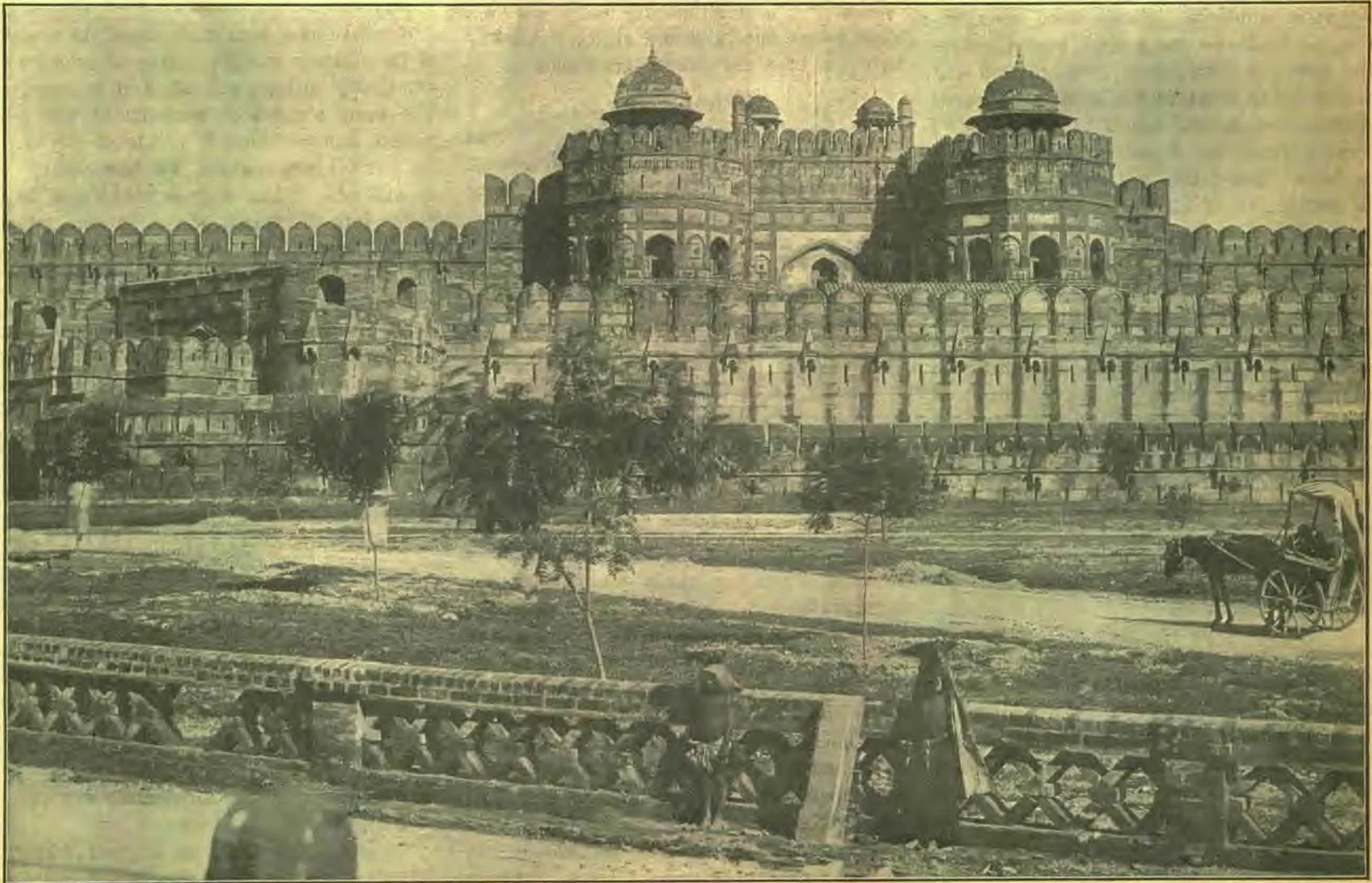
Agra Fort, where the British troops and Europeans of Agra were shot up during the Mutiny of 1857. They remained in the fort until the capture of Delhi. This fort was built by Magal rulers before the English got possession of India. Akbar began it in 1566 on the site of an older one constructed by Salim Shah Sur.
The poorer classes are either ignorant, superstitious Catholics, or out and out atheists. The former class marches blindly on under the lash of the domineering priest, while the latter class can not be depended upon in a fierce struggle for principle. The situation surely calls for some real reformers who are ready to stake their all for the cause of religious freedom.
The liberal parties make powerful demonstrations every so often, but these are not sufficient to cope with the persistent, steady, undermining influence of the Papacy, which, with its centuries of political experience, is making a life and death struggle to ostracize the enemy from its "home."
Just now Italy is celebrating the centennial of the birth of its great hero and patriot, Joseph Garibaldi. On this memorable occasion12the veterans that helped to liberate the country from papal usurpation are reminded, by contrasting the present conditions with those of 1870, that the Papacy in the last years has retrieved much of its lost prestige and greatly strengthened its position. In fact, so strongly has this conclusion forced itself home to their minds that at the present time they have had large posters put up all over Rome which read as follows:
Clericalism in Italy.
(Continued from Page 11.)
"The Joseph Garibaldi Society of Veterans of Rome: In view of the program that forms the basis of this patriotic society; and in view of the fact that this program is and must be maintained and continued by this association; and that our lamented companion Menotti Garibaldi and the successive presidents have held themselves true to the same program, we declare that any concession or transaction with the Papacy shall be considered a violation of the natural rights of the people and a setting aside of the causes that contributed to the uprising of the Italian people in favor of liberty and union: and would create a certain peril for the internal peace and security of the nation. We further declare that United Italy can have nothing whatsoever in common with the program and aspirations of the Vatican. We recommend all sister societies, and, in fact, all Italians, to ever defend Italy from every influence and intrigue of clericalism, guarding energetically the civil rights of the great Italian family which should not be forgetful of its origin and its mission in Rome and in the world, neither ought we to lose sight of the sublime ideals for which an entire generation of martyrs has been sacrificed."
Such powerful and significant statements made by men who are not political agitators or alarmists, but those who have put their all on the altar of liberty and have fought the nation's battles until now they are gray in the service of their country, ought to have some weight in convincing us of the real seriousness of the situation.
At this present time also the municipal elections are taking place at Rome, and the fight is on for the political supremacy of the city. The clerical forces have for some time been in power in the municipal government, but on this memorable occasion when the country is celebrating the triumphs of the great leader and liberator of Italy, Garibaldi, the liberal forces are making a tremendous fight to gain control of the political situation in Rome. Great, flaming posters cover every available place on the public and private buildings. The liberals have posted extensively the following significant placard:
"The liberal party must not accept alliance with the clericals. If the ecclesiastical authority adopt spiritual arms for spiritual interests, I, confiding in the public conscience and the tradition of our forefathers, will find the power to maintain intact the civil liberty. Victor Emmanuel II."
Among other places, I saw this poster pasted on the walls of the great Jesuit church in which the body of Ignatius Loyala rests. Another poster reads as follows:
"'Voters, reject resolutely every alliance with the clericals. I can not conceive of a greater calamity that can befall a civilized people than to see the civil and the religious power united in the hands of its ruler. The history of every century as well as of every country demonstrates that wherever this union takes place, civilization almost always immediately ceases to progress, or, in fact, always retrogrades; and the most obnoxious despotism establishes itself; and the result is ever the same, whether a priestly caste usurp the temporal power or a caliph or a sultan grasp the spiritual power. Everywhere this fatal mixture has produced the same effects. God help us, therefore, that this may not take place in our country. Camillo Cavour.'"
This powerful agitation on the part of the liberal parties has not proven in vain, for the results show that the clerical party has been snowed under and that the liberals have won a splendid victory. The clericals made a desperate fight, and many priests and monks went to the polls to register their vote in favor of the church's choice. In one place as many as fifty priests voted. The results of the election were received with much bitterness by the Roman hierarchy, and especially by the pope himself, who has always taken a lively interest in the local politics of the city where he has been situated. This great interest taken in politics by the leaders of the Roman church together with the stir seen in the ranks of the priesthood during the recent election are indications of a mighty awakening on the part of the Papacy in favor of a more aggressive political policy in Italy.
And while the liberal parties arise and for the moment sweep everything before them, when the enthusiasm has passed, the agitation ceases. But the church keeps continually and everlastingly at it till it wins out. The leaders that form the heads of the political parties have their affairs to attend to and thus are also impeded from spending all of their time in the political arena. But the Church of Rome has an army of prelates and priests that have nothing else to do than to tend to the call and beck of the Papacy and consequently also it is in a position to keep everlastingly working away at a problem until it wins.
However, the fact remains that clericalism is stronger in Italy to-day than it has been since Italian liberty was declared.
C. E. MILTON.
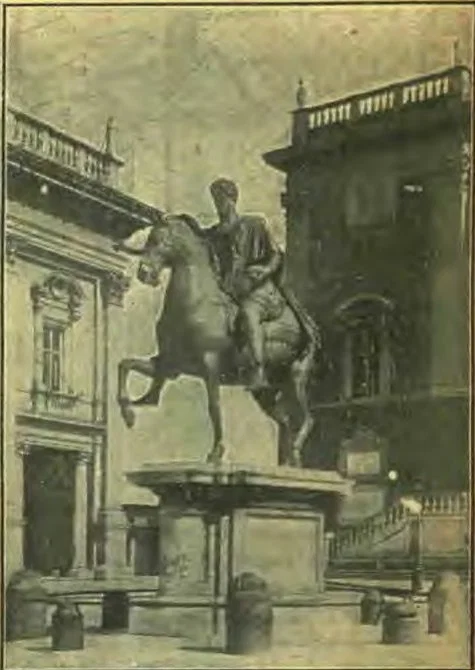
Statue of Marcus Aurelius.
If Trials Come
By Max Hill
By Max Hill
If trials come to me to-day
To lead my wandering feet astray,
With enemies on every hand;
If sickness comes to lay me low,
And if the way I do not know,
Will I be able then to stand?
If there should come a call to work,
A call I do not care to shirk,
Would I the voice of duty know?
If to a foreign field He send,
Mayhap to witness to the end,
O will I answer Him, 'I go'?
And if the day of God should dawn—
Probation closed and mercy gone,—
And judgment pass upon all men;
If He should make His glory known
And Jesus come to save His own,
Would I be ready for Him then?
My soul, be ready for His call,
To Him surrendering thine all,
Come from thy choosing life or death,
For when the foes of life assail
Naught else for saving will avail
But faith in Him of Nazareth.
Chinese Students in Japan
By P. J. Laird
By P. J. Laird
Dress.
A RECENT statement by the Chinese minister at Tokyo puts the number of Chinese in that city alone at more than ten thousand. The absence of the queue and the wearing of a neat semi-uniform attire renders it quite difficult, if not impossible, at first to distinguish between Chinese and Japanese students. Those more conservative, or in Japan for a brief period, retain the queue in a shortened form, platted and rolled up on front of the head and secured with an ornamental lady's hairpin. Others have adopted the Japanese students' dress entirely. The latter are the most difficult to distinguish of all classes. It goes without saying that the new Chinese student, as seen in Japan, is much superior in appearance to the vast majority of his less fortunate brothers toiling at their studies in China. Physically they appear more robust, with sometimes a freshness even amounting to color on their cheeks. We heard with great thankfulness of the absence of blood-spitting among these men so often reported among the same class in China. No doubt the distance to be traversed going to and from schools and classes is indirectly a great benefit along these lines.
Food.
The Chinese do not take very readily to the food prepared in Japanese style, but have to be content with it owing to the increased cost of following the Chinese style, only obtainable at the restaurants and higher-class Chinese boarding houses. Even the rice is much different from what they have been accustomed to eat in their own land. Curiously enough, if they eat much (three meals a day) of it, it seriously affects them and causes pain in the knees. At least such is the report given by not a few. The absence of salt, oil, and vegetables is a real trial for a time, but they take it all in good part. The smallness of the average meal partaken of by Japanese is a common topic with them.
Furniture may consist of a table, chair, and a small oil-lamp, if electric light is not laid on. A small bookcase makes up the catalog. Of course those having means deck their rooms out in grand style; but many have not even the things mentioned.
Musical Talent.
A curious feature of their life in Japan is the development of their musical genius. Some of us had often wondered whether some of them ever possessed such a thing. Quite a number of them had organs and melodions in the rooms we visited. The tunes were often played fairly well, even if repeated a trifle too frequently.
Literature.
Coming, as do the majority, from the interior of China, where foreign languages have hardly penetrated the dust of ages, they are all more or less well versed in the literature of their own land. Several hold the first degree. Their desire in going to Japan is more for up-to-date modern learning than to return to China as clerks and agents for foreign firms at large and remunerative salaries, as is common among so many who have had a little taste of foreign learning. The phenomenal influx of these Chinese students into Japan, in preference to going further afield to Europe and America, can be explained by the similarity of the Japanese to Chinese literature. It is surprising how readily the Chinese fall back on the written language when difficulties are met in the ordinary routine of life. A second cause is the much cheaper rate at which they can study in the schools of Japan, when once they are admitted. This is not as easy as it might seem. Some schools have several hundred Chinese students in addition to several thousand Japanese. One for Chinese exclusively has approaching fourteen hundred in its classes. The classes are usually very large, a great drawback to good work.
Apt Scholars.
It will not surprise many to know the Chinese are doing well at their studies. Very few take a year to learn sufficient Japanese to enable them to follow lectures in that language. Of course many do not stop that long in the country. A few thousands must be studying privately or in small classes awaiting their entrance into the regular institutions. The weakness of the system is felt in the fact that at least three-fourths, probably more, go to Japan without any preparation and without knowing a word of Japanese or English. Consequently only a few hundred are scattered in the higher institutions of learning, as the Imperial University and First Higher School; the remainder are for the most part at the elementary stages of work.
Students of technology, mechanical engineering, or medicine are not numerous. Hundreds may hardly get beyond the secondary stage, returning to China after a year or two of study in Japan. Many question the usefulness of such men in their provincial centers, or filling responsible posts under the government, to say nothing of the lack of economy in the whole system. There appears to be a real and urgent call for sound improvement of the home regulations for education in the Chinese Empire.
Morals.
Remarks have been made about the morals of the Chinese students, many of which are manifestly unjust, unkind, and inaccurate. The same number of students of any one nation, dumped down in one large city with its terrible temptations, we fear would be no different. Some of these young men have fallen into the vortex of temptations, which must be seen to be realized, and are grappled by the foul curse. Altho drinking and drunkenness are far more prevalent among the Japanese than one had imagined before going to live in Tokyo, we have not seen a Chinaman intoxicated.
China's great sage, Confucius, was ever looking into the past. His successors, the students of China, are doing the same. He invented nothing fresh, neither do they. Great world-powers have long since risen and fallen into decay. China, like the brook, "goes on forever." Being shut in by sea, desert, and mountains, she has been led to think of those without as "barbarians" and as such, her "tributaries." "Her exclusiveness kept her ignorant, her ignorance kept her self-satisfied, her self-satisfaction kept her conservative." She is much the same to-day.
Introduction of Christianity among Students.
"The Chinese must be a great factor." They are one-fourth of the earth's millions. Plant them where you will, while others succumb they thrive and multiply. Famine, war, and plague have worked terrible havoc with China's millions;13yet ere long their places are filled with new arrivals, who seem to have sprung out of the very ground. With this enormous concourse of people once awake, no nation or nations can afford to despise them as now.
As a result of the Shanghai Centennial Conference, a special committee has been chosen to deal with this great question that has long baffled the effort of missionaries in China; namely, to reach the student population, and to organize a church for those who are to become members. In the providence of God it would appear that the Chinese students in Japan would furnish the key to the situation. What are we going to do to bring present truth before this enormous concourse of students in Japan?
Chang Sha, Hunan, China.
Our Work and Workers.
NINE new members were welcomed into the Aberdeen (S. D.) church early in July.
TWELVE have accepted the truth of the third angel at Dinuba, Cal., thru the labors of Brother H. C. Basney.
AN effort in Cherry County, Neb., conducted by Brother J. W. Beams, closed with the baptism of eight, July 21.
TEN additions to the ranks were recently gained by Brother C. W. Miller at Bellview, Texas, two English and eight German.
A CARD from Brother Jacob Wibbens states that there is a Sabbath-keeping church of twenty-seven in The Hague, where a year ago there were but two members.
BROTHER J. W. BOYNTON writes from Ponoka, Alberta: 'Last Sunday I had the pleasure of baptizing six dear souls in the beautiful Buffalo Lake, north of Steller.'
SIXTEEN adults, members of seven families, of Hamby, Texas, have signified their intention of keeping all the commandments of God. Brethren T. W. Field and H. B. French bore the message to them.
Wanted for Missionary Work.
C. D. M. WILLIAMS, 767 Kinau St., Honolulu, H. T., desires supplies of all our denominational papers to use in prisons and on ship board.
Clean copies of the Signs. Address, Ella E. Fowler, Box 762, Twin Falls, Idaho.
Foreign Literature for San Francisco.—Tracts, periodicals, and books in French, German, Spanish, Italian, Finnish, Rumanian, or other foreign languages, are much needed in San Francisco. Brother J. P. Novak, care Hydriatic Dispensary, 916 Laguna St., San Francisco, Cal., is engaged in self-supporting missionary work, and can use to advantage any literature in any language, including English publications. Always prepay transportation.
SALESMAN FOR OAKLAND.
Wanted.—A good man to introduce two good articles to the trade—wholesale and retail—in Oakland, Cal. Write for full particulars to Alfred Mallett, Sacramento, Cal. A good opening for an experienced man.
Help Wanted.—Young people for nurses' training class, and domestic work, also man to do chores and assist in milking. Address at once, Garden City Sanitarium, San Jose, Cal.
WANTED.—Ten men to chop wood near Sanitarium, Cal. Must be Sabbath-keepers. Address, J. B. Fradenburg, Sanitarium, Napa Co., Cal.
Herschel, the Astronomer.
SIR JOHN FREDERICK WILLIAM HERSCHEL, Bart., only son of the astronomer, Sir William Herschel, was born at Slough, 1792, and educated at Cambridge. His first publication was a "Collection of Examples of the Application of the Calculus of Finite Differences," 1820. In 1822 he applied himself especially to astronomy, using his father's methods and instruments in observing the heavens. As early as 1826 the Royal Society had voted to him a gold medal for observations on double stars, but by 1833 his preeminence was beyond the necessity of being marked by acknowledgments. In 1836 appeared his "Treatise on Astronomy." At this time Herschel was at the Cape of Good Hope, where he arrived in January, 1834, with the intention of completing the survey of the sidereal heavens, by examining the southern hemisphere as he had done the northern. Here he established his observatory at a place called "Feldhausen," [in which identical house this extract is being copied] six miles from Table Bay. On March 5, 1834, he commenced his observations; and in four years, working all the time at his own expense, he completed them.
Quoting Herschel's own words on his work in Africa: "I resolved to attempt the completion of the survey of the whole surface of the heavens, and for this purpose to transport into the other hemisphere the same instrument which had been employed in this (the northern) so as to give a unity to the results of both portions of the survey, and to render them comparable with each other." In accordance with this resolution, he and his family embarked for the Cape on the 13th of November, 1833; they arrived in Table Bay on the 15th of January, 1834. "On the 22d of February, I was enabled to gratify my curiosity by a view of Crucis, the nebula about Argus, and some other remarkable objects in the twenty-foot reflector, and on the night of the 4th of March to commence a regular course of sweeping."
To give an adequate description of the vast mass of labor completed during the next four busy years of his life at "Feldhausen" would require the transcription of a considerable portion of the "Cape Observations," a volume which probably is not surpassed in varied interest or astronomical importance by any scientific work in existence. It was published at the sole expense of the late duke of Northumberland, but not until 1847, nine years after the author's return to England, for the very cogent reasons assigned by himself—"The whole of the observations, as well as the entire work of reducing, arranging, and preparing them for the press, have been executed by myself."
There are 164 pages of southern nebulae and clusters of stars. There are then careful and elaborate drawings of the southern appearance of the great nebula in Orion, and of the region surrounding the remarkable star of Argo. The labor and the thought bestowed upon some of these objects are almost incredible; several months were well spent upon a minute spot in the heavens, containing 1,216 stars, but which an ordinary spangle, held at a distance of an arm's length, would eclipse. He confirms his father's hypothesis that these wonderful masses of glowing vapors are not irregularly scattered, and without apparent law, hither and thither in the visible heavens, but are collected in a sort of canopy, whose vortex is at the pole of that vast stratum of stars in which our solar system finds its position.
Then follows his catalog of the relative positions and magnitude of the southern double stars; the double stars and their stately revolutions and lustrous colors dismissed. In the next chapter he proceeds to describe the observations which he had made on their varying and relative brightness. "The variations from time to time," he remarks, "in the luster of our sun to the extent of half a magnitude, would account for those strange alterations of a semi-arctic and semi-tropical climate, which geological researches have disclosed as having occurred in various regions of our globe."
Herschel returned to his English home in the spring of 1838. He died May 11, 1871, and after his death appeared his catalog of 10,300 multiple and double stars.
In private life, Sir John Herschel was a firm and most active friend; he had no jealousies; he never discouraged, and still less disparaged, men younger than, or inferior to, himself. It was said of him by a discriminating critic, "His was a life full of the serenity of the sage and the docile innocence of a child."
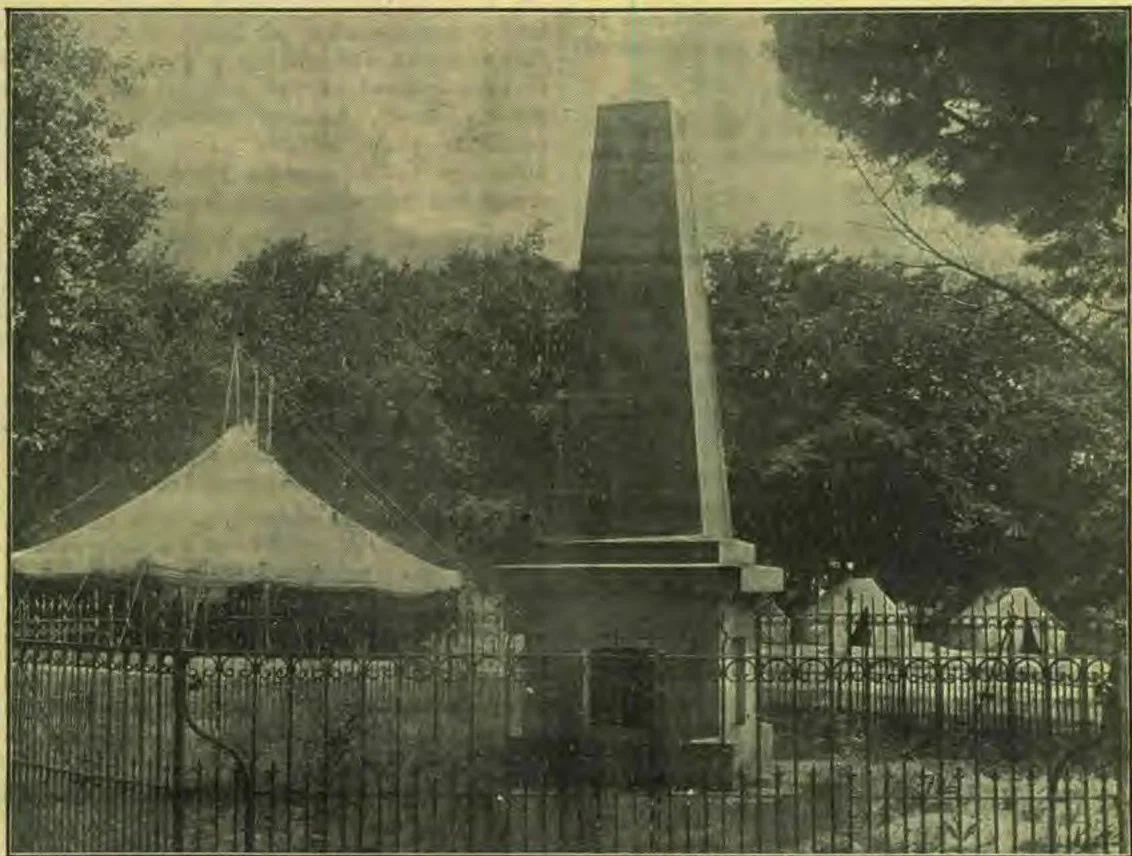
HERSCHEL'S MONUMENT, SOUTH AFRICA, ERECTED 1841.
His remains are interred in Westminster Abbey, close to the grave of Sir Isaac Newton.—Cape History.
A Narrow Place.
By William P. Finney
O SOUL that's filled with discontent,
Shouldst thou lament
Because thy life in narrow bounds is pent?
The land was small where Jesus dwelt.
Yet he ne'er felt
That God with Him had thus unwisely dealt.
But rather, in His narrow place,
He set His face
To do God's will—and there redeemed the race!
So, soul, learn this: thou hast a part
Just where thou art,
Which, if thou'lt do, will surely bless some heart.
And not so much where thou dost dwell
As whether well
Thy work thou dost, at last thy fate will tell.
—William P. Finney.
The Flowing River of Life
Our life is a flowing river
That flows from the Fount above.
We may keep its waters bright and clear,
That the thirsty soul may drink with cheer,
And learn of our God of love.
F. E. Y.
The Elastic Conscience
The conscience is the most elastic material in the world. To-day you can not stretch it over a mole-hill, to-morrow it hides a mountain.—Bulwer-Lytton.
The First Time
This is the list of Bible Lessons or talks outlined by the General Conference Educational Department to be presented during each of the first three school years.
The reading lessons in True Education Reader Series Nos. One, Two, and Three run parallel to these talks—each book covering the entire course.
These readers contain the memory verse designed to accompany each talk; also the story upon which the talk itself is based.
With these readers the parent or teacher will find the task of interesting the child in Bible stories and of teaching him to read an easy one.
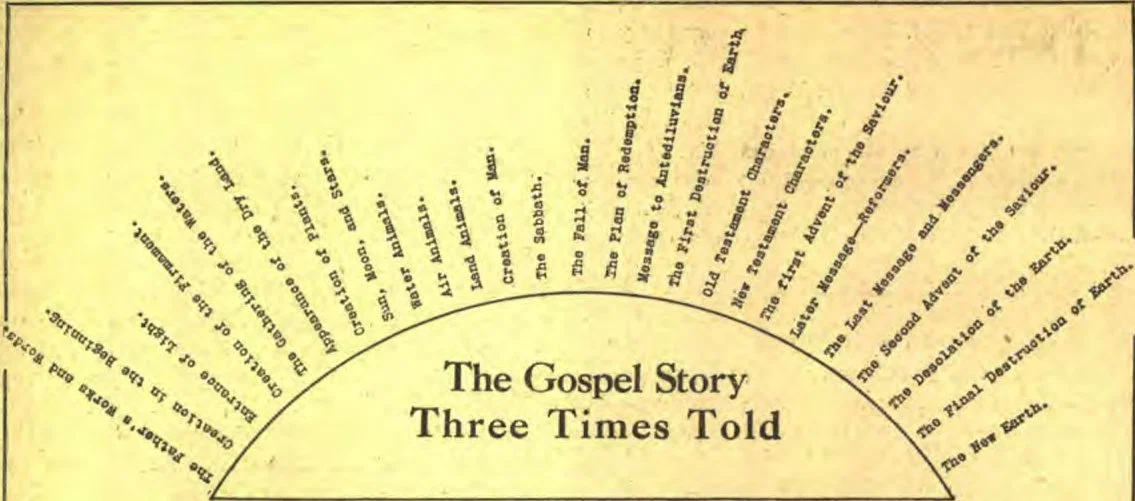
While the special purpose of True Education Readers Nos. One, Two, and Three is to put the child in possession of a complete key to English reading, they also familiarize him with the most important Bible truths. Three times over they tell of God's plan for the earth in the beginning, the successive steps in the work of Creation, something about each of these steps, a sketch of certain selected Bible child biographies, including the life of the perfect Child, Jesus, His work, His sacrifice, the plan of salvation finished, and the new earth.
The First Time
In simple language, by attractive pictures and the best methods of teaching reading, True Education Reader No. 1 fixes upon the child's mind in his first school year an outline of the beautiful Gospel story from Creation to Redemption.
The Second Time
Enriched by many illustrations, enlarged by additional topics, made more interesting by sketches from the lives of insects, birds, and animals, the incidents of the Gospel story are given the second time in True Education Reader No. 2.
The Third Time
True Education Reader No. 3 tells it again, and in connection with it brings in a variety of other matter, such as poems, biographical sketches, Bible selections, our Saviour's parables, simple lessons on physiology, geography, and botany, and adapts it all to the growing intelligence of the child in his third school year for whose use it is intended.
How the Mind Is Prepared for This Thrice-Told Story
The oral Bible lessons which follow the same outline as the readers are given by the teacher or parent before (perhaps one or two weeks) the child comes to the subject in his reading, so when he does come to the lesson in his reading, he recognizes it and reads with greater interest and understanding.
And Then the Story Is Reviewed
The regular text-book for Bible study which is now being prepared for grades or school years four, five, and six, is developed from this same outline. Hence, the child's fourth, fifth, and sixth year's work in Bible will be in the nature of a review of the lessons, the general features of which he has been made familiar with during the preceding three years.
An Illustration
Suppose a child with his parents takes a trip across the continent. Before he reaches each point of special interest, he is told a story concerning it by his parents. When the point is reached he has developed an interest in it and is likely to remember something about it.
The next year the trip is taken again. The same method is followed by the parents. More points are visited and much more is learned about those seen the first time.
The succeeding year he takes the same journey but with various side trips and spends more time at each point. Old memories are revived and strengthened, new facts concerning familiar places are learned, and all is vividly impressed upon his mind by the thrice-told story to which he has listened and the threefold view he has enjoyed.
The Application
This is the kind of trip and the method of instruction enjoyed by the child who learns to read by use of the True Education Reader Series, books One, Two, and Three.
The Harmony of This Plan
So you see the True Education Reader Series harmonizes with the plans and methods adopted by the Educational Department of the General Conference in behalf of our church schools
Description and Prices
These books are all durably bound in cloth
No. 1 contains 204 pages, post-paid ........................ 75c
No. 2 " 256 " " ........................ 75c
No. 3 " 304 " " ........................ 90c
Sample Pages Sent Free. Address your tract society, or
PACIFIC PRESS PUBLISHING COMPANY
Mountain View, California.
285 Salmon Street, Portland, Oregon.
1109 East 12th Street, Kansas City, Missouri.
REVIEW & HERALD PUBLISHING ASSOCIATION
Takoma Park, Washington, D. C.
Battle Creek, Michigan.
SOUTHERN PUBLISHING ASSOCIATION
24th Avenue North, Nashville, Tennessee.
217 South Main Street, Fort Worth, Texas.