Its Nature Misunderstood by Many Bigoted Protestants.
BY JAMES I. CONWAY.
[Written for the Catholic Mirror.]
IN these closing days of the nineteenth century, when every wind brings news of discovery, and when every word that falls from the lips of humanity adds a gem to the crown bestowed on modern progress; the atheist, the infidel, the heretic, impelled by religious prejudice or blinded by ignorance, still points a finger of scorn at the medieval ages when the church of Christ ruled with the sceptre of faith the civilized world.
Many are the charges brought against the peoples of those times, which, if true, must have made those ages sad indeed. Foremost among these charges; most grievous in its nature, and most ready to the tongue of every opponent of Catholicity, is the Inquisition, which we have in purpose to examine. History divides the Inquisition into two distinct tribunals: The Roman Inquisition, and the Inquisition of the Spanish Government. Great care must be taken not to confound the two; one is purely ecclesiastical, the other strictly secular. The one was undertaken and must be defended from a religious standpoint; the other was established and perpetuated by the civil government, and must lean for its justification on national rights and privileges. But to give a fair, unbiased judgment upon either, one must set truth in one eye and personal disadvantage in the other, and look upon both indifferently. He must identify himself with the customs, habits and opinions of the people who lived in those ages; he must take into account their education, and, most of all, their religion, and beget in his soul the reverence and love with which they cherished the time-honored traditions of their forefathers. This done, he will see that, in the times of which we speak, all the world embraced the teachings of the Catholic Church. King and subject, prince and peasant, rich and poor, priest and people, all believed her doctrines not only to be true, but incapable of being false.
Schools and churches, assemblies and meeting-houses, echoed and re-echoed with her tenets and dogmas. And so, quite naturally, it seemed to all who lived in such surroundings, and rightly too, that any one who sought to destroy the faith of a nation, which is at all times its most priceless treasure, was as great an enemy to the state as one who contrived to undermine its civil institutions.
Moreover, since all statesmen and public officers were at the same time Catholics, it is most easy to understand that they enacted laws and punishments in keeping with their religious convictions. To put it briefly, in those middle ages, there was the greatest union of church and state. This union was the natural outcome of the beautiful marriage of civil and religious institutions. The state then, as it should now, protected and defended her holy bride from danger and persecution; the church softened the might and impetuosity of her sterner companion with gentleness and mercy. The state made
enactments and laws for the government of its citizens; the church inspired and seasoned them with justice and wisdom. All the laws, then, had a tinge of Catholicity, and they were carried out in a manner savoring of the principles of that universal religion. Consequently, it is evident that one who was a heretic then, was by that very fact in opposition to the spirit of the laws and customs of his country—in other words, a disturber of the public peace and an underminer of CIVIL society. And so it was that in the year 1184, when Lucius III. sat upon the throne of Peter, the Roman Inquisition was formally established to bring to trial the Catharoi. And at the same time bishops established special tribunals in different places, to examine into the charges against other persons who were suspected or known to be heretics.
But the Inquisition was not fully established until, in 1248, Innocent IV. took the tribunal out of the hands of the seculars, and turned it over to the Dominicans, who had done great work in converting the Catharoi. The Dominicans, according to their mission, introduced the Inquisition into all countries, and diligently sifted out and indicted heretics of every description.8There were three classes of heretics, and three were the kinds of punishments meted out to them.
The first class were the Jews, who were punished very lightly; the second class were the ordinary heretics, who were condemned to banishment or else imprisoned; the third class, however, those heretics who were at the same time open disturbers of the peace, and enemies to society; were punished to the full extent of the law. The church could suffer the pagans to worship because they erred from ignorance; she should tolerate the Jews because they were the living and most singular witnesses to the truth; but never could she countenance or encourage a formal heretic, a foe to civilization, a barrier in the way to salvation, to scatter his poisons unmolested. But aside from the question of civil society, was the church justified in punishing heretics for that reason alone? Most assuredly. The church is the divinely appointed guardian of the revelations of Jesus Christ, and consequently has the right to rebuke those who, in any way, attack the purity of that faith. Besides, every one will admit that any society has the right to impose certain obligations upon its members, and to reprimand and punish, and even exclude them from membership, if they do not comply with these duties. If, then, any society, no matter what may be its nature and aim, is free from blame in so doing, a fortiori, it was not only not unjust but even obligatory and praiseworthy for the Catholic Church, which has been entrusted with the teachings of the Spirit of Truth, to exclude from within her sacred fold the wolves who sought to prey upon the innocent lambs which she sheltered and guarded therein. Few, very few, are the charges brought against the Roman Inquisition—it seems as tho mankind has ever acknowledged the justice of its punishments.
But when the Spanish Inquisition is spoken of, then Protestantism trembles, her knees quake, her lips falter, and a sickly pallor rushes to her countenance. All the chicanery of popery, all the secrecy of the confessional, all the darkness of deep-laid conspiracy, all the intolerance and oppression and persecution and religious thraldom of Romanism, are embodied in that dread word. Books have been written, libraries filled, talents misused, energies wasted, to picture the imaginary horrors of this wicked, marble-hearted tribunal. The cannons roar, the dungeons ring with the curses and groans of the despairing imprisoned, the streets are flooded, and the executioner's ax is red with the blood of innocent victims. As to the truth of these accusations, the faintest knowledge of history will show that they are either altogether false and malicious, or else if true, exaggerated and multiplied—the sure outcome of prejudice and envy.
Before, however, I undertake to refute any of these charges, it is my purpose, most of all, to impress upon the minds of my readers, that the Spanish Inquisition was an entirely royal tribunal, and that, consequently, were the charges as "huge as high Olympus," they could not cloud the glories of Catholicity. And, as in our justification of the Roman Inquisition, we relied much and drew great sustenance from the customs of the peoples who established and were ruled by it; so now, in our defence of the Spanish Inquisition, must we, no less than before, again fall back upon the manners and usage of the epoch in which it flourished. In those ages of faith, as from what has been said before will be easily understood, it was well nigh impossible for a Jew or infidel to ascend to prominency in any walk of life. And thus prescription of the Jews was dominant not only in Spain, but in the other Christian countries as well; and resulted, in the medieval era, as in our own, from the intense feeling which Christians had against the Jews, who were looked upon as the accursed race which had persecuted, mocked, and crucified Jesus Christ, whom they, as Christians, adored as the Son of God, the Redeemer of the world, and the founder and preserver of their holy religion. Statesmen and warriors, grandees and noblemen, harboring and cherishing dispositions such as these, would have as their friends and companions, only those who were of their own faith. This was most galling to the avaricious Jew, and numbers of them, thirsting for wealth, while secretly remaining Jews, pretended to profess the Catholic faith, were baptized, pushed themselves into the courts and kingly palaces, became holders of large estates, and even were found among the priests and prelates of the church of God. In this hidden, underhand manner, they were seeking to overturn the institutions, not only of the Catholic Church, but also of the Spanish nation. And the fact is, that, in time, this consumptive germ did not fail to cause great trouble and danger and alarm in Spain. Such a state of things called for immediate action; but since there was no doubt but that very many of the Jews were honest in their conversion, what to do was a very perplexing question. Hence arose a great difficulty—a difficulty, which, as all will agree, could be overcome only by an Inquisition. To establish an Inquisition, Ferdinand asked the permission of the Pope, Sixtus IV. That pontiff, however, was at first unwilling to grant Ferdinand's request, but was so urged by the court of Spain that he finally agreed, and in the year 1478, the Spanish Inquisition sprang into existence.
But before the first trial was opened at Seville in 1481, the Pope withdrew his sanction because he had not been consulted as to the plan which had been adopted.
Nevertheless, pleadings on the one hand, and anxiety for the Spanish nation on the other, again prevailed upon him to renew the permission, and from that time on there was a continual controversy between Spain and Rome. Often was the tribunal at variance with the Popes, and most frequently were the victims condemned by the Inquisition pardoned on appealing to the successor of Peter—nay, more, so serious were the frictions between them, that several times the Holy See threatened the Spanish Inquisitors with excommunication.
But here I may be met with a very great objection: What need was there of the permission of the Pope? If the Inquisition was purely secular, what had the Pope or the church to do with its actions? Ah! there is just the point. The permission of Rome was necessary for many reasons, but chiefly for two: First, because the men who were appointed as Inquisitors by the court of Spain were priests and prelates and theologians of the CHURCH, and were, for that reason, under the JURISDICTION OF THE POPES; and secondly, and most especially, because the Inquisition was instituted to try people on MATTERS OF FAITH. Truly, indeed, did Ranke call it a royal tribunal furnished with ecclesiastical weapons. "In the first place," says that liberal-minded and authoritative Protestant historian (History of the Popes, vol. 1., pp. 242, etc., in original German edition), "the Inquisitors were royal officers; the king having the right to appoint and dismiss them; the tribunals of the Inquisitors were subject to royal visitations," (which means royal control), "just as any other authority under the king." In the second place, all the profits and advantages resulting from confiscations fell to the king. "And in the third place, it was by means of this tribunal that the Spanish nation was completely rounded off and finished. The king obtained a tribunal from which neither grandee nor archbishops could escape." As the tribunal is founded upon the king's power, so its exercise redounds to the king's advantage. It is one of the spoils of ecclesiastical power which the Spanish nation snatched to itself, and by which it has become powerful. In its meaning, object, and aim, it is, above all, a political institution. It is the Pope's interest to stand in its way, as often as he can, and as he does so; it is the king's interest always to keep the way clear for it, and he does." So far says Ranke, Leo (History of the World, vol. 2, pp. 431, etc.), Guizot (Cour's D'Histoire Moderne), and Menzel (History of Modern Germany, vol. 4, p. 196). All Protestant writers declare the Inquisition to have been a state machine.
So far we have said nothing of the Inquisition against the Moors, for the reason that the same causes and circumstances concomitant to the Inquisition against the Jews in 1481, gave rise to the Inquisition against the Moors in 1500. These Saracens had crossed over from Africa to Spain in great numbers, and had practically conquered the whole Peninsula. They held sway in Spain for a long time, and were not completely driven back until the time of Ferdinand and Isabella. This may be called the reconquest of Spain by the Spaniards; and nobly, and like true sons, did those swarthy southerners rescue from bondage and oppression—yes, from destruction, the land which had given them birth. To rid their country of the danger, they rose up in their might, and after a long struggle finally succeeded in expelling the infidels. Some of the Moors, however, rather than go, were baptized, and in this way the same trouble arose as with the Jews. And if the Inquisition purged the Spanish nation of the plotting Jew in 1481, it proved no less a blessing against the revengeful Saracen in 1500. They were ousted, or im-
prisoned, or put to death, and Spain was proudly and gloriously out of the dangers which had threatened her with utter destruction. When we review these facts, and take into account the royal advantages and the ecclesiastical disapproval of the Spanish Inquisition, we, as Catholics, maintain, and have for authority, the best and most upright and learned historians, Protestant as well as Catholic, among whom I enumerate, in addition to those quoted above, Balmes, Hefele, De Noso Cortez, Demester, and Reuben Parsons; that it grew out of peculiar circumstances; that it was introduced by the state, empowered, fostered, and cherished by the state; that its punishments were inflicted by the brachium saeculare; and that, consequently, no matter what outrages were committed by the Inquisition, they can not be laid at the threshold of the Catholic Church. But the fact of the matter is, there were no outrages committed by the Spanish Inquisition, and let us here refute some of the charges brought forward against it.
They say that the Dominican, Torquemada, the grand inquisitor, slew 11,400 victims in his time of office, and that during his first year alone as inquisitor, he put to death 2,000 heretics; and during the whole existence of the tribunal itself, in all 34,000 victims perished. These charges we flatly deny. They are taken from Llorente, a Spanish historian. Now, who was Llorente? He was a renegade Catholic, an apostate priest, an ingrate, who, in order to satisfy his ambitions and glut his own desires, like some of the so-called ex-priests of our day, hesitated not to trample under foot the honor of his family, his country and his church. The history of such a man is not to be credited with authority, even tho we had no other reason for doubting his writings. But he attempts to quote Mariana, and here, as the expression has it, we have him "on the hip."
Mariana says that during the whole Inquisition about ten thousand were killed. And as far as Torquemada is concerned, the most honest historians declare him to have been a pure, upright, just, humane, uncorrupted and undaunted inquisitor. The same Llorente tells us that on February 12, 1486, seven hundred and fifty victims were punished; but even granting these figures to be correct—he does not add that a single one of these victims were put to death. The same may be said of the charge that April 2, of the same year, added 900 more victims in Toledo. Not one was put to death. All that most of the condemned had to do was to make the auto da fé. This word, so terrifying to bigots, is nothing more than the corruption of the Latin actus fidei, an act of faith. When, then, we say that those found guilty were compelled to make the auto da fé, we mean that those who had been publicly brought to trial and forthwith condemned and punished, were obliged to make some outward manifestation that they were really and truly members of the church of Christ. In fact, the Inquisition was a very merciful tribunal—I repeat it, almost a compassionate tribunal. Very few of those condemned were sentenced to death; and a man was only allowed to be racked once, which no one can deny was a most wonderful leniency in those times.
Again, they say that the Inquisition, during the time it existed, hung over Spain like a dark, heavy cloud, enslaving the spirit, robbing the poor country of the free manifestation of all that is dear to natural life. The truth is that during the flourishing period of the Inquisition and shortly after, in the arts, the sciences, in knowledge and grandeur, in empire and dominion, Spain was the envy of the civilized world. No nation was more enlightened, more powerful, more extensive. In those days her sceptre swayed princes and potentates, and the muses seem to have deserted the rest of the earth, and nestled only on her soil. Under their enlightened guidance the illustrious Lope de Vega, the writer, employed his talents to delight all Christendom with his beautiful works; and the renowned Cervantes, the father of novel writers, brought into the world his famous "Don Quixote." Up rose the great Ximenez, the statesman and orator; and the heroic Columbus braved the unknown seas and opened up to the unknown world a new-found continent. In the midst of the Inquisition was born the conqueror Cortez, and the explorer De Soto. And scarcely had it ceased to exist when the church was enriched with Ignatius Loyola, Francis Borgia, Francis Xavier and the great St. Theresa, the greatest warriors for the faith which Spain had begotten.
O Spain! beautiful, smiling Spain! loaded with calumny, held down beneath the scorn of thy sister9nations, struggling and struggling, yet in vain, to regain thy long-lost grandeur; fair mother of saints, warriors, heroes, discoverers, explorers; land of chivalry and conquest; who could but admire and extol thy greatness and fame?
It was such charges and slanders as these that forced the Count de Maisere to exclaim that "history for the past three hundred years has been a conspiracy against the truth." But truth crushed to earth will rise again, more beautiful from its long obscurity. And the atheist, the infidel, and the heretic, will have to own that Catholicity, after three hundred years of calumny and persecution, is yet, as she always has been, as she ever will be, far from being injured, made more glorious and sublime in her struggle for truth and salvation.—Catholic Mirror.
Question Corner.
By Editor
"Enquire, and make search, and ask diligently."
No. 424. What Churches and Ministers?
IN reply to J. B. V. we will say that where ministers, missionaries, churches, etc., are mentioned we design to be specific, tho we sometimes fail. The movements of our own missionaries are noted either on the last page or in Our Work and Workers' notes. In the news departments general references are to ministers, etc., of other denominations.
No. 425. St. Peter at Rome.
WAS St. Peter a Roman Catholic?
There is no evidence in the word of God, either in his own writings or the writings of others, that Peter was ever in Rome. Had he been living there, would not Paul have referred to him in Romans 16? Roman Catholic tradition declares that he was the first Roman bishop, but this is disputed by learned men. But even tho he was in Rome (which is exceeding doubtful), what does it matter? Paul was at Athens, but what of it?
No. 426. No Repentance—Why?
WILL you kindly explain Rev. 16: 9? If probation is closed when the four last plagues begin to fall, what need would there be of repentance? If I understand it aright, there is no hope after probation closes.
We understand that when the plagues begin to be poured out, the case of every man will have been decided. It is not an arbitrary decree of God which does this irrespective of man; but what the Lord says (Rev. 22: 11) is a statement of what there is and will be forevermore. Every man can repent only by cherishing God's agencies to save him, the sacrifice of Christ, the word, and the Spirit of God. When man finally rejects these, his case is hopeless. Before the plagues are poured out, God will present before every soul living his truth, that man may accept or reject it. Accepting it, he will be saved; rejecting it, the Spirit of God leaves him, and he is lost. When that time comes, man can not of himself repent. And Rev. 16: 9 is a solemn warning which God gives in advance to every soul, that when man has rejected the Gospel message, chosen sin in preference to righteousness, done despite to the Spirit of grace, his case is hopeless indeed; he can not, and will not because he can not, repent when he comes to experience the full fruition of his own course.
No. 427. What Is the Way?
WHAT is the meaning of Isa. 35: 8, "an highway" and "a way?"
The whole connection shows that the passage has reference to the redeemed state of God's people. Adam Clarke, Boothroyd, the Syriac, and many ancient MSS. omit "and a way." Boothroyd reads: "And a highway shall be there; and it shall be called The way of holiness; but God shall be with them, walking in the way, and the foolish shall not err therein." The perfect way of righteousness or holiness in law is the way of God's commandments.
See Ps. 119: 27, 32, 33. The way of righteousness and holiness in life and character is Jesus Christ the Way, the Truth, the Life. John 14: 6. The word "highway" denotes a path cast up above all common ways, as we would speak, a turnpike. God's way is a high way, above the low level of the world, as well here as hereafter. From that way people may err here. In his kingdom the simplest shall not turn aside. But if we would walk in that way there, we must learn to walk in it here.
No. 428. What about the Angel?
IN John 5, beginning with the last clause of verse 3 and verse 4, we read: "Waiting for the moving of the water. For an angel went down at a certain season into the pool, and troubled the water; whosoever then first after the troubling of the water stepped in was made whole of whatsoever disease he had." The question is, Did the people simply believe this to be true? or, Did the angel so come down?
We do not know. Some of the oldest Greek manuscripts, older than that from which our New Testament was translated, either omit a part of what we have quoted, or all. The general opinion of Bible critics is that the passage is spurious; that is, it was not written by John. We have no certain proof that it was or was not. It seems to be a matter where opinions may differ without controversy. Yet it is often the case that the thing about which men know the least they say the most.
No. 429. Why Did He Omit Sabbath-breaking?
(1) WHEN Paul was enumerating the numerous perils of the last days in his very explicit manner, why did he leave out the terrible sin of Sabbath-breaking? Why does he fail in every instance to warn the last-day church against the danger of that sin? (2) When Philip and others were examining and preparing candidates for baptism, why were they not instructed relative to the duty of Sabbath observance?
1. Evidently reference is made to 2 Tim. 3: 1-5. Paul did not warn against Sabbath-breaking for the same reason that he did not specifically warn against the transgression of the first, second, and sixth commandments. And yet all are included between the expressions, "lovers of their own selves" and "lovers of God." In the same chapter he tells us that the Scriptures (and only the Old Testament was then thus known) are profitable for all things needed by the man of God, and through Christ able to make wise unto salvation. He elsewhere condemns sin as the transgression of God's law (Rom. 3: 20; 7: 17), that law of which the Jews had "the form of knowledge and of the truth" (See Rom. 2: 17-23), tho not the essence; that law against which the carnal mind is enmity (Rom. 8: 7), but which is life in Jesus Christ (verse 2), by faith in whom its righteousness will be fulfilled in us (verse 4).
2. We do not know but that they were so instructed. We might ask the same question with reference to every moral duty. Fornication and idolatry were common, but we have no record that questions were asked relative to these sins. The fact was that he who at that time accepted Christ with his whole heart accepted all other things. And now if Jesus Christ is properly set before men, and is accepted for what he is, there will be no need of asking detail questions. Such things should never be asked to extort a pledge, but given in the way of instruction. The candidate should make his decision over the truth as it is in Jesus. "With the heart man believeth unto righteousness."
No. 430. Oath Taking.
PLEASE explain Matt. 5: 34 and James 5: 12. Do they apply to the oath administered to witnesses, or to one who registers?
These passages refer to extra-judicial oaths. If the law requires of you an oath, submit to it as did Jesus Christ. See Matt 26: 63, where the high priest administered the oath to our Lord. The texts in question refer to voluntary affirmatives, or oaths to confirm what we say in common. Is it true?—Yes. Is it false?—No. Let it rest there. Do not say, "It is true, as I live," or any stronger expression. We are called upon to take oath only when it is required of us by proper legal authorities.
"WHO IS SHE?"
A NEW YORK physician relates the following fact:—
A few weeks ago he was called to the help of a man who was mortally wounded in one of the low dance halls or "dives" of that city. When he had attended his patient, the doctor looked curiously about him. The wounded man lay before the bar, against which lounged some drunken old sots. In the next room a few young men, flushed and bright-eyed, were playing cards, while the gaudily dressed barmaids carried about the liquor. But neither the gamblers nor the drunkards paid any attention to the dying man on the floor. They squabbled and laughed, deaf to his groans. The proprietor of the dive, a burly fellow, who had been a prize-fighter in his younger days, having seen the police secure the murderer, had gone back quietly to his work of mixing drinks. Death, apparently, had no interest or terror for these people.10Suddenly a little old woman with white hair, a thin shawl about her, came to the street door. Her appearance produced a startling effect. The besotted old men at the bar put down their glasses and looked uneasy; the card players hastily shut the door to keep out of sight of her, and the barmaids huddled together in silence; but the change in the brutal landlord was most striking. He rose hastily and came up to her, an expression of terror on his face.
"Is James here?" she asked gently.
"No, no; he is not here. I do not know where he is," he said hurriedly.
She looked around bewildered and said:— "I was sure he was here. If he comes will you tell him his mother wants him, sir?"
"Yes, yes," he said, and the man urged her out of the door. The physician soon followed, and saw her going into another and another dive and grog-shop along the street.
"Who is she?" he asked of a policeman outside. "Is she any danger?"
The man shook his head significantly. "They will not harm her, sir. They’ve done their worst to her. She is the widow of a clergyman, and she had one son, a boy of sixteen years. They lived happily and comfortable enough till he took to going to pool rooms, and then to the variety theaters, and at last to these dives here. He was killed in one of them in a fight three months ago—in that very one you were just now in—and was carried home to her, bloated from drink, covered with blood, and dead. She knows nothing since. She only remembers that he came to these houses, and she goes about them searching for him every day. They are afraid to see her. They think she brings a curse on them. But they won’t harm her; they’ve done their worst to her."
This is a true story. How many sons of loving mothers are going down like this boy into these dark places to-day?—Youth’s Companion.
DREAMING OF HOME.
By Eugene Field
It comes to me often in silence,
When the firelight sputters low—
When the black, uncertain shadows
Seem wraiths of long ago;
Always with a throb of heartache,
That thrills each pulsive vein,
Comes the old, unquiet longing
For the peace of home again.
I'm sick of the roar of cities,
And of faces cold, and strange;
I know where there's warmth and welcome,
And my yearning fancies range
Back to the dear old homestead,
With an aching sense of pain;
But there'll be joy in the coming,
When I go home again.
When I go home again! There's music
That never may die away,
And it seems the hands of angels,
On a mystic harp at play,
Have touched with a yearning sadness
On a beautiful broken strain,
To which is my fond heart wording—
When I go home again.
Outside of my darkening window
Is the great world's crash and din,
And slowly the autumn shadows
Come drifting, drifting in.
Sobbing, the night wind murmurs
To the splash of the autumn rain;
But I dream of the glorious greeting
When I go home again.
—Eugene Field.
GOD’S PROVIDENCE.
“FIFTY years ago,” writes an aged man from Vermont, “when I was a small boy, I had a good, pious mother. One time she was in a great strait for food or fuel, I have forgotten which.
“Tho without earthly resources, she had great faith in her heavenly Father, and looked confidently to him. I did not share her confidence, and thought within myself, ‘I wonder, mother, how you can think the Lord will send you any money.’
“But he did send it, and in a wonderful manner. Soon after, an old, rich miser came into the house, and somehow or other, dropped his old purse, nearly full of money, on the floor. The money scattered well, and rolled in all directions, and we picked it up and hunted for it till he was satisfied, and said, ‘I guess we’ve got it all; if there is any more, you may have it.’
“When he was gone, it seemed as if right under the soles of his feet we found just the sum she wanted. I believe that helped my faith wonderfully. It seems as if I have thought of it a thousand times since, when tempted to distrust my heavenly Father’s care.”
Accounts of God’s providences may be derided by the skeptic who shuts his eyes to the plainest evidences; but to the believer who has tested the promises, they are a source of never-failing comfort and inspiration.—Selected.
Tea and Coffee Poisons
BY J. H. KELLOGG, M.D.
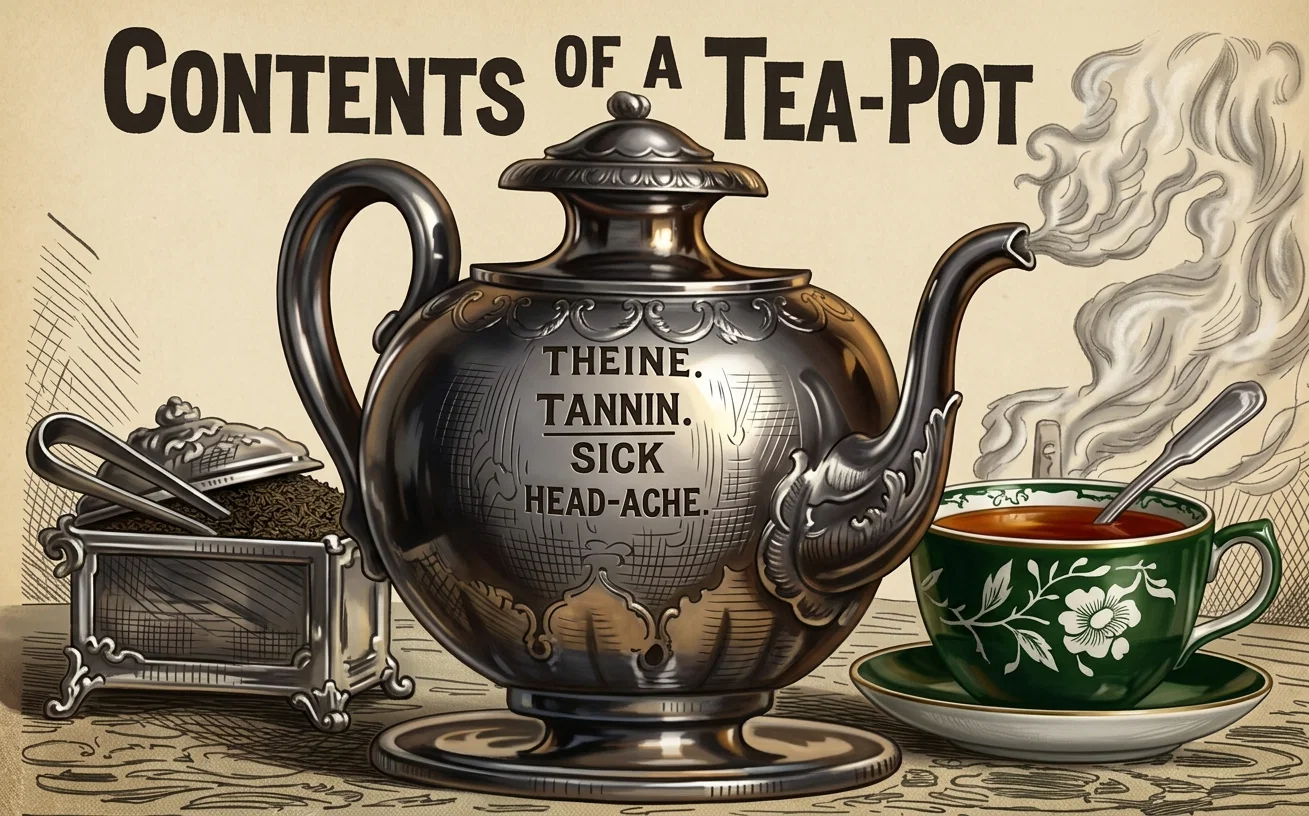
THE vast number of teapots in constant requisition in all civilized countries of the globe, warrants the supposition that in the estimation of the tea-drinking public, at least, the teapot is an indispensable culinary utensil, and the steaming decoction which it contains, an innocent or necessary beverage. The object of this article is to call attention to the fact that the revelations of modern scientific researches, as well as the observations of scientific physicians in various parts of the world, have found in tea and its congeners, coffee, etc., active causes of serious disease.
Tea contains two harmful substances, theine and tannin—from three to six per cent of theine and more than one-fourth its weight of tannin.
Coffee contains both theine and tannin, tho in less proportion than tea.
It will surprise many devotees of the cup to be told that these common beverages contain a violent poison, but such is the fact. Theine has been separated from both tea and coffee, and experiments have been made with it which show most conclusively that it is a deadly poison, capable of producing immediate death in both human beings and lower animals.
Theine belongs to the same class of poisons as strychnia, and is still more closely allied to the newly-discovered cocaine. The last-named drug is obtained from coca leaves, which are used in South America as tea is in this country, and with the same effects. The results of cocaine upon those who become habituated to its use are found to be more terrible than those of any of the numerous vice drugs which have been longer known, not excepting opium or alcohol. Theine is almost identical with cocaine, both in its chemical composition and in its effects.
Dr. H. C. Wood, and other writers on the various drugs used in medicine, describe numerous experiments with this poisonous constituent of tea. One observer found that one-seventh of a grain killed a frog in a very short time. Five grains killed a good-sized cat and also a rabbit. Death occurs in lower animals in a manner almost the same as that in which death occurs in poisoning from strychnia. Strong convulsions are produced with the arrest of respiration, and in a short time the heart ceases to beat. Tea contains about three per cent of theine, or more than fourteen grains to the ounce. Every pound of tea contains enough of this poison to kill fifteen hundred frogs or more than forty cats. One case is on record in which a fine horse belonging to an English army officer was killed by eating accidentally a small quantity of tea.
The largest dose of theine which is recorded as being taken by a human being, is twelve grains, which produced very dangerous symptoms, and with the addition of a few grains more would undoubtedly have proved fatal; yet half an ounce of tea, containing six or seven grains of the poison, is often used in making a strong cup of tea. Many persons drink half a dozen or more such cups of tea daily, thus imbibing a sufficient amount of poisonous theine to kill two or three men not accustomed to its use, if taken at one dose.
If tea contains such a poison, why does it not produce fatal results more frequently than it does? may be inquired. We answer, Simply because a tolerance of the drug is established by use, just as in the case of tobacco. One-tenth of a grain of nicotine will kill a frog, and so small a dose as one-sixteenth of a grain has produced dangerous symptoms in a man; it has also been shown that the smoke from a half ounce of tobacco contains sufficient nicotine to produce death, yet sudden death from tobacco-smoking is not a very common result of the almost universal use of this poisonous drug. The wakefulness and increased mental activity which many persons experience from the use of tea, are evidences of its poisonous character.
But the teapot sometimes contains other things besides theine and tannin. Probably there is no article in common use which has been so extensively and so harmfully adulterated as this. According to the Chicago Grocer, a reliable trade journal, not less than one-fifth of all the tea sold is adulterated more or less. Lead, Prussian blue, and many other poisonous and harmful substances are used for this purpose, and the injury done in this way, aside from the harmful effects of the drug itself, may be said to be incalculable.
The adulteration of coffee is equally notorious. It is stated by those who are authority on this subject that it is practically impossible to obtain a pound of ground coffee which is not adulterated; and it has recently been discovered that unground coffee is also skillfully adulterated by means of machinery which molds the adulterants into the exact form of the real coffee bean.
In view of the above facts, would it not be well for the thousands of tea-drinkers in this and other civilized countries to pause and consider between the sips of the steaming beverage, whether it would not be well to substitute hot water, hot milk, or some other harmless beverage for this subtle but certainly harmful drink?
FOR THE LORD.
By Mother Experience
TRY it. Whenever a dollar or a dime comes into your hands, lay aside a dime or a penny of it to be used strictly “in his name.” Put it in another purse. Make it a definite offering. If you have a regular salary you can easily estimate how much this will be in six months, and then you can meet your regular “dues” in proportion and always have “a little something” left for the unexpected calls that come to one for help.
You may smile, but I must tell you a bit of personal experience. “Hard times” have more than once led me to the bottom of my pocketbook, and when the Lord’s purse—where I kept my tenths—has been empty I have said, “Lord, your treasury is empty, but if you will supply mine I will replenish yours,” and I have always a sweet consciousness of a friendly compact between this Friend and myself, whereby the Head of the firm takes care that financial disaster shall not overtake us, if I do my part. And I can say to-day, after years of experience, that his promise to supply all my need—not my desire, mind you—has never failed, and his treasury is taken care of as he sees best.—Mother Experience, in Union Signal.
ARIZONA'S STONE FORESTS.
THE regions of the Little Colorado River in Arizona abound in wonderful vegetable petrifications—whole forests being found in some places which are as hard as flint, but which look as if but recently stripped of their foliage. Some of these stone trees are standing just as natural as life, while others are piled across each other just like the fallen monarchs of a real wood forest.
Geologists say that these stone trees were once covered to the depth of 1,000 feet with marl, which transformed them from wood to solid rock. The marl, after the lapse of ages, washed out, leaving some of the trees standing in an upright position. The majority of them, however, are piled helter-skelter in all directions, thousands of cords being sometimes piled up on an acre of ground.—Cincinnati Commercial Gazette.
Opening the Heart to God’s Goodness
"THERE is dew in one flower and not in another, because one opens its cup and takes it in, while the other closes itself and the drops run off. So God rains goodness and mercy as wide as the dew, and if we lack them it is because we will not open our hearts to receive them."