Your ShelfYour Projects

Signs of the Times, Vol. 40, No. 34.

Question Corner

Signs of the Times

Sep 2, 1913

Pacific Press Publishing Association · Mountain View, California · Sep 2, 1913

Question Corner

“IF YE WILL INQUIRE, INQUIRE YE.”
This Inquirer's Department is conducted for the purpose of helping those who are studying the Bible. The answers are oftentimes only suggestive. They are never to be considered infallible, only as they agree with the infallible Word. The writer who may answer these questions does not consider that his opinion is infallible. He will simply give the best that he has, and plead with the inquirer to search the Word. Such questions only will be answered as, to the editors, seem to minister to the good of the readers and to the mission of the paper. We can not answer repeatedly in the same volume questions upon the same scripture. The name and address must accompany question, not for publication, but as an evidence of good faith, and that answer may be made by letter if deemed advisable. No letters are answered which do not contain the name of the writer. It is well always to enclose stamp for reply.

4164 — Who Wrote the Law on the Tables of Stone?

Who wrote the second two tables of the covenant, Moses or the Lord? J. L. L. and others.
You are correct in stating that the Lord wrote both. Verse 28 of Exodus 34 would seem to indicate that Moses wrote them; but the “He” in the sentence, “And He wrote upon the tables,” certainly must refer to the promise in the first verse. The first verse reads: “And the Lord said unto Moses, Hew thee two tables of stone like unto the first: and I will write upon these tables the words that were in the first tables, which thou brakest.” Now did God fulfil that? Did He do what He said He would do? Verse 28 shows that He did, and the “He” refers to the Lord. This is clearly confirmed by Moses in Deut. 10:1-4: “At that time Jehovah said unto me, Hew thee two tables of stone like unto the first, and come up unto Me into the mount, and make thee an ark of wood. And I will write on the tables the words that were on the first tables which thou brakest, and thou shalt put them in the ark.” That is the Lord’s instruction. Now in carrying it out, Moses says: “And I made an ark of shittim wood, and hewed two tables of stone like unto the first, and went up into the mount, having the two tables in mine hand. And He wrote on the tables, according to the first writing, the Ten Commandments.” It is Moses’ declaration that God wrote the words. Certainly this ought to be conclusive.

4165 — The Penalty of Sin

If Adam and Eve paid the penalty of their sin by death, labor, and losing their home, why should the penalty be paid again by Christ four thousand years afterward? W. H. D.
The death and the labor and the loss of home came to Adam as a consequence of his sin. Just as soon as he departed from the law of his life, he departed from the law of his life. “In the way of righteousness is life; and in the pathway thereof there is no death.” If man had continued in obedience to God, he never would have died. But just as soon as he transgressed the law of his life, he brought himself within the dominion of death. It came as an actual consequence. If no gospel had come in, it would have been eternal death. But God brought the gospel in; and through that gospel all men, irrespective of character, are redeemed from that Adamic death. That is not the penalty of sin. Christ has redeemed all from that, and placed man on a new probation; and now when man utterly refuses that, of course he will die. If he rejects it, he will meet the penalty of his own sin, which is eternal death. We read in 1 Cor. 15:22, “For as in Adam all die, even so in Christ shall all be made alive.” Because of Adam’s sin, death passed upon all men (Rom. 5:12); but to those who will accept of the one Offering for sin, Christ Jesus, there is abundance of grace, and the gift of righteousness and the reigning in life by Him. Rom. 5:17, 18. Under the gospel, the death through Adam becomes a consequence of Adam’s sin. Christ meets all of that, places us on a new probation, and asks us to accept of the abundance of grace to save us from our sinful condition. Rejecting that, we must meet the penalty and consequence, death.

4166 — Change of the Day’s Beginning

Will you tell me when and by whom the beginning of the day was changed from sundown to midnight? P. W.
It is really impossible to learn the time when the change of the day took place. It is generally agreed that the Egyptians were among those who started the day at midnight, and it came from them through Rome to the civilized nations of the world. The custom seems to have grown out of the four night-watches, and the day began between the two watches. Hales says (“Analysis of Chronology,” volume 1, pages 15, 16): “The inconveniences resulting from a variable beginning of the civil day, earlier or later, according to the different seasons of the year, induced several ancient nations,—the Egyptians (according to Pliny, ‘Natural History,’ book 2, page 77); the Ausonians, the most ancient inhabitants of Italy; the Roman pontifices; Hipparchus, the Grecian astronomer; and the Chinese astronomers of Cathai and Oighur, etc.,—to reckon their civil day from midnight to midnight, as from a fixed, invariable point; and this usage has been adopted by most of the modern nations of Europe.” It evidently runs far back into antiquity. And yet it is also true that the early Greeks began the day as did the Scripture, with sunset. Hales quotes Solon as saying that the twelfth hour ended at sunset,—“Let the sun setting upon the mountains be the last hour;” and this was copied in the laws of the twelve tables at Rome: “Solis occasus suprema tempestas esto.” Some of our readers may have more definite data than this.

4167 — Rebaptism

John the Baptist was a messenger from God, and was commissioned to baptize. Why was it necessary for the disciples to be rebaptized, as recorded in Acts 19:3-5? W. A. M.
Simply because those disciples had been imperfectly instructed, and did not see all that the gospel meant. When Paul found them at Ephesus, he asked them, “Did ye receive the Holy Spirit when ye believed?” They said to him, “Nay, we did not so much as hear whether the Holy Spirit was given.” And he said, “Into what then were ye baptized?” And they said, “Into John’s baptism.” And Paul said, “John baptized with the baptism of repentance, saying unto the people that they should believe on Him that should come after him, that is, on Jesus.” These disciples evidently had not understood all that their baptism stood for. They had been imperfectly instructed. They did not know about the outpouring of the Holy Spirit. They evidently did not understand the promises of Jesus, that He would bestow His Spirit when He went away. Really, they had come into possession of great and marvelous light. The commission which Jesus gave for baptism was, “baptizing them into the name of the Father and of the Son and of the Holy Spirit” (see Matt. 28:19, 20), which, in other words, would mean baptism into righteousness (including repentance, of course); baptism into absolute self-emptying, as did our Lord; and baptism into service—into the Holy Spirit. It is just as proper in these days, if one has been baptized in faith in Jesus, when he sees that that means so very much more than he saw when he was baptized, and that first baptism was a mere formal baptism, and the soul sees so much larger vision of duty and responsibility to God, to be rebaptized. At least it seems to us very fitting that this should be, and that those to whom such light had come would be glad to be rebaptized, just the same as were those disciples at Ephesus. It was large additional light, which practically meant a new birth into the kingdom of God.

4168 — Baptism

Has baptism any history before John the Baptist? If so, how, and when, and for what purpose, was it used? Were the disciples baptized after the crucifixion? and if not, why not, if they were baptized for the same reason that we do now, that is, to commemorate the death and resurrection of Christ? O. F. F.
See the article in this week’s “Signs” on baptism, by Mr. Starr. That will help you regarding baptism before the time of John the Baptist, or baptism as brought out in the Septuagint Greek Old Testament. However, baptism for the purpose of expressing faith in the Lord Jesus Christ, of course, did not originate until John the Baptist. John the Baptist baptized in view of Him who was to come. The disciples instructed by our Saviour found that sufficient, doubtless, because He led them on from step to step. They were joined to Him, and He taught them all that that meant. Therefore they were not baptized after the crucifixion, save into the Holy Spirit. They were baptized for the same reason we are now,—they were baptized for faith in Jesus; but they were in Him brought into the fullest communion and knowledge of all that it meant. Evidently there were others baptized after John’s baptism who did not see all of this. This is shown in the nineteenth chapter of Acts. They did not know that the Holy Spirit had been given. They had not been instructed regarding these things in the fullest sense. But this we can not believe regarding the disciples of Jesus. But as to our duty, and to the duty of believers from that time forward, we can have no question. We have our Lord’s own command in Matthew 28 and Mark 16, as well as the instruction found in the Acts of the Apostles.

4169 — His Will, Luke 12:47

Please explain Luke 12:47. Which will does it really mean, the lord’s will or his own (the servant’s)? R. F. H.
The servant was condemned. He knew his lord’s will, and prepared not himself, nor did according to it,—that is, according to the will that he ought to do. It was the business of that servant to do his lord’s will. He had been hired for that purpose. That was his duty, and he knew it, but he did not prepare himself, nor did he do according to that will. Consequently the punishment. Rotherham renders, “And that servant who had come to know the will of his lord, and neither prepared nor wrought unto his will, shall be beaten with many stripes.”

4170 — J. L. C.

For explanation of Gal. 4:2 see question 4140 in the “Signs” for July 25.

Our Bible Band

Schedule for the Week Ending September 6, 1913
Sunday August 31 Hosea 1, 2, 3, 4 Monday September 1 " 5, 6, 7, 8 Tuesday " 2 " 9, 10, 11 Wednesday " 3 " 12, 13, 14 Thursday " 4 Joel 3; Amos 1, 2 Friday " 5 Amos 3, 4 Sabbath " 6 " 5, 6, 7
We begin our readings for the week with the book of Hosea, and read to Amos 7 inclusive. Hosea’s name means salvation. He was the last of the great prophets of the northern kingdom. Some of the chronologists place him as far back as 785, others about 748, believing that his first three chapters were written then, chapters 4-14 about 734. He predicts very strongly the coming captivity of the tribes, warns his people against an alliance with Egypt, points out the sad moral conditions and degeneration and decay of the nation. His own painful and pathetic personal history is used to symbolize Jehovah’s separation from His people. He points out the gross iniquity of priests and princes, and yet his closing words are full of beautiful remonstrance and tender exhortation, with rich promises of blessing from God as the result of repentance. He is said to be “the most subjective and individual of the prophets. Many of his passages are odes or dirges. In tragic pathos he is unexcelled.”
Joel, who lived nearly eight hundred years before Christ (some place it a little later), evidently preceded Hosea. There are some marked coincidences between his prophecy and that of Amos. The calamities which came upon Judah and Jerusalem at that time are typical of far greater calamities which would come upon the world when the great day of the Lord is near. There are three things of import in this book,—the signs of our Lord’s coming, among which are the army of pests, the great preparations that will be made in the last days for the universal war which is to take place, and God’s promise in the outpouring of His Spirit.
The name “Amos,” which means burdened, well expresses the spirit of the book. It shows the great burden of the prophet regarding not alone the condition of God’s people, but that of other nations. God chose him from the lower walks of life, from among the men of Tekoa, a place about six miles from Jerusalem. He prophesied during the reigns of Uzziah king of Judah, and Jeroboam II king of Israel; was accused of treason, and expelled from the northern kingdom, to which his prophecies mainly refer. The book itself will show his predictions. It is full of references to the country and the constant things that a shepherd would meet with in tending his flocks.

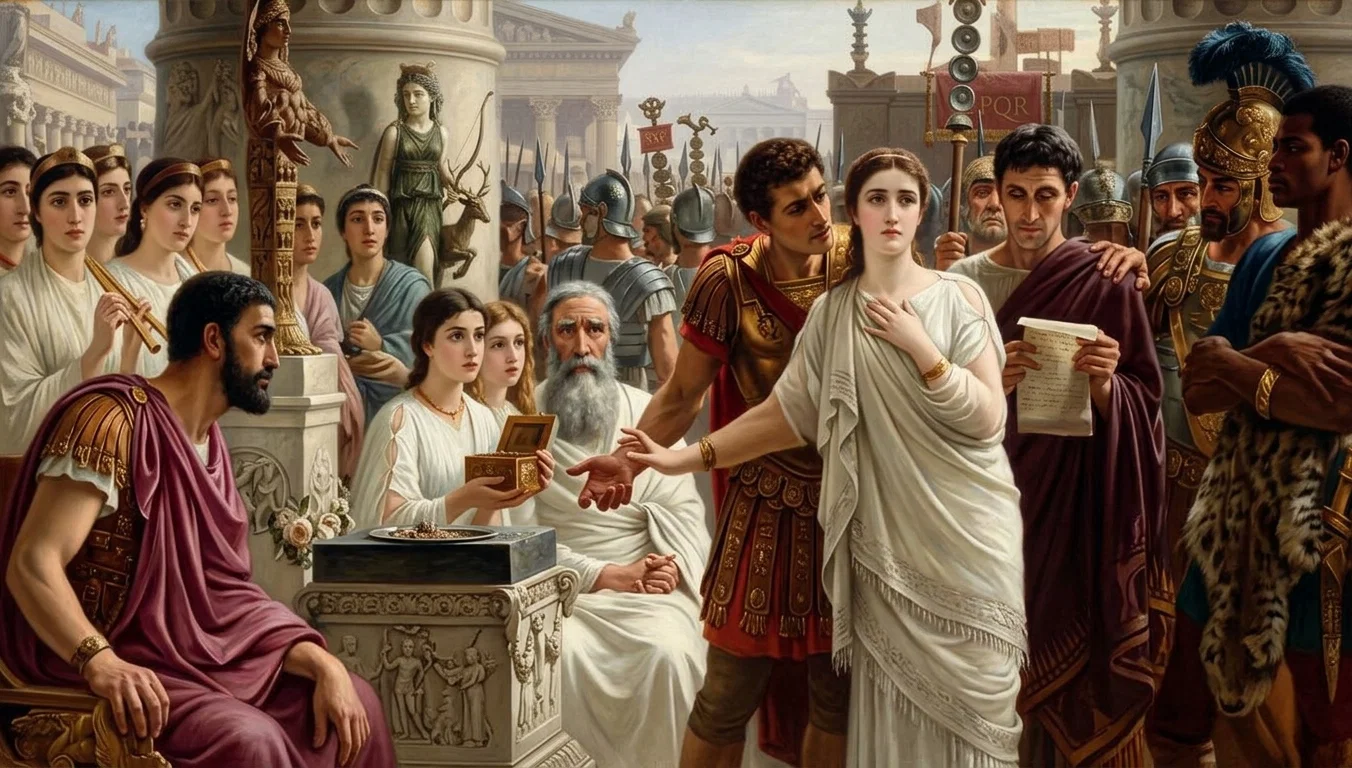
Diana or Christ

By Margaret Wright
EDWIN LONG'S GREAT PICTURE “CHRIST OR DIANA”
A few grains of incense upon the flame, And that is the all; but the holy name Of Him who died for the sin-cursed race Is rejected. Diana takes its place — Diana, the goddess of the sun, Honored by almost every one. Diana or Christ? Thank God, not all Responded then to the sun-god's call.
Diana or Christ? Still the call goes now To bow at the feet of the sun-god now, Just as it did in the days of old, When only a few were brave and bold — When pagan Rome, with her flame and sword, Killed those who stood for His holy word. Diana or Christ? The conflict's on. Soon will the battle forever be won.
Diana or Christ? Can it be that we Live now in an age of idolatry? The same sun is worshiped now as then, And adored by multitudes of men. The same call goes to bow at the shrine Of the same sun-god — to its laws incline. But His faithful word, as in days gone by, Points the way to Him who reigns on high — Points the way to the God of truth and right, And leads from the darkness into light; Shows which is the day He gave and blessed, That we might from care and labor rest, And learn of Him who all things made, Our thoughts and hopes on Him be stayed, Nor lead us some other god to love, But only the God who reigns above.
A controversy wide, fierce, and strong Is waging now between right and wrong. The enemy of our souls has tried God's great memorial to hide. He slyly forth has brought a day, And banished the hallowed one away. The masses follow, with blinded eyes, Their leader — the father of all lies.
The heathen feast-day of the sun Is honored by almost every one. So an effort is made that those who rest On the day our Creator hallowed and blessed, Must homage pay to the god of wrong, Then all the world to him be won. They are calling you now, O friend. Beware! Keep your heart uplift to God in prayer.
Diana or Christ? What a little thing Can reproach to the cause of our Saviour bring! Such a trifling thing to the incense burn! But that trifle proves to which god we turn. O brother, O sister, be firm, be true To the God above who cares for you, And stay not a moment to count the price. Be firm, and choose — not Diana — but Christ.
Coeur d'Alene, Idaho.

The Moral Warfare

By John G. Whittier
Our fathers to their graves have gone; Their strife is past — their triumph won; But sterner trials wait the race Which rises in their honored place — A moral warfare with the crime And folly of an evil time.
So let it be. In God's own might We gird us for the coming fight, And, strong in Him whose cause is ours In conflict with unholy powers, We grasp the weapons He has given,— The light, and truth, and love of Heaven.

God’s Judgment upon Sin

By Mrs. E. G. White
UNMERITED mercy, no less than strict justice, was strikingly displayed in the Lord’s dealings with the house of Eli. Notwithstanding the Heaven-daring crimes of the ungodly sons, and the sinful neglect of the indulgent father, the Lord waited long for them to turn from their evil ways. Then He sent a prophet to denounce their sins and to warn them of impending judgment. Without fear or favor, this chosen messenger of God set forth the high honors which the Most High had conferred upon them, and their base ingratitude in so degrading their holy office:
“Thus saith the Lord, Did I plainly appear unto the house of thy father, when they were in Egypt in Pharaoh’s house? and did I choose him out of all the tribes of Israel to be My priest, to offer upon Mine altar, to burn incense, to wear an ephod before Me? and did I give unto the house of thy father all the offerings made by fire of the children of Israel? Wherefore kick ye at My sacrifice and at Mine offering, which I have commanded in My habitation; and honorest thy sons above Me, to make yourselves fat with the chiefest of all the offerings of Israel My people? Wherefore the Lord God of Israel saith, I said indeed that thy house, and the house of thy father, should walk before Me forever: but now the Lord saith, Be it far from Me; for them that honor Me I will honor, and they that despise Me shall be lightly esteemed.”
Except in his neglect to restrain and control his sons, Eli had faithfully performed the duties of his office. But his failure to maintain the honor of God by repressing sin with an impartial hand, gave rise to a long train of evils, bringing crime and anguish upon a whole nation. In the history of Eli and his sons is a solemn warning for all the ministers of Christ—an admonition to guard their own hearts with diligence, to keep holy all God’s requirements, that His blessing may rest upon the workmen, and that the work may bear the signet of Heaven. It should also impress upon them their duty to rebuke sin in the members of the church, be they high or low, rich or poor. Even our dearest friends are not to come between us and our allegiance to God. We need not expect to receive the divine blessing until all that has been left for man to do is done to correct error and repress sin. To neglect this duty, or to be slothful and careless in its performance, is to disobey God, to sanction sin, and to bring His wrath upon His people.
The example of ministers should be such as to impress the people with reverence for God, and with fear to offend Him. They should honor the Lord at all times, ever acknowledging that of themselves they can do nothing, that their strength and wisdom must come from God, and that all the glory belongs to Him. Those who occupy responsible positions, where if connected with God they might do much good, yet who abuse these privileges by the gratification of appetite or unlawful passion, will be visited with the wrath of God according to the gifts which they have perverted.
It is plainly written on the unrenewed heart and on the fallen world, All seek their own. Selfishness is the great law of our degenerate nature. Selfishness occupies that place in the soul where Christ should sit enthroned. Never does Satan more effectually accomplish his work than in controlling the minds and hearts of those who minister in sacred things. Transforming himself into an angel of light, his true character is not discerned.
Alas, how many of the agents of the great deceiver are to be found in the holy office of the ministry! They may possess intellectual ability, they study, preach, and pray, and are looked upon as pious men because engaged in a sacred work. Then, taking advantage of the confidence reposed in them, they lead souls to ruin and to death. There are men in holy office to-day who are similar in character to Hophni and Phinehas. They give loose rein to passion, and disguise their depravity under a cloak of religion. When at last their true character is detected and exposed, the faith of the people receives a shock that often destroys their confidence in religion. Imperceptibly there is left upon the mind a distrust of all who profess to teach the word of God. The message of the true servant of Christ is doubtfully received. The question constantly comes up, “Will not this man prove to be like the one we thought so holy and found so corrupt?” Thus the word of God loses its power upon the souls of men. These false shepherds are of the class who in the day of God will say, “Lord, Lord, have we not prophesied in Thy name? and in Thy name have cast out devils? and in Thy name done many wonderful works?” It is to such that our Lord will declare, “I never knew you: depart from Me, ye that work iniquity.”
Said the great apostle, “I keep under my body, and bring it into subjection: lest that by any means, when I have preached to others, I myself should be a castaway.” We live in an age when the spurious abounds; but, thank God, there is a true, or there would be no counterfeit. Let all who would be numbered with the faithful few, seek to follow the example of the self-denying apostle.

The Two Kingdoms

By T. H. Starbuck
Jesus taught His disciples to pray: “Thy kingdom come. Thy will be done in earth, as it is in heaven.” When He stood before Pilate to be judged, He said: “My kingdom is not of this world: if My kingdom were of this world, then would My servants fight, that I should not be delivered to the Jews: but now is My kingdom not from hence.” In reference to these earthy powers, His word teaches that they are ordained of God. By a comparison of these scriptures, we conclude that there must be a sense in which God’s will is being done in earth among men; but it is far from being that higher sense in which His will is now being done in heaven, and will be done in earth when this era of sin is past.
When God created the world, and gave the dominion into the hand of man, it was His will that the principles of the heavenly kingdom should be regnant here; but the introduction of sin overthrew that perfect form of government, and it became necessary to institute a form of government of a far different nature. When we consider these two forms of government, it becomes evident that humanity in this state of sin can not be governed by those higher principles which prevail among sinless beings; and it is just as evident that the principles of earthly government are entirely unfitted to prevail in sinless realms where Christ is king. Neither can the two forms coalesce; for each is adapted to a special environment, and the two environments are antagonistic. They differ constitutionally, as sin and righteousness differ.
It is very essential that the laws of a realm be suited to the moral condition of the subjects to be governed; otherwise a state of anarchy, or of tyranny, will be induced. The ruler and his subjects must be possessed of the same moral nature, and be living under the same environment, in order to attain to any degree of perfection in the administration of government. The divine nature of Christ unfits Him to occupy the throne of a temporal kingdom here upon earth; for the antagonism between sin and righteousness would make void such an effort. The idea of making Christ king of this world through “the gateway of politics” is a libel upon His divine nature; yet there are well-meaning people who strenuously advocate such an impossible scheme.
God’s ultimate purpose is that the principles of the heavenly kingdom shall some day prevail over the world under the righteous sway of King Immanuel. Many scriptures, as well as the Lord’s Prayer, make this very evident; for He would not teach men to pray for that which is not embraced in His ultimate plan. In this state of sin where men “see through a glass, darkly,” even good men may differ in opinion as to the way in which the “kingdom of heaven” is to be ushered in; yet the Scriptures are very explicit in their testimony that the zeal of the Lord is working to that end. (See Isa. 9:6, 7.) They also testify just as clearly that God is advancing to that end by means of the proclamation of the gospel to the nations of the earth; for it is declared to be His instrumentality for gathering out a people who shall finally possess the whole earth under the reign of Jesus Christ, in a sinless, glorious state of immortality, which is to be ushered in by the proclamation of the gospel rather than through the gateway of politics.

Essential Differences

But the true nature of the two forms of government should be carefully studied by all Christians. The essential principles of the two forms differ radically in many ways, especially in morals, in the exercise of authority, and in their duration. The moral principles of the kingdom of heaven are founded upon the attributes of the divine nature, and are morally right and perfect in all respects; while those of earthly governments are based upon human attributes in this state of sin, and can not be wholly in harmony with the divine will, because of their inherent imperfection, for sin is antagonistic to the attributes of God.
In the kingdom of heaven, the authority of the divine will springs spontaneously into action in each individual subject, or God works to will and to do His good pleasure in each subject of the kingdom; while in the governments of earth, authority is exercised by one individual over many others. The divine government is kingly, and yet democratic; the earthly form, being exercised over the many from without, is liable to be arbitrary, and can never give perfect satisfaction, because of the moral imperfections of both the ruler and his subjects.
The divine form of government is unlimited by time. It is in the way of righteousness, and in the pathway thereof there is no death nor uncertainty. It is perpetual and eternal. Earthly governments are temporal. The wages of sin is death; and death will place a limit to all things that partake of the nature of sin. A condition antagonistic to the divine plan can not endure beyond a certain limit.

Conclusion

The prayer which our Saviour taught His followers, embraces the consummation of the gospel plan, and is prophetic of the perfect condition which God will establish in the earth; and Christians are to pray for the consummation of that plan. That prayer is being answered in two instalments, first as a kingdom of grace, and second as the kingdom of glory. Here in this earthly state Christ becomes enthroned in the hearts of His followers; and under His spiritual dominion and direction they are being trained for subjects of a coming kingdom of exceeding glory. The prayer is thus being answered in them now in a moral sense; but when He comes the second time, those who have learned the lesson of obedience in this earthly sphere will be made immortal, and will live and reign with Him eternally in possession of all the earth, under the benign principles of the kingdom of heaven, both morally and physically.
Each subject of His kingdom will be a part of the divine government—not because of having somebody to reign over, as some assert, but because of having obtained the power of self-control through the grace of God; for when sin entered the world, man lost that power of control over self, and it can return in no other way but by learning obedience to God’s commandments by responding to the gospel plan. This is all made plain in the final invitation of the Great Shepherd when He says, “Come, ye blessed of My Father, inherit the kingdom prepared for you from the foundation of the world.”
A temporal kingdom of Christ in this world is but a dream of a misled mind. Immortalized saints can never live and reign with Christ over mortal nations of the earth. That is an impossible condition; for it would be a mingling of the two forms of government, and a defilement of the principles of heaven. When Jesus was here in the flesh, He declined all offers of the kingdom, and refused to act as judge even in a civil case when invited to do so. His kingdom “is not of this world.”

“I Remember All Their Wickedness”

In the days of Israel, the prophecy of calamity and captivity had been so many years delayed, in God’s long-suffering mercy, that they said, one to another: “The Lord hath forsaken the earth.” “The Lord seeth us not.” “The days are prolonged, and every vision faileth.” “The Lord hath forgotten, He will never see it.” But Ezekiel was bidden to say impressively to them:
“The days are at hand, and the effect of every vision. . . . For in your days, O rebellious house, will I say the word, and will perform it, saith the Lord God. . . . There shall none of My words be prolonged any more, but the word which I have spoken shall be done, saith the Lord God.”
And truly, in a few short years Jerusalem was desolate, as had been so long foretold, and Canaan was keeping her sabbaths, while Israel toiled and pined in bitter exile in a foreign land, or slept the sleep of death on the blood-soaked battle-fields and the famine-depopulated streets.
Many years ago, a warning cry of the coming judgment-day went around the world, and multitudes repented. God had mercy, and has pity still, upon the sinful sons of men, calling to all, “Turn ye, turn ye; . . . for why will ye die?” But all the time, those predicted judgments draw nearer and nearer, while God’s merciful seeming delay of the execution of justice is misunderstood, and scoffers say, “Where is the promise of His coming? for . . . all things continue as they were from the beginning.” But, reader, “God is not slack” now, any more than He was anciently, “concerning His promise.” It shall be fulfilled, for “He hath appointed a day, in the which He will judge the world in righteousness by that Man whom He hath ordained.”
The Judge’s last, heart-stirring message to us is, “Behold, I come quickly.” And surely the Lord’s Spirit is saying to this generation: “The days are at hand. . . . For in your days, O rebellious house, will I say the word, and will perform it. . . . There shall none of My words be prolonged any more, but the word which I have spoken shall be done, saith the Lord God.”
My dear reader, do not join doomed Israel in saying the ancient proverb, “The days are prolonged, and every vision faileth.” The Word says: “The Judge standeth before the door.” “The days are at hand, and the effect of every vision.”
M. A. DAKE.
Sparta, Wisconsin.
Continue reading: The Atonement