Your ShelfYour Projects

Signs of the Times, Vol. 26, No. 36.

THE LAND OF THE PYRAMIDS

Signs of the Times

Sep 5, 1900

Pacific Press Publishing Company · OAKLAND, CALIFORNIA · Sep 5, 1900

THE LAND OF THE PYRAMIDS.
AROUND Egypt cluster many events of sacred as well as profane history. In the Scriptures it is called the land of Ham (Ps. 78:51; 105:23, 27; 106:22), because it was settled by the descendants of Ham. The Hebrews called it Mizraim. The early history of Egypt is involved in great obscurity. The Egyptologists of modern times differ greatly concerning the date of the accession of the first Egyptian king, Menes. The earliest date assigned to the beginning of his reign is over 3,000 years before the latest date. Böckh places it in B.C. 5702, Rawlinson in B.C. 2700, and Sir Gardner Wilkinson in B.C. 2691.
CONCERNING the cause of this wide divergence of dates, Rawlinson says: "A monarch might occupy the throne ten years in conjunction with his father, thirty-two years alone, and three years in conjunction with his son; in an Egyptian royal list he will be credited with forty-five years, altho his first ten years will be assigned also to his father, and his last three years to his son."-History of Ancient Egypt, chapter 12, par. 2. Another excellent authority, Lenormant, says: "The greatest of all the obstacles in the way of establishing a regular Egyptian chronology is the fact that the Egyptians never had any chronology at all. The use of a fixed era was unknown, and it has not yet been proved that they had any other reckoning than the years of the reigning monarch. Now these years themselves had no fixed starting-point; for sometimes they began from the commencement of the year in which the preceding king died, and sometimes from the day of the coronation of the king."-Manual of the Ancient History of the East, book 3, chapter 1, sec. 2, par. 6.
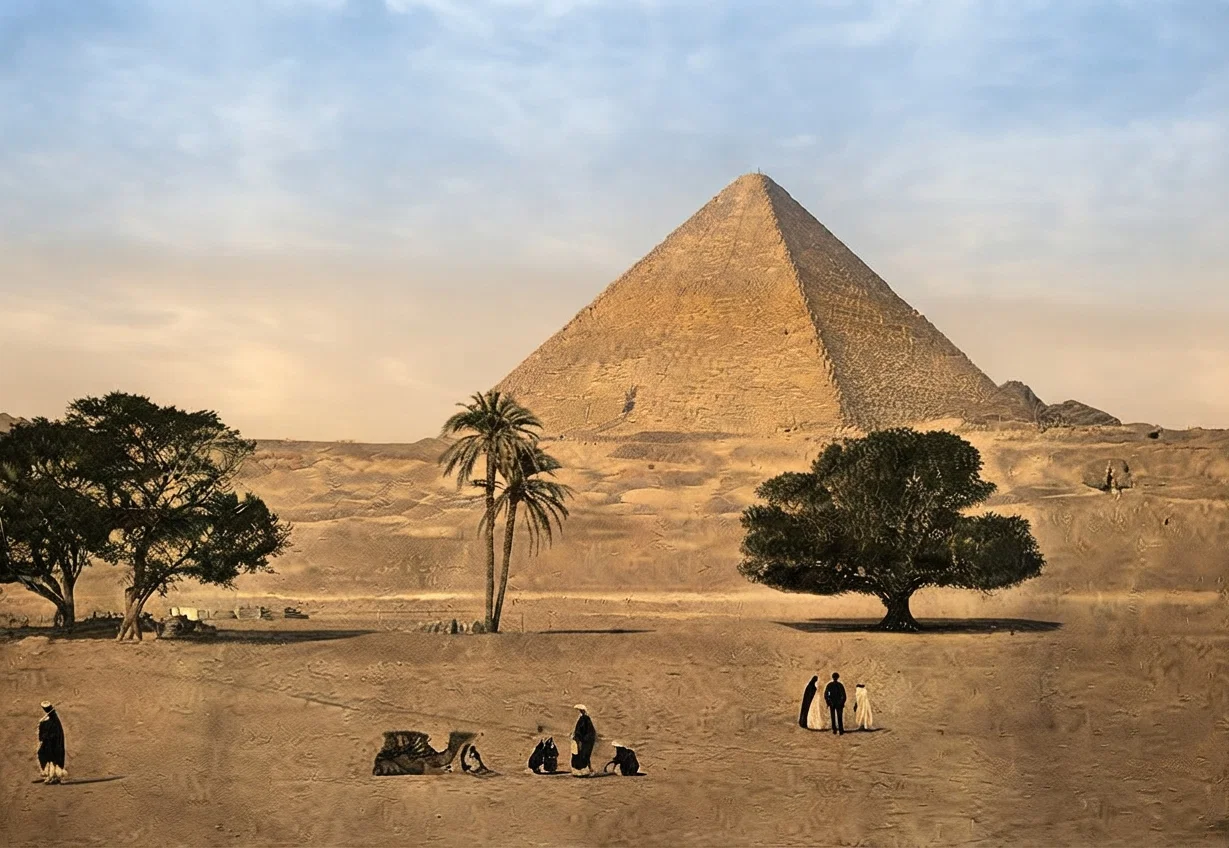
The Great Pyramid of Cheops, Egypt.
LITTLE'S "Cyclopedia of Classified Dates" gives a list of twenty-six dynasties, which ruled Egypt prior to 525 B.C., when it was conquered by Persia. Under the fourth dynasty Cheops distinguished his reign by building the great pyramid. This is called the pyramid dynasty, and Egyptian history "emerges from the mists of obscurity, and discloses a genuine and progressive civilization." The great pyramid covers an area of 13 acres, and is still 474 feet high. It was built by Cheops for his tomb. Herodotus says it required the labor of 100,000 men for 20 years in its construction; 10 years were previously spent in making a road of highly polished stone from the quarry to the selected site, a distance of 3,051 feet.
FROM the seventh to the eleventh dynasties Egypt "seems to have disappeared from the nations." This was a period of over 400 years. Near the close of the thirteenth dynasty the Hyksos, or "Shepherd Kings," invaded Egypt. They were wandering tribes of Semitic descent, which came from the northeast and dominated more or less of the country for several hundred years. "They wroughtsuch ruin of every kind everywhere, massacring the men, enslaving the women and children, burning the cities, and razing the temples, that they made forever the very idea of a shepherd 'an abomination unto the Egyptians.' Gen. 46 : 34."-Empires of the Bible, pp. 81, 82. They were finally expelled by Aahmes or Amasis I., under the eighteenth dynasty, about 1800 B.C.
THE oppression of the Hebrews occurred in the reign of Rameses II., under the nineteenth dynasty. He reigned from 1564 B.C. to 1497 B.C. He was the builder par excellence among the Pharaohs. "It is almost impossible to find in Egypt a ruin, or an ancient mound, without reading his name." He died six years before the Exodus, which took place 1491 B.C., in the reign of Meneptah II., the thirteenth son of Rameses II.
UNDER the twenty-seventh dynasty Cambyses defeated the Egyptians at the battle of Pelusium, and Egypt became a Persian province in 525 B.C. The Persians dominated Egypt to a greater or less extent till the thirty-second dynasty, when it was subdued by the Grecians under Alexander, in 332 B.C. He founded Alexandria, and was buried there in 322 B.C. The thirty-third dynasty was Ptolemaic, consisting of the reign of the Ptolemies from 323 B.C. to 31 B.C., when, by the battle of Actium on September 2, Egypt became a Roman province. In 284 B.C. Ptolemy Philadelphus founded the Alexandrian Library, and during his reign the Septuagint version of the Scriptures was completed, in 274 B.C. In 47 B.C. Julius Caesar besieged and burned Alexandria, and the great Alexandrian Library, consisting of 400,000 manuscript books, was destroyed by fire.
DURING the Christian era Egypt has suffered much from its varied but generally intolerant and cruel rulers. The Romans, the Saracens, and the Turks have been their principal masters. It is now tributary to Turkey, but under the control of England. It has an area of 10,698 square miles, and a population of about 7,000,000. The Lord said, "It shall be the basest of the kingdoms; neither shall it exalt itself any more above the nations; for I will diminish them, that they shall no more rule over the nations." Eze. 29 : 15. This is a prophecy which was made B.C. 589. How truly it has been fulfilled!
EGYPT was once the home of Abraham (Gen. 12 : 10), of Joseph (Gen. 39 : 1), of Jacob and his other sons (Gen. 46 : 6), of Moses (Ex. 2 : 1-10), of Jesus (Matt. 2 : 13-15). It was enveloped in heathen darkness and idolatry, and hence, like wicked Sodom, the Lord has used the name as a synonym or emblem of spiritual darkness and antagonism to Him. See Rev. 11 : 8. Because of her opposition to God and her great wickedness, and notwithstanding her great glory, her boasted civilization, and her great antiquity, she has become the basest of kingdoms. At one time she stood before the world without a peer in all that goes to make up human glory. In the arts, sciences, and wonderful structures, especially the pyramids, she stood unrivaled. Where now are her glory, her greatness, and her power?—Gone forever.
THE mighty men who once ruled that prosperous kingdom have long since passed away. Their monuments, as seen in the pyramids, the obelisks, and other structures, are more enduring by far than the minds that conceived and the hands that reared them.
What a lesson for the world's great men today! How brief, how fading, how unsatisfying is human glory! Surely "all flesh is as grass, and all the glory of man as the flower of grass. The grass withereth, and the flower thereof falleth away; but the word of the Lord endureth forever." 1 Peter 1 : 24, 25.
THE examples of Joseph and Moses, whose names are so closely associated in our minds with Egypt, are worthy of careful study. Joseph stands forth as a character whose faithfulness, integrity, and virtue could not be shaken, even under fierce temptations. Josephs are needed in this age of dishonesty, pleasure-seeking, and licentiousness. Moses is an example of meekness, devotion, and sacrifice. With all the glory, honor, wealth, and pleasures of Egypt within his reach, he "refused to be called the son of Pharaoh's daughter; choosing rather to suffer affliction with the people of God, than to enjoy the pleasures of sin for a season; esteeming the reproach of Christ greater riches than the treasures in Egypt; for he had respect unto the recompense of the reward." Heb. 11 : 24-26. The Lord gave Egypt a Joseph and a Moses, that she might learn righteousness, and become acquainted with God, but she chose the way of darkness, and her history reveals the sad consequences of her folly. M. H. BROWN.

"ASK, AND IT SHALL BE GIVEN YOU."

"Ask, and it shall be given you; seek, and ye shall find; knock, and it shall be opened unto you; for every one that asketh receiveth; and he that seeketh findeth; and to him that knocketh it shall be opened." Christ knows that it is not possible for us to resist Satan's temptations in our own strength. We can do this only by receiving divine help. In our own strength we should surely fail. Provision has been made that in every emergency and trial we may flee to the stronghold. When in faith we ask for help, it will be given us. We have the assurance of this from lips that can not lie. His word is Yea and Amen.
Then let every weary, burdened soul ask, and he shall receive. Will not He who gave His beloved Son to die for us give us help in time of need? Let us not dishonor God by unbelief. Let us take Him at His word, remembering His promise. The blessing is ours if we grasp it by faith. Why should our Christian experience be weak and nerveless? Why should our souls be anxious? Why should we not venture out by faith on the promises given?
Christ says, "Be ye therefore perfect, even as your Father which is in heaven is perfect;" and He has the power to make us perfect. But too often we forget this. Too often we forget to look to Christ. He is the Redeemer and Restorer, and those who call upon Him in faith will receive strength to overcome every wrong habit and practise.
Those who do not strive to bring the will into conformity to God's will can not be vessels unto honor. A defective character shows that the grace of God has not been allowed to work in the heart. Wrong habits are a constant hindrance to usefulness. Those who cherish them can not be Christians; for to be a Christian is to be Christlike. We must comply with the conditions laid down in God's Word. We must grasp in confidence the rich promises of God; then we shall be overcomers.
"Ye have not chosen Me," Christ declares, "but I have chosen you, and ordained you, that ye should go and bring forth fruit, and that your fruit should remain; that whatsoever ye shall ask of the Father in My name, He may give it you." Before we loved God, He loved us. Before we turned toward Him, His grace was making its impression on our hearts. He has bought us with a price, "the precious blood of Christ, as of a lamb without blemish and without spot," and He desires us to walk before Him in holiness, bearing fruit to His glory.
God will be to us all that we let Him be. But we must believe that we shall receive of Him the things He has promised. Languid, half-hearted, faithless prayers will bring no returns from heaven. We need to press our petitions to the throne of grace, asking in faith, waiting in faith, receiving in faith, rejoicing in hope; for every one that asketh receiveth.
Be in earnest in this matter. Seek God with all the heart. Men put earnestness and energy into temporal business. They know that if they do not, their efforts will not be crowned with success. With intense earnestness learn the science of seeking for the rich blessings promised in God's Word. Work with persevering effort, and you will receive light and truth and grace. These blessings are for all who serve God aright. We need to fear lest the promise being left us of victory through Christ, we should come short of it.
Christ is our example. His life was a life of prayer. Yes, Christ, the Son of God, equal with the Father, Himself all-sufficient, the storehouse of all blessings, He whose voice could rebuke disease, still the tempest, and call the dead to life, prayed with strong crying and many tears. He often spent whole nights in prayer. While the cities were hushed in slumber, angels listened to the pleadings of the Redeemer. See the Saviour bowed in prayer, His soul wrung with anguish. He is not praying for Himself, but for those whom He came to save. In the mountains of Galilee and in the groves of Olivet the Beloved of God prayed for sinners. Then He came forth to minister to them, His tongue touched anew with living fire.
Christ was the representative of the race. As our example He prayed to the Father for strength and grace. These prayers reach down to our time. He has identified Himself with us. Being tempted in all points like as we are, He is able to sympathize with those who are tempted. He bowed before His Father as a suppliant, obtaining strength from on high. By communion with God He was invigorated and refreshed for His work of helping those who were in need. Braced for duty and prepared for toil by intercession with the Father, He went forth to encourage and bless others. Those who are indeed friends of Christ will often commune with Him, having implicit faith that He will answer all the prayers offered in His name.
God permits a crisis to come now and then,that His children may go to Him. He sees and knows all things. He desires them to feel their helplessness, and to plead with Him, casting their helpless souls upon Him. Then they are ready to be taught. "Draw nigh to God, and He will draw nigh to you." In the Saviour's presence God's people will have no fear of evil. The ever-varying perplexities, the abrupt and unexpected changes, of this age will not baffle or discourage them, but will give them fortitude and courage, bracing them for labor.
Christ declares, "Every one that asketh receiveth; and he that seeketh findeth." This is a law of the divine government, a law sure and unfailing, establishing a connection between human and divine agencies. O, what a world of promises we have in the Word of God! To all who seek Him at the footstool of mercy Christ gives power to witness for Him. He has placed Himself under obligation never to disappoint a true seeker for the Holy Spirit's guidance. And to assure us of this He appeals to the love of earthly parents: "What man is there of you," He asks, "whom if his son ask bread, will he give him a stone? or if he ask a fish, will he give him a serpent? If ye then, being evil, know how to give good gifts unto your children, how much more shall your Father which is in heaven give good things to them that ask Him?" MRS. E. G. WHITE.

HEAVENLY LOVE.

They sin who tell us Love can die. With life all other passions fly, All others are but vanity. In heaven, Ambition can not dwell, Nor Avarice in the vaults of hell. Earthly these passions of the earth; They perish where they have their birth. But Love is indestructible; Its holy flame forever burneth. From heaven it came, to heaven returneth. Too oft on earth a troubled guest, At times deceived, at times oppressed, It here is tried and purified, Then hath in heaven its perfect rest. It soweth here with toil and care, But the harvest-time of Love is there. —Southey.

APOSTASY IN THE CHURCH.

IN past numbers we have considered some questions having a bearing upon the subject of the world's conversion. We have found that in the last days the nations of the earth will be preparing for war, and the stirring developments of every day demonstrate that such is the case. We have found, further, that there would be marked moral degeneracy, which is now evident to every observer.
But, while these conditions may exist in the world, may it not be true that, through the professed church of God, the Lord may accomplish the conversion of the heathen? There might, indeed, be a plausibility of hope in this, did the church of God stand where it should in coping with these conditions that exist; but, alas, we find that the same spirit of degeneracy which marks worldly society has permeated the church. It is so that to-day, instead of the church of God standing as the light of the world, with the line of demarkation clearly drawn between it and the ungodly, it is influenced, and to a large extent molded, by the worldly influences with which it has come in contact.
This condition of the professed church of God in the last days is made a subject of prophecy by our Lord and His apostles. Paul, in his second Epistle to Timothy, bears the following testimony relative to this state of affairs: "This know also, that in the last days perilous times shall come. For men shall be lovers of their own selves, covetous, boasters, proud, blasphemers, disobedient to parents, unthankful, unholy, without natural affection, truce-breakers, false accusers, incontinent, fierce, despisers of those that are good, traitors, heady, high-minded, lovers of pleasures more than lovers of God; having a form of godliness, but denying the power thereof, from such turn away." Chapter 3: 1-5.
Here is a category of eighteen different sins of which man would be guilty. The first verse says that these sins would be found among the people in the last days, and the fifth verse says that a class of people having a form of godliness would be doing these wicked deeds.
This can refer to none others than to those who profess the name of Christ but in whose lives generally there is nothing but a profession; hence the power of Christ and the profession of their lives are denied. In Rev. 14:6, 7 the last church is again brought to view under the term of Babylon. The fall to which reference is made is not a physical but a moral fall, a departure from the Lord Jesus Christ, and a union with the world.
We come now to the question, Does the professed church of God to-day meet these conditions? The prophecy states that these conditions will be found in the last church. Do we find the prophecy meeting its fulfilment in the church? It seems hardly necessary to point out to the intelligent reader the conditions now existing in Christendom which do show that the prophecy is being fulfilled. Sad as it may seem, and loath as we may be to make the admission, we are still forced to the conclusion that the church of Christ to-day has been bereft of its power. This is indicated by marked tendencies which we see on every hand. Among the many let us briefly consider the following:—

Increasing Worldliness.

Unwillingly and painfully the conclusion is being forced upon many minds that the church of to-day has degenerated into a great social organization. True, in every denomination are honest hearts. In every church community and church organization are those who love the Lord Jesus Christ, honest, humble, God-fearing souls, who, to the best of their ability, are endeavoring to manifest before the world the character of Jesus. But there is also another element, and one which is largely in the ascendancy, who have united with the church on account of its advantages to them in a business and social way, rather than from a conviction born of the Spirit of God. We find the business man joining the church to increase his business, and the professional man uniting with the church to extend his practise, etc. It can not be denied but that ulterior and selfish motives actuate many who now present themselves for church membership in our large church organizations. This trend of increasing worldliness is further manifest in the spirit of parade, and love of display and dress, which are fostered by a large part of the church membership. It is seen in the extension of the church ritual, in church embellishment, in hired choirs, in operatic music, and in scores of ways in which the form is brought in to make up for the lack of the power.

Adoption of Worldly Methods.

In bringing down its standard to meet the desires of the world, and to gain influence and favor, the church has unconsciously come to adopt worldly methods and plans in the carrying forward of its work. The prophecy says that the church would be "lovers of pleasures more than lovers of God." How truly this is evidenced in the various entertainments provided to raise funds for church purposes! Instead of the church educating men that it is a duty and a privilege for them to sustain the cause of God by gifts and offerings, it has adopted the plan of giving them an equivalent in fun for that which they donate to the church, so we have church festivals, fairs, and bazaars, where the church, instead of inculcating principles of abstinence and control, gives liberty to license and dissipation, thus strengthening, rather than endeavoring to uproot, the evil tendencies of the appetite and of the human heart.

Infidelity.

Added to the evil practises and wrong methods enunciated above, the confusion of doctrine held by the professed church of Christ must be evident to every thinker. Of what absurdities of idea and preaching has not the pulpit been guilty? And during the last few years Higher Criticism has been doing its baneful work. Christened infidelity sits enthroned behind many sacred altars. Simple faith is relegated to the past, and classed with the superstitions of savagery. The story of Eden is classed as an allegory, the characters in Job as myths, Christ but a good man, and His atonement of no vicarious virtue.

Appealing to State Aid.

Never has there been a time in the history of Protestantism when there has been such general appeal to the State in carrying out its behests as in the last two or three years. Jesus Christ is set forth in the Scriptures of truth as the husband of the church. Whenever the church leaves Christ and takes hold of the arm of civil power, the Bible represents the act as spiritual adultery, the same as it would be for a woman to leave her natural husband and unite with another man. We have seen during the last few years the church appealing to the State for government aid to carry on sectarian and denominational schools. We see appeals made to the civil arm for the enforcement of religious laws, compelling men to observe one day in the week as the Sabbath. All this is but an evidence that the church has fallen from the high spiritual plane it occupied, and, conscious of its lost spiritual power, it now reaches out for civil power to supply its lack. Surely if the church of God to-day hopes to bring the heathen to Christ, it must first purify its own assemblies, it must weed out the leaven of worldliness which has been at work.
A great effort is being made by the combined churches of the world to enforce religious laws, but let it be remembered that men never can be made righteous by legal enactment. They may be forced to conform to some outward ceremony, but that will only serve to turn them from open sinners to wretched hypocrites, bringing hardness to their hearts and bitterness to their spirits which they did not before possess.
The fact remains, and must be apparent to all, sad tho it may be, that the great church organizations of our country and of the world have fallen—fallen morally and spiritually—and there can be but little hoped for conversions in the world as long as the church itself affiliates with the world and indulges in its practises. We would that the conditions might change, but the Word of God clearly indicates that evil men and seducers shall wax worse and worse until the end. Only by the return of the Prince of Peace, and the transformation which He shall work by His mighty transforming power, will this earth be rid of sin and sinners, and the glory of God cover the earth as the waters cover the sea. May the Lord preserve His children spotless unto that time.
Now, as never before, it is for the true ones to remain faithful. From the treason of others they must be incited to greater loyalty; from others' cowardice they must be led to exercise greater courage; and from the prevailing coldness in the world they must gather new warmth and vigor and life. The church as a whole has departed from God, there are still true and tried ones. Let these still hope in God. They are the most precious objects of His love. He hears their prayers, He treasures their tears, and soon He will turn their mourning into rejoicing, their sorrow of heart into abounding joy. Faithfulness will meet its reward, and he who sows in tears shall reap in joy, and, with songs of rejoicing, come in the glad harvest gathering, bringing the sheaves with him.

THE SIN-OFFERING AND TRESPASS-OFFERING.

"When his soul hath given a trespass-offering, he shall see his seed, and live long in the pleasure of the Lord." Isa. 53:10, Waldenstrom's translation.
"The sacrifices of God are a broken spirit; a broken and a contrite heart, O God, Thou wilt not despise." Ps. 51:17.
THO the one general meaning of all the sacrifices, as we have seen, was the divine and infinite love of God, that gave the divine life through Christ, and by Christ Jesus, and through us also, for others, yet it will repay us to study these offerings more carefully. When we do this we shall find revealed in them all the fulness of Christ's wonderful teaching.
To really understand them, we must separate them into their different classes. There was the sin-offering, the trespass-offering, the burnt-offering, the peace-offering, and the meat-offering. Of these, the last three are said to be for a sweet savor unto the Lord, but not so of the first two. They had to do with sin. Human guilt was upon them. Of course even these offerings represented Christ, upon whom God "laid the iniquity of us all." This does not mean, however, that God arbitrarily punished Jesus for our guilt. Christ took our sinful flesh at the point of weakness and sinfulness to which our sins had brought it. He entered this sinful world when it was at the depths. It was the enmity, and hate, and sin of the world that slew Him; and in His own flesh also He felt the stress of all the world's terrible temptations. Surely, in and through the incarnation, God did lay upon Christ the iniquity of us all.
Christ is the great sin-offering. "For He hath made Him to be sin [or a sin-offering] for us, who knew no sin; that we might be made the righteousness of God in Him." Christ gave Himself, His life, for us. He is the great Sacrifice by which souls are saved,—"The Lamb of God, which taketh away the sins of the world." But the Christ Spirit says to us, "I beseech you therefore, brethren, by the mercies of God, that ye present your bodies a living sacrifice."
So the sacrifice represented not only the Christ, but also the Christian; not only Christ on Calvary or in the incarnation, but also Christ back there in the sinner, bringing him to God; for it is only by Christ in us that we are brought to God, and reconciled to Him as our Father. Each sacrifice stood in the place of the one who sacrificed it. God viewed the offerer in the light of his offering. If he came bringing a sin-offering, he was viewed as a sinner confessing his guilt, and pleading by this offering for pardon and renewing grace through Christ. If he came bringing a trespass-offering, by that act he said, "Tho Thou hast forgiven me, O my Father, yet I am conscious of having sinned anew, and I hereby confess my fault and ask through Christ for forgiveness!"
Nor could he bring any offering he chose and have it accepted. He must, to be recognized and accepted of God, bring just the offering which truly represented his present condition. Here was the wilful and wicked mistake of Cain. It was all right to bring, under the proper circumstances, the offering he brought. It was a meat-offering, professing, as we shall see hereafter, complete consecration to God. Abel brought the same offering as Cain, but he "also brought of the firstlings of the flock." Abel brought his sin-offering first, but Cain refused to humble himself to do this. While full of sin, and fit only for repentance, he came hypocritically professing consecration. On the day of atonement the high priest offered first a sin-offering for himself, and then the two goats (the live goat and the one killed, both said to be a sin-offering) for the people. Only after these had been offered, and after the priest had put off the clothes he wore while offering them, and had washed his flesh with water in the holy place, and put on his consecrated garments, only then could he offer a burnt-offering for himself and a burnt-offering for the people. In John's Gospel we read, "Now we know that God heareth not sinners; but if any man be a worshiper of God, and doeth His will, him He heareth." Yet we know that there is one prayer that God will hear even from a sinner, else the sinner could never be anything but a sinner, and that one prayer is a prayer for pardon. Jesus taught that the sinner who went up to the temple and prayed, "Lord, be merciful to me a sinner," was heard and answered. All this is only saying that now, as in the olden time, the sinner, to be accepted, must bring his sin-offering first. The world, and the church also, has to-day many Cains, who, in self-righteous pride, refuse to do this, and so, like Cain, they are not accepted of God, but instead are under Cain's curse.
When the sin-offerings or the trespass-offerings were brought, what was done with them? How were they offered?—There was one law for both the sin-offering and the trespass-offering. In the case of a priest, or of the whole congregation, the sinners brought the offering to the door of the tabernacle, and there laid their hands upon it and killed it. If the sin was a sin of the whole congregation, then the "elders of the congregation," representing the whole people, killed the offering. It is the sinner, not the priest, unless he himself is the sinner, that killed the sacrifice. This was to show that it is sin that kills, not the divine anger that arbitrarily demands death. The sacrifice being killed, the officiating priest took of the blood, and sprinkled it seven times before the Lord, before the inner vail of the sanctuary; he also put some of the blood upon the horns of the altar of incense, and the remainder of the blood was poured out at the foot of the altar of burnt-offering. Only the fat was burned on the altar of burnt-offering; all the rest, "even the whole bullock," was carried forth without the camp, as unclean, and burned. Wherefore Jesus also (when made a sin-offering for us) suffered without the gate. This was the law for the trespass-offering, and for the sin-offering of the whole congregation.
When, however, one of the rulers or one of the common people sinned through ignorance, he brought his sin-offering and killed it as before; but instead of the priest carrying the blood into the holy place, he put it upon the horns of the altar of burnt-offering, and poured the rest out at the bottom of that altar. Instead of the flesh being considered as unholy, and therefore burned without the camp, it was considered holy, and eaten by the priests in the holy place, that the priests might "bear the iniquity." But "no sin-offering, whereof any of the blood is brought into the tabernacle of the congregation to reconcile withal in the holy place, shall be eaten; it shall be burned in the fire."
What does all this mean?—It is evident that in some way it represents the sinner coming to God, and God's manner of dealing with him. It is plain, too, that the flesh of the sin-offering represents the flesh of the sinner who brought it; for when the sinner was really guilty and to blame for the sin, the flesh of the sin-offering was considered unholy, and burned without the camp. What does the "flesh" stand for throughout the whole Bible? What is it but the symbol of the carnal heart, the carnal nature, which "must die," "must be crucified," etc., because, as Paul says, "it is not subject to the law of God, neither indeed can be"?
On the day of atonement, the man who burned the sin-offering without the gate was equally unclean with the man who led off the scapegoat. Both had to purify themselves by washing their clothes and bathing their flesh in water, before they could enter the camp, which was holy, and participate in the burnt-offering. The scapegoat represents Satan. But man's sinful flesh, his sinful nature, originated with Satan, and is as corrupt as its author. It must die, it must perish without the gate of the eternal city. It can not enter the final camp of the saints,—the true Israel. Our only hope is to let it go, to give it up unto crucifixion. The sinner, when he came to the Lord back there, to be received of Him, must come confessing his sinfulness, and yielding up his whole carnal nature, to be consumed in God's own way as unholy. It is the same to-day. God is no respecter of persons. He deals the same with men in all ages.
We have seen, however, that when one of the rulers or one of the common people sinned through ignorance, the flesh of his sin-offering was not burned without the gate as unholy, but it was holy, and was eaten by the priest in the holy place, that the priest might bear the iniquity. Thus God holds the teacher who professes to teach in His name, as in a large degree responsible for the sins committed in ignorance by those under his charge. This sin was upon the priest, and was carried without the camp in the flesh of his sin-offering.
"The blood is the life." This blood was sprinkled before the inner vail, put upon the horns of the altar of incense, and poured out at the foot of the altar of burnt-offering. The incense is the merit of Christ. The horns of the altar of incense represent the renewing power of Christ. The altar of burnt-offering is the altar of complete consecration. Even so, to be received, must the life of the sinner be presented to God to-day. The carnal nature must first be willingly renounced and given over to crucifixion; then the life must be presented, with no self-righteous pride, with no self-congratulation, but only in the merit of Christ, to be first renewed by His power, and then gladly poured out in His service. It is not even ours to direct as to how it shall be poured out. It is His to direct,now, as back there. We must ask no questions as to how it will be appropriated. If God so wills it, we, like Christ, must let the life go willingly, even tho it be spit upon, and insulted, and covered with the dust of oblivion and forgetfulness. But here, as back there, the conscientious, trusting soul that sins through ignorance, while gladly walking in all known light, may still offer his life in perfect trust to God; for Christ's merit covers his unknown sin, and his is the blessedness of the man to whom the Lord imputeth not iniquity.
The fat of the sin-offering and of the trespass-offering was burned as holy upon the altar of burnt-offering. Why was this fat so different from the flesh, which was burned without the camp as unholy? What does the fat, or oil, represent throughout the Scripture? What but the grace of the Spirit? It was used in anointing, as a sign of the bestowal of the Spirit. When the Holy Spirit descended upon Jesus, He was said to be anointed with the oil of gladness above His fellows. He Himself said, "The Spirit of the Lord God is upon Me, because He hath anointed Me." The oil is the grace of the Spirit, the result of the Christ-life that is in us. Christ is the light that lighteth every man that cometh into the world. If that Spirit has been wholly grieved away, if that divine light has wholly become darkness, that sinner will have no desire to repent, no hunger after God. Thank God, there is a little of the oil or fat of the Spirit left in the poorest, leanest sinner, and in the worst and most repeated trespasser that can come to God. That is just so much of the image of God, and it is holy. It does not have to be crucified, but only to be "renewed after the image of Him who created it."
The trespass-offering was offered the same as the sin-offering. It differed from the sin-offering only in meaning. The sin-offering represented the sinner coming to God in repentance for what he was by nature, a sinner, without perhaps the present consciousness of any particular sin. It is thus that the little child must first come to God, even tho he has never wilfully and knowingly done wrong. But the trespass-offering represented the trespasser (who, tho professing to serve the Lord, has become conscious of having transgressed His law) coming in repentance for the individual sin. Let us thank God for the trespass-offering, whereby He can heal our backslidings, and receive us graciously.
In conclusion, dear reader, if you are a sinner, let me plead with you to come, bringing yourself as a sin-offering. O, yield up the sinful nature, and give your life into His keeping! The Lord will receive you with great joy, and glorify your life with His own goodness. The river of His life will first purify you, and cause you to grow into His image, and then flow through you to bless others. If you are a poor, discouraged, backsliding trespasser, do not stay away longer from the only source of hope and joy. Come, bringing your trespass-offering, and by living faith claim forgiveness and victory. It was for just such as you that God ordained the trespass-offering, and so He can not refuse to receive you if you come as He directs.

THE WONDERS OF PRAYER.

ABRAHAM's servant prays—Rebekah appears. Jacob wrestles and prays and prevails with Christ—Esau's mind is wonderfully turned from the revengeful purpose he has harbored for twenty years. Moses cries to God—the sea divides. Moses prays—Amalek is discomfited. Joshua prays—Achan is discovered. Hannah prays—Samuel is born. David prays—Ahithophel hangs himself. Asa prays—a victory is gained. Jehoshaphat cries to God—God turns away his foes. Isaiah and Hezekiah pray—185,000 Assyrians are dead in twelve hours. Daniel prays—the dream is revealed. Daniel prays—the lions are muzzled. Daniel prays—the seventy weeks are revealed. Mordecai and Esther fast—Haman is hanged on his own gallows in three days. Ezra prays at Ahava—God answers. Nehemiah darts a prayer—the king's heart is softened in a minute. Elijah prays—a drought of three years succeeds. Elijah prays—rain descends apace. Elisha prays—Jordan is divided. Elisha prays—a child's soul comes back; for prayer reaches eternity. The church prays ardently—Peter is delivered by an angel.—Rev. J. Ryland.
Continue reading: IS PHYSICAL RESTORATION ALWAYS A MIRACLE?