I HAVE never been one to feel that the best love was won from a child by extreme indulgence. In fact, I hold that the contrary is the rule. Observing the families of my contemporaries and predecessors, it is borne in upon me that the most indulged children have not been the most devoted to their fathers and mothers. On the contrary, having had the happiness to be associated with several households where strict obedience has always been demanded and received, I feel justified in declaring that the families where discipline is observed are those whose children are most affectionate.
Be it noted that strictness does not mean harshness or severity. It does stand for reasonable rules, positively enforced, for commands which must be obeyed, and, above all, it should stand for justice.
Were I asked to put in a word the most desirable quality in dealing with boys, or with girls, either, for that matter, I would put justice first. It would not be a synonym for hardness, although this is a meaning often applied to it. It would mean obedience to orders and penalties when orders were disobeyed, but it would mean also an appreciation of the child's standpoint, an almost agonizing care that he should not be punished without adequate cause, a rigid adherence to promise of reward as well as of rebuke, an understanding of what led to this or that course of action which from an adult's view-point may seem inexplicable.
There may be well-brought-up children who resent a just punishment. I have never known them. But I have found injustice of reproof or of penalty resented with a bitterness which left its mark for years afterward.—Christine Terhune Herrick.
A Life in Christ
A LIFE in Christ is a life of restfulness. There may be no ecstasy of feeling, but there should be an abiding, peaceful trust. . . . Let the mind dwell upon his love, upon the beauty, the perfection, of his character. Christ in his self-denial, Christ in his humiliation, Christ in his purity and holiness, Christ in his matchless love,—this is the subject for the soul’s contemplation. It is by loving him, copying him, depending wholly upon him, that you are to be transformed into his likeness.—“Steps to Christ,” pages 77, 78.
Wise Use of Energy
“He is a wise man who wastes no energy on pursuits for which he is not fitted.”
Rest
By F. R. Havergal
Thou hast made us for Thyself, and the heart never resteth till it findeth rest in thee.— St. Augustine.
MADE for thyself, O God!
Made for thy love, thy service, thy delight;
Made to show forth thy wisdom, grace, and might;
Made for thy praise, whom veiled archangels laud;
O, strange and glorious thought, that we may be
A joy to thee!
Yet the heart turns away
From this grand destiny of bliss, and deems
’Twas made for its poor self, for passing dreams,
Chasing illusions melting day by day;
Till for ourselves we read on this world’s best,
“This is not rest!”
Nor can the vain toil cease,
Till in the shadowy maze of life we meet
One who can guide our aching, wayward feet
To find himself, our Way, our Life, our Peace.
In him the long unrest is soothed and stilled;
Our hearts are filled.
O rest, so true, so sweet!
(Would it were shared by all the weary world!)
’Neath shadowing banner of his love unfurled,
We bend to kiss the Master’s pierced feet;
Then lean our love upon his loving breast,
And know God’s rest.
— F. R. Havergal.
East Caribbean Conference
By L. E. WELLMAN
L. E. WELLMAN
THE record of the work of the East Caribbean Conference during the last two years is one of continued advancement.
At the beginning of the year 1907, immediately after the union conference in Jamaica, so suddenly interrupted by the earthquake in Kingston, our field was for a time very feebly manned, owing to the withdrawal from Barbados of Elder G. F. Enoch, and of myself from the Leeward Islands. After seven years' labor in the islands, I spent a three-months' furlough in the States, whither my family had already returned on account of a breakdown in health, thus depriving the field of the labors of its only American worker. The financial side of the conference work was looked after during this interval by Elder S. A. Wellman from the office of the South Caribbean Conference.
Early in May, my family and myself returned to the field, locating in the island of Barbados, which was at that time conference headquarters. Elder F. G. Lane and family, of the East Michigan Conference, accompanied us to the field. The needs of our field having been presented to him at the East Michigan Conference meeting, at Holly, Mich., he offered himself as a volunteer, to help us in our work; and his home conference kindly consented to bear his expenses to the field, and support him while there.
ROSEAU, DOMINICA, W. I.; HEADQUARTERS OF EAST CARIBBEAN CONFERENCE
He located in what was then the central part of the conference, making the city of St. John, Antigua, his home. As a result of his labors in this part of the field, one good company, with a small church building, has been added to the conference, one company organized into a church, and between twenty and thirty baptized and added to our conference membership.
About the middle of the year, there also came among us Elder H. C. J. Walleker and family, who located in the northern islands, making St. Thomas his headquarters. This addition brought the number of our American laborers up to three before the close of the year.
At the close of the year 1907 it was impossible for us to hold a regular conference session, but the conference committee as elected at the union conference in Jamaica, met in connection with the South Caribbean Conference in Trinidad, where plans were laid for the work during the year 1908. It was thought best by the members of the union conference committee, who also met at this time, to cut off from this conference the Danish and Virgin islands. Thus our constituency was reduced by about fifty members, and our ministerial force by one American and one native ordained minister, leaving our list of workers as follows: two ordained Americans and one ordained native worker; three native licentiates and two missionary licentiates.
At the close of 1907 our work was further added to by the arrival among us of Dr. and Mrs. Charles Cave. Dr. Cave having obtained an English diploma, and his wife being a graduate nurse, they were qualified in an eminent way to enter upon the medical missionary work in this field. The doctor and his wife are both natives of the islands comprising this conference. We trust their coming will give an added impetus to the work in this part of the Lord's vineyard. Though they are starting in a small way, with meager facilities, the work has steadily grown; it has been self-supporting, and is becoming day by day a means in God's hands of helping on the message in this field. For all this we feel to give thanks to our Heavenly Father.
During the year just closed, 1908, the work has made steady advancement, both from the spiritual and the financial standpoint. Though our constituency was materially reduced by the division of our territory at the close of 1907, the accessions during the year 1908 have more than filled the gap, about seventy having been added by baptism to our numbers during the year. Our conference now numbers about four hundred.
In financial lines we can report decided gains also, as the excess of local receipts for 1908, from all sources, amounted to about two hundred forty dollars over and above the total receipts for the preceding year, the total for 1908 being very slightly less than one thousand dollars. We are hoping for better things for 1909, both spiritual and financial.
Two church buildings have been dedicated during the year, one in Roseau, Dominica, which was started in August, 1907, by Elder P. Giddings, and a small one in Cedar Grove, Antigua. This work was done under the supervision of Elder Lane, the dedication taking place early in November, the conference president also being present.
The dedication of the Roseau (Dominica) church took place in August; the workers present were: Elder Giddings,13the local laborer; and from other fields Elder Lane and Brother W. D. Forde, and myself. The occasion was one we shall long remember.
During the latter part of the year, it was deemed advisable for Elder Lane to remove his family, on account of his wife's health, to Barbados, and he is now located there in charge of that part of the field, assisted by one licentiate and two missionary licentiates.
On account of the central location of Dominica, thereby affording greater facility for reaching all parts of the field in the shortest time and at a minimum of expense, it was decided to locate the president's office there; therefore, the present address of the East Caribbean conference office is Roseau, Dominica.
At our annual conference at the close of the year it was decided to locate Elder Giddings at Pointe Pietre, Guadeloupe, thus for the first time making an effort for the evangelization of the Catholic French islands of our field.
We will be, in fact, the first Protestant church that has opened mission work in those islands. Elder Giddings will locate in his new field after a well-earned furlough of three months, which he is spending in Barbados since the conference. Our earnest prayer is that God may add his blessing to this new work, and to the work in all its phases throughout our field and the world.
Roseau, Dominica; W. I.
Woman's New Era in the Far East
By Evelyn Clark Morgan
CHINESE women are at last awakening to the advantages of education. Traveling from Canton to Macao, I had an interesting conversation with a young Chinese wife and mother, who was enthusiastic upon the subject of female education and the enlightenment of Chinese women.
“I know so little,” she lamented, almost pathetically; “but I am willing to devote myself, body and mind, to the women of China, for their ignorance is indeed deplorable. My husband is the founder and physician of a hospital at Canton, and I have my little children to care for; but some are girls, and that makes me all the more anxious to help raise the standard of education for women. Of course, there are some of my sex—and the number is increasing—who feel an interest in their own advancement; but there are others who don't care much. They are so used to being shut off from all outside life that it seems to them right to continue so.”
“What have been the results, so far, of the new era?” I asked.
“Well, the antifootbinding movement is one thing; then education of women, more independence of thought and speech, and lastly, a strong disposition to break down some of the barriers that separate the classes. The people are objecting to the kow-tow [a Chinese form of obeisance, in which an inferior kneels and touches the ground with his forehead], and an effort has recently been made to do away with it. This would have been carried, but some member of the nobility protested against it. I should like to visit other lands,” she continued, “to study conditions and bring home new and advanced ideas from progressive countries to my poor benighted sisters.”
Another lady, in whose society I have found much pleasure, is Mrs. Ah Hok. She is the pioneer in China of woman's cause. She was the second Chinese woman to go to England; the first was the wife of an ambassador. She went to persuade English women to come to China to help her countrywomen. It is eighteen years since this brave and talented woman took the first step toward the relief of her Chinese sisters.
By courtesy of the Christian Herald
MRS. AH HOK
Mrs. Ah Hok's husband was a wealthy merchant and philanthropist. He was interested in education, and gave ten thousand dollars (Mexican) to the Anglo-Chinese College, at Foochow, where he resided, and where Mrs. Ah Hok still lives. . . . He was the means of saving the lives of hundreds of baby girls by providing rice for them, when their parents would have drowned them or sold them for slaves. Those parents, poor and miserable, say: “We can not afford girls. They soon leave us (at about seven or eight years old) to work for their future mothers-in-law; so why should we have the expense of feeding them?”
Mrs. Ah Hok's home is a charming one, as Chinese homes go. Its doors and ventilation screens are richly carved. When I visited her, I was ushered into a small reception room, the most conspicuous objects in which were a small ebony table and two elaborately carved ebony chairs. They stood on a slight elevation, the table between the chairs, and all placed close against the wall. I seated myself in the chair nearest the door; and when Mrs. Ah Hok entered, she at once took my hand and led me to the one farthest from the door. Inadvertently, I had done the proper thing, and madam had politely insisted upon my “going up higher,” which meant taking the seat farthest from the door. . . .
“Until Christian schools were introduced into China,” said Mrs. Ah Hok, “there were no schools for girls; they received no education whatever. Now, there are Chinese day- and boarding schools. Many of the heathen girls, however, attend Christian schools. This is a distinct advance, too, as at first it was almost impossible to get pupils.”
“Heathen families were afraid to trust their children to Christians?” I suggested.
“Yes,” replied madam. “One father made me responsible that they should not put out his daughter's eyes before he would allow her to cross the threshold of the school.”
I afterward learned in a visit to Miss Lee's school, one of the largest in Foochow for high-class girls, that Mrs. Ah Hok's influence in enlightening the parents to the advantages of education was very great. When Miss Lee's school was first started, they paid pupils to come; but after six years she had one hundred girls, all from heathen families, and paying $1.50 (Mexican) a month.
“Do the mandarins' daughters mingle freely with the other girls?” I asked Mrs. Ah Hok.
“O, yes! the only people who are clannish are the field people. They are practically the farmer classes.”
“Do the high-class girls still bind their feet?” I inquired.
“O, there has been a great change in that respect! It was hard to bring this reform about among the upper classes. It was their badge of aristocracy, and they clung to it; but now they see how hampered they are by the custom, and so they are not binding the feet of the young children, and are unbinding those of the older girls. Parents are beginning to take some pride in the education of their daughters. I think this is really not because they are so anxious to have them acquire knowledge as it is the dislike to have them appear to know less than their neighbors' daughters who are being educated,” and Mrs. Ah Hok laughed as she spoke of this very human trait in her countrypeople.
“Tell me,” I urged, “something about the education of a Chinese girl of today.”
“The parents now feel sufficient interest to come to the school to arrange. They generally like to make a pretty good bargain financially. This is not to be wondered at, for some of the most aristocratic have but little money for so extravagant a thing as education. Upon opening day, the girl appears, carried in a sedan-chair, for no high-class Chinese girl would think of walking in the street. She would surely be looked at, and that, from a Chinese standard, would be unpleasant and mortifying—a thing not to be thought of, outside of the lower classes. Her wardrobe, which is usually a very scant one, is folded in a piece of cotton cloth. Among her belongings will be found a luncheon box and a fire-basket. These she will not be allowed to carry into the class rooms, but may have in the corridor or bedroom. It is rather difficult to get our girls to take exercise; they are accustomed to an indoor life.”
“Do you teach the languages?”
“We teach English only. The Chinese14are not linguists, but every girl is anxious to know English. The usual course includes astronomy, geography, mathematics, algebra, and some Chinese classics—quite much,” said Mrs. Ah Hok. “Calisthenics are taught, and music—the pupils are very fond of that; also drawing, painting, lace-making, and embroidery. Embroidery is considered the most important branch of a girl's education, and great stress, too, is laid upon the study of etiquette. This means the serving of tea, the bowing and reception etiquette and table conventionalities. Certain phrases are demanded on different occasions. Well-bred persons will make no mistakes. It is the polite thing to go as far as the outer door with a departing guest. In that case, the guest will say, ‘Please go within;’ but if the parting is inside the house, then the departing one says, ‘Please be seated,’ which means, ‘you must not take the trouble to go to the door with me.’ The person addressed usually insists upon doing so.”
“Is there any disposition toward co-education?”
“Not much; that must come very slowly in China. But who can say?”
When I asked whether any religious instruction was given in the schools, madam replied by asking, “What religion would you teach? Of course, the Buddhist religion is instilled into the pupils in heathen schools, just as we try to bring Christian influence to bear in Christian schools. But even in the latter schools, it is difficult to teach Christianity to girls of the higher class.”
“Are Chinese girls bright?”
“Some are bright, and some are not bright, some are lazy, and some industrious,” was the quick reply.
When, at parting with Mrs. Ah Hok, I congratulated her upon the methods of Chinese education, she answered, brightly: “I like yours better.”—Evelyn Clark Morgan, in The Christian Herald.
Ethiopia
By Julius Persson
JULIUS PERSSON
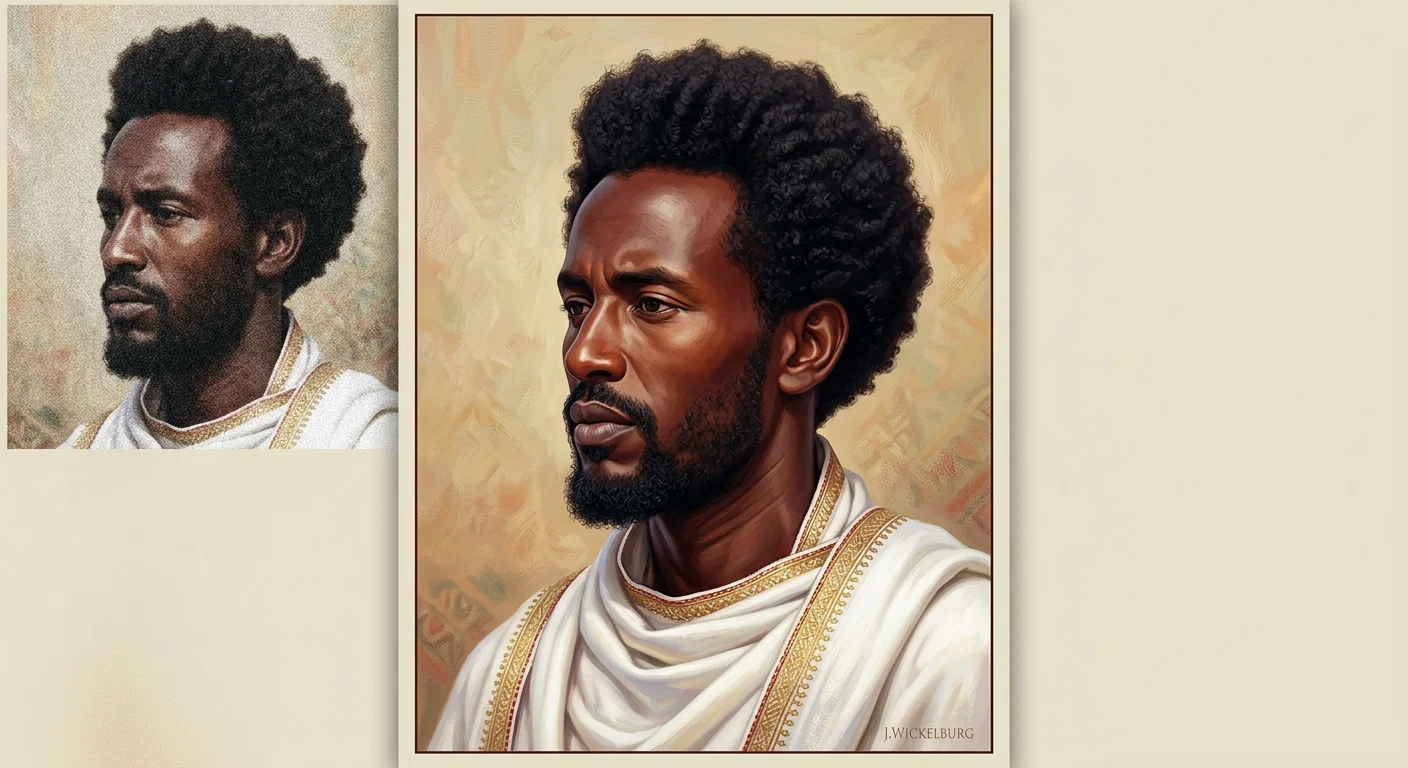
According to Abyssinian tradition, Cush, the son of Ham, came to the land now named Abyssinia, or Ethiopia, and built the city Axum. He is said to have had twelve sons, one of them called Ethiops, who gave the whole land the name of Ethiopia. This is in harmony with the most reliable historical facts. The word Abyssinia, however, is probably derived from the Arabian Habesch, and among the Abyssinians Habesha is still used.
The history of Axum is interwoven with the tradition of the queen of Sheba. She is supposed to have been queen of Ethiopia, and to have been succeeded by her son, Menilek Ebu Hakim. This Menilek is said to have reigned in Ethiopia about twenty-nine years. This belief, that their royal line comes from the queen of Sheba, is so deeply rooted in the minds of the Abyssinians that to doubt it is to contradict the Bible. So much for the tradition as to how the people of this country first came in contact with the chosen people of God. And many are the evidences of its truth, as we shall see later when studying the rites of the church. From the time of Menilek Ebu Hakim till the time when Philip preached Christ to the Abyssinian eunuch there is a space of about eleven hundred years, of which scant information is obtainable.
The following is a historical fact, showing when the gospel was first preached in Abyssinia and the Bible was translated into the language of the Ethiopians:—
A TYPICAL ABYSSINIAN
“About 330 A. D., a Christian merchant named Meropius, traveling along the shores of the Red Sea on business, together with his two young clerks, Frumentius and Aedisius, landed in the present Massua.” The merchant and all the sailors were killed by the ferocious inhabitants. Only Frumentius and Aedisius escaped death. They were taken to the court as captives. Here they were kindly received, and the king, Parah Din, entrusted them with high official positions. By their direction other Christians entered the country, and soon a small church was raised up, consisting of Christian merchants and some converted natives.
Some years later, the clerks returned to their home land. At that time Athanasius was archbishop in Alexandria. Aedisius was ordained priest, with the church in Tyrus under his direction. But Frumentius went to Athanasius, beseeching him to send “a shepherd” to the small church in Abyssinia. The archbishop did not know any one more fitted for this task than the petitioner himself, and he ordained him bishop, and sent him back to Abyssinia. Arriving at Axum, he immediately began the translation of the New Testament, and the seed of truth was now scattered all over the land. From this time Athanasius is named Abba Salama (father of peace), and under this name he is best known among the Abyssinians in this period of their national history.
Asmara, Eritrea.
The East German Conference
By GUY DAIL
GUY DAIL
Originally, that is, in 1901, the East German Conference was comprised of the provinces of East and West Prussia and Posen and Silesia, of the kingdom of Saxony, and of that which constitutes its present territory—the provinces of Brandenburg and Pomerania, and the city of Berlin. The organization of the Prussian Conference in 1903 took away East and West Prussia; Silesia and Posen were cut off into the Silesian Conference in 1907; and in 1908 the kingdom of Saxony was separated from the East German field. Of the seven and a quarter million people still within the bounds of this conference, about three million live in the great city of Berlin, with its suburbs, where we have six churches and five hundred members.
The eighth annual session of the East German Conference was held at Stettin, January 27–31. The thirty-five churches and companies of the field were represented by ninety-eight delegates. Brethren L. R. Conradi, who had just returned from his African trip, H. F. Schuberth, O. Luepke, P. John, F. A. Doerner, and Dr. Emma Behn were at the meeting, and rendered timely help in the instruction for our people and in lectures for the public. These lectures were held in two large halls. The one hall is known as the Aula, located at the city gymnasium, and the other is in the Konzerthaus, where the conference proper was convened. The lectures were well attended by interested audiences.
The president’s report showed that three hundred six had been added by baptism and vote in 1908, and that the membership had increased in the present territory of the field from eight hundred forty-five at the beginning, to ten hundred twenty-one at the close, of last year. The tithe showed an increase of seven thousand one hundred forty-four marks. There was a corresponding increase in the other church moneys. Ten churches and companies were received at the conference. The auditing was done, and a neat surplus was left in the treasury to begin the new year, notwithstanding that fifteen hundred marks had just been voted from the tithe to assist the message in Austria. One thousand one hundred twelve marks was raised at the meeting toward the school building in Friedensau.
Sabbath was especially blessed of the Lord. Two hundred fifty attended the Sabbath-school, and the collection for missions amounted to one hundred four marks. Several were baptized at the meeting. Sunday morning, after a missionary talk by Brother Conradi on our work in Africa, and the rendering of a pleasing program by the children of the Stettin church, the first-day offering was made, amounting to nearly fifty-eight marks; and in connection with the meeting one hundred ninety marks was raised by the brethren toward purchasing a bell for the mission station at Kiburio, German East Africa.15
Elder G. W. Schuberth was re-elected president. Associated with him for the coming year are three ministers, three licentiates, fifteen Bible workers, and twenty-five regular canvassers under the leadership of Brother A. Luedtke.
We wish for this interesting field, with its great city, continual advancement and constant growth. May it be remembered in the prayers of God’s servants.
Hamburg.
· Virginia
By H. W. HERRELL.
CHILTONS.—As the result of a tent effort, in charge of Brethren Stevens and Hennage, held at Chiltons, Westmoreland County, a church of seventeen members was organized, Sabbath, April 17. Twelve joined on profession of faith, and five by letter.
A neat little church building, valued at five hundred dollars, has been erected at this place, free of debt. On Sunday, April 18, the writer had the privilege of conducting the dedicatory services, assisted by Brethren Stevens and Hennage. The building is very neat in appearance, and is a credit to the cause of truth in that community.
While there is considerable opposition to the message at this place, yet we believe there are others who are in the valley of decision. We hope and pray that they may soon decide to obey. Let us all remember the members of this church before the throne of grace.
H. W. HERRELL.
Brazil
By J. G. Kroeker
ALMOST nine months have passed since my family and myself came to Brazil. After a voyage of twenty-two days, we found ourselves in Rio de Janeiro, the nation's capital. We had no storms during our voyage, but nevertheless we were glad to have solid ground under our feet again; for we were not accustomed to the movements of the ship. When we stood on the shore of Brazil, all faces were unknown to us, and the language was strange. We were alone among Brazilians. Brother F. W. Spies, who expected to meet us, did not get our letter in time to do so, as he had just returned from a trip in southern Brazil. After a few hours, we succeeded in finding a German brother of our faith, and after resting a while, he accompanied us to the home of Brother Spies, in Cascadura, a suburb of Rio de Janeiro. Here we stayed nine days, and rested from the journey. It made our hearts rejoice to get acquainted with the company of believers at this place. Although we could not understand them, our hearts were united in the love of Christ and the third angel's message.
From Cascadura Brother Spies and I went to San Bernardo, in the state of Sao Paulo, which was to be my future field of labor. The International Tract Society of Brazil is located here, also all our publishing is done at this place. We became acquainted with our people, and thought of making our home here, but the brethren advised us to locate at Sorocaba, which is nearer the center of the state. This we did. We rented a small house in a quiet part of the city, near the public garden, and began at once the study of the language and the customs of the people. It takes much study to learn a new language, but the Lord's promises are, “Ask, and it shall be given you: seek, and ye shall find; knock, and it shall be opened unto you: for every one that asketh receiveth.” Matt. 7:7, 8. “If any of you lack wisdom, let him ask of God, that giveth to all men liberally, and upbraideth not; and it shall be given him.” James 1:5. I thank God that his promises are yea and amen. He has helped me and given me health and a knowledge of the language, so that I am now able to preach to the people in Portuguese, of course not without mistakes, but well enough to make them understand.
As Brother Emilio Hoelzle, with whom I was to labor, was conducting a canvassers' institute at this place, I stayed here about a month with my family, then Brother Hoelzle and I left to work in other parts of the state where an interest had been created. I soon learned to sing in the native language, and so could help a little in the meetings; and where we found German or English families, I could present the truth to them. In Botucatu a German family has commenced to keep the Sabbath. From this place Brother Hoelzle went to Ibitinga, where, after laboring a short time, he expected to organize a Sabbath-school and baptize seven souls.
I went to another city called Rio Claro, where we have a small company of believers. There I baptized three souls. Then Brother Hoelzle and I went to Itarare, where four souls were baptized. After this we went home to attend a council meeting which was to be held in San Bernardo. Here I got acquainted with Brother J. W. Westphal, the president of the South American Union Conference, and Brother H. S. Prener, who had recently arrived from the United States.
After this meeting we went to Itapetininga to attend our conference; here I met Brethren J. Lipke and W. Ehlers, of the South Brazil Mission. After the conference, two other workers and myself stayed to continue the work. Some had backslidden, but by the help of God nearly all were again united in the truth. The meetings were well attended. Brother J. Camillo, of Rio de Janeiro, stayed with us nearly a month; and after he went home, a canvasser and I were left alone to fight the battle. Our work here was not in vain, as several families have taken their stand for the truth. I hope soon to baptize six or seven believers. I also became acquainted with an English family of thirteen members. The mother had been praying for years for some one to come and teach them the Bible, and show them the true way, but no one came until present truth was brought to them. We have studied and prayed together, and God has heard our prayers. Several have already begun to keep the Sabbath, and the others are deeply interested. We hope to see all the family on the Lord's side. The mother said, “The Lord has heard my prayers after many years.” Verily the field is ripe for the harvest, but few are the laborers. The people are tired of their religion of works, and are longing for something better, something that will satisfy the soul. Isa. 55:1-3.
Brazil is a large field. The state of16Sao Paulo alone has an area equal to the States of Nebraska, Kansas, and Missouri; but it is only one of the twenty-one states, some even larger than Sao Paulo. Only seven of these have been entered by our workers. Brethren, pray for the work here, and help to answer your prayers by bringing the tithes and offerings into the Lord's storehouse willingly. Mal. 3:8. Let us no longer rob God while precious souls are starving for want of the bread of life.
J. G. KROEKER.
What Dollars Will Do in China
By T. E. BOWEN
T. E. BOWEN
The Takoma Park Sabbath-school superintendent wrote on the blackboard, “One dollar a day for missions! Can we do it?” the first Sabbath in April. So far the school has more than answered this question in the affirmative.
The second Sabbath after this motto was placed on the board, Dr. A. C. Selmon, who recently returned from China, spoke to the church on the needs of that great field, and his eye catching the “dollar a day for missions,” he jotted down a few items as to what this amount, invested in the third angel’s message in China just now, would accomplish. Having access to these figures, we pass them on for others to think over.
“Three hundred sixty-five dollars would fit up two dispensaries in China, where hundreds of cases of sore eyes, ulcers, malaria, skin diseases, etc., could be treated and cured. Also at these dispensaries, as is the case in each of the ones now being operated, fifty to one hundred lives could be saved annually from suicide graves; and, besides, thousands of pages of literature could be distributed; gospel talks unlimited be given.
“Three hundred sixty-five dollars would support for one year fifteen Chinese Bible women, who could visit in the non-Christian homes. These workers never fail to have a good company of women and girls to listen to the gospel.
“Three hundred sixty-five dollars will support for one year, in one of our boarding-schools, twenty-three boys or girls, children of Sabbath-keepers.
“Three hundred sixty-five dollars, exclusive of the building site, would build and equip a boarding-school, where these twenty-three boys or girls could be taught and trained as workers to give the message to their own people.”
All the above is estimated upon conditions found in interior China, where buildings and wages and living expenses are less than in the large cities of the coast region.
These facts place before us, in a very practical and definite way, what the investment of a little money would accomplish in this needy field. Likely, equally remarkable results might be cited of what the same investment would accomplish in other needy mission fields. Then think of the compounding rate of interest that would go on as the result of such a deposit. Would it pay? Christ answers: “Some an hundredfold, some sixtyfold, some thirtyfold.”
Takoma Park. D. C.
The Work in Mexico
By G. W. CAVINESS
We are glad to report that the work is onward in this field. Two weeks ago, here in the city of Mexico, I baptized six persons; four of them were girls, children of our Sabbath-keepers, and two were mothers of families. Our company here in Mexico City now numbers about seventy-five. Between fifty and sixty of these are Mexicans; the others are our workers and the few resident Americans of the place.
The bishop of Morelia has had read in all his churches an order prohibiting all Catholics in his diocese to read El Mensajero de la Verdad. From this it is evident that he fears the influence of the paper. Despite all that is done against it, the paper still circulates more than ever before. I am in almost daily receipt of letters from those who have seen or heard of the paper and desire to become subscribers. I think probably the bishop is advertising us, and so helping the work.
There are quite a number who are writing me asking questions about the truth. One brother in Torreon, who has been keeping the Sabbath for a number of years, now writes that he has three Catholic families ready for baptism; and another brother near the same place writes of another; and I have letters from two other places, where we have no brethren, but where a few are asking for help, and saying that they are ready to join us.
Brother John Robles, of Los Angeles, Cal., is now in San Luis Potosi, and reports encouraging prospects. Brother J. F. Blunt is now with us here in Mexico City, and will stay and carry on the work during the time that I am absent at the General Conference. He also seems to be pleased with the work before us here, and we trust the Lord will bless his efforts. The other workers are continuing to have success in different lines, and are all pressing forward, except Brother Marchisio, who has had to stop for a short time on account of his health. Elder G. W. Reaser has gone to California, to spend a short time there before going to the General Conference.
We thank the Lord for the omens of good that we see, and feel like taking fresh courage and pressing forward in the work, expecting to see great results in the near future.