Old-time Methodism is being definitely repudiated by modern Methodists. At a Methodist ministers’ meeting in Chicago, December 29, the Rev. Coburn delivered a sweeping condemnation of the Methodism of Wesley’s time, declaring that it could not be applied to modern conditions. The old Methodist hymns were declared to be altogether out of date. By a rising vote the pastors present expressed almost unanimous preference for the “new Methodism.”
Note and Comment
“All Europe in a Gloomy Mood” is a prominent headline in the Chicago Tribune of January 4, under which is a column descriptive of the adverse conditions which prevail in the Old World at the opening of the new year. Only in America is there prosperity, and Europe is predicting that this prosperity will be short-lived, though it is thought this view may be due in some measure to envy. But the gloomy character of the situation does not arise wholly from financial difficulties, crop failures, and the burden of heavy taxation. Political institutions are in an unsettled condition, which gives rise to a feeling of uncertainty and apprehension. According to Mr. Frederic Harrison, whose opinions are much respected in England, the system of government by parliaments will not much longer remain in force. On this subject he speaks as follows:—
“The cardinal fact of our time is the exhaustion of the parliamentary system of government. Parliaments everywhere are passing into a stage of decadence, discredit, and servility. In Germany a parliamentary coup d’état has reduced the chamber to an office in which decisions of state which are decreed by the sovereign and a minister are registered with a formula which has been seen and approved.
“The same process is being applied in England to the mother of free parliaments, somewhat less openly, but quite as efficiently. Wars which might indirectly have brought us into collision or dispute with the two greatest nations in the world were begun behind the back of Parliament, almost without any explanation of their cause or object. Treaties were made with foreign powers such as might indirectly have shaken our whole commercial fiscal system to its foundation without any explanation to Parliament, and even while Parliament was offered a false explanation and wrong translation of an important document, the House of Commons was called upon to waive its most cherished privileges, including the keystone of the British constitution—the absolute control of taxation.”
Parliamentary government being based on the recognition of popular rights, it follows that the political tendency of the times is to ignore the rights of the people, and return to some form of monarchy. It indicates a revival of the old struggle of the masses against the classes. And the beginning of this struggle is as evident in America to-day as it is in Europe.
Cattle Diseases Soon to Be Banished
Secretary Wilson, of the government Agricultural Bureau, sends out the comforting assurance that diseases of cattle will soon be banished from this country, as a result of the work being done by the agricultural department. We shall make note of the verification of this prophecy if it occurs.
L. A. S
By L. A. S.
A “new interpretation of the second coming of Christ,” is described by the Literary Digest of January 3. There have, says the Digest, been very many, including some of the foremost Christian teachers of our day, such as Spurgeon, Moody, A. J. Gordon, Newman Hall, etc., who have believed that Christ will come again personally and visibly. The “new interpretation” of the prophecy of this event is presented by the Rev. Dr. I. K. Funk, of New York City, in a pamphlet entitled “The Next Step in Evolution.” It is an application of the doctrine of evolution to the Scripture doctrine of the second advent. The nature of the view which is thus produced appears in the following statement by this author: “Christ came the first time into men’s vision by coming on the plane of their senses; he comes the second time into men’s vision by lifting them up into his plane of spiritual comprehension.” He then proceeds to a description of the successive steps, or stages, involved in the supposed evolution from inorganic matter, through the plant and animal spheres, to the present state of man’s existence, from which the next state of his being, representing the fulfilled prophecy of the second coming, is to be evolved. “The spiritual man,” he says, “that is, the physical basis of the life of the spiritual man, comes from the natural man and the kingdoms below him.” This is exactly the opposite of the process described in the Scripture, which, with one voice throughout, declares positively that the spiritual man is from above, and not from beneath, and that the natural man cannot possibly give birth to anything spiritual, but on the contrary, that it is of the earth, and is destined to perish forever with earthly things. Dr. Funk’s view is logical from the evolutionary standpoint, and shows us what sort of view of the great doctrine of Christ’s second coming is made necessary by a belief in evolution, as now so generally taught. Happily, we do not hold to this doctrine of “science falsely so called,” and are at liberty to believe that Christ’s second coming will be a visible, glorious event, which will bring to all his followers immediate and complete deliverance from all things that have opposed and oppressed them in this life.
L. A. S
The Guiding Light
By Harriet Auber
Bright was the guiding star that led,
With mild, benignant ray,
The Gentiles to the lowly shed
Where the Redeemer lay.
But lo! a brighter, clearer light
Now points to his abode;
It shines through sin and sorrow's night,
To guide us to our God.
O, haste to follow where it leads,
The gracious call obey,
Be rugged wilds or flowery meads
The Christian’s destined way.
O, gladly tread the narrow path,
While light and grace are given!
Who meekly follow Christ on earth
Shall reign with him in heaven.
— Harriet Auber.
The Signal of Advance
By Ellen G. White
Mrs. E. G. White
It is an eternal law of Jehovah, that he who accepts the truth that the world needs is to make it his first work to proclaim this truth. But who is there that makes the burden of perishing sinners his own? As I look upon the professed people of God, and see their unwillingness to serve him, my heart is filled with a pain that I cannot express. How few are heart to heart with God in his solemn, closing work. There are thousands to be warned, yet how few consecrate themselves wholly to the work, willing to be or to do anything if only they may win souls to Christ. Jesus died to save the world. In humility, in lowliness, in unselfishness, he worked and is working for sinners. But many of those who ought to co-operate with him are self-sufficient and indifferent.
Among God’s people to-day there is a fearful lack of the sympathy that should be felt for souls unsaved. We talk of Christian missions. The sound of our voices is heard; but we do not feel Christ’s tender heart-longing for those outside the fold. And unless our hearts beat in union with the heart of Christ, how can we understand the sacredness and importance of the work to which we are called by the words, “Watch for . . . souls, as they that must give account.” Heb. 13: 17.
God is waiting for men and women to awake to their responsibilities. He is waiting for them to link themselves with him. Let them mark the signal of advance, and no longer be laggards in working out the will of the Lord.
Do we realize how large a number in the world are watching our movements? From quarters where we least expect will come voices urging us forward in the work of giving to the world the last message of mercy. Ministers and people, wake up! Be quick to recognize and seize every opportunity and advantage offered in the turning of the wheel of providence. God and Christ and the heavenly angels are working with intense activity to hold in check the fierceness of Satan’s wrath, that God’s plans may not be thwarted. God lives and reigns. He is conducting the affairs of the universe. Let his soldiers move forward to victory. Let there be perfect unity in their ranks. Let them press the battle to the gates. As a mighty Conqueror, the Lord will work for them.
Let the gospel message ring through our churches, summoning them to universal action. Let the members of the church have increased faith, gaining zeal from their unseen, heavenly allies, from a knowledge of their exhaustless resources, from the greatness of the enterprise in which they are engaged, and from the power of their Leader. Those who place themselves under God’s control, to be led and guided by him, will catch the steady tread of the events ordained by him to take place. Inspired with the Spirit of him who gave his life for the life of the world, they will no longer stand still in impotency, pointing to what they cannot do. Putting on the armor of heaven, they will go forth to the warfare, willing to do and dare for God, knowing that his omnipotence will supply their need.
God’s servants are to make use of every resource for enlarging his kingdom. The apostle Paul declares that it is “good and acceptable in the sight of God our Saviour; who will have all men to be saved, and to come unto the knowledge of the truth,” that “supplications, prayers, intercessions, and giving of thanks, be made for all men.” 1 Tim. 2: 3, 4, 1. And James says, “Let him know, that he which converteth the sinner from the error of his way shall save a soul from death, and shall hide a multitude of sins.” James 5: 20. Every believer is pledged to unite with his brethren in giving the invitation, “Come; for all things are now ready.” Luke 14: 17. Each is to encourage the others in doing whole-hearted work. Earnest invitations will be given by a living church. Thirsty souls will be led to the water of life.
The apostles carried a weight of responsibility to enlarge their sphere of labor, to proclaim the gospel in the regions beyond. From their example we learn that there are to be no idlers in the Lord’s vineyard. His servants are constantly to enlarge the circle of their efforts. Constantly they are to do more, never less. The Lord’s work is to widen and broaden until it encircles the world.
After making a missionary tour, Paul and Barnabas retraced their steps, visiting the churches they had raised up, and selecting men to unite with them in the work. Thus God’s servants are to labor to-day, selecting and training worthy young men as co-laborers. God help us to sanctify ourselves, that by our example others may be sanctified, enabled to do successful work in winning souls to Christ.
We are nearing the close of this earth’s history; soon we shall stand before the great white throne. Soon your time for work will be forever past. Watch for opportunities to speak a word in season to those with whom you come in contact. Do not wait to become acquainted before you offer them the priceless treasures of truth. Go to work, and ways will open before you.
At the day of judgment there comes to the lost a full realization of the meaning of the sacrifice made on Calvary. They see what they have lost by refusing to be loyal. They think of the high, pure association it was their privilege to gain. But it is too late. The last call has been made. The wail is heard, “The harvest is past, the summer is ended, and we are not saved.” Jer. 8: 20.
Upon us rests the weighty responsibility of warning the world of its coming doom. From every direction, from far and near, are coming calls for help. God calls upon his church to arise, and clothe herself with power. Immortal crowns are to be won; the kingdom of heaven is to be gained; the world, perishing in ignorance, is to be enlightened.
The world will be convinced, not by what the pulpit teaches, but by what the church lives. The minister in the desk announces the theory of the gospel; the practical piety of the church demonstrates its power.
Enfeebled and defective, needing constantly to be warned and counseled, the church is nevertheless the object of Christ’s supreme regard. He is making experiments of grace on human hearts, and is effecting such transformations of character that angels are amazed, and express their joy in songs of praise. They rejoice to think that sinful, erring human beings can be so transformed.
As the third angel’s message swells into a loud cry, great power and glory will attend its proclamation. The faces of God’s people will shine with the light of heaven.
The Lord will fit men and women—yes, and children, as he did Samuel—for his work, making them his messengers. He who never slumbers nor sleeps watches over each worker, choosing his sphere of labor. All heaven is watching the warfare which, under apparently discouraging9circumstances, God’s servants are carrying on. New conquests are being achieved, new honors won, as the Lord’s servants, rallying round the banner of their Redeemer, go forth to fight the good fight of faith. All the heavenly angels are at the service of the humble, believing people of God, and as the Lord’s army of workers here below sing their songs of praise, the choir above join with them in thanksgiving, ascribing praise to God and to his Son.
Nothing is apparently more helpless, yet really more invincible, than the soul that feels its nothingness, and relies wholly on the merits of the Saviour. God would send every angel in heaven to the aid of such a one, rather than allow him to be overcome.
The battle-cry is sounding along the line. Let every soldier of the cross push to the front, not in self-sufficiency, but in meekness and lowliness, and with firm faith in God. Your work, my work, will not cease with this life. For a little while we may rest in the grave, but, when the call comes, we shall, in the kingdom of God, take up our work once more.—“Testimonies for the Church,” Vol. VII.
Building the Temple of the Lord
In Zech. 6: 12, 13, we read: “Thus speaketh the Lord of hosts, saying, Behold the Man whose name is The BRANCH; and he shall grow up out of his place, and he shall build the temple of the Lord: even he shall build the temple of the Lord; and he shall bear the glory, and shall sit and rule upon his throne; and he shall be a priest upon his throne: and the counsel of peace shall be between them both.” As we read this, the mind involuntarily turns to the words of Christ in answer to the Jews who asked him for a sign to show that he had authority to drive the buyers and sellers and money-changers out of the temple rebuilt by Herod: “Destroy this temple, and in three days I will raise it up.” John 2: 19. Blind because of their unbelief, the Jews caviled, and said: “Forty and six years was this temple in building, and wilt thou rear it up in three days? But he spake of the temple of his body,” a temple not made with hands.
From these last two texts we see that Jesus—The BRANCH—builds the temple of the Lord by the power of the resurrection. He was “declared to be the Son of God with power, according to the Spirit of holiness, by the resurrection from the dead” (Rom. 1: 4); but he was just as much the Son of God before his resurrection as he was afterward; and hundreds of years before he was manifest in Bethlehem, he was sitting and ruling on the throne, “a priest forever after the order of Melchisedec.” Ps. 110: 1, 4. His own body was the true tabernacle; his name is Emmanuel,—“God with us,”—and so in his manifestation in the flesh, just as truly as it will be on the new earth, the tabernacle of God was with men, and God did in very deed dwell on the earth.
But that which was, is now; for Jesus Christ is “the same yesterday, and to-day, and forever.” He says, “Lo, I am with you alway, even unto the end of the world.” Therefore the tabernacle of God is still with men, and he dwells with them; as we read: “What agreement hath the temple of God with idols? for ye are the temple of the living God; as God hath said, I will dwell in them, and walk in them; and I will be their God, and they shall be my people.” 2 Cor. 6: 16.
Thus not only the body of Christ,—that body which was born of Mary,—but all his people are the temple of God. “Ye are no more strangers and foreigners, but fellow citizens with the saints, and of the household of God; and are built upon the foundation of the apostles and prophets, Jesus Christ himself being the chief corner stone; in whom all the building fitly framed together groweth unto an holy temple in the Lord; in whom ye also are builded together for an habitation of God through the Spirit.” Eph. 2: 19-22.
The church as a whole is the body of Christ, but the same is true of each individual member. It is your body and mine, as well as that which was born of Mary, that God has prepared for him to dwell in and to offer as a living sacrifice. “What? know ye not that your body is the temple of the Holy Ghost which is in you, which ye have of God?” 1 Cor. 6: 19. Christ himself is the temple of God, and “if any man be in Christ, he is a new creature: old things are passed away; behold, all things are become new.” 2 Cor. 5: 17. Notice that it is when “the former things are passed away,” and he that sits upon the throne says, “Behold, I make all things new,” that the tabernacle of God is with men, and he dwells with them. Rev. 21: 1-5. But “now are we the sons of God” by the power of the resurrection, and that which in the world to come will be true of all creation is even now the case with the true believer. God dwells in those who receive Christ, working through them to reconcile the world unto himself, even as he did through Christ.—Present Truth.
Christ's Intercession
The ordinary notion of intercession is not the New Testament idea. We tend to limit it to prayer for others. There is no such thought in the New Testament use of the phrase. It is a great deal wider than any verbal expression of sympathy and desire. It has to do with realities, not with wishing for another, that some blessing may come upon him; but the intercession of the great High Priest who has gone into the holiest of all for us, covers the whole ground of all the acts by which, by reason of our deep and true union with Jesus Christ through faith, he communicates to his people whatsoever of blessing and grace and sweet tokens of ineffable love he has received from the Father. Whatsoever he draws in filial dependence from the divine Father, he, in brotherly unity, imparts to us. And that, the real communication of real blessings, and not the verbal petitioning for gifts, is what he is doing from within the veil. The great High Priest has “passed into the heavens,” and is “able also to save . . . to the uttermost . . . seeing he ever liveth to make intercession” for us.—Dr. Maclaren.
Morsels
By Philip Giddings
Philip Giddings
1. He reaps hunger-crop who sows hunger-seed; for Laziness and Want are father and child.
2. Hereafter is after here. The After is the fruit that Here has borne.
3. It is not the length of your prayer, but its depth; not your logic, but God's love; not your grammar, but his grace. Though the sentence be broken, if it come from a contrite heart, it will not be despised, but prized.
4. You may have doctrinal lumber sky-heaped; that's no house. Nor can you build it with your tongue.
5. We may have heaven in our mouth, but until we get it in our feet, we do not get there. Not by talk, but by walk, saith The Follow-Me.
6. They are worse “who hold the truth in unrighteousness” than they who hold unrighteousness in truth.
7. “Take the kings away, every man out of his place, and put captains in their rooms.” 1 Kings 20: 24. The needs of the hour are for doers, not dudes. Those who are merely ornamental are out of place in life's stern battle. The dignity that cannot dig — soft men of soft raiment — must give way to those who will “endure hardness, as a good soldier of Jesus Christ.”
8. Better the road be rough if right, be safe though not soft.
The Future His Mercy Shall Clear
“I see not a step before me,
As I tread on another year;
But the past is all in God's keeping;
The future his mercy shall clear.
And what looks dark in the distance
May brighten as I draw near.”
Think, Speak, and Live Truly
“Think truly, and thy thoughts
Shall the world's famine feed;
Speak truly, and each word of thine
Shall be a fruitful seed;
Live truly, and thy life shall be
A great and noble creed.”
My Trip to the Land of the Pharaohs
By L. R. Conradi
L. R. Conradi
That he might become more fully acquainted with the lay of the country, I accompanied Elder Wakeham to Upper Egypt, November 12. Our first stop was at Assiut, the leading city of Upper Egypt, with a population of about fifty thousand, where the American Presbyterian Mission had its headquarters. Their work is chiefly among the Copts, for whom they have labored many years. In this field they now have one hundred stations, twenty-six churches, and ninety-seven schools. We were very kindly received by Dr. Alexander, formerly of Ohio, who is at the head of their school. There are several hundred students attending their large college here. We visited some of the classes, many of which are taught by American teachers.
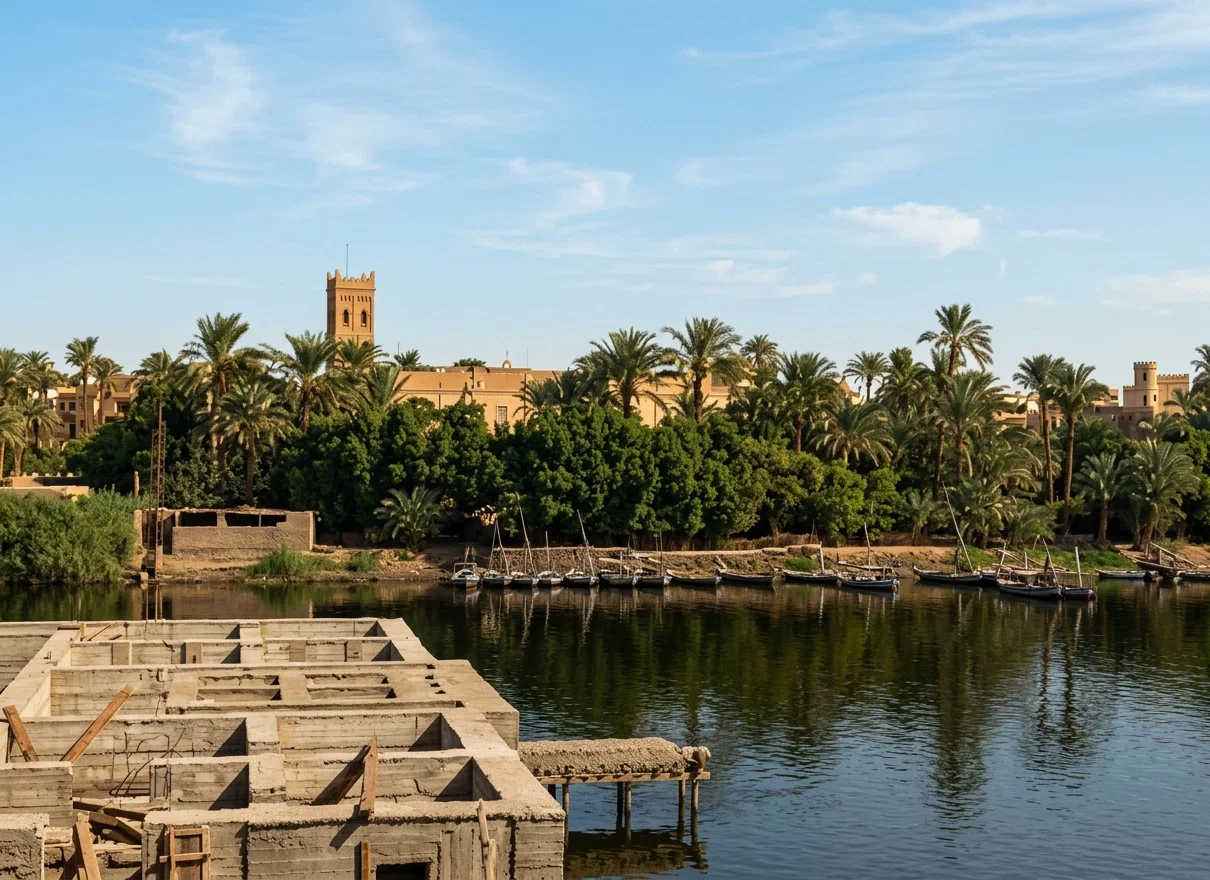
PRESBYTERIAN MISSION COLLEGE BUILDING, ASSIUT
The accompanying illustration is made from a view taken across the channel of the Nile. Among the palm trees may be seen the main college building; it can be identified by the tower rising above the surrounding villas. The building in the process of construction, in front, was begun by a wealthy gentleman, but after spending thousands of dollars in excavating, and laying the foundation, he died, and the building stands unfinished, much to the satisfaction of the hospital authorities, who are thus spared an unpleasant neighbor. We visited the hospital, and were cordially received by the matron, Sister Dorcas, an American lady who had been with the institution from the very beginning.
She related to us many interesting and valuable facts about their work. At the time, their head physician was ill, but we formed the acquaintance of two young American doctors connected with the institution. We found one of them very busy in the free dispensary, which is open an hour or an hour and a half, daily, when he frequently treats as many as sixty cases, mostly persons suffering with sore eyes. They all seemed glad to know that we, too, contemplated doing medical missionary work, and we felt thankful that Dr. Keichline, whose traveling expenses have been furnished by the Young People's Society, and whom we had invited to come to Egypt at once, would soon be with our little band of workers in this great field, to further assist in this important branch of the message. They wished us Godspeed in our work, and we, in turn, hoped that God would bless their efforts to help their fellow men.
From here we went to the new dam across the Nile. It consists of eight piers, the first and the last having three arches and a lock, while the other six have nine arches. Every arch can be closed by an iron lock, so that the whole river may be dammed up, and a good part of it can be diverted into different channels to water several provinces. But a still greater work is now being dedicated at Assuan, in the neighborhood of the First Cataract of the Nile. This is the greatest dam in the world. It is constructed of solid granite blocks. It is more than 6,400 feet long, by 88 feet wide, and 100 feet high. The water can be dammed up to a depth of 65 feet. There are 180 locks in the dam, and it cost $10,000,000.
Proceeding, we visited the home of Elder Awada, in Luxor. This city contains thirteen thousand inhabitants, three thousand of whom are Copts. Luxor, with Karnak a little to the north, and Thebes across the Nile, was the scene of the grandest work of the Pharaohs; and even to this day, there is no other building in the world that will compare with it in grandeur. The Bible mentions this ancient city under the name of No Amon (Nahum 3: 8), where the attention of Nineveh is directed to the fate of this “populous” city, situated on the channels of the Nile, whose strength was Ethiopia and Egypt, and whose helpers were Put and Lubim; and “yet was she carried away, she went into captivity,” and was utterly destroyed. The mighty ruins of this city testify to the truthfulness of this prophecy, as well as to the words found in Jer. 46: 25 and Eze. 30: 14-16. God has indeed executed his judgments in No, and against its temples, which were wholly dedicated to the worship of the sun. We were glad indeed that while these ancient cities mentioned in the Word of God are in ruins, yet there are some honest ones near them, whose ears are open to present truth. Since my visit here last year, Elder Awada has had the joy of baptizing his own companion, and some of his relatives attended our Bible study there during the Sabbath.
While at Karnak, we saw the monument of victory erected by Shishak (1 Kings 14: 25) in commemoration of the defeat Rehoboam, king of Jerusalem, suffered at his hands. The monument shows Ammon, with his sword in his right hand, leading five rows of conquered cities with his left hand, typified by a ring and a prisoner, whose face very plainly reveals Israelitish features. Some of the names of the cities can still be identified. Thus these dumb stones testify to the truthfulness of the Word of God.
On Sunday we crossed the Nile to Thebes, the necropolis of ancient Egypt. Elder Awada had formerly been pastor of a company of Copts, who had united with the Presbyterian Church (there were about twenty in the company); and as we called upon them, they received us very kindly, and furnished us donkeys to go farther across the plain, up to the mountains where the elder of the company lived. They at once arranged for a meeting in the courtyard, and it was quite an interesting sight to see a number of men sitting down on the floor of the courtyard, while the women remained in the adjoining apartments, listening to the truths of the third angel's message. The old gentleman, who was glad to meet me again, charged me before I began the service, that I should present to them the Word of God, giving them his message for this time.11Elder Awada translated my words from English into Arabic. I improved a part of the forenoon and afternoon in presenting the solemn truths for our day, and all seemed grateful for the privilege of listening to them. I believe that the seed sown will spring up in the near future. We also called upon several at their homes, and enjoyed their hospitality, and at the same time visited the ruins of the temples in the neighborhood.
FREE CLINIC (PRESBYTERIAN), ASSIUT
Next morning we rode on donkeys away around the mountains, through a dreary waste of country, to see the sepulchers of the kings at Biban-el-Muluk, where the yellow-colored rocks narrow the valley down to a mere point. A terrible loneliness pervades this whole region, and it is unlike anything else in the Nile Valley. All life seems to be extinct. As we come up to the mighty rocks, we can perceive, here and there, a number of small openings . Anciently, these were closed up. These are the entrances to the sepulchers of the kings, and have been discovered within a few years. Up to date, no less than forty-one have been found. Although the Pharaohs dug hundreds of feet into the solid rock that they might secure a safe burial place for their bodies, yet it was all in vain; for robbers gained access to these tombs, and modern scientists are discovering the most hidden places; and while some rested safely for thousands of years in their dark, unknown sepulchers, laboriously cut out in the hard rock, to-day these tombs are being opened, and some of them are even lighted with electricity. These sepulchers date from the time of the Pharaohs, 1500-1100 B. C., during the rule of the eighteenth to the twentieth dynasties. On the other side of the mountains are the great temples, built in honor of the dead.
We again returned to Cairo, where we spent a few more days together.
I originally planned to visit Palestine, Syria, and Constantinople, but the latest reports in the newspapers, and letters from our brethren, were of such a nature that I felt it unwise to attempt such a journey at that time. Not only was there a ten days' quarantine against all boats from Egypt, but, as the cholera had entered Palestine, there was a state of quarantine in the different towns. For several weeks the railway connecting Joppa and Jerusalem was not in operation, and there was five days' quarantine between the two cities, so that if one entered the country, after passing a two weeks' quarantine, he might spend almost as long a time in trying to get a steamer for the outgoing voyage. The cholera had decimated the population in the ancient land of the Philistines, around Gaza, and had also made its appearance in Joppa. Brother Jespersson, of Jerusalem, wrote me that this had naturally made hard times for them. No tourists whatever were visiting Palestine, and on account of the quarantine, their supplies were cut off to a greater or less degree, so that the expense of living was rather high. On the other hand, fruit could not be transported to Egypt as usual, so it was rather high priced. These things show us the difficulties we shall have to encounter when pestilence and plagues multiply upon the earth.
Under the circumstances, we thought it best to leave Sister Weidmann at Cairo, until the quarantine would be lessened, so she could go on to Palestine; but as soon as I reached Germany again, I was informed by the brethren in Basel, that they had received a telegram stating that she was dying. A letter by Elder Wakeham, a few days later, confirmed her death. She passed away with inflammation of the bowels. Our medical missionaries in Palestine had long desired help, and we were so glad to think that it was soon to be provided. While we may not understand the dispensations of providence in removing faithful workers as they are just entering their field, yet, on the other hand, we know that when such workers pass away at their post of duty, their reward is assured them in the courts above, and that they will soon be clothed with immortal glory.
Hamburg, Germany.
The Santal Mission in India
By W. A. Barlow
W. A. Barlow
We have just started another branch of our industrial work, aided by the district board, by planting fruit and other trees along the government roads around Simultala, which employs quite a number of poor villagers. For this I am thankful to God. This work I have secured through the kindness of a physician and missionary to the Indians, who lives about sixteen miles from us, and is very friendly and kind to us. He takes all our difficult cases into his hospital, and has helped us in different ways in pushing our work.
Last year we had only five papia fruit trees bearing, and this year we have nearly thirty bearing. For this again we thank our Heavenly Father.
During the past year a poor Indian jogi, or hermit, found his way here while on his journey to the heights of the Himalaya hills to spend the rest of his life in “meditation and communion with God,” as he said. He has been reading the Bible more or less for forty years. He was formerly a school-teacher, and was educated in a missionary college near Calcutta. For the past twenty-five years he has lived a lonely life in the jungles, and this Simultala jungle life seems to have drawn him to us. He reads our books and papers very eagerly. He is waiting for Christ’s second coming. Yesterday he volunteered to go out with our Santal preacher and myself, to preach and sing the gospel. At the close of our service, a poor Roman Catholic came home with us, and united in our evening service, singing the Hindi bhajans (hymns), and to-day he has been busy painting our district bullock van. The jogi wishes to accompany us in camp this cold season in our evangelistic tour. He witnessed earnestly yesterday before a crowd of Hindus and others, and volunteered to buy a Hindi bhajan for a Brahman in the crowd. We sold two copies—one to a Brahman, and one to the village postmaster.
Last night we were visited very late by the village watchman, bringing his little son, who had been stung by a scorpion, and was in great pain. I administered some remedies, encouraging them to pray to the great Healer; and this morning, when bringing back our lantern, he told us that his son was all right again. My son invited him to join in our morning service, and I was led to speak from John 3: 14-16.12This same man was near death’s door last year, and we carried him here on a bed, and gave him some water treatments, and through God’s blessing he is a fine, stalwart village watchman to-day, as strong as ever.
During the past few months we have had the pleasure of having with us a God-sent Santal evangelist. He is the only one I know of among the Santals who knows and keeps the Sabbath. He has been helping me translate six of our new tracts from Hindi and Bengali into Santali, and I hope that thousands more will be led by the Holy Spirit into the truth, through the reading of these tracts, comparing the same with God’s Word, as I did. Brother Shaw has helped me to get six thousand printed—two thousand each of three kinds—“The Second Coming of Christ,” “Signs of Christ’s Coming,” and “The Drunkard’s Stomach.” Three more are translated, and ready for the press as soon as our own press is ready for work.
This is one of the most powerful and practical ways by which we can reach the minds of our dear Santal brethren, and the missionaries also. Pray that God will make these people ready and willing to read and meditate concerning the important truths therein, as we send the tracts by post, and circulate them personally. About twenty-five thousand English and vernacular tracts have been circulated in this province during the past year, besides a few thousand Dutch papers, which I placed among the Boer prisoners in the different camps in northern India during July. I trust the Lord will bless his own Word to the Boers and others.
Simultala, India.
South Africa
By J. V. Willson
Kimberley.—Many times the work here has looked as if it would go down on account of financial difficulties, but the prospect now is the best it has ever been since we arrived here three years ago. Our bath and treatment rooms are rebuilt, at a cost of more than nine thousand dollars. A large share of the expense is paid, and the debt of six thousand dollars has also been paid. With our new treatment rooms comes an increased patronage from a better class of people. Our income for the past few months has been about six hundred dollars a month.
But what gives us great joy is that the medical side of our work is coming up rapidly. Calls are coming for medical treatment. Seven physicians are sending us patients. The great De Beers Company has voted to authorize its physicians to send its employees here for treatment, at the expense of the company. Openings are being made with the Cape police and the post-office clerks for our treatments at government expense. We have seen many remarkable cures lately. We are called to the homes of some of the best and most influential people, to give treatments; among these are government officials, members of the legislative assembly, merchants, and mine managers.
Our health remains good, although the summer heat is very trying. We are deeply interested in our work, and rejoice to see it extend. There is no other place so attractive to us as our field of labor. J. V. Willson.