Six months have passed since the Portuguese freed themselves from two heavy yokes, and they surely have demonstrated stability in governing themselves and cleaning up the rubbish of many years. One measure was taken in giving the workingman the right to strike. Then followed a lengthy series of strikes, gas makers, street-car and railway employees, shoemakers, and sewing girls, all desiring an increase of wages and less hours of work. They were very orderly; and with one exception in the city of Setubal, there was no great trouble, altho many companies are foreign. Owing to misunderstandings, two ministers spoke of retiring from office; but large delegations begged them to stay, and having the confidence of their colleagues and the people, they kept to their posts of duty.
Ever since the revolution the Jesuits, who fled or were banished, have kept up a continual propaganda in foreign papers against the republican government and people. Many false telegrams were published, with other calumnies. And it is not to be wondered at if the "Signs of the Times" has published some of the same. Altho the hatred against the priests seemed to be great, yet this was forgotten in the victory. Only two priests were shot, and these had guns in their hands. Lourenzo Mattos, the Jesuit editor of the journal "Portugal," escaped to Spain, and was not shot and dragged in the streets. The convents were attacked because they were centers from which the people were fired on. Arms and ammunition, besides a great amount of provisions, were found. So far as I can judge, the monks and nuns were very well treated, considering everything. Near where we lived, over nine hundred priests were imprisoned in a fort. I chanced to come into Lisbon on the same train with twenty-one priests who were conducted by a company of soldiers. These were met by cavalry in Lisbon and taken to the Ministry of Justice. The people made no special demonstrations.
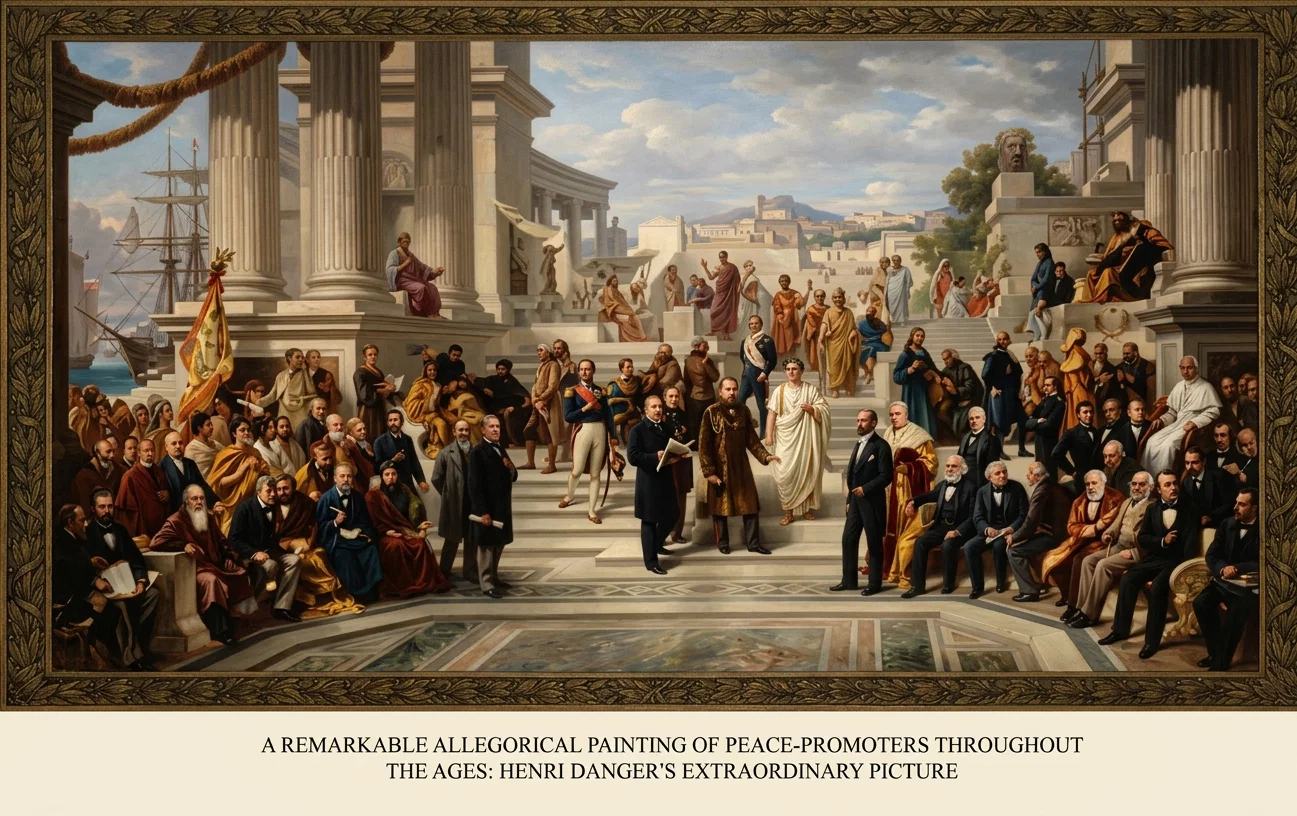
A REMARKABLE ALLEGORICAL PAINTING OF PEACE-PROMOTERS THROUGHOUT THE AGES: HENRI DANGER'S EXTRAORDINARY PICTURE
One early decree was to give freedom and protection to all in their religious worship. The Protestants sent in messages, as also did the Portuguese mission of Seventh-day Adventists. In the cities all Catholic processions in public are prohibited; while in villages where all are Catholics they are allowed. The law for the separation of Church and State has been delayed. One reason is that if decreed so soon many would have thought the law was anti-religious. Many priests have taken advantage of the delay, in arousing the people against the government. The bishops were the leaders. However, the government took energetic measures, deposing one bishop, and imprisoning priests.
In the month of January Bishop Hartzell, of the African Methodist Episcopal Church, with Mr. Robert Moreton, sub-director of the British and Foreign Bible Society in Portugal, as interpreter, had an interview with the Minister of Justice, Affonso Costa, and Minister of Colonies and Marine.
The organ of the Methodist Episcopal Church in Madeira, called "Voz da Madeira," in both English and Portuguese, published the same as written by the bishop and examined by the minister. With respect to the general plan of the government in religious matters the following was declared:
NO. 1
Religion in the public schools and work in private religious schools was also talked about. A spirit of justice to all is kept uppermost. We will give the words of the interview on this point.
NO. 2
Many Protestants here can not bear the thought of having religion taken out of the schools, and advise a change of the religion to be taught. Even the bishop seems to have ideas along this line; but Mr. Affonso Costa has a better understanding of the proper use of public funds and the separate places religion and State should occupy.
For Propagating Doctrines of Demons
The late Senator Leland Stanford left a brother, Thomas Welton Stanford, of Melbourne, Australia. That brother is a devotee of Spiritualism. At séances conducted in his Melbourne home he has been the recipient of various articles "materialized" or brought to him in original substance by spirits, such as tablets, coins, ancient manuscripts, and other marvelous things. Some of these were presented to the university a few years ago, and were refused, so report stated; but now a collection of them has been donated and accepted.11
But this is not all. The San Francisco Bulletin of May 1 states:
"For the founding of a chair of Spiritualism at Stanford University Thomas Welton Stanford of Melbourne, Australia, a brother of the late Senator Stanford, has given the university $50,000. This is half of the $100,000 gift announced Sunday. . . .
"Mr. Stanford is said to have assured the university authorities that he stands ready to donate $1,000,000 for the investigation of Spiritualism.
"The other half of the $100,000 gift is to be used to complete the wings to the university, where the famous Australian landscape paintings presented by Mr. Stanford are to be housed."
There is a tremendous amount of deception practised in séances and manifestations; but without question there are superhuman intelligences—spirits—that reveal a knowledge of mundane affairs of past and present above and beyond the human, that say and do what humans could not say or do, because humans do not know. These spirits have deceived millions into believing that they are spirits of the dead, when according to God's Word, "The dead know not anything." All investigations of Spiritualism apart from God's Word will only serve to help forward the cause of the devil.
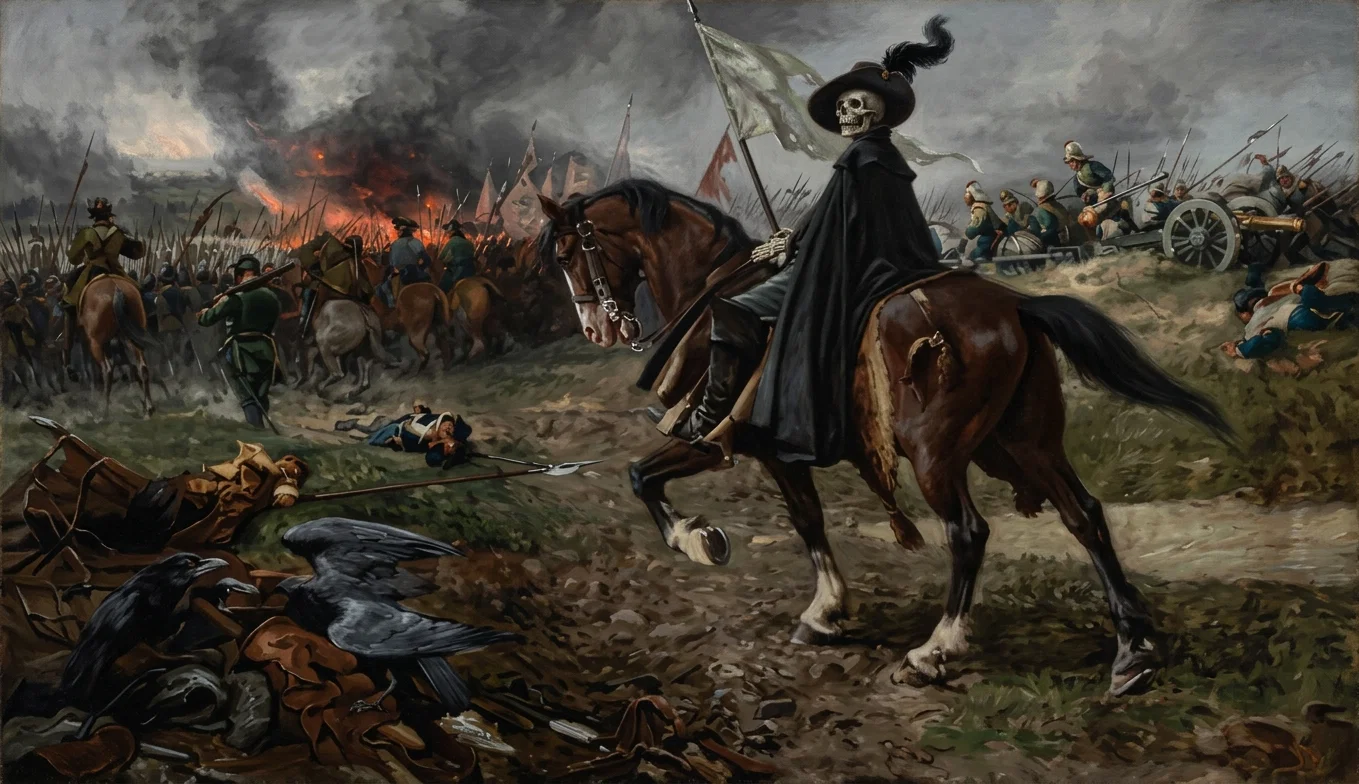
“THE SWORDS OF SOLDIERS ARE HIS TEETH: THE ONLY VICTOR IN THE WARS OF THE WORLD”
—**—
Current Events and Gospel Progress
By Editor
Dr. O. W. Owen, of Detroit, who is digging in the bed of the river Wye near Chepstow, England, for the manuscripts of the Shakespeare plays that Bacon wrote, according to Dr. Owen's cipher, declares that Bacon not only wrote Shakespeare's plays, but that Bacon murdered Shakespeare, and the cipher tells where the supposedly great dramatist's skull is hidden. Most people will have more faith in the skull than in the cipher.
The "Woman's National Weekly," published at St. Louis, Missouri, is authority for the statement that William D. Haywood, at a Socialist meeting in that city, proposed a general strike, which shall include every worker in every industry in the United States, as a protest against what he calls the "capitalistic conspiracy against the life of John J. McNamara," the secretary of the structural iron workers, who is under indictment in Los Angeles for setting the bomb that destroyed the Times building. It is hard to predict what will come out of this trial of McNamara. But it is safe to suggest that such tactics could not help either justice or the cause of labor.
It is possible nowadays for a person to ride in comfort from London to Yokohama in fifteen days. The world is being very rapidly and very closely brought together in these times by constantly improved methods of transportation. There is a striking connection between this fact and the prophecy of Christ that His Gospel of the kingdom would be preached in all the world in a single generation.
LETTERS
By Mother
TO A
DAUGHTER
By a Mother
Choice of Life-Work—Importance of Habit—Promptness—Neatness—Order
MY DEAR DAUGHTER:
Since you have left us, my heart has been filled with thoughts of you. Not with anxious thoughts, my dear, for I know I can trust you to do your best. I feel that your heart and purpose are fixed. Still, at this budding time of youth, this period of greatest possibilities, this time in which the shade and coloring of your whole life will be cast, there is so much which will make for or against its brightest attainment, that I feel I must write you many things.
In the quiet hours of the night, when thoughts of you are sweeter than sleep to the weary body, when before the Father's throne I talk about your beautiful life as I see it perfected before me, these thoughts come tumbling over each other in such profusion, I feel I have a volume at my tongue's end to speak to you. I have no fear, my daughter, that you will think mother is sermonizing, and lightly lay aside my letter; for I remember with comfort that once when I wrote you in this strain you answered quickly, and told me how precious my words seemed to you, and expressed a wish that I would write you again concerning these things. You were a schoolgirl then.
It has been with holy gladness of heart that I have watched your developing womanhood, and your choice—your own free choice—of life-work. I am glad you have chosen to be a trained nurse, for in it, I believe, more easily than in any other, you can follow the footsteps of your Elder Brother, the Holy Comforter of Galilee.
Now, dear, you have gone to your training, and for a time at least (to mother it seems such a long time) you will be away from us, and I shall give you in instalments the thoughts of my heart to you-ward.
We have prayed and studied carefully to know the best school, that which would afford you the best experience in the care and treatment of the sick, and would fit you best to help lift the standard of nursing higher wherever the Master might direct you to work later on. You may have to stand alone as a light-bearer of the third angel's message; hence the necessity of your leaning hard, my dear one, very hard, on the arm that will never fail.
Dwell often upon the "vision" of a life filled with love and service; and strive daily, hourly, that you may not be disobedient to the "heavenly calling"—for such I think we may rightly name it; for have we not sought earnestly for guidance in making this your life-work?
Now will begin in earnest the work of crystallizing your ideals into character building as no experience it has been your privilege to have in the past has done. Right here I want to recall to your mind what I have often tried to impress, the great value of habit in perfecting those qualities that will make for success in the profession you have chosen. Some one has defined habit as "aptitude from frequent repetition," a force as strong for good as for evil, whose strength you can never appreciate until you undertake to break a bad habit once fully formed. Make habit, then, your all in strengthening those traits of character and those practises of life that will make you most able to serve and hence most successful in your profession.
Probably the first thing that will impress you as you enter upon your training will be the exactness with which every item of your daily task will be required. If I have been rightfully informed, your first months, several of them, will be put in at bed making, sweeping and dusting, washing dishes, pots, and kettles, cleaning of toilets, etc. I did not tell you of this—I did not need to. I am sure you will not be daunted by it, nor falter for one moment. You may wonder what all this has to do in training you for your life-work; but as you proceed you will see its bearing and be thankful for it. I deem this the most important part, one of the fundamentals of your training, not alone for your chosen profession, but as tributary to that other calling, the highest ever given to woman, that of home making. Remember this always: Your work, whatever it is, however small or menial, will be characteristic of all your work, however exalted. If you are prompt at your scrubbing of tiling, toilets, halls, etc., in the morning, you will also be prompt at the bedside of the suffering to whom you are called to minister. Let me urge you to strive to make every step of your work complete. Look out for the hidden corners. Let not one particle of dust be left there any more than you would wear a stocking with a hole in it ever so small, or hide away or cover up an unclean thought.
I want to emphasize this matter of promptness. It is nearly always a matter of habit when one is a little behind in meeting an appointment or in coming to the table. Begin right in this respect, and hold to it as for your life. By so doing you will in the end save much valuable time to yourself. What is more, you will avoid doing great injustice to many others, whom you will rob of much valuable time otherwise.
It goes without saying that your own person should be immaculate. Your hair must be neatly dressed before you leave your bedchamber, your gown and apron neat and clean. Before you retire at night see that you have the wherewith to do this. I have often thought what must be the disappointment of a young husband when his bride appears in the kitchen with disheveled hair and untidy dress. It is not to be wondered at that his ideals of home life crumble and his ambitions wane.
But after you have been prompt in your every duty and thoro in the discharge of every detail, one very important thing rests with you in order that this neatness may prevail. I have seen people who were prompt and neat in the extreme who nevertheless lived continually in the utmost confusion. It is said that any one can clean a house, but it takes a fine housekeeper to keep it clean. The secret of this can be told in the story of a little mother whom I once visited. She was a frail little woman, and she had four little ones all under eight years of age. She had no one to help her, yet her house was in perfect order. Of course the babies had their playthings in moderation, and when they were playing with them they were in the middle of the floor; but when they were not, as if by magic the floor was clear. I asked how she kept her house thus. "Simply by having a place for things and putting them in it. If I didn't, I would lose my mind," she said. This principle she instilled in her children in their babyhood. I stayed a week with my own two babes, and was simply amazed at the ease with which she entertained us, never hurried, never apparently weary. Those children have since grown to be very13accomplished and useful young people. This is why I have so often urged you to keep your room, your wardrobe, and your bureau drawers in order. You ought to be able to find any article of your belongings in the dark.
I am glad, my dear, for just the experience you are having right now. Write me often.
Your affectionate—
Mother.
—**—
A Chapter for Girls
One of the chapters in that delightful little book "Out-of-Doors," by M. Ellsworth Olsen, is of special interest to girls. Its title is
Beauty Culture
Out-of-Doors
From it we quote: "Beauty as well as health is the offspring of outdoor life, — a fact which the young woman should not forget. The formative influences of nature, tho too subtle to allow of close analysis, are none the less powerful. . . . Active outdoor habits are necessary to maintain beauty as well as to create it. There is nothing better than a brisk morning walk to give brightness to the eyes and color to the cheeks. . . . If we desire beauty that instead of quickly fading away matures and takes on added richness and depth, we must look to the outdoor girl to furnish it."
The author then goes on to speak of the various forms of exercise and their relative value. The titles of other chapters are:
A Sedentary Race
The Problem of the Children
The Young Man's Needs
More Fresh Air and Less Furniture
"Too Much House"
The Higher Ministry of Field and Wood
Around the Camp-Fire
"The Long Brown Path"
Back to Nature and the Soil
"Out-of-Doors" contains 97 pages, a frontispiece showing Yosemite Valley in colors, and is bound in art canvas.
Price 60c
Pacific Press Publishing Association
Mountain View, California
61 Park St. N., Portland, Oregon
1109 East 12th St., Kansas City, Missouri
Box 1599, Calgary, Alberta, Canada
Training Young Children in Betting
It is easy to become confused as to the lines between harmless and thoroly evil practises; but it is a perilous thing to do. An earnest mother in Montreal is under pressure to sanction an amusement that is far from right:
Should I permit or forbid my children playing marbles "for keeps"?
Is the principle wrong? I find other children would not care to give, or have given to them, the same marbles at the finish of the game as they had at the start. Yet one mother of my acquaintance does not allow her children to play for keeps.
The children say there is no "fun" playing at all if made to give back, yet they are quite willing to play fair. In a child of selfish disposition it seems to develop a willingness-to-lose idea which otherwise (that is, on the give-back principle) he would never have learned.
I am a teacher of a mothers' class; what my children do is looked upon by some as a guide to what their children should do.
I object to the saying that marbles is the same principle as cards, for it seems to me marbles is a game of skill, with no chance element.
Betting does not depend upon chance as over against skill; there is much betting of heavy stakes upon games or events of pure skill. The unhealthy excitement and demoralization of a bet or wager is due to the fact that it rests upon the vicious principle of getting something for nothing; that is, every winning is the result of another's loss. That principle is absolutely contrary to decency, humanity, and Christianity. A child into whose life it is permitted to enter is deliberately being trained in the practise of a principle that wrecks honor, character, and life.
Playing marbles "for keeps" is straight-out betting. It is exactly the same kind of betting as that which the owners of thorobred horses indulge in when they enter their favorites in races of pure skill and place some thousands of dollars on the results. The race-track horse-owners relieve each other of their money; the children relieve each other of the marbles they were playing with — and the marbles cost money. And betting on events of skill and gambling on events of chance, as one grows older, never stay long apart.
So the practise would seem to be rather a costly way of teaching a child unselfishness, even if there were any unselfishness in it at all, which there is not. Unselfishness is the giving up of something that we do not have to give up, not something that we do have to give up. But no child lives of whom it is true that "he would never have learned" how to give up freely unless he had played marbles for keeps. If any parents and teachers suppose so, it is they who need to learn some of the simplest lessons in what unselfishness really is, and how to take advantage of the thousand opportunities in child life to teach it.
If the children complain that there is no fun in a game without material winnings or losings, this shows that their practise is already destroying their normal sense of enjoyment in a real game. A game ceases to be a game when its chief interest is other than relaxation or recreation through amusement or the healthy exercise of skill. The moment the interest turns on what one is going to "get" out of it, the game value is gone. These children need to be taught what a real game is. They will not learn while they are allowed to bet and gamble. — Sunday School Times.
— ★★ —
Foes of Beauty
If I were asked what is the greatest foe to beauty in both man and woman, I would say, not errors in diet, not lack of exercise, not overwork, nor any one of these, but bad mental habits. What do I mean by bad mental states? I mean anger, fear, worry, anxiety, irritability, regret, envy, jealousy, lack of trust in the great God — all these are bad mental states; and all these destroy beauty, not only by interfering with the action of the vital organs, but by directly disfiguring the expression on the face.—Outing.
Glendale Sanitarium Training School for Missionary Nurses
WE desire at least twenty-five young people for our nurses' class beginning June 1, 1911. Applicants will be admitted to class any time during May and June, but it will be well for each one to enter as early as possible.
We are now able to offer a very strong course, one in which an exceptionally large amount of valuable practical experience can be obtained. Our proximity to Los Angeles enables us to give our nurses thoro training along all lines, each nurse spending some time in visiting nurses' work in this city. We desire to put at least twelve nurses into the city during the next few months to help do the work in Los Angeles that we are being called to do in all of our large cities. We can do this and more if our young people will respond to this call. The training that we can offer is one which many if not all of our young people should have to prepare them for active missionary service whether as nurses, canvassers, or Bible workers.
We are just about to open up a surgical ward in our sanitarium which will greatly increase our surgical and obstetrical work.
Those desiring to enter, apply as early as possible to Belle Wood-Comstock, Superintendent Training School, Glendale, California.
Approximate Chronology
"Type and Antitype"—a booklet giving the Scriptural and historical facts, physical and climatic conditions, and astronomical calculations, that enable us to establish in our own modern calendar time the exact date of the Passover, Crucifixion, and Resurrection of Jesus. Price 25 cents. Address H. H. Perry, 67 19th St., San Diego, California, or your tract society secretary.
Hygienic Vegetable Cooking Oil
No More Healthful Shortening Made
Like Olive-oil and keeps indefinitely. 5-gal. can, $4.50; two cans, $8.50; 8 1-gal. cans, $7.75; half barrel (about 32 gal.), 76c per gal. Cash with order. By freight from Louisville or New Orleans. Address Dr. O. C. Godsmark, Chattanooga, Tenn. Department D.