Australiasian Signs of the Times, Vol. 35, No. 25.

Righteous by Resolution
Earlier text: Righteous by Resolution

The Claim for the First Day

W. H. JAMES, M.B., B.S.
THE first day of the week is now almost universally kept by Christendom; and the reason given for its observance is that Christ’s resurrection occurred on that day. We are told that redemption is greater than creation. It is not necessary to dispute this point, but we would ask that even if a memorial of the resurrection were instituted by Christ or His disciples (which is absolutely untrue), are we justified in substituting it for the one already existing to commemorate both creation and sanctification, without some definite statement in Scripture that the former was abrogated? The first day of the week is never in Scripture spoken of as a Sabbath rest day. Are we, then, justified in taking the Sabbath commandment out of the very heart of God’s law and substituting a fresh institution? For if Sunday is to be kept in honour of Christ’s resurrection, it is clearly an altogether new institution. Christ right through His earthly pilgrimage observed the seventh-day Sabbath; the apostles, according to the history of the early Church given in the Book of Acts, always preached on the Sabbath. Only on one occasion have we any record of Paul preaching on the first day of the week, and that is found in Acts 20. At the close of the Sabbath on our Saturday evening the disciples came together to break bread. Paul preached to the believers till midnight as he intended leaving them on the Sunday morning, and taking a long walk to meet the other disciples at Assos. We read of Paul while at Corinth: “And because he was of the same craft, he abode with them [Aquila and Priscilla] and wrought: for by their occupation they were tent-makers. And he reasoned in the synagogue every Sabbath, and persuaded the Jews and the Greeks. . . . And he continued there a year and six months, teaching the Word of God among them.” Acts 18:3-11.
We have no account here of Sunday meetings during this eighteen months, the first day of the week being evidently an ordinary working day, occupied by Paul and his hosts in tent-making. Again, we read that while Paul was at Thessalonica, he, “as his manner was, went in unto them, and three Sabbath days reasoned with them out of the Scriptures.” Acts 17:2. Again, we read of Paul at Antioch in Pisidia: “And when the Jews were gone out of the synagogue, the Gentiles besought that these words might be preached to them the next Sabbath. . . . And the next Sabbath day came almost the whole city together to hear the Word of God.” Acts 13:42-44. If the Sunday institution had been in force, would it have been necessary for Paul to wait a whole week before preaching to the Gentiles? Such a delay might be necessary to get the Jews together, but this was a special sermon for the Gentiles.
The substitution of Sunday for the Sabbath was a gradual one. The early Christians met together for the breaking of bread Sunday morning before commencing the duties of the day, but the Sabbath remained intact. “The earliest recognition of the observance of Sunday as a legal duty is a constitution of Constantine in A.D. 321, enacting that all courts of justice, inhabitants of towns, and workshops were to be at rest on Sunday (venerabili die Solis), with an exception in favour of those engaged in agricultural labour.”—“Encyclopædia Britannica,” art. Sunday ninth edition, 1887. No sacred title is given to Sunday in the above enactment, it is simply “the venerable day of the sun.” Constantine, like his ancestors, was a worshipper of the sun. The first day of the week had for ages been dedicated to that worship, and from that fact retains the name Sunday. See Webster. But on acknowledging Christ, Constantine refused to surrender “the venerable day of the sun,” and brought it into Christianity with him, and thus it was handed down to the Christian Church.
Prynne says, “The seventh day Sabbath was . . . solemnised by Christ, the apostles, and primitive Christians, till the Laodicean Council did, in a manner, quite abolish the observation of it . . . The council of Laodicea (A.D. 364) . . . first settled the observation of the Lord’s day.”—“Dissertation on the Lord’s Day Sabbath,” page 163, ed. 1633. This decree stated in regard to the Sabbath that “Christians ought not to Judaise, and be idle on the Sabbath, but towork on that day. . . . Wherefore if they shall be found to Judaise, let them be accursed from Christ.”—Id. pages 33, 34. The foregoing are Protestant testimonies. See also Hefele’s “History of the Councils,” Laodicea, canon 29.
The change of the Sabbath to Sunday is thus the work of the Roman Catholic Church, and they not only confess it but boast of it. “They (the Catholics) allege the Sabbath changed into Sunday, the Lord’s Day, contrary to the decalogue, as it appears; neither is there any example more boasted of than the changing of the Sabbath day. Great, say they, is the power and authority of the Church, since it dispensed with one of the ten commandments.”—Augsberg Confession, art. 28. “It [the Roman Church] has reversed the fourth commandment, doing away with the Sabbath of God’s Word, and instituting Sunday as a holy day.”—N. Summerbell, in “History of the Christians,” page 418. Sunday gradually acquired the title of “The Lord’s Day,” a title not given it in Scripture where only the Sabbath is designated by the title, as in Rev. 1:10.
Prophecy, in speaking of the Apostate Church, reveals the audacious assumption of power to change God’s law, in the following words: “And he shall speak great words against the most High, and shall wear out the saints of the Most High, and think to change times and laws: and they shall be given into his hands until a time and times and the dividing of time.” Dan. 7:25. Protestants generally recognise what history abundantly reveals,—that the Roman Catholic Church did wear out the saints of the Most High, that millions of God’s people were tortured and put to death because they would not obey the decrees of the Church which were in opposition to the Word of God; but they are slow to recognise that in “thinking” to change the Sabbath to the first day of the week, they also fulfilled prophecy—“he shall think to change times and laws.”

A Quiet Talk on Loyalty

J. L. SIMPSON
Some day life's winding pathway may lead you through the Gethsemane garden, and, amid the anguish and gloom, the knowledge of one faithful friend will be to you as a bright star shining through the darkness. A friend who believes in you, who will stand loyal and true to you and your interests under all circumstances, will be as an anchor to your soul when the storm of the world's censure threatens to drive you to despair.
This is LOYALTY, loyalty to a cause, your cause. Happy the man or woman with such a friend. Christian, whoever and wherever you may be, listen: You profess allegiance to the Christ. Are you as loyal to Him and His cause as you would desire to be to a worthy friend? He represents the greatest cause this world has ever known: “The Kingdom of God upon earth.” Have you seen in your Master the greatest Patriot the world has ever seen? Truly He was, for He was absolutely loyal to His cause. And you are representing Him today. He lived, prayed, suffered, and died for His cause, and He says to you and me, “Follow thou Me.” He also tells us to take up His cross, but many of the professed loyal Christian soldiers are today “dodging the cross and the sacrifice.” But God will not accept from you the title “Lord and Master” unless you are whole-hearted for His cause. Listen while one of earth’s great men tells you how he regarded your Leader:—
“I have inspired multitudes with such devotion that they would have died for me,” said Napoleon on St. Helena, “but to do this it was necessary that I should be present, with the electric influence of my looks, my words, my voice. Christ alone has succeeded in so raising the mind of man toward the unseen that it becomes insensible to the barriers of time and space. Across the chasm of eighteen hundred years Jesus Christ makes a demand which is above all others difficult to satisfy. He asks for that which a philosopher may often seek in vain at the hands of his friends, or a father of his children, or a bride of her spouse, or a man of his brother. He asks for the human heart. He will have it entirely to Himself. He demands unconditionally, and forthwithHis demand is granted. Wonderful! In defiance of time and space, the soul of man with all its powers becomes an annexation to the empire of Christ. Time, the great destroyer, is powerless to extinguish the sacred flame; time can neither exhaust its strength nor put a limit to its range. This it is which strikes me most. I have often thought of it. This it is which proves to me quite conclusively the divinity of Jesus Christ.”—“Manhood of the Master,” by H. E. Fosdick, D.D.
This man, a leader of armies, sees in the Christ One who asks of His followers that which He Himself gave, absolute devotion, loyalty.
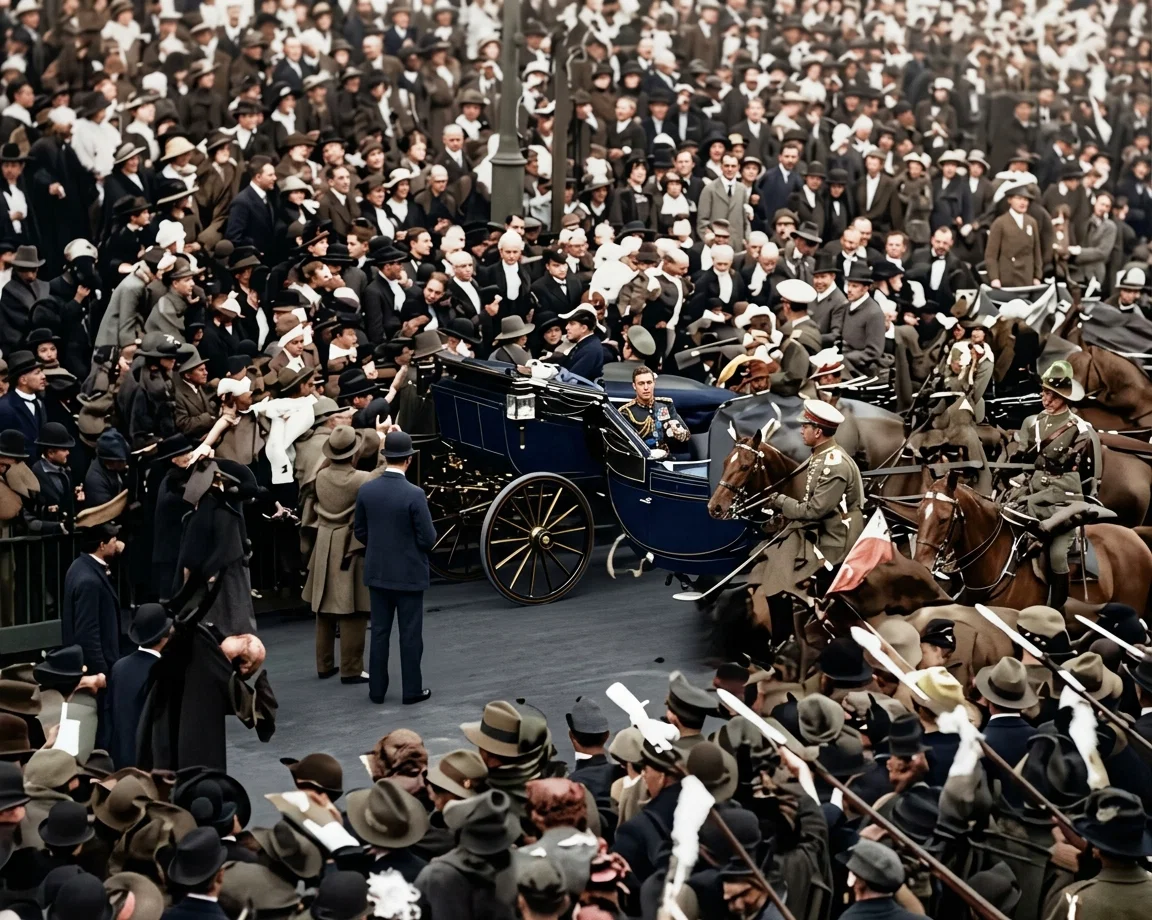
Pathe Photo. MELBOURNE SHOWS ITS LOYALTY TO THE ROYAL VISITOR

A Personal Question

Have you given Him this? Let your heart answer as you kneel before your Prince in the quiet hour. He is speaking to you: “Ye call Me Lord and Master”; “Many shall say unto Me in that day, Lord, Lord, have we not prophesied in Thy name? and in Thy name have cast out devils? and in Thy name done many wonderful works? And then will I profess unto them, I never knew you; depart from Me, ye that work iniquity.” Matt. 7:21, 22.
What fearful condemnation to those who not only professed to serve Christ, but actually did marvellous works in His name! But verses 21 and 24 tell us plainly why they were rejected,—disloyalty. “He that doeth the will of My Father”; “whosoever heareth these sayings of Mine and doeth them.”
This means loyal obedience to all our Leader’s commands, standing true to every principle of His cause. Disloyalty does not alone consist of refusing large responsibility, a call to larger or more difficult service, but it is in the little daily duties which come to us that we prove whether we are loyal to our vow of allegiance, loyal to our Commander. We may think we hear a call to a larger field of labour than the one in which we now serve. Loyalty consists in our standing true to duty just where the Leader places us. Humble duty it may seem, but it is for a King we serve, and although humble it may be, it is essential to the success of His cause. If you fail to do it faithfully, He will find some one to fill your place. The cause cannot fail; victory may be delayed; but the loss will be yours eternally.
Your profession does not flatter the Master. He knows your heart just as He read men and women in days of old. Christ demands loyalty to His cause.
Christian, your Leader asks of you today, “Are you all for the Master”? He says, “A city that is set on a hill cannot be hid.” Just so surely is it impossible to hide your false profession. The world knows what a Christian should be. The world knows what you are, just how much you are like your great Leader. Don’t let them point the finger of scorn at His cause because you are false to your vows of loyalty. Don’t disappoint Him. Many manifest great pleasure at hearing of the wonderful progress of God’s work in the earth; they enjoy association with God’s people. Perhaps at one time they took the vow of loyal service, but the battle went hard, rations could perhaps have been more plentiful, and they began to feel that the One in charge of the storehouse had neglected toprovide for them, so they “dropped out of the ranks” to gather a little more of this world’s goods, and now are watching the progress of the army, and endeavouring to hush the still small voice which disturbs their peace. They see the army is marching on to victory, but the carnal heart says: “Wait a while longer; don’t make any needless sacrifice, for it will embarrass your interests in business if you give your support to the cause without making considerable reserve for this world. You did good service once, God won’t forget that, and you can make a decided step later on.”
Friend, how much will your good intentions avail when God “cuts His work short in righteousness,” and the warfare ceases suddenly? When the Master of the house arises and shuts the door, will your former association and present interest stand you in good stead then? No. In “that day” you will say, “Lord, Lord, we have eaten and drunk in Thy presence and Thou hast taught in our streets.” But He shall say, “I know you not, whence ye are; depart from Me, all ye workers of iniquity.” Sad scene! May you have no part in it, for it is your privilege to hear from your Commander, “Well done, good and faithful servant.”
Have you tried to be loyal and failed? What then? The cause is bound to win. Victory is assured. Your Leader was certain of that, for when “all forsook Him and fled,” in that very hour He said: “Hereafter shall ye see the Son of man sitting on the right hand of power and coming in the clouds of heaven.” Matt. 26:56, 64.
That power is at your disposal today. “All power is given unto Me in heaven and in earth Go ye therefore.”
Can you hold back your full devoted service from such a Commander? The arch-enemy may taunt you with the discouraging words: “You are very weak; you have tried to make good many times; you are doomed to fail.” Turn a deaf ear to him. It is your continued trying that makes success certain.
Now look at the battle from the other side. “Where to us have appeared only confusion, disappointment, broken purposes, and thwarted plans, will be seen a grand overruling, victorious purpose, a divine harmony.”—“Education,” page 305. Will you, therefore, again resolve today that your loyalty will hasten the victory for your Commander and cause? Remember, as one writer puts it, “He is counting on you.”

Consult God’s Promises in Prayer

WHEN you are about to ask of God, do not consult your feelings, or your past experiences or the experiences of others, but consult God’s promises.

China’s Cigarette Imports in 1918

During 1918 China imported goods to the value of £10,000,000, among which were cigarettes valued at £6,000,000, electrical fittings worth £1,000,000, and motor cars with a value of £300,000.

French Appeal Against War-Inspired Names

An appeal has been issued in France that the custom of giving children names connected with the war should cease, and that names such as Joffrette, Joffretta, Namur, Liege, Alsace, Verdun, Salonique, Victoire, Nenette, and Rintintin should be made illegal.

Sweden Plans Powerful Wireless Station

FOR some time past there has been a movement in Sweden for the erection of a wireless station powerful enough to communicate with the world at large and with America particularly. Lately this project has taken on a very different shape. All the details have been worked out, and the matter referred to the Swedish Government, which will, it is understood, present a request to the Parliament for the appropriation of £500,000 to be expended in the erection and equipment of this wireless station.

Ontario Farmers Lead Car Ownership

The latest official statistics just published show that farmers in Ontario last year owned more passenger motor-cars than were owned in all the cities of the province; they also owned more than double the number of passenger cars owned in Toronto, and far outdistanced all other occupations in the number of cars owned by individual trades. The classification, according to occupation, shows 46,997 passenger cars and 825 trucks owned by farmers. Skilled trades come next with 15,042 passenger cars; business men, 13,837; doctors, 3,157; other professions, 5,119; manufacturers, 4,362.

Lyons Turns War Industries to Peace

THE city of Lyons is now busily engaged in applying to peace purposes the vast organisations built up in that centre during the war. Owing to its geographical situation, as well as its industrial history, this French city became during the war the most important arsenal in France. Its chemical and metallurgical industries, which enjoyed an exceptional reputation before the war, have been considerably developed during these past five years, and when they are reorganised for operations under peace conditions they will undoubtedly be the most important establishments of their kind in France.

New European Postage Stamps

The total number of new European stamps issued is about 2,000, of which 1,500 are the first stamps of the European States. Poland, formerly represented by a single stamp, has since the Armistice produced 400 separate and distinct postage stamps. Ukrainia ranks second with 175 varieties, Jugo-Slavia and Czecho-Slovakia contribute about 130 specimens each, and Fiume 73. The average remaining for the other States to divide up is between 30 and 50 stamps. The Trans-Caucasian Republic of Georgia brings up the rear with a modest four. Unified postage will in future cover the Kingdom of the Serbs, Croats and Slovenes, instead of the existing separate issues.

Boro-Budur Temple to Become a Tourist Attraction

The great Buddhist temple of Boro-Budur, in Central Java, will shortly, if the plans of the Dutch Government are carried out, become as well known as the Pyramids of Egypt. The temple, which is one of the most gigantic and finest buildings ever erected, was built about the seventh century after Christ, but when a Mohammedan invasion swept the country eight hundred years later, the temple was deserted and soon became covered with jungle and volcanic débris. In 1814 it was accidentally discovered by Sir Stamford Raffles, and was restored later by the Dutch authorities. Its out-of-the-way position, however, has resulted in a great scarcity of visitors; but now that the Dutch Government has started an aeroplane service in the Malay Archipelago, this world wonder will doubtless become a favourite spot for globe-trotters.

The Value of Dogs and Babies

The Washington Times gives the following quotations on the live stock market: “Dogs, preferred, $10,000. Babies, common, $1,000. These are the figures quoted by two women within a week. One owned a dog which took first prize in a big show. She fixed the price to an enquiring buyer at ten thousand. Another woman, driven to desperation by debt and poverty, offered to sell her little one for a thousand. How much is a dog of this kind really worth?—Nothing. He cannot hunt well enough to provide himself with his own food. He is not big enough to be of any use as a protection. He can be a good home for a few fleas and many disease germs, and there his usefulness ends. The little one, with wrinkled face and wailing eyes, the muscles of which are not yet under control, has all the possibilities of great men who have made its race famous. The dog can never be anything but a dog. The child may be anything that development combined with normal brain power can produce. As far as legislation goes, the quotations on dogs and babies show just about their estimated value—dogs, 10; babies, 1. There ought to be a readjustment that will give the baby at least an equal show.”—American Signs.

The Japanese Typewriter

OWING to the fact that a typewriter to be of any use at all in writing the Japanese language must have more than three thousand characters, it is obvious that only the most general principles of the ordinary machine could be applied. It was necessary to build a machine which contains so many special features as to be to all intents and purposes a new invention. In the writing of the Japanese language three distinct sets of characters are employed. Of these, two, the Katakapa and the Hirakana, are phonetic, each character designating a syllable. The third is the Kanji, or Chinese characters—ideographs—of which one must know three thousand or more in order to write the language at all well. These characters convey the same idea to both a Chinese and a Japanese, although the pronunciation is entirely different. This fact has an advantage in the case of typewriter making, as the same machines may be used by the Japanese and the Chinese.
When K. Sugimoto set about building his typewriter it was obvious from the first that the foreign model could not be followed. A machine having more than 3,000 key arms would be as cumbersome as a grand piano. He solved the difficulty by providing a movable arm which picks up the type from its section in the type tray, strikes it against the paper, and then deposits it back in its proper place. The average speed of experienced writers is from sixty to seventy words a minute, and one speed marvel has set a record of seventy-nine.

Mabel Ashton's Dream

As the guests came together in the brilliantly lighted parlours at the home of Mabel Ashton that crisp winter evening, there was nothing unusual in the appearance of the rooms to indicate that the party to which they had been invited was to be in any respect different from the round of gaiety to which they had been devoting themselves for the greater part of the winter. Some of the guests, as they greeted their young hostess, noticed an unusual degree of nervousness in her manner, but, attributing it to the excitement of preparation and anticipation, thought no more of it, and all were soon engaged in conversation.
The musicians were all in their places, and the young people were beginning to wonder why the signal was not given for the orchestra to strike up, when Mabel Ashton, her sweet face flushed and pale by turns, took her stand near the musicians. After closing her eyes for a moment, during which the room became perfectly still, in a voice at first trembling, but clear and steady, she said:—
“Friends, I know you will think me very queer; but before we do anything else, I must tell you a little story.
“I had a dream last night, which has made such an impression on my mind and heart that I must tell it to you. I dreamed that to-night had arrived, and you had all assembled in these rooms, when there came to the door, and was ushered in, a guest who seemed strangely familiar, and yet whom I could not recognise. He had a rare face, peaceful, yet a little sad in its expression, and his eyes were more penetrating than any that I had ever before seen. He was dressed in neat yet very plain clothing, but there was something in his appearance which marked him as no ordinary man.
“While I was trying to think where I had seen him, he advanced to me, took my hand, and said, gently, ‘You do not recognise me, Mabel?’ Surprised at such a form of salutation from a stranger, I could only say, ‘Your face, sir, seems familiar, yet I cannot recall your name.’”
“‘Yet I am one whom you have invited here this evening, or, I should rather say, one to whom both you and your parents have extended many invitations to be present here whenever I am able to come. You have even invited me to make my home here; and I have come to-night to join your little company.’
“‘I beg a thousand pardons,’ I replied, ‘but you mystify me all the more, and I beg you will relieve me by telling me whom I have the pleasure of greeting.’
“Then he offered to my view the palms of his hands, in which were scars as of nail wounds, and looked me through and through with those piercing yet tender eyes; and I did not need that he should say to me, ‘I am Jesus Christ, your Lord.’
“To say that I was startled would be to express only a very small part of my feelings. For a moment I stood still, not knowing what to do or say. Why could I not fall at His feet and say with all my heart, ‘I am filled with joy at seeing you here, Lord Jesus’?
“With those eyes looking into mine, I could not say it; for it was not true. For some reason, on the instant only half comprehended by myself, I was sorry He had come. It was an awful thought, to be glad to have all the rest of you here, yet sorry to see my Saviour! Could it be that I was ashamed of Him, or was I ashamed of something in myself?
“At length I recovered myself in a degree, and said, ‘You wish to speak to my parents, I am sure.’
“‘Yes, Mabel,’ as He accompanied me to where my mother and father sat gazing in surprise at my evident confusion in greeting an unexpected guest; ‘but I came this evening chiefly to be with you and your young friends; for I have often heard you speak enthusiastically in your young people's meetings about how delightful it would be if you could have Me visibly present with you.’
“Again the blush came to my cheeks as the thought flashed through my mind, To-morrow night is prayer-meeting night; I should have been delighted to see Him then. But why not to-night, on this pleasant occasion? I led Him to my parents,and, in a somewhat shamefaced fashion, introduced Him.
“They both gave a start of amazed surprise, but, convinced by His appearance that there was no mistake, my father recovered a degree of self-possession, and bade Him welcome, as he offered Him a seat, remarking that this was an unexpected pleasure. After a somewhat lengthy pause, he explained to Jesus that his daughter Mabel, being very closely occupied with her studies, and having little variety in life, had been allowed to invite a few friends in for a social evening, with a little quiet dancing by way of healthful exercise. Her friends were all of the very choicest, and he felt that this was a harmless amusement, which the Church had come to look upon in a somewhat different light from that in which it was viewed forty years ago. Removing the objectionable feature of bad company, had made this pleasant pastime a safe indulgence.
“As my father stammered out, in the presence of Jesus, these words of apology, which had fallen from my own lips, I felt myself flush crimson with shame, both for my dear father and for myself. Why should he apologise at all for what he considered unquestionably right? How hollow it all sounded there in the presence of the Lord! Did not Jesus know that my studies were not so pressing but that I could keep late hours, sometimes several nights in the week, at parties?
“Then father, anxious to relieve my evident embarrassment, said, ‘I am sure we can leave these young people safely to themselves, and nothing would please me so well as to take you, my Lord Jesus, off into my study for a talk.’
“‘No,’ said Jesus, ‘Mabel has often invited me, and I came to-night especially to be with her. Will you introduce me to your friends, Mabel? Some of them I know, but some I do not know.’”
(Concluded next issue)

A LIMITED NUMBER

At the completion of each volume of the “Signs of the Times” we bind up a limited number in full cloth and furnish same to those of our readers who wish to obtain copies at cost of manufacture. These volumes would be valuable in your library, and we would suggest that you send in your order at once to

Avoid Disappointment

Copies on hand Year published Price Postage extra
4 1915 7/- 9d.
1 1916 8/- 9d.
6 1917 8/- 9d.
6 1918 8/- 9d.
6 1919 8/- 9d.
Postage to New Zealand 1/6 extra
Send Orders to SIGNS OF THE TIMES, Warburton, Victoria

Contentment with One’s Lot

“I NEVER complained of my condition but once,” says the Persian poet, Sadi, “when my feet were bare and I had no money to buy shoes; but I met a man without feet, and therewith became contented with my lot.”

God’s Dwelling in a Meek Heart

“GOD has two dwellings: one in heaven, and the other in a meek and thankful heart.”

Colporteurs Distribute 220,000 Books in Szechuan

IN the Chinese province of Szechuan, colporteurs distributed 220,000 books during 1918.

Belgrade Agent’s Bible Sales

DURING one year the Belgrade agent of the British and Foreign Bible Society has sold over twelve thousand books, three times as many as in any previous year.

Chinese New Testament for the Blind

IN embossed type for the blind the British and Foreign Bible Society has published some part of the New Testament in seven different forms of Chinese. These books will help to carry the gospel message to the half a million blind people living in that vast land.

Tramps Becoming Instruments of Production

An American paper makes the announcement that prohibition is ruining the workhouse! Further, it is witnessed by an official of the New York Central Railroad, that the “hoboes,” or “tramps,” are going to work, and are becoming instruments of production instead of waste!

Bible Distribution in China and Brazil

CHINESE Bible sellers in North China during last year sold nearly three million books, mainly copies of the Gospels. Many of these Chinese colporteurs travel about the country with their Bible cart drawn by a camel. In Brazil the Bible Society has built a steamer to sail up and down the Amazon and its tributaries with its cargo of Bibles and Gospels which will be sold to persons who have never had an opportunity of possessing one before.

Preventing the Sale of Spirits

THE great nations combined during the nineteenth century and suppressed the slave trade along all the coasts of Africa and Arabia. Is it too much to ask that in the twentieth century they shall combine to prevent the sale of spirits to the less favoured nations and the backward peoples of the Near East, protecting them against the dreadful horrors which have already shown their effects?—Rev. Samuel M. Zwemer, D.D., Cairo, Egypt.

WANTED

WANTED a middle-aged woman to assist in light duties. Good home for a Seventh-day Adventist. Wages 10/- weekly. Apply 186 St. Leonards Rd., Ascot Vale, Melbourne.

THE HOME STUDY HABIT

That is the habit to form if you cannot go to school. And the Fireside Correspondence School was organised to help you form this habit. The President of the General Conference says, “I believe this school is conferring an unspeakable benefit upon our people.”
For full particulars write to-day to
C. C. Lewis, Principal, Tokoma Park, D.C., U.S.A.

Australia's Home of Health

(The Warburton “San.”)
Is the place to get well if you are sick, or if you need a health-restoring rest or change.
WARBURTON is a beautiful township situated in the Upper Yarra Valley amidst magnificent mountain scenery, 48 miles from Melbourne. The climate, both in summer and in winter, is bracing and invigorating. Fine scenery and a good climate, coupled with the hydro-therapeutic, electro-therapeutic treatments, and the excellent vegetarian diet of the Sanitarium, are just the factors which are needed to restore the sick to health.
Send for illustrated booklet to
THE MANAGER, Australia’s Home of Health, (The Warburton “San.”) Mt. Donna Buang Road, Warburton
Conveyance meets train when advised Telephone 5 Warburton Ex.

You have reached the end of this edition.

Australiasian Signs of the Times · Jun 21, 1920