Signs of the Times, Vol. 33, No. 20.

With Our Inquirers
Earlier text: When Ye Shall See These Things, Know

America's Great Peace Parliament

By Our Own Correspondent
PEACE! PEACE! PEACE! was the cry of the great National Peace Congress in New York City. Peace in the POLITICAL world; peace in the industrial and commercial world; peace in ALL THE WORLD.
President Roosevelt's letter to the Congress was a plea for peace and amity among the nations, and at the same time A WARNING AGAINST THE DISARMAMENT of earthly powers as to the danger to the nations if universal DISARMAMENT should become a fact, instead of a theory.
Singular as it may seem, on the very day the President's message was read to the Congress, there was announced the launching of a Japanese battle-ship, built in Japan, in almost, if not quite, record time, which was bigger even than the formidable British Dreadnought; AND THAT WITHIN TWENTY-FOUR HOURS OF THE ADJOURNMENT OF THE CONGRESS, THE SECRETARY OF THE NAVY PASSED UPON THE PLANS OF TWO 20,000-TON BATTLE-SHIPS, and the authorization of these immense death-dealing monsters of the sea WAS DUE TO THE PRESIDENT'S URGENCY.
The writer does not refer to these incidents to criticize the President or the government in the least, but simply to illustrate in a striking manner the peculiar paradox of the situation, PERHAPS THE MOST SIGNIFICANT ITEM of the whole matter of the peace and arbitration movement! Nor is the United States alone in this gigantic work of building navies or equipping armies. England, France, Germany, Russia, Spain, Italy, "the Sick Man of the East," and "the yellow races," are as one, so to speak, in THE PREPARATIONS FOR WAR. The world watches Japan, shrewdly, wisely, and quickly mobilizing the forces of the vastly populated regions of the flowery kingdom—and THE WORLD TREMBLES FOR THE POSSIBLE DEVELOPMENTS! And it is because of this fear and universal dread and apprehension of what is yet to come, that Peace Conferences and Peace Congresses are rapidly multiplying and progressing upon a scale never before realized.
Mrs. Henry Villard.
Mrs. Henry Villard.
Stereograph, Copyright 1907, Underwood & Underwood, New York. Wm. T. Stead, the Noted London Journalist.
Let the reader bear in mind—and as to this there is no controversy—the world is preparing for war upon a scale the magnitude of which can scarce be realized by the human mind.

Peace Conferences Necessary.

Perceiving this, Peace Conferences and their feeble efforts to harness the elements of the terrific destruction that would come as a result of A WORLD WAR, are both natural and necessary. Nor could any one find fault with the organized effort of a Congress of individuals, or wish them other than success in an attempt to "abolish" or even to "regulate" war, or to substitute "arbitration" for "shot and shell." The question remains, can the success in what is sought be secured in this way—by international agreement between nations—without regard to the conditions of HUMAN HEARTS, or the real conditions necessary to UNIVERSAL and LASTING peace!
The President's ONE contribution to the progress of disarmament was a proposal for the "LIMITATION OF DISARMAMENT." Every nation, however, is building the biggest battle-ships that it can, and as to the limit of size, it is governed by harbor and dry dock, and is not fixed BY INTERNATIONAL LEGISLATION. No nation will consent now, NOR AT THE HAGUE CONFERENCE EVEN, to have the size of battle-ships it may project limited BY A CONFERENCE of PEACEMAKERS. They have already authoritatively stated as much.
And as there can be no cessation of war without disarmament, and as there can be no disarmament without consent of the nations, and as the nations are in nowise willing to consent to disarmament or even its limitation; and inasmuch as peace after all depends upon the spiritual transformation of the individual and of individuals that "the peacewhich passes all understanding" is not, and never can be, a subject of arbitration or international agreement, or war or its danger be eliminated while vast armies and great, floating fortresses are ready for war, and while greed, avarice, lust, and selfishness rule in the hearts of men, how may we expect peace to come—"UNIVERSAL PEACE AND JUSTICE AND RIGHTEOUSNESS"? HOW, INDEED? HOW CAN IT COME!
Baron D'Estournelles De Constant, member of the French Senate and of The Hague Tribunal, and the foremost advocate of peace in Europe (and one of, if not the foremost, figures in the New York Congress) referring to the crushing burden of the expense of maintaining ARMED PEACE in the world at our time justly sensed the danger in the following statement made to the Interparliamentary Union in London last summer:
"It is therefore evident that if this state of things (armed peace) is prolonged it will inevitably lead to precisely that cataclysm which we seek to avert, the thought of the horror of which causes the human mind to shudder. To put an end to these incessant armaments, and to seek a means of averting the calamities which threaten the whole world, is the supreme duty which imposes itself on all the States."

The Opening.

The National Peace Conference was formally opened in Carnegie Hall, on Monday afternoon, by Mr. Andrew Carnegie, and almost a thousand delegates were ready to hear the addresses and begin the deliberations of memorable days to follow. In the hall there was a display of everything emblematical of peace. The back of the stage was hung with white material, gold star adorned, with white-bordered silk American flags festooned here and there. In the center a soft electric sign blazoned forth the watchword of the Congress, "Peace," and on the white-draped and flag-hung balconies were shields of David and placards bearing the names of the world's peacemakers of all times, with the single exception of the name of CHRIST, THE PRINCE OF PEACE. And on a shield directly in front of the speakers' stand an inscription epitomized the chief "thought and intent of the heart" of the peacemakers:
Mrs. Frederick Nathan, President of the New York Consumers' League.

"The Parliament of Man"

The meeting was addressed by Secretary of State Root, Governor Hughes, Mayor McClelland, and Mr. Carnegie. Thus did city, State, and nation join in the plea for peace, in the chiefest city of the Western Continent, while the universality of the movement was largely indicated by the fact that far to the south of us, and simultaneously, delegates from the warring Central American governments were gathering for a peace conference to consider the paramount question of international arbitration at Amalpa.
Hon. Oscar S. Straus, Secretary of Commerce and Labor.

Of the More Important Things

I will epitomize as much as possible, and refer briefly to a few of the more striking and characteristic statements of the Conference. Secretary of State Root made a statement which is worthy of remembrance, as follows:
"Let me add a few words of warning concerning your anticipations of what the Second Peace Conference at The Hague is to do. Do not expect too much from it. Such a conference is an agency of peace; not the peace of conquest, but the peace of agreement; not enforced agreement, but willing and cheerful agreement. So far as the nations can go together in such an agreement, the Conference can go, and no further."
In favor of his plan of policing the nations, and securing peace by the decisions of a permanent tribunal, backed up by an armed force, Mr. Carnegie said:
"Before resorting to force it would be well to begin by proclaiming non-intercourse with the offending nation. No exchange of products, no loans, no military or naval supplies, no mails—these restrictions would serve as a solemn warning, and probably prove effective. Force should always be the last resort, but it should be the last."
So, then, it appears, and it would be amusing, if consequences involved were not so serious, the cessation of wars, and the securing of ultimate peace upon the earth is to be accomplished first, BY BOYCOTT; and, if that fails, then BY FORCE—which means WAR!
Further, Mr. Carnegie said: "All speeches, all work, all contributions (of the National Peace Society) are devoted to the ABOLITION OF WAR."
How singularly accurate was the prophecy of Isaiah, so long ago, that "IN THE LAST DAYS" MANY PEOPLE SHOULD SAY: "THERE SHALL BE NO MORE WAR," and in the fulfilment of that prediction to-day we have striking evidence, who can doubt? Indeed, there was a marvelous unanimity of opinion
and of action, in the declaration of "NO MORE WAR." War-drums shall cease to throb and the battle-flags shall be furled! Yet now and then, some bold and intrepid spirit gave the war-cry, spoke of its advantages and merits, and threw a glamor over, and protecting argument for, its mission in civilization! But such an one was inevitably rebuked!
The New York press, with rare exceptions, were united in making the pointed statements that the Congress which was so assiduously working for peace among the nations, did not even possess it among themselves. Then the incongruity of men without it in their own hearts attempting to ORGANIZE PEACE among the nations. "Organized peace," they called it, but peace does not, and can not, come in an organized way alone. Something deeper, truer, must be the mainspring, not only of individuals, but of nations. Organized force, organized means, has, as every student of history must admit, more often cursed the world and brought to it unhappiness, human misery, and bloodshed, than it has blessed it and brought peace and tranquility, happiness and safety, love and established justice!
It was Baron D' Estournelles who pointed out in his Pittsburg speech on "The Organization of Peace," that organization ALONE could never effect the purpose so much desired. The world was well organized to-day, and yet it was bristling with bayonets and spears, and warriors were everywhere preparing implements for the destruction of humankind. Genuine, heartfelt love, the love of brother and the brotherhood of man, love of justice and of mercy and of righteousness, and a sincere desire of peace, could only bring about true results and make the organization for peace really effective. In a word, there was an absolute lack of harmony in the Peace Conference. True, resolutions breathing the very spirit of peace were unanimously passed at last, but not without discord and absence of harmony everywhere noticeable. I may quote from the New York papers to show this lack of harmony:
"Peace Conference Not All Harmony. Dutch Delegate Arouses Storm by His Advocacy of Preparedness for War. Stead Center of Uproar. His Speech at Children's Meeting Cut Off and He Has Lively Tilt with East Siders." —Caption, "New York Times" Article.
Sir Robert Ball, Professor of Astronomy, Cambridge University
"Noted Men's Discordant Views Jar Peace Congress."—N. Y. Journal.
"Lively Tilts at Peace Congress. Delegates in Discord as Conference Continues. Mr. Carnegie Disagrees. President of the Arbitration and Peace Congress is Jarred by President Roosevelt's Letter, and Makes Reply to It.
He also Makes a Sharp Retort to Professor Munsterberg, and Mr. Stead Follows Suit. A Good Deal of Friction Is Noticed."—N. Y. Sun.
"The attack of Andrew Carnegie on President Roosevelt caused a sensation to-day among the delegates to the National Peace conference in session at Carnegie Hall."—N. Y. Evening Journal.
Suffice it to say, your correspondent has not been in any convention of any kind, heretofore, where so much asperity, heated colloquy, and interruptions were to be observed. The Peace Congress, so far as peace related to it, was indeed a failure. The women's great meeting of Tuesday was, perhaps, the only meeting free from heated discussions and difficulties. Even the great banquet at the Astor House was not free from discord. A commotion was caused by certain remarks made by Mr. Van Cleave declaring for WAR in event of the failure of arbitration. The elements of discord were let loose on Sunday of the beginning of the Conference when the Rev. Dr. Morgan Dix, in a public way, declared that war was an ancient and honorable and necessary art, that we were a long way from the thousand years mentioned in the Bible; that even with international peace we should have to contend with internal strife, and finally that people who talked of international peace wasted both time and breath. To this Bishop Potter replied, and the Conference was well launched upon a sea of difficulties.
These differences arose from a difference of opinions as to WAR ITSELF, and not only as to war, but as to the plan for its eradication. Mr. Carnegie and many of the advocates contended for AN INTERNATIONAL POLICE POWER which, of course, would prevent any kind of disarmament, while others—in the minority, I judge—were for a gradual and final complete disarmament of the nations. It was Judge Morrow of San Francisco who quoted the saying: "WE ARE GOING TO HAVE PEACE IF WE HAVE TO FIGHT FOR IT." Indications are that it may take a fight of great proportions to make even an approximate approach to the coveted goal!
Tuesday morning, there was a Women's Peace meeting at Carnegie Hall, A Business Men's meeting at the Hotel Astor, in which leading business men of the continent urged PEACE as the safeguard of commerce, a great Young People's meeting in which thousands of school children took part, and which was addressed by the Baron D'Estournelles and other eminent men. In the evening university professors addressed a mass meeting at Carnegie Hall. At the same time there was a great peace meeting in Cooper Union addressed by Samuel Gompers and other labor leaders, also Rev. Algernon S. Crapsey and Mr. W. T. Stead.
[This report will be concluded next week. The last part is as interesting as the first. The final discussion of the subject will not conclude till God's work is done.]

Meat-eaters Versus Vegetarians

Meat-eaters Versus Vegetarians.—"After exhaustive experiments upon forty-nine students, professors and physicians," says the New York World, Prof. Irving Fisher, of Yale, "finds that the non-meat-eaters out-class the meat-eaters in such tests of physical endurance as holding the arms out horizontally against time, deep knee-bending, and goose-step drill. One vegetarian held his arms out more than three hours, while a meat-eating track athlete cried quits in nine minutes." The World throws in some half-questions, yet admits that "prosperous Americans who lead a sedentary life eat far too much of it." The only thing, however, that the World has to present in favor of meat-eating is that it "rouses and sustains the combative instincts." It declares, what is a truth, that "meat makes its eaters quarrelsome," leading its users to fight about trifles, as among American and English boys. Japanese are much more peaceable; yet vegetarian Japan conquered meat-eating Russia. Meat is not needed, and the world would be better off to-day without it.

The Religions of China.

Taoism, Buddhism and Mohammedanism.

(Concluded.)
TAOISM, as Confucianism, is indigenous to Chinese soil. It was originally quite pure, and dealt with the problem of life in a philosophic way. Lao-tsz, the founder, was some fifty years the senior of Confucius. He held a high position in the State, but seeing so much disorder and lawlessness, he retired from office and led the life of a recluse, giving himself up to philosophical speculation. He wrote a small book about twice the size of the matter contained in the Sermon on the Mount, in which he set forth some very excellent thoughts. This is the Taoist bible, and on this little base the entire system of Taoism rests.
The chief corner-stone of this system is "Tao," literally meaning "the way," "the right way," tho it doubtless refers to impersonal nature, which permeates all things, and is in very truth the source of all things. Lao-tsz taught that true peace comes from ceasing to strive and by living in harmony with the leadings of "Tao." Man, by all his artful and unnatural development, is the cause of all the disorder in the world. His remedy, return to the "Tao."
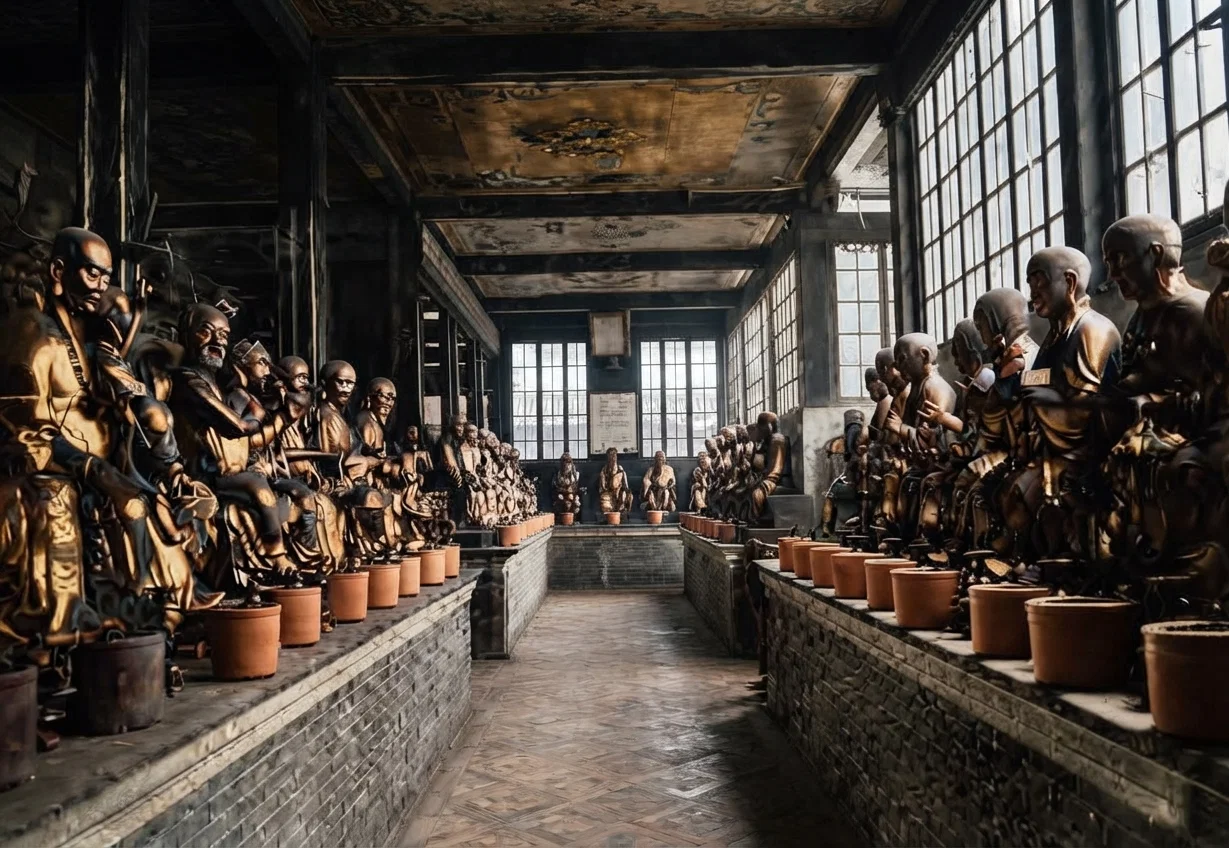
WA LUM TEMPLE, CANTON.
He was never understood by his own countrymen, and his entire system has been perverted into a mass of superstitions, which finds expression, at present, in the Black Art, and which, in a very large measure, is the fruitful source of the wild and fanatical outbursts, which from time to time sweep over whole provinces, bringing death and unnamed horrors. It is this modern Taoism with all its admixture from every other source of idolatry that fills the Chinese mind with superstitious terror. This is very vividly depicted in the "Temple of Horrors," in this very city of Canton. Here in the "Ten Courts of Hell" are illustrated every conceivable form of punishment which poor mortals are supposed to undergo in the nether world. Stucco images about the size of children stand all about busily inflicting the most cruel tortures, while the hapless victims are shown in indescribable torture. This Taoistic hell easily holds its own with that of Dante, or even that of the ancient Greeks. A life lived in anticipation of such awful prospects can not be other than miserable.
"The dread of spirits is the nightmare of the Chinaman’s life, and to this dread Taoism panders." This is where the ignorant, drone-like priest reaps his harvest by posing as the sole mediator between the material and spirit world.

Buddhism.

Buddhism, a foreign religion emanating from India, is said to have been introduced into China by imperial authority, in the first century of the Christian era. Ever since its appearance, it has been by turns welcomed, smiled upon, persecuted, patronized, tolerated, until to-day it has come to be looked upon as a fixture. Its early vigor and strength have long since passed away, leaving it an effete system whose ignorant, immoral, and opium-poisoned priests, as well as its nuns, are the objects of popular contempt and ridicule.
How many Buddhists are there in China? —Broadly speaking, there are no less than there are individuals, for the reason that by a peculiar and inexplicable eclecticism, a Chinese is at once a Confucianist, a Taoist, and a Buddhist. These three religious systems are said to supplement each other, so making one whole scheme of human salvation.
Buddhism is a meditative, speculative, pantheistic philosophy, having as its studied objective, absolute "nothingness;" and as such it is well received by peoples of enervating climates. After being introduced into China, it was, owing to the more practical turn of mind of this people, materially modified as is evidenced by the substitution of a real and material paradise for the Nirvana of the more orthodox Buddhism, which deals almost altogether with abstractions. In India, Buddhism is atheistic, while in China it is rather silent or non-committal as to God. Let us hope and believe that this misleading light of Asia is speedily being displaced by the eternally true and invincible light of the true God and His Son Jesus Christ.
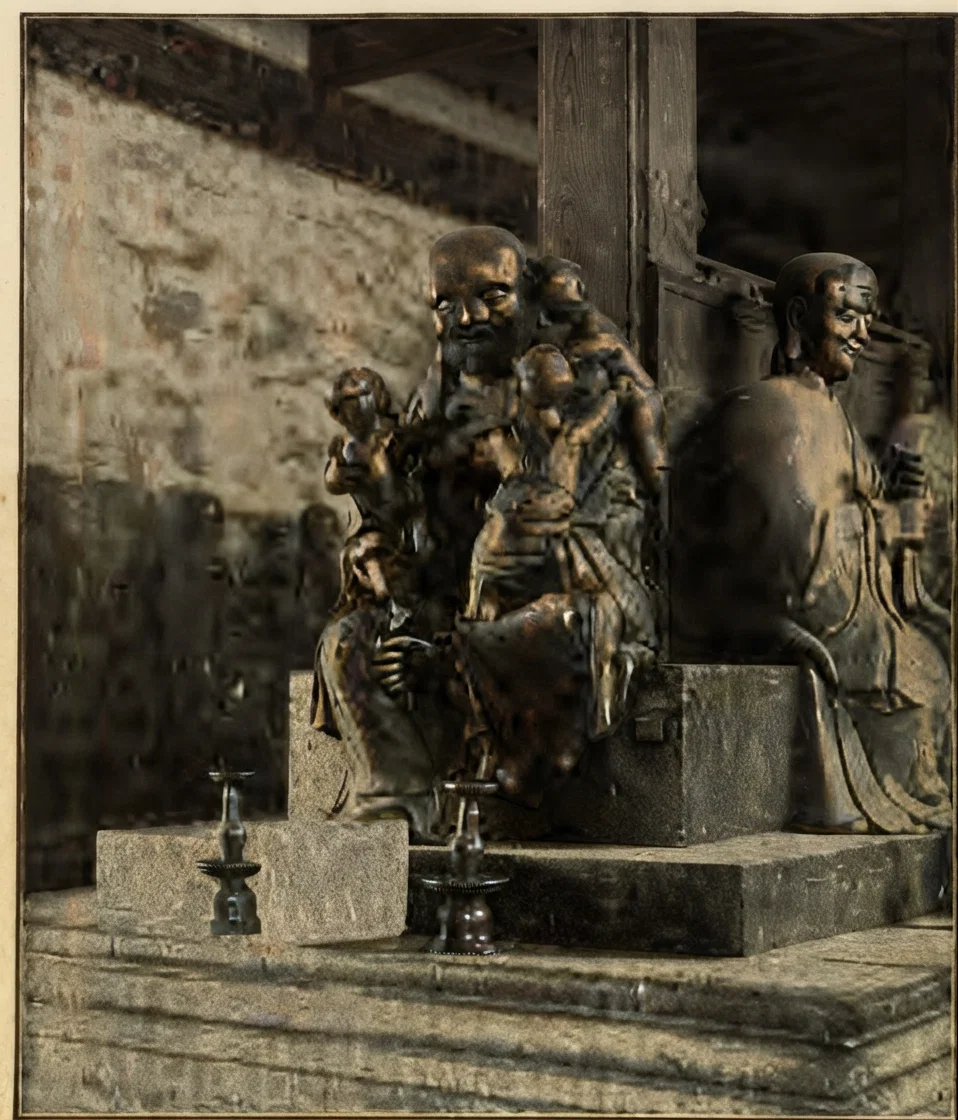
Buddha, with three smaller ones climbing on him. Wives desiring children worship at this shrine.

Mohammedanism

The Arabian prophet has in China a following of some 20,000,000 scattered thru the entire empire. Strange as it may seem, these idol-haters have been led into at least one form of idolatry, that of worshiping the emperor’s tablet. Doubtless this came about thru fear of persecution, on which account the Koran allows the lapse.
Mohammedanism in China has been more conspicuous for its rebellions than for its activity in propagating its faith. The Koran has not been translated into Chinese, and this faith never exerted a great influence in China.
This in brief, and more or less perfectly, is China, groping about in the dim, misleading light of her own and foreign faiths. She is in sore need of the one true Light of the world. She needs the Bible, the living word of the living God; and she needs the convicting and comforting power of the Holy Spirit. On her own part, she is consciously turning away from the false gods of her fathers, and it becomes the followers of Jesus to see and seize upon this their opportunity. Let us all as never before give ourselves tothe work of preaching in China as elsewhere the Gospel of Him who is "King of Kings, and Lord of Lords."
J. N. ANDERSON.

Bible-Readings for the Home Circle

Bible-Readings for the Home Circle. This book comprises 162 readings for public and private study, and answers nearly 3,000 questions on religious topics,—practical, historical, and prophetical. It contains 600 octavo pages, printed on a superior quality of tinted paper, embellished with 57 full-page engravings and 170 ornamental headings, together with 10 full-page Scriptural and prophetic diagrams, 3 colored plates, and other attractive features. The bindings are elegant and substantial, the styles and prices being as follows: Cloth, gilt side title, marbled edges, $2.25; library, marbled edges, $3.25; full leather, marbled edges, $4.25. Cheap edition, 400 pages, solid type, no illustrations or colored plates, no poetry, thin paper, brown cloth, plain edges, $1.00. Address this office.
S. S. Supplies.—We still have a good supply of S. S. Record F at 35 cents, for schools of 20 to 90 members; class records at 10 cents; S. S. Quarterlies at five cents each. If you need a Bible, send for our "Select List of Bibles." Address, Pacific Press, Mountain View, Cal.
For Sale.—Ten-acre fruit farm in the beautiful Santa Clara Valley of California. The main crop of fruit is cherries, apricots, and prunes, with a few trees each of various other kinds for family use. The place has a seven-roomed house, with bath, hot and cold water, and the usual modern conveniences; good well, tankhouse, tank, windmill, barn, chicken houses, 190 trays for drying fruit, 60 fruit boxes, etc., etc. The crop last year sold for $1,350, cash. This year's crop goes with the place. Will sell for $5,700; $3,500 cash down, the balance can be had on long time, if desired, interest at eight per cent., and the person holding mortgage pays the taxes. It is a very desirable place, in a good community. The owner has a large family of small boys, and desires to move to newer country where he can get a large tract of cheap or government land. Address, F, care Pacific Press, Mountain View, Cal.
Wanted at Once.—Twenty-five young ladies, fifteen young men, all consecrated Seventh-day Adventist Christian workers, to make immediate arrangements to enter the Glendale Sanitarium Training-school for Missionary Nurses. Class begins June 1. Exceptional opportunity to secure a practical missionary training that will fit you for any field in the world. Address Dr. Winegar Simpson, Glendale Sanitarium, Glendale, Cal.

Choice Tracts

TOPICALLY ARRANGED

Per hundred Post-paid
IMMORTALITY QUESTION:
Thoughts for the Candid (B. S. L., 47) $.50
Rich Man and Lazarus (B. S. L., 146) 1.00
Is Man Immortal? (A. G. L., 86) 1.00
SECOND COMING OF CHRIST:
Without Excuse (B. S. L., 46) .50
The Eastern Question (B. S. L., 144) 1.00
We Would See Jesus (B. S. L., 173) 1.00
The Gospel Message (B. S. L., 188) 1.00
Waymarks to the Holy City (B. S. L., 189) 1.00
Signs of the End (B. S. L., 194) 1.00
Coming of the Lord (A. G. L., 40) .50
Heralds of His Coming (A. G. L., 85) 1.50
"Come, for All Things Are Now Ready" (A. G. L., 87) 1.00
THE SABBATH QUESTION:
Why Not Found Out Before (B. S. L., 52) .50
Jewish (B. S. L., 69) .50
From Sabbath to Sunday (B. S. L., 95) .50
Identical Seventh Day (B. S. L., 114) 1.00
The Seal of God and the Mark of the Beast (B. S. L., 130) 2.00
New Testament Sabbath (B. S. L., 137) 1.00
Who Changed the Sabbath? (B. S. L., 187) 1.00
Elihu on the Sabbath (B. S. L., 192) 1.00
The Seventh or One-Seventh (A. G. L., 39) .50
Day of the Sabbath (A. G. L., 50) 1.00
* Which Day Do You Keep, and Why (A. G. L., 75) .50
Is Sunday the Sabbath (A. G. L., 76) .50
The True Seventh Day (A. G. L., 78) 1.50
Sunday in a Nutshell (A. G. L., 88) 1.00
TEMPERANCE:
A Chat with My Tobacco-Loving Brother (A. G. L., 67) .50
Food: Its Mental and Moral Value (A. G. L., 68) .50
* The Name (A. G. L., 72) 1.00
* Demons' Council (A. G. L., 80) .50
It Does Not Pay (A. G. L., 82) 1.00
SPIRITUALISM:
Spiritualism: Its Source and Character (B. S. L., 112) 1.00
Try the Spirits (A. G. L., 48) .50
MILLENNIUM:
Temporal Millennium (B. S. L., 121) 1.50
THE LAW:
Under the Law; or Under Grace (B. S. L., 163) 1.00
Relation of the Law and Gospel (B. S. L., 166) 1.50
The Perpetuity of the Law (B. S. L., 178) 1.00
Ceremonial and Moral Law Distinguished (B. S. L., 195) 1.00
The Two Covenants (A. G. L., 83) 1.00
PRAYER:
Prayer, by A. T. Pierson (A. G. L., 52) 1.00
GOSPEL STORIES:
How Esther Read Her Bible (A. G. L., 7) .50
Back to the Old Paths (A. G. L., 44) 1.00
BIBLE STUDY:
Benefits of Bible Study (A. G. L., 10) .50
Topical Bible Studies (B. S. L., 185) 1.50
MISCELLANEOUS:
* Way to Christ (B. S. L., 105) 1.00
The Priesthood (B. S. L., 191) 1.00
* Looking Unto Jesus (A. G. L., 1) .50
* The Christian's Privilege (A. G. L., 2) .50
The Sure Promises of God (A. G. L., 3) .50
Return of the Jews (A. G. L., 62) 2.00
Jesus Died for You (A. G. L., 63) .50
Some One Cares for Your Soul (A. G. L., 69) .50
Great Popular Evils (A. G. L., 89) 1.00

PACIFIC PRESS PUBLISHING CO.

Mountain View, Cal. 285 Salmon St., Portland, Ore. 1109 E. 12th St., Kansas City, Mo. Box 666, Regina, Sask., Canada. REVIEW AND HERALD Battle Creek, Mich. Takoma Park Station, Washington, D. C. 32 Union Square East, New York. SOUTHERN PUBLISHING ASSOCIATION Nashville, Tenn. Hickory, N. C. 217 So. Main St., Fort Worth, Texas.
Continue reading: Studies in the Christ-Life at Brother Eldred's