Your ShelfYour Projects

Review and Herald, Vol. 82, No. 6.

Publishers’ Page
Earlier text: The Better Way

The Work in the Latin Union

L. R. CONRADI
Of all the European unions, the Latin Union has the smallest number of Protestants. With a population of about one hundred and ten millions, there are not more than one million Protestants in the whole field, and they are largely settled in French Switzerland.
The Central European Conference was organized in 1884, and is to-day known as the Roman or French-Swiss Conference; thus this is the oldest field in Europe. However, the work has moved forward slowly. When the Central European Mission was opened, there were included within its territory the countries embraced in the German Union Conference, but as the work grew, it was divided.
Even in Switzerland itself, we now have two divisions—German Switzerland and French Switzerland; and in what was formerly the German part of the Central European Mission we have the present German Union Conference. However, there is yet plenty of territory in the Latin Union; for it includes, aside from French Switzerland, the countries of France, French Belgium, Spain, Portugal, Italy, and the French colonies in northern Africa. Most of the work in the union has been done in French Switzerland. Some efforts had formerly been put forth in France and Italy, but they could hardly be termed permanent. It is only within the last few years that we have in reality begun to work France and Italy, and we have but recently made a beginning in French Belgium, Spain, and Portugal. Thus every country of the European portion of the Latin Union has been opened. What we need yet to enter are the African colonies of France, as Algeria and Tunis.
As all continental Europe was at one time embraced within the territory of the Central European field, the Basel house served well as the general headquarters and publishing house; but the base of operations was changed on account of the troubles we had in Basel with reference to the Sunday laws there, and especially as we were able to secure far better facilities in Germany for our printing and publishing work. The Basel house was then converted into a sanitarium and food factory; but as it was not originally intended for such purposes, and it furnished room for only a limited number of patients at best, and as Basel is a German city, while we were trying to conduct in it a training-school for the education of French nurses, the reader can readily see that we have always had to work at great disadvantage in conducting our health work here. We needed a French training-school for nurses and workers in a French-speaking district.
LATIN UNION CONFERENCE TRAINING-SCHOOL
Brother Wilkinson had two institutes for workers, one in Geneva and the other in Paris, but these were of short duration, and the brethren felt that for this great field, with its millions and millions who should hear the message, we certainly ought to have a permanent school for the education of native laborers.
Realizing this need, we have tried for two years to find either in French Switzerland or in France a suitable place for the training-school we desiredto establish. We desired to sell the Basel house, that we might release the capital tied up in that property; but the financial conditions of the country have been such that we have not been able to accomplish this; so we turned our attention to the possibility of making an exchange of the Basel property for a more suitable location in French Switzerland. One great advantage of this arrangement would be that it would enable us to conduct the food factory on Swiss soil. The food factory has been, up to the present time, financially the paying factor in our Swiss sanitarium work. On account of the customs, we could not advantageously import our health foods into Switzerland; hence the necessity of continuing the work inside of the Swiss border.
THE MANSION
THE MANSION
A little more than two years ago, while the leading brethren from America were here to assist us in our councils, it was decided that the Basel property be disposed of, and that the capital invested in it be equitably divided among the Latin Union, the French-Swiss, the German-Swiss, and the German Union fields. At the same time, in view of the money on hand, it was advised that the Latin Union conduct its evangelical work from the cash thus secured. This capital had been saved up through great economy on the part of the management, and through the liberality of our brethren who were anxious to help in the cause of God. As a number of workers were sent over from America, and the evangelical work was extended, about twelve thousand dollars of this capital has been consumed. Then, as the publishing work was moved from Basel later on, it took about seven thousand dollars from them in stock, and now all the capital at the disposition of the Latin Union and French-Swiss fields is about thirty-five thousand dollars.
Finally, at the time of our French-Swiss camp-meeting last summer, we were informed that a suitable property had been found for our needs, on Lake Geneva. In company with Brother Spicer, we visited the place. It at once impressed us very favorably. Here was a large estate with forty acres of fine oak timber, several hundred years old. There are a number of good buildings on the farm. It is an ideal location for a sanitarium and school. It lies nearly midway between Geneva and Lausanne, two of the largest cities in Switzerland, about sixteen miles from the first-mentioned city. The main pike thoroughfare between Geneva and Lausanne runs through the place, and there is a railway station about one mile away. Three miles distant is the steamship landing on the lake.
Of course we did not contemplate taking the whole estate. The owner, an elderly gentleman of Lyons, had probably invested one hundred and twenty thousand dollars in this property. His wife had died, and his son had been lost to him through misfortune, so he felt anxious to sell the estate, that he might be relieved of the burden of caring for it. However, he had no inclination to take over the property at Basel, so we had to deal through the agent, who did not have very much capital at his disposal. This agent bought the whole estate, and sold that part which is under cultivation to the man who had been farming it for some time, and we bought the other part of the land, the agent agreeing, as one of the conditions of the bargain, to dispose of the Basel house at a stipulated sum before a specified time. We receive about eighty acres, with the main buildings. This is a most ideal spot for the sanitarium and school. As there was a large cow stable for about forty cows, and the barn was close to the mansion, we had to take these, and pay five thousand dollars extra; otherwise we could have made an even deal.
Thus, while in Basel we had only a city lot and a building sufficiently large to accommodate about twenty patients, and very limited room for the food factory, we now have a location as suitable for our wishes as we could desire. We already have room for the accommodation of twenty patients and as many students. We have about one thousand feet, well walled, on the lake front, where we can erect our sea baths, and there is plenty of room for the sun-baths. We now need to provide some treatment rooms and more rooms for patients, and to remodel the barn into a food factory and living-rooms.
(To be concluded)

God Rewards Faithful Workmen

God never discharges nor lowers the wages of his faithful workmen.

Mission Notes

“By what right do you choose your King’s last command as the thing to be crowded out of your life?”
SPEAKING of the Sabbath-school at Tonga, Sister Butz writes: “The school has taken a deep interest in the lessons. Most of the senior class, and also the two children in the junior class, have learned nearly all the book of Revelation by heart.” Our Tongan brethren have set us a very worthy example. We wonder how many have done likewise.
A MISSIONARY writes: “Two young men who came often to our meetings said they believed in Jesus. We hoped they would soon show a desire to be baptized, but they did not. One day they called together on us, and we read the Scripture, ‘Whosoever . . . shall confess me before men, him will I confess also before my Father which is in heaven.’ ‘Ah, we did not understand,’ they said. ‘We thought if we believed with the heart, we need not be baptized; we could just go on quietly so.’ Three weeks later they were baptized. They have still much to learn, but we hope to see them ever confessing Christ, and themselves confessed at last before the Father.”
“THE problem is no longer ‘the open door.’ The doors are wide open in every land. With the exception of Tibet, Afghanistan, and the Belgian Congo State, there is not a country in which the delivery of the gospel message is not merely feasible, but a constant fact. It is not the securing of an audience. It is, indeed, no more true to-day than it ever has been, that the great masses of Asia and Africa are hungering and thirsting for Christianity. Yet nowhere is it difficult to gather a company of those willing to hear, while many, everywhere, are eager to know of Christ. The great problem of to-day is the securing of the funds needed to enter these open doors.”
WORD comes from Brazil that “Elder Graf is just now instructing some students in the Taquary school for the canvassing work. Two of our German canvassers are ready to go among the Brazilians, but we lack books in this language. Elders Spies and Ehlers have been moving their families to new fields, and this always takes a long time in this country. You will be glad to hear that the Lord is greatly blessing the efforts of Elder Schwantes. At one place he baptized eighteen, with about twenty more awaiting baptism. Brother Haelzle reports quite a number of converts awaiting baptism in Parana. So you see the work is onward. A few days ago we had a small revolution in this city, with the aim to depose the president. All is quiet again now, but only for a time. O that we could enter these cities at once with a number of good workers! Pray that this may speedily be done.”

Panama

BOCAS DEL TORO.—We were much disappointed, on reaching Bocas, to find that Elder Knight had gone to the States just the day before we arrived. He is expecting to return in a few months. We have done the best we could in a strange land, and the brethren have all rendered much help.
The more I get a glimpse of the real life of this people here, the more I can understand their needs. I must confess that I never before witnessed such moral degeneracy and physical depravity. And it will take long, persistent effort to reach most of the people here. Their condition will necessitate a course of training, and that course of training must begin with the child, in order to accomplish much good.
In view of the need of a school, we have decided to open one here in the mission building, for the children of our own people. Then as the work grows, we can move to other quarters, or enlarge our borders. The brethren here are very anxious for a school, and my sister-in-law has consented to take up that work for the children. I think it will prosper.
C. E. PECKOVER.

Western Washington

TACOMA.—Since the Sedro Woolley camp-meeting I have been in the city of Tacoma. Our work here is progressing nicely. Tacoma has always been considered a hard field, and at one time it looked as if the work here would go to pieces. I am glad to say, however, there has been a happy change, and now the outlook is very encouraging. Since the South Tacoma camp-meeting I have been in the city twenty-six weeks, and there have been twenty-six additions to the church. The members of the church are greatly encouraged, and are earnest in the work. The week of prayer was a season of drawing nearer God, and advance steps were taken. Some had not been paying tithe, but have decided no longer to rob God. There is a successful church-school in progress. Dr. T. J. Allen is conducting a private sanitarium, which is well patronized. I have a room in the building, and conduct worship with the helpers and patients.
Last Monday morning the nature of man and the Sabbath question were up for discussion before the ministers’ alliance. I had the privilege of defending the truth on these points before about thirty of the leading ministers of the city. I believe that a good impression was made. Some of the ministers were bitter in their attacks, yet I was pleased to see the spirit of fairness on the part of a large number of those present. At the close of the meeting, which occupied more than two hours, several ministers shook my hand very cordially, and wished me God’s blessing. I feel thankful for a truth that can stand against all the wisdom of the world. I trust that seeds were sown that will bring forth fruit. There are honest, broad-minded men among the ministry, who, I hope, when the final test comes, will range themselves on the side of God’s truth for this time. I am thankful for a part in the work of God, and for his blessing as I do that work. My courage is good.
W. F. MARTIN.

Jamaica

CHRISTIANA.—We have had a good hearing in the tent-meetings, the attendance being the largest that I have ever seen at any tent-meeting, either here or in America. But the enemy is contesting every inch of the way. A house-to-house canvass is in progress by the ministers and officials of the churches operating in this section, and strenuous efforts are being made to prejudice the minds of the people against the truth. Our meetings have been disturbed and the tent stoned several times. One wealthy man, living near us, tried to have me ejected from the premises where I live, the tent being in my front yard. He himself offered to rent the property for a long time. But the man from whom I rent is a gentleman, an honest man, a lover of the message, and would not yield to the solicitations of the chief man of the town, who was and is loudly clamoring to have our work stopped. A few have begun to walk in the light, in spite of all opposition, and we hope many others will do so. We are of good courage, more determined to press forward in the work than ever before, knowing that they can do nothing against the truth, but for it.
Our conference this year was a most pleasant and profitable occasion to all who attended it. Perfect unity prevailed at all times. We are all entering the new year with hope and a determination to achieve great victories before the next annual meeting, believing with all our hearts that we are almost at the journey's end. J. A. STRICKLAND.

The Training-School in Argentina

CONSIDERING everything, the most satisfactory year of the Colegio Camerero (the Argentine training-school for workers) closed Nov. 11, 1904. The total enrolment, including those attending the children's department, was forty-one. About twenty-five were members of the missionary training department, some of whom had attended regularly for the last three years.
We have been anxious for the time to come when laborers could go out into the different branches of the work from this school. Our hopes are being realized. Four young men who have had more or less training in the school have been granted ministerial licenses. One of these has already had success in bringing souls into the truth. Two of the others have had good experiences in canvassing, and all give promise of becoming successful soul winners. Six were given missionary licenses; one of these has been selected to fit himself to take charge of the printing work when it is begun, another to unite with the office in Buenos Ayres, and also to take part with Elder Town in work in the city, and the rest to engage in the canvassing work. Besides these, several others are already engaged in canvassing without special conference recognition.
The farm work has been more profitable than in former years. Besides what has been used in the school, about one hundred dollars' worth of corn was sold. Over one hundred fruit-trees, besides shade trees, have been set out, which are adding to the appearance of the school property. The stock has increased by one horse and two cows, and we have eleven swarms of bees.
But little was added to the building, owing to a lack of funds. The debts which resulted from the effects of the cyclone of two years ago were all paid, and we have in pledges about two hundred dollars, and a kiln of twenty-five thousand brick that have been burned on the place. Teachers find themselves greatly hindered in carrying on the work, both in the school building and outside, for want of facilities. The forty acres of land is not sufficient for pasture and cultivation. The machinery and tools are insufficient. There are no reception rooms. One of the teachers has had to share his room with a student, and also use it as a class room. The other rooms were crowded, as many as six students being in one room. There is no bath room; the water must be drawn with a bucket from a well eighty feet deep; there is not one foot of veranda; and there are other less apparent but often more annoying deficiencies. The teachers have therefore had to workunder great disadvantages, and sometimes discouragements. One thousand dollars would not be one cent too much to make the most urgent improvements. But where is it to come from?
The receipts on tuition are sufficient to meet the salary of one of the teachers, while the wages of the matron and the kitchen and room expenses have all been met from the garden and dairy, and from payments from the students and teachers.
We are greatly rejoiced over the receipt of thirty-four dollars toward the erection of a bath room, and about one hundred and seventy-five dollars as a fund from which to assist by loans worthy young people in our school, from the Union College Young People's Missionary Society. They have the most hearty thanks of all connected with the school, and of all our people in this field.
Professors Fulton and Lude have again been chosen as the teachers for the next year, the former as principal, and the latter to have charge of the German Department, with the general oversight of the farm.
J. W. WESTPHAL.

Porto Rico

MAYAGUEZ.—We reached the island safely, and were glad to get home. We are finding plenty of work to do in almost every branch. At the present time, Brother and Sister Connerly are away for a little trip, looking after the interest in another part of the field. He came home for a few hours to-day to lay plans for the native worker to leave to-morrow for another place. We are a busy company.
We found the work moving nicely. Brother Connerly had just begun a series of lectures on the prophecies. A good interest has been awakened in both the upper and lower parts of the city. Last Sabbath was a good day for us. Although Brother and Sister Connerly and Brother Moulton were absent, we had sixteen out to services. The native worker took the children, while I took the adults. Our lesson was on Acts 1. As we studied the return of Christ in connection with Matthew 24, the Spirit of God witnessed to the truth, and the faces of those who were interested glowed with rapture.
I am glad we as workers can see eye to eye in pressing home this message. The time has come for it in Porto Rico, and we are planning to push it with all the power that God gives us. The Lord has blessed us wonderfully. I am truly thankful for the progress of the message here.
MRS. IDA M. FISCHER.

En Route to India

STEAMSHIP “ARABIA,” DEC. 18, 1904.—This beautiful morning finds us near Aden, and enjoying a very pleasant and quiet voyage. We have had a calm sea ever since we left Port Said. There we met Ella McIntyre, Miss Passebois, and Brother Quinn, who is on his way to America from Australia. They remained with us Tuesday afternoon and until noon Wednesday. We had a very enjoyable time together.
Sister McIntyre could speak some Arabic, so we went ashore to see the natives, and how they lived. Some lived in little, dark rooms with only a cloth for a door, and the ground for a floor. Yet they seem healthy and happy. Many of the children followed us because we noticed them. I gave one a half-penny, and then the company increased until we had quite a crowd. Old and young seem to enjoy having strangers notice them. They live in filth. Their clothing is very scant, but they do not need much. We saw one man in his store, saying his prayers. He was sitting on the counter, going through a performance which we, of course, could not understand. Another man was in a pen, bowing himself to the ground repeatedly. Notwithstanding these conditions, I have faith to believe that some can be won to the truth; for they are very kind.
We were sorry not to see Brother Wakeham and his family. He was with a native brother, holding meetings some distance from Cairo. Had we not been pressed to reach Calcutta before Brother Shaw leaves for General Conference, we could have made Brother Wakeham a visit.
We have been happy and of good courage all the way, and what we have already witnessed since coming aboard this ship proves that it is time for us to send workers as fast as we can to the unworked fields. This boat is alive with missionaries, going to different parts of India,—Scotch Presbyterian, Episcopalian, Methodist, Friends, Catholic, and others. Many of these are from the States, and so we meet from time to time. All seem anxious to reach their field of labor, and so are we. If we ever give this truth to all the world, it is high time we were at work wherever we can find an opening.
I have made the acquaintance of a lawyer, a doctor, and other Hindus who live in Calcutta. They are very congenial. One offered his servants to teach us the language free of charge. We feel that the Lord is working for us already. W. W. MILLER.

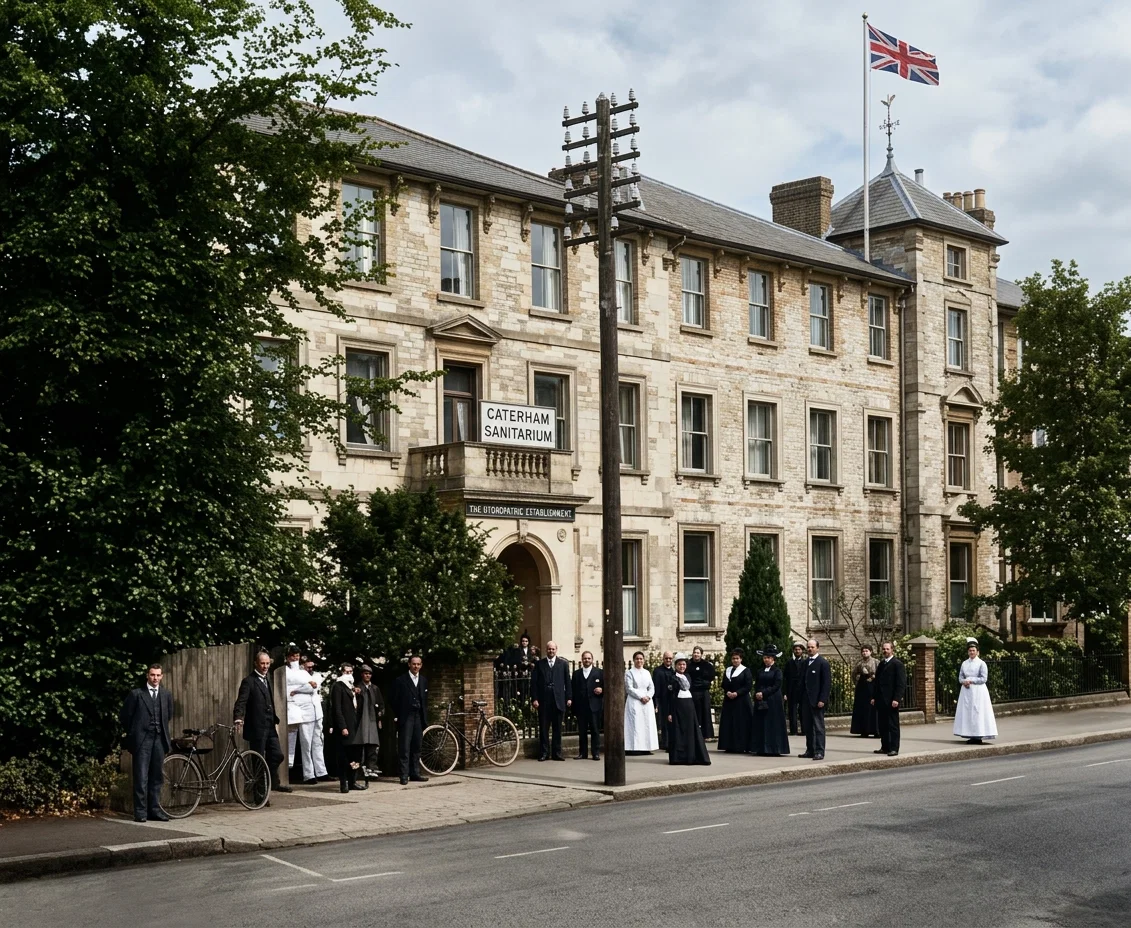
Caterham Sanitarium, Surrey, England

THE CATERHAM SANITARIUM
You will be interested to hear a little about our work in Caterham. Last week we entered into possession of the adjoining villas, which we decided to rent, and have already begun to occupy one of them. As you will remember, the other is rented, and will not, therefore, entail any expense until we require it for occupation. The terms of rent secured are quite favorable. We are to pay seventy pounds a year in quarterly instalments, with the privilege of purchasing. The lease extends over three years. The villas contain eighteen rooms, the greater number of which will be available for patients.
Our patronage has been excellent. We have often been at our 'wits' end to know what to do for accommodations for those who came. We are continuing to make various necessary improvements, and thus far have been able to meet all our bills promptly. Yes, and besides this, we have been able to do considerable charity work, considering the size of our place. We are glad for this. I feel keenly that we must keep the charitable feature in view all the time. With careful economy and wise planning, I believe that we shall always be able to do some charity work.
Our Good Health magazine is continuing to enjoy a wide circulation. We printed seventy thousand copies of the Christmas number.
We have a nice family of workers, and they are taking hold heartily, and are meeting with success. We have now two classes, with six members in each.
Recently I received a letter from a former patient, from which I will quote just a few lines. She had been several weeks with us last spring and early summer. It shows that we can not always see the fruit of the seed sowing, and that time is often required for the germination and growth:—
“I often think of your words, and can plainly see the blessing that came of the sore trial. Had it not been for this [the illness], probably I should never have been an inmate of your peaceable home—home in every sense. How many good things I learned there, I can not tell you. One thing you will be glad to know—I have joined the Adventists, and attend the meetings at Duncombe Hall. I have also tried to follow all the good instruction you gave us from time to time, and have never tasted tea since entering your institution. I try to live as nearly as possible as I did when there.”
The poor woman was much afflicted, and it had all come about through no fault of her own. Her case is practically incurable, although she was much benefited by her stay, and I tried to show her that the Lord would bring her a great blessing out of it, if she would be patient and loyal.
So the Lord has already, during the few brief months of the existence of this institution, given us several souls for our hire. We have three students in the missionary college in London, who accepted the truth through coming to Caterham. These three are young people, and are developing into excellent workers.
ALFRED B. OLSEN, M. D.

An Appeal to Believers in Vermont

“From every country is heard the cry, ‘Come over and help us.’ Rich and poor, high and low, are calling for light. Men and women are hungering for the truth as it is in Jesus.”—“Testimonies for the Church,” Vol. VIII, page 16.
We in this land of gospel light and liberty have been blessed with the glorious light of this last message to the world. How thankful we should be to have a part to act in sending this light to those not so highly favored as ourselves! The ten-cent-a-week plan for the support of the work in distant fields gives all an opportunity to do something in the work of the Lord. In Vermont we are endeavoring to carry out this plan, but we are not succeeding as well as we had hoped. If we should raise a sum equivalent to ten cents a week per capita, we should have two thousand six hundred dollars annually to send to distant fields. Last year our First-day offerings were less than one tenth of this sum, or not quite one cent a week for each member in this State. We are sorry to be compelled to make this statement; but we hope that those who readthis article will think seriously upon this subject.
We have reason to believe that many of our Vermont people have adopted this plan, in part at least. We hope during the year 1905 that all our people in the State will adopt the plan in full. We hope our church officers will co-operate with us in this work, and that we shall see a large increase in this fund for the support of missionaries who go to distant lands to carry this blessed message. Our Vermont people have always been loyal to the cause of God; we are thankful for this. But, brethren, can we not by a little planning and faithfulness on our part, greatly increase this ten-cent-a-week fund? I am sure that none of us is opposed to the plan, but we allow the weeks to pass by without the payment of the ten cents. Let us make a sacrifice, if need be, in order fully to carry out this plan. If we do this, doubtless one more laborer can be sent into the distant fields, and supported while there. Vermont is paying one such worker from her tithe. Shall we not support at least one more by the ten-cent-a-week plan?
If librarians need envelopes, let them write to F. M. Dana for a supply. May the Lord help his people to do their whole duty. J. W. WATT.

Reading Courses for Young People

The managers of the educational and young people's work in the Central Union Conference have been carefully considering and planning to develop something that will meet the needs of the young people of the conference. It is a sad thing to see so large a number of young people who are not in training for the Master's service, many of whom are even walking in the ways of the world. Many desire to attend some one of our training-schools, yet, for one reason or another, are not permitted to do so.
These young people must be reached and trained for some place in the work of the Lord. How to do it is the question. The reading-course plan seems to be the most feasible. If they can not attend the school, then we must bring the school to them.
The following extract, taken from Volume VII of the “Testimonies,” pages 63, 64, is to the point:—
“Many who desire to obtain knowledge in medical missionary lines have home duties that will sometimes prevent them from meeting with others for study. These may learn much in their own homes in regard to the expressed will of God concerning these lines of missionary work, thus increasing their ability to help others. Fathers and mothers, obtain all the help you can from the study of our books and publications. . . . Form a reading circle in which every member of the family shall lay aside the busy cares of the day and unite in study. Fathers, mothers, brothers, and sisters, take up this work heartily, and see if the home church will not be greatly improved. Especially will the youth who have been accustomed to reading novels and cheap story-books receive benefit by joining in the evening family study. Young men and young women, read the literature that will give you true knowledge, and that will be a help to the entire family.”
The plan devised by the committee is to have what shall be known as the Home Improvement Courses. Two courses have been arranged for the present needs; others may follow. One of these courses is general in character in the style of reading offered, and will be known as the General Culture Course. The other is to be more specific, and known as the Special Training Course. The General Culture Course is to be under the general supervision of the secretary of the young people's work of the Central Union Conference, M. E. Kern, and the Special Training Course is to be under the supervision of the educational secretary, B. E. Huffman.
The report adopted by the committee having the matter in charge is as follows:—

General Culture Course

“1. We recommend, That the General Culture Course be in part required, and part elective.
“Whereas, There being so much instruction given us by the spirit of prophecy with which our youth are not familiar, we do not think it wise to offer a course which does not include some of these books; and,—
“Whereas, The tastes for reading being varied among our youth, we believe more can be encouraged to take the course, and thus better results be obtained, if the course provides a variety of style of reading. Therefore,—
“2. We recommend, That in this course two classes of books be offered; first, some of Sister White's writings; second, books on missionary effort, travel, or biography.
“3. That for the first attempt in this work the required books shall be ‘Steps to Christ’ and ‘Mount of Blessing.’ The elective books shall be either ‘In the Tiger Jungle,’ ‘Princely Men in the Heavenly Kingdom,’ or ‘Up from Slavery,’ an autobiography of Booker T. Washington.
“4. That four months, beginning February 1, be allowed for the completion of this course.
“5. That when a book is finished, lists of test questions for a written examination be sent to all who have enrolled in this course.
“6. That a certificate showing the work done be issued to all who within a specified time complete the work, and satisfactorily pass the examination.”

Special Training Course

“1. We recommend, That the Special Training Course be for teachers and others especially interested in this line of work, and that the lessons already in preparation and use in this work among the teachers be adopted.
“Believing that all who take this course will get a broader and better view of Christian education,—
“2. We recommend, That the educational secretary, B. E. Huffman, seek to enlarge the number taking it, and conduct the work among those not already receiving the lessons from the State superintendents.
“3. That six months be allowed for the completion of this course.
“4. That lists of test questions for written examination be sent monthly to all who enroll in this course.
“5. That a certificate showing the work done be issued to all who within a specified time complete the work, and satisfactorily pass the examination. This is to include the teachers already taking the course.
“6. That the Educational Messenger be made the organ of this department of the young people's work in the Central Union Conference.”
Of ‘Steps to Christ’ and ‘Mount of Blessing’ too much can not be said in their favor. ‘Steps to Christ’ has been styled the ‘Primer of Christian Experience.’ All who have made a study of these books know that their value can not be overestimated. The more they are read, the more they are prized.
The other books mentioned in the General Culture Course are books of a high moral tone. They are interesting and attractive, and well calculated to inspire the reader to high aims and purposes in life. A missionary zeal is also likely to be kindled.
It will be observed that in all the books mentioned in the course, there is something that will meet the cravings of the mind, and at the same time direct the attention to reading that is ennobling and healthful.
The Special Training Course is especially adapted for those who are planning to take up church-school work. Many of our young people have a fair common-school education, and with a little training could do acceptable work as church-school teachers. All such persons who can not attend one of the training-schools should avail themselves of this special course.
All who contemplate taking one of these courses should immediately apply to M. E. Kern or B. E. Huffman, College View, Neb. L. A. HOOVER.
Continue reading: Religious Liberty Day