Review and Herald Publishing Association · Washington, D. C. · May 24, 1906
“Behold, He Cometh”
By Joseph A. Seiss
Here is the great fact unequivocally stated. Christ has not gone to heaven to stay there. He has gone for His church’s benefit; and for His church’s benefit He will return again; not in spirit only, not in providence only, not in the mere removal of men by death, but in His own proper person, as “the Son of man.” Few believe this, and still fewer lay it to heart. Many sneer at the very idea, and would fain laugh down the people who are so simple as to entertain it. But it is nevertheless the immutable truth of God, predicted by all His prophets, promised by Christ Himself, confirmed by the testimony of angels, proclaimed by all the apostles, believed by all the early Christians, acknowledged in all the church creeds, sung of in all the church hymn-books, prayed about in all the church liturgies, and entering so essentially into the very life and substance of Christianity that without it there is no Christianity, except a few maimed and mutilated relics too powerless to be worth the trouble or expense of preservation. That religion which does not look for a returning Saviour, or locate its highest hopes and triumphs in the judgment scenes for which the Son of man must reappear, is not the religion of this Book, and is without authority to promise salvation to its devotees. And those addresses to the churches which have no “Behold, He cometh” pervading or underlying them, have not been indited by “the seven spirits of God,” nor sent by Him whose Apocalypse is the crown of the inspired canon. Murmur at it, dispute it, despise it, mock at it, put it aside, hate it, and hide from it, as men may, it is a great fundamental article of the gospel, that that same blessed Lord, who ascended from Mount Olivet, and is now at the right hand of God the Father Almighty, shall come from thence to judge the quick and the dead, and to stand again on that very summit from which He went up. This is true, as Christ Himself is true; and “he that hath an ear to hear, let him hear.” Amen.—Joseph A. Seiss, D. D.
CONTENTS
of the Earthquake Special
What These Things Mean
SIGNS & TIMES
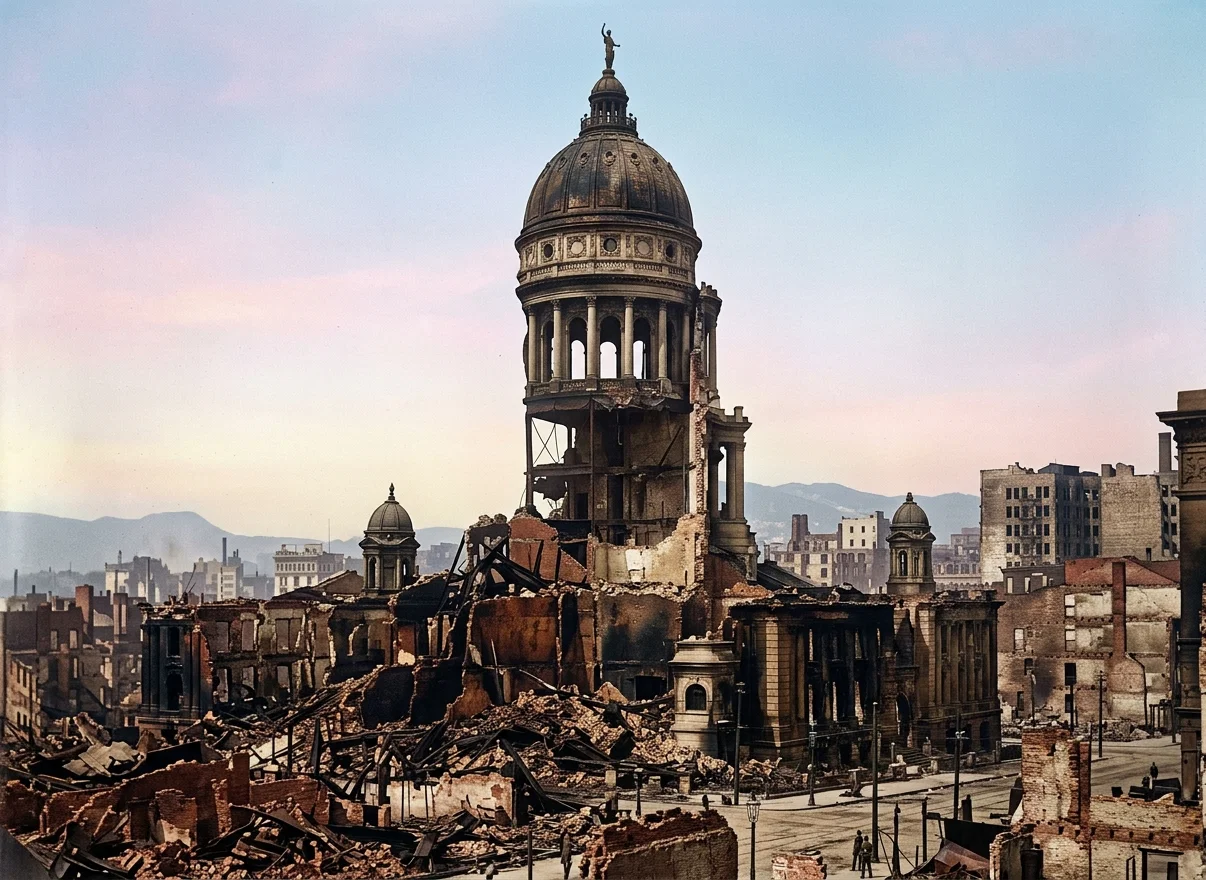
San Francisco's magnificent City Hall, which cost six million dollars, as it appeared before the Earthquake. The lower picture shows it in ruins
ARTICLES
THE EVERLASTING AND SURE REFUGE
THE EARTHQUAKE
THE “QUEEN OF THE WEST” LAID LOW
SAN FRANCISCO
(A powerful word-picture of the city’s visitation, by Fred Hewitt of the Examiner)
WHAT DO THESE THINGS MEAN?
SAN FRANCISCO’S SISTER CITIES TO THE RESCUE
HOW SAN JOSE FARED
LAST DAY DELUSIONS
VESUVIUS IN ACTION AGAIN
STANFORD UNIVERSITY
THE CRY OF THE CHILDREN (Poem)
OTHER TOWNS THAT SUFFERED
MOUNTAIN VIEW EXPERIENCES
DISASTERS OF THE PRESENT YEAR
CHINATOWN REVEALED
SEISMOGRAPHIC RECORDS
A GENEROUS LAND
ILLUSTRATIONS
MAGNIFICENT CITY HALL BEFORE EARTHQUAKE
THE SAME AFTER THE EARTHQUAKE
PANORAMA OF CITY ON FIRE—FROM NOB HILL
VIEW FROM UNION SQUARE BEFORE THE FIRE
CALL AND EXAMINER BUILDINGS AFTER THE FIRE
CITY ON FIRE AS SEEN FROM FERRY BOAT
UPHEAVAL OF STREET BY EARTHQUAKE IN FRONT OF G. P. O.
VIEW OF BURNED DISTRICT SOUTH OF MARKET STREET
MAP OF BURNED DISTRICT
WRECK OF HOTEL VENDOME ANNEX
WRECK OF PACIFIC COAST BUSINESS COLLEGE AND HOME UNION STORE
COMPLETE WRECK OF LARGE STORE
BIRD’S-EYE VIEW OF VESUVIUS IN ERUPTION
MARTIAL LAW AND THE BREAD LINE IN SAN FRANCISCO
STANFORD MEMORIAL CHAPEL BEFORE THE EARTHQUAKE
STANFORD MEMORIAL CHAPEL AFTER THE EARTHQUAKE
STANFORD MEMORIAL ARCH BEFORE THE EARTHQUAKE
STANFORD MEMORIAL ARCH AFTER THE EARTHQUAKE
STANFORD ENTRANCE BEFORE THE EARTHQUAKE
STANFORD ENTRANCE AFTER THE EARTHQUAKE
PACIFIC PRESS AFTER THE EARTHQUAKE
TWO-STORY UNION STORE AFTER THE EARTHQUAKE
CORNER OF PACIFIC PRESS AFTER THE EARTHQUAKE
POST-OFFICE, STORE, ETC., AFTER THE EARTHQUAKE
PACIFIC PRESS ENGINE HOUSE AFTER THE EARTHQUAKE
PACIFIC PRESS BUSINESS OFFICE AFTER THE EARTHQUAKE
SEISMOGRAPHIC RECORD OF APR. 19, 1892
SEISMOGRAPHIC RECORD OF MAR. 30, 1898
SEISMOGRAPHIC RECORD OF APR. 18, 1906
PRICES
Less than 1,000 to one name, one address, 3 cents a copy; over 1,000 copies to one name, one address, 2 1-2 cents a copy.
Order direct from the
Pacific Press Pub. Co.
or your State Tract Society, Mountain View, Cal.
Editorial
By Editor
“His Mighty Power,”
THE eternal power and Godhead of the Creator are seen in the things of nature, and at times this power is manifested in a way that humbles the pride of men by a revelation of the utter impotence of human power before it. No human mind can measure the vastness of the power which moves the solid earth as though it were water, and in a moment completely changes the whole appearance of its surface. Yet all this power is but a small fraction of that constantly exercised by the infinite Being who guides the worlds in their courses and upholds all things by his word. This power speaks wrath and consternation to the wicked, but how different its significance to the righteous! To the believer the mighty power of God is “his glorious power,” the power to save from sin, the power to give a new and perfect life, the power to obey the divine law. God would have his children know “what is the exceeding greatness of his power to us ward who believe, according to the working of his mighty power, which he wrought in Christ, when he raised him from the dead, and set him at his own right hand in the heavenly places.” The exhibition of the mighty power of God, in whatever way, is to the believer only an additional reason for trust in him. In that day, soon to come, when God’s power is shown as never before in judgments against sin, when the whole earth reels to and fro, and the wicked call for rocks and mountains to fall upon and hide them from him with whom they are being brought face to face, all this power will speak to the righteous of salvation. “Lo, this is our God; we have waited for him, and he will save us.”
The Gospel to Abraham
FROM the Word of God we learn that “the scripture, foreseeing that God would justify the Gentiles by faith, preached the gospel beforehand unto Abraham, saying, In thee shall all the nations be blessed.” The full statement, from which this quotation is taken, is as follows: “Now Jehovah said unto Abram, Get thee out of thy country, and from thy kindred, and from thy father’s house, unto the land that I will show thee: and I will make of thee a great nation, and I will bless thee, and make thy name great; and be thou a blessing: and I will bless them that bless thee, and him that curseth thee will I curse: and in thee shall all the families of the earth be blessed.” After Abram, in obedience to this instruction, had come into the land of Canaan, the Lord appeared unto him and said, “Unto thy seed will I give this land.” The Spirit of God has unfolded the meaning of these promises in these words: “Now to Abraham were the promises spoken, and to his seed. He saith not, And to seeds, as of many; but as of one, And to thy seed, which is Christ.”
It is thus clear that the gospel which was preached unto Abraham in the promise, “In thee shall all the nations be blessed,” was the gospel of Christ, and that the blessing vouchsafed to him was the blessing of the gospel of Christ,—the blessing of righteousness by faith. “For not through the law was the promise to Abraham or to his seed that he should be heir of the world, but through the righteousness of faith.” “And if ye are Christ’s, then are ye Abraham’s seed, heirs according to promise.” All the blessings promised to Abraham were promised to Christ and through Christ, and they are shared in by those only who are in Christ.
That this is the same gospel which was preached by the apostle Paul is evident from these earnest words: “I marvel that ye are so quickly removing from him that called you in the grace of Christ unto a different gospel; which is not another gospel: only there are some that trouble you, and would pervert the gospel of Christ. But though we, or an angel from heaven, should preach unto you any gospel other than that which we preached unto you, let him be anathema.”
And it should be remembered that these words were addressed first to the same people to whom he declared that “the scripture . . . preached the gospel beforehand unto Abraham.” Evidently the apostle Paul knew nothing of the modern error that the first instance of the preaching of the gospel was at Jerusalem on the day of Pentecost.
But we must go back of Abraham’s time to find the first instance of the preaching of the gospel. Before our first parents were expelled from the garden of Eden, the good tidings were announced to them: “I will put enmity between thee and the woman, and between thy seed and her seed: he shall bruise thy head, and thou shalt bruise his heel.” This is the same gospel that is defined by the apostle Paul to be “the gospel of God . . . concerning his Son, who was born of the seed of David according to the flesh.” In fulfilment of this promise “when the fulness of the time came, God sent forth his Son, born of a woman, born under the law, that he might redeem them that were under the law, that we might receive the adoption of sons.” Thus the gospel of Christ the Redeemer was preached in Eden, showing the only way from Eden lost to Eden restored.
From a statement made in the epistle to the Hebrews it is also clear that the same gospel was preached to the children of Israel in the wilderness that was preached to the church in the first century after Christ. Let us read the passage: “But with whom was he grieved forty years? was it not with them that had sinned, whose carcasses fell in the wilderness? And to whom sware he that they should not enter into his rest, but to them that believed not? So we see that they could not enter in because of unbelief. Let us therefore fear, lest, a promise being left us of entering into his rest, any of you should seem to come short of it. For unto us was the gospel preached, as well as unto them: but the word preached did not profit them, not being mixed with faith in them that heard it.” The gospel preached after the coming of Christ was simply a continuation of the gospel which was preached before his coming. The gospel which did not profit the children of4Israel, because they did not believe it, was proclaimed to their lineal descendants after the resurrection of Christ, and has since been “made known to all nations for the obedience of faith.” During all the centuries, from the entrance of sin until the present day, there have been those who believed the simple gospel of Christ and have been saved by it, just as it is recorded of Moses: “By faith Moses, when he was grown up, refused to be called the son of Pharaoh’s daughter; choosing rather to share ill treatment with the people of God, than to enjoy the pleasures of sin for a season; accounting the reproach of Christ greater riches than the treasures of Egypt: for he looked unto the recompense of reward.” Moses believed the gospel of Christ.
All this effort to show that a new gospel was introduced at the time of the first advent, or that the preaching of the gospel began at that time, is the result of a failure to understand the unity of the plan of salvation, and to grasp the full meaning of the declaration that “Jesus Christ is the same yesterday and to-day, yea and forever.” The Saviour of the New Testament is the Saviour of the Old Testament, and the gospel of the New Testament is the gospel of the Old Testament. The gospel of righteousness by faith which was preached to Abraham is the gospel which should be preached in all the world to-day. It is the gospel of the kingdom.
The Eastern Question
By L. A. S.
AGAIN the attention of the world is brought to the Eastern question, by another step, and an important one, toward the expulsion of the Turk from Europe, and the final fulfilment of the prophecy of Daniel II. There is a new alignment of the powers of Europe, and Turkey finds herself no longer supported by the power which for so many years has stood between Russia and Constantinople. Great Britain is no longer the protector of the Ottoman empire. Recently Turkey undertook to assert her claim to sovereignty in Egypt, by the occupation of the town of Tabah, at the head of the Gulf of Akabah. Great Britain peremptorily ordered Turkey out of Egyptian territory, and the latter was forced to comply; but what is more significant, Great Britain and Russia appear to have reached an amicable understanding with regard to Russia’s future relations with Turkey. The following paragraphs on the subject give the view of the editor of the New York Sun:—
We are not surprised at the uneasiness caused in Constantinople by the strange spectacle of Russia’s ambassador supporting Great Britain’s demand for the withdrawal of Turkish troops from Tabah, the Egyptian frontier town, and for a delimitation of Egypt’s eastern boundary. When the two Christian nations which for a century have pursued diametrically different policies with regard to the Ottoman empire are found in cordial co-operation, the expulsion of the Turks from Europe may well seem to be not distant.
At the time when the treaty between France and Great Britain was signed, and all the old causes of friction between the two countries were eliminated, we pointed out that a logical result of the friendship thus established would be a readjustment of England’s relations with the French republic’s Russian ally. The drift of things in this direction was accelerated rather than checked by the offensive and defensive alliance concluded between Great Britain and Japan, for thereby Russia’s aspirations were diverted from the far East and the central East to the near East. Nor is it any longer a matter of vital concern to England, now that her possession of Egypt and the Suez Canal is assured, to shut out Russia from the Bosporus. For these reasons British public opinion has undergone a remarkable change with reference to Russian expansion in south-eastern Europe. . . .
It must be obvious to every well-informed and candid Turk that from the time when General Diebitsch advanced to Adrianople, some three quarters of a century ago, up to the conclusion of the treaty of San Stefano in 1878, there has never been an hour when the Ottoman sultan did not practically rely upon Great Britain’s fleet to protect Constantinople from a Russian army. That protection can be counted on no longer. In view of the cordial understanding which was established primarily between England and France, but which inevitably tended to create amicable relations between the former country and the latter’s Russian ally, the Sultan Abdul Hamid must recognize that no British prime minister is likely to follow Lord Beaconsfield’s example and interpose to save his capital by sending a fleet to Besika Bay. For the moment, of course, the Ottoman ruler has no molestation to dread from the northeast, for Russia is absorbed in the process of national self-regeneration. But whatever may be the outcome of the great political experiment now making at St. Petersburg, whether the popular hunger for expansion shall find expression through representative institutions, or a restored autocracy shall seek to atone for acts of perfidy by military glory, the eyes of the Russian people are certain soon to revert to the city on the Bosporus. . . .
The support given by a Russian ambassador to a demand urged by Great Britain at Constantinople marks the beginning of the end of the Ottoman power in Europe.
When the end of Ottoman rule in Europe shall come,—when the Turk, driven into Asia, shall plant the tabernacles of his palace “between the seas in the glorious holy mountain,” then “shall Michael stand up,” “and there shall be a time of trouble, such as never was . . . and at that time thy people shall be delivered, every one that shall be found written in the book.” We stand now at “the beginning of the end.”
L. A. S.
History, Rome, and the Government
By L. A. S.
A ROMAN Catholic journal, The New World, publishes in a recent issue notices of two books, one of which it approves, while the other is declared to be “inaccurate and offensive.” Of the latter, which is a history of the Philippines written by David P. Barrows, for use in the Philippine schools, a Catholic correspondent writes:—
The book was published and made its due appearance at Manila. A protest was immediately entered by the Catholic authorities against its use, and the papers forwarded to the War Department. After a careful investigation of the case, the department prohibited the use of the book in the Philippine schools. This was done on the ground that it was not good policy to allow the use of books published by school officials, and the department wanted to avoid even the appearance of “graft” in the public schools.
The American Book Company, which had published the book and was financially interested in its sale, called the attention of the War Department to a parallel case in Cuba, where a geography was allowed to be sold of which the superintendent of Cuban schools was the author. “Then,” says the correspondent,5“the department of war informed the book company that the history contained statements offensive to Catholics, and would not be, on that account, introduced in the Philippine schools. That decision is final, and the prospects of the future use of the history are not worth considering.”
Of the other book, “Lawler’s Essentials of American History,” The New World says that it “is a well-balanced book,” whose “author shows a scholarly mind and a desire to be fair and unbiased in his presentation of facts. The missionaries of early days are given credit for their heroic and self-sacrificing acts—for their devotion even unto martyrdom for the cause of religion and Holy Mother Church.”
“Professor Lawler’s statement of fact is convincing to the most skeptical,” says The New World, “that the Catholic Church through her ministers was the civilizing power that founded, peacefully conquered, and civilized the Western hemisphere. . . . The duplicity of England in our times of peril and the persecution of the Catholics under English regime are fittingly emphasized. The book is a good specimen of historical writing, and no one can read it without concluding that by every right of justice, the founding, the civilizing, and in a great measure the preservation of the American republic are due to the Catholic Church.”
America was discovered at a time when the Old World was almost wholly Catholic, and it is not surprising that Christopher Columbus, its discoverer, should have been of that religion. But the statement that America was discovered by a Catholic, brings us to the end of all that can be truthfully said to the credit of the Catholic Church in connection with American history. American history, as regards all that which gave character to the nation, began with the landing of the Protestant Pilgrims on the shores of New England. All the early colonies, with one exception (Maryland), were Protestant. The men who fought the Revolutionary War were almost wholly Protestants. Washington was a Protestant. So was Jefferson, the author of the Declaration of Independence. The men who framed the Constitution were Protestants. Lincoln, Madison, Andrew Jackson, all the great Americans who left their impress upon the history of their times, were Protestants. The principles of the national Constitution and of the State constitutions are Protestant. The educational system of the country is Protestant—anathematized by the Catholic Church.
So much for the claim that this republic is mainly indebted to the Catholic Church for its present greatness. It is wholly untruthful. Yet Rome demands that American histories should make such claims. Only histories of this kind, which will ascribe to Rome the credit for the world’s mental, moral, and material progress, will have her approval. The whole issue between Romanism and Protestantism is involved in the controversy. Rome’s claim to be the dispenser of all that is most valuable in political, social, and religious life is a denial of every claim of Protestantism, and governmental sanction of books making such claims or setting forth the Catholic Church in such a light, is governmental opposition to Protestantism.
Whether it is true or not that the War Department prohibited Barrows’s Philippine history in the islands because it “contained statements offensive to Catholics,” we do not know. But if it is true, the prohibition rested upon a basis which afforded it no justification whatever. In writing history, the truth of a statement is the whole question to be considered; no other is of any importance. That is all history pretends to be, and all that real history can be,—a chronicle of facts stated just as they occurred, without reference to either praise or discredit which they may cast upon any person or organization of people. Any other kind of history is worse than useless.
It is an interesting question for Protestants whether or not the Catholic Church, notwithstanding its numerical inferiority in this country, is to be able to control the government in so important a matter as the teaching of history. The attempt to do this will certainly not be confined to the Philippines.
L. A. S.
A Religious Boycott
By L. A. S.
A RELIGIOUS boycott is threatened in Chicago. A Methodist “rally” was recently inaugurated there, with meetings in the Auditorium led by a number of bishops, and plans have been laid for a great revival. But the Methodist Book Concern having broken with the labor unions, the latter now come forward and declare that they will not permit any revival to be conducted in Chicago by the Methodist Church.
The Chicago Tribune states editorially that because the Methodist Publishing House does not pay the union scale of wages, “the Methodist bishops have been notified that if they persist in their announced intention to hold revival meetings on a large scale, the meetings will be boycotted, picket lines will be established to prevent, so far as possible, attendance upon them, and it will be brought to the attention of all the unions that the Methodist Church is unfair.”
This is probably the first time that trades-unionism has come into conflict with a church. We know it will not be the last time. A religious boycott, as this incident shows, is not at all impossible; and the spirit which will attempt to break up a religious revival will not stop at anything. It will be no long step from this to the boycott prophetically described in Revelation 13, when those who refuse homage to the “beast” power of which the prophecy speaks will be forbidden to buy or sell. We are living almost in sight of the end.
L. A. S.
The Lake Union Conference
By A. G. Daniells
THE third biennial session of the Lake Union Conference was held in Berrien Springs, Mich., May 8 to 18. About one hundred and forty delegates were in attendance. Besides these, one hundred or more workers connected with the various institutions and lines of local work were present. In addition to the laborers of the union conference, Elders W. W. Prescott, I. H. Evans, G. B. Thompson, and the writer were present during the latter part of the meeting.
It was a matter of deep gratitude to all that Elder Moon had so fully recovered from his operation and illness as to be able to attend and preside at this meeting. He was unanimously chosen as president for the coming term.
The session from the beginning to its close was marked with deep spirituality, and the utmost harmony prevailed throughout. In some respects this meeting was in marked contrast with the one held at this same place two years ago. The spirit of courage and hope was very marked in all the deliberations, and all lines of the work were given the most careful and prayerful consideration. Plans were formulated to push the message the Lord has committed to our hands with renewed vigor, and to finish the work in this generation and bring the coming of our divine Lord which has been so long delayed.
The needs of the mission fields of the world, where millions are yet waiting for the advent message, were not forgotten, and after responding to some of the calls for help from needy local fields, a resolution was passed appropriating all their surplus tithe, amounting to several thousand dollars, to the extension of the work “in the regions beyond.” Various other steps of an aggressive character were also taken.
The leaflet written by Elder A. T. Jones dealing with the General Conference organization and the reliability of the Testimonies, and now being widely circulated, was in the hands of the delegates, who asked the officers of the General Conference what explanation could be made of the charges it contains.
In response to an invitation from the Lake Union Conference Committee, the writer took some time during the last two days in making a reply to the charges against our denominational organization and administrative work, and against the Testimonies of the Spirit of God. Elder Jones himself was present during a portion of this time.
A large part of the pamphlet which has been prepared by the General Conference Committee in reply to Elder Jones’s leaflet was read. The Spirit of God was present in a marked manner during this time, and the mist and fog which have enveloped many minds were cleared away, new hope sprang up in hearts, and faith and confidence in the integrity of this message and in the divine source of the Testimonies were strengthened. Ministers and people reconsecrated themselves and all that they have to the carrying forward of this message. The power of God was manifested in our midst, and the impressions made on hearts will not soon be effaced.
At the close of these meetings, Elder W. J. Stone, president of the Indiana Conference, said he wished to read to the delegation a statement which the executive committee of the Lake Union Conference had adopted, expressing their attitude regarding the charges preferred by Elder Jones in his leaflet. He then presented the following statement:—
In view of the fact that a leaflet entitled “Some History, Some Experience, and Some Facts,” prepared by Elder A. T. Jones, of Battle Creek, Mich., is being widely circulated throughout this6union conference, and is, in our judgment, calculated to do great spiritual harm, we deem it proper to make the following statement of our position:—
1. We very deeply regret the unwise course Elder Jones has taken in thus making most serious charges against our General Conference administration, and in attempting to establish the claim that the instruction professedly given through the spirit of prophecy is unreliable.
2. Our own experience in connection with the administration of General Conference affairs leads us to disagree wholly with the charges preferred by Elder Jones. During our entire connection with the message we have not seen manifest the spirit of domination here alleged, but have always had most friendly co-operation, and have experienced the fullest freedom in carrying forward our work.
3. We have the fullest confidence that Elder Jones’s conclusions concerning the Testimonies rest upon no sufficient basis, and we wish, while most kindly, yet most earnestly protesting against the charges preferred, also to assure our brethren and sisters in the local churches throughout the Lake Union Conference, that they need be in no way disturbed or unsettled by the groundless assertions being circulated among them by means of this leaflet.
4. We take great pleasure in declaring our confidence in the administration of affairs of the General Conference, and in extending to it our earnest and loyal support in carrying forward and fostering the message in all its phases in the various portions of the wide harvest-field.
5. We regard Elder Jones’s assertions concerning the unreliability of the Testimonies as having no weight when considered in the light of the history of this denomination, and we deem it a privilege to again express our thankfulness to our Heavenly Father for the gift of the spirit of prophecy manifest in our midst, and renewed confidence in its integrity, and to pledge greater faithfulness in the future to the instruction which comes to us through this instrumentality.
ALLEN MOON,
WM. COVERT,
W. J. STONE,
A. G. HAUGHEY,
E. K. SLADE,
H. H. BURKHOLDER,
C. MCREYNOLDS,
S. E. WIGHT,
W. D. PARKHURST.
As soon as this statement was read, the delegates stated that the sentiment expressed in it was in exact harmony with their feelings regarding the matter, and they requested that they be permitted to vote upon it, and that it be published as an expression of the attitude and feeling of the Lake Union Conference. Requests then came from the large congregation present, outside of the delegation itself, that they, too, be allowed to express themselves upon the question. These requests were granted, and by a rising vote the above statement was unanimously adopted as expressing the views of all present.
We feel exceedingly thankful to God to see this decided protest entered against the charges being circulated in our churches everywhere by means of this leaflet. Never were we more profoundly impressed with the power and energy contained in this message. It is its own defense. Its truths are what have given it its strength. They are very dear to the hearts of our people throughout the world, and they expect to stand loyally by them and enjoy the final triumph of the message so near at hand.
The Lord greatly blessed his servants at this meeting, and we believe that it marks a new era in the work of the Lake Union Conference. We pray that this may be so.
A. G. DANIELLS.
The President and Congress
To the framers of the national Constitution, some of the press statements of to-day regarding existing relations between Congress and the chief executive would make strange reading. For example, head-lines in the Washington Times of May 16 state that the President's hands are tied in Congress by the loss of his allies; and the question is asked, “How is President Roosevelt to accomplish results in legislation, now that he has broken with the Democrats?” It is further stated that “the President has been in need of the Democrats to get results on more questions than rate regulation. He could not have passed the Philippine tariff bill through the House but for the Democratic votes,” etc.
From these and many like statements that might be quoted one would suppose that he would find prominently set forth in the Constitution that it is the duty of the president to frame legislative measures and secure their enactment into laws by Congress. Yet if with this supposition in mind he should read the Constitution, he would find from beginning to end no suggestion of any such thing, but on the contrary, would learn that the executive and legislative branches of the government are co-ordinate, neither having any control over the other; and that the chief executive is not therefore authorized to concern himself at all with what Congress may do in the matter of legislation. Congress is elected to have entire charge of the making of laws, and the executive department exists to see that the legislation enacted by Congress is carried into effect. The president is simply the head of the executive branch of the government.
But so far has the nation lapsed, in practise, from the ideal of republican government embodied in the Constitution, that to-day no other man has so much to do with the legislation of the government as the president, who does not belong to the legislative branch at all. An observer of events at the seat of the government might be excused for raising the question whether Congress is needed at all, if its chief concern is to enact administration measures, somewhat amended perhaps, into laws. If the president is to initiate legislation by presenting the chief measures to come before Congress, and is to exercise a controlling and guiding influence over the deliberations of the legislative body, so that the action taken is mainly such as he suggests, why not authorize him to make the laws himself as well as execute them? That would be a vastly cheaper way of running the government, and the ends arrived at would be substantially the same. If such a question would not be entirely pertinent to-day, it will be so at no distant date in the future if the tendency to combine in the president both the executive and the legislative functions of the government continues. The tendency is directly away from republican government, and in the direction of one-man power.
Note and Comment
WHAT are spoken of as “freaks” of the earthquake in San Francisco, show that it was not merely a quaking of the ground that occurred on that memorable morning, but that the erstwhile solid earth suddenly became like the surface of wind-swept water, and moved in waves which met and broke like sea waves, having a much more destructive effect in some places than in others close by. A writer in Collier’s Weekly says:—
A building that lay under the breaking point of an earth wave was pulled apart as you pull apart a piece of bread, or its sides ground together, or it fell like a house of cards. For blocks the pavement was scarcely disturbed; then there would be a block where it had been turned into miniature hills and valleys. The stone blocks of the post-office seemed to have been screwed about like dominoes under the hand of a player, and still the building stood. But if the seven-million-dollar city hall had been built with a view to earthquake destruction, its fate could not have been worse.
The nature of the power which gives this motion to the surface of the solid earth is a mystery no human mind has solved. But certainly such forces do not manifest themselves independently of the will of God. “There is no power but of God.” Even the falling of the sparrow is a matter of note to him. These destructive events occur only as God permits them to occur; and in permitting them he has a purpose, which it is incumbent on men to discover. To say that God had nothing to do with the San Francisco earthquake is to deny God altogether.
A Little Way From This
By Mary V. Nowlin
MRS. MARY V. NOWLIN
A LITTLE way from this and it will all be ended,—
The sorrow, the crying, and the pain;
A little way from this the broken hearts be mended,
And we shall find the smiles we lost again.
A little way from this, some fair and golden morning
Shall we behold the snow-white cloud arise;
And it will have for its most beauteous adorning,
All, all the glory of the upper skies.
Behold, with clouds He cometh, and every eye shall see;
None from the glorious view will be shut out.
Some will cry, “O rocks, O mountains, fall on me!”
And some will greet their Master with a shout.
A little way from this, O weary, sad hearts weeping
For loved and lost that you have buried deep,
The trump will sound, and the dear ones sweetly sleeping
Will wake forever from their dreamless sleep!
A little way from this the harp strings mutely waiting
For fingers, O so tired and worn with pain!
Will vibrate with a song past human power relating,
And heaven will thrill with one harmonious strain.
A little way from this, the pearly gates wide swinging
And everlasting doors uplifted high,
The “nations who have kept the truth” will welcome, singing:
The glory of their King as they pass by.
Day, O, long expected, hope of all the ages,
The hope that lights the tomb, and dries the tear!
O day of glad fruition, foretold in sacred pages,
A little way from this, and thou art here!
A little way from this—but now to know the meaning,
But now to know the cleansing and the power,
And for our strength each day on Jesus to be leaning,—
O, sweet will be the coming of that hour!
And glad will be the meeting with earthly loves long parted—
We've ever missed them from the accustomed place—
To clasp the vanished hand that left us broken-hearted,
But gladder far to see Him face to face!