Although the Catholic Church has for the past four centuries ruled with a despotic sway in the Philippines, the united front of that body is now broken. A few years ago it was impossible for any one who was not in harmony with that church to do any religious work. Any attempt to hold religious service, or to circulate the Bible, or even to read it, was dealt with promptly, and with an unsparing hand. To-day, as far as the laws of the land are concerned, it is as easy to preach the gospel there as in any Protestant country. This condition of things must be a sad surprise to the church authorities, because for hundreds of years they have felt secure in their wicked attempt to keep the masses in darkness and ignorance for the benefit of the clergy.
A PUBLIC PARK IN MANILA
To-day the different Bible societies have their agents stationed in the leading street of the walled city, almost under the eaves of the cathedral and other large churches. In different parts of Manila, and in other towns of the group, are many Protestant churches — Methodist, Presbyterian, Episcopal, Congregational, Baptist, United Brethren, etc. But although these denominations have made many converts and are pushing their work with great vigor, their efforts are insignificant compared with the movement known as the Aglipay movement.
Nearly four years ago a certain priest named Gregorio Aglipay left the Catholic Church, and formed what is known as the Independent Catholic Church of the Philippines. This priest had been educated in a Catholic seminary, and, although a Filipino, was advanced with great rapidity. But coming under the displeasure of the church authorities for some alleged irregularity, he was excommunicated. Failing to get a reversal of the sentence of excommunication, he joined the forces of the Insurrectos under the leadership of Aguinaldo, and was by him made vicar-general. When the insurrection was suppressed, and the Philippines came under American rule, Aglipay took the oath of allegiance to the new government.
In 1901 he made an effort to secure the co-operation of the Protestant ministers of the island in an effort to split the Catholic church in two. They very wisely refused to unite with a movement that went no further than to simply protest against the Romish church while leaving the people without the Bible. Aglipay was advised to study the subject more fully, and to unite with the Protestant cause. The next year he organized his Independent Church, and was elected archbishop.
Large numbers of the Catholics at once joined the new church, and many churches sent invitations to the new archbishop to occupy their houses of worship. Whole congregations, with their priests and priests’ houses, joined the movement. In one province it is said that but three churches and priests continued to hold with the old church. Aglipay and his followers took possession of the church houses of the congregations that united with his movement, which led to a decision by the governor, Mr. Taft, called the Proclamation of Peaceable Possession. As the Catholic authorities denounced Aglipay’s possession of the houses as trespass, and demanded that he give them up, the governor decreed that whichever party was in peaceable possession of the house should be considered the rightful occupant, and that the contrary must be proved in the courts before ejection could take place. By this decision large numbers of church houses worth hundreds of thousands of pounds have passed into the hands of the new church. It is said that at least one million five hundred thousand members are in fellowship with Aglipay. These, of course, are Filipinos, as the movement is in opposition to the Spanish friars who have so long oppressed the people of the islands. It is true the movement does not make full-fledged Christians of the adherents, nor are they probably any better than the adherents of the old church; but they are cut off from their allegiance to the pope, and so are in a better condition to receive the truth. Another thing that is favorable is the fact that Aglipay now recommends the reading of the Bible. Many thousands of copies of the Scriptures have been purchased by the leaders of the movement, and sold to the people. This is all of the deepest interest, for until the Bible is made use of and obeyed, there will not be any permanent good as the result of this or any other revolt from the authority of the Romish hierarchy.
A few weeks ago when in Manila, I saw an article in one of the papers which stated that the pope at Rome was much offended at the time of the visit of Miss Alice Roosevelt, daughter of President Roosevelt, to Manila, because Miss Roosevelt showed more respect to Aglipay than the Romish church authorities thought should be shown to one under the frown of that church. It seems that when she visited Manila, and when the citizens of the place called on her, Aglipay was shown honors which were not accorded to the Roman Catholic friars. It is said that she committed the awful offense of having her photo taken standing by the side of this apostate priest. This the infallible pope counted as an insult to the church of which he is the head, and to him in particular. Since the many favors that have been shown to the Romish church by the United States, the pope seems to have the idea that the people of that great nation are his children, and that even the daughter of the chief executive must not show any respect to any one who is regarded as an enemy of that church. This ought to open the eyes of the people of that nation, and of every other, to the great danger of allowing the Romish church to13get any foothold in governmental matters.
Let the United States once come under the rule of Rome, and the people will be ruled with the same severity that has characterized her dominion in the Philippines.
The Protestant churches have taken a noble stand in their determination to flood the Philippines with the written Word of God. The efforts of the Bible agents who go from island to island selling these Bibles, while putting up with all manner of hardships, is commendable. We could only wish them Godspeed. Now it remains to be seen what these workers will do when God’s truth for these times shall be proclaimed among the millions of these islands. Up to the present time they have stood on the side of truth in declaring that civil governments have no right to coerce the conscience. It is to be hoped that the same liberality will characterize their actions when the law of God and the testing truths of the last message shall be proclaimed among them.
I learn that the different Protestant churches have divided the territory of the group among themselves into “spheres of influence,” and that it is regarded a breach of missionary comity to get into the territory of another denomination. But God’s last message must be given notwithstanding these regulations, and it will be given, and the honest in heart will recognize the voice of the true Shepherd.
(To be concluded)
Advice to Missionary Candidates
By L. F. Hansen
L. F. HANSEN
After twenty years of varied experience in the stronghold of heathenism, Dr. Judson took occasion to write to the mission board on the above subject, and it is with a reverent hand that we copy the words of this noble man who served his generation so faithfully, and who, though “being dead, yet speaketh.” In introducing his suggestions, he said:—
“I am desirous of setting down a few items which may be profitable to you in your future course. Brief items they must be, for want of time forbids my expatiating.
“In commencing my remarks, I take you as you are. You are contemplating a missionary life. First, then, let it be a missionary life; that is, come out for life, and not for a limited term. Do not fancy that you have a true missionary spirit, while you are intending all along to leave the heathen soon after acquiring their language. Leave them! for what? To spend the rest of your days in enjoying the ease and plenty of your native land?
“Second, in choosing a companion for life, have particular regard to a good constitution, and not wantonly or without good cause, bring a burden on yourselves and the mission.
“Third, be not ravenous to do good on board ship. Missionaries have frequently done more hurt than good, by injudicious zeal, during their passage out.
“Fourth, take care that the attention you receive at home, the unfavorable circumstances in which you will be placed on board ship, and the unmissionary examples you may meet with at some missionary stations, do not transform you from living missionaries to mere skeletons before you reach the place of your destination. It may be profitable to bear in mind that a large proportion of those who come out on missions to the East die within five years after leaving their native land. Walk softly, therefore; death is narrowly watching your steps.
“Fifth, beware of the reaction which will take place soon after reaching your field of labor. There you will find native Christians, of whose merits or demerits you can not judge correctly without some familiar acquaintance with their language. Some appearances will combine to disappoint and disgust you. You will meet with disappointments and discouragements, of which it is impossible to form a correct idea from written accounts, and which will lead you at first almost to regret that you have embarked in the cause. You will see men and women whom you have been accustomed to view through a telescope some thousands of miles long. Such instruments are apt to magnify. Beware, therefore, of the reaction you will experience from a combination of all these causes, lest you become disheartened at commencing your work, or take up a prejudice against some persons and places, which will embitter all your future lives.
“Sixth, beware of the greater reaction which will take place after you have acquired the language, and become fatigued and worn out with preaching the gospel to a disobedient and gainsaying people. You will sometimes long for a quiet retreat, where you can find a respite from the tug of toiling at native work—the incessant, intolerable friction of the missionary grinding-stone. And Satan will sympathize with you in this matter; and he will present some chapel of ease, in which to officiate in your native tongue, some government situation, some professorship or editorship, some literary or scientific pursuit, some supernumerary translation, or, at least some system of schools; anything, in a word, that will help you without much surrender of character, to slip out of real missionary work. Such a temptation will form the crisis of your disease. If your spiritual condition can withstand it, you recover; if not, you die.
“Seventh, beware of pride; not the pride of proud men, but the pride of humble men—that secret pride which is apt to grow out of the consciousness that we are esteemed by the great and good. This pride sometimes eats out the vitals of religion before its existence is suspected. In order to check its operations, it may be well to remember how we appear in the sight of God, and how we should appear in the sight of our fellow men, if all were known. Endeavor to let it be known. Confess your faults freely, and as publicly as circumstances will require or permit. When you have done something of which you are ashamed, and by which, perhaps, some person has been injured (and what man is exempt?), be glad not only to make reparation, but improve the opportunity for subduing your pride.
“Eighth, never lay up money for yourselves or for your families. Trust in God from day to day, and verily you shall be fed.
“Ninth, beware of indolence which leads to neglect of bodily exercise. The poor health and premature death of most Europeans in the East must be eminently ascribed to the most wanton neglect of bodily exercise.
“Tenth, beware of genteel living. Maintain as little intercourse as possible with fashionable European society. The mode of living adopted by many missionaries in the East is quite inconsistent with that familiar intercourse with the natives which is essential to a missionary.”—“Life of Judson,” page 577.
Being on the ground where Christianity waged such a long and persistent warfare on Buddhism, till it enjoyed its most signal triumphs, we seize with eagerness on every experience of others, to profit by it. The past history of the true church contains practical lessons, which will never become obsolete.
Insein, Burma.
Mission Notes
KOREA has practically no religion save ancestral worship, but is now accessible to Christianity.
“BUT as truly as I live, all the earth shall be filled with the glory of the Lord.” Num. 14:21.
IN 1898 the Moravian Church, with less than forty thousand members, gave eighty thousand dollars to missions.
BUT “I say unto you, Lift up your eyes, and look on the fields; for they are white already to harvest.” John 4:35.
“BEHOLD, these shall come from far: and, lo, these from the north and from the west; and these from the land of Sinim.” Isa. 49:12.
IN the Uganda mission there are two hundred churches, and one hundred thousand souls already under the influence of the gospel.
THERE are one billion heathen in the world. There are ten thousand missionaries. Each missionary is responsible for one hundred thousand souls.
“THE harvest truly is great, but the laborers are few: pray ye therefore the Lord of the harvest, that he would send forth laborers into his harvest.” Luke 10:2.
South Carolina
By D. E. BLAKE
SPARTANBURG.—We are glad to say that the Lord is blessing our efforts in lifting up the standard of truth for the colored people in this place.
Although no one has taken a stand for the truth as yet, many are studying it with intense interest, in fact, it seems to be the only theme of interest for them, and we hope they will eventually accept it.
There is, however, a slight undercurrent of opposition, which occasionally runs so high as to be noticeable here and there, but the truth will triumph; for they “can do nothing against the truth, but for the truth.”
A leaflet entitled “A Letter from Jesus Christ,” is now being circulated by the “Holiness” people. In this leaflet is set forth the theory that the Sabbath was changed by Christ after his resurrection, and this letter, the original copy of which has been carefully preserved, and is now in possession of one of high position in Europe, was written by our Lord himself before his ascension. As this deception is so glaring, there is not much danger of many being swept away by it.
We have organized a Young People’s Society and a canvassers’ class in connection with our work. About ten are now engaged in the canvassing work, and are having rich experiences and good success. We are still working and praying for a church building.
D. E. BLAKE.
Hayti
By W. Jay Tanner
CAPE HAYTIEN.—This place has always been a popular resort, and I think this is helping to make our work prominent; at least, it is a place that the better class will visit readily. The only time that it might prove an undesirable place is during a revolution. This is because it is bounded on three sides by the arsenal, forts, and military station. I feel much encouraged at the prospects for the work here the coming year.
The believers at Ranquitte and at Hinche need further instruction, and there is an outside interest, also. I have planned to have Brother Isaac visit the companies at Grand Riviere and Ranquitte periodically.
As I look at the work as it now exists in this republic, it seems clear to me that in the movement that occurred here the past year, the Lord prepared for the Haytians to carry this message among their own hills and towns to a large extent, by calling a goodly number of intelligent and serious young men into the cause.
Since I began this report, Brother Isaac has returned from a trip to Grande Riviere. He brings a good report of renewed interest there. He also brings me a message from the Catholic priest, a Frenchman, saying that he desires to have a conference with me the next time I visit Grande Riviere. Just what this means I do not know; but Brother Isaac says he is friendly, and last week entered into an argument with some of our opposers, and silenced them in a discussion as to the merits of our work.
I hope that the Spirit and power of God are taking hold of the work everywhere as here. If so, it will mean that Jesus will come very, very soon.
W. JAY TANNER.
Dominica, West Indies
By P. Giddings
It being fine, dry weather, I left Roseau for a country district over forty miles from town. It was not so dry here, however; we had rain almost every day, so my plans had to be altered somewhat. I was able to hold only three open-air meetings. The rest of the three weeks was spent in visiting, selling papers, tracts, small books, and holding Bible readings.
I met a couple who were keeping the Sabbath, but still held their membership in the Methodist Church. The lady said that it was like the death of a mother to leave her church. I held Bible readings with them on different phases of the message, including health and dress reform.
The last Friday I was there was a glorious day to me. I spent it by the seashore in fasting and prayer. It was the world's anniversary of the crucifixion, and I wished it in a special sense to mark my crucifixion with Him; and as I prayed, then asked the Lord to direct me to passages that would be meat in due season, I opened the Bible and read such applicable portions that my soul was comforted and strengthened.
On Sabbath the man and his wife whom I have already mentioned came forward and desired baptism. He is the son of a local preacher, and she was superintendent of the Sunday-school, and daughter of another local preacher. They were certainly influential persons in church work. The children of the Sunday-school were very sad to lose her, but she invited them to Sabbath-school at her home.
She has not kept the knowledge of the Sabbath from children, adults, or parson, but has taught it freely to all, insomuch that many are convinced. The last time the parson spoke, he declared Sunday was not Sabbath. I left other interested ones for whom I am praying.
Instead of returning on the steamer, I walked part of the way, to see the country and the people. Now on lofty highlands, then in valleys; on tortuous roads, then, shoes off, fording rivers; meeting kind strangers, Catholics and non-Catholics; selling and giving away tracts on the Sabbath question, etc., furnished a program varied enough to beguile part of the fatigue.
Our Sunday afternoon Bible class in town continues encouragingly. Among our students is an intelligent young man, a Catholic, who is telling his friends what he learns. Some, of course, do not want to hear.
The Catholic editor continues friendly. He has offered us his columns, which we have used. Despite the proscription of the Bible by his church, he urges the people to read it. We need your prayers.
P. GIDDINGS.
The South American Union Conference
By J. W. Westphal
THE South American Union meeting was held, according to appointment, at Parana, Entre Rios, Argentina, March 15-25. Two representatives from Brazil, Elders H. F. Graf and F. W. Spies, and two from the west coast, Elders F. H. Westphal and E. W. Thomann, besides the laborers and many of the brethren of the River Plate Conference, were present. Elder W. A. Spicer, of the General Conference Committee, arrived in good season, and rendered inestimable assistance in preaching and in organizing and planning our work. There was an average attendance of about one hundred and twenty-five, but many went home during the progress of the meeting to give opportunity for others to come. The Entre Rios Railway gave half fare to the meeting, as did also the Buenos Ayres and Rosario line. The evenings were devoted to the preaching of the message in the Spanish language, and the meeting being located in the very heart of the capital of the province, a city of about thirty thousand inhabitants, many had an opportunity to hear the truth for this time. The attendance was fair, and some became very much interested, and requested that the work might continue. This is being done by house-to-house work. This, as well as other efforts made in new places in these fields during the last two years, shows that everywhere there are honest souls waiting for the truth. Evidently this is a time specially favorable to giving the third angel’s message in South America.
The superintendent’s report showed an increase in every part of the work. In the two years the tithe had practically doubled, increasing from $6,316.01 to $12,382.62. The increase for 1905 was $4,535.96. The Sabbath-school offerings gained $533.64, from $763.88 to $1,297.52. Other regular mission donations had increased from $897.62 to $1,496.23, or a gain of $598.61. Thus the total increase in these funds during the two years was $7,198.86. There was even a larger increase in donations for local and special enterprises. This increase was not entirely due to increase in membership, for the tithe was raised from $4.28 per capita in 1903 to $6.10 in 1905. The church-membership during the two years increased 560, the increase during 1905 being 435. The beginning of 1906 finds us with a church-membership of 1,873, the total number of Sabbath-keepers being 2,029.
With this foundation it was thought best to organize a South American Union Conference, a resolution to this effect being unanimously passed. A constitution was adopted similar to other union conference constitutions. Complete harmony prevailed throughout the entire proceedings. The usual committees were appointed, and their reports were unanimously adopted. The writer was elected president, and Elder N. Z. Town secretary and treasurer. Credentials were granted to eight persons, and Brother Emil Hoelzle, of Brazil, was15recommended for ordination and credentials. Five were given ministerial licenses, and ten received missionary licenses. Other cases that might come as the result of subdivision of our field were referred to the committee.
The West Coast field was divided into three parts, to be known as the organized Chile-Bolivia Mission and the unorganized missions of Peru and Ecuador. Elder F. H. Westphal was elected superintendent of the Chile-Bolivia Mission, Elder Frank Perry director of the Peru Mission, and Elder Geo. Casebeer of the Ecuador Mission. Uruguay, and Paraguay and Missiones, were recommended to be set off from the River Plate Conference as two mission fields, the former as an organized mission, and the latter as an unorganized one. A special meeting of the River Plate Conference was called, and the plan was at once carried into effect. Elder John McCarthy was appointed director of the Uruguay Mission, with a committee of five, and the Alta Parana (Upper Parana), embracing Paraguay and Missiones, has Elder Luis Ernst as its director. It was also recommended to divide Brazil into two conferences, Rio Grande and Santa Catharina, and one or more mission fields. This arrangement will undoubtedly be carried out in our coming Brazil meetings.
In this arrangement we can see much light. It will divide responsibility, bring the directors of the fields into closer touch with the constituency (a thing that will mean much in these countries of magnificent distances and slow and expensive means of travel and communication), will save much wearing travel and expense, and will enable the laborers to do more active work in the field. We had often discussed this matter, but no clear plan had suggested itself without materially increasing the expense. Elder Spicer’s experience in the advanced plans of organization among us flashed light and cheer into our counsels, and difficulties gave way to beauty and harmony.
Resolutions were heartily adopted, proposing that the River Plate, Rio Grande, and Santa Catharina Conferences and the Uruguay Mission make an earnest endeavor to become self-supporting, that the Sabbath-school and annual offerings go to the South American Union Conferences, that the three missionary papers continue to be the organs of the same territory as in the past, and that the publishing and school interests already begun be developed, and that others be not started before the development of the work will warrant it. After an interesting discussion, in which three of the first Sabbath-keepers of South America took part, the following resolution was heartily adopted:—
“Whereas, Under God, we are indebted in a large measure to our brethren in the United States through the General Conference and Mission Board for the great truths of the threefold message for this time, therefore,—
“Resolved, That, on the occasion of organizing a union conference, we thank them for their kind interest in our behalf, and for their spirit of sacrifice in sending us men and means to establish and carry it forward in our field, and assure them that we will carry it forward in the spirit and for the purpose for which it was begun.”
This, the first South American union meeting, closed with hope and courage in the hearts of all present. Probably never have the prospects been so bright for the work in our great field. The laborers go out with courage and zeal to press the conflict into the regions of darkness.
J. W. WESTPHAL.
Progress of the Work in Rome
By Chas. T. Everson
A NUMBER of letters have come to me expressing an intense interest in the conversion of the professor of whom I wrote some time ago, and therefore I have been thinking that it might not be out of place to add another word concerning this case.
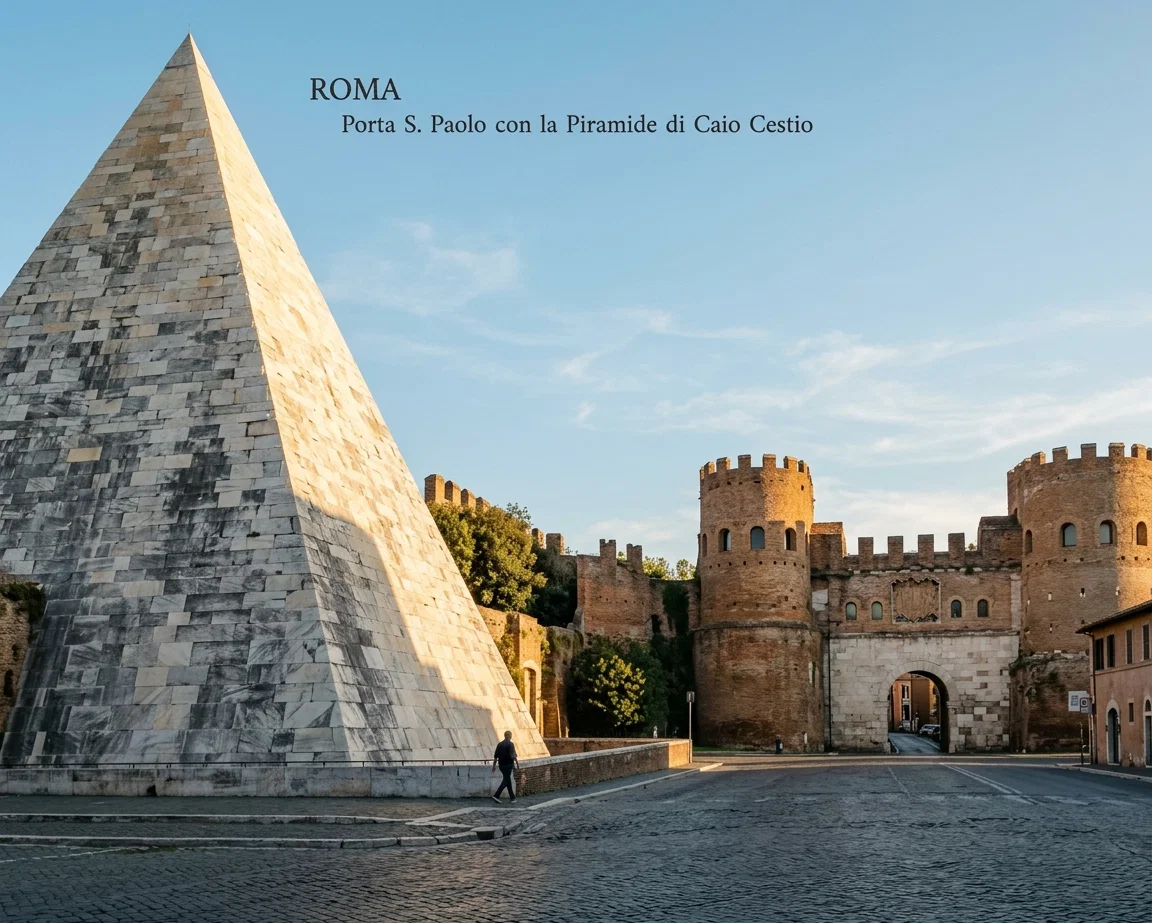
ANCIENT GATE OF ST. PAUL, WITH PYRAMID OF CAIUS SESTIUS
On account of the Sabbath he was compelled to resign his position in the college where he held his professorship, but a few days afterward the Lord opened the way for him to procure a good position in the home of one of the leading members of the Italian Parliament. There he remained until the summer of 1905, when the deputy and his family went traveling. However, before the deputy left, he assured the professor that at his return he wished to avail himself of his services; and, in fact, he has been making a strenuous effort to procure his services again, for he is the only professor he ever had for his son that has been able to do anything with him. Being liberated from his employment for a time at the departure of the deputy, the professor was afforded the time necessary to attend the camp-meeting which was held in Gland, Switzerland. He was very much pleased to avail himself of this privilege that he might become better acquainted with our people and work. There he met Elder Daniells, with whom he was very well impressed, as well as Elder Conradi. He returned from the meeting greatly blessed, and more certain than ever that we have the truth of God for these times. He summed up the teachings of the camp-meeting in these three words—prayer, study, and action.
Returning to Rome in the vacation season, he accompanied me to Terni, a city two hours' journey from here, and there engaged in the canvassing work, at the same time studying the truth, and at times speaking in the meetings. He would begin canvassing very early in the morning. In this country the canvassing work is looked down upon by probably the people in general, and therefore he was told that he ought to go to work and make an honest living, for it was a disgrace for a big man like him to go around and impose himself on the people with books and tracts. He took it all patiently, and simply replied that he was not doing this work to make a living, but to advance the cause of God. He always insists that the canvassing work is one of the very best ways of advancing the cause of present truth.
At Terni we remained three months, after which we returned to Rome. Since our return to “the Eternal City,” the professor has resumed his teaching, while at the same time he preaches at the hall and helps in other ways as much as his time will permit. He preaches with great power, born of a deep conviction.
That he is thoroughly convinced and converted to this truth I have not the least doubt. He often tells me that he is certain that this is the truth because it is founded upon the Bible, and therefore if he is deceived, it is God who has deceived him, for he is following his Word. He says that after studying the other churches if he had not found this truth, he would not have believed in anything; for their teachings and practises do not administer to the yearnings of the heart, nor satisfy the longings of the tempest-tossed soul.
The longer I labor here, the more I am convinced that it takes great courage for a man of his ability and standing to accept the truth; for it is true, as Elder Irwin wrote me, that “it would seem as if a man were taking his life in his hands to come out of the Roman Church and take a decided stand right under the very shadow of the Vatican. I believe we are coming rapidly into the time when we must expect, however, to see just as decided positions taken in favor of the truth as we read about in the days of Martin Luther and the early Reformers; for our Saviour says that when he comes, faith will be almost lost out of the earth. But there must be a few people possessed of it, or the one hundred and forty-four thousand would not be made up.”
The pope was much interested in reclaiming the professor to the church, and while cardinal of Venice, he, together with a bishop, delegated a priest to wait upon our brother and try to persuade him to return to the Catholic Church. He was called from Rome to Florence, and there this priest had a long interview with him, offering him a good position as professor if he would return to the church. But he replied that he did not believe as he had16the past, and therefore could not accept the offer; for while he might remain always poor, he was not willing to sell himself.
The priest urged regard for family ties, position, comfort, the miracles of the church, etc., but all to no avail, for he was firm in his decision. The professor then asked the priest how he happened to know his address at Rome, to which the priest replied, “When least you are aware of it, there are a hundred eyes looking at you.” Thus we see that these men are closely watched, and the Catholic Church is not sleeping on their trail.
While still in the Catholic Church, the professor was fervent in his devotions and duties, and therefore, as Paul the apostle, he was led out of the darkness into the truth. And now after the long struggle through which he has passed in his endeavor to discover the truth, he finds himself satisfied and tranquil in spirit, and, as he expresses it, concerning the future he has a “holy indifference.”
CHAS. T. EVERSON.
Arkansas
By H. Clay Griffin
I AM now enjoying a short visit with loved ones at home, after an absence of over three months spent in visiting the churches and isolated brethren and sisters in this State.
January 4-18 I was with the church at Black Rock. Sister Jessie McConnell, of Springdale, Ark., was teaching our church-school there, and I had the pleasure of baptizing six of the pupils on January 13. The outside interest was good, and we trust much good will result from the seed sown.
I met Elder Bender at Searcy, where we spent a day or two with the brethren in social meetings and teaching the word. We stayed at Little Rock one or two days, and then went to Hot Springs. After spending two or three days with the brethren there, I returned to Little Rock, and met with the church January 27. We had quite an enjoyable time. It was indeed a treat to meet with those of like precious faith after having been alone in the front of the battle for six months.
On Sunday, January 28, I visited Mabelvale, ten miles south of Little Rock; and spoke three times to an interested congregation. The consistent lives of Sister S. J. Null and family had created quite an interest to learn more about the third angel's message, and there is an urgent call for a tent-meeting at that place. It is encouraging to visit a community where our people are living out the principles we teach.
I returned to Little Rock, and in company with Elder Bender took the train for Keene, Tex., to attend the Southwestern Union Conference, February 1-11. On the eleventh I stopped at Dallas, Tex., and by request of Elder McCutchen, occupied his pulpit. Passing through Texarkana, I stopped a few days with the brethren at De Queen, Mena, Acorn, Eagleton, and Booneville.
February 23 I began one of the best meetings at Ava that I ever held. From the first, the interest was good. On Sunday, March 18, I expected to baptize a sister who had united with the church, but the rain fell in torrents all day, and it was only by faith I could believe it was all for the best. The rain ceased in time to have evening meeting, and although the night was dark, and the roads were muddy, we had a crowded house. I soon realized the truthfulness of Rom. 8: 28, and arranged to stay another week. At the close of the fourth week, seven others united with the church, making a total of ten, eight of whom I baptized. I also visited the churches at Ellsworth and Cline, and had some profitable meetings.
I am planning to pitch a tent at Chester, Ark., and begin meetings there.