Your ShelfYour Projects

Signs of the Times, Vol. 38, No. 5.

Important Articles in This Number

Signs of the Times

Jan 31, 1911

Pacific Press Publishing Association · Mountain View, California · Jan 31, 1911

Important Articles in This Number

Israel and the Law Lessons in Liberty The Four Living Creatures of Revelation 4 The Sabbath a Blessing and Not a Burden The Sure Word of Prophecy The Great Eastern Powers The Aeroplane in War Moses and Christ What Christ’s Coming Means to the Earth
(For full Table of Contents see last page)

Weekly Bible Reading: Exodus and Leviticus

OUR BIBLE BAND
OUR BIBLE BAND

Schedule for Week Ending February 11, 1911

Sunday | February 5 | Exodus 24-26 Monday | " 6 | " 27-29 Tuesday | " 7 | " 30-32 Wednesday | " 8 | " 33-35 Thursday | " 9 | " 36-38 Friday | " 10 | " 39, 40 Sabbath | " 11 | Leviticus 1-4
Six more days in Exodus and one in Leviticus this week. Exodus 24 relates the story of God's call of Moses, Aaron, Nadab, Abihu, and seventy of the elders of Israel into the mount. Moses was called into still closer relationship with God for forty days, receiving at their close God's voice expressed in Ten Words on tables of stone. During this time instruction concerning the building of the sanctuary and the instruments of its service was given. Chapters 25 to 31.
WHEN Moses came down he found the people in shameless idolatry, turning the glory of God into the likeness of a four-footed beast. Moses' just indignation, expressed in the breaking of the tables, symbolical of Israel's transgression, his heart-breaking plea for the people, their punishment, Moses' return, and God's second writing of the commandments on stone, the glory of God reflected in Moses, and much more, are all told us in striking force in chapters 32 to 34.
THE building and inauguration of the sanctuary and its services are told in chapters 36 to 40; and God's glory manifested showed His acceptance of the people's repentance.
THE Hebrew name of the third book of Moses is Vayyikra, the first word in the Hebrew text, meaning "And He called." The word "Leviticus" is from the Septuagint, because so much of its instruction pertained to the priestly tribe, Levi. The types of Exodus pointed largely to redemption, those of Leviticus largely to worship. The first four chapters have to do wholly with offerings. It has been said that the Lord begins with the burnt offering and closes with the sin-offering; we in going to Him begin with the sin-offering and end with the burnt offering. Note the meaning of these sacrifices and offerings, the fine flour, the oil, the frankincense, and the clean beast without blemish.

"IF YE WILL INQUIRE, INQUIRE YE."

This Inquirers' Department is conducted for the purpose of helping those who are studying the Bible. The answers are oftentimes only suggestive. They are never to be considered infallible, only as they agree with the infallible Word. The writer who may answer them does not consider that his opinion is infallible. He will simply give the best that he has, and plead with the inquirer to search the Word. Such questions only will be answered as, to the editors, seem to minister to the good of the readers and to the mission of the paper. We can not answer repeatedly in the same volume questions upon the same scripture. The name and address must accompany question, not for publication, but as an evidence of good faith, and that answer may be made by letter if deemed advisable. No letters are answered which do not contain the name of the writer. It is well always to enclose stamp for reply.

3334.— Moses and Christ

Will you please give us some light on Ex. 21:24 as compared with Matt. 5:38, 39? Are the teachings of Moses contrary to Christ? INQUIRER.
First, Moses was certainly a prophet of God; all recognize that to be the case. But the prophets of the Old Testament spoke through the Spirit of Christ. 1 Peter 1:10, 11. Again, our Lord gave the strongest possible endorsement to the writings of Moses in using them solely when He was tempted of the devil. Three times the devil came to Him with his temptations, and three times Jesus met these temptations by quoting directly from the books of Moses. See Matt. 4:4, 7, 10 compared with Deut. 8:3; 6:16; 6:13. (3) Our Lord puts it a great deal more emphatic than that by teaching that rejection of Moses means rejection of Himself. See John 5:46, 47; "For if ye believed Moses, ye would believe Me; for he wrote of Me. But if ye believe not his writings, how shall ye believe My words?"
Then how are we to harmonize the two passages of Scripture above referred to? Ex. 21:24 reads, "Eye for eye, tooth for tooth, hand for hand, foot for foot," etc. Jesus says, in referring to that, "Ye have heard that it was said, An eye for an eye, and a tooth for a tooth: but I say unto you, Resist not him that is evil." All of which is very easily understood if we will but recognize this one fact,—that Moses lived under a theocracy, a direct government of God; that in that theocracy there were moral laws like the Decalogue, and those growing out of it, showing man's moral duty to God; there were laws regulating worship, sacrifices, offerings, etc.; there were laws regulating health and hygiene, sanitary laws; there were also laws which we would now call civil laws, enjoining justice between man and man, just as we find them of necessity in every nation on the earth. The expression above relates to one of these civil laws. If a man did a wilful injury to his fellow he must meet at the State the same thing. If he wilfully gouged out the eye of his fellow, he should lose the sight of his own eye. If he cut off the hand of his fellow man, justice demanded that his own hand should be cut off. Surely we can see nothing but justice in the administration of the State in doing those things.
But when Jesus came the theocracy had passed away, and Rome ruled. Jesus was calling out a people who would exist in all the various States of earth, but would not be a part of those States. Strangers and pilgrims in the earth would they be, heralds of a spiritual kingdom, whose sole mission for the Master would be to save souls for whom He died. Consequently civil law would have no part in their régime. They were not to avenge insult; and yet the apostle Paul tells us in the 13th chapter of Romans that in civil government the proper officers would be the avengers of wrath upon them that do evil. Verse 4. We can therefore see in this that there are no differences between our Lord and Moses. Moses' law was for the time being, and the law of our Saviour is for this dispensation. There were other laws, however, given at the time of Moses, which in the very nature of the case could not pass away, and of course Jesus just as emphatically spoke of this in Matt. 5:17-20.

3335.— The Modern Prayer-Wheel

I enclose a prayer which was sent to me. What do you think about it? Is it of God or of Satan? AN INTERESTED READER.
There is absolutely no virtue in machine-made prayers. It certainly is proper for persons to pray for themselves or for their friends or for the church of God or for the heathen. At times doubtless every Christian feels thus to pray. The Spirit of God impresses these things upon him, and requests from friends touch his heart. But when a prayer is sent out as this is, accompanied by certain curses if one does not repeat it and send it on to others, or promises of certain blessings if one does repeat it and copy it for others, we may surely make up our mind that God has nothing to do with it in any way. It is wholly a superstition, which ought to be crushed as far as good, stalwart Christian faith can crush it. We may always make up our mind to this: that any such curse pronounced and peddled by the human is what is termed in the Proverbs "the curse causeless," that "shall not come." Then think what it would mean if this were carried through ten series of persons; the first series would reach nine; the tenth series would mean the writing of nearly three and one half billion of letters, more than twice as many as there are people in the whole world; and at three cents a letter it would cost, to write and mail them, more than one hundred and four million of dollars.

3336.— The Wolf, Lamb, Lion, and Ox

Please explain Isa. 65:25: "The wolf and the lamb shall feed together, and the lion shall eat straw like the ox; and dust shall be the serpent's food. They shall not hurt nor destroy in all My holy mountain, saith Jehovah." Does the curse upon the serpent last through all eternity? H. R. C.
If the passage has reference to eternity, and if an entire change in nature is a curse, then the curse upon the serpent will last through all eternity. Among all the prophets of the Bible, perhaps there is no one of them that deals in double prophecy more than does Isaiah—prophecy which to a greater or less extent has application in this earth, and yet is used as typical of the great eternal future. Now it is true that in Isaiah's time God would have restored Palestine and the Jews to a glory that was unsurpassable and inconceivable to them. He promised it under Ezekiel in the sanctuary and division of the land described in chapters 40 to 48. Life would have been lengthened; the character of the people would have taken hold upon the very animals themselves; and in that glorious kingdom, with a true-hearted people, the manifest presence of God would have been constantly seen; and in that holy mountain where the presence of God dwelt there would be no injury, no hurt or destroying in all God's holy mountain. But Israel did not accept God's conditions, and consequently they were not fulfilled then. They will be fulfilled under far greater conditions, with more or less of the former detail eliminated. All that we could gather from this to remind us of the new earth state would be that there will be absolute joy and peace and harmony among all God's creatures.

3337.— Wearing Wedding-Rings

Is it proper for Christians to wear wedding-rings? They are not worn for adornment, but for a sign of the marriage vows, which gives it a sacred meaning. J. B. H.
There are countries where it is absolutely necessary for women to wear a wedding-ring, and where it would not be considered proper for a married woman not to wear one. That however is not true in this country, and we opine that there are just as faithful wives in this land who do not wear the wedding-ring. The wearing of it is not a question of faithfulness in any way. The matter of faithfulness to marriage is a matter of heart and principle and not in the wearing of a gold ring. From conversations which we have heard and from incidents which come under our own observation, we think that it is just as often used for adornment as for a symbol of marriage vows; and if used for ornament certainly it comes under the condemnation of the scriptures found in 1 Tim. 2:9, 10; 1 Peter 3:3, 4.

3338.— Will God Bring with Him

Please explain 1 Thess. 4:14, last clause. Does it mean that Jesus will bring the departed with Him from heaven when He comes? J. B. H.
It does not so mean. "For if we believe that Jesus died and rose again, even so them also which sleep in Jesus will God bring with Him." The same thought is expressed in Heb. 13:20: "Now the God of peace, that brought again from the dead our Lord Jesus." Also 2 Cor. 4:14: "Knowing that He which raised up the Lord Jesus shall raise up us also by Jesus, and shall present us with you." Also 1 Cor. 6:14: "And God hath both raised up the Lord, and will also raise up us by His own power." The text in question therefore means that as God has brought Jesus from the dead, so He will bring all those who sleep in Jesus from the dead to be with Christ.

Israel and the Law

By Mrs. E. G. White
THE Lord gave the Israelites evidences of His presence with them, that they might know that He was leading them, and that they might fear His name and obey His voice. Great and radical changes were to be wrought in the lives of these demoralized people, upon whose characters, habits, and appetites, servitude and the idolatrous associations of Egypt had left their mark. God was lifting them to a higher moral level by giving them a knowledge of Himself through the manifestations of divine power seen in His dealings with them, and an acquaintance with His will as expressed in the laws given for their government.
Moses, who under the divine direction was leading the children of Israel through to the promised land, understood the character and value of the law of God. He assured the people that no other nation had such wise, righteous, and merciful rules as had been given to the Hebrews. “Behold,” he says, “I have taught you statutes and judgments, even as the Lord my God commanded me, that ye should do so in the land whither ye go to possess it. Keep therefore and do them; for this is your wisdom and your understanding in the sight of the nations, which shall hear all these statutes, and say, Surely this great nation is a wise and understanding people.”

God’s Voice

Moses called their attention to the “day that thou stoodest before the Lord thy God in Horeb.” “And the Lord spake unto you out of the midst of the fire: ye heard the voice of the words, but saw no similitude; only ye heard a voice. And He declared unto you His covenant, which He commanded you to perform, even ten commandments.” And he challenged the Hebrew host: “What nation is there so great, who hath God so nigh unto them, as the Lord our God is in all things that we call upon Him for? And what nation is there so great, that hath statutes and judgments so righteous as all this law, which I set before you this day?”
When Moses was about to relinquish the position that he had so long held as the visible leader of the hosts of Israel, he rehearsed in the hearing of the people the dealings of God with them and the rules and regulations He had given them. He endeavored to impress upon their minds the importance of obeying the law of God, and urged them to make its sacred precepts the rule of their daily life. As children of God, they should be willing to suffer any inconvenience, rather than to break one of His commandments. Such a course would be more pleasing to Him than mere professions of loyalty or words of praise.

A Wise and Understanding People

Obedience to God would preserve harmony between man and man and between man and his Maker, and would cause Israel to be regarded as a wise and understanding people. And in the path of obedience alone was there safety for them either as individuals or as a nation; for nothing but obedience would secure the divine favor, and insure to them happiness and prosperity in the land to which they were going. God had plainly stated this to them. If they did not keep His commandments, He would not — He could not — fulfil the rich promises which were given them on condition of obedience.
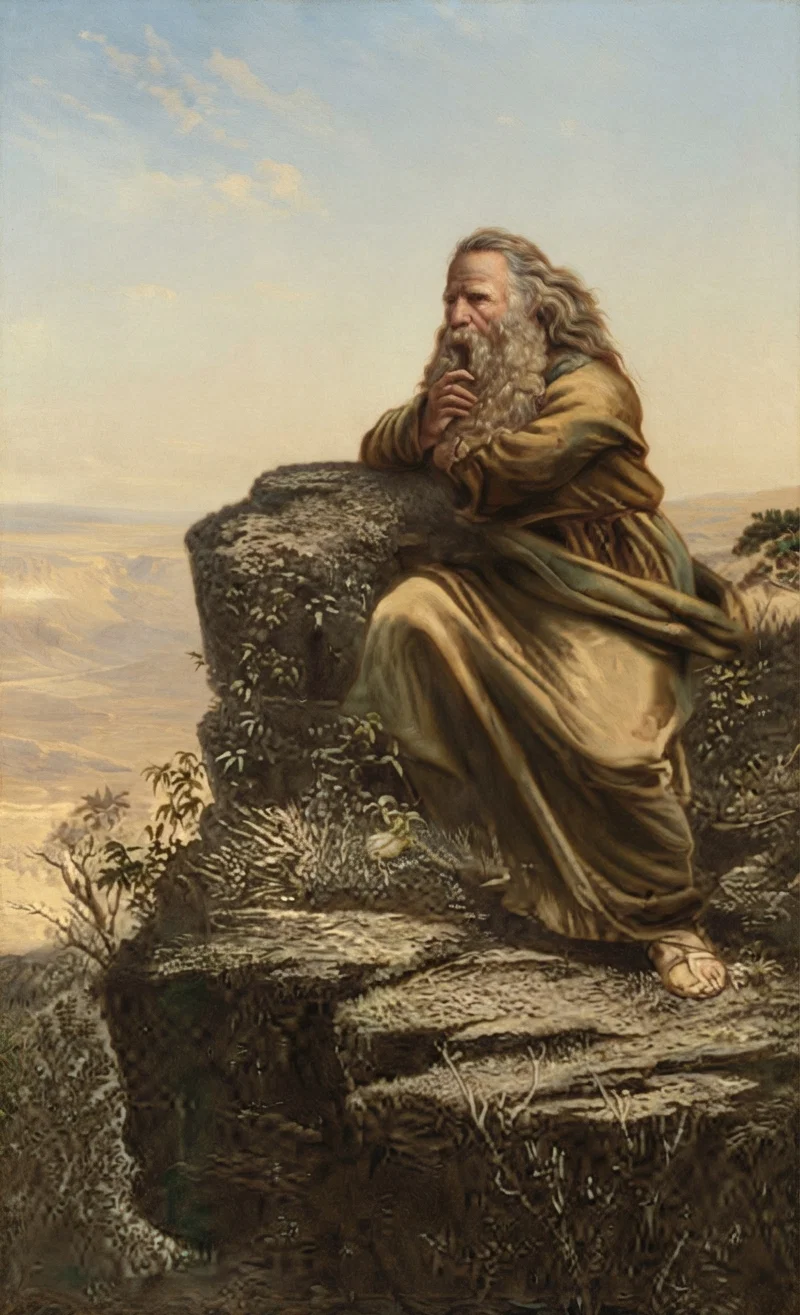
"Moses the Man of God" on Mt. Nebo, who led Israel through the wilderness from Egypt to Canaan, but who was not permitted to go farther
Israel was highly honored of God, and the surrounding nations looked upon them with wonder and admiration. Their laws and discipline, when compared with the laws of other nations, seemed, even to their enemies, in every way superior to their own. And Moses, as their visible leader and lawgiver, appears on the page of history as superior in wisdom and integrity to all the sovereigns and statesmen of earth; yet Moses ever recognizes that he is the servant of God, speaking and acting according to divine direction. He claims no credit for himself, but points the people to God as the source of power and wisdom.

The Law and the Sabbath

When the law was given to Israel, the Sabbath was made specially prominent. It had been instituted in Eden as a memorial of God’s creative work. After He had wrought six days, God rested on the seventh; and He blessed and sanctified that day, setting it apart as a day of rest and worship for mankind. And at Sinai He commanded: “Remember the Sabbath day, to keep it holy.” “In it thou shalt not do any work.” Man was to rest from his labor; and as he should look upon the earth beneath, and the heavens above, his thoughts were to be directed toward Him who brought all these wonderful and beautiful things into existence; and his heart was to be filled with love and reverence to his Maker, as he should behold the tangible proofs of His infinite wisdom and goodness.
The Sabbath was placed in the Decalogue as the seal of the living God, pointing out the Lawgiver, and making known His right to rule. It was a sign between God and His people, a test of their loyalty to Him. Moses was commanded to say to them from the Lord: “Verily My Sabbaths ye shall keep: for it is a sign between Me and you throughout your generations; that ye may know that I am the Lord that doth sanctify you.”
God is merciful. His requirements are reasonable, in accordance with the goodness and benevolence of His character. He claims the Sabbath as His own, and will not let His blessing rest upon those who disregard His holy day; yet the Sabbath institution was designed as a blessing to mankind. Man was not made to fit the Sabbath; the Sabbath was made after his creation, to meet the necessities of his nature. The Sabbath should stand before the people in its moral power, answering its original design — to keep in remembrance the living God, the Creator of the heavens and the earth. But the Sabbath has been treated with great disrespect. Men have dared to detract from its dignity; they have ventured to remove the sanctity placed upon it by the Creator Himself.
Temporal affairs must come under divine restrictions. The Sabbath is not to be molded to meet men’s business arrangements, but business affairs are to be arranged to meet God’s great standard of righteousness. But the god of this world has confused the minds of many on thissubject. They need to come into the divine presence, and listen to the voice of the great I AM.

Friendship with Jesus

By Clara Edna Rosencrans
IN that memorable talk with His disciples, on the way from the upper room, where He had given them such a beautiful lesson in humility, to the garden, with its agony and bloody sweat, its betrayal and arrest, is made one of the most wonderful statements in the Bible. “Ye are My friends,” He said. Marvelous condescension, that the Son of God should stoop to be the friend of man! We all know what friendship is. There is not a man or woman in the world who has not at one time or another known what it was to have a true, loyal friend, whose hand clasp meant perfect faith, whose sympathy and loving help were almost indispensable. And yet in all its depth and purity of purpose, the truest earthly friendship can not compare with the friendship of Jesus. In its utter self-abnegation, its self-effacement, it stands without a parallel.
This was not shown so much by His death as by His life. In the life that He lived on the earth, and the life that He now lives in and through us, is shown the highest, noblest friendship. Not a sorrow darkens our lives, not a throb of anguish thrills our hearts, but Jesus feels it too. This is the great atonement, that stooping down He condescends to suffer with us, lifting us at the same time into the heights of His own purity and peace.
But in taking so much of Jesus, let us remember that friendship that is worth the name is always reciprocal. If we accept such loyal, loving service from Him, we should be willing to give as much in return. Jesus never speaks unkindly of any one, and to His friends He was always gentle and courteous. We must be very careful, therefore, lest by word or action we lead the world to think that we do not regard Him very highly. Alas, how many of us, by cowardly silence or open rebuff, cause those who have never known its blessedness, to think that the friendship of Jesus is scarcely worth the having! Like Peter, we follow afar off, where there will be no danger of being classed with the inner circle of His friends.
Friendship includes also kindness and consideration. Few would wilfully turn their backs upon the merest acquaintance, while talking; and yet how often we let whole days pass, without allowing this our dearest Friend to speak to us through His Word! How often we neglect to seek Him out, and show Him that we love Him! While we seek the companionship of those who can only amuse, we wound and slight Jesus, in the house, too, of those who claim to be His friends.
There is another phase of this subject, which I wish to mention. When we have a friend visiting us, do we ever leave him at home alone, while we go to places of questionable resort—for a Christian—and spend whole days or evenings, fearing if he should know our whereabouts it might lower us in his estimation? I certainly hope there are none of my readers who could be so rude; and yet—and yet—we treat our best Friend in this discourteous manner, going where His delicacy and native refinement would recoil at the merest contact.
Ah, friendship of Jesus, how deep, how true, that can endure such treatment, yet remain unswervingly loyal! We have all felt like Peter, in moments of deep religious feeling, that it would be easy to die for Jesus; but ah, how little we do to show that we are in fact living for Him!

Lessons in Liberty

By W. M. Healey

V. Christ Alone Our Master

BUT be not ye called Rabbi: for One is your Master, even Christ; all ye are brethren.” Matt. 23: 8. In these words Christ taught the equality and liberty that should exist among His followers. No one should seek to dominate others. All are to look to the Lord for guidance. This does not imply that there is to be no organization for the work of the Lord, or that men are not to occupy special places for specific work. Christ said, “He that is greatest among you shall be your servant.” In giving directions as to what the elders in the church should and should not do, Peter said, “Neither as overruling [margin] God’s heritage, but being ensamples to the flock.” 1 Peter 5: 3.
When the Lord created Adam and Eve, He gave them power to act independent of each other, holding them individually responsible for their course. When they sinned He pronounced sentence upon them separately. Abel worshiped God in the way the Lord had taught him, and did not interfere with Cain. God did not hold him responsible for the course his brother pursued. Abel set before Cain his views of God and worship, by the sacrifices which he offered, and then left him to choose and act for himself. Cain, having turned away from the Lord, sought to rule over Abel, and compel him to desist from his method of worship. This Abel did not do, but conscientiously served God. This we know because 1 John 3:12 says that his works were righteous, and that was the reason that Cain slew him, his own works being evil.
Cain had not been appointed his brother’s keeper, but he assumed that position. When he chose that responsibility, it was right that he should be responsible for the results. These he was not willing to answer for. When the Lord called him to answer for his work, and asked him, “Where is Abel thy brother?” evasively he replied, “Am I my brother’s keeper?” When Cain was called to give account for that brother whom he had assumed to guide and control, he saw the failure he had made, and wished to be rid of the responsibility.
Thousands of men and women in the past have assumed that they were their brother’s keeper, to whom in the great reckoning day God will say, “Where is thy brother?” and they will remember when they tried to make their brother turn from the Word of the Lord as it appealed to his conscience, and when he chose to “obey God rather than men,” and they, like Cain, were “angry,” and in that anger slew him. They may not have wielded the club that killed him; they may have made their appeal to the arm of the civil government to perform the bloody work. But they will call to mind how they worked and voted for a law to coerce the conscience of another, which resulted in his death.

An Evil Seed

When Constantine made his Sunday edict, he had little knowledge whereto it would grow; and when Bishop Sylvester endeavored to force the church to observe this heathen law and custom, and regard the “venerable day of the sun” instead of the “Sabbath of the Lord,” thereby making himself his brother’s keeper, he could not see the rivers of blood, nor hear the pitiful pleas for mercy and the dying groans of millions of men, women, and children who went to the martyr’s death because others had assayed to be their keeper and director in matters of worship.
The men and women of to-day who are striving to obtain civil laws to give authority over the consciences of others in the matter of Sunday observance, are assuming to be their brother’s keeper; and when God shall ask them in the judgment, “Where is thy brother?” and they shall look backward and see the conscientious ones who kept the Sabbath of the Lord instead of the one directed of men, and remember how, in anger, they brought upon them the power of the civil government, taking from them all that was possible for the law to take, even their life,—then, like Cain, they will wish to escape the responsibility of the results of attempting to be their brother’s keeper.
This is no mere unfounded imagination; for not a few of the most prominent advocates of Sunday laws tell us that those who will not observe Sunday, but persist in keeping the seventh-day Sabbath, should be put to death.
“My brethren, be not many masters, knowing that we shall receive the greater condemnation.” James 3:1. The more one tries to be master, and rule over his brother, the more failures he will have to answer for. The blackness of heathenism has fallen like a pall over the earth because men have been masters and guides of other men, and poor humanity has leaned upon the arm of flesh and not upon the arm of God.
Every one is in duty bound to aid his brother to the extent of his ability. He is to be his teacher so far as he has light and truth which he is able to impart. Jesus said, “Go ye therefore, and teach all nations.” Matt. 28:19. It is his duty to be a helper to his brother; to feed the hungry, clothe the naked, and care for the sick, to the extent of his ability, but never to be his master or ruler in duties of worship toward God. Those who have caused the church to follow them instead of God, will meet a record of sin and ignorance that God would have kept those souls from possessing if they had leaned on Him instead of on humanity.No man can be safely trusted to force upon others even the simplest truths of worship. He lacks in all things necessary to qualify him for such a place. God only has patience, love, and forbearance, sufficient for such work. Mankind of to-day, like Cain of old, soon become angry with the dull or dilatory brother, or the wilful and stubborn one, and like James and John, would bring fire down upon him. Luke 9:54.
But God continues to love and bless, to follow after, and plead in tenderness and pity.

Studies on the Sabbath

IV. As Kept by Christ a Blessing and Not a Burden

And the ruler of the synagog answered with indignation, because that Jesus had healed on the Sabbath day, and said unto the people, There are six days in which men ought to work: in them therefore come and be healed, and not on the Sabbath day. The Lord then answered him, and said, Thou hypocrite, doth not each one of you on the Sabbath loose his ox or his ass from the stall, and lead him away to watering? And ought not this woman, being a daughter of Abraham, whom Satan hath bound, lo, these eighteen years, be loosed from this bond on the Sabbath day? Luke 13: 14-16.
At the time of Christ's first advent the Sabbath had been perverted and bound about by restrictions and traditions, so that the day designed by God to be a great blessing had become a burden, if not a curse. Christ's mission was to remove false conceptions of God's law, and to "undo the heavy burdens, and to let the oppressed go free." Christ lived the law. His life was a perfect example to men of the law's requirements in all the relations of life.
It is true Christ aroused the indignation of the rulers, as He tore away the false conceptions of what constituted righteousness. He showed that a man's life was worth more than a beast's, and that all their outward show of hypocrisy was of no avail. His life was an example of His words in Isa. 58: 6, 7:
Is not this the fast that I have chosen? to loose the bands of wickedness, to undo the heavy burdens, and to let the oppressed go free, and that ye break every yoke? Is it not to deal thy bread to the hungry, and that thou bring the poor that are cast out to thy house? when thou seest the naked, that thou cover him; and that thou hide not thyself from thine own flesh?
It has ever been the plan and purpose of the rebel leader against the government of God to make it appear that the terms of God's law were oppressive and unreasonable. Especially has this been so with reference to the observance of the Sabbath. Satan succeeded in leading the Jewish nation to add numerous ceremonies and restrictions which made the Sabbath a burden rather than a blessing. It was regarded as a sin to walk on the grass on the Sabbath, lest some seed might be thrashed out by this means. Physical rest and fasting were the outward signs of great piety. To correct this false view Christ led the disciples through the corn fields and began to pluck the corn to eat.
But when the Pharisees saw it, they said unto Him, Behold, Thy disciples do that which is not lawful to do upon the Sabbath day. But He said unto them, Have ye not read what David did, when he was an hungred, and they that were with him; how he entered into the house of God, and did eat the shewbread, which was not lawful for him to eat, neither for them which were with him, but only for the priests? Or have ye not read in the law, how that on the Sabbath days the priests in the temple profane the Sabbath, and are blameless? But I say unto you, That in this place is One greater than the temple. BUT IF YE HAD KNOWN WHAT THIS MEANETH, I WILL HAVE MERCY, and NOT SACRIFICE, YE WOULD NOT HAVE CONDEMNED THE GUILTLESS. For the Son of Man is Lord even of the Sabbath day. . . . And He said unto them, What man shall there be among you, that shall have one sheep, and if it fall into a pit on the Sabbath day, will he not lay hold on it, and lift it out? How much then is a man better than a sheep? Wherefore IT IS LAWFUL TO DO WELL ON THE SABBATH DAYS. Then saith He to the man, Stretch forth thine hand. And he stretched it forth; and it was restored whole, like as the other. Matt. 12: 2-8; 11-13.
All these acts of Christ were regarded as Sabbath desecration and worthy of death by the Pharisees. The Lord of the Sabbath, who was its Maker and Author, is now in their midst revealing what real Sabbath-keeping consists in. It was to be a day of blessing rather than a curse, a day of joy and gladness instead of a day of mourning and fasting, a day of worship and refreshing to man. "From even unto even, shall ye celebrate your sabbath." Lev. 23: 32.

A Day of Rejoicing

We do not celebrate days by fasting and afflicting ourselves. We remember the days of greatest blessings to celebrate, such as our birthdays, our wedding anniversaries. Americans celebrate Thanksgiving and Independence days. O, what a different view the Sabbath presents when viewed from the divine standpoint! If there is one day in all the week that the children as well as each member of the family should look forward to with pleasure, as it returns to bring its added blessings to the week, it is the Sabbath of the Lord our God. While we are not to pursue the ordinary labor of the week, the Sabbath is not to be a day of idleness. The priests in olden times offered more sacrifices on the Sabbath than on any other day in the week. See Num. 28: 3, 4, 9, 10; Eze. 46: 4.
"Six days shall work [thy work] be done: but the seventh day is the Sabbath of rest, an holy convocation." Lev. 23: 3. We are admonished to "call the Sabbath a delight, the holy of the Lord, honorable." Isa. 58: 13. This day of richest blessings we are to celebrate in holy convocation, in renewed consecration to service, in gifts and offerings, abundant, showing our appreciation of the blessings of God for which the Sabbath stands as a memorial and sign. "Give unto the Lord the glory due unto His name: bring an offering, and come into His courts. O worship the Lord in the beauty of holiness: fear before Him, all the earth." Ps. 96: 8, 9.
They brought their gifts to Jesus, And laid them at His feet; And love for this dear Saviour, Made every offering sweet; Good deeds and words of kindness, Help for the poor of earth, And not a gift among them Was thought of little worth.
Apart from other givers A poor wayfarer stood; He saw the gifts they offered, The poorest counted good, And he was filled with longing A gift, the poor, to bring; Alas! all empty-handed He stood before the King.
"Dear Lord," he cried in sorrow, "I know how kind Thou art; Take all I have to give Thee, My sinful, wayward heart." Then Jesus answered softly, "Count not the gift as small; Though all of them are precious, Thine is the best of all."
Reader, is the Sabbath day one of delight and soul refreshing, instead of dolorous grief, to you? Is it a day of intellectual and spiritual feasting of good things? Do the members of your family, including the children, look forward to the approach of the Sabbath as they do to the coming of a friend most welcome? Or is its observance one of stern duty and fear? If so, at its close the children and perhaps other members of the family feel a sense of relief when the sun disappears in the west. If the latter is the experience of your family, there is something decidedly wrong in the way the Sabbath is kept in your home. Let the Sabbath be welcomed by songs and prayers of thanksgiving. On the "preparation" day wholesome fruit and nourishing food should be made ready to "celebrate" the approaching day. Let the children and all expect that on the day of greatest "delight" and blessing they will receive temporal and spiritual blessings in keeping with the "blessed" rest day of Jesus Christ our Redeemer.

Becoming Christlike Through Good Associations

"Would you grow Christlike, let your associates, and the books you read, be companions that present the pure, beautiful life of Christ. By such association you will be brought into the place where you will constantly behold the Saviour, and by beholding become 'changed into the same image from glory to glory, even as by the Spirit of the Lord.'"
Continue reading: XIII. God's Agencies