THE colonies of the world are inhabited by about 500,000,000. Of these only three small groups, numbering less than three per cent of the whole, are composed in any considerable degree of the people of the governing country or their descendants. The principal of this small proportion of 15,000,000 are the English colonies, British North America, Australia, and South Africa.
The vast remainder of 485,000,000 people are governed by countries not contiguous to them and are different stock from that of the governing country. All the governing countries are located in the temperate zone, and all of the governed territory as colonies, with the exception of Canada, southern Australasia, and New Zealand, is tropical or subtropical.
The governed countries are divided into three groups, the East Indian, West Indian, and African. The East Indian, or oriental group, includes the British colonies of India, Ceylon, the Malayan Peninsula, Fiji, and Borneo; the Dutch colonies, of Java and Sumatra, and the French colony, of Indo-China. These are all comparatively near the Philippines.
The second group is the West Indian. Here are colonies governed by the British, French, Dutch, and Danish governments.
The third group includes Africa and the neighboring islands. Therein are territories governed by Great Britain, France, Germany, Italy, Portugal, and Belgium. Three hundred and fifty million of these are in the British colonies; 56,000,000 in the French, 35,000,000 in the Dutch, 30,000,000 in the Belgian, 15,000,000 in German, 9,000,000 in Portuguese, and only 135,000 in the Spanish colonies.
The United States now has a population of about 10,000,000, including the Philippines, Porto Rico, and the Sandwich Islands. These facts are taken from a monograph just issued by the Territorial Bureau of Statistics covering 1890 to 1900 inclusive.
—Christian Advocate.
THE BOOKS OF THE BIBLE.
In Genesis the world was made by God's creative hand;
In Exodus the Hebrews marched to gain the Promised Land.
Leviticus contains the Law, holy, just, and good;
Numbers records the tribes enrolled, all sons of Abraham's blood.
Moses in Deuteronomy records God's mighty deeds;
Brave Joshua into Canaan's land the host of Israel leads.
In Judges their rebellion oft provoked the Lord to smite;
But Ruth records the faith of one well pleasing in His sight.
In First and Second Samuel of Jesse's son we read;
Ten Tribes in First and Second Kings revolted from his seed.
The First and Second Chronicles see Judah captive made;
But Ezra leads a remnant back by princely Cyrus' aid.
The city walls of Zion Nehemiah builds again;
Whilst Esther saves her people from plots of wicked men.
In Job we read how faith will live beneath affliction's rod;
And David's Psalms are precious songs to every child of God.
The Proverbs like a goodly string of choicest pearls appear;
Ecclesiastes teaches man how vain are all things here.
The mystic Song of Solomon exalts sweet Sharon's Rose,
Whilst Christ, the Saviour and the King, the rapt Isaiah shows.
The warning Jeremiah—Apostate Israel scorns;
His plaintive Lamentations, their awful downfall mourns.
Ezekiel tells in wondrous words of dazzling mysteries,
Whilst kings and empires yet to come Daniel in vision sees.
Of judgment and of mercy Hosea loves to tell;
Joel describes the blessed days when God with man shall dwell.
Among Tekoa's herdsmen Amos receives his call;
Whilst Obadiah prophesies of Edom's final fall.
Jonah enshrines a wondrous type of Christ, our risen Lord;
Micah pronounces Judah lost—lost, but again restored;
Nahum declares on Nineveh just judgment shall be poured.
A view of Chaldea's coming doom Habakkuk's visions give;
Next Zephaniah warns the Jews to turn, repent, and live.
Haggai wrote to those who saw the temple built again;
And Zechariah prophesied of Christ's triumphant reign.
Malachi was the last who touched the prophet's chord,
Its final notes sublimely show the coming of the Lord.
Mathew, Mark, Luke, and John the Holy Gospel wrote,
Describing how the Saviour died—His life—and what He taught.
Acts prove how God the apostles owned, with signs in every place;
And Paul, in Romans, teaches us how man is saved by grace.
The Apostle in Corinthians instructs, exhorts, reproves;
Galatians shows that faith in Christ alone the Father loves.
Ephesians and Philippians tell what Christians ought to be;
Colossians bids us live to God, and for eternity.
In Thessalonians we are taught the Lord will come from heaven;
In Timothy and Titus a bishop's rule is given.
Philemon marks a Christian's love, which only Christians know;
Hebrews reveals the Gospel, prefigured by the Law.
James says that without holiness faith is but vain and dead;
And Peter points the narrow way in which the saints are led.
John in his Three Epistles, on love delights to dwell,
St. Jude gives awful warning of judgment, wrath, and hell.
The Revelation prophesies of that tremendous day,
When Christ, and Christ alone, shall be the trembling sinner's stay.
—Anon.
A PLAIN TALE WILL "PUT THIS DOWN."
By Editor
An amazing tale has been sent around the United States from the beautiful village of Succasunna, N. J.
It is said that a venerable woman there had been in a trance for five days, that a few minutes before she died, and while the family were at the bedside, she opened her eyes and said in a clear but faint voice:—
'Too long has my spirit been held in this temple of clay. Friends, loved ones, in the great beyond there is peace and happiness; I am of it and I see you all, know you all, and tell you that we shall meet over there. Father and mother, all are with me now. Good-by.'
She then closed her eyes, breathed softly for a few minutes, the respirations becoming fainter and fainter until they ceased altogether.
We inquired into this, and find on the best authority that the story of "trance," or "clairvoyance," circulated, is utterly without foundation. The subject of this statement was a very quiet and consistent member of the Methodist Episcopal Church, was born near the village, and had always lived there. She suffered greatly from paralysis. The only true thing in the despatch is that "a little before she died she opened her eyes." She had not spoken for about three days, and had not taken food, and she did not speak.—Christian Advocate.
THE SHIP'S STEWARD AND HIS DUTY.
[From "Life on a Liner," in Leslie's Monthly for May.]
A STEWARD is nothing more or less than a combination waiter and chambermaid. His duties begin an hour before breakfast, by all rights, inasmuch as it should take him that time at least to brush up his blue or black uniform, shave, make his hands neat, and shine his shoes. He is supposed to wear a spotless and expansive bosom to his shirt, clean collar, and black or white tie. I do not think I ever saw but two stewards who had shirts; all the others used a dickey for the sake of economy.
Waiting on the passengers at table, the care of the tables, the care of the silverware, and a certain amount of dishwashing and pantry work, make up the steward's dining-room duties. The other half is work in the staterooms, making the beds, straightening up the rooms, and doing the general work of a chambermaid, as well as giving a certain amount of attendance to the occupants of the rooms.
The pay is very poor, and the principal dependence of the steward is on the tips he receives. They are really the poorest paid class that goes to sea in one way, and yet I have known men to make £40 in tips on a six weeks' voyage.
PATIENTLY WAIT.
A LITTLE boy was given a bulb to plant, and was told if he put it in the ground it would grow, and by and by he would have a beautiful flower. He undertook the task with great delight, and promised blossoms to all his friends; but at the end of a week he came to his mother in sore disappointment. "The bulb isn't good for anything!" he said. "They told me it would grow and have pretty flowers, but it doesn't grow a bit, for I have dug it up every day to see."
Just such impatient gardeners are most of us in spiritual soil. We go to our Father with the old complaining cry: "We have served God and kept His ordinances, and what are we profited by it? The dishonest ones get ahead faster, the careless ones are happier. Where are the promised rewards of righteousness—the fruits of obedience?" But the harvests of God ripen slowly, and the seed which is sown in the earth finds its perfection above the earth. Sometime, somewhere, whatsoever we have sown we shall surely reap.—Selected.
REWARD OF VIRTUE.
A curious example of the reward of excessive virtue is the case of certain British pickle manufacturers who have been making their pint bottles hold a little more than a pint, to be on the safe side of the British law. When these pint bottles arrived at Canada, they found that there was a law in operation which provides that any package measuring more than a pint must pay duty as a quart.
INTERNATIONAL SERIES THE SUNDAY SCHOOL
LESSON 13.—JUNE 28.—REVIEW.
Golden Text.—"The Lord shall deliver me from every evil work, and will preserve me unto His heavenly kingdom." 2 Tim. 4:18.
LESSON 1.—Paul's Farewell to Ephesus. Acts 20:28-38. Golden Text: "Remember the words of the Lord Jesus, how He said, It is more blessed to give than to receive." Acts 20:35.
LESSON 2.—The Resurrection. 1 Cor. 15:20, 21, 50-58. Golden Text: "Now is Christ risen from the dead, and become the firstfruits of them that slept." 1 Cor. 15:20.
LESSON 3.—The Law of Love. Rom. 13:7-14. Temperance Lesson. Golden Text: "Love worketh no ill to his neighbor; therefore love is the fulfilling of the law." Rom. 13:10.
LESSON 4.—Paul's Journey to Jerusalem. Acts 21:3-12. Golden Text: "The will of the Lord be done." Acts 21:14.
LESSON 5.—Paul Arrested. Acts 21:30-39. Golden Text: "If any man suffer as a Christian, let him not be ashamed." 1 Peter 4:16.
LESSON 6.—The Plot Against Paul. Acts 23:12-22. Golden Text: "The Lord stood by him, and said, Be of good cheer." Acts 23:11.
LESSON 7.—Paul Before Felix. Acts 24:10-16, 24-26. Golden Text: "I will fear no evil; for Thou art with me." Ps. 23:4.
LESSON 8.—Paul Before Agrippa. Acts 26:19-29. Golden Text: "Having therefore obtained help of God, I continue unto this day." Acts 26:22.
LESSON 9.—The Life-giving Spirit. Rom. 8:1-14. Golden Text: "For as many as are led by the Spirit of God, they are the sons of God." Rom. 8:14.
LESSON 10.—Paul's Voyage and Shipwreck. Acts 27:33-44. Golden Text: "Then they cry unto the Lord in their trouble, and He bringeth them out of their distresses." Ps. 107:28.
LESSON 12.—Paul's Charge to Timothy. 2 Tim. 3:14 to 4:8. Golden Text: "There is laid up for me a crown of righteousness." 2 Tim. 4:8.
THE SMALLNESS OF SEEING FLAWS.
It is easier to see a fault in another man's course than to perceive his good qualities. Hence a man measures himself by his measures of others. The fault-finder and the sneerer is commonly a small man. As a man approaches greatness, he grows generous and gracious. Not what he thinks of himself, but what he sees in others, shows what he really is. It is well to have this truth in mind as we pass judgment on our fellows.—S. S. Times.
AN APPEAL FOR FIJI.
By A. Currow
FRUIT and vegetables, cotton, corn, coconut, and other valuable productions thrive wonderfully here. A plantation of coconuts brings in a yearly revenue of at least one dollar a tree, besides supplying food. Copra is in great demand. Three crops of corn can be raised yearly. Here is a country where any man with industry can live and prosper. We want some good families to settle in these parts, to be a help to the work. Why live in cities, where iniquity abounds, when such shores as these offer fields of usefulness, with elevating influences all around? The cost of living in the country is very small, if one will but cultivate; in fact, very little cultivation is necessary. Foodstuffs grow so prolifically that after planting, very little attention is given them. There are places where persons of small means could open stores, and, with a small garden, live profitably.
Then, too, we need a medical mission. So far, what little help we have in this direction is in too great demand in other lines of work. The people are very desirous of having trained nurses. The nurses here are mostly untrained. A good field for self-supporting missionary workers offers itself in Suva and Levuka. We must have that element here to give influence to the work. In a year or two it would lend a power of help to our mission. On account of ignorance, much sickness prevails among the native population. The last census shows a decrease of fifteen thousand in a decade. The causes are not hard to discover, but the remedy is not at hand. A physician with an English diploma is necessary here. I trust the time is not long distant when we shall receive help in this way.
If ever there was a time when the educating spirit of the Third Angel's Message was needed, it is now; and here are fields ready for operation. Calls are coming from all directions, and as yet we have no suitable means of travel. For over six months we have had only a small boat at our disposal, and our native preacher has been using this at great risk. It is with much gratitude that we see the willingness of our people to contribute towards the work here, and our hopes are revived as we see the new launch nearing completion. Your gifts towards it are taking material form, and will bear fruit as long as time shall last. A great work awaits its advent. It means more laborers now, and more work for more laborers who come.
The existing conditions at present offer many advantages for our work; but who can tell how long they will last? Opportunities move on and pass away, as do other things. Shall we not give ourselves unreservedly, and all that we have, to the closing work of the everlasting Gospel, thus taking part in the infinite sacrifice that heaven has made in behalf of the universe? It has been decreed that whosoever shall save his life shall lose it; but whosoever shall lose his life for the Gospel's sake shall keep it unto life eternal. Let us take part in the latter.
A. CURROW.
Suvá, Fiji.
A NEEDY FIELD.
By Jennie L. Blowers
[Jennie L. Blowers, in American Missionary.]
On the northeast corner of the island of Porto Rico is a narrow cape running out into the sea called the "Heads of San Juan." On the very point, high up on the bluff, is the lighthouse tower, a landmark by day and a danger signal by night, its great red eye gleaming brightly over the tumbling white surf that leaps and dances against the beautiful coral reefs, a peril to the careful mariner. On the north the waves roll down from Labrador, unhindered by even a tiny dot of land. But on the south there are near neighbors in the islands of Vieques and Culebra, with St. Thomas just discernable like a black cloud against the horizon. Here, on this cape of about five miles in length and one in width, lives a very sturdy, healthy people.
Chief's House, Fiji.
Almost shut off from the mainland, they are ignorant, but they have also escaped many of the vices that fall in the wake of civilization. Unlike the country people in many parts of the island they never suffer hunger for they raise their own provisions—beans, rice, sweet potatoes, and vegetables.
Not many of them are Catholics, and one of the women, who knew a little English, recently sent in this word to the pastor of the Congregational church of Fajardo: "O please come out and preach to us, the people are just bleating and yelling for the Gospel." In response to this earnest appeal two services have been held here, with a congregation of over fifty bright, intelligent, earnest worshipers. The first time a regular sermon was preached, but the second the minister could not attend, so the service was conducted by a company of live church workers.
We had a glorious ride, following the coast for more than a mile. On the land side the mountains, covered with a rich, tropical vegetation, sloped back from the shore or rose in jagged cliffs. Our pony crushed the shells and bits of dainty coral as he cantered along, while the tide came in to our very feet.
We stopped in a sheltered cove where a few shacks were clustered together, and where fishing-nets and skiffs were drying on the sand. The people were awaiting our coming, and, as a fine mist was creeping in from the sea, we were forced to crowd into one of the largest shacks for our meeting.
O, if you who have always worshiped in a magnificent city church only attended one such service as this! Your hands would go down into your pockets and they would not come up empty. During our three years in Porto Rico we have never attended a more spiritual service than this one. The guests were given the few benches, the children sitting on the floor, and the adults closely packed together standing behind and filling the doorway. All were well-dressed and clean, and listened to every word with a most eager, reverent attention. A holy hush filled all the place, as Peter, our spokesman, read the Word, and one and another prayed or gave a few earnest words of Christian experience or admonition.
In this company of over fifty people of unmistakable intelligence, only two of the women could read, and not more than a half dozen of the men or boys. There is a public school for boys somewhere on the cape, but none for girls. We are determined to get out and teach the poor women and children if we have to live in a shack, eat fish, and fraternize with mosquitoes and other nocturnal companions.
But we need funds to buy Bibles and hymn-books, and to meet the other expenses of the work which should be opened at once. But you ask, "Why such need of haste?" This is why: Because the immediate need is imperative.
THE OPENING AT DOLORES, MEXICO.
MR. OLDS, of Parral, reports a remarkable change of feeling in the town of Dolores, to which Señor Balderas has now gone to act as pastor:—
"He went to Dolores rather unwillingly, but once there, began earnest work, which resulted in stirring the town to its foundations. All opposition to the Protestants seemed to be overcome. The fanatics, almost without exception, began coming to the meetings. The leading men came to Balderas and asked him to open a boys' school, promising to pay him at least thirty dollars a month, besides his house. A former president of the town, who had used his authority to harass the Protestants in various ways, as, for example, by sending for the leading men among them to act as special police on Sunday, calling them out of their morning service for the purpose, subscribed, with others, a sum of money to help pay Balderas's expenses in moving over there. Another young man, who had several times threatened the Protestants with violence, and one Sunday, armed with a heavy whip, had gone to Don Placido's house, determined to find and horsewhip the preacher, and who was only kept from carrying out13his purpose with the greatest of difficulty,—this young man was so much moved by the Gospel, and so remorseful for what he had done in the past, that he offered himself to Don Isabel as his mozo for the trip to Parral, and came with him the six days' journey, serving him faithfully, and doing everything in his power to make the trip easy. The principal merchant of the place gave five dollars toward his expenses, and so on. Other cases might be mentioned, showing what a change has come over the community.
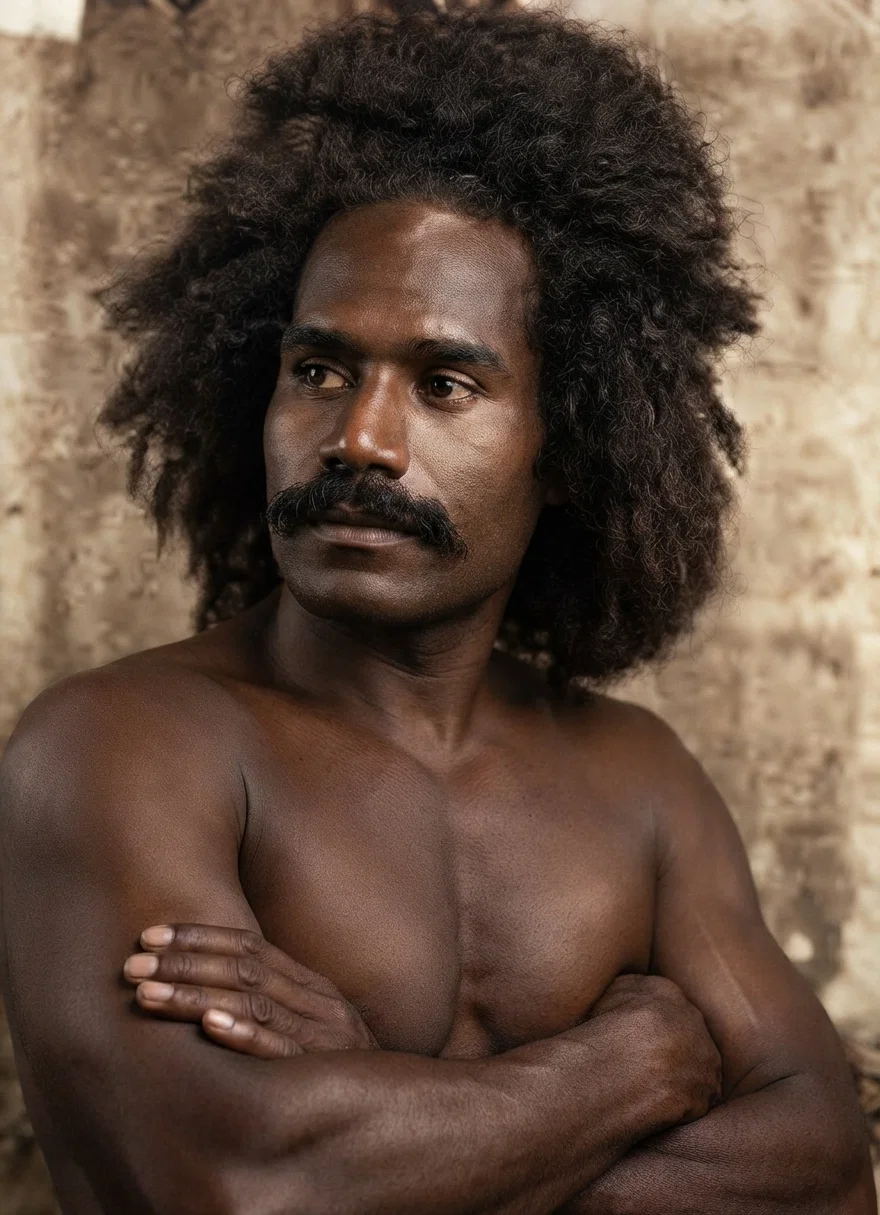
Fijian Man.
"The opportunity seemed so good, tho entirely unexpected, that we did not hesitate in approving of Balderas's going. The party left here last week, and will probably get through by the close of this week. He will open the boys' school, which they wish, and will have forty or fifty boys; quite a contrast to the school of half a dozen pupils which Balderas had there two years ago, when the majority of the people would have nothing to do with the school or the teacher.—Missionary Herald.
Fijian Woman.
A DAY.
By Ella Cornish
GOD chose
From the eternity of future things
A bright new day, aglow with morning light,
Untouched by joy, unsullied all with sin;
And sent it forth for man to use a space,
And fill with kindly deeds while it should pass
To the eternity of what has been,
To live through years untold in things that were.
'Tis gone: its record made for good or ill,
No man can take away nor add thereto,—
It came from God and has returned to Him.
Asylum, Neb. ELLA CORNISH.
OUTLOOK IN NORTH CHINA.
Encouraging word has come from Dr. Sheffield, dated August 29, from Tung-cho. He refers to the outlook for missionary effort in North China in the following language:—
It is very possible that we shall be obliged to fish in troubled waters in China for a good number of years to come, but our business is to catch fish, and if we get more than in the more quiet waters of the past, our purpose is accomplished! There is a very general testimony among missionaries that there is a new spirit of listening among all classes of the people, and much of this listening is because of real interest in what is being taught. Certainly it is no time to delay to see what is to happen. We have it in our power to do not a little to shape the events of the future by wisdom and energy in our work. Mrs. Sheffield and I have returned to Tung-cho for good, and are now settling ourselves in our new home; yet so like the old one that we can not realize the great change that has come to the city and to our work.—Missionary Review.
"FROM HOUSE TO HOUSE."
By G.
PEDDLERS and solicitors in the interest of all manner of business, legitimate and illegitimate, go from house to house to introduce their wares or their enterprise, whatever it may be. And people think it all right; indeed they have come to expect such calls, are often disappointed if passed by. Then why not call from house to house on the most important business in all the universe—the salvation of souls for whom Christ died? The Lord Himself set the example. One instance is sufficient to illustrate His estimate of the importance of carrying the Gospel into the homes of the people.
He was passing through the city of Jericho and a great multitude was following Him. A man named Zacchaeus was very anxious to see Jesus, but was so small of stature that he could not see over the crowd. So he ran ahead and climbed into a tree, that he might see Jesus as He passed. Notwithstanding the pressure of the multitude, the Spirit pointed out the man in the tree, and Jesus saw the possible disciple. He might have said, "Zacchaeus, I am going to preach on a street corner a little farther along, and I would be glad to have you come and hear what I have to say." The little man in the tree would doubtless have felt much flattered by such a special invitation, and would gladly have stood near the noted Preacher throughout even a very long discourse.
But Jesus did better than that; He looked up into the tree and said, "Zacchaeus, make haste, and come down; for to-day I must abide at thy house." What thrilling emotion must have filled the little man's heart at the sound of such a salutation! "And he made haste, and came down, and received Him joyfully." Then, in addition to the instruction that might have been given in a sermon, Zacchaeus had the great honor and pleasure and privilege of entertaining in his house the Bearer of the Gospel tidings. And there are many people to-day who would be glad to have a call from some humble servant of God, man or woman—some one "that bringeth good tidings of good; that publisheth salvation." There are those in the quiet of home life who would accept the good news of salvation if brought to their homes by some one who manifested a deep personal interest in their welfare; yet those same ones might never be induced to enter a church or attend a religious meeting of any kind. "From house to house" is a recognized method of Gospel work, and it is an important method. G.
ABYSSINIA AND CHRISTIANITY.
THERE is a very large negro church in this city known as the Abyssinian Baptist Church. When it was founded some one told the pastor that it was abominable to name a Christian church after a heathen country; but Abyssinia is not a heathen country. Christianity went down there at a very early period, and the traveler in Jerusalem who fails to visit the Abyssinian convent, or to see the Abyssinians performing religious services allowed to them in the holy places, fails to make realistic to himself the existence of this great semibarbaric Christian people, now ruled by one of the greatest men of the world.—N. Y. Christian Advocate, Jan. 22, 1903.
SEED-TIME.
By Hilton R. Greer
(Hilton R. Greer, in Sunday School Times.)
HASTE ye, my soul, for the sowing
Deep in the garden of years,—
Truths that may grant ye in growing
Meed for the toil and the tears.
Long have the furrows lain fallow,
Waiting the husbandman's share;
Haste to thy task, while ye hallow
All of the plodding with prayer.
Haste ye, my soul! on the morrow
Season and sun may be past.
Haste ye, lest sighing and sorrow
Strangle the seed that ye cast.
Haste, while the green ways are glowing;
Off with vain doubtings and fears.
Haste ye, my soul, for the sowing
Deep in the garden of years.
Pittsburg, Texas.
OUR WORK AND WORKERS.
By Editor
At the late annual session of the Montana Conference, all the officers were re-elected.
THERE will be a young people's convention at Healdsburg, Cal., July 9-14, and one at Hanford, July 16-21.
THE baptism of four candidates at Panther Creek, I. T., is reported by Brother M. H. Gregory, in the Southwestern Union Recorder.
THE addition of ten to the membership of the church at Jacksonville, Oregon, is reported in the Pacific Union Recorder, by Brother C. J. Cole.
A CANVASSERS' institute is in progress at Healdsburg (Cal.) College, with Brother S. C. Osborne, general agent for Pacific Union Conference, in charge.
As a result of the late institute held at College Place, Wash., thirty-five persons are expected to enter the canvassing work in the Northwestern Conferences.
FIVE new Sabbath-keepers are reported by Brother C. D. M. Williams, at Williams, A. T. To this he adds: "The Lord is filling His people with zeal for the work of the Master."
REPORTING for the Arkansas Tract Society to the Southwestern Union Recorder, Brother V. B. Watts says: "We have replied to at least a dozen letters in the past few weeks from those not of our faith, who wish to canvass for our books."
At the meeting of the Upper Columbia Conference held at Pendleton, Oregon, last month, the following officers were elected: President, A. J. Breed; treasurer and secretary, J. L. Kay; executive committee—A. J. Breed, J. A. Holbrook, Adam Schlotthauer, J. M. Willoughby, C. C. Lewis, S. Yarnell, and T. L. Ragsdale.
BROTHER A. D. GILBERT, special agent of the Pacific Press Publishing Company, has been invited by the Indiana Conference to visit that State in behalf of the SIGNS OF THE TIMES. The brethren there appreciate the importance of giving this paper a more distinctive recognition as a pioneer in the Gospel work.
A REPORT from Brother B. R. Nordyke, manager of our Kansas City branch, gives an encouraging prospect for the canvassing work in the Southwest. Forty agents in Kansas, thirty in Oklahoma, and twenty more going out from the school at Keene, Texas, will give a decided impetus to the work of disseminating the truth through our literature. During one week, ending May 8, says another report in the Review, nine agents in Texas sold books to the value of $833. About three-fourths of this amount was for "Desire of Ages."
WANTED.—God is advertising all over the land for laborers. He wants men and women, boys and girls, to labor in His vineyard. He wants them right away. No one need hold back because of the lateness of the hour. Tho it be the eleventh hour, He says, "Go ye also into the vineyard; and whatsoever is right, that shall ye receive." He is saying to those who know the truth, "Why stand ye here all the day idle?" These are times of disaster and calamity, forerunners of the great day of judgment upon all the world. God wants messengers to carry the warning, and to carry offers of refuge to all who will seek it in Him before it is too late. Why will you seek employment and investment in the world's enterprises, when the all-wise Employer is calling for talent and muscle and means, and is offering work and safe investment to all who will heed His choicest of offers?
PUBLICATIONS WANTED.
By Editor
LATE copies of our periodicals for missionary work. Address, post-paid, Minnie M. Killen, Morganton, N. C.
ANY of our periodicals for missionary work. Address, post-paid, James W. Miller, Bartle, I. T.
CLEAN copies of the SIGNS, Life Boat, and Pacific Health Journal. Also a few second-hand denominational books. Address, post-paid, H. L. Peake, 410 N. Poplar Street, Greenville, Miss.
ADDRESS WANTED.
Will Mrs. D. M. Gosnell please send her address to Mrs. A. D. Kelly, South Park, Wash.